Kwofi And The Gods
Kwofi And The Gods: Kwofi was the eldest son of a farmer who had two wives. Kwofi’s mother had no other children. When the boy was three years old his mother
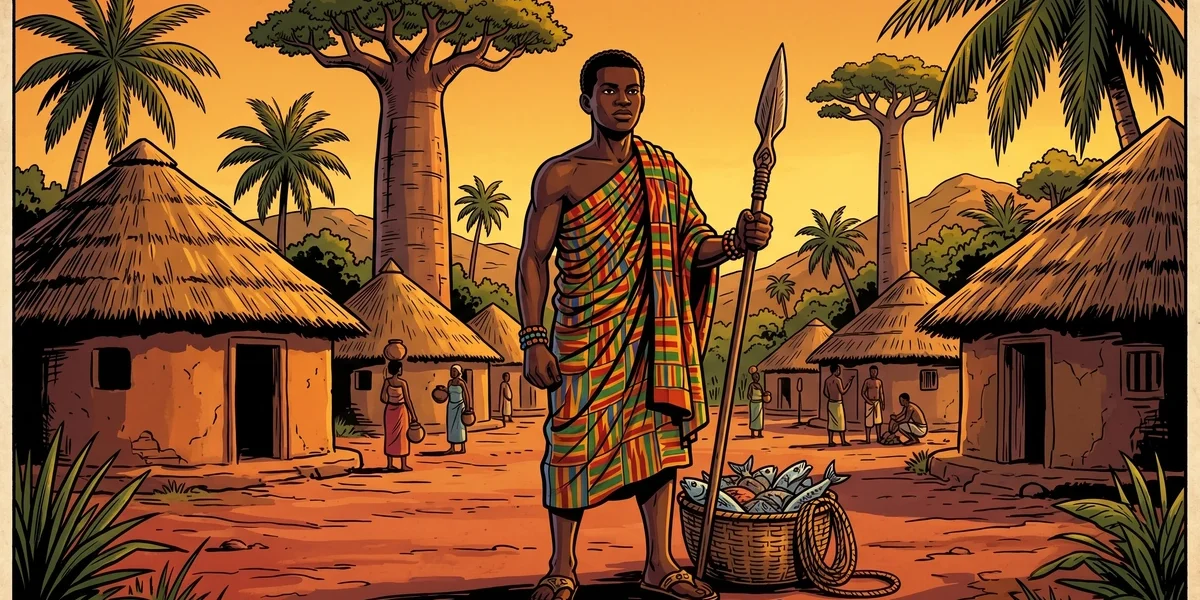
Among the folk tales gathered along the Gold Coast of West Africa — in the Akan towns and Twi-speaking villages of what is now Ghana — there is a short, startling story about a boy named Kwofi, an orphan whom no one loved, and the morning a god walked into his village carrying a bag of death. It is one of the briefest tales in its collection, and one of the strangest. It contains no trickster, no talking animal, no clever escape. A boy is wronged, quietly and daily, by the people who should have fed him; and then, with no warning at all, the wrong is answered. The story is so spare that a careless reader might miss its point entirely. Told well, it is unforgettable.
The earliest published English version of this tale appears in West African Folk-Tales, collected and arranged by W. H. Barker and Cecilia Sinclair and issued by George G. Harrap & Co. of London in 1917. William Henry Barker served as an inspector of schools on the Gold Coast, and he gathered the stories from Twi- and Ewe-speaking storytellers and from the schoolchildren in his charge; Cecilia Sinclair arranged them for a young readership. The collection stands beside R. S. Rattray’s later Akan-Ashanti Folk-Tales (1930) as one of the foundational printed records of southern Gold Coast oral narrative. “Kwofi and the Gods” belongs to the broad family of folk narratives concerned with rewards and punishments — the group of motifs gathered in the Stith Thompson index under Q, “Rewards and Punishments,” and turning here on motif Q40, “Kindness rewarded,” read through its mirror-image, the punishment of cruelty. It also carries a faint etiological echo, an answer of sorts to the oldest human question of all: why does death come to some and pass over others? The name Kwofi itself is a Twi “day-name,” Kofi, the name traditionally given to a boy born on a Friday — a small detail that fixes the tale firmly in Akan soil.
The Orphan in the Farmer’s Compound
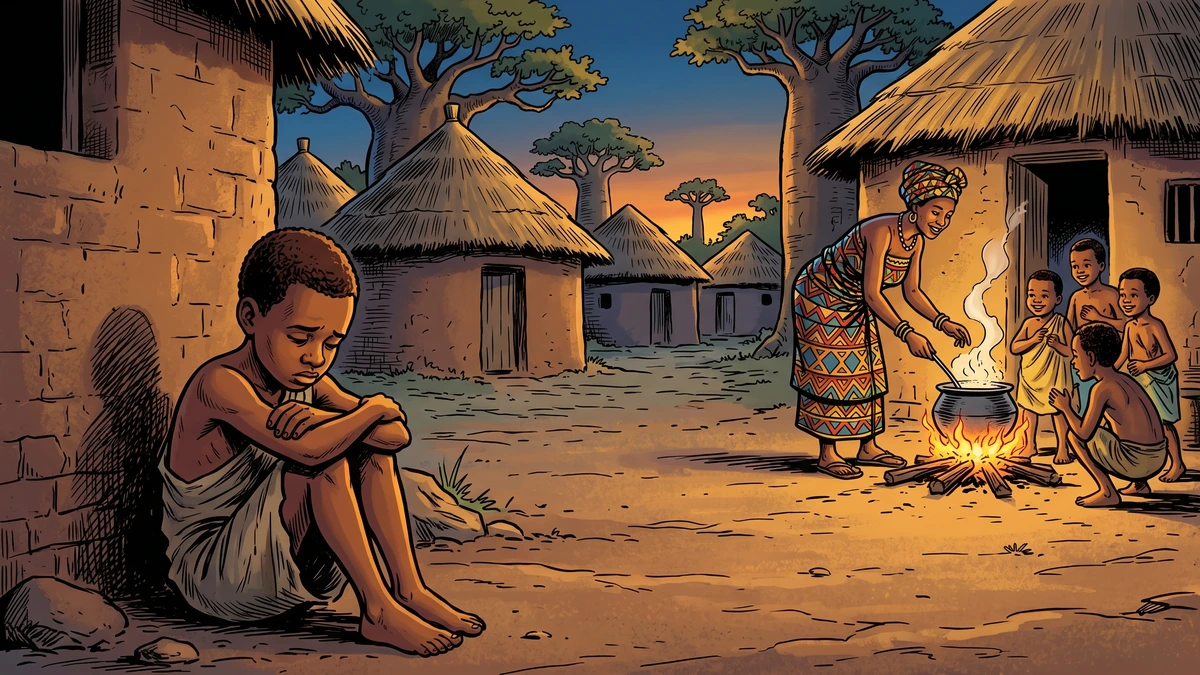
The story opens, as so many Akan tales do, with a household. Kwofi, we are told, “was the eldest son of a farmer who had two wives.” This single sentence already contains the whole machinery of the tragedy to come. A polygynous farming compound on the old Gold Coast was not one family but several, gathered under one roof and one authority: each wife with her own hearth, her own children, her own claim on the husband’s land and grain. Within such a household a child’s security depended entirely on his mother — on her standing, her watchfulness, her willingness to fight for his share. And Kwofi’s mother, the tale notes pointedly, “had no other children.” He was her only one, and she was his only shield.
Then the shield is taken away. “When the boy was three years old his mother died.” With those seven words the story removes the one person in the world bound to protect him. Kwofi is handed to his stepmother to raise — and the tale records, with quiet precision, what happens next: “After this she had many children. Kwofi, of course, was the eldest of all.” He is now a single orphan inside a growing crowd of half-siblings who are not orphans, who have a living mother to portion out their food and take their part. The arithmetic of the compound has turned against him.
The last prop is knocked away when Kwofi is about ten. “His father also died.” The boy who began the story as the eldest son of a landholding farmer ends this opening passage with nothing: no mother, no father, “no relative but his stepmother, for whom he had to work.” In the space of a few sentences the Akan storyteller has stripped Kwofi of every ordinary source of belonging — kin, inheritance, the simple right to be fed — and set him down, alone, in a house that does not want him. The story has not yet shown a single act of open cruelty. It has simply, methodically, removed every reason anyone in that compound has to be kind.
The Table Where Kwofi Was Forgotten
What follows is the heart of the tale, and its quietest, most painful stretch. As Kwofi grows older his stepmother watches him — and what she sees, the story says plainly, is that “he was more clever and handsome than her own children.” This is the engine of the whole tale: not hatred born of nothing, but envy. The stepmother does not resent Kwofi for any wrong he has done. She resents him for what he is. He has become living proof that her own children are outshone in their own house, and she sets out, day by day, to grind that proof down.
Her instrument is food. Kwofi grows into “such a good hunter that day after day he came home laden with meat or with fish.” Here the cruelty acquires its terrible exactness. It is Kwofi who feeds the household. It is Kwofi’s skill, Kwofi’s labour, Kwofi’s hours in the bush that fill the cooking pot. And it is Kwofi, alone, who is never allowed to eat from it. The tale gives us the stepmother’s words almost as a refrain, the same small speech repeated meal after meal: she cooks the meat, portions it out, “gave to each a large helping, but when it came to Kwofi’s turn she would say, ‘Oh, my son Kwofi, there is none left for you! You must go to the field and get some ripe paw-paw.'”
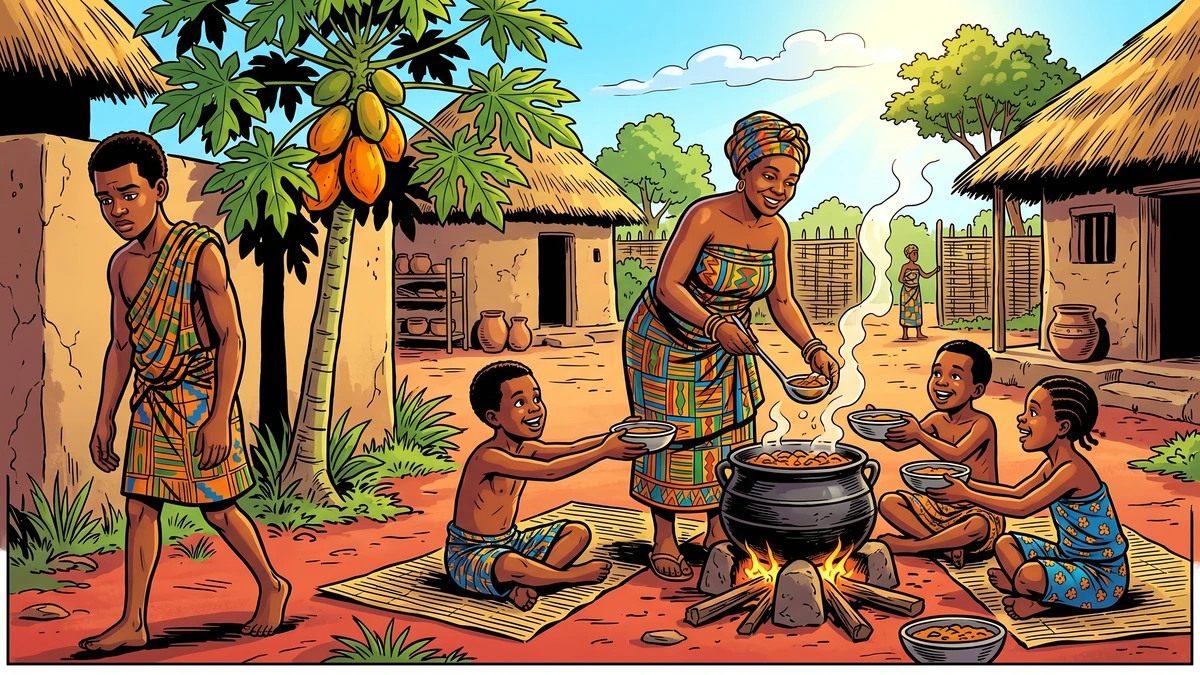
Listen to what the storyteller is doing in that line. The stepmother does not strike Kwofi. She does not curse him or drive him from the house. She wounds him with a smile and an endearment — “my son Kwofi” — and with the soft, unanswerable fiction that the meat has simply, accidentally, run out. Cruelty disguised as misfortune is the hardest kind to protest, because there is nothing to protest against; only an empty pot and a kind voice sending a hungry boy out to forage fruit in the dark. And the tale underscores the completeness of it: “Kwofi never complained. Never once did he taste any of the meat he had hunted. At every meal the others were served, but there was never enough for him.” Day after day, year after year, the boy who provides the feast eats paw-paw alone in the field. He bears it in silence. That silence — patient, uncomplaining, without a trace of revenge in it — is the thing the story most wants us to notice. It is the quality the gods are about to weigh.
The God with the Bag of Death
The turn comes on an ordinary evening. “The usual thing had happened” — the meat shared out, Kwofi passed over, the boy already rising to go and fetch his paw-paw supper — when the story breaks open. “All at once one of the gods appeared in the village, carrying a great bag over his shoulder.”
In Akan cosmology this is not an absurd image but a recognisable one. Above all stands Onyame, the supreme God, the sky and the source; below him move the abosom, the lesser gods and spirits who deal directly with human towns — who can be petitioned, who can be angered, and who can arrive, as this one does, walking into a village in the shape of a visitor. The god summons the whole community together and speaks a sentence of plain, ceremonial terror: “Oh, my villagers, I come with a bag of death for you!” Then “he began to distribute the contents of his bag among them” — moving through the assembled people, dealing out death the way the stepmother had dealt out meat, a portion to each in turn.
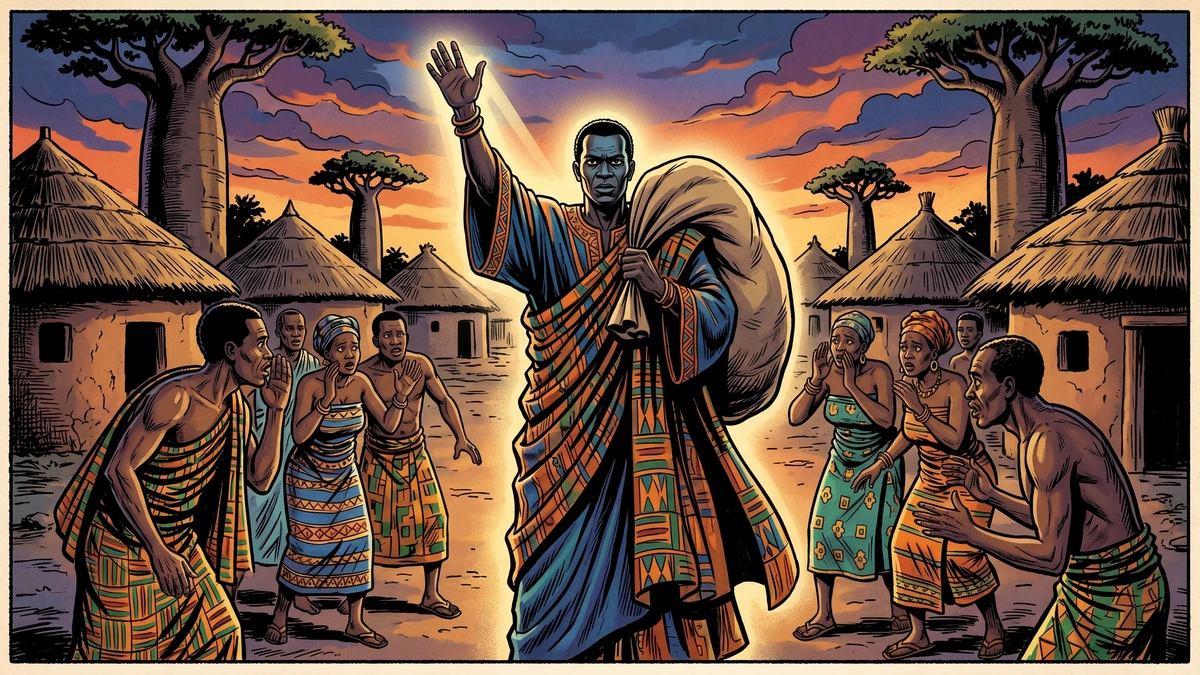
The image of death carried in a bag and handed out portion by portion is itself an old and widespread one. Across West African oral tradition, and far beyond it, death is rarely an abstraction; it is personified, given a body, made to walk and speak and carry its work in a vessel — a bag, a basket, a calabash. To picture mortality this way is to make it answerable. A force that walks into a village on two feet can be addressed, can be reasoned with, can — crucially — choose. The folk imagination that gave death a bag also gave it the power of selection, and a story that grants death the power to select is a story that can ask the question this tale is really asking: not why do people die, but by what justice is one person spared. The Akan storyteller answers that question not with doctrine but with a boy, a cooking pot, and years of paw-paw eaten alone.
The storyteller has built this moment with great care, and its power lies in an echo. The village has spent the whole tale watching one person hand out shares to a waiting line. We have seen the stepmother do it at every meal — “a large helping” to each of her own, and to Kwofi the same words, the same exclusion. Now a god stands where the stepmother stood, and he too moves down a line, giving each villager his portion. The structure is identical. Only the substance has changed: where she dealt out meat and the appearance of kindness, he deals out death. And the audience, hearing it, already senses what is coming — because they remember exactly what always happened when the distributor reached Kwofi.
“Neither Is There Any Death”
The god comes at last to the boy at the end of the line, the one always served last, always served nothing. And he speaks to Kwofi using the very form of words the stepmother had worn smooth with repetition — the same tender address, the same announcement of an empty share: “Oh, my son Kwofi, there was never sufficient meat for you, neither is there any death.”
It is one of the most quietly devastating sentences in West African folk literature, and everything depends on how the listener has been prepared to hear it. For the length of the whole tale, “there is none left for you” has been the sound of Kwofi’s exclusion, the formula of his suffering. Now the formula returns inverted. The same shape of sentence that once meant you alone go without nourishment is spoken again to mean you alone go without death. The boy who was always passed over is, this once, passed over by the one visitor in the world it is a mercy to be passed over by. “As he said these words every one in the village died except Kwofi.”
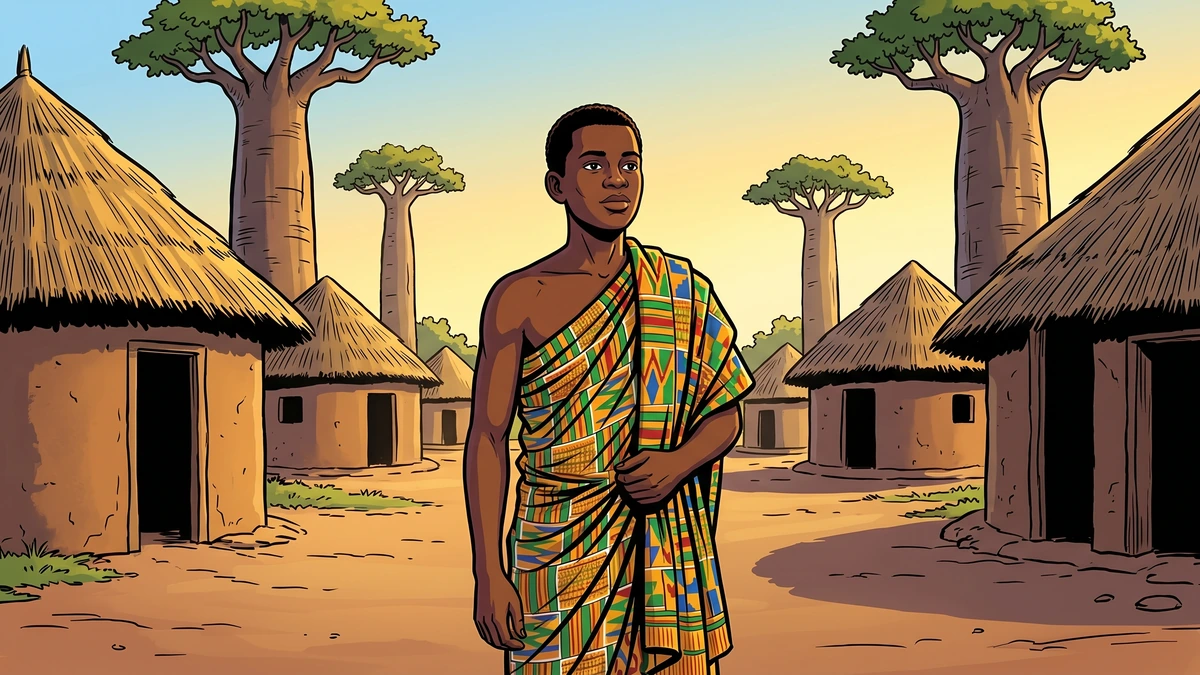
The stepmother, her many children, every neighbour who watched a hungry boy sent out for paw-paw and said nothing — all of them receive their portion from the bag, and all of them fall. Kwofi alone is left standing in the silent village. And the tale closes not with his grief and not with his triumph, but with a single, level sentence: “He was left to reign there in peace, which he did very happily.” The orphan with no relative in the world inherits the whole village — its houses, its fields, its quiet — and the boy whom no one would feed becomes the one man left alive to be its king. The wheel that had pressed him to the very bottom has turned all the way round.
The Moral of the Tale
“Kwofi and the Gods” is, on its surface, a story of reversal — the last made first, the starved made sovereign — but the Akan storytellers who kept it were after something more exact than a happy ending. The tale insists on how the reversal is earned. Kwofi is not rewarded for cleverness; he never outwits anyone. He is not rewarded for strength; he never raises a hand. He is rewarded for two things and two things only: he kept providing for a household that gave him nothing back, and he bore his wrong without complaint and without revenge. The gods, in this telling, are not capricious. They are watching. They see the hunter who feeds others and eats paw-paw alone, and in their own time, by their own reckoning, they answer for him.
There is a second, subtler lesson folded inside the first, and it is one the Akan elders stated openly in their proverbs. Kwofi survives precisely because he had no one. He has no mother to fight for his share, no father, no kin — and it is exactly this defencelessness that the divine visitor singles out and protects. The point is captured in a proverb still spoken in Twi today:
“Aboa a onni dua, Onyame na ɔpra ne ho.”
“The animal that has no tail — it is God who brushes the flies from its body.” — Akan (Twi) proverb
A beast born without a tail cannot drive off the flies that torment it; it has no defence of its own, and so — the proverb says — God Himself takes up the task. Kwofi is that tailless creature. Stripped of every human protector, he becomes the special charge of the divine. The story does not teach that the meek should stay meek; it teaches that no wrong done to the defenceless goes unwitnessed, and that the One who watches over those with no one else is, in the end, protector enough.
Why This Story Has Lasted
“Kwofi and the Gods” has survived for more than a century in print, and for far longer in the mouths of storytellers, because it does something most moral tales never risk. It refuses to make its hero remarkable. Kwofi is not brave, not cunning, not gifted with any magic; he is simply a boy who keeps doing right while being treated wrongly. That ordinariness is the whole gift of the story to the children who first heard it around Gold Coast hearths. The tale tells them that you do not have to be a trickster or a warrior to deserve a good ending — that endurance, honest work, and the refusal to answer cruelty with cruelty are themselves a kind of heroism, and one the gods can see.
You May Also Like
 African Folk Tales
Ages 6-8
African Folk Tales
Ages 6-8
Why the Sun and Moon Live in the Sky
An Efik pourquoi tale from southern Nigeria: the Sun and his wife the Moon welcome their friend the Water too well, are flooded out of the great house they built, and are driven up to live in the sky forever.
 African Folk Tales
Ages 6-8
African Folk Tales
Ages 6-8
The White Man And Snake
The Khoikhoi fable of a man who frees a snake pinned under a stone, only for the snake to turn on him - until the clever Jackal restores her to the trap by asking her to prove her story. A Cape retelling of tale type ATU 155.
 African Folk Tales
Ages 6-8
African Folk Tales
Ages 6-8
The Ungrateful Man
The Ungrateful Man: A hunter, who was terribly poor, was one day walking through the forest in search of food. Coming to a deep hole, he found there a leopard