Jackal And Monkey
A captive jackal escapes a Cape farmer's wip snare by tricking a gloating monkey into taking his place - a dark South African trickster tale from the Khoikhoi jackal cycle, retold from James A. Honey's South-African Folk-Tales (1910).
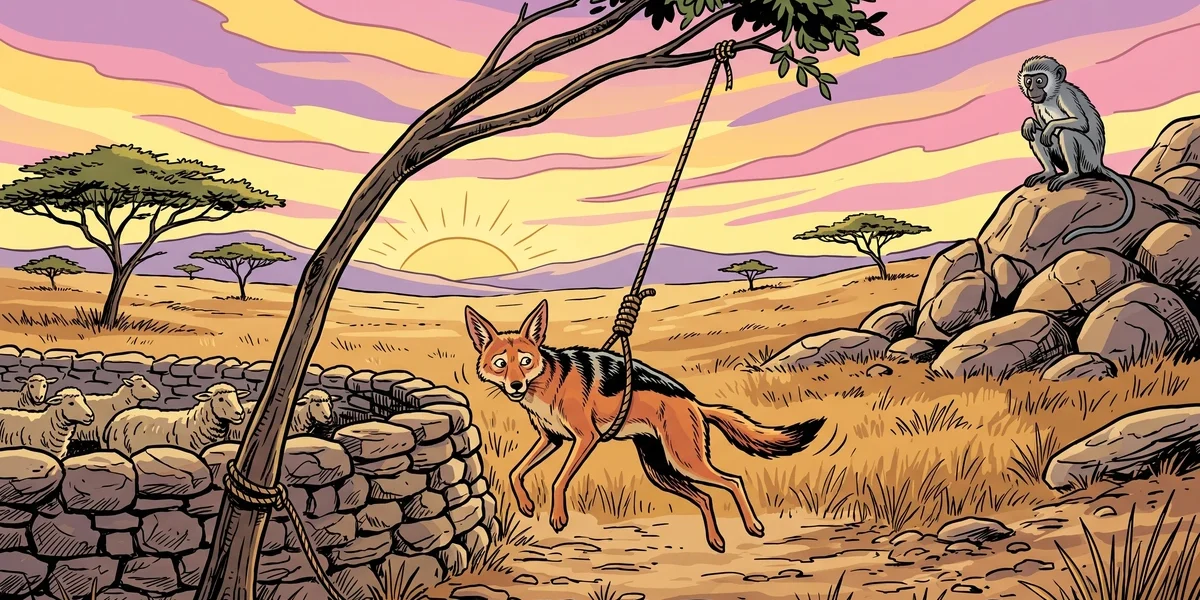
On a Boer farm somewhere in the dry interior of the Cape, a jackal has been raiding the sheepfold night after night, and one grey dawn the farmer’s snare finally closes around him. What happens next is not the tidy justice an Indian fable or an Aesopic moral might promise. Instead, Jackal and Monkey delivers one of the most unsettling endings in southern African folklore: the real thief talks his way free, and an innocent busybody is shot in his place. It is a small, hard, brilliant story – and it has been making listeners flinch and grin for well over a century.
This retelling restores the tale to its proper home. Jackal and Monkey is not, as careless summaries sometimes claim, a Panchatantra story or an Indian beast-fable. It belongs to the Cape jackal cycle of southern Africa, and it reaches us through a specific printed source with a specific lineage, which the sections below set out in full.
A Thief Caught in the Wip
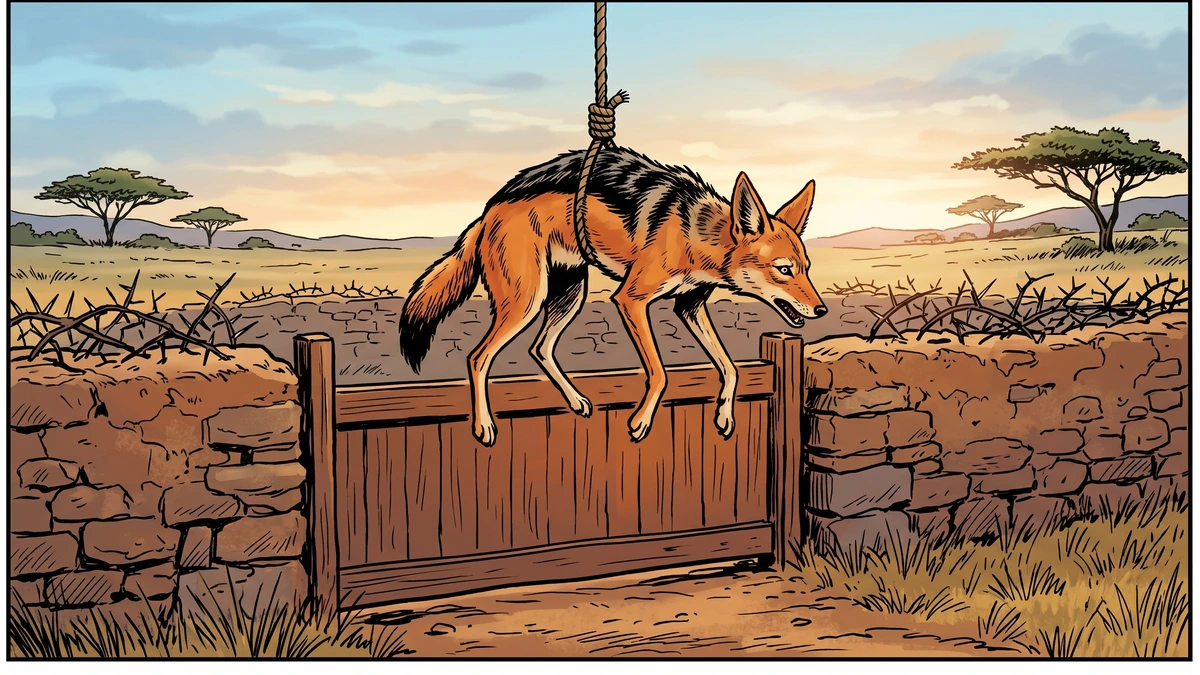
The story opens with a habit. Every evening Jackal trots down to the Boer’s kraal – the stone-walled enclosure where the farmer keeps his sheep – slips through the low sliding door, and carries off a fat young lamb. He does this not once but many times in succession, and each success makes him a little surer of himself. In the moral architecture of the tale, that confidence is the trap before the trap.
The farmer answers cunning with craft. He sets a wip at the kraal door. The word is Cape Dutch, and the device deserves a moment of attention because the whole plot turns on it. A wip is a springle snare: a green sapling is bent down under tension, a running noose is fastened to its tip, and a delicately balanced cross-stick holds the bough in place. The instant an animal treads on the trigger, the cross-stick slips, the sapling whips upright, and the noose snatches the creature off the ground and into the air. It is a trap that does not merely hold its victim – it displays him, swinging and helpless, for everyone to see.
Jackal, expecting another easy lamb, steps into it. Zip – the noose closes around his body and flings him aloft. He swings and sways high above the ground, unable to touch earth with any paw. As the sky begins to pale toward dawn, his cleverness curdles into something closer to panic. The trickster who has spent the story so far in command is now, quite literally, hanging by a thread, and the day that is coming will bring the farmer with it.
The Mockery on the Wall
Onto this scene comes the second character. Monkey has spent the night on a stone kopje – one of the small, abrupt rock hills that punctuate the South African veld – and as the light strengthens he sees the whole affair laid out below him: the kraal, the snare, the jackal turning slowly in the air. He does not run for help. He does not look away. He climbs down in a hurry for one reason only: to enjoy the spectacle and to mock.
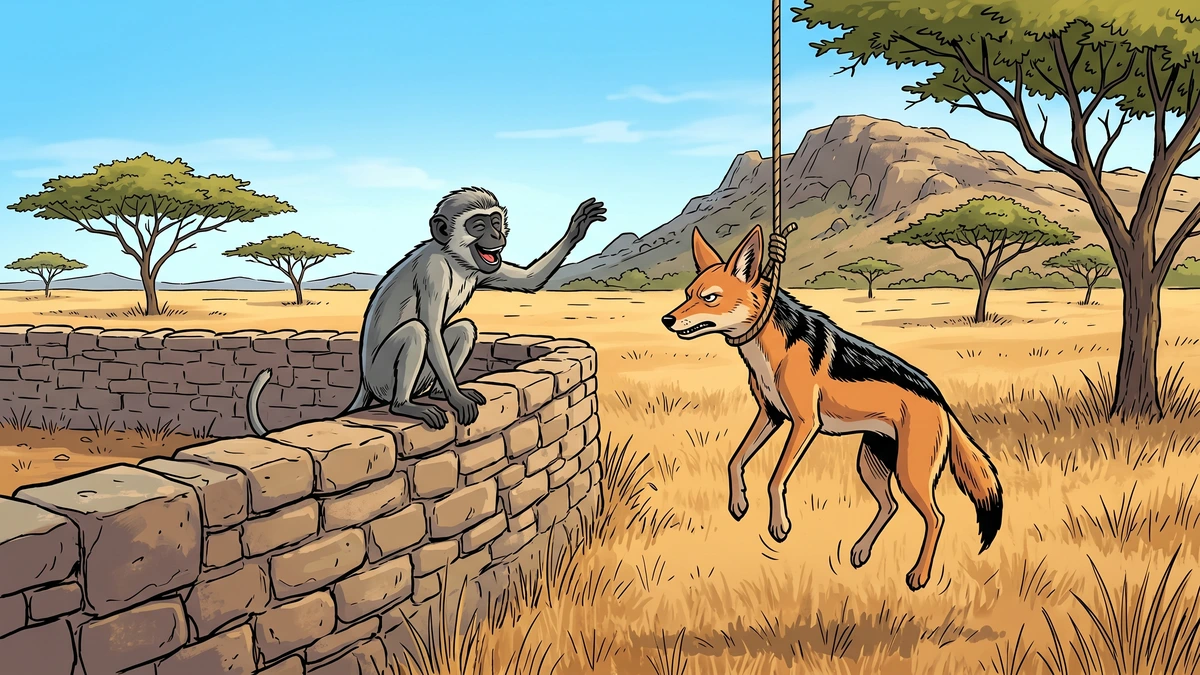
Monkey settles himself comfortably on the kraal wall and begins. “Good morning,” he says, with elaborate politeness. “So there you are, hanging now – caught at last.” It is the tone of someone who has waited a long time for this and intends to savour every second of it.
Here the tale springs its first real surprise, and it is psychological rather than physical. Jackal does not beg. He does not admit he is caught. He simply denies the obvious. “Caught? Not at all. I am swinging here for my own pleasure – it is delightful.” Monkey, sensibly enough, refuses to believe him: “You fibber. You are caught in the wip.” And so the two animals settle into an argument about the plain evidence of Monkey’s own eyes – an argument that Jackal, against all reason, is slowly winning. This is the engine of the whole story. Jackal cannot break the noose, so he goes to work on the only thing he can still reach: the mind of the creature who came to laugh at him.
The Sweetest Lie
Jackal’s method is worth studying, because it is a small masterclass in manipulation. He never argues that he is not caught – that argument is unwinnable. Instead he changes the subject from captivity to sensation. The swinging, he insists, is wonderful. It makes the body feel healthy and strong; it sets a creature up for the whole day; afterward one never feels tired. He paints the snare not as a trap but as a tonic, a private luxury Monkey is foolish to refuse. “If you only knew how nice it is to swing and sway like this, you would not hesitate.”
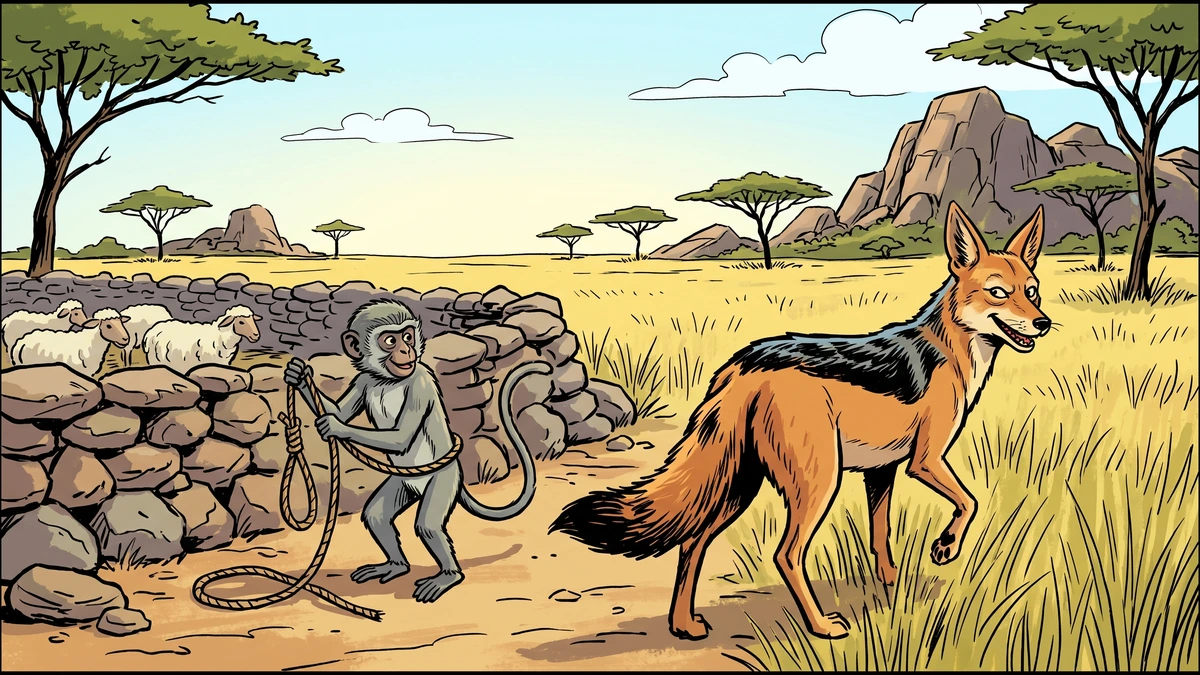
Notice what Jackal is exploiting. Monkey came down from the kopje hungry for an advantage – the small superiority of the onlooker over the victim. Jackal feeds that hunger. He offers Monkey something even better than mockery: the chance to possess a pleasure the clever jackal supposedly enjoys. Envy does the rest. After a while – the story is unhurried here, and the slowness is the point – Monkey is convinced. He springs down from the wall, lifts the noose from Jackal’s body, and fastens it around his own.
The reversal is instant and merciless. The moment Monkey is secured, Jackal lets go of every pretence. He drops to the ground, free, and bursts out laughing while Monkey rockets upward into the very position Jackal occupied a minute before. “Ha, ha, ha,” he crows. “Now Monkey is in the wip!” The con is complete. The trickster has done the one thing a captive trickster can do: he has found a substitute.
The Boer’s Gun
Monkey, dangling and frightened, begins to scream for release. “Jackal, free me!” But Jackal is no longer negotiating; he is narrating. “There – the Boer is coming,” he announces, and every time Monkey pleads, Jackal answers with the same calm bulletin: the farmer is on his way, the farmer has his gun, rest a while in the noose. The threats Monkey throws back – I will break your playthings – are the threats of someone who has not yet understood that the game is already over. With a cheerful “Good morning,” Jackal turns and runs, as fast as his legs will carry him, away from the kraal and out of the story.
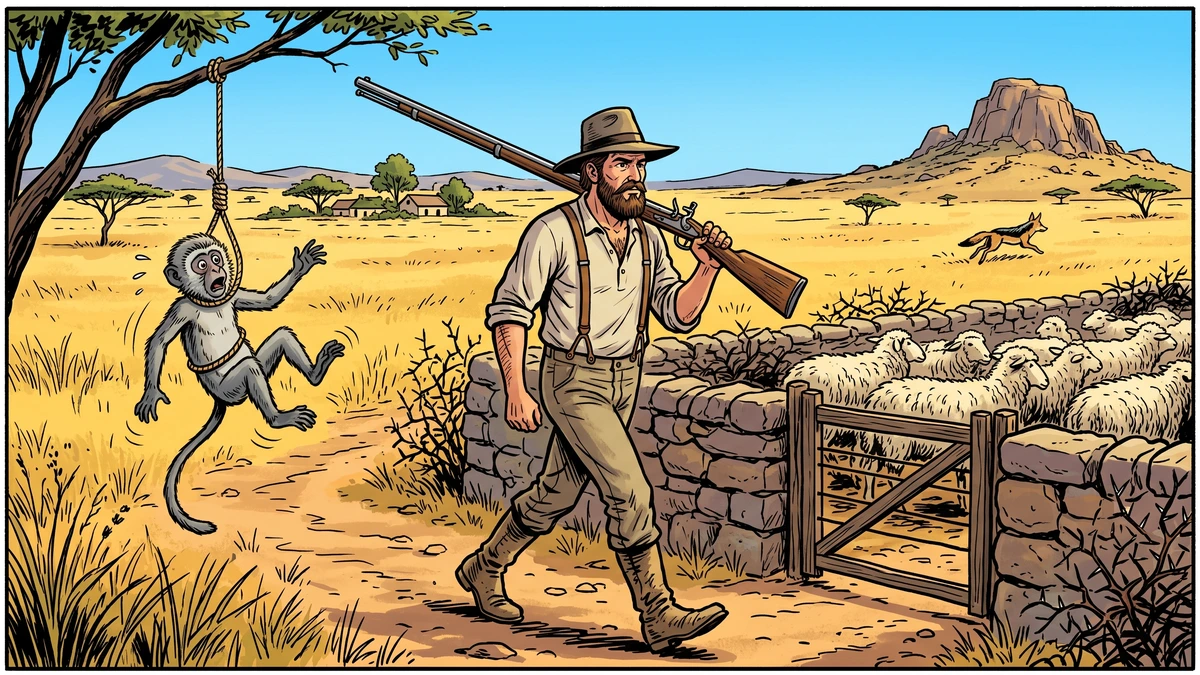
Then the Boer arrives. He sees a creature swinging in his snare and draws the natural conclusion: here is the thief who has been emptying his fold. “So, Monkey, now you are caught. You are the one who has been stealing my lambs.” Monkey tells the exact truth – “No, Boer, not I, but Jackal” – and stammers it again, and again. But the truth, arriving in the mouth of the creature actually hanging in the trap, persuades no one. “I know you,” says the farmer. He raises his gun, takes aim, and the mocking monkey meets the end the thief had earned.
It is a brutal ending, and folklorists have long noted that the Cape jackal cycle does not soften its conclusions. The guilty animal escapes; the innocent animal dies; and the story declines to apologise for the imbalance. That refusal is precisely what gives the tale its staying power. It is not a fable about crime being punished. It is a fable about how cunning survives – by transferring its consequences onto someone naive enough to accept them.
The Moral of the Tale
Most folk traditions hand the listener a single tidy lesson. Jackal and Monkey hands over at least three, and they sit together uneasily, which is part of the story’s honesty.
The first lesson belongs to Monkey, and it is about the danger of scorn. Monkey is harmed by nothing he did wrong in any criminal sense – he stole no lambs. He is destroyed by the impulse to climb down and gloat. His desire to feel superior is the open door through which Jackal walks. The Cape Dutch farmers who retold these tales had a proverb that fits him exactly:
“Hoogmoed kom voor die val.”
— Cape Dutch / Afrikaans proverb: “Pride comes before the fall.”
The second lesson is about credulity. Monkey can see, with his own eyes, that Jackal is trapped. He even says so out loud. Yet he allows a confident voice to talk him out of the plain evidence in front of him. The tale is merciless about this: cleverness that cannot defend its own conclusions is no cleverness at all. A listener who watches Monkey argue himself out of the truth is being trained, gently, to hold on to what they actually know.
The third lesson belongs to the wider world the story describes, and it is the darkest. Cunning, the tale suggests, does not simply win; it survives by exporting its risks. Jackal does not escape the snare by being strong or by being lucky. He escapes it by finding someone else to occupy it. The story asks its listeners, especially as they grow older, to recognise that pattern when they meet it – the charming, plausible voice that offers them a wonderful opportunity which is, in fact, simply a noose with the previous occupant’s name still on it.
Folkloric Roots and Canonical Attribution
The version retold here descends directly from South-African Folk-Tales, collected and edited by James A. Honeÿ and published in New York by the Baker & Taylor Company in 1910. Honey’s slim volume gathered tales then circulating among the Dutch-descended (Boer) farming communities of the Cape, and the jackal stories form its sharpest, most memorable section. The internal evidence in Jackal and Monkey confirms the provenance beyond doubt: the Boer and his kraal, the stone kopje, and above all the wip – a word and a device specific to the Cape Dutch countryside.
Honey’s farm-told versions did not originate with the Boers, however. They are reworkings of a far older indigenous body of storytelling: the jackal trickster cycle of the Khoikhoi (the people once labelled “Hottentot” in colonial sources), among whom the wily jackal is the central trickster figure, the southern African counterpart to the hare, the spider Anansi, or the tortoise elsewhere on the continent. The foundational printed record of that cycle is Wilhelm H. I. Bleek’s Reynard the Fox in South Africa; or, Hottentot Fables and Tales (London, 1864) – the earliest published collection of indigenous southern African literature. Bleek assembled forty-two translated oral narratives, and he placed the “Jackal Fables” first: a run of thirteen tales in which the jackal schemes, deceives, and slips free. Honey’s Cape-Dutch Jackal and Monkey is a later branch of that same living tree, the Khoi trickster passed through Afrikaner farmhouses and finally onto the printed page.
Bleek’s title was itself a piece of interpretation. By naming his book after Reynard, the trickster fox of medieval French, Dutch, German, and English beast-epic, he signalled to European readers that the jackal occupied the same narrative role – the cunning underdog who triumphs through wit. Modern scholars of Khoi orature add a further layer: in the mouths of a colonised people, the jackal’s victories over larger, more powerful figures often carried a satirical charge, mocking and quietly subverting the dominance of the settler. Read with that history in mind, the Boer’s gun at the end of Jackal and Monkey is not a neutral prop.
In the comparative apparatus of folklore studies, the tale’s central trick is catalogued as Stith Thompson motif K842, “Dupe persuaded to take prisoner’s place” – the captive who escapes bondage by convincing a foolish bystander to be bound in his stead. It is a motif of remarkable reach: the same structural trick powers the “briar patch” and tar-baby episodes of the African-American Brer Rabbit cycle (themselves carried across the Atlantic from African oral tradition) and a whole family of European trickster tales in the Aarne–Thompson–Uther index of trickster narratives. Monkey’s gullibility, meanwhile, falls under the broad motif group J2050, the deceptions practised on the foolish. Recognising these classifications is not pedantry; it is the way folklorists demonstrate that a story told on one Cape farm belongs to a conversation spanning continents and centuries.
Two Animals, Two Kinds of Cleverness
It is tempting to read Jackal and Monkey as a simple contest between a clever animal and a stupid one. The tale is sharper than that. Both creatures are clever – they are clever in different ways, and the story is precisely about which kind of cleverness survives a crisis.
Monkey’s intelligence is the intelligence of the observer. From his kopje he sees everything; he reads the situation correctly the instant the light comes up; he names the trap accurately “You are caught in the wip” and holds that judgement firmly through several rounds of denial. In any ordinary moment, Monkey is the smarter animal. His fatal weakness is not a lack of wit but a lack of discipline over his own appetites. He cannot resist coming down to gloat, and once he is within reach of Jackal’s voice, he cannot resist the flattering picture Jackal paints. His cleverness is real but undefended; it collapses the moment his vanity is engaged.
Jackal’s intelligence is the intelligence of the operator. He is, by any honest measure, in a far worse position than Monkey – he is the one in the noose, the one the farmer actually wants. But Jackal never wastes a second on the facts he cannot change. He concentrates entirely on the one variable still within his power: the decisions of the only other creature present. He does not try to win the argument about whether he is caught; he abandons that ground instantly and opens a second front, the argument about whether the snare is pleasant. This is the heart of the tale’s wisdom. Jackal teaches, by dark example, that a manipulator does not need to be right – he only needs to control which question is being discussed.
Placed side by side, the two animals form a complete lesson. Monkey shows that knowing the truth is not enough if you will trade it for a compliment. Jackal shows that the most dangerous opponent is not the strongest one but the one who keeps thinking clearly when everything has gone wrong. The story does not ask us to admire Jackal – he is a thief and, in the end, something close to a murderer by proxy. It asks us to study him, the way a sensible traveller studies the habits of a predator whose territory they must cross.
Why the Story Has Lasted
Plenty of folk tales survive because they comfort. Jackal and Monkey survives because it does the opposite – and that is rarer, and more valuable, than it first appears.
Children remember this story because the trick is so clean and so visible. There is no magic in it, no spell, no enchanted object: just a snare, a wall, and a conversation. A young listener can see exactly how the swap is done, can feel the moment Monkey’s envy gets the better of his eyes, and can sense the cold drop in the stomach when the trade becomes irreversible. Stories that explain themselves this transparently lodge in the memory and stay there.
Adults return to it for a different reason. With age, the listener stops identifying with the clever jackal and starts recognising the monkey – and, worse, recognising the times they themselves climbed down from a safe wall to enjoy someone else’s misfortune, or talked themselves out of something they plainly knew. The tale’s refusal to reward innocence is not cynicism; it is a kind of respect. It treats its listeners as people who will, sooner or later, meet a persuasive voice offering them a delightful opportunity, and it wants them to remember – before they reach for the noose – who was hanging in it first.
That is the quiet, durable gift of this small South African tale. It does not promise that the world is fair. It promises something more useful: that the patterns of flattery, envy, and misdirected blame are old, and knowable, and – if you have heard the story – survivable.
You May Also Like
 African Folk Tales
Ages 6-8
African Folk Tales
Ages 6-8
The Hare and the Hyena
An East African Swahili trickster tale: during a famine the clever hare Sungura outwits the greedy hyena Fisi, eating their shared honey-store under cover of invented naming-feasts. Tale type ATU 15.
 African Folk Tales
Ages 6-8
African Folk Tales
Ages 6-8
Honourable Minū
Honourable Minū: It happened one day that a poor Akim-man had to travel from his own little village to Accra - one of the big towns on the coast. This man
 African Folk Tales
Ages 6-8
African Folk Tales
Ages 6-8
How Mushrooms First Grew
How Mushrooms First Grew — a tale of brothers, trickery, and transformation. Two brothers with bad habits deceived their community, changing the land.