The Leopard And The Ram
The Leopard And The Ram: A ram once decided to make a clearing in the woods and build himself a house. A leopard who lived near also made up his mind to do the
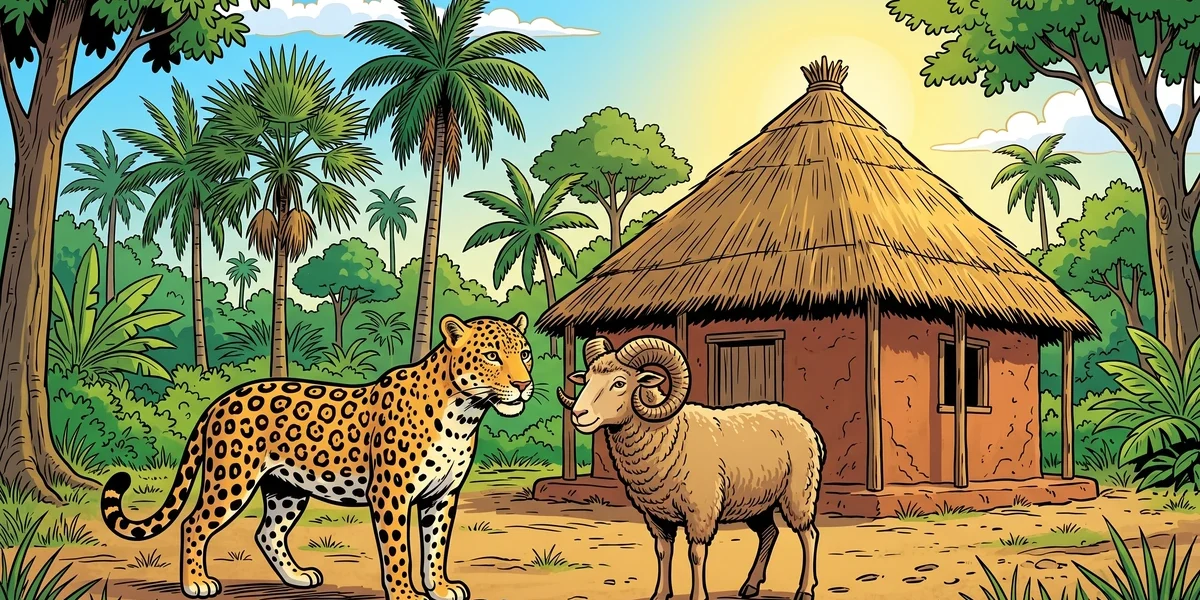
A leopard and a ram once built a single house without ever meaning to — each working alone, each certain that helpful spirits were finishing the job in his absence. “The Leopard and the Ram” is a West African tale of an accidental friendship, two very different ways of hunting, and a single misread movement on a rain-slick floor that sent a leopard fleeing into the forest forever. It belongs to the Akan peoples of the Gold Coast — modern Ghana — and it ends, as the best of these tales do, by explaining something a listener can still see in the world: why the leopard keeps to the wild woods while the ram lives quietly among people.
Where This Story Comes From
“The Leopard and the Ram” was collected and published in West African Folk-Tales, compiled by William H. Barker — then Vice-Principal of the Government Training College at Accra — together with Cecilia Sinclair, who also drew the volume’s illustrations. The book was issued in London by George G. Harrap & Co. in 1917, and it gathers the evening tale-telling of the Gold Coast peoples, principally the Akan.
Unlike the trickster anansesem — the “spider stories” of Kwaku Ananse that fill much of the same collection — this is an animal fable of a gentler, more reflective kind. It has no villain at all. Its leopard and its ram are both decent, hard-working, friendly creatures, and the catastrophe that ends their friendship is caused by nobody’s malice — only by fear, and by a question that was never asked.
In the language of folklore the tale is an etiological or “pourquoi” story — one that explains why the world is arranged as it is, here accounting for the leopard’s wildness and the ram’s place among humankind. It also carries two widespread folk-narrative patterns: the motif of the unknown helper, in which two people labour by turns at one task and each credits the work of the other to spirits or fairies; and the motif of the friendship destroyed by misunderstanding, in which a harmless act is read as a deadly threat. Stith Thompson’s Motif-Index of Folk-Literature gathers such confusions under J1820, “inappropriate action from misunderstanding of a situation,” and the tale’s close belongs to the broad A2400 band, the origin of the habits and homes of animals.
Two Builders and One House
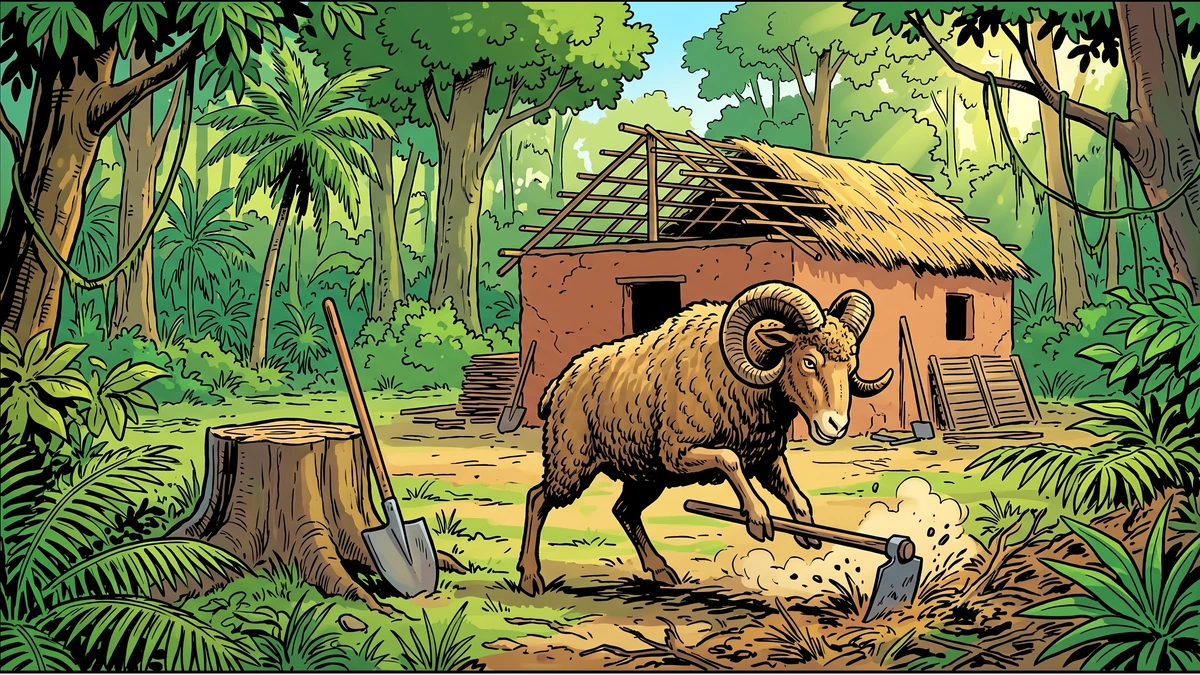
A ram, the story begins, once decided to make a clearing in the woods and build himself a house. A leopard who lived near by made up his mind, at the very same time, to do exactly the same thing. Neither knew anything of the other — and, as luck would have it, the two chose the identical site.
Ram came one day and worked at the clearing, then went home. Leopard arrived afterward and was much surprised to find part of the work already done; but he was glad of it, and simply carried on where the unseen worker had left off. The next day Ram returned, found his clearing further advanced, and marvelled in his turn. So it went, day after day. Each was astonished at the progress made in his absence, and each came to the same comfortable conclusion — that the fairies, the kindly spirits of the forest, had been helping him. Each gave the spirits his thanks and kept cheerfully at the task. And thus, working alternately and never once meeting, a leopard and a ram together raised a single house.
The Meeting and the Friendship
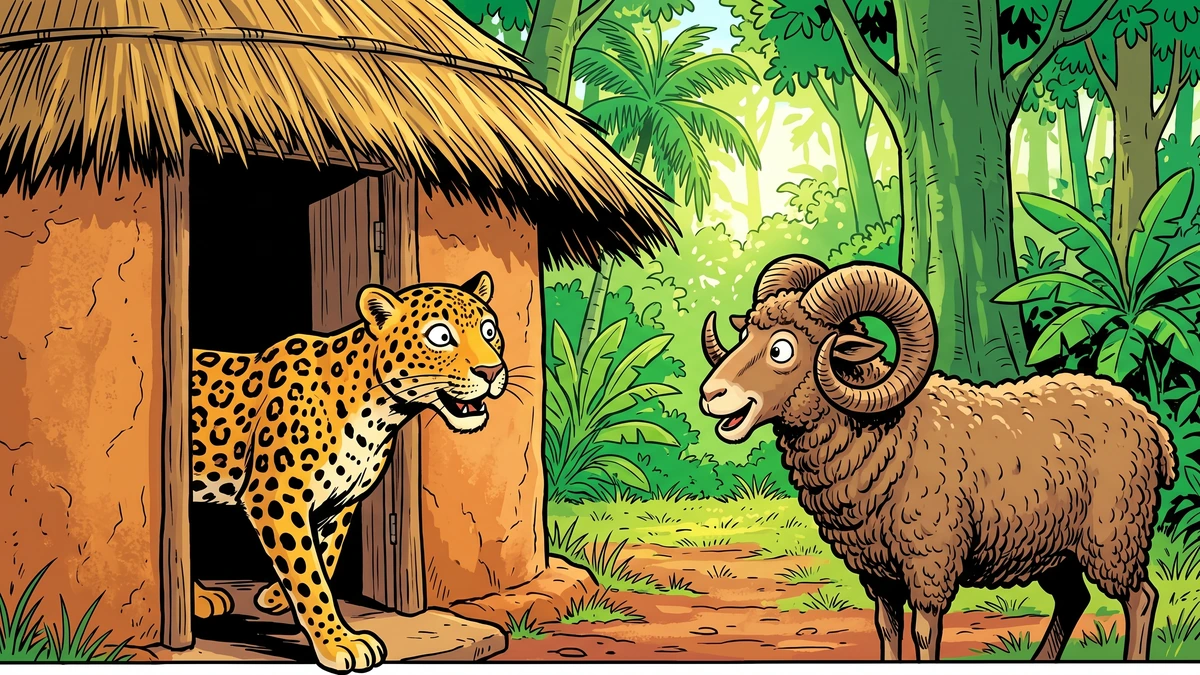
At last the house was finished, and both animals, on the same day, prepared to move into their fine new home. They met on the threshold — and the astonishment of that meeting can be imagined. Each had believed the building was his alone; each had thanked the fairies for a neighbour he had never seen.
But there was no quarrel. Each told his tale, the long comic story of the half-built clearing and the imagined spirits, and after a friendly discussion the two saw the sense of the thing: the house had been built by both, and it could be shared by both. Leopard and Ram decided to live together. It was a friendship founded, fittingly, on cooperation — even if neither had known, at the time, that he was cooperating.
The Secret of the Hunt
The two friends settled into an easy life. Both Leopard and Ram had young sons, and the little ones played happily together while their fathers went out hunting. And it was the hunting that planted the first seed of trouble.
Each evening the leopard noticed that his friend the ram came home from the hunt with just as much meat and venison as he himself had taken — and this puzzled him deeply. The leopard knew his own strength: the stalking, the spring, the claws. How could a ram, with no claws at all, match him kill for kill? Yet here was the simple, courteous solution staring him in the face — he had only to ask. And that is the one thing the leopard could not bring himself to do. He did not dare. So instead of asking his friend an honest question, he sent his son to spy out the answer in secret.
The Children’s Game
The next day, while the fathers hunted, young Leopard coaxed young Ram into showing how each of their fathers made a kill — and the two cubs turned it into a game. Young Leopard set a piece in position against a tree-stem and acted out his father’s way: stepping first to the right, then to the left, bowing low, rising on his hind legs, peeping along the stem to take his aim — and then springing forward to tear it down with his claws.
Then young Ram set his piece in position and showed his father’s way, which was utterly different. He wasted no time creeping or peeping. He simply walked backward a little way, lowered his head, took his aim — and then ran swiftly forward, driving his head and horns against the stem and shattering it. The game finished, the two cubs swept the place clean and went home. But young Leopard had seen something that frightened him, and that evening, when his father asked what he had learned, he told him the ram’s whole method — and added a warning. Be careful, he said, always be careful, whenever you see the ram step backward.
The Slip on the Wet Floor
For a while nothing happened, and the warning sat quietly in the leopard’s mind, doing its slow work. Then, some time afterward, it rained — a hard Gold Coast downpour that left the floor of the shared house wet and dangerously slippery.
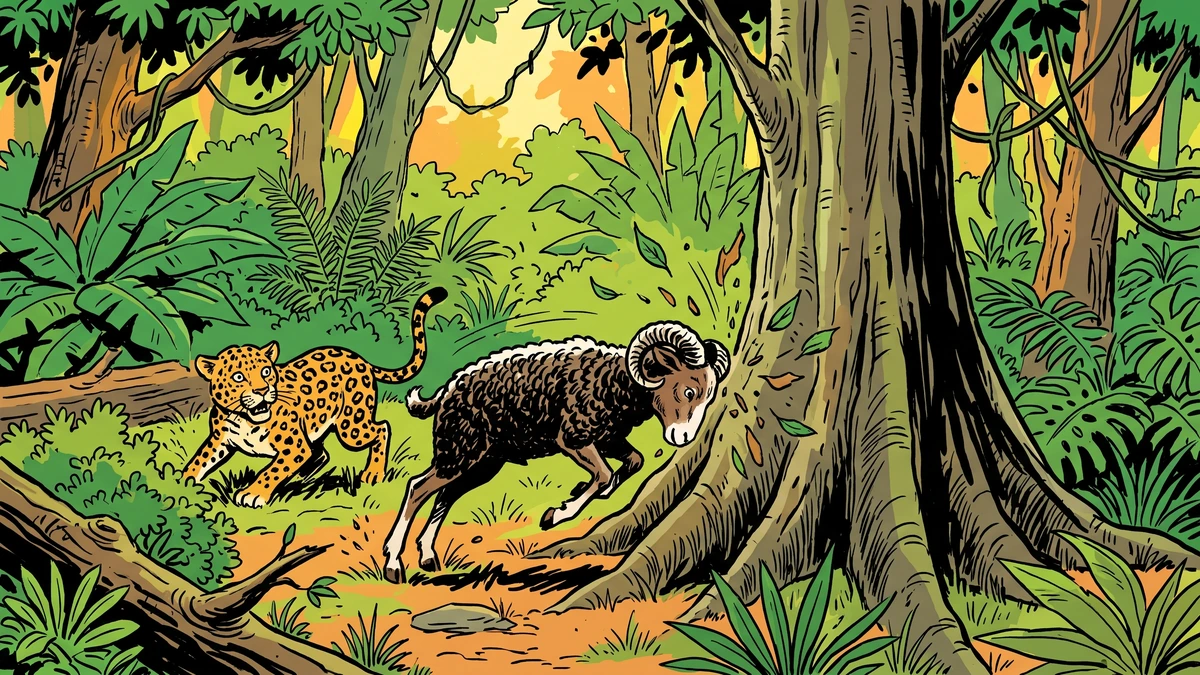
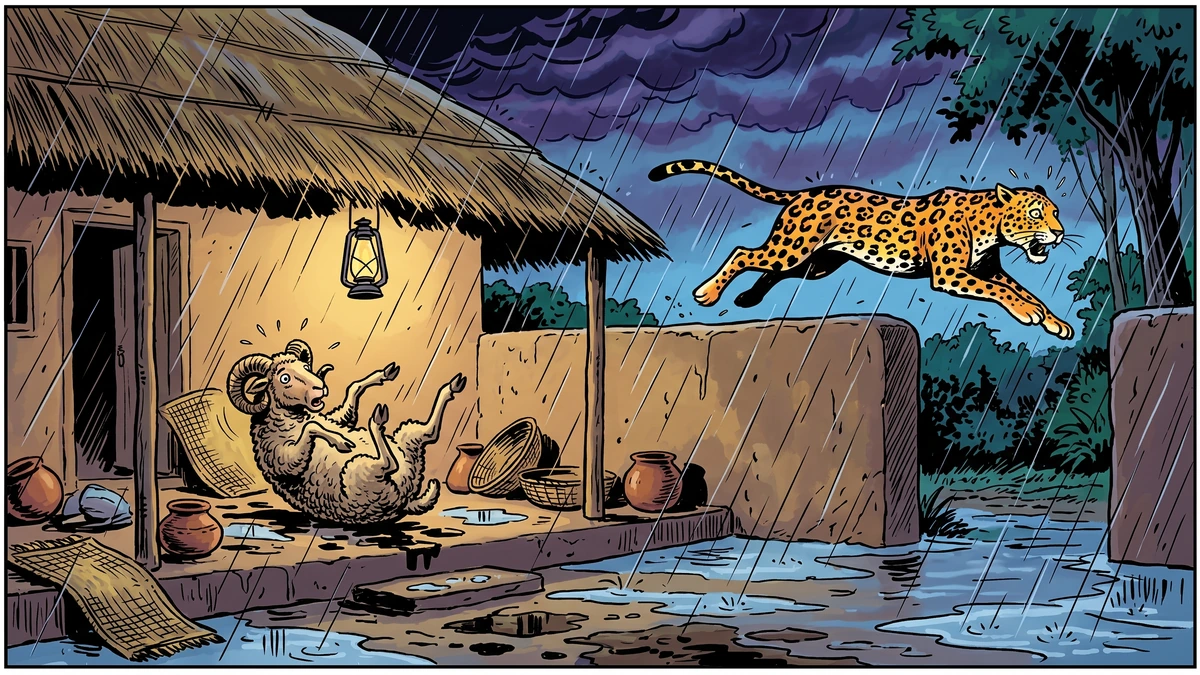
That evening the leopard called the ram, as he often did, to come and dine with him. The ram rose and started across the room — and on the wet floor his hoof slid, and he lurched backward. It was nothing: a slip, an accident, the most ordinary stumble in the world. But the leopard saw only one thing. He saw the ram step backward, and his son’s warning crashed through him like cold water: be careful whenever the ram steps backward. Certain, in that instant, that his friend was winding up to charge and kill him, the leopard shouted to his son to follow, gathered all his strength, sprang clean over the wall of the house, and bolted for the woods.
The Fear That Broke a Friendship
The ram, picking himself up, called after his friend — called him back, tried to explain that it was only a slip on the wet floor, that nothing was wrong, that nothing had ever been wrong. But the leopard was already gone, and he would not listen, and he did not return. From that day the leopard has kept to the wild woods, startled and watchful, while the ram has lived on peacefully among people in their villages. And that, the tale says, is why the leopard and the ram are friends no longer.
What destroyed the friendship is worth looking at closely, because it was not hatred and not betrayal. It was fear built on a half-truth. The leopard never saw the ram do anything dangerous. He saw a stumble, and on top of the stumble he laid a warning, and on top of the warning a whole secret history of suspicion — the unease he had felt for weeks about a friend who hunted as well as he did and whose method he had been too proud, or too afraid, to simply ask about. By the time the ram’s hoof slipped, the leopard was already primed to be afraid. The slip did not create the panic; it only released it.
Why the Leopard Should Have Asked
Every misfortune in the second half of this tale flows from a single missing action. The leopard wondered how the ram hunted — and “did not dare” to ask him. From that one act of avoidance everything else follows: the spying son, the secret game, the frightening warning, and at last the leopard launching himself over his own wall in terror of a friend who had only lost his footing.
It is a sharp irony, given how the friendship began. The house itself was built by two strangers who, without ever speaking, trusted that good was being done and answered it with thanks. Cooperation came easily to the leopard and the ram when they could not see each other at all. What they never learned to do was the harder, plainer thing — to turn to a friend who was right in front of them and ask an honest question. Knowledge gathered by spying comes warped and frightening; the same knowledge, asked for openly, would have come with a reassuring laugh. The ram would simply have explained that a ram fights with his head, and the leopard would have nodded, and no wet floor would ever have meant a thing.
The Moral of the Tale
On its plainest level the story warns against fear founded on ignorance: the leopard fled a friend who had done nothing, because he had armed himself with a secret instead of a question. Beneath that lies a lesson about the danger of the half-told thing — the son’s warning was true, but partial, and a partial truth in a frightened mind is more dangerous than no knowledge at all. And beneath that again is the quiet observation that trust, so patiently built, can be lost in a single unconsidered instant.
“Sɛ wonnim a, bisa.”
“If you do not know, ask.” — Akan (Twi) proverb
— a wisdom carried in the oral tradition behind West African Folk-Tales, W. H. Barker & C. Sinclair, 1917
The Akan proverb is the whole tale in four words. The leopard’s ruin was not that he lacked knowledge — it was that, lacking it, he would not ask. He chose the spy over the question, the secret over the conversation, and so he received his answer in the worst possible form: as a fear whispered by a child rather than a fact offered by a friend. Sɛ wonnim a, bisa. Had the leopard simply asked, the ram would still be his friend, and the two would still be sharing the house that, between them, they so improbably built.
The Tale Among Its Cousins
The most charming turn in the story — two builders raising one house, each crediting the other’s labour to spirits — belongs to a motif found in folklore around the world: the unknown helper, the work that advances by night or in one’s absence and is gratefully laid at the door of fairies, brownies or kindly ghosts. What the Akan tale does with the motif is quietly clever. It lets the listener enjoy the comedy of the misunderstanding while the friendship is still innocent, so that the second, darker misunderstanding — the slip mistaken for a strike — lands with full force. The same mechanism, a thing misread, builds the house in the first half and destroys the household in the second. The story is, in effect, a single idea told twice: once as a blessing, once as a calamity.
Its closing shape — a friendship between two animals broken forever, explaining why they now live apart — is a favourite of West African storytelling, which again and again uses the falling-out of two creatures to account for the arrangement of the natural world. Here the explanation carries a notably humane sting. The leopard is not wild because he is wicked, and the ram is not tame because he is virtuous. They simply live apart now because, one rainy evening, fear was faster than a question.
Why the Story Has Lasted
More than a century after Barker and Sinclair set it in print, “The Leopard and the Ram” still travels — read aloud in classrooms, retold in folklore anthologies, carried far beyond the Gold Coast forests where it was first spoken. It lasts, in part, because it is so unusually kind. It has no wicked character to blame and no punishment to relish; it simply watches, with something like sympathy, as two good friends lose each other to nothing but a misunderstanding. That gentleness makes its warning land all the harder, because the listener cannot comfort himself that he would never have behaved so badly. Anyone might mistake a slip for a strike, if he had been quietly afraid for long enough.
It lasts, too, because it does the double work of the finest folk tales. It answers a child’s real question — why does the leopard live wild in the forest, while the ram lives safe in the village? — and in the same breath it teaches the child something to carry into every friendship of a long life: that fear feeds on silence, that a question asked plainly is worth more than a secret cleverly stolen, and that the things people build together are far easier to raise than they are, once fear gets into the house, to keep.
Frequently Asked Questions
Where does “The Leopard and the Ram” come from?
It is a West African folk tale of the Akan peoples of the Gold Coast — modern Ghana — published in West African Folk-Tales, collected by William H. Barker and Cecilia Sinclair and issued by George G. Harrap & Co. in London in 1917. It is a gentle animal fable rather than a trickster tale.
How did the leopard and the ram come to live together?
Without knowing it, both animals decided to build a house on the very same site. Working on alternate days and never meeting, each believed forest fairies were helping him. When the house was finished they met at last, told their stories, and agreed in friendship to share the home they had unknowingly built together.
Why did the leopard run away from the ram?
The leopard’s son had warned him to beware whenever the ram stepped backward, because that was how a ram charged. One rainy evening the ram slipped backward on the wet floor by pure accident. The leopard, primed by the warning, mistook the harmless slip for an attack and fled in terror to the woods.
What kind of folk tale is this?
It is an etiological or “pourquoi” tale — a story that explains why the world is as it is, here accounting for why the leopard lives wild in the forest while the ram lives among people. It also dramatises the motif of a friendship destroyed by misunderstanding.
What is the moral of the story?
If you do not know something, ask. The leopard’s friendship was destroyed because he was too proud or too afraid to ask the ram an honest question, and chose to spy instead. Knowledge gathered in secret reached him as fear; the same knowledge, asked for openly, would have reached him as reassurance.
You May Also Like
 African Folk Tales
Ages 6-8
African Folk Tales
Ages 6-8
The Girl Who Could Not Be Eaten
The Zulu tale of Untombinde, a king's proud daughter, and the swallowing monster of the haunted pool - who devours a whole nation and cannot keep a single soul down.
 African Folk Tales
Ages 6-8
African Folk Tales
Ages 6-8
The Lion And The Wolf
The Lion And The Wolf: A certain old lady had a very fine flock of sheep. She had fed and cared for them so well that they became famous for their fatness. The
 African Folk Tales
Ages 9-12
African Folk Tales
Ages 9-12
Lion And Jackal
Lion and Jackal is a southern African folk tale from James A. Honey's South-African Folk-Tales (1910): a lion and a jackal agree to hunt on shares, the jackal hoards the meat, and the cheated, prideful lion is destroyed by his own greed.