Why Tigers Never Attack Men Unless They Are Provoked
An Akan pourquoi tale from West African Folk-Tales (Barker & Sinclair, 1917): a hunter and a leopard become friends, and a feigned death tests whether the friendship is true — explaining why the great cats leave men in peace unless provoked.
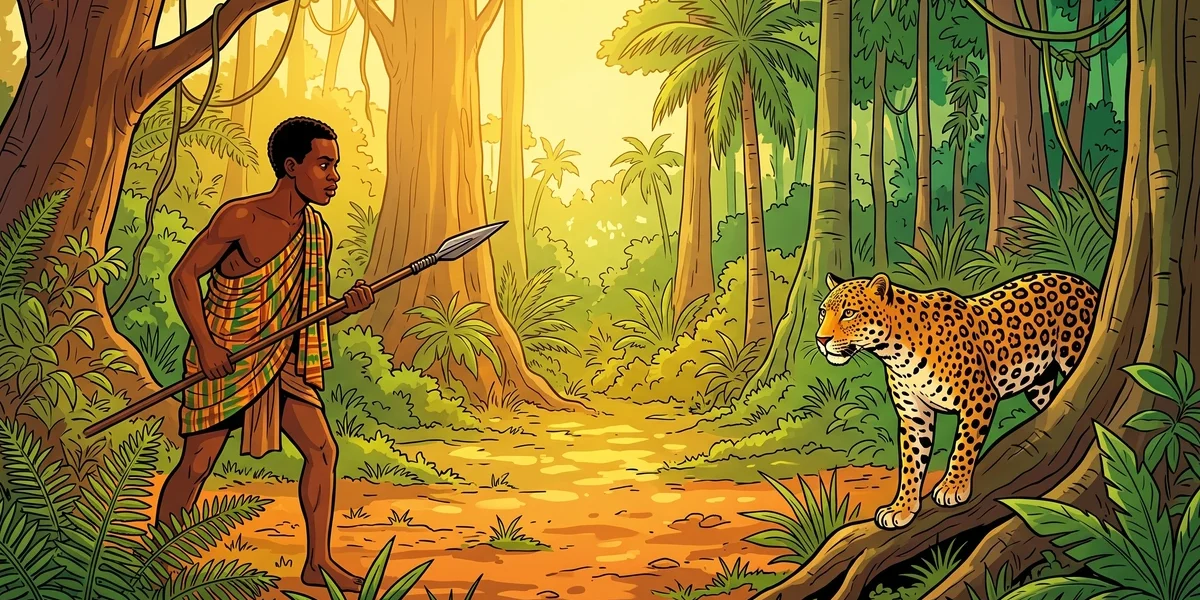
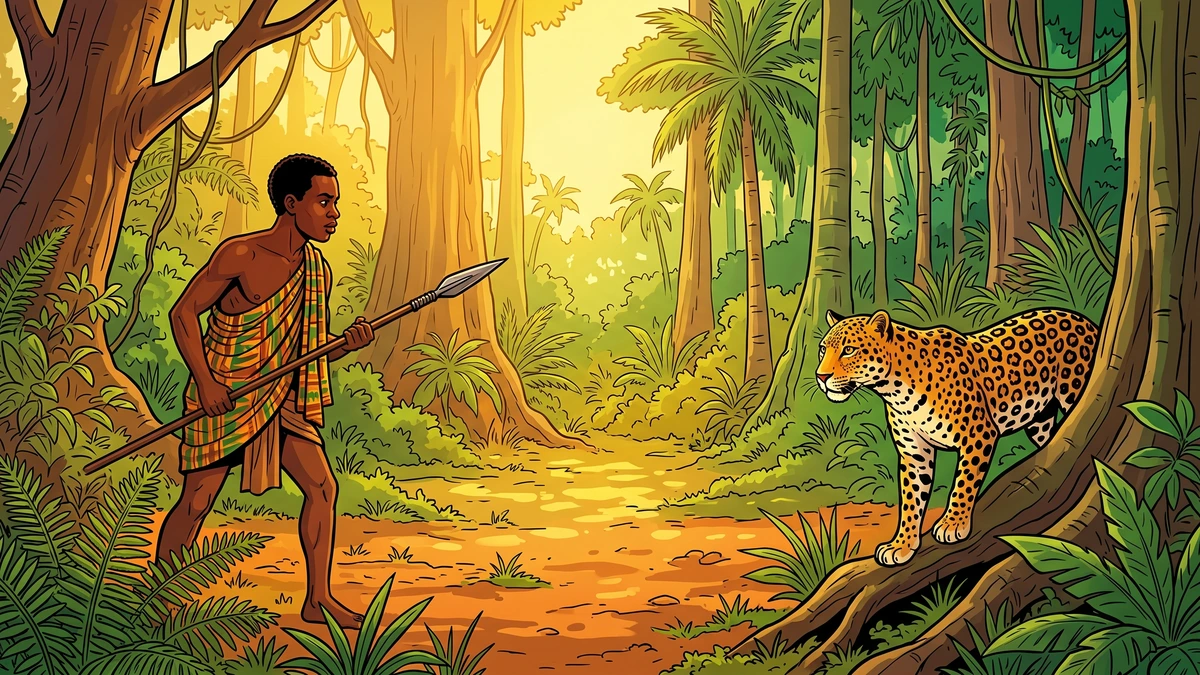
Deep in the forests of the Gold Coast, the old storytellers say, there was once a time when a man and a tiger could sit down together as friends. Why Tigers Never Attack Men Unless They Are Provoked is a tale from that imagined age – a story that begins with two wary strangers meeting among the trees and ends with a promise that, the Akan say, the great cats of the forest have kept ever since. It is a tale about how trust is built slowly and broken quickly, and about the difference between an injury and an insult.
On the surface it answers a child’s question: why does the leopard, so terrifyingly powerful, so rarely trouble the people who share its forest? Beneath that question lies a deeper one, the question the Akan elders most wanted the young to carry into adulthood – what does a true friend owe a friend, and how should a wronged creature respond when it cannot yet tell whether the wrong was deliberate?
An Unlikely Meeting in the Forest
A man went hunting one day and met a tiger among the trees. Each was afraid of the other, and for a long moment neither moved. But fear, when it is shared, can become the strange beginning of understanding. They began to talk. The talk eased the fear, and the easing of fear left room for something neither had expected: friendship.
They made an unusual agreement. They would live together for a while, learning each other’s ways from the inside. First the man would spend two weeks in the tiger’s forest home. Then the tiger would come and spend time in the man’s house among other people. It was a bargain built entirely on the willingness of each to be a guest in a world he did not control – and to trust his host with his safety.
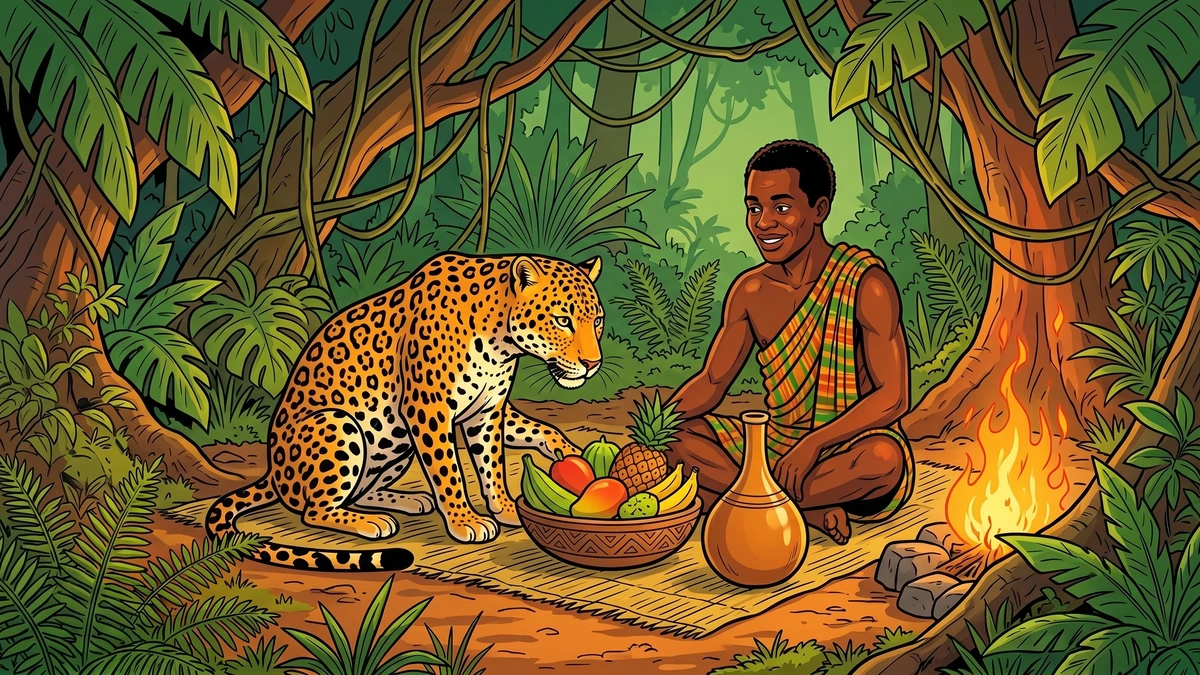
The tiger kept his side of the bargain beautifully. During the man’s stay in the forest, he was treated with such care and generosity that the man later said he had never been so well looked after in all his life. The lesson of this opening movement is quiet but firm: friendship across a great divide is possible, but it is not declared into being. It is constructed, visit by visit, kindness by kindness, until each friend has evidence – not merely hope – that the other can be relied upon.
A Friendship Sealed by Kindness
When the time came for the tiger to return the visit, his courage faltered. He was walking into a village of human beings, creatures who hunted his kind, and he asked his friend plainly: “What if your people do not like my face and kill me?” The man’s answer was a host’s pledge of protection – no one would touch the tiger while he was there. On the strength of that word, the tiger came, and he brought his young cub with him. He stayed three weeks. The cub and the man’s son became close companions, and for a time the two families lived as one.
Then sorrow entered the story. The man’s father died. When the tiger heard of his friend’s loss, he did not send word or wait to be asked. He and his cub set out at once to mourn alongside the man, and they carried with them a large sum of money to ease the family’s burden. This is the emotional summit of the tale’s first half. The tiger had become the kind of friend who shows up – who travels toward grief rather than away from it, and who arrives with his hands full.
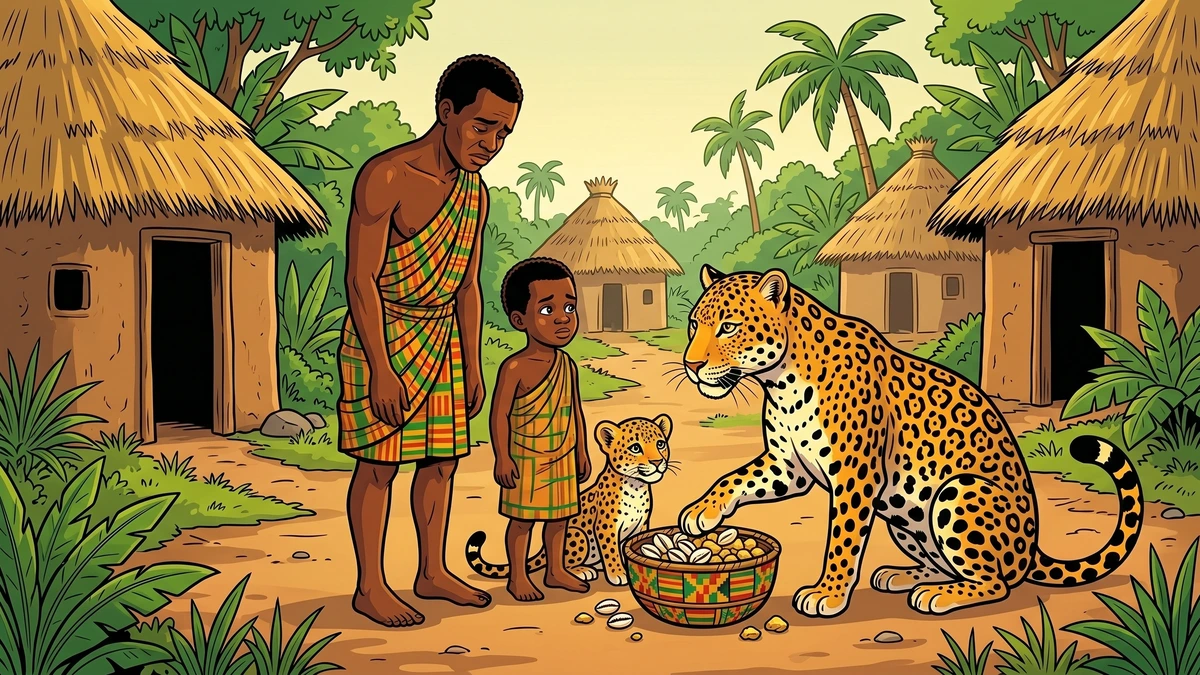
It matters, in the moral architecture of the story, that we see the friendship at its fullest before it is tested. The Akan storyteller is careful to leave no doubt about the depth of what is about to be endangered. The tiger has been a perfect guest, a generous neighbour, and a faithful mourner. Whatever happens next, the audience already knows exactly how much is at stake.
The Ambush and the Wound of Doubt
As the tiger made his way home from the house of mourning, two of the man’s friends lay in wait for him and shot him. He was wounded but not killed. Yet the wound to his body was not the wound that troubled him most. A far worse pain took hold of his mind: had his friend known? Had the man, the host who had sworn that no one would touch him, secretly arranged the ambush, or wished for it?
This is the hinge of the entire tale, and it deserves to be felt fully. The tiger does not lash out. He does not assume the worst and take revenge. He does not even assume the best and forgive blindly. Instead he recognises the most honest fact of his situation: he does not yet know. An injury had been done to him, but whether it was an act of betrayal or merely the act of two reckless men acting on their own – that he could not tell. And so, rather than acting on a guess, he resolved to find out the truth before he allowed his heart to decide anything.
There is enormous wisdom packed into this restraint. The tiger’s power is never in question; he could have answered the gunshots with violence and no one would have been surprised. What the story admires is that he chooses to suspend judgement. He treats his own anger as a witness that has not yet finished giving evidence.
The Test of the Feigned Death
The tiger went back to the very place in the forest where he had first met the man. There he lay down and made himself perfectly still, as though life had left him. He told his cub to stay close, to watch, and to remember everything that happened.
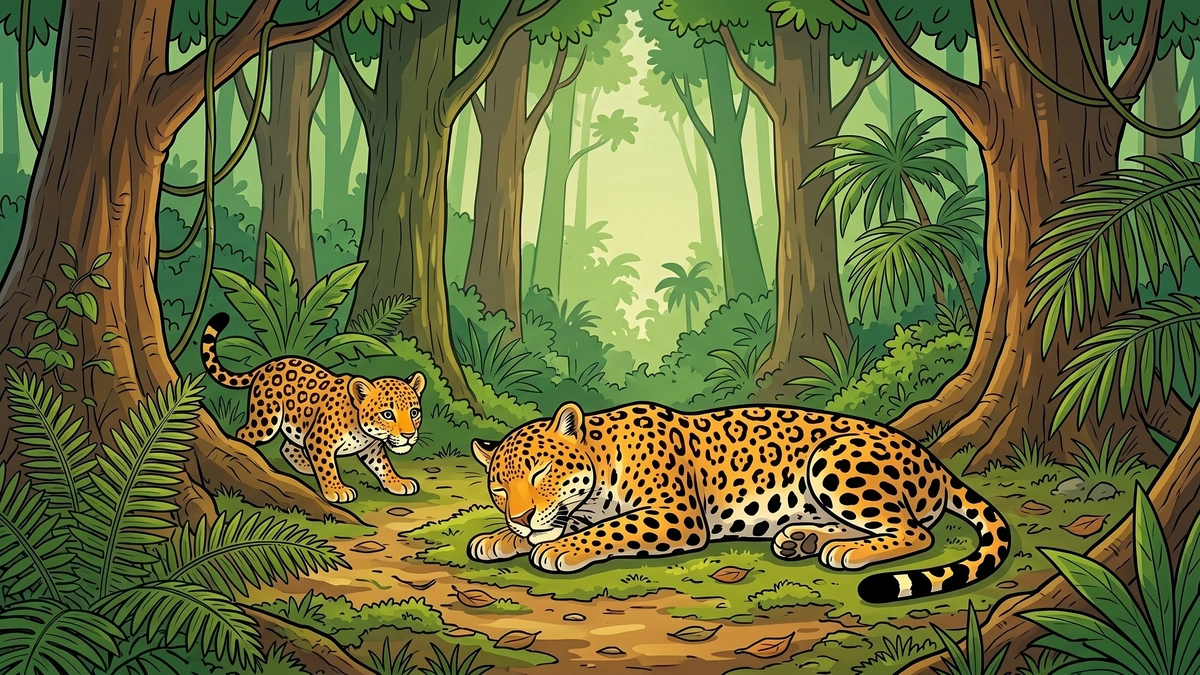
In time the man came walking through the forest, and he saw the tiger lying there, to all appearances dead. His response was immediate and unguarded, the kind of response a person cannot fake because he does not know he is being watched. He was overcome with grief. He wept. He mourned aloud for his friend. And then he sat down beside the body and stayed there through the entire night, together with the tiger’s cub, keeping watch so that no harm should come to his friend’s remains.
The tiger lay still and listened to all of it. By morning he had his answer, and it was the answer he had longed for: his friend was innocent. The man had known nothing of the ambush and had wished him nothing but good. With that certainty, the tiger rose to his feet.
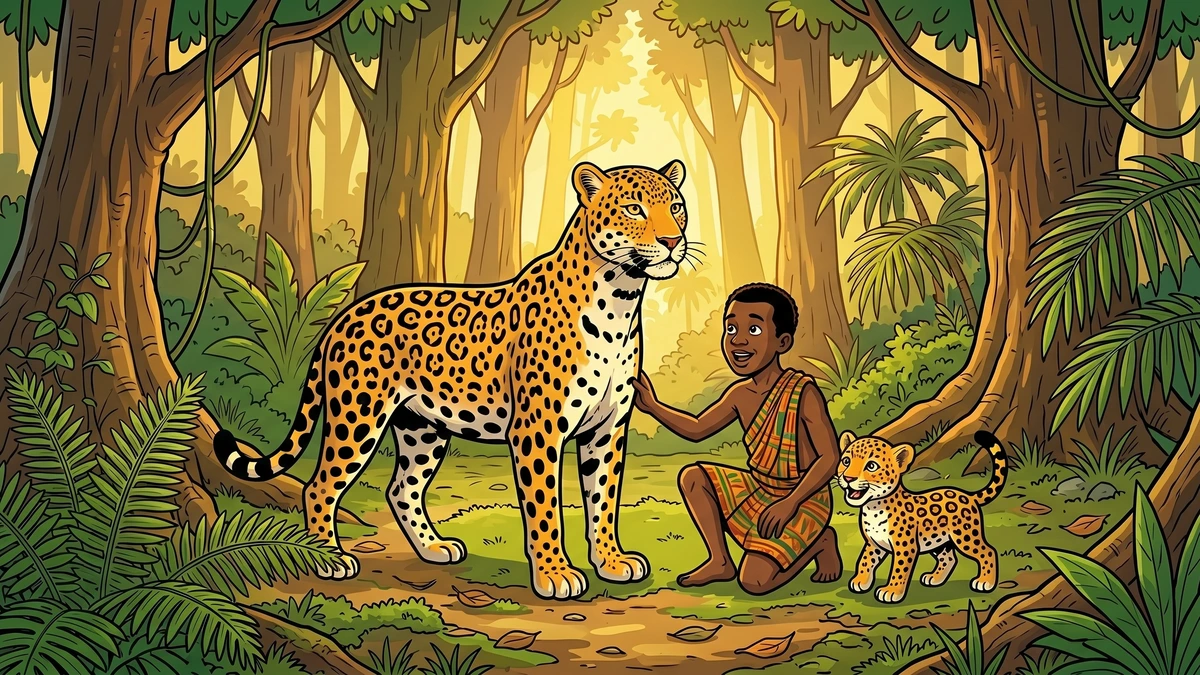
The man’s astonishment must have been complete – his dead friend, standing and whole. The tiger explained the trick gently, and why he had needed it. Then he gave the man a parting promise, and through that promise the story turns at last into the explanation it had always meant to be:
“Go home, and remember me always. In future, for your sake, I will never touch a man unless he first meddles with me.”
And that, the Gold Coast elders tell their children, is why the great cats of the forest leave human beings in peace – and why they answer only those who provoke them first.
The Moral of the Story
The tale teaches a double lesson, one for each kind of creature in it. To the powerful it says: do not strike from suspicion alone; injury is not the same as betrayal, and the strong must be slowest of all to take revenge, because their revenge does the most harm. To everyone it says: the way you behave when you think no one is watching is the truest measure of your friendship – and that measure, once taken, settles old doubts forever.
Underneath both lessons runs a single Akan principle, one so central to the moral imagination of the Gold Coast that it was carved into one of the people’s sacred Adinkra symbols. The symbol is called Bi Nka Bi, and the words mean:
“Bi nka bi.”
“No one should bite another.”— Akan (Twi) maxim and Adinkra symbol of peace, harmony, and the avoidance of provocation and strife
The tiger’s closing promise is Bi Nka Bi spoken in the voice of a leopard. He will not bite unless he is bitten. He will not provoke, and he asks only not to be provoked. The story takes an abstract proverb and gives it fur, breath, and a name, so that a child who hears the tale will carry the principle long after the words of the maxim are forgotten.
Origins and Canonical Attribution
This story is one of the best known of the Gold Coast tales preserved in West African Folk-Tales, collected and arranged by W. H. Barker and Cecilia Sinclair and published in London by George G. Harrap & Company in 1917. In that volume it appears as Tale XXXIII, “Why Tigers Never Attack Men Unless They Are Provoked,” in the second part of the book, the section of “Miscellaneous Tales” that follows the famous cycle of Anansi the Spider stories.
William Henry Barker served as an educator on the Gold Coast – the British colonial territory that is now the Republic of Ghana – and worked with Cecilia Sinclair to gather and arrange tales told among the Akan-speaking peoples. Their collection was prepared for schoolroom use, and its great value is that it set down in print an oral tradition that had until then lived only on the tongues of storytellers. The tales it preserves belong above all to the Akan, the cluster of peoples – Ashanti, Fante, Akuapem and others – whose homeland lies in the forests and coastlands of southern Ghana.
One detail of language deserves a clear explanation, because it puzzles many modern readers. There are no tigers in Africa; the tiger is an Asian animal. In the West African storytelling English of Barker’s day, the word “tiger” was simply the everyday name for the leopard – Panthera pardus – the great spotted cat that truly does prowl the Ghanaian forest. Barker’s own collection makes this plain, noting in a footnote to a neighbouring tale that “tiger” in West African stories means the leopard. So the “tiger” of this story is the leopard the Akan know well, the most powerful predator of their woods, and the etiology the tale offers is a real observation about real animal behaviour: the leopard, for all its strength, is not a habitual man-eater and generally avoids people unless cornered or harmed.
Folkloric Classification
In the language of folklore studies, Why Tigers Never Attack Men Unless They Are Provoked is a pourquoi tale, also called an etiological or “origin” tale – a story whose purpose is to explain how some feature of the natural world came to be. Pourquoi tales form one of the largest families of folk narrative on earth, and they cluster in the Aarne–Thompson–Uther and Thompson motif systems under the great range of animal-characteristic motifs, A2200–A2599, which account for everything from why the tortoise has a shell to why the leopard avoids the hunter.
The story does not correspond to a single discrete ATU tale-type number, which is common and expected for African etiological tales; many were collected and classified after the index’s European core was fixed. It is, however, rich in widely catalogued story motifs. Its central device is the test of friendship (motif H1558) carried out through a feigned, or sham, death (motif K1860, “deception by feigning death”) – the wronged friend pretends to die in order to observe, unseen, how the suspected friend truly behaves. The tale also belongs among the motifs of friendship between man and beast (A2493), and it carries the broad pourquoi frame explaining why a particular animal is, or is not, hostile to human beings.
What makes the construction elegant is that the etiological “answer” and the moral “lesson” are the same sentence. The tiger’s vow – never to strike a man unless meddled with first – simultaneously explains an observable fact of the forest and delivers the ethic the story exists to teach. The story does not bolt a moral onto a nature-fact; it shows the two as one truth seen from two sides.
Cultural Context: Storytelling Among the Akan
To understand this tale fully is to understand the setting in which it was told. Among the Akan, folk stories belong to a living performance tradition often called Anansesem – literally “Spider stories,” named for Anansi (Kwaku Ananse), the trickster spider who is the most celebrated figure of Gold Coast folklore. Although “Why Tigers Never Attack Men” sits in Barker’s “Miscellaneous” section and has no spider in it, it was carried by the same storytelling culture, told on the same evenings, and shaped by the same expectations of an active, responsive audience.
Anansesem were performed after dark, after the day’s work, with the community gathered together. The telling was not a quiet recitation but a shared event: a storyteller would call out and the listeners would answer, songs would be woven into the narrative, and children and elders alike took part. In this tradition a tale was never merely entertainment. It was the chief instrument of moral education, the way a community handed its values from one generation to the next without the need for lectures or written rules.
The leopard occupies a particular place in the Akan imagination. It is a creature of genuine power and danger, an emblem of strength and even of kingship in the symbolic vocabulary of the forest peoples. By choosing this most formidable of animals as the friend who refuses to take revenge on suspicion, the storyteller makes the lesson far stronger than it would be in the mouth of a weak or timid creature. Restraint is impressive in the powerless because they have no choice; in the powerful it is a deliberate virtue. The tale insists that the mightiest forest cat would rather establish the truth than indulge its anger – and that is precisely why the lesson stings and stays.
The principle behind the tale, Bi Nka Bi, was not a casual saying. It belonged to the Adinkra system of visual symbols, the cloth-stamped emblems through which the Akan recorded proverbs, concepts and warnings. That a maxim about not biting one another was given a permanent symbol shows how seriously the culture treated the avoidance of needless provocation. This story is, in effect, the Adinkra symbol unfolded into a narrative a child can live inside.
Why This Story Has Lasted
Folk tales endure when the human situations inside them never go out of date, and the situation at the heart of this one is permanently modern. Every person, sooner or later, is hurt by someone close to them and faces the tiger’s exact dilemma: was this betrayal, or only accident? Did my friend mean it, or did the harm come from somewhere else? The tale’s answer is as useful in an age of messages and misunderstandings as it was in the forests of the old Gold Coast – do not let suspicion alone decide the verdict; find out the truth before you let your heart pass sentence.
It lasts, too, because it understands something subtle about evidence. The tiger learns the truth not by asking the man – an accused friend can always say the right thing – but by watching how the man behaves when he believes himself unobserved. The story quietly teaches a test that holds for a lifetime: character is what a person does when there is no audience and nothing to gain. The man passes that test by weeping through the night for a friend he thinks is past all helping.
And it lasts because of its generosity. The tale could have ended in tragedy – a wounded predator, a ruined friendship, a forest made dangerous forever. Instead it ends with a promise of peace that benefits every man who ever walks beneath those trees. The leopard’s restraint becomes a gift to the whole human race. That is the deepest hope folk tales carry from one generation to the next: that the powerful can choose mercy, that broken trust can be honestly repaired, and that the way we treat one friend can become the peace we leave to everyone who comes after. As long as people make friends, doubt them, and must decide what to do about the doubt, the tiger’s wisdom will be worth retelling.
You May Also Like
 African Folk Tales
Ages 6-8
African Folk Tales
Ages 6-8
The Judgment Of Baboon
A mouse tears the tailor's cloak, and when every creature blames the next, Baboon the judge turns the chain of excuses into a chain of punishment - a Khoikhoi tale from Namaqualand explaining why the cat hunts the mouse and the baboon walks on all fours.
 African Folk Tales
Ages 6-8
African Folk Tales
Ages 6-8
The Girl Who Could Not Be Eaten
The Zulu tale of Untombinde, a king's proud daughter, and the swallowing monster of the haunted pool - who devours a whole nation and cannot keep a single soul down.
 African Folk Tales
Ages 6-8
African Folk Tales
Ages 6-8
Abiyoyo: The Monster and the Boy
Abiyoyo: The Monster and the Boy: In a small South African village nestled at the edge of the high veld, where grasslands stretched endlessly toward a horizon