The World’s Reward
The World's Reward is the Cape South African form of the Bremen Town Musicians: seven cast-off old animals join forces, frighten a band of robbers out of their house, and keep it for themselves.
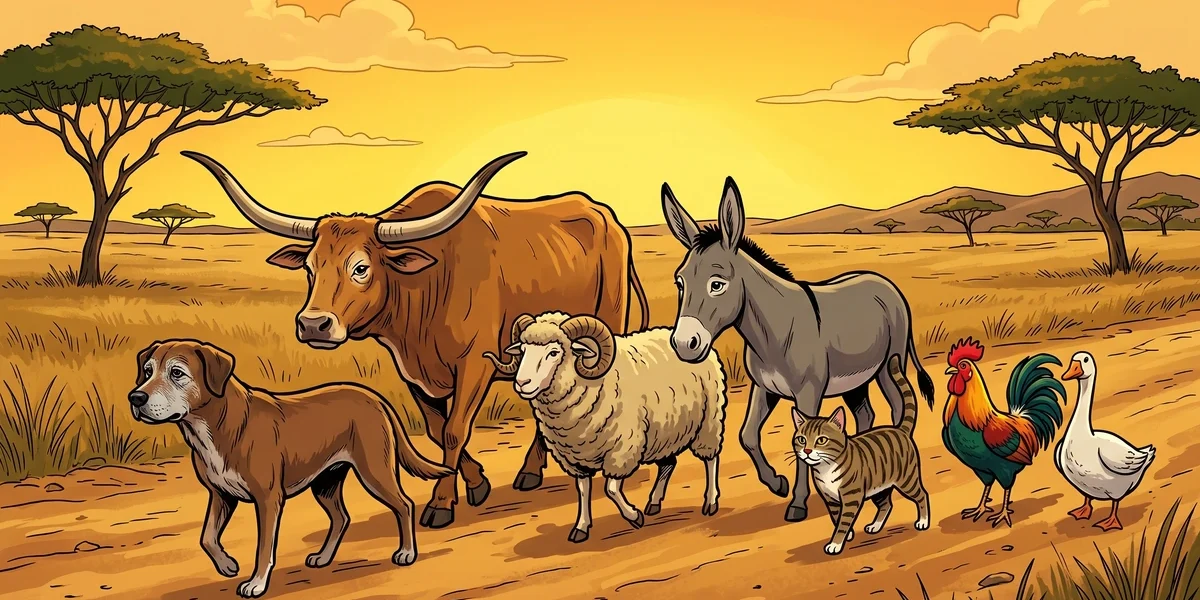
Every great fairy tale seems to belong to one place — and then you discover it belongs to the whole world. The World’s Reward is a small, brisk southern African tale of seven cast-off old animals who frighten a houseful of robbers and keep the house for themselves; and it is, at the same time, the African form of one of the most beloved fables ever told in Europe, the Brothers Grimm’s Bremen Town Musicians. The dog and the donkey of the German story have here become a dog and a bull of the dry South African veld, but the bones of the tale are the same, and so is its warm, defiant heart: that the old and the discarded are not worthless, and that together they can hold their ground against far stronger foes.
The tale opens on a note of quiet injustice and then turns, with great speed, into comedy. A faithful old dog learns that his master means to be rid of him; rather than wait for that blow he walks away of his own accord, and on the road he gathers a company of fellow outcasts — a bull, a ram, a donkey, a cat, a cock, and a goose, seven aged creatures bound for a half-imagined “land of the aged” where loyal service is not repaid with ingratitude. What they find instead is a robbers’ house, a hot supper, and the chance to prove that cleverness and courage have no retirement age. The story’s very title carries its sting: the world’s reward for long faithful service, the dog discovers, is to be thrown away — and the rest of the tale is his cheerful, thumping answer to that bitter fact.
Origins and Canonical Attribution
“The World’s Reward” reaches modern readers through South-African Folk-Tales, the anthology compiled by the American physician James A. Honey and published in New York in 1910. Honey’s slim volume gathered forty-four tales of the Cape — animal fables of the Bushmen (San), the Khoikhoi or “Hottentot” herders, and the Zulu — and drew, as Honey openly acknowledged, on the pioneering nineteenth-century collections that came before him, above all the philologist Wilhelm Heinrich Immanuel Bleek’s Reynard the Fox in South Africa; or, Hottentot Fables and Tales (London, 1864), the first published collection of indigenous southern African oral literature. This particular story, however, shows the other current that runs through Honey’s book: the European tale carried to the Cape by Dutch and German settlers and absorbed, over generations, into the colony’s shared Afrikaans-speaking storytelling. Its very name is a Cape Dutch proverb — Ondank is die wêreld se loon, “ingratitude is the world’s reward” — and the seven animals, all of them domestic livestock and farmyard creatures, mark it at once as a settler-tradition retelling rather than a wild-veld San fable.
Origin & Canonical Attribution
Tradition: Cape southern African oral tale, in the Afrikaans-speaking settler storytelling of the Cape Colony — an African retelling of a European migratory fable.
Primary printed source: James A. Honey, South-African Folk-Tales (New York: Baker & Taylor, 1910), “The World’s Reward,” pp. 29–32.
Antecedent collection: W. H. I. Bleek, Reynard the Fox in South Africa; or, Hottentot Fables and Tales (London: Trübner & Co., 1864), the foundational anthology of Cape oral literature on which Honey drew.
Tale type: ATU 130, “The Animals in Night Quarters” — the international type best known as the Bremen Town Musicians; European cognate, Brothers Grimm, Kinder- und Hausmärchen no. 27, “Die Bremer Stadtmusikanten,” added in the second edition of 1819.
Principal motifs: K335.1.4, loud (animal) noise frightens robbers from a house; K1161, animals hidden in various parts of a house attack the returning robber with their characteristic powers; B296, animals go a-journeying; J2131.5, the numskull’s terrified misreport.
What makes the story so striking is the journey it has made. Folklorists classify it as tale type ATU 130, “The Animals in Night Quarters,” and its most famous form in the world is the Grimms’ Bremen Town Musicians, the German tale of an ass, a hound, a cat, and a cock — four worn-out animals whose owners no longer want them — who set out for the city of Bremen, never reach it, and instead capture a robbers’ house in the forest by piling up and bellowing into the night. The early folklorist Antti Aarne argued that the type was Asian in origin; the French scholar Paul Delarue later distinguished two great branches of it — a Western branch, in which the travelling animals are always domestic creatures, and an Eastern branch, popular from Japan to Indonesia, in which they are humble “inferior” things like an egg, a needle, and a crab. “The World’s Reward” belongs squarely to the Western, domestic-animal branch; it is that branch transplanted to the Cape, where the German ass becomes an African bull and donkey, the forest becomes the open veld, and the company swells from four animals to a full seven.
The Old Dog and the Land of the Aged
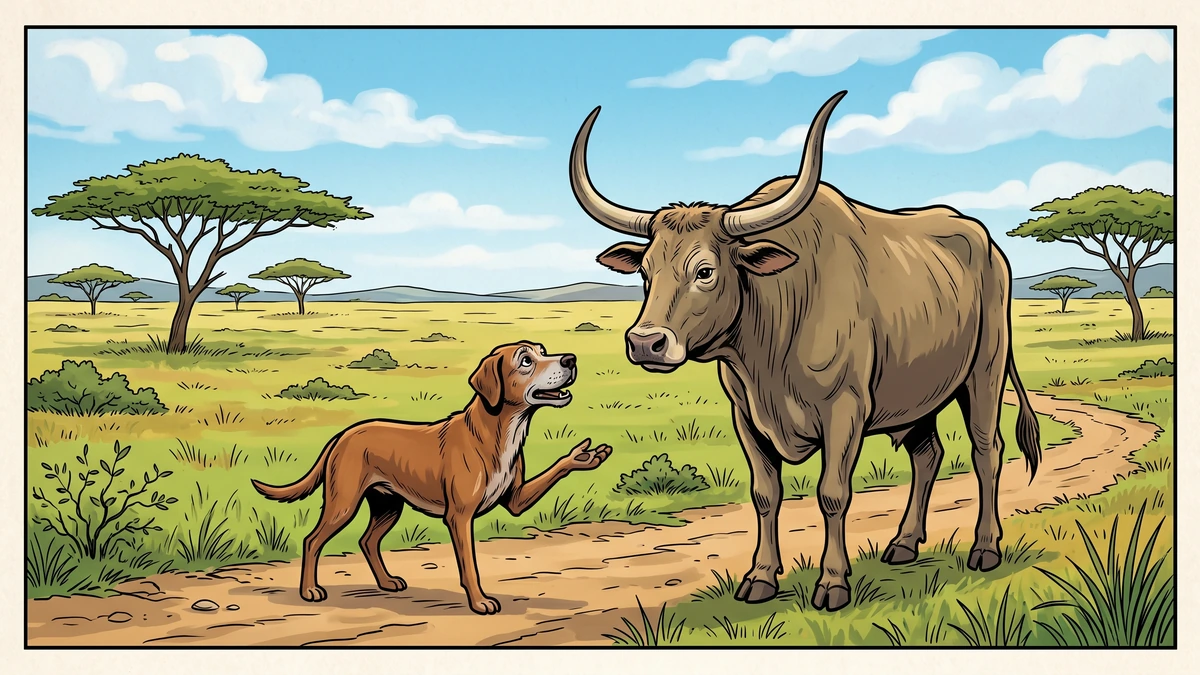
The story begins with a small domestic cruelty, told without any softening. A man owns a dog — once young, strong, and tirelessly faithful in his master’s service — who has now simply grown old. And because he is old, the man wishes to “put him aside,” to dispose of him. The storyteller pauses here to name the bitter principle behind the moment in a single phrase: ingratitude is the world’s reward. The dog has given his whole working life to this household, and his recompense, now that the work is done, is to be discarded. It is the oldest grievance a faithful servant can have, and the fable lets it stand plainly, without sentiment, as the wound from which everything else in the tale will grow.
But the dog is not a passive victim. The “old dumb creature,” the tale says, ferreted out his master’s plan — and, having understood it, resolved at once to go away of his own accord. This is the first of the story’s small acts of dignity: the dog will not wait to be thrown out; he will leave on his own terms, on his own four feet, while the choice is still his to make. He sets off into the veld, and there he meets an old bull, and asks him a question that turns the whole tale from a sad one into a hopeful one: “Don’t you want to go with me?”
Where, the bull asks. To the land of the aged, the dog answers — a place “where troubles don’t disturb you and thanklessness does not deface the deeds of man.” It is a beautiful, wistful invention, this imagined country: a homeland for the worn-out and the unwanted, where long service is finally honoured rather than forgotten. The bull agrees instantly — “Good, I am your companion” — and so, one after another, do a ram, a donkey, a cat, a cock, and a goose. Each is, by implication, another creature past its prime, another household’s discarded servant. Seven aged animals now travel the road together. None of them will ever actually reach the land of the aged; but in finding one another they have already found the thing that imagined country promised — company, common cause, and a reason to keep walking.
The Tower of Animals at the Robbers’ House
Late one night the seven travellers came upon a house. Through its open door they could see a table spread with every kind of good food — and around that table sat a band of robbers, eating their fill. The animals were hungry, and the sight of the feast was a torment. To knock and ask for a share would plainly be useless; robbers do not share. So, the storyteller says, the seven “must think of something else” — and the something else they devise is the famous, gloriously absurd image at the centre of every version of this tale.
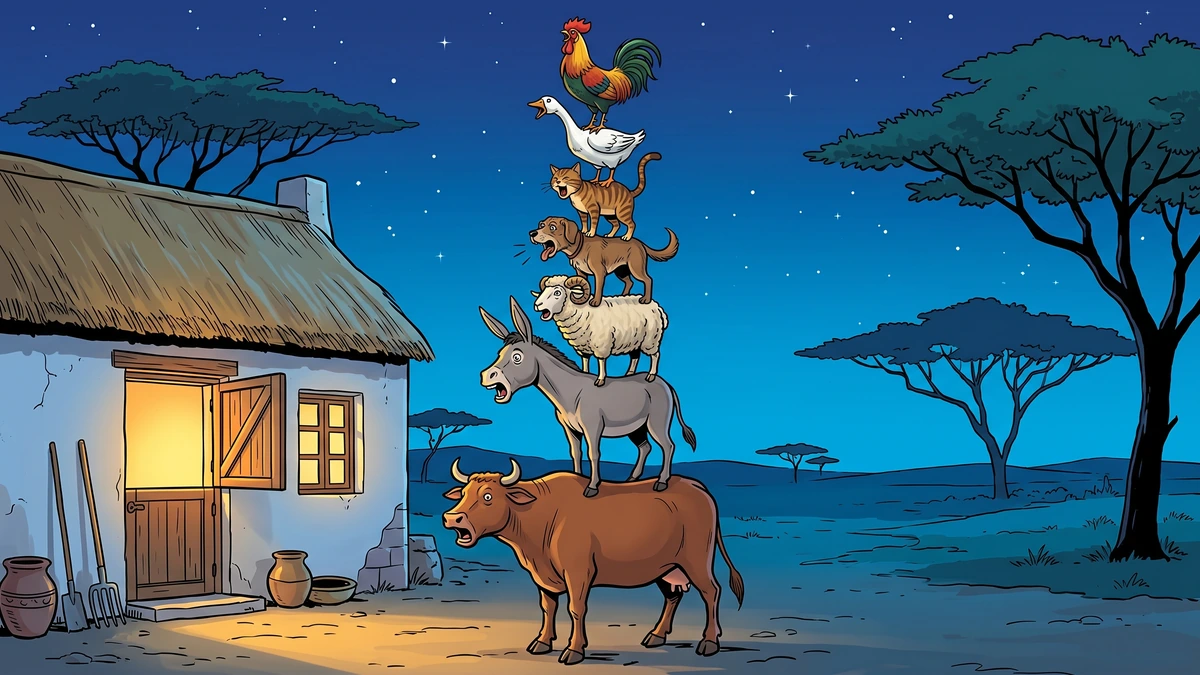
They build themselves into a tower. The donkey climbs upon the bull; the ram upon the donkey; the dog upon the ram; the cat upon the dog; the goose upon the cat; and, at the very summit, the cock. Seven aged animals balanced one atop another into a single swaying, top-heavy creature — and then, with one accord, they let loose every voice they own. The bull bellows, the donkey brays, the dog barks, the ram bleats, the cat mews, the goose cries its giggling gabble, and the cock crows, all of it at once and none of it stopping. To the robbers inside, snug over their stolen supper, this monstrous braying chord erupting out of the dark is simply terror itself. They do not investigate; they do not count their numbers or reach for weapons. They glance out, see the strange tottering shape against the night, and bolt — some over the back half-door, some through the windows — and in a few heartbeats the house stands empty.
It is worth noticing how the fable arranges its justice here. The animals do not fight the robbers, and they could not win such a fight if they tried; they are old, and the robbers are armed and many. What defeats the robbers is not strength but combination — the pooling of seven small, separately unremarkable abilities into one overwhelming effect. Alone, an old dog’s bark or an old cock’s crow is nothing to fear. Stacked together and sounded at once, they become a horror no robber will stay to face. The cast-off creatures win the house with the very voices their owners had stopped valuing.
Seven Old Watchmen Hold the House
The seven climbed down from one another, walked into the abandoned house, and ate the robbers’ supper to their hearts’ content. And here the fable does something quietly shrewd: there is still a great deal of food left over — far too much to carry away on the road — and so the animals decide not to wander on at all, but to hold the house at least until the next day’s breakfast is eaten. The land of the aged was always a place that existed only in the telling; this warm, well-stocked house, won by their own wit, is the real thing, and they are wise enough to keep it.
To hold it, each animal takes the post that suits its nature, and the listing of those posts is one of the small delights of the tale. The dog, who says, “I am accustomed to watch at the front door of my master’s house,” lies down to sleep across the front doorway. The bull takes his stand behind the door. The ram climbs to the loft; the donkey settles at the middle door; the cat curls into the fireplace among the warm ashes; the goose tucks itself by the back door; and the cock flies up to sleep on the bed. Without quite intending it, the seven have arranged themselves into a perfect, accidental fortress — a defender at every threshold, every level, every weak point of the house, each one simply doing the comfortable, habitual thing an animal of its kind would do. They are not soldiers laying an ambush. They are old creatures going to sleep in the places that feel natural to them. That those places happen to cover every approach is the fable’s sly joke, and the trap is set without a single one of them knowing they have set it.
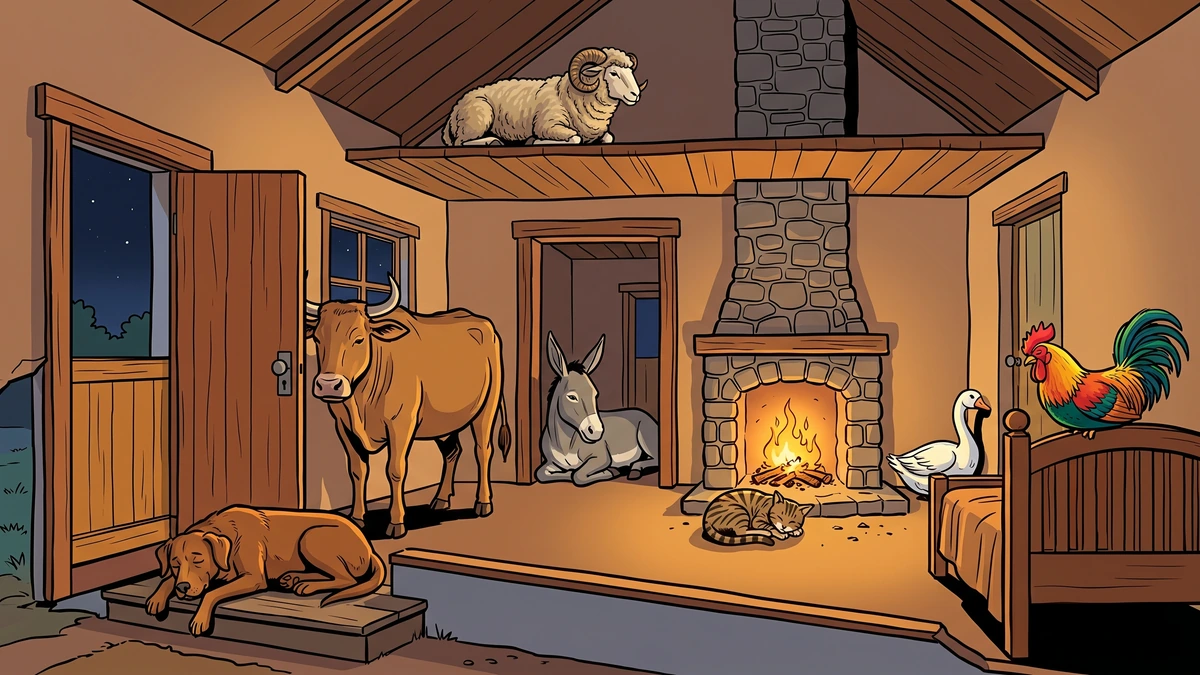
Out in the dark, meanwhile, the robber captain has been thinking. He cannot quite believe his house is lost, and so he sends one of his men creeping back to find out whether the strange creatures have gone. That scout’s journey into the silent, firelit house is the comic engine of the tale’s final movement — and everything the seven sleepers have casually arranged is about to be sprung on him, post by post, in the dark.
The Scout’s Terrible Return
The robber crept up to his own house very cautiously. He listened and listened, and heard nothing — the animals were asleep. He peeped through the window and saw, in the grate, only two coals still faintly glimmering, like two small dim eyes. Reassured, he stepped through the front door — and the fortress woke.
What follows is a single, breathless circuit of the house, the scout flung from one defender to the next with no chance to recover between them. At the front door the old dog seizes him by the leg. He leaps inside — straight into the bull, who is ready behind the door and sweeps him up on his horns and tosses him to the loft. There the ram receives him and butts him off the loft again. He hits the ground, scrambles for the middle door — and the donkey lets fly a terrible braying kick that lands him in the fireplace, where the cat in the ashes flies at his face and scratches him nearly to pieces. He bursts out the back door, and the goose catches him by the trousers. And as he finally pelts away into the night, the cock on the bed crows triumphantly after him. He runs, the tale says, so hard that you could hear the stones rattle in the dark.
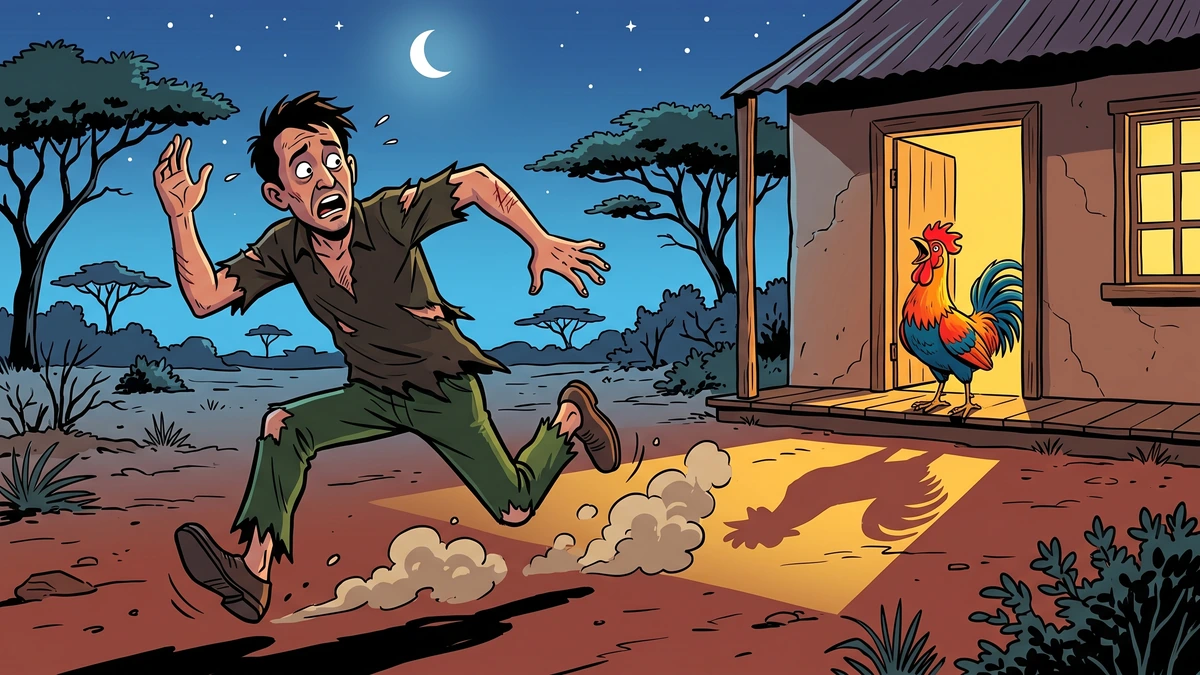
He arrives back among his companions purple and crimson and utterly out of breath, able at first to say only “Frightful, frightful!” And then comes the part that has made audiences laugh for centuries: his report. The scout has been routed by seven sleepy farm animals, but he has no idea that animals had anything to do with it — and so his terrified mind translates every creature into a human enemy armed with a weapon. The dog’s teeth on his leg become an iron trap he stepped into at the door. The bull’s horns become a man who seized him with a fork and pitched him onto the loft. The ram becomes someone waiting in the loft to throw him down. The donkey’s bray and kick become a trumpet blown in his face and a sledge-hammer blow. The cat’s claws become yet another attacker who flew at him and scratched the eyes almost out of his head. The goose at his trousers becomes a sixth enemy gripping him with fire-tongs. And the cock’s crow becomes a voice shouting after him out of the house, “Stop him — stop h—i—m!”
The comedy is exact and merciless. The robber’s report is, point for point, a complete inventory of the seven animals and their posts — and it is also completely wrong, a house of farm creatures rebuilt by panic into an arsenal of traps, forks, trumpets, hammers, and tongs manned by a gang of invisible giants. The fable lets the listener hold both pictures at once: the cosy true scene of old animals dozing at their stations, and the monstrous false scene inside the robber’s head. And because the robber believes his own terror utterly, the band will never come back. Seven discarded creatures have won themselves a home for good — not by being strong, but by being, between them, far more frightening than they could ever know.
The Meaning of the Tale
“The World’s Reward” teaches on two levels at once, and the Cape storytellers meant both to be felt. The first is the lesson folded into the title and into the dog’s opening grievance: that faithful service is too often repaid with ingratitude, and that the world’s reward for long loyalty can be a cold dismissal once the strength is spent. The fable does not pretend otherwise. It opens with that injustice frankly stated, and the Cape herders had a blunt proverb — the very phrase that gives the story its name — for the hard truth of it:
“Ondank is die wêreld se loon.”
— Afrikaans proverb: “Ingratitude is the world’s reward.”
But the fable refuses to end where the proverb ends. That is its second and deeper lesson. The dog, told in effect that he is worthless, does not accept the verdict; he walks out into the world and proves it false — not alone, but by finding six others in the same plight and joining his fortunes to theirs. The old animals are dismissed as useless one by one; together they outwit an armed gang and win a house. Age has not taken their abilities, only scattered their value; what the story celebrates is the moment those scattered abilities are pooled. The bark, the bellow, the bray, the crow — each negligible alone — combine into something no robber will face. The tale’s answer to ingratitude, then, is neither bitterness nor revenge but solidarity and ingenuity: the discarded, standing together and using their wits, can build a better place than the one that cast them out. The land of the aged was a dream; the captured house is what dreaming, walking, and acting together actually produced.
Why This Story Has Endured
Few tales have travelled as far as this one. The story of the cast-off animals who join forces and capture a robbers’ house is told across Europe, through Scandinavia and the Slavic lands, around the Mediterranean, and — as “The World’s Reward” proves — deep into Africa, wherever Dutch and German settlers carried it and local tellers made it their own. It endures because it joins two things every listener wants: a sharp little protest against a real injustice, and a wholly satisfying, comic triumph over it.
For children, the appeal is immediate and physical. The tower of animals is a picture that delights at once; the rout of the robber scout — flung from dog to bull to ram to donkey to cat to goose in one helpless circuit of the house — has the rhythm of the best slapstick; and the garbled report at the end, in which a cat becomes a clawed monster and a cock becomes a shouting man, lets a child feel clever, because the child can see exactly what the frightened robber cannot. The story rewards a young listener with the warm certainty that the gentle, the old, and the small can win.
For older listeners, the same tale carries weight. It is, quietly, a story about what a society does with its elders — about the dog whose lifetime of service earns him only the threat of disposal, and about the dignity of his decision to leave on his own terms rather than be thrown away. And it is a story about the power of the overlooked when they combine: seven creatures, each individually written off, who together accomplish what none could alone. That is a lesson that does not age. “The World’s Reward” sends every listener away laughing — but it leaves behind, under the laughter, a steady and serious conviction: that worth is not lost when others stop seeing it, and that the cast-off, walking together, can still take the world’s best house and keep it.
Frequently Asked Questions
What is the origin of “The World’s Reward”?
It is a Cape southern African folk tale, best known from South-African Folk-Tales, the anthology compiled by the American physician James A. Honey and published in New York in 1910. Honey’s book gathered Cape animal fables of the San, Khoikhoi, and Zulu, drawing on earlier collections such as W. H. I. Bleek’s Reynard the Fox in South Africa; or, Hottentot Fables and Tales (London, 1864). “The World’s Reward” itself, however, is a settler-tradition tale: its company is made up entirely of domestic animals, and its title is the Cape Dutch proverb Ondank is die wêreld se loon — “ingratitude is the world’s reward” — marking it as a European fable absorbed into the Afrikaans-speaking storytelling of the Cape.
How is this tale related to the Bremen Town Musicians?
“The World’s Reward” is the African form of the same international tale type as the Brothers Grimm’s Bremen Town Musicians (Grimm’s Kinder- und Hausmärchen no. 27, added in 1819). Folklorists classify both as tale type ATU 130, “The Animals in Night Quarters”: cast-off old animals set out together, never reach their intended destination, and instead frighten robbers out of a house and take it for themselves. The Grimm version has four animals — ass, hound, cat, cock — bound for the city of Bremen; the Cape version has seven, bound for an imagined “land of the aged.” The plot, the stacked-animal trick, and the routed robber are the same in both.
Why does the old dog leave his master?
The dog has served his master faithfully his whole working life, but now that he has grown old the man wishes to “put him aside” and be rid of him. The dog discovers this plan — the tale says he “ferreted it out” — and decides not to wait to be discarded. He chooses instead to leave of his own accord, on his own terms. That decision is the first of the story’s small acts of dignity, and his search for a “land of the aged” where loyal service is honoured rather than forgotten is what leads him to gather the other cast-off animals.
How do the seven animals frighten the robbers out of the house?
Seeing robbers feasting inside, the seven animals climb upon one another into a tall, swaying tower — the bull at the bottom, then the donkey, ram, dog, cat, and goose, with the cock at the top — and all together let out every sound they own at once: bellow, bray, bark, bleat, mew, cackle, and crow. To the robbers, this monstrous combined cry erupting out of the dark is pure terror, and they flee through the doors and windows without stopping to look. The fable’s point is that the animals win not by strength but by combination: seven small, separately harmless voices become, pooled together, something no robber will face.
Why is the robber scout’s report so funny?
When the robber captain sends a scout back, the seven animals — asleep at the front door, behind the door, in the loft, at the middle door, in the fireplace, by the back door, and on the bed — attack him in turn as he passes each post. But the scout never realises they are animals. His panicked mind rebuilds each creature as a human enemy with a weapon: the dog’s bite becomes an iron trap, the bull’s horns a man with a fork, the donkey’s kick a sledge-hammer, the cat’s claws an attacker who nearly scratched out his eyes, the goose’s grip a pair of fire-tongs, and the cock’s crow a voice shouting “Stop him!” The comedy lies in the gap between the cosy true scene and the monstrous false one in the robber’s head — a gap the listener can see and the robber never will.
You May Also Like
 African Folk Tales
Ages 6-8
African Folk Tales
Ages 6-8
The Hare and the Hyena
An East African Swahili trickster tale: during a famine the clever hare Sungura outwits the greedy hyena Fisi, eating their shared honey-store under cover of invented naming-feasts. Tale type ATU 15.
 African Folk Tales
Ages 9-12
African Folk Tales
Ages 9-12
Why We See Ants Carrying Bundles As Big As Themselves
An Akan pourquoi tale from West African Folk-Tales (Barker & Sinclair, 1917): the trickster Anansi, condemned to carry an enchanted box for ever, deceives the honest Ant into bearing his punishment - which is why we see ants carrying bundles as big as themselves.
 African Folk Tales
All Ages
African Folk Tales
All Ages
Ohia And The Thieving Deer
Ohia And The Thieving Deer: There once lived upon the earth a poor man called Ohia, whose wife was named Awirehu. This unfortunate couple had suffered one