The Story Of A Dam
The Story of a Dam is a Khoikhoi folk tale of southern Africa in which veld animals dig a dam against drought, the idle Jackal fouls it and dupes its guard, is caught by a tar-coated Tortoise, and then escapes his sentence by abandoning Lion under a rock. It is the southern African form of the famous tar-baby tale.
On the dry plains of southern Africa, where a failed rain can empty a whole countryside and the difference between a wet hollow and a cracked one is the difference between life and death, the storytellers kept a long, four-cornered fable about water, work and a creature who would not lift a paw. It opens with a drought and a shared labour, and it ends with a king abandoned under a rock; and between those two points it passes through every kind of cunning the veld knows — the flatterer’s honeyed bargain, the sticky trap that turns a thief’s own struggling against him, and the last desperate trick of a condemned animal who talks his way off the executioner’s ground. The Story of a Dam is, in one breath, a parable of cooperation and a showcase of the southern African trickster at the very height of his mischief.
The tale is unusual among Cape animal stories for its sheer length and its episode-by-episode build. Most veld fables turn on a single trick; this one strings four together, each sharper than the last, and lets a single character — Jackal, the lean, clever, untrustworthy trickster of the Khoikhoi cycle — run the whole gauntlet of folk cunning from beginning to end. He refuses the common work, fouls the common water, dupes the guard set to catch him, is himself caught by the one creature nobody feared, is sentenced to die, and then slips the noose by a trick so cool it leaves the king of beasts starving in his place. It is a story that admires cleverness and distrusts it in the same breath.
Origins and Canonical Attribution
“The Story of a Dam” belongs to the great body of southern African animal tales gathered and printed in the nineteenth and early twentieth centuries. Its best-known English form appears in South-African Folk-Tales, the anthology compiled by the American physician James A. Honey and published in New York in 1910. Honey was a collector-editor rather than a field researcher; his book openly retells and arranges material drawn from earlier and more scholarly hands — above all the work of Wilhelm Heinrich Immanuel Bleek, the German-born philologist whose Reynard the Fox in South Africa; or, Hottentot Fables and Tales (London, 1864) was the first published collection of indigenous southern African literature. The cast of this tale — Lion as king, Jackal as trickster, Baboon and Hyena and the slow Mountain Tortoise — is the unmistakable furniture of that Cape Khoikhoi cycle.
Origin & Canonical Attribution
Tradition: Khoikhoi (Khoekhoe) oral narrative of the Cape region, southern Africa — a long composite fable of the “Lion, Jackal and Tortoise” trickster cycle.
Primary printed source: James A. Honey, South-African Folk-Tales (New York: Baker & Taylor, 1910), “The Story of a Dam,” pp. 73–78.
Antecedent collection: W. H. I. Bleek, Reynard the Fox in South Africa; or, Hottentot Fables and Tales (London: Trübner & Co., 1864), the foundational anthology of Cape oral literature on which later compilers drew.
Tale type: Its central episode is the southern African form of ATU 175, “The Tarbaby and the Rabbit” — the sticky trap that captures a trickster — with Tortoise in the snaring role and Jackal in the captive’s. The tale is a composite, joining that climax to a drought-and-dam frame and a closing “holding up the rock” deception.
Principal motifs: K741, capture by tar-baby; K1251, holding up the rock; K551, respite from death granted for a last request; W111, laziness; the unjust partner who shares the reward but not the work.
The composite shape of the story is worth pausing on, because it is the key to how it works. “The Story of a Dam” is really four fables welded into one chain, and the weld is the figure of Jackal. The drought frame and the dam are local: the same hard southern African landscape that drives dozens of Bleek’s Khoikhoi tales, where animals hold councils and dig for water exactly as the herding peoples of the Cape did. The honey-bargain and the greased-tail escape are pure trickster business, the stock-in-trade of the Cape Jackal. But the centrepiece — the creature smeared with a sticky black substance who traps an attacker fast by his own blows — is one of the most widely travelled motifs on earth. Folklorists know it as the “tar-baby,” tale type ATU 175; it is told from West Africa to the Caribbean to the American South, where it became famous as the Br’er Rabbit story. In “The Story of a Dam” the roles are simply re-cast for the veld: the sticky figure is the patient Mountain Tortoise, and the victim glued fast by his own violence is the cunning Jackal himself.
The Drought and the Idle Jackal
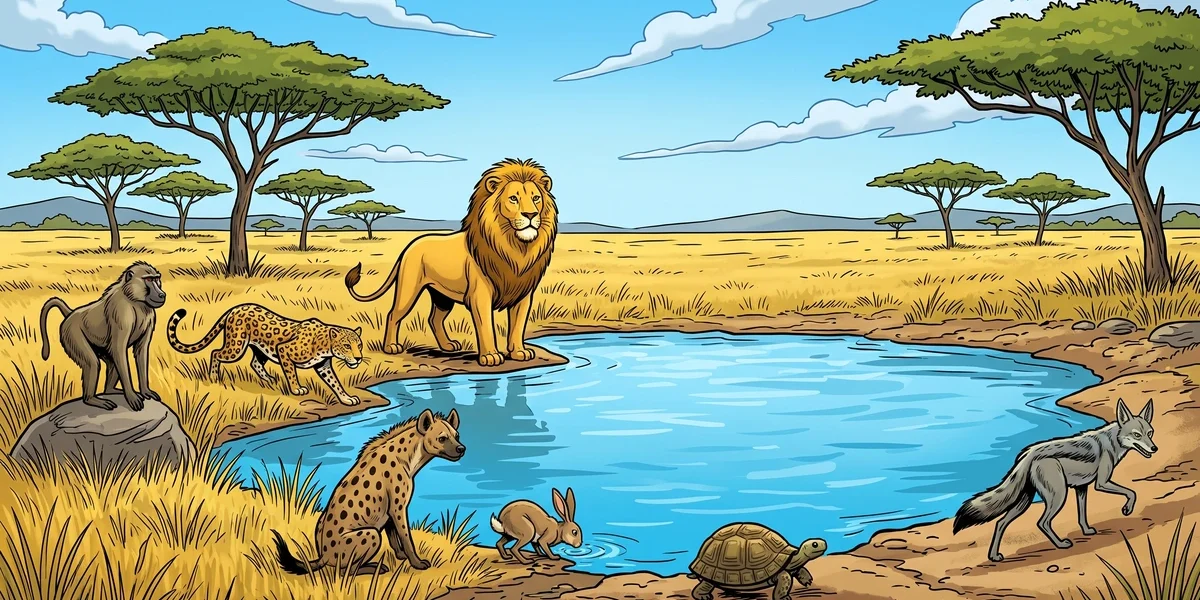
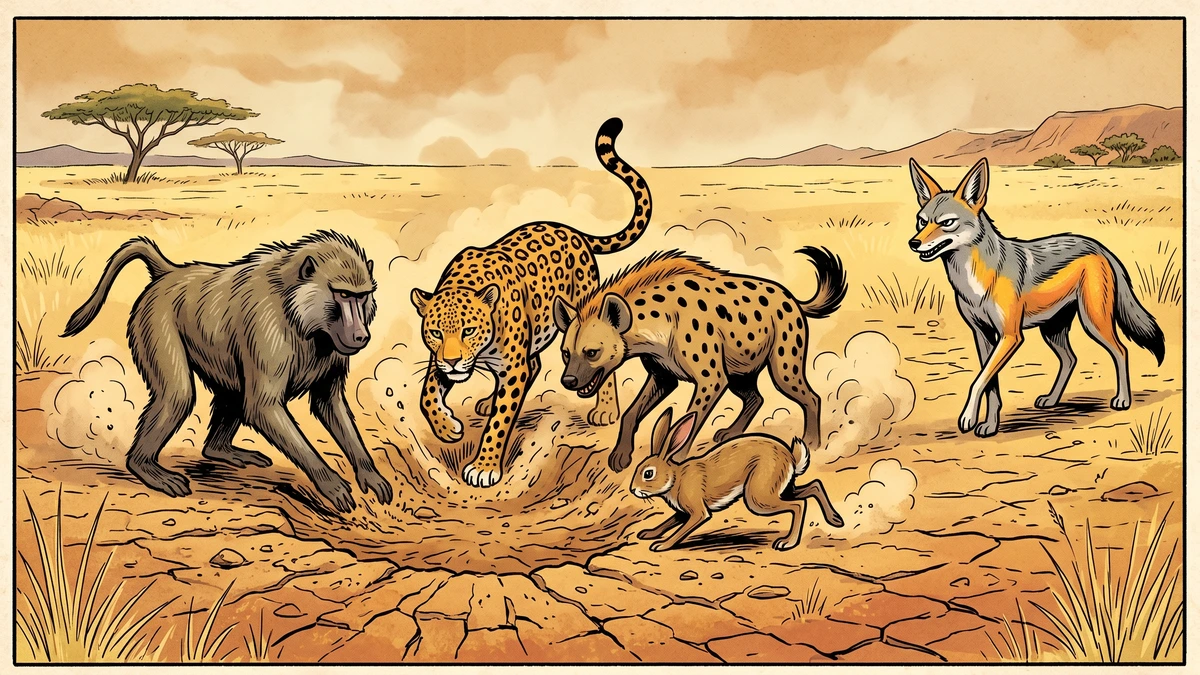
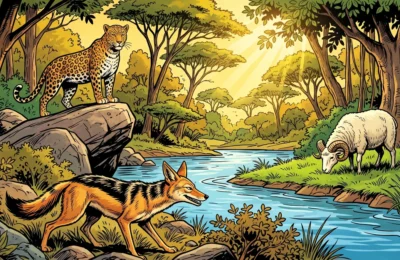
The story opens in want. There was a great drought in the land, the storyteller says, and Lion called together a number of animals so that they might devise a plan for retaining water when the rains at last fell. The council that answered his summons was a broad one — Baboon, Leopard, Hyena, Jackal, Hare and the Mountain Tortoise — and it reached a sensible, practical decision. They would scratch a large hole in a suitable place, a dam to hold the rain when it came; and the next day every one of them set to the digging. Every one, that is, but Jackal.
Jackal did not refuse openly. He simply hovered about the place where the others laboured, doing nothing, and was overheard muttering that he was not going to scratch his nails off in the making of water holes. It is a small, sharp piece of characterisation. Jackal is not stupid and he is not weak; he is something the veld finds harder to forgive — he is a creature who wants the benefit of the common effort and intends to contribute nothing to the cost of it. The dam was finished without him. The rains fell, the great hole filled with clean water, and the animals who had worked so hard looked on their dam with delight.
And the very first creature to come and drink there was Jackal. He did not merely drink. He filled his clay pot with water for later, and then — out of nothing but mischief — he climbed in and swam, churning and muddying the whole dam until the labour of the working animals was fouled as thoroughly as he could foul it. This is the act that sets the entire plot in motion, and it is worth marking what kind of act it is. Jackal gains nothing by ruining the water; he has already taken what he wanted. He spoils it simply because it was made by others, and the spoiling tells the listener exactly what manner of creature the tale has loosed among the animals.
The Honey-Trick on the Guard
When the fouling of the dam was brought to Lion, the king was angry, and he answered it with the obvious remedy: a guard. He ordered Baboon to watch the water the next day, armed with a huge knobkirrie — the heavy knob-headed fighting club of southern Africa — and Baboon hid himself in a bush close to the dam. But Jackal soon sensed that he was there and guessed why, and against a guard he set a trick perfectly fitted to the guard’s own weakness. Knowing how baboons love honey, Jackal began to march to and fro within Baboon’s sight, dipping his fingers again and again into his clay pot, licking them with enormous relish, and saying, just loud enough to be heard, that he wanted none of their dirty water when he had a whole pot of delicious honey.
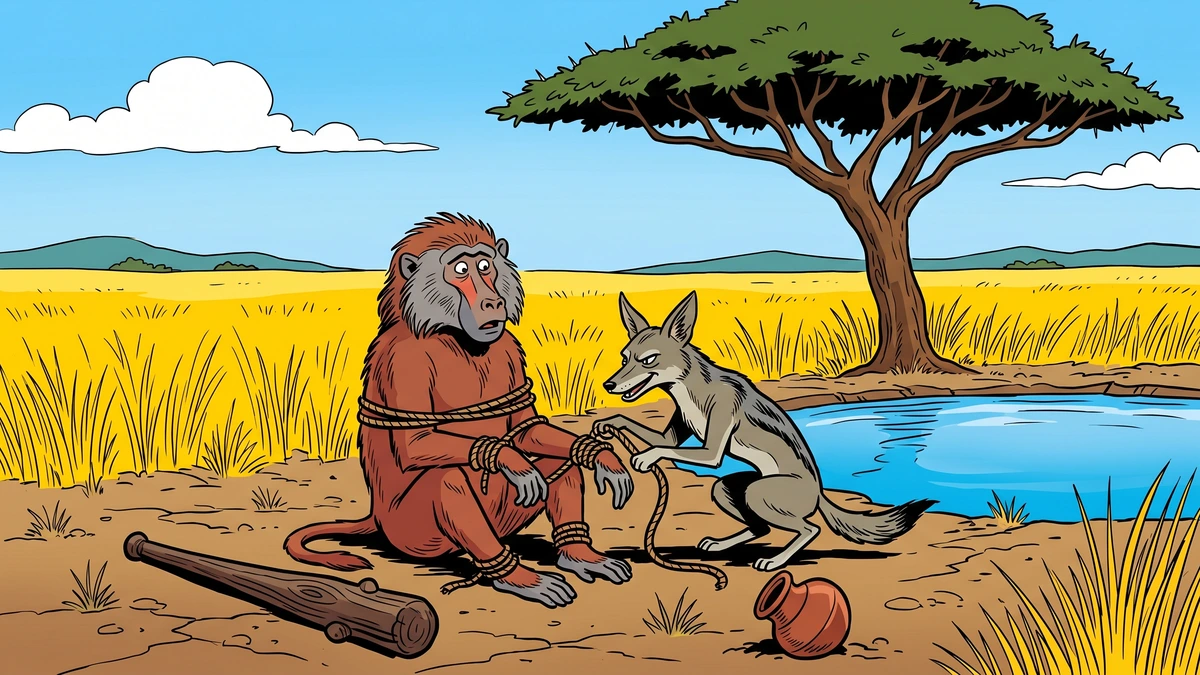
It was more than poor hungry Baboon could bear. His mouth watering, he began to beg for a taste, pleading that he had watched for hours and was weary and famished. Jackal, after pointedly ignoring him, at last looked round and said in a patronising way that he pitied so unfortunate a creature — and would give him honey on conditions. Baboon must give up his knobkirrie, and must let himself be bound by Jackal. Foolishly, the guard agreed; and he was soon tied so fast that he could not move hand or foot. Then Jackal drank, and filled his pot, and swam in plain sight of his helpless prisoner, mocking him for being so easily duped, and adding that he had no honey at all to give — nothing but the odd blow on the head with Baboon’s own club. When the animals found Baboon in that sorry state, Lion was so exasperated that the guard was severely punished and denounced as a fool. The tale is quietly merciless here: it does not let Baboon’s hunger excuse him. He surrendered his weapon and his freedom for the promise of a treat, and the story counts that surrender, not Jackal’s cunning, as the thing most worth condemning.
The Tortoise and the Sticking-Place
Then the Mountain Tortoise stepped forward and offered to catch Jackal himself. At first the animals thought he must be joking — the slowest creature on the veld, proposing to take the fastest and slyest — but when he explained his plan they found it so sound that they accepted it. He asked only that a thick coating of bijenwerk, the sticky black substance found on the combs of wild bees, be spread all over his shell and body. Then he would go and stand at the very entrance of the dam, down on the water level, where Jackal must step on him to reach the water — and stick fast. It was done; the Tortoise was smeared and posted; and the trap was set.
The next day Jackal came warily, found no guard, and grew bold. He noticed, at the water’s edge, what he took for a large black stepping-stone, and remarked aloud how kind the animals had been to place it there for him. He trod upon it — and stuck. The supposed stone put out a head and began to move, and Jackal saw he had been tricked. His hind feet were still free, so he threatened to smash the Tortoise with them; the Tortoise answered only, “Do as you like.” Jackal kicked and jumped, and found his hind feet now glued fast as well. He threatened to eat the Tortoise alive with his teeth; again the calm reply came, “Do as you like.” In a frenzy Jackal bit down hard — and stuck fast by the mouth, so that now head and four feet were all held. Quietly, even proudly, the Tortoise marched up the bank with the great trickster fixed helpless on his back, to be displayed to the astonished animals as they came down to drink.

This is the heart of the tale, and the reason it travels under the name of the tar-baby. The trap is built out of the victim’s own nature. The Tortoise does not fight Jackal; he does not need to. He simply stays still, repeats four cold words, and lets Jackal’s violence do the binding. Every threat Jackal carries out — every kick, every jump, every furious bite — only glues another part of him to the snare. It is a profound little image, and folk audiences across three continents have recognised it: that rage and force, loosed against a thing that simply will not be provoked, become a cage the angry creature builds around himself. The fastest animal of the veld has been undone by the slowest, and undone chiefly by his own temper.
The Greased Tail and the Falling Rock
Jackal was now brought before Lion and condemned to death, and Hyena was named to carry out the sentence. Jackal pleaded for mercy, and finding pleading useless, made instead a single last request to Lion — always, he said flatteringly, so fair and just in his dealings. He asked only not to suffer a lingering death: let his tail be shaved and rubbed with a little fat, he said, and let Hyena then swing him round twice by it and dash his brains out on a stone. Lion thought the request fair enough, and ordered it carried out in his own presence. But the moment Jackal’s greased tail was in Hyena’s grip, and before Hyena had even lifted him clear of the ground, the cunning creature slipped clean out of that oiled hold and was away, running for his life with the whole council baying behind him.
Lion led the chase, and ran the trickster down at last to an overhanging precipice. There Jackal stopped, reared on his hind legs with his shoulders jammed against the rock, and cried out to Lion to help him — the cliff was falling, he shouted, and would crush them both. Lion set his own great shoulders to the stone and strained with all his strength to hold it up. After a while Jackal proposed, very reasonably, that he should creep out and fetch a stout pole to prop the rock, so that Lion too could escape. He crept out. He did not come back. He left the king of beasts pinned against an overhang that had never been falling at all, to starve and die there alone.

It is a startling place to end a children’s tale, and the storytellers meant it to startle. The two closing tricks are a matched pair. In the first, Jackal turns the courtesy of the court — the granting of a last request — into the very instrument of his escape: the mercy is the loophole. In the second, he turns Lion’s strength and Lion’s decency against their owner, persuading the king that his power is needed to hold up a danger that exists only in Jackal’s words. The trickster who would not dig the dam, who fouled the water and duped the guard, ends the story not punished but triumphant, and the most powerful animal of all ends it doomed by his own willingness to help. The tale refuses the tidy justice a listener expects, and that refusal is the point.
The Meaning of the Tale
“The Story of a Dam” carries two moral currents, and it does not pretend they run the same way. The first belongs to the dam itself. The opening of the tale is a clear, almost civic lesson in cooperation: faced with drought, the animals pool their labour, and the dam they scratch out together holds water that no single creature could have stored. The working animals are right, and their dam is real and good. The story honours that. But it also knows — and this is the second current — that a common good, once made, is fragile, and that it takes only one creature who will share the benefit while shirking the cost to foul the whole of it. Jackal never lifts a paw, and Jackal nearly ruins everything; the tale’s sympathy is plainly with the diggers and plainly against the swimmer in the mud.
Yet the ending withholds the punishment the listener wants, and that, too, is deliberate. “The Story of a Dam” is not finally a tale in which the wrongdoer is caught and made to pay. He is caught, splendidly, by the Tortoise — and then he wriggles free and wins. The story is honest, in the cool way of old folk tales, about a hard fact of the world: that cleverness without conscience is genuinely dangerous, that it can defeat strength and patience and even the law, and that it is not always brought to book. The Cape farmers and herders who traded these animal stories had a blunt proverb for the shape of it, and it stands as the truest moral the tale will allow:
“Wie ’n kuil vir ’n ander grawe, val self daarin.”
— Afrikaans proverb: “He who digs a pit for another will fall into it himself.”
The proverb fits the tale with a double edge. Jackal will not dig the dam — will not scratch his nails, as he says — and the refusal to dig is the very root of his disgrace; and the trap that finally holds him fast is itself a kind of pit dug for a digger of pits. That he then escapes does not cancel the lesson; it complicates it. The story leaves its young listeners with a clear preference — be a digger of the common dam, not a fouler of it — and leaves its older listeners with a colder, more useful knowledge: that the world contains creatures like Jackal, that their cunning is real, and that the wise animal is the one who, like the Tortoise, neither trusts them nor loses his temper with them, but quietly sets a patient trap and lets their own nature do the rest.
Why This Story Has Endured
“The Story of a Dam” has lasted because it gives a listener four stories for the price of one, and every one of them lands. For a child it is a fast, vivid, slightly wicked adventure: the muddied dam, the honey-pot, the black stepping-stone that turns out to be alive, the greased tail slipping through Hyena’s claws, the great Lion left holding up a rock that was never going to fall. Each episode is a complete small drama with its own trick and its own surprise, and the chain of them carries a young listener helplessly along. The image of Jackal glued fast by his own four feet and his own biting mouth is the kind of picture a child keeps for a lifetime.
For an older listener the same tale opens into something graver and more interesting. Its central episode ties this Cape fable to one of the most widely travelled motifs in all of human storytelling — the tar-baby, ATU 175, told in West Africa and the Caribbean and the American South — so that to know “The Story of a Dam” is to hold one end of a thread that runs across oceans and centuries. And its refusal of a neat ending is itself a kind of maturity. Many folk tales comfort; this one informs. It tells the truth that cooperation builds real and necessary things, that those things are vulnerable to the selfish, and that selfish cleverness is not a cartoon to be laughed off but a genuine force that patience must learn to handle.
Most of all it endures because it balances, very precisely, two attitudes a culture needs to pass on at once. It teaches admiration for the patient, public-spirited work of the diggers and the cool ingenuity of the Tortoise — and, in the same breath, a clear-eyed wariness of the Jackal who will always be among them. That is why the story is still told to children on this site and elsewhere. It sends them away thrilled, and it leaves behind, almost without their noticing, a piece of grown-up wisdom: build the dam with your neighbours, guard it against the one who would not help build it, and never, ever lend your strength to a falling rock on a stranger’s word.
Frequently Asked Questions
Is “The Story of a Dam” the African version of the tar-baby tale?
Its central episode is exactly that. The “tar-baby” is one of the most widely travelled motifs in world folklore — a sticky figure that captures an attacker by his own blows — catalogued by folklorists as tale type ATU 175, “The Tarbaby and the Rabbit.” It is told across West Africa, the Caribbean and the American South, where it became famous as the Br’er Rabbit story. In this Khoikhoi tale the roles are recast for the veld: the sticky figure is the Mountain Tortoise, coated in bijenwerk, and the creature glued helpless by his own kicking and biting is the trickster Jackal. The full story, however, is a composite — the tar-baby climax joined to a drought-and-dam frame and a closing rock-holding trick.
Where does this folk tale come from?
It is a Khoikhoi (Khoekhoe) animal tale of the Cape region of southern Africa. Its best-known English text appears in James A. Honey’s South-African Folk-Tales (New York, 1910). Honey was a collector-editor who retold material from earlier Cape collectors, above all the philologist W. H. I. Bleek, whose Reynard the Fox in South Africa; or, Hottentot Fables and Tales (London, 1864) was the first published collection of indigenous southern African literature. The cast of Lion as king, Jackal as trickster, and Baboon, Hyena and the slow Tortoise is typical of that Cape oral cycle.
What is “bijenwerk,” and why does it trap Jackal?
Bijenwerk is a Cape Dutch word meaning, literally, “bee-work” — the dark, sticky substance found on and around the combs of wild bees. The Tortoise has it spread thickly over his shell and body, then stands at the water’s edge where Jackal must step on him. Jackal, mistaking him for a black stepping-stone, treads on the coated shell and sticks fast. The cleverness of the trap is that it uses Jackal’s own violence against him: every kick and jump and furious bite he aims at the Tortoise only glues another limb to the sticky coating, until his head and all four feet are held.
What is a knobkirrie?
A knobkirrie is a traditional southern African club or fighting stick with a heavy rounded knob at one end, used both as a weapon and as a herding and hunting tool. In the tale, Lion arms the guard Baboon with a “huge knobkirrie” to defend the dam. The detail matters to the plot: Jackal’s honey-trick persuades Baboon to give up that club and let himself be bound, after which Jackal taunts the helpless guard and strikes him with his own weapon — a small, vivid lesson about surrendering the means of your own defence for the promise of a treat.
Why does the tale end with Lion trapped instead of Jackal punished?
The unsettling ending is deliberate. “The Story of a Dam” is not a tale in which the wrongdoer is finally caught and made to pay; Jackal is caught by the Tortoise, but then escapes by two linked tricks — slipping his greased tail from Hyena’s grip, and persuading Lion to hold up a rock that was never falling. Old folk tales are often honest in this cool way: they admit that cleverness without conscience is a real and dangerous force, that it can defeat strength, patience and even the law, and that it is not always brought to book. The lesson is carried not by Jackal’s punishment but by the contrast between the public-spirited diggers and the patient Tortoise on one side, and the idle, destructive trickster on the other.
You May Also Like
 African Folk Tales
Ages 6-8
African Folk Tales
Ages 6-8
Lion Who Thought Himself Wiser Than His Mother
A Khoikhoi animal fable from the Cape of southern Africa, recorded in James A. Honey's South-African Folk-Tales (1910): a proud young lion ignores his mother's threefold warning about Man, his white dogs and his pinching weapons — and dies in the very ambush he set at Aroxaams.
 African Folk Tales
All Ages
African Folk Tales
All Ages
The Lion And Jackal
A Khoikhoi trickster tale of the Cape: Lion and Jackal hunt on shares, but Jackal cheats Lion's family of the winter meat and, cornered at last on a krantz, destroys the great beast with a red-hot stone disguised as a ball of fat.
 African Folk Tales
Ages 6-8
African Folk Tales
Ages 6-8
The Tiger, The Ram, And The Jackal
A Panchatantra tale where a clever jackal's lies to tiger and ram destroy his own plans.