The Lion And Jackal
A Khoikhoi trickster tale of the Cape: Lion and Jackal hunt on shares, but Jackal cheats Lion's family of the winter meat and, cornered at last on a krantz, destroys the great beast with a red-hot stone disguised as a ball of fat.
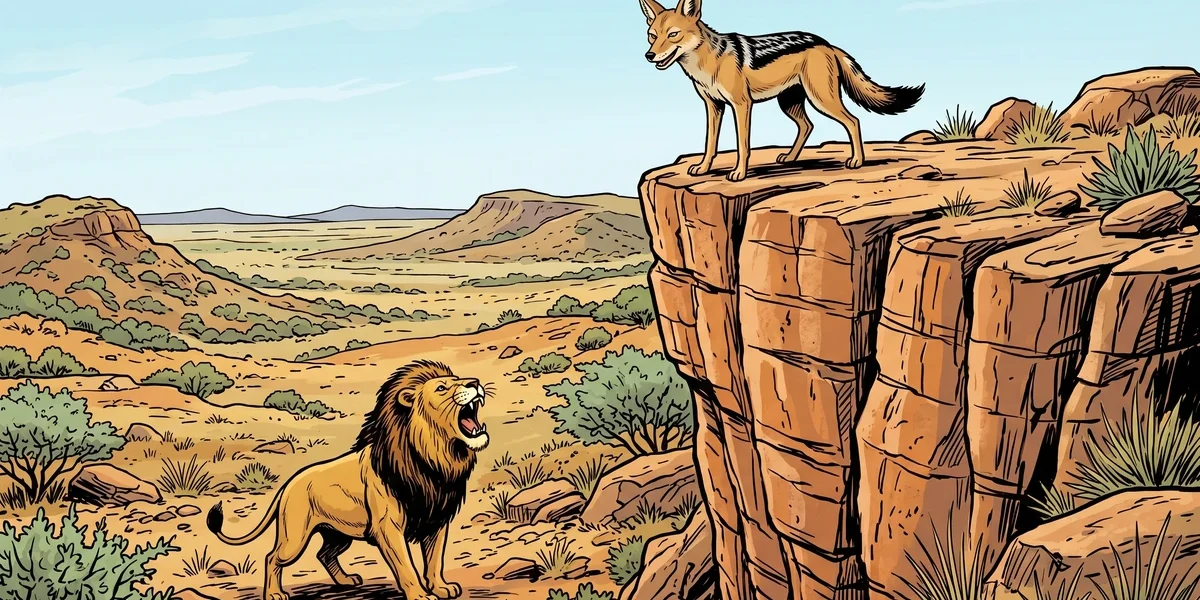
The Lion and the Jackal is one of the most widely told animal tales of southern Africa — a sharp, unsettling comedy in which the strongest hunter on the veld is starved, humiliated, and finally destroyed by the smallest and most cunning of his neighbours. It belongs to the great Khoikhoi (Khoekhoe) jackal-trickster cycle of the Cape, the body of stories that nineteenth-century scholars recognised as Africa’s own answer to the European Reynard the Fox. Where the European fox swindles farmyards, the Cape jackal out-thinks lions; and in this tale the trickster does not merely embarrass his victim but kills him outright, leaving the reader to sit uneasily with a story that rewards deceit and punishes brute trust.
The plot turns on a partnership — a hunting agreement between Lion and Jackal — and on the slow discovery that the partnership was a fraud from the first handshake. It is a tale about how the powerful are robbed not by force but by the management of appearances, and about a victim whose hunger and pride make him the willing accomplice of his own undoing.
Origin & Canonical Attribution
- Cultural origin: Khoikhoi (Khoekhoe; historically called “Hottentot”) pastoralist communities of the Cape and Great Namaqualand, southern Africa.
- Tale tradition: the Cape Lion-and-Jackal cycle — the southern African animal-trickster tradition in which the black-backed jackal is the resident trickster figure.
- Principal printed source: James A. Honey, South-African Folk-Tales (New York: Baker & Taylor, 1910), where the story appears as “Lion and Jackal.”
- Foundational collection: Wilhelm H. I. Bleek, Reynard the Fox in South Africa; or, Hottentot Fables and Tales (London: Trübner & Co., 1864), assembled from the manuscripts of Sir George Grey and with material gathered by the missionary G. Krönlein. Bleek’s title deliberately named the jackal cycle as Africa’s Reynard.
- Tale type: the hunting-partnership fraud follows the international type ATU 9, “The Unjust Partner,” in which a trickster cheats a stronger animal of the shared harvest or kill.
- Key motifs: K2010 (hypocrite pretends friendship); K963 (rope cut so that climber falls); K1035 (deceptive food — a burning object disguised as a morsel and swallowed); J1117 (the jackal as cunning trickster); W151 (greed).
The Partnership of Unequal Shares
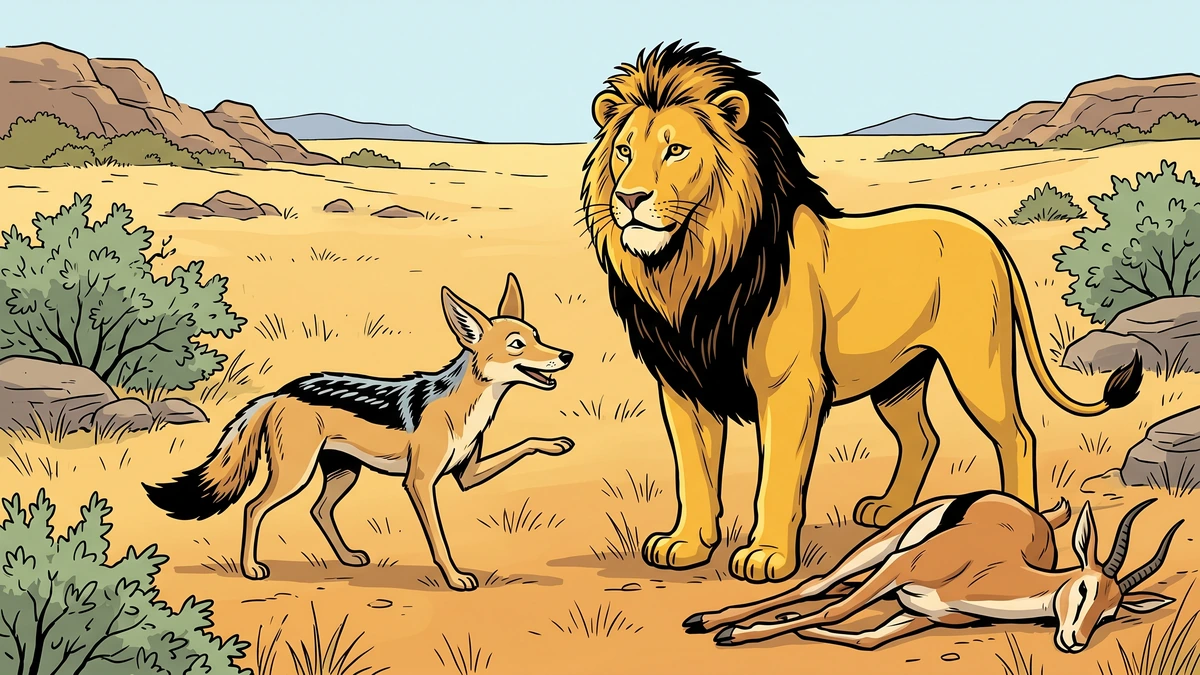
The story opens with what sounds, on its surface, like prudent neighbourliness. Lion and Jackal agree to hunt together “on shares” — to pool their effort through the lean season and lay in a common store of dried meat so that neither family will go hungry through the winter. It is a contract of mutual aid, the kind of arrangement that holds a community of unequal creatures together.
But the terms are written by the weaker partner, and that is where the trap is set. Lion, everyone agrees, is by far the more capable hunter, so it is decided that he will do the killing. Jackal, with a great show of modesty, volunteers for the humbler work: he will carry the game home, and his wife and the little jackals will cut and dry the meat. He adds a generous-sounding promise — that he will personally see to it that Mrs. Lion and her cubs never want for anything. Lion, flattered by the deference and glad to be relieved of the drudgery, agrees at once.
It is worth pausing on how reasonable this all seems. Jackal has not lied; he has merely arranged the division of labour so that he alone stands between the hunt and both households. He has made himself the channel through which everything must flow — and a channel can always be quietly narrowed. In the Khoikhoi telling, Jackal is the neighbour who is forever giving the impression of competence and public spirit, the smooth-tongued fellow who can deliver a favourable speech and carry himself as gravely as a judge. His reputation does the work that his honesty never could.
A Family Left to Starve
For a long stretch of weeks the hunt goes well. Lion kills steadily and successfully, and at last, satisfied with the season’s work, he returns home expecting to find a fat, contented family and a den heaped with the winter’s provision.
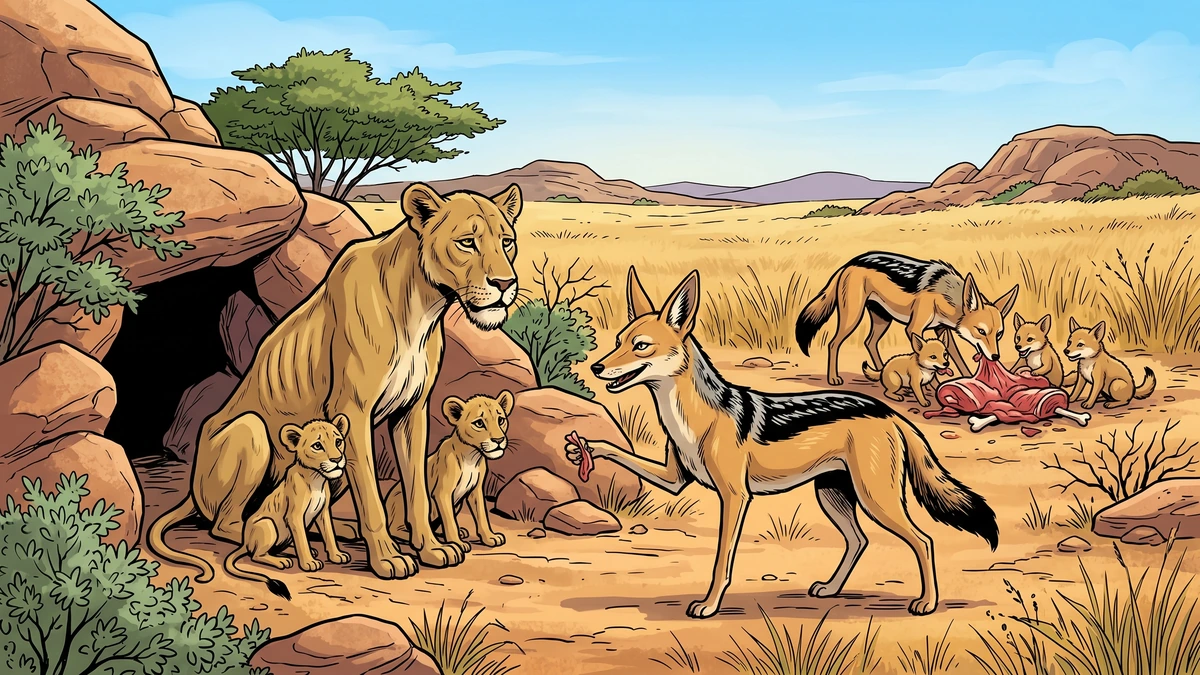
What he finds instead stops him at the threshold. Mrs. Lion and every one of the young lions are on the very point of death — gaunt, mangy, barely able to lift their heads, kept alive only by a trickle of scraps. Jackal, it emerges, had been bringing them nothing but a few entrails of the game, doled out in portions just large enough to prevent outright starvation, and always accompanied by the same mournful report: that he and Lion had hunted hard but met with almost no luck. Meanwhile, a short walk away, Jackal’s own wife and children are sleek, glossy, and visibly overfed, revelling in the abundance that should have been shared.
This is the heart of the tale’s social sting. The fraud was not a single bold theft but a long, patient campaign of small lies, each one plausible, each one easy to believe because it came wrapped in sympathy. Jackal did not need to overpower Lion’s family; he only needed to control the story they were told about the world beyond their den. By the time the truth is visible, it is written in the ribs of starving cubs — and the tale lets that image land before it allows Lion, or the reader, the relief of anger.
The Fortress on the Krantz
Lion’s response is pure, thunderous fury. He sets off at once, vowing the death of Jackal and every member of his family, wherever in the veld he should come upon them.
But Jackal — this is the trickster’s defining trait — has been ready for the storm long before it broke. Anticipating exactly this reckoning, he has already moved his entire household to the top of a krantz, a sheer rock cliff, reachable only by a single difficult and winding path that he alone knows. When Lion arrives below, roaring, the geography of the scene has already decided the contest: rage has nowhere to climb.
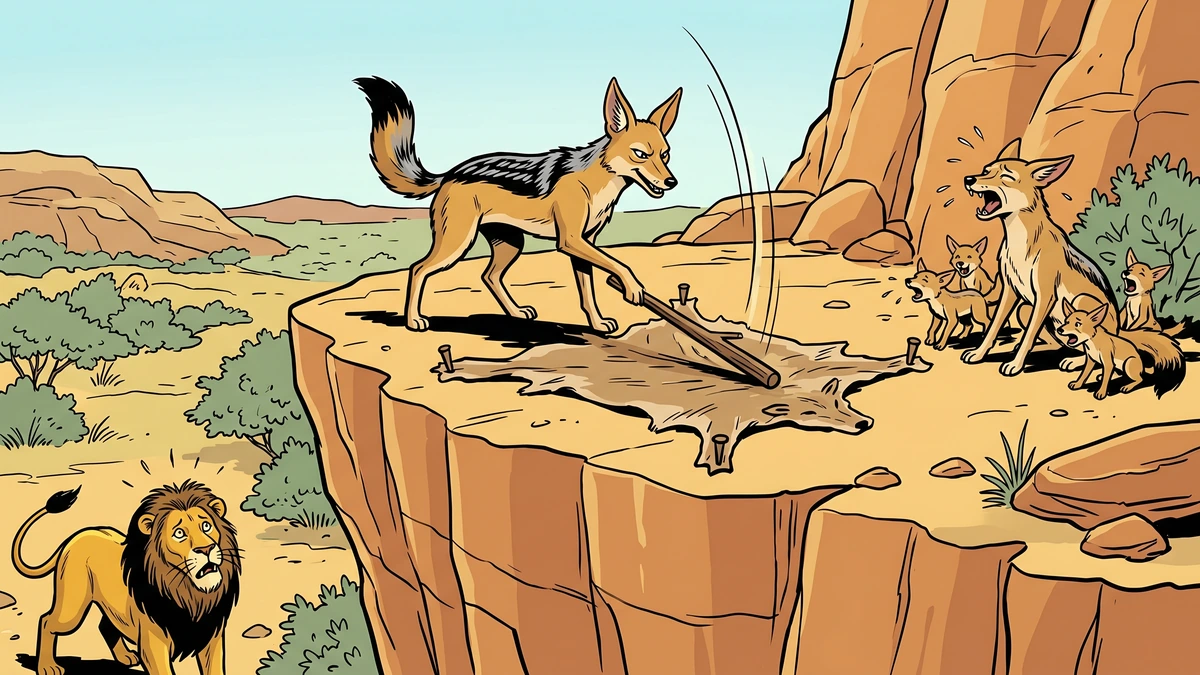
And now Jackal performs. He greets the furious Lion sweetly — “Good morning, Uncle Lion” — and when Lion bellows at the insolence of being called uncle, Jackal launches into a masterpiece of misdirection. It was all his wife’s doing, he cries; that wretched beast of a wife has shamed the family, and he will punish her this instant. Whereupon a great whack, whack is heard as Jackal beats a stick against a stretched dry hide — a stand-in for Mrs. Jackal’s back — while Mrs. Jackal, carefully rehearsed, shrieks on cue and the little jackals join in a doleful, convincing chorus. The pantomime is so pitiful that the enraged Lion finds himself, absurdly, begging Jackal to stop flogging his wife. In a few moments the trickster has converted Lion’s wrath into pity. The con has not ended; it has simply changed its costume.
The Ball of Fat
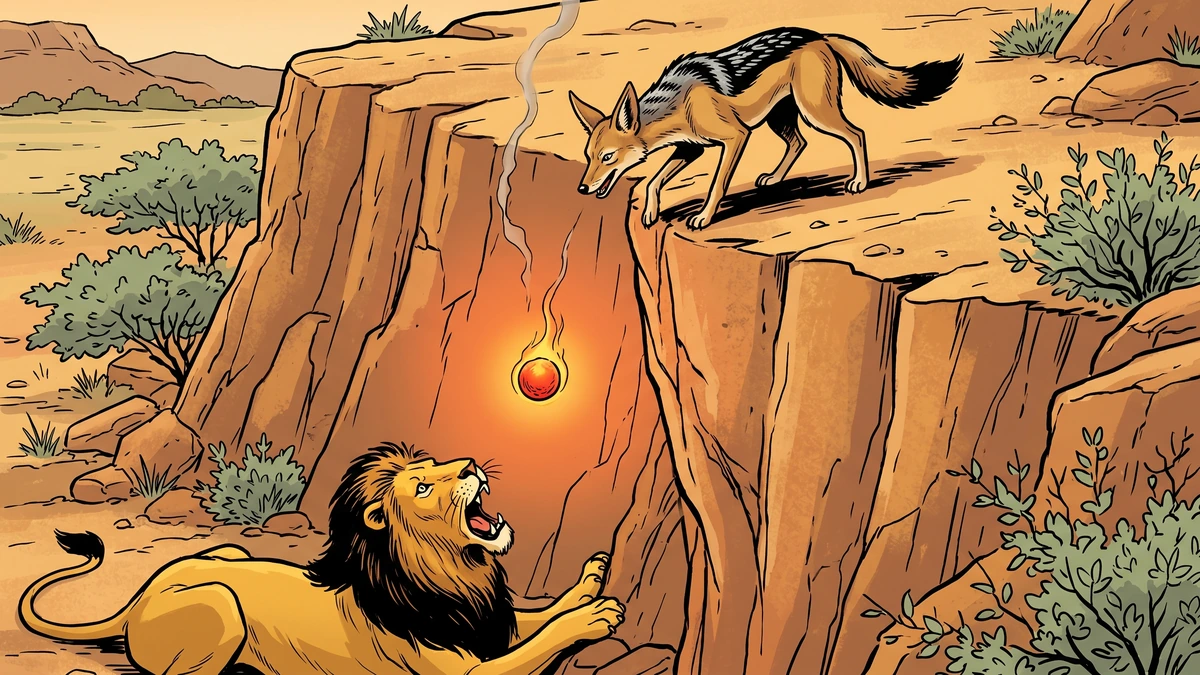
His fury blunted, Lion is invited up to share a meal — an offer Jackal knows is safe, because the krantz cannot be climbed. After several failed scrambles at the precipice, Lion gives up. Ever helpful, Jackal proposes a solution: a reim, a leather thong, will be lowered to haul Uncle Lion up.
It is, of course, another trap. When Lion has been drawn halfway up the cliff by the straining family of jackals, the reim is neatly cut, and Lion crashes to the ground, badly hurt. Jackal at once stages another beating — of the hide — in fierce indignation at his family for supplying such a rotten thong, and the screams ring out again. He calls for a strong buffalo-hide reim that will bear any weight; it is lowered, fastened, and Lion is hauled up a second time. Just as he rises far enough to see over the edge — to glimpse the pots of fat meat simmering and the biltong strips hanging out to dry, the very abundance stolen from his own family — the reim is cut once more, and he falls so hard he is stunned senseless.
When Lion comes to, Jackal adopts his most sympathetic tone. Hauling Uncle up, he says sadly, is plainly hopeless; instead, why not let a fine fat piece of eland’s breast be roasted and simply dropped down into his waiting mouth? Lion — half-famished, bruised, and by now wholly dependent on the goodwill of the creature who has ruined him — accepts eagerly and lies back with his great jaws open to their fullest. Jackal heats a round stone until it glows red-hot, wraps it in a thick layer of suet so that it looks for all the world like a ball of fat, and drops it cleanly into the open mouth. The burning stone runs straight through the old beast and kills him on the spot. That night, the tale ends, there was great rejoicing on the precipice.
The Moral of the Tale
Modern readers often expect a folk tale to end by punishing the cheat. This one does not, and its refusal is deliberate. The Khoikhoi jackal cycle is not a set of nursery morals but a body of clear-eyed observations about how power actually moves in a community — and its lesson is a warning rather than a reassurance. The danger to the strong, the tale insists, is almost never another strong creature. It is the trusted intermediary: the smooth-spoken partner who positions himself between you and the truth, controls the flow of what you receive and what you are told, and uses your own pride and hunger as the levers of your ruin.
Lion is not destroyed by the red-hot stone alone. He is destroyed at every earlier step by his willingness to be flattered, to delegate without checking, to let pity overrule evidence, and finally to keep reaching for food from a hand that has already dropped him twice. The trickster supplies the cunning; the victim supplies the trust. The Cape Afrikaans proverb that the herding peoples attached to such jackal tales puts the trickster’s whole character in five words:
“Jakkals prys sy eie stert.”
— The jackal praises his own tail. (Of one who is forever advertising his own worth — the boaster whose good name is a thing he manufactures, not a thing he has earned.)
The honest moral, then, is not “cunning wins.” It is closer to this: watch most carefully the neighbour who manages your impression of him — and never let hunger, vanity, or pity do your thinking for you. The tale frightens precisely because it is fair: it shows what really happens when a powerful, decent, unsuspecting creature hands the keys of his household to a charming fraud.
The Jackal as the Cape Reynard
To understand why the jackal of this story behaves as he does, it helps to know that he is not a free-standing villain but the fixed hero of an entire narrative tradition. In the Khoikhoi tales gathered by Bleek and Honey, the black-backed jackal occupies the same role that the fox occupies in the medieval European Reynard cycle and that Anansi the spider occupies in West African and Caribbean tradition: he is the small, physically weak animal whose survival depends entirely on intelligence, nerve, and a genius for performance. Audiences did not come to these tales asking whether the jackal would be punished. They came to watch how he would escape, and to admire the artistry of the escape even while disapproving of the figure it made him.
This is what makes the trickster cycle morally complex rather than morally empty. The same cunning that ruins Lion in this tale will, in a neighbouring story, save a defenceless creature from a cruel and far stronger oppressor. The jackal is a tool the tradition uses to think with — a way of dramatising the uncomfortable truth that intelligence is a power like any other, neither good nor evil in itself, and that a community contains those who will use it to feed their families at any cost. Bleek’s choice of the title Reynard the Fox in South Africa was therefore an act of intellectual respect: he was telling European readers that the Cape herders had produced, entirely independently, a trickster literature as layered and as adult as their own.
The setting of this particular tale is unmistakably the dry interior of the Cape and Namaqualand. The vocabulary alone roots it there. A krantz is a sheer rock face of the kind that breaks up the Karoo and Namaqualand landscape; a reim is a thong of rawhide, the universal cordage of a pastoral people; biltong is wind-dried strips of meat, still the characteristic preserved food of the region. These are not decorations borrowed from elsewhere. They are the working furniture of a herding economy, and they anchor the comedy in a real place where drying meat for winter was a matter of survival, and where a partner who cheated you of your winter store could genuinely cost you your family.
Why This Tale Has Lasted
“The Lion and the Jackal” has survived for more than a century and a half in print — and far longer in oral telling — because it works on several levels at once. For children it is a brisk, vivid comedy of a clever little animal outwitting a huge frightening one, complete with the irresistible slapstick of a lion being dropped off a cliff twice. For adults it is something sharper: a study of confidence trickery so precise that it could be lifted into any age of brokers, middlemen, and reputations.
The tale also matters as a record. When Wilhelm Bleek published Reynard the Fox in South Africa in 1864, he was making a scholarly argument — that the Khoikhoi possessed a fully formed, sophisticated trickster literature worthy of comparison with the celebrated beast-epics of medieval Europe. James Honey’s 1910 South-African Folk-Tales carried that tradition to a wide English-reading public. Through both books, “The Lion and the Jackal” stands as evidence of an indigenous southern African storytelling tradition with its own consistent cast, its own trickster hero, and its own unsentimental moral imagination — one that prefers an honest, uncomfortable truth to a comforting, dishonest one. That refusal to flatter the listener is exactly why the story still has teeth.
Frequently Asked Questions
Where does the folk tale “The Lion and the Jackal” come from?
It is a Khoikhoi (Khoekhoe) animal-trickster tale from the Cape and Great Namaqualand region of southern Africa. It was printed in English in James A. Honey’s South-African Folk-Tales (New York, 1910) as “Lion and Jackal,” and belongs to the same Cape jackal-trickster tradition that Wilhelm H. I. Bleek had documented in his foundational 1864 collection Reynard the Fox in South Africa; or, Hottentot Fables and Tales.
What is the moral of “The Lion and the Jackal”?
The tale warns that the greatest danger to the powerful is rarely another strong rival but the trusted intermediary who controls what you receive and what you are told. Lion is ruined not by force but by his own willingness to be flattered, to delegate without checking, and to let pity and hunger override clear evidence. The lesson is to watch most carefully the smooth-spoken partner who manages your impression of him, and never to let vanity or appetite do your thinking for you.
Why isn’t the jackal punished at the end of the story?
The Khoikhoi jackal cycle is not a set of tidy nursery morals; it is a clear-eyed body of observations about how cunning operates in a community. The jackal is the fixed trickster hero of the tradition, and audiences came to admire the artistry of his escape rather than to see him punished. The tale’s refusal to punish him is deliberate: it tells an uncomfortable truth about real life rather than a comforting fiction, which is exactly why it still unsettles readers.
What do the words “krantz,” “reim,” and “biltong” mean in the tale?
These are Cape Dutch and Afrikaans words that root the story firmly in the southern African interior. A krantz is a sheer rock cliff or precipice, the kind that breaks up the Karoo and Namaqualand landscape. A reim is a thong or strap of rawhide, the everyday cordage of a herding people. Biltong is wind-dried strips of meat, the characteristic preserved food of the region, prepared for the winter store that the jackal steals.
How is the Cape jackal connected to Reynard the Fox?
When Wilhelm Bleek published his 1864 collection he titled it Reynard the Fox in South Africa, deliberately identifying the black-backed jackal as Africa’s own equivalent of the medieval European fox-trickster. In both traditions the trickster is a small, physically weak animal whose survival depends entirely on intelligence, nerve, and performance. Bleek’s title was an act of scholarly respect, asserting that the Khoikhoi possessed a trickster literature as sophisticated and adult as the celebrated beast-epics of Europe.
You May Also Like
 African Folk Tales
Ages 9-12
African Folk Tales
Ages 9-12
Story Of Lion And Little Jackal
A string of clever escapes from southern African oral tradition: the small black-backed jackal outwits the mighty lion again and again, proving that wit, not muscle, rules the veld.
 African Folk Tales
Ages 9-12
African Folk Tales
Ages 9-12
The Tail Of The Princess Elephant
The Tail Of The Princess Elephant: There once lived a woman who had three sons. These sons were very much attached to their mother and always tried to please
 African Folk Tales
All Ages
African Folk Tales
All Ages
Farmer Mybrow And The Fairies
Farmer Mybrow And The Fairies — a tale of justice and vindication. Farmer Mybrow faces cruel accusations, but justice arrives through supernatural intervention.