The Tiger, The Ram, And The Jackal
A Panchatantra tale where a clever jackal's lies to tiger and ram destroy his own plans.
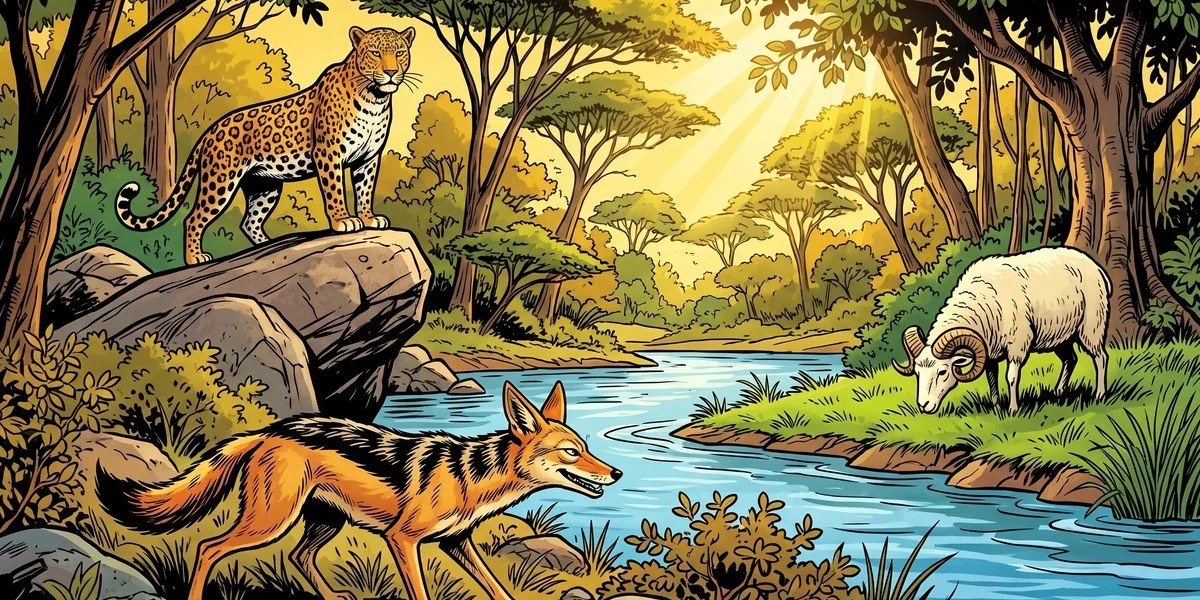
Among the animal tales of southern Africa, The Tiger, the Ram, and the Jackal is one of the most quietly dangerous. Nothing in it is settled by tooth or claw; the whole story turns on words — on what one small, smiling creature whispers into two pairs of ears. It is a fable about the oldest and cheapest weapon in the world: the lie that sets friend against friend. The jackal at its centre is the great trickster of African storytelling, and here he practises the trick that folklorists have catalogued in every corner of the earth — the calumniator who separates two who should have stood together.
Origin & Canonical Attribution
Tradition: Southern African oral tradition; the jackal-trickster animal-fable cycle
Printed source of the title: James A. Honey, South-African Folk-Tales (New York: Baker & Taylor Company, 1910), where the tale appears as “The Tiger, the Ram, and the Jackal”
Trickster lineage: the African jackal-trickster, documented in W. H. I. Bleek, Reynard the Fox in South Africa; or, Hottentot Fables and Tales (London, 1864) — the figure Bleek explicitly compared to the European fox Reynard
A note on “tiger”: in South African English the word tiger traditionally names the leopard; no true tiger lives in Africa, and the “tiger” of this tale is the spotted predator of the bushveld
Tale family & motifs: the “calumniator who separates two friends” type — Stith Thompson motif K2131 (“Calumniator separates friends”); its most celebrated literary parallel is the first book of the Sanskrit Panchatantra, Mitra-bheda (“The Separation of Friends”), in which the jackal Damanaka sets the lion Pingalaka against the bull Sanjivaka
The Jackal’s Hunger and the Peace of the Forest
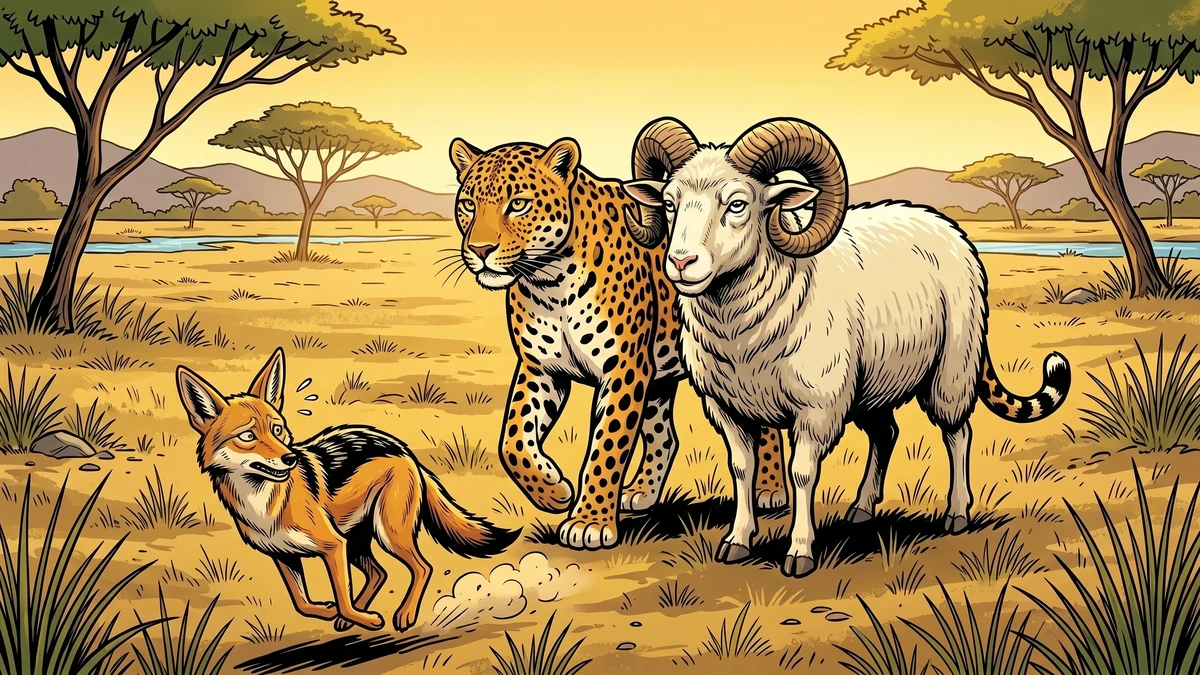
The forest in this tale begins as a settled and peaceable place. Tall trees carry their crowns up into the clouds, sunlight falls in golden bars through the leaves, a cool river runs between soft banks of grass, and the birds keep up their ordinary singing. Into this ease the story drops a single restless mind. The jackal — called Manthar in the tellings that name him — is small, lean, and perpetually hungry, and his hunger is the kind that does not want to hunt. He wants to be fed without effort, and he has noticed two animals who could, if handled correctly, feed him for many days.
The first is the Tiger: a powerful spotted predator, the acknowledged king of that stretch of forest, proud of his strength and accustomed to being feared. The second is the Ram: a gentle, woolly creature with curved horns and a trusting heart, who eats grass in the meadow, harms nothing, and is liked by everyone precisely because he threatens no one. The jackal looks at these two and does not see a king and a kindly neighbour. He sees meat. “If I can make these two fight each other,” he reasons, “one of them will fall — and I will eat well for a long while without ever lifting a paw to hunt.”
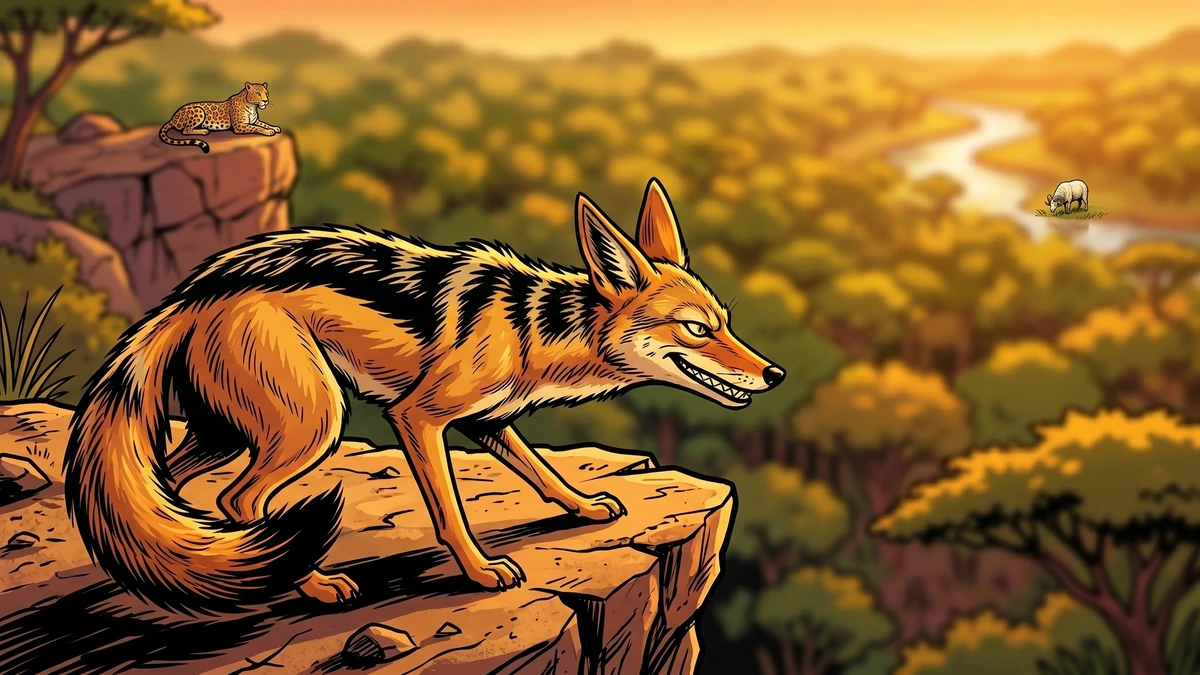
It is worth pausing on how the story characterises him, because the tale is careful about it. The jackal is not strong and does not pretend to be. His only instrument is his tongue, and his plan depends entirely on the two stronger animals never comparing notes. That is the engine of the whole tale: a lie can only do its work in the dark, between two people who do not speak to each other. The jackal’s scheme is, in the end, a bet against conversation.
The First Lie: Poisoning the Tiger’s Pride
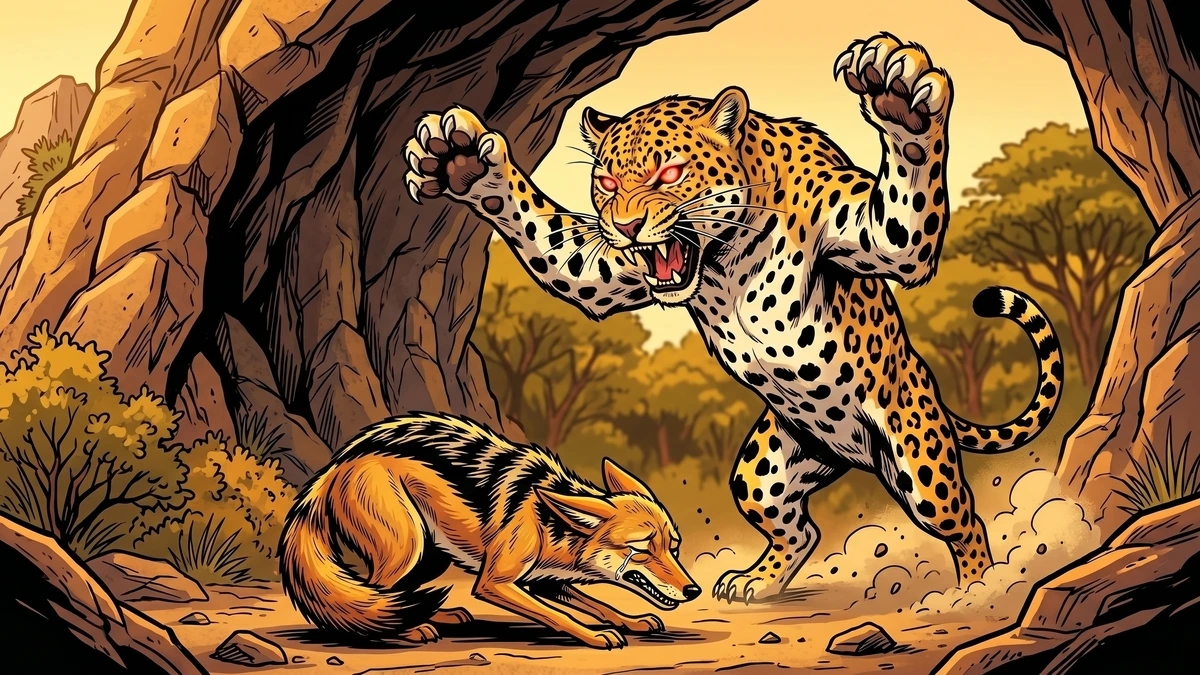
Manthar goes first to the Tiger, and he goes wearing a borrowed face. He bows low at the mouth of the great cat’s cave, arranges his features into sorrow, and speaks like a friend burdened by a painful duty. “Great King,” he says, “I bring news that makes my heart heavy — but I cannot keep silent and let a friend be mocked.” It is a small masterpiece of manipulation. Before he has told a single lie, he has cast himself as loyal, reluctant, and brave for speaking; he has made the Tiger feel that to doubt him would be ungrateful.
Then comes the poison. The Ram in the next valley, he says, speaks contempt of the Tiger behind his back — calls him old, says his teeth have gone soft and his claws dull, laughs that he is no longer the king he was, and boasts that he is not afraid of him and could beat him in a fight. Every detail is chosen to strike exactly where a proud animal is thinnest-skinned: not at his life, but at his reputation, his power, his standing in the eyes of others.
It works precisely as designed. The Tiger’s eyes redden, his claws slide from their sheaths, his breath comes heavy as wind before a storm. “A tiny Ram says this of me?” he roars, until the leaves shake and the birds scatter. He begins to pace his cave, rehearsing the lesson he will teach. And Manthar bows himself out, smiling, his work half done. He has not made the Tiger angry at the Ram by accident or by argument; he has simply handed a proud creature an insult and trusted pride to do the rest. The seed is in the soil. He has only to plant the second.
The Second Lie: Wounding the Gentle Ram
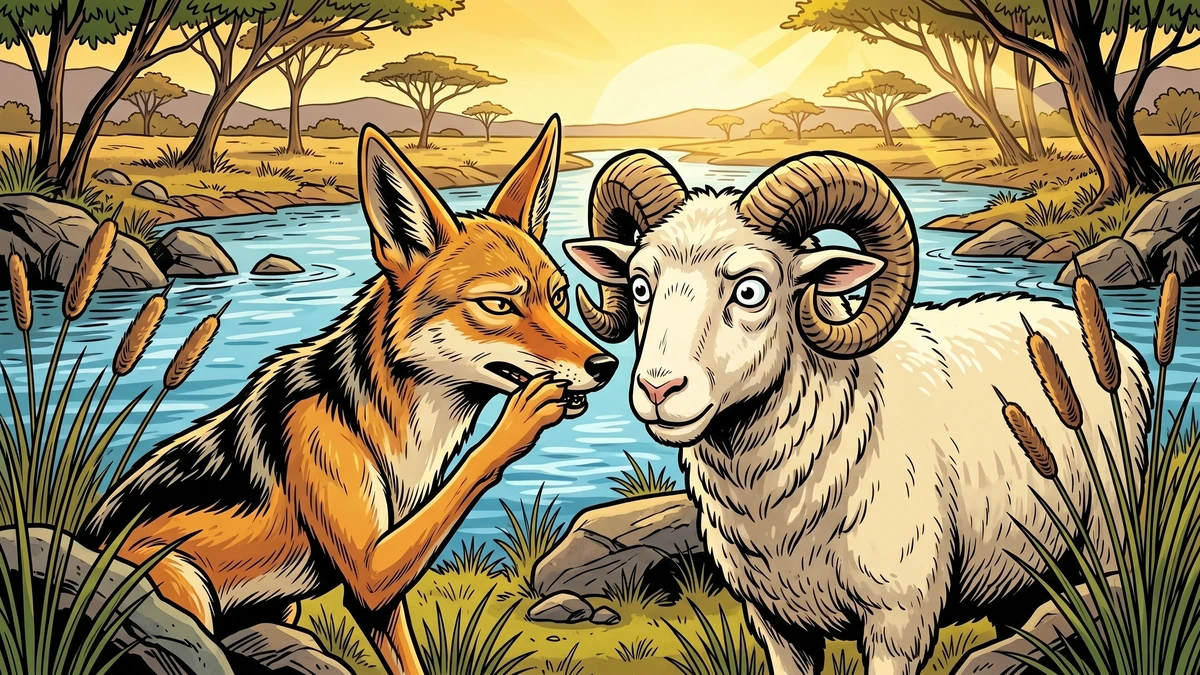
The jackal runs to the river and finds the Ram exactly where a gentle animal would be: grazing peacefully among the rocks, untroubled, glad of company. The Ram looks up kindly when the jackal approaches, because rams in this story are trusting by nature and a trusting animal assumes a visitor is a friend. That assumption is the very thing the jackal has come to exploit.
He shapes his second lie to fit a different wound. He does not tell the Ram that he is weak — the Ram knows he is no warrior and would only nod. Instead he tells the Ram that the Tiger has been laughing at him: calling him a mouse pretending to be a lion, saying he has the courage of a chicken, boasting that he could crush him like an ant with his eyes closed. The cruelty here is precise. The jackal has measured each animal and aimed each lie. To the proud Tiger he reported a challenge to his power; to the gentle Ram he reports mockery and scorn — because even the mildest creature, the one who never wanted to fight anyone, cannot bear to be laughed at and called a coward.
And the gentle Ram, who has never harmed an insect, feels his ears go stiff and his quiet heart fill with a hot, unfamiliar anger. “If the Tiger says I am weak,” he declares, “then I will go and prove that I am brave.” This is the saddest turn in the tale. It is not malice that the jackal awakens in the Ram — it is hurt pride and wounded dignity, the most ordinary feelings in the world. The jackal has not corrupted two villains. He has taken two decent animals and weaponised their most human weaknesses against each other. Both lies are now planted. All that remains is to wait.
The Battle, the Question, and the Unmasking
They meet the next morning at a wide clearing on the forest’s edge, and the air is tight with the violence to come. The Tiger roars his accusation; the Ram, eyes hot with a grief he mistakes for fury, lowers his head, charges, and drives his curved horns into the great cat’s chest. The Tiger bites and claws, trying to fling the smaller animal down. They fight and fight, and a cloud of dust climbs into the air around them. And on a hill safely above it all sits the jackal, rubbing his paws, licking his lips, watching his feast take shape. “Soon one of them will fall,” he thinks, “and then I shall eat and eat for many days.”
And then the story performs its quiet miracle — and it performs it with a question, not a weapon. Gasping between blows, the Tiger says something he has no reason to say unless it is true: “I never said you were weak. Who told you that I did?” The Ram stops mid-charge, astonished. “A jackal told me,” he answers, breathing hard. “Manthar the jackal.” And in that single exchanged sentence the entire scheme collapses. The Tiger had been told the Ram insulted him; the Ram had been told the Tiger mocked him; and the moment they compare what they were told, both lies stand exposed in the open air. They had never been each other’s enemy. They had been fighting a phantom — the invention of a third animal who was, even now, waiting on a hill for one of them to die.
Their anger drains away “like rainwater sinking into the earth,” and it is replaced by a colder, clearer feeling aimed in a new direction. They walk together — side by side, the king and the gentle grass-eater — toward the hill where the jackal sits. Manthar sees them coming united and understands at once that his plan has not merely failed but reversed: the two animals he tried to turn into enemies have been turned, by the truth, into allies, and he is the enemy now. He runs, but the open forest gives him nowhere to hide, and the two who once would have killed each other catch him easily because they move as one. They do not kill him. They pass a judgement that fits his crime: the jackal who used the forest as a stage for his lies is told to leave it, and to live henceforth alone and unwelcome — exiled, in the end, by his own cleverness.
The Moral of the Tale
The Tiger, the Ram, and the Jackal teaches its lesson through a structure rather than a sermon, and the structure has three clean parts. First: a lie needs darkness to work. The jackal’s scheme was never strong — it was simply unexamined, and it survived only as long as the Tiger and the Ram did not speak to each other. Second: the deceiver studies you before he lies to you. Manthar did not tell the same story twice; he told the proud animal a story about disrespect and the gentle animal a story about mockery, because a good liar aims at the particular soft place each victim is hiding. Third, and most hopeful: one honest question can undo months of careful poison. The Tiger’s “I never said that — who told you?” cost nothing and ended everything. Southern African storytellers, who knew how quickly a village could be torn by a whisper, kept this wisdom alive in a proverb still spoken across the continent today:
“Umoja ni nguvu, utengano ni udhaifu.”
— Swahili: “Unity is strength; division is weakness.” The Tiger and the Ram were each strong alone, but it was only standing together that they could defeat the lie between them.
The moral is not, finally, that the world is full of jackals — though it is. It is that the jackal’s power is entirely borrowed. He has no strength of his own; every blow in the fight he started was struck by someone else. He is dangerous only because two friends were willing to believe a stranger’s account of each other before they were willing to ask each other directly. Take away the silence between them and the jackal has nothing. The tale hands its listener a single, portable instruction: when someone brings you an ugly story about a friend, do not carry the anger — carry the question back to the friend.
Origin, Collection, and Canonical Sources
The Tiger, the Ram, and the Jackal belongs to the great jackal-trickster tradition of southern Africa. Across the storytelling of the region, the jackal is the small, clever, self-serving figure who lives by his wits and his tongue — the African counterpart of the European fox. It was exactly this resemblance that struck the philologist Wilhelm Heinrich Immanuel Bleek when he gathered Khoikhoi animal tales into his 1864 volume and gave it the deliberately comparative title Reynard the Fox in South Africa; or, Hottentot Fables and Tales. In that cycle the jackal is rarely a hero in any clean sense: he is admired for his cleverness and distrusted for the uses he puts it to, and tales like this one belong to the strand of the tradition that shows his cunning rebounding against him.
The tale’s title is best known to modern readers from James A. Honey’s anthology South-African Folk-Tales, published in New York in 1910, which drew together southern African material — including tales from Bleek’s Khoikhoi collection and from George McCall Theal’s Xhosa Kaffir Folk-Lore (1882) — for an international readership. It is from Honey’s widely reprinted volume that the tale acquired its familiar English title, which is also why it is so often labelled simply “South African.” A word of caution belongs here for the careful reader: the “tiger” of the title is not the Asian big cat but the leopard, which South African English of the period regularly called a tiger.
The plot itself — a trickster who fattens himself by setting two stronger creatures at war — is not unique to Africa; it is one of the most widely travelled story-shapes in the world. Its single most famous literary form is the opening book of the Sanskrit Panchatantra, Mitra-bheda or “The Separation of Friends,” in which the scheming jackal Damanaka, hungry for influence and advantage, poisons the friendship between the lion-king Pingalaka and the bull Sanjivaka until the two destroy each other. The African tale and the Indian frame-story are not copies of one another; they are independent flowerings of the same deep human observation — that the cheapest way for a weak creature to profit is to make strong ones fight.
Tale Type and Motifs
Folklorists file the central action of this story under Stith Thompson’s motif K2131, “Calumniator separates friends” — the deceiver who breaks an alliance by carrying false reports between its members. It sits within the broader family of K2100 motifs covering false accusation and slander, and it is closely tied to K2010, the hypocrite who pretends friendship while plotting harm: the jackal’s sorrowful face and his pose as a reluctant well-wisher are essential equipment of the type, not incidental colour. The resolution — the discovery of the deceit through direct conversation and the reconciliation of the wronged pair — belongs to the recognition-of-truth motifs that so often close such tales, and the deceiver’s exile is the type’s characteristic poetic justice: the schemer is undone by precisely the scheme he set in motion.
The structural signature of the type is its parallel asymmetry: two near-identical deception scenes that are not actually identical, because the calumniator tailors each lie to each victim. Recognising that pattern is part of what the tale teaches. A listener who has heard the jackal visit the Tiger already knows, with a pleasurable dread, what is coming when he trots off toward the Ram — and also knows to listen for how the second lie will differ from the first. The form itself trains the ear to expect manipulation and to notice its craft.
Frequently Asked Questions
Is the “tiger” in this story really a tiger?
No. There are no tigers in Africa. In South African English of the nineteenth and early twentieth centuries — the period when James A. Honey collected and published this tale — the word “tiger” was the ordinary name for the leopard, the large spotted predator of the bushveld. The “king of the forest” in this fable is that leopard. The title has simply kept the older usage.
Why does the jackal want the Tiger and the Ram to fight?
Pure self-interest, and a very specific kind of laziness. The jackal is hungry but does not want the effort and danger of hunting. He calculates that if he can provoke a fight between two strong animals, one of them will be killed or badly wounded — and he can then feed on the loser for many days without ever hunting himself. His scheme is a plan to be fed by other animals’ violence. He has no quarrel with either the Tiger or the Ram; they are simply his intended meal.
How are the Tiger and the Ram able to discover the truth?
By doing the one thing the jackal’s plan depended on them never doing: comparing what they had each been told. In the middle of the fight the Tiger asks the Ram who claimed he had insulted him, and the Ram names the jackal — and instantly both realise they were told opposite lies by the same animal. The jackal’s scheme survived only in the silence between them; a single honest question destroyed it. The tale makes the point exactly: communication is the cure for manipulation.
Why don’t the Tiger and the Ram kill the jackal?
The story chooses a punishment that mirrors the crime rather than a violent one. The jackal used the forest as the stage for his lies and used the trust of its animals as his tool, so the judgement is exile: he is driven from the forest to live alone and unwelcome, cut off from the community he tried to poison. It is a fitting end — the trickster who tried to break others’ bonds is left with no bonds of his own — and it keeps the tale’s focus on the social cost of deceit rather than on revenge.
How does this African tale relate to the Panchatantra?
They are independent tellings of the same universal story-shape, not copies of each other. The first book of the Sanskrit Panchatantra, Mitra-bheda (“The Separation of Friends”), tells how the jackal Damanaka sets the lion Pingalaka against the bull Sanjivaka. The African tale tells how a jackal sets a tiger against a ram. Folklorists treat both as expressions of motif K2131, “Calumniator separates friends” — a pattern so true to human nature that many cultures arrived at it on their own.
Why This Story Has Lasted
The Tiger, the Ram, and the Jackal has survived because the danger it describes never goes out of date. Every generation rediscovers the jackal — the person who profits by carrying poison from one ear to another, who tells you what your friend “really said,” who arrives wearing concern and leaves having lit a fire. The technology changes; the rumour now travels by message and by screen rather than from cave to riverbank. But the mechanism is exactly the one this old fable diagrammed: two people who would never quarrel on their own are made to quarrel by a third who benefits from the quarrel and who depends, absolutely, on the two of them not speaking directly.
What gives the tale its staying power, though, is not the warning but the remedy — and the remedy is wonderfully small. The Tiger and the Ram are not rescued by a wise king, a magic charm, or a stroke of luck. They are rescued by one honest question asked in the middle of a fight: who told you that? The story’s enduring gift is that it locates the cure for manipulation not in cleverness greater than the jackal’s, but in something every listener already possesses — the willingness to check an ugly story with the person it is about before letting it become anger. The jackal is exiled at the end, but the tale knows he will always come back in some new shape. Its real and lasting message is that he is powerless the moment two friends decide to talk.
You May Also Like
 African Folk Tales
Ages 6-8
African Folk Tales
Ages 6-8
The Lion’s Whisker
An Amhara wisdom tale from Ethiopia: a young stepmother, desperate to win her grieving stepson's love, is sent by a wise hakim to pluck a whisker from a living lion - and learns that patience, not magic, is the cure.
 African Folk Tales
All Ages
African Folk Tales
All Ages
Crocodile’s Treason
A scholarly retelling of “Crocodile’s Treason,” a South African veldt folk tale from James A. Honeÿ’s South-African Folk-Tales (1910) — the story of the weeping crocodile and the origin of the phrase “crocodile tears.”
 African Folk Tales
Ages 9-12
African Folk Tales
Ages 9-12
Maku Mawu And Maku Fia
Maku Mawu And Maku Fia: I will die God’s death’ and ‘I will die the King’s death’ Once upon a time there were two men who were such great friends that they