Crocodile’s Treason
A scholarly retelling of “Crocodile’s Treason,” a South African veldt folk tale from James A. Honeÿ’s South-African Folk-Tales (1910) — the story of the weeping crocodile and the origin of the phrase “crocodile tears.”

In the old country speech of the South African veldt — that wide, sun-baked grassland where the rivers run thin in the dry season and a farmer’s pump can drink a stream to its bones — there survives a tale about the most famous false tears in the world. “Crocodile’s Treason” is the story of a treaty made in good faith and broken in cold blood, of a reptile who wept on cue and a jackal who refused to be fooled. It is, at heart, the folk explanation of why we still speak of crocodile tears when we mean grief that is performed rather than felt.
The tale belongs to the great jackal-and-lion cycle of the South African plains, where the animal kingdom is governed like a frontier republic — with kings and commandos, treaties and despatch riders — and where survival depends less on strength than on knowing which smile to trust. It is a story about diplomacy, about the seductive language of peace, and about the one cynic at the table who turns out to be right.
Origins: The Veldt, the Boer Farm, and a Collector Named Honeÿ
“Crocodile’s Treason” comes down to us through South-African Folk-Tales, compiled by James A. Honeÿ and published in New York by the Baker & Taylor Company in 1910. Honeÿ’s slim volume gathered forty-four tales from the southern tip of the continent — stories he drew partly from earlier printed collections, partly from tales translated out of Afrikaans, and partly from stories he remembered hearing as a child. The collection draws most heavily on the Bushman (San) and Khoikhoi (“Hottentot”) traditions, with some Zulu material besides.
This particular tale is unmistakably one of the Cape Dutch veldt stories. Its furniture gives it away: a Boer’s farm with steam pumps draining the river, a vaarland willow shading the negotiating ground, antelope dried into biltong, a commando of escorts, and despatch riders carrying the king’s summons. These details place the story in the long jackal-cycle that South African folklore shares with the European Reynard tradition — the same cycle the philologist W. H. I. Bleek had already made famous for English readers in his 1864 book Reynard the Fox in South Africa; or, Hottentot Fables and Tales. In that cycle the Jackal is the trickster-sage, the Lion is the slow and dignified king, and the lesser animals form a parliament that is always one clever speech away from disaster.
Folklorists classify “Crocodile’s Treason” among the tales of the treacherous animal and the false peace. Its narrative engine is motif K2295, “treacherous animal,” braced by motif K815, “victim lured by kind words within reach of the trickster,” and shadowed by motif W154, “ingratitude.” Its closing flourish — explaining why the elephant still flings crocodiles into the forks of trees — is a pourquoi tag of the A2200–A2599 animal-characteristic family, the same etiological habit that runs through African oral storytelling. And braided through all of it is one of the oldest images in world literature: the weeping crocodile, a symbol of counterfeit sorrow recorded in European bestiaries and medieval travel writing centuries before Honeÿ set this version on the page.
The Drought and the Crocodile’s Plan
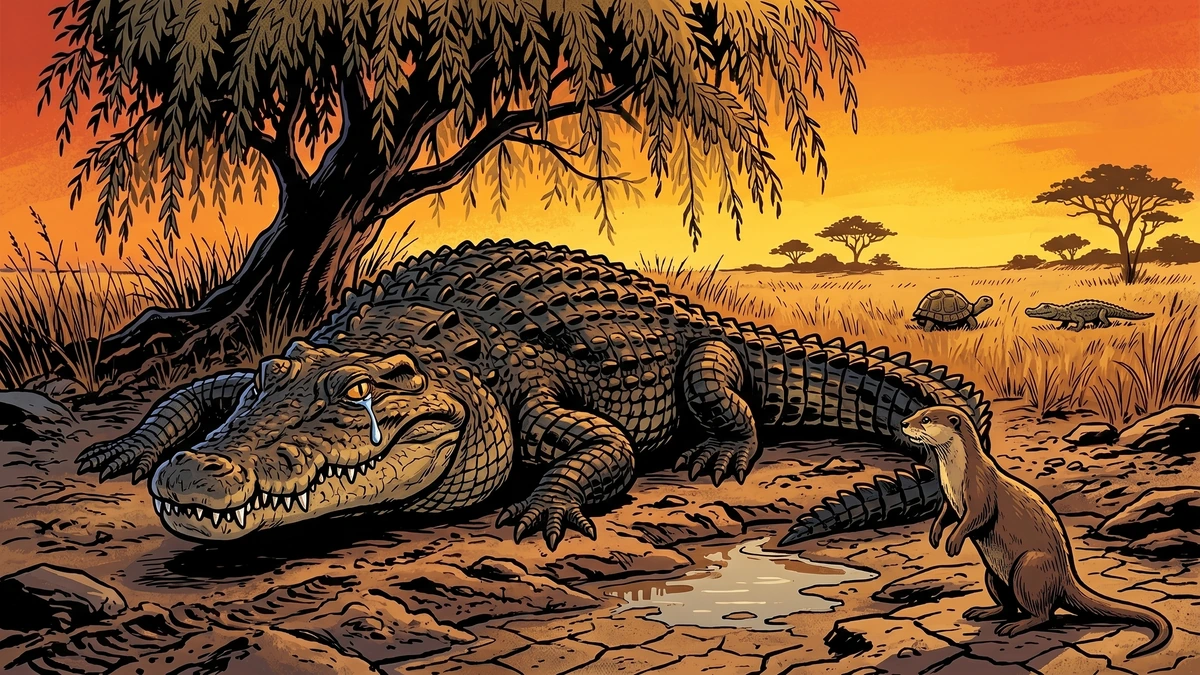
The story opens in the years “when animals still could talk,” and it opens with a crisis. Crocodile was the acknowledged foreman of all the water creatures — a kind of civil servant of the river, charged with the general care of every animal that lived in it. That year the drought bit hard. The river where his subjects lived shrank and soured, the water grew scarce, and Crocodile understood that if he did nothing his whole nation would die in the mud.
He was, to his credit, a competent administrator. He sent Otter out as a scout, and Otter returned after two days with good news: there was still a fine river a short distance off, with deep sea-cow holes that no drought of several years could empty. The trouble was the route. To reach that water the slow, soft-bodied creatures of the river would have to cross open, sun-blasted veldt, and worse, they would have to pass directly by a Boer’s farm — and “a fish on land,” as Crocodile observed dryly to his lieutenants, “is sometimes a very helpless thing.”
So Crocodile devised a plan that was, on its surface, statesmanship of a high order. He would sue for peace with Lion, king of the veldt, and with all his land-dwelling subjects. Under a treaty the water animals would be granted safe passage to the new river, escorted past the dangerous farm and unmolested by the predators of the plain. He summoned Tortoise and Alligator, handed them the proposal, and sent them trudging across the burning, waterless veldt to carry his treaty to the Lion. It was a punishing journey for two such creatures, but they reached the king and delivered the message.
The Treaty Under the Vaarland Willow
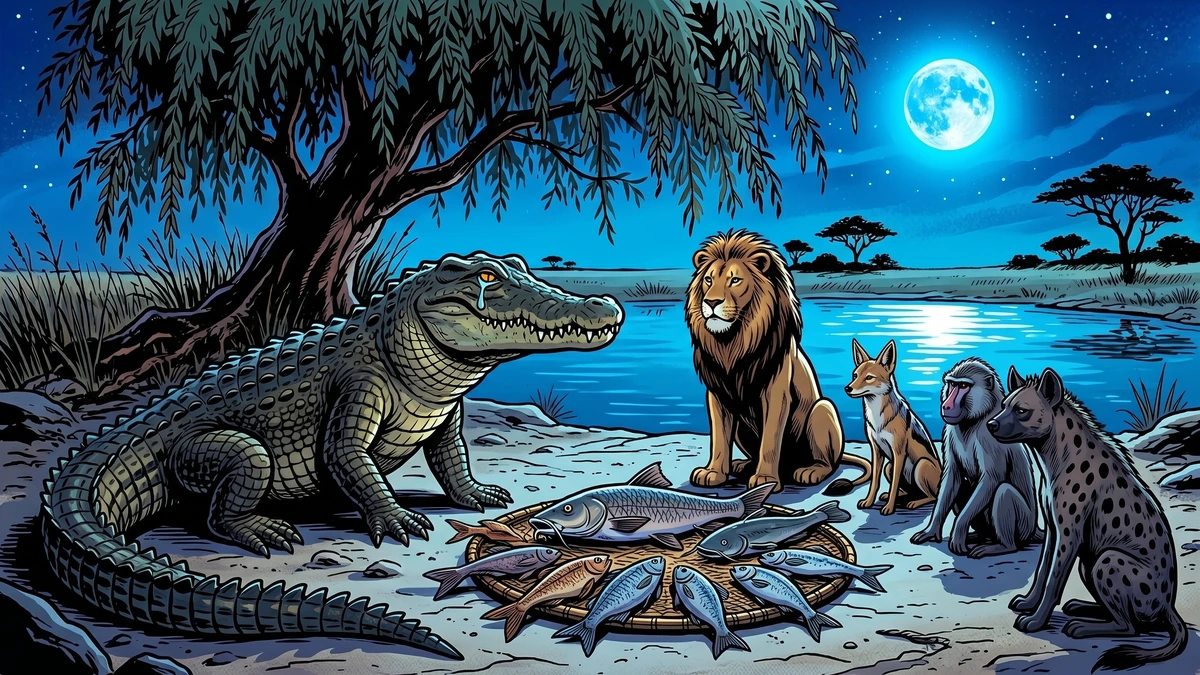
Lion read the proposal and was cautious. “What is going on now?” he thought. “I must consult Jackal first.” He sent word back that he would come the following evening, with his advisers, to Crocodile’s headquarters at the great vaarland willow at the far end of the water hole. When Tortoise and Alligator brought that answer home, Crocodile was delighted, and he ordered Otter and the others to lay out a generous feast of fish for the guests.
That night Lion arrived in the moonlight with his council — Wolf, Jackal, Baboon, and other animals of consequence — and Crocodile received them with open-hearted warmth. He was so moved by the gathering, the story says, that now and then he let fall a great tear of joy that vanished into the sand. When the land animals had eaten their fill of fish, Crocodile laid out his case. He spoke beautifully. He wanted only peace, he said; the animals were destroying one another while the real enemy, the Boer, was destroying them all. The farmer had set three steam pumps at the river’s source and was draining it dry; he was trapping the stranded water creatures in the shallows and killing them one by one. Surely it was to Lion’s glory to make peace and escort these desperate refugees to safety.
Only one voice cut against the warm current of the speech. “And what benefit shall we receive from it?” asked Jackal. Crocodile answered smoothly: peace would serve both sides. The land animals could come and drink without fear of being seized by the nose; in return, the water creatures would be freed from Elephant, who liked to toss crocodiles up into the narrow forks of trees and leave them to dry like biltong. Lion and Jackal stepped aside to confer, and Lion asked what security he would have that Crocodile would keep his word. “I stake my word of honor,” came the prompt reply — and Crocodile let a few more long tears of honesty drop into the sand. Baboon judged the offer fair and only sensibly suggested it be written down. Jackal alone would not be moved; he could see no good in it for the veldt. But Wolf, comfortable and full of fish, urged peace, and at last Lion agreed. A document was drawn up, and before midnight the great trek began.
The Secret Word to Yellow Snake
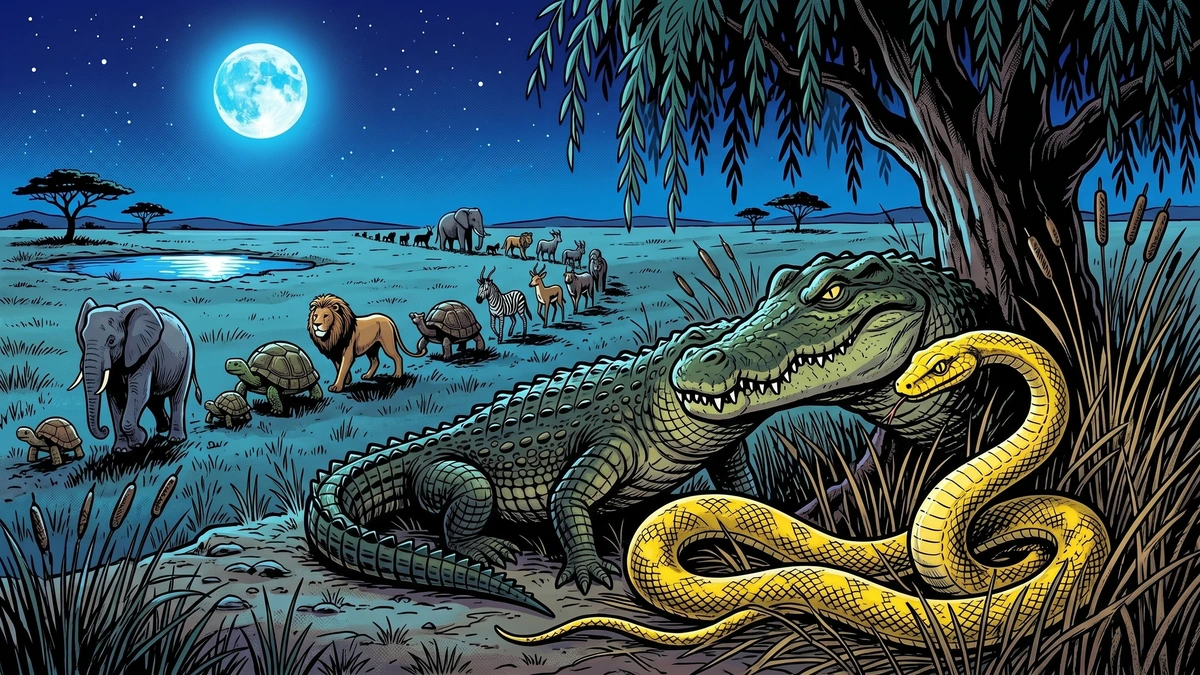
Here the story turns its blade. The trek was organized with military care: Jackal would scout ahead, Elephant would walk advance guard because he stepped so softly and heard and smelled so keenly, Lion would lead one division, Crocodile’s people would travel in the protected centre, and Wolf would bring up the rear. But Jackal’s distrust had not cooled. He drew Lion aside and spoke plainly: “See here, I do not trust this affair one bit. I am going to make tracks. I will spy for you until you reach the sea-cow pool, but I am not going to be the one to await your arrival there.” And he slipped away to the far side of the destination, to watch from safety.
He was right to. While the column was being arranged, Crocodile was quietly arranging his treason. He called Yellow Snake aside and gave him a chilling instruction. It was to the water animals’ advantage, Crocodile reasoned, to have the land animals — the very creatures who came down to the river every day — fall into the hands of the Boer. So Yellow Snake was to stay behind, unnoticed. When he heard Crocodile shout in triumph from the sea-cow pool, he would know the water creatures had arrived safely; then he was to creep to the farm and harass the Boer’s dogs — and the rest, Crocodile said with awful indifference, would look out for themselves. The treaty, the feast, the tears, the written document: all of it had been theatre, staged to march the trusting veldt animals straight under the Boer’s guns.
The Betrayal at the Sea-Cow Pool
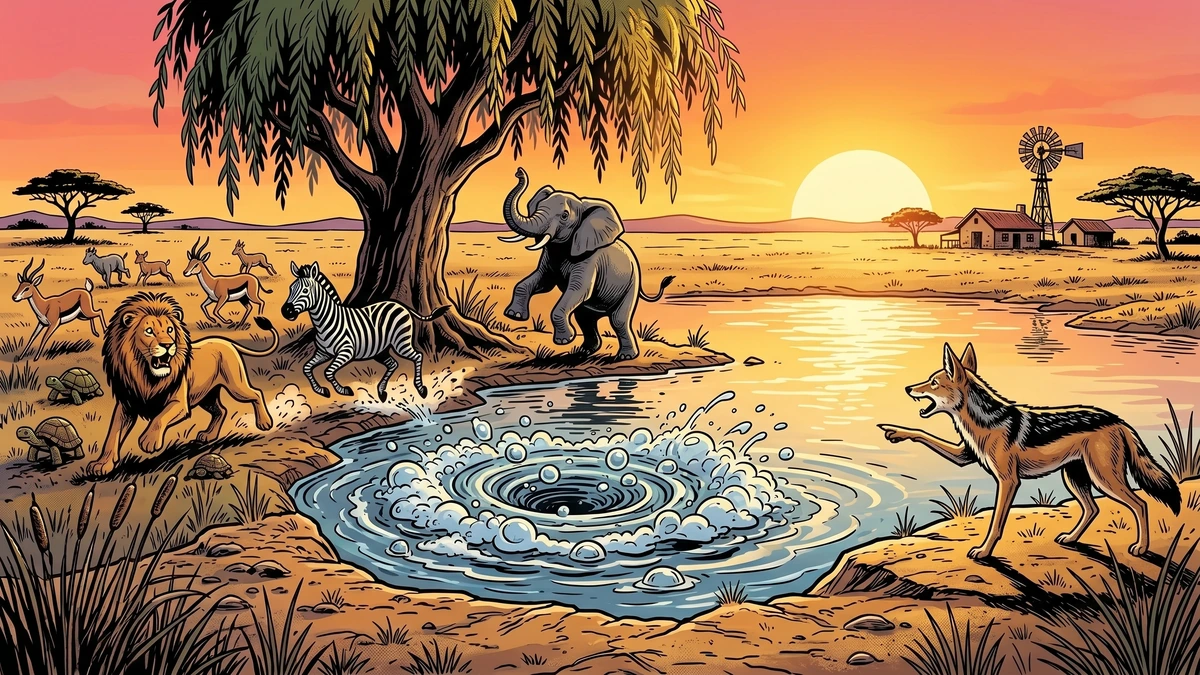
The trek moved off slowly, for many of the water creatures were unused to travelling on land, but it passed the Boer’s farm in safety and reached the great sea-cow pool toward daybreak. There the water animals slipped one by one into the deep, safe water. Crocodile prepared to follow them — but first, with tearful eyes, he told Lion how grateful he was, how overcome with relief and joy, and begged leave to give vent to his feelings with a few loud screams. He screamed until the mountains echoed. He thanked Lion at length on behalf of all his subjects, and he deliberately spun out a long, glowing speech about the blessings the peace would bring to both sides — keeping the king and his escort standing in the open while he did it.
Lion was just turning to say good day when the first shot rang out, and Elephant fell with it, and several other animals beside him. From across the sea-cow pool came Jackal’s voice, bitter and vindicated: “I told you all so! Why did you allow yourselves to be misled by a few crocodile tears?” Crocodile had long since vanished into the water; all that marked the spot was a trail of rising bubbles. On the bank a real war broke out, the Boers’ rifles crackling against the trapped and startled animals — though most of them, fortunately, escaped with their lives.
The tale ends with rough folk justice. Crocodile, they say, got his well-earned reward not long after, when he met a driver hauling a load of dynamite. And to this very day, the story finishes, whenever the Elephant gets the chance he still pitches crocodiles up into the highest forks of the trees — the old grudge of the veldt, never forgiven, never forgotten.
The Moral: The Cost of a Counterfeit Tear
“Crocodile’s Treason” is built around a single, hard idea: that the warmest words and the wettest eyes are exactly the disguise a betrayer will choose. Crocodile never raises his voice or bares a tooth. He weeps, he feasts his guests, he signs a document, he stakes his “word of honor” — and every gesture is a weapon. The tale teaches the listener to read the gap between performance and intent, and it places its trust not in the eloquent peacemaker but in the unpopular skeptic who keeps asking the rude question: and what benefit shall we receive from it?
“I told you all so! Why did you allow yourselves to be misled by a few crocodile tears?”
Jackal’s cry across the water is the story’s true verdict. He is not braver than the others and not stronger; he is simply unwilling to mistake a comfortable feeling for a safe one. Significantly, the storyteller does not let Crocodile escape into his bubbles unpunished. The dynamite cart is folk justice in its plainest form — the conviction, deep in the oral tradition, that treachery may win the day but rarely wins the year. The betrayer gains the river and loses everything else; his name becomes a byword, and centuries later children still learn the phrase crocodile tears as a warning that wears his face.
Why the Tale Has Lasted
This story has travelled well because its central image is one of the most durable in human culture. The weeping crocodile predates Honeÿ’s 1910 collection by many centuries: medieval European bestiaries and the widely copied Travels of Sir John Mandeville already described a beast that wept while it devoured its prey, and the expression “crocodile tears” had entered English long before this veldt version was written down. What the South African tale adds is a full political drama around that image — a treaty, a parliament of animals, a trek, a written contract — so that the proverb is no longer a curiosity but a story with named victims and a named cynic who saw it coming.
It has also lasted because it is a remarkably honest piece of frontier history in animal dress. The Boer’s steam pumps draining the river, the scramble for shrinking water, the fragile alliances struck between groups that would, in better times, prey on one another — these are the real pressures of a drought-prone land, transposed into a fable a child can hold. And finally it endures because of Jackal. Folk audiences love the trickster, but they love still more the trickster who is right and unheeded, because every listener has been, at some point, the one warning a room that would not listen. “Crocodile’s Treason” gives that figure his moment of grim, echoing satisfaction — and gives the rest of us a phrase to reach for whenever sorrow is suspiciously well rehearsed.
Frequently Asked Questions
Where does the story “Crocodile’s Treason” come from?
It was published in South-African Folk-Tales, compiled by James A. Honeÿ and issued by the Baker & Taylor Company of New York in 1910. Honeÿ’s collection of forty-four tales drew on Bushman (San), Khoikhoi (“Hottentot”) and Zulu traditions, along with stories translated from Afrikaans. “Crocodile’s Treason,” with its Boer farm, steam pumps, vaarland willow and commando of escorts, belongs to the Cape Dutch veldt branch of the jackal-and-lion cycle — the same South African trickster cycle made famous in English by W. H. I. Bleek’s Reynard the Fox in South Africa (1864).
What does the phrase “crocodile tears” mean, and how does this tale explain it?
“Crocodile tears” means false, performed grief — sorrow displayed for effect by someone who feels none. The expression is far older than this story; it appears in medieval bestiaries and travel writing describing a beast that wept while killing. In “Crocodile’s Treason” the crocodile literally weeps “tears of joy” and “tears of honesty” into the sand while he is planning the destruction of his guests, giving the proverb a complete narrative: the tears are the disguise, and the treachery is the truth beneath them.
Why is the jackal the hero of the story?
Jackal is the trickster-sage of the South African veldt cycle, and here his gift is not cunning trickery but clear sight. He alone asks what the land animals actually gain from the treaty, he alone distrusts Crocodile’s eloquence, and he alone refuses to wait at the destination — slipping instead to the far bank to watch from safety. When the ambush comes, his shout across the water, “I told you all so,” confirms him as the one honest reader of the situation. He is the tale’s model of the skeptic who is unpopular, ignored, and ultimately proven right.
What is the moral of “Crocodile’s Treason”?
The tale warns that warm words and visible emotion are not evidence of good faith — and may be its opposite. Crocodile betrays the veldt animals not with force but with hospitality, weeping, and a signed contract. The story teaches listeners to weigh intentions and incentives rather than performances, to value the cautious question over the comfortable speech, and it reassures them that treachery, though it may succeed for a moment, tends to earn its own punishment — as Crocodile does when he later meets the cart of dynamite.
Why does the story end by explaining the elephant and the crocodile?
The closing lines — that Crocodile met his reward at a dynamite cart, and that Elephant still flings crocodiles into the high forks of trees — are an etiological or “pourquoi” ending, a common feature of African oral tales (motif family A2200–A2599, animal characteristics). It ties the moral drama to the listener’s own world: the ancient grudge between elephant and crocodile is offered as living proof that the betrayal really happened, and that the veldt has never forgiven it.
You May Also Like
 African Folk Tales
Ages 9-12
African Folk Tales
Ages 9-12
The Omanhene Who Liked Riddles
The Omanhene Who Liked Riddles: The Omanhene is the chief of a village. A certain Omanhene had three sons, who were very anxious to see the world. They went to
 African Folk Tales
Ages 6-8
African Folk Tales
Ages 6-8
The Lion, The Jackal, And The Man
The Khoikhoi folk tale of a boastful lion whom a clever jackal humbles by leading him to meet a man — and the man, armed with dogs, fire and steel, proves the strongest creature of all.
 African Folk Tales
All Ages
African Folk Tales
All Ages
Quarcoo Bah-Boni
Quarcoo Bah-Boni: Once upon a time in a certain village lived a man and his wife who were childless. One day, however, when the husband was away hunting, the