Thunder And Anansi
Thunder And Anansi: There had been a long and severe famine in the land where Anansi lived. He had been quite unable to obtain food for his poor wife and
Thunder and Anansi is one of the best-loved spider tales of the Akan people of the Gold Coast — modern Ghana — and reaches English readers through West African Folk-Tales (London: George G. Harrap & Co., 1917), collected and retold by William H. Barker and Cecilia Sinclair. Barker, an educator and inspector of schools on the Gold Coast, worked with Sinclair to set down the Anansesem — the “spider stories” — that Twi-speaking families told around the evening fire. In the book it stands as the fourth tale, following the famous account of how all stories came to be called after Anansi. It is a story about hunger, a gift from the storm, and the small, fatal voice of greed.
A Famine, a Floating Palm, and a Broken Boat
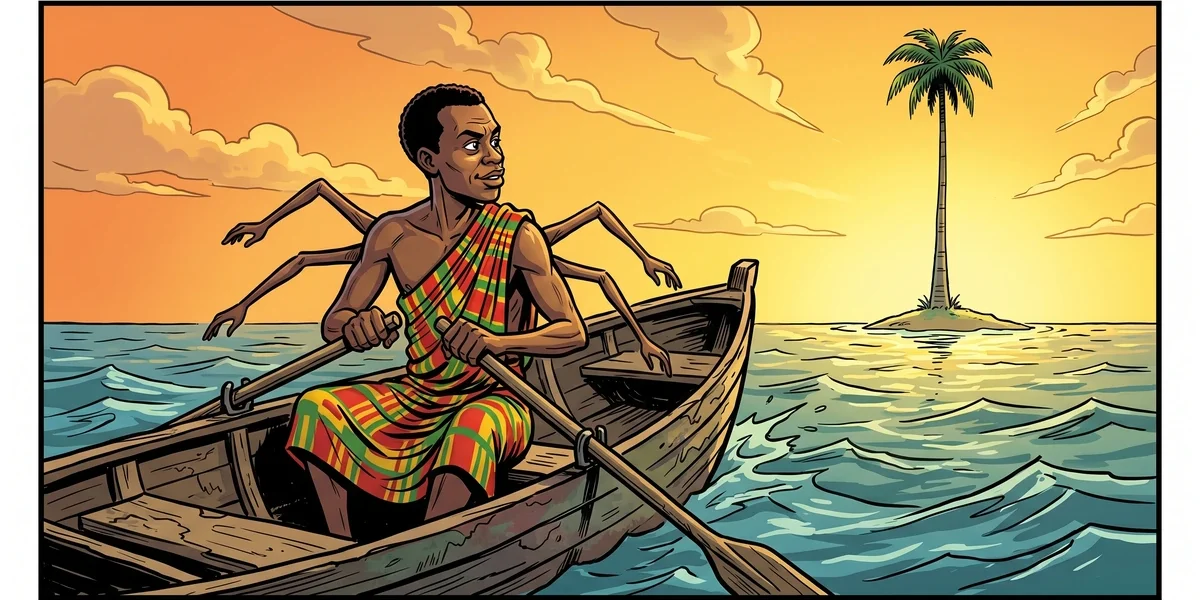
A long and severe famine had settled over the land where Anansi the spider lived, and however he searched he could find nothing to bring home to his hungry wife and children. One day, staring out to sea in despair, he saw a tiny island rise from the water with a single tall palm-tree growing almost straight out of the waves. Where there was a palm there might be nuts, and where there were nuts there might be a meal. The only question was how to reach it.
The answer lay waiting on the beach: an old, broken boat, battered and far from seaworthy. Anansi launched it anyway. Six times a great wave hurled him back onto the sand, and six times he dragged the boat out again, for he was nothing if not persevering. On the seventh attempt the sea let him pass. He steered the leaking hull as well as he could and at last tied it to the trunk of the palm.
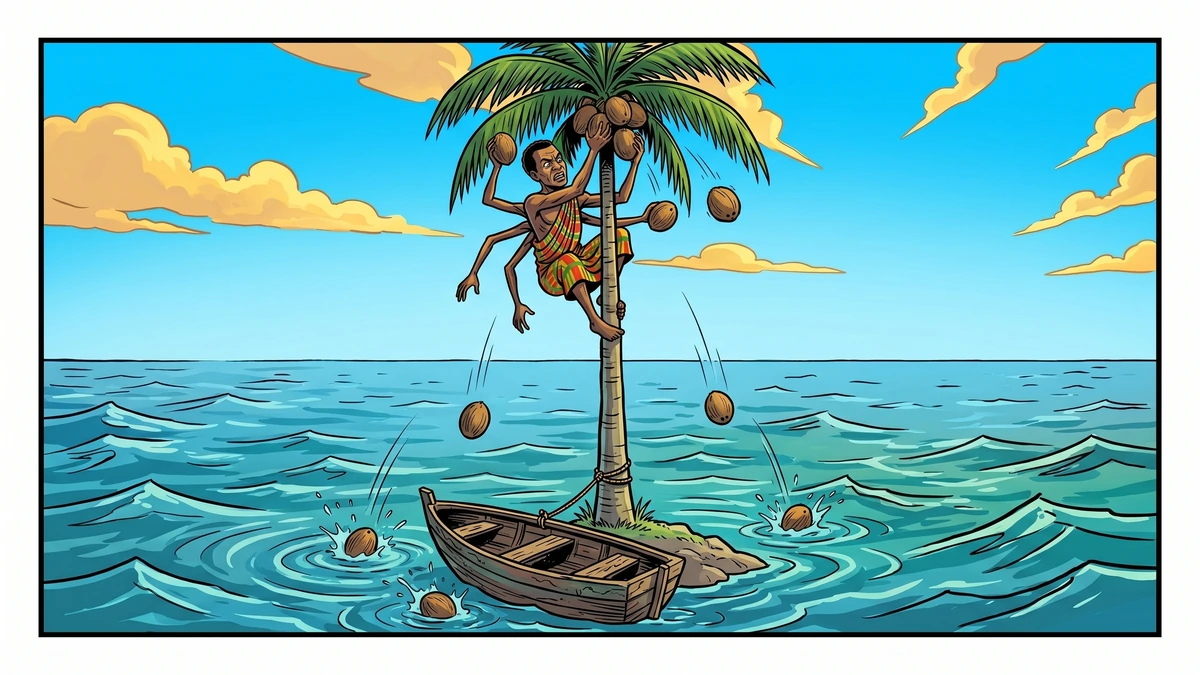
Then came the cruel part. Anansi climbed and plucked every nut within reach, dropping them one by one toward the boat below — and one by one every nut missed the boat and vanished into the sea. He aimed the very last one with desperate care. It too slipped into the water and was gone. He had not tasted a single nut, and now there were none left to taste.
Thunder’s Cottage Beneath the Sea
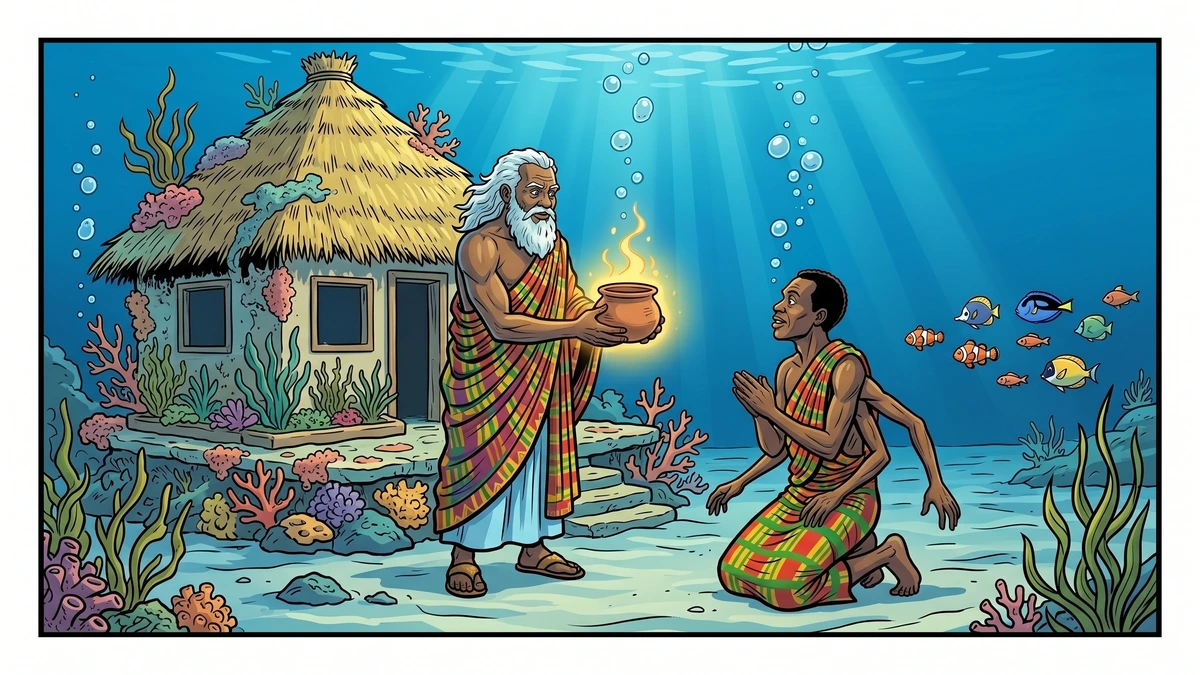
Anansi could not bear the thought of returning to his family empty-handed. In his despair he threw himself into the water after the lost nuts — expecting, perhaps, to drown. Instead he found himself standing on the sea-bottom before a pretty little cottage. An old man stepped out and asked the spider what he wanted so badly that he had come all the way down to Thunder’s cottage to find it.
Anansi told his tale of famine and failure, and Thunder — the storm himself, keeping a quiet house at the bottom of the ocean — was moved to pity. He went inside and brought out a fine cooking-pot, and he placed it in the spider’s hands. Anansi need never be hungry again, Thunder told him; the pot would always supply enough food for himself and for his whole family. The spider thanked the old man many times over and made his way back to the surface.
He could not wait to test the gift. The moment he was seated in the old boat he spoke the words Thunder had taught him — “Pot, pot, what you used to do for your master, do now for me” — and at once good food of every kind appeared before him. Anansi ate a long, hearty, delicious meal. The famine was beaten. His children would be saved.
The Secret Pot and the Watching Fly
And here the tale turns, as Anansi tales so often do, on the trickster’s own weakness. Rowing toward shore, his first thought was to run home and feed his starving family from the wonderful pot. But a second thought, small and selfish and greedy, crept in behind it: what if I use up all the magic of the pot on them, and have nothing left for myself? Better, he decided, to keep the pot a secret and enjoy his meals alone.
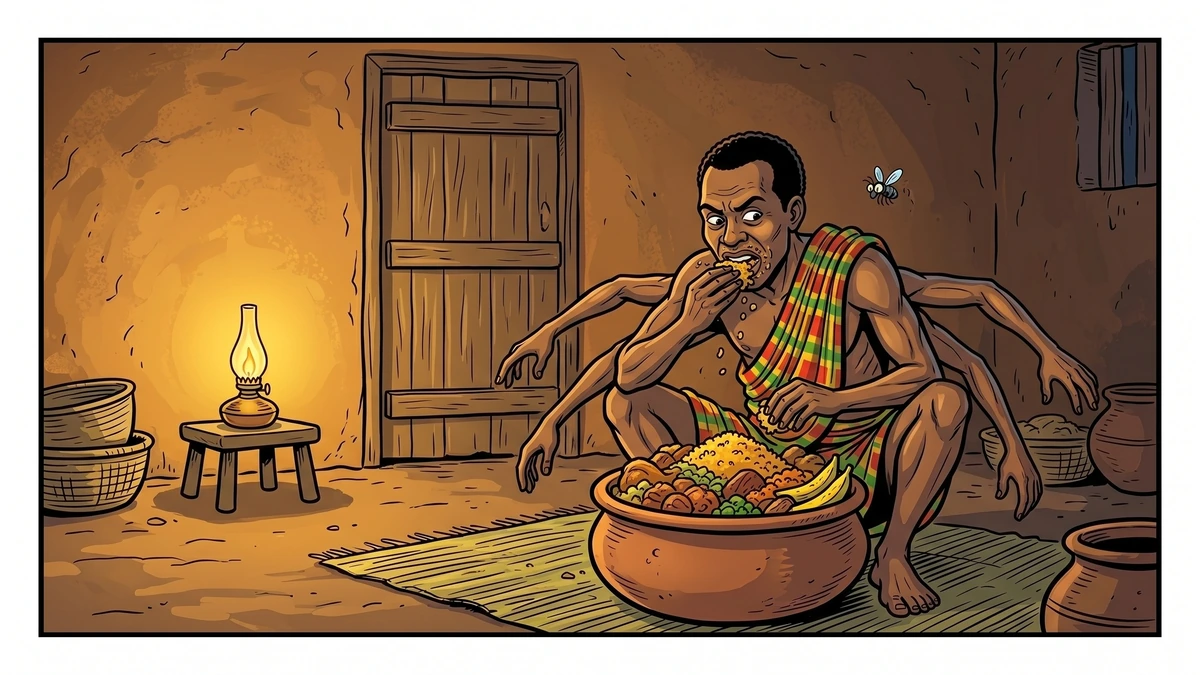
So Anansi came home pretending to be worn out with hunger and fatigue, and said there was not a grain of food to be found anywhere. His wife and children grew thinner and weaker by the day, while he slipped away to his locked room whenever hunger called and ate his fill from the hidden pot. They grew gaunt; he grew plump. A man cannot starve in plain sight and fatten in secret without his family beginning to wonder.
His eldest son, Kweku Tsin — who in these tales has the power to change himself into any shape he pleases — turned himself into a tiny fly and rode, unseen, on his father’s shoulder. He watched Anansi shut the door, lift the pot from its hiding place, eat a fine meal, and tuck the pot away again. The secret was out. As soon as Anansi left “to look for food,” Kweku Tsin fetched the pot and called his hungry mother and brothers and sisters to eat as well as their father had eaten.
Then Mrs. Anansi decided to punish her husband’s selfishness in the most generous way imaginable: she would carry the pot down to the village and give every hungry neighbour a meal. She did — but in cooking for so great a crowd at once, the pot grew too hot and melted clean away. The gift was destroyed. Fearful of Anansi’s anger, his wife forbade anyone to speak of it.
The Second Gift — and a Lesson Delivered by Hand
Anansi came home hungry, shut himself in his room, and reached into the hiding place — and found it empty. Someone had discovered his treasure. He said nothing, but he waited for the light of morning and then went straight down to the shore where the old broken boat lay.
This time the boat needed no coaxing. It set off of its own accord, gliding swiftly to the palm-tree. The nuts that had once tumbled into the sea now fell easily into his hands and into the boat — and Anansi, who had learned nothing at all, deliberately threw them overboard and dived after them, straight back to Thunder’s cottage.
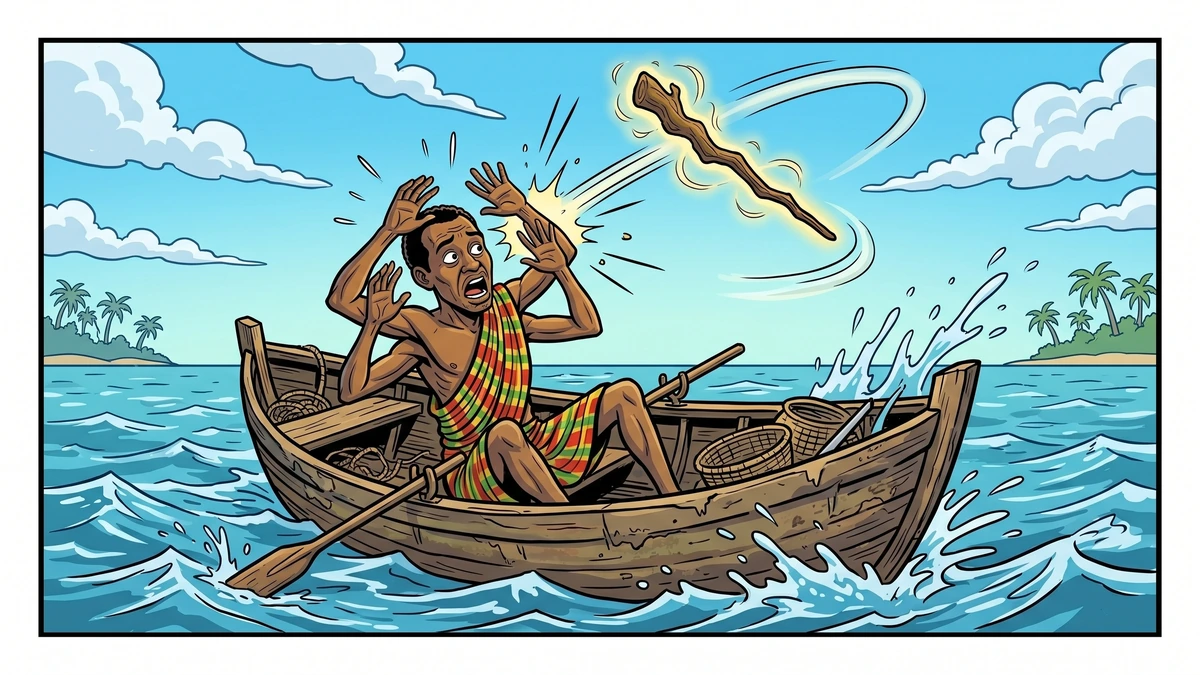
The old man listened to his new tale of woe with the same patient sympathy as before. But this time Thunder did not fetch a cooking-pot. He presented Anansi with a fine stick, wished him good-bye, and sent him on his way. Anansi, greedy and impatient as ever, could not even wait to reach home. Seated in the boat he commanded, “Stick, stick, what you used to do for your master, do for me also.”
The stick set about beating him — so hard and so fast that within minutes Anansi was forced to throw himself into the sea and swim for shore, leaving boat and stick to drift away wherever they pleased. He returned home at last, nursing his bruises and wishing, far too late, that he had acted more wisely from the very beginning.
The Moral of the Tale
The lesson of Thunder and Anansi is plain, and the storytellers never blunted it: the food that is hoarded turns to nothing, and the hand that grasps too tightly is the hand that is struck. Thunder’s pot was never a private prize. It was given to feed “himself and his family,” and the moment Anansi tried to keep its abundance for himself alone, the gift was already doomed. Generosity multiplies a blessing; greed melts it away in the pot.
The Akan have a proverb that the tale seems written to illustrate:
“Aniberɛ nyɛ yie.”
— Akan (Twi) proverb: “Covetousness never ends well.”
Notice, too, how the punishment fits the crime. Anansi’s second journey is an exact, mocking echo of his first — the same boat, the same tree, the same nuts, the same dive, the same cottage, the same sympathetic old man. Everything is repeated except the spider’s heart, which has not changed at all. Because he has learned nothing, he receives not a pot but a beating, and the beating is simply his own greed handed back to him with interest.
Origins, Source, and Tale-Type
This telling is the version recorded by William H. Barker and Cecilia Sinclair in West African Folk-Tales (Harrap, 1917), drawn from the oral tradition of the Akan (Ashanti and Fanti) peoples of the Gold Coast, the country known today as Ghana. The hero is Anansi — Kwaku Ananse, the spider — the supreme trickster of Akan storytelling, so central that the whole genre of fireside stories is called Anansesem, “Anansi stories.” Carried across the Atlantic during the era of the slave trade, Anansi became Aunt Nancy and Brer Anansi in the Caribbean and the American South, which makes these Gold Coast tales among the most widely travelled folklore on earth.
Folklorists classify Thunder and Anansi within the international tale-type ATU 563, “The Table, the Ass, and the Stick” (Aarne–Thompson–Uther index) — the family of stories in which a poor man receives magical objects that provide food and wealth, loses them through theft or carelessness, and is finally given a cudgel that thrashes the thief and recovers the loss. Its closest European cousin is the Brothers Grimm tale Tischchen deck dich, Goldesel und Knüppel aus dem Sack (“The Wishing-Table, the Gold-Ass, and the Cudgel in the Sack”), KHM 36. The relevant motifs in the Stith Thompson Motif-Index of Folk-Literature include D1472.1.8, the magic cooking-pot that supplies food; D861, the magic object lost; D1401.1, the magic stick that beats a person; and Q272 / W151, avarice and greed punished.
What the Akan version adds to that ancient frame is entirely its own: a giver who is Thunder, the storm, keeping a tidy cottage on the floor of the sea; a shape-shifting son who becomes a fly; and a wife whose “punishment” of her husband is an act of village-wide charity. The bones are international folklore; the flesh is unmistakably Ghanaian.
Thunder, the Sea-Cottage, and the Shape of the Telling
One of the quiet pleasures of this tale is its picture of Thunder. In much of West African belief the storm is a vast, frightening power, but Barker and Sinclair’s storytellers domesticate him completely: he is “an old man” who keeps a “pretty little cottage” on the floor of the ocean, listens patiently to a spider’s troubles, and gives gifts out of simple sympathy. The terror of the sky has become a kindly grandfather under the waves. That gentleness is essential to the story’s justice: when Anansi is finally punished, it is not because the giver was cruel, but because the receiver was greedy. Thunder offers the same patient kindness both times; only Anansi changes the outcome.
The telling is also shaped, as oral tales so often are, by patterning and by numbers. Anansi must launch the broken boat seven times before the sea relents — a number that signals, to an Akan audience, a trial that demands real endurance. The two voyages mirror each other almost line for line, so that the listener can feel the second one coming and brace for the variation. And the gifts themselves form a matched pair: a pot that feeds without limit and a stick that beats without mercy, abundance and chastisement handed across the same cottage threshold. A skilled teller can stretch or compress these repetitions to suit an evening’s audience, which is one reason the tale survives in so many forms.
It is worth remembering, too, how far this spider has travelled. During the centuries of the transatlantic slave trade, captives carried the Anansesem from the Gold Coast across the ocean, and Anansi resurfaced in the Caribbean and the American South as Aunt Nancy and as a cousin of the Brer Rabbit tales. A story about a hungry trickster and a vanishing pot of plenty thus became part of the shared inheritance of three continents — folklore that refused to drown.
Why the Tale Has Lasted
Anansi is never simply a hero or simply a villain, and that is the secret of his long life. He is clever, brave, and tireless — he launches a broken boat seven times against the sea — and he is also vain, secretive, and greedy enough to let his own children starve. He is, in other words, the part of every listener that wants to keep the good thing hidden. A tale that punished a monster would teach nothing; a tale that punishes Anansi teaches everyone, because everyone has felt the small selfish voice he obeyed.
The story has also lasted because it is built for the voice. Its structure is a near-perfect repetition with one savage variation, which makes it a delight to tell aloud and impossible to forget: children listening already know, the second time the boat glides to the palm, that the gift will not be a pot. And it has lasted because its economics are the economics of the village, where survival depended on sharing scarce food and where hoarding was not merely rude but dangerous. Thunder and Anansi dresses that hard communal wisdom in a comedy of a spider being chased around a boat by a stick — and a lesson that can make a child laugh is a lesson that child will keep for life.
Frequently Asked Questions
Who is Anansi in this story?
Anansi — Kwaku Ananse — is the spider trickster at the heart of Akan folklore from Ghana. He is so important to the storytelling tradition that the entire genre of fireside tales is named after him: the Anansesem, or “spider stories.” In Thunder and Anansi he shows both of his usual faces: the persevering, resourceful adventurer who reaches Thunder’s island, and the greedy hoarder whose selfishness brings the punishment of the beating stick.
Why did Thunder give Anansi a magic cooking-pot?
Thunder, who lives in a cottage on the sea-bottom, took pity on Anansi when the spider explained that a famine had left his family with nothing to eat. The pot was a gift of compassion, and Thunder was explicit about its purpose: it would always supply enough food “for himself and his family.” The gift was meant to be shared from the very start — which is exactly why Anansi’s decision to hide it was a betrayal of the gift itself.
How was Anansi’s secret discovered?
Anansi’s family grew suspicious because he became plump while they grew thinner and thinner. His eldest son, Kweku Tsin, who can change into any shape he chooses, turned himself into a tiny fly and followed his father unseen. He watched Anansi eat secretly from the hidden pot, and afterwards fetched it out to feed the whole hungry family.
What happened to the magic pot?
After the family ate from it, Mrs. Anansi decided to punish her husband’s selfishness by carrying the pot to the village and giving every neighbour a meal. But cooking for so large a crowd at once made the pot grow too hot, and it melted away entirely. When Anansi later went back to Thunder for a replacement, he was given not a pot but a stick — which beat him soundly.
What is the moral of Thunder and Anansi?
The tale warns against greed and selfish hoarding. A blessing meant to be shared is destroyed the moment it is kept for one person alone, and the second gift — the beating stick — shows that greed, repeated without remorse, simply returns to punish the greedy. As the Akan proverb has it, “Aniberɛ nyɛ yie”: covetousness never ends well. Generosity preserves a gift; greed melts it in the pot.
You May Also Like
 African Folk Tales
Ages 6-8
African Folk Tales
Ages 6-8
How The Tortoise Got Its Shell
How The Tortoise Got Its Shell: A few hundred years ago, the chief Mauri (God) determined to have a splendid yam festival. He therefore sent his messengers to
 African Folk Tales
Ages 3-5
African Folk Tales
Ages 3-5
Why Mosquitoes Buzz in People’s Ears
West African pourquoi chain-tale — a mosquito’s lie, a forest of fright, Mother Owl, and a guilty buzz — ages 3–5 / 6–8.
 African Folk Tales
Ages 9-12
African Folk Tales
Ages 9-12
Why The Lizard Continually Moves His Head Up And Down
Why The Lizard Continually Moves His Head Up And Down: In a town not very far from Anansi’s home lived a great king. This king had three beautiful daughters