Why Spiders Are Always Found In The Corners Of Ceilings
Why Spiders Are Always Found In The Corners Of Ceilings: Egya Anansi was a very skilful farmer. He, with his wife and son, set to work one year to prepare a
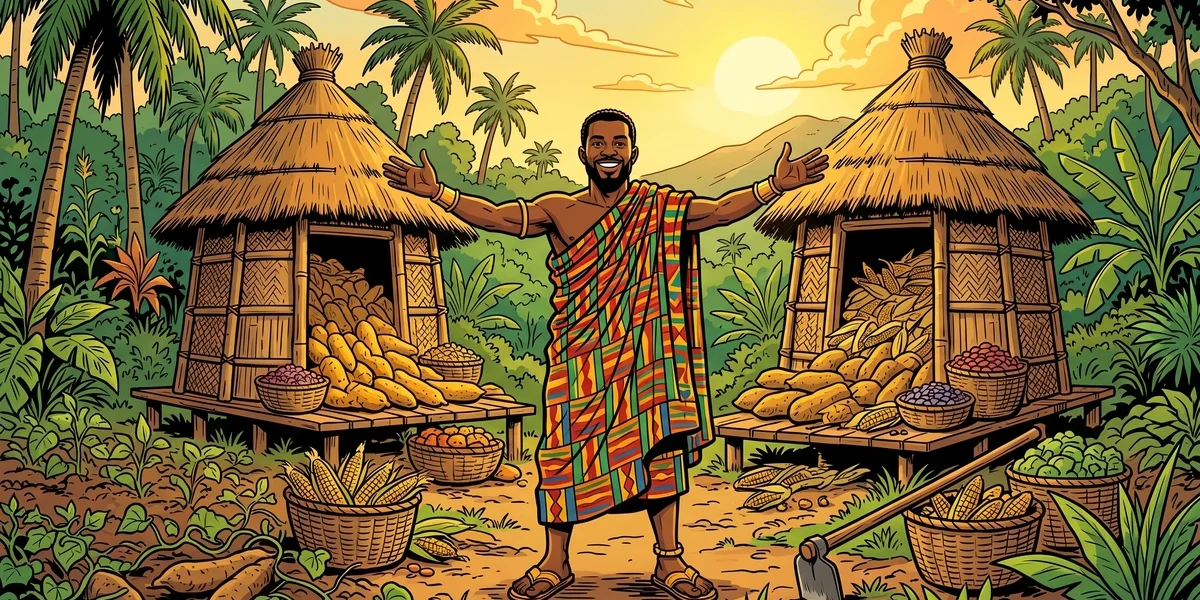
Why Spiders Are Always Found in the Corners of Ceilings is a pourquoi tale — an origin story that explains a small, everyday fact about the natural world. It belongs to the great Anansi cycle of the Akan peoples of the Gold Coast, the coastal forest region that is today the Republic of Ghana. The version retold here was collected in the early twentieth century by W. H. Barker and Cecilia Sinclair and published in their landmark anthology West African Folk-Tales (London: George G. Harrap & Co., 1917), where it appears among the opening Anansi stories. In Akan storytelling these spider tales are known collectively as Anansesem — literally “spider words” or “spider stories” — and the name came to mean folktales of every kind, so completely did the trickster spider dominate the tradition.
The tale answers a question a child might ask on any quiet evening: why do spiders always seem to hide in the high, dusty corners of a room? The storyteller’s answer is not biology but morality. The spider hides there, the tale says, because he is ashamed — and the shame is the whole point of the story.
A Harvest Too Large to Share
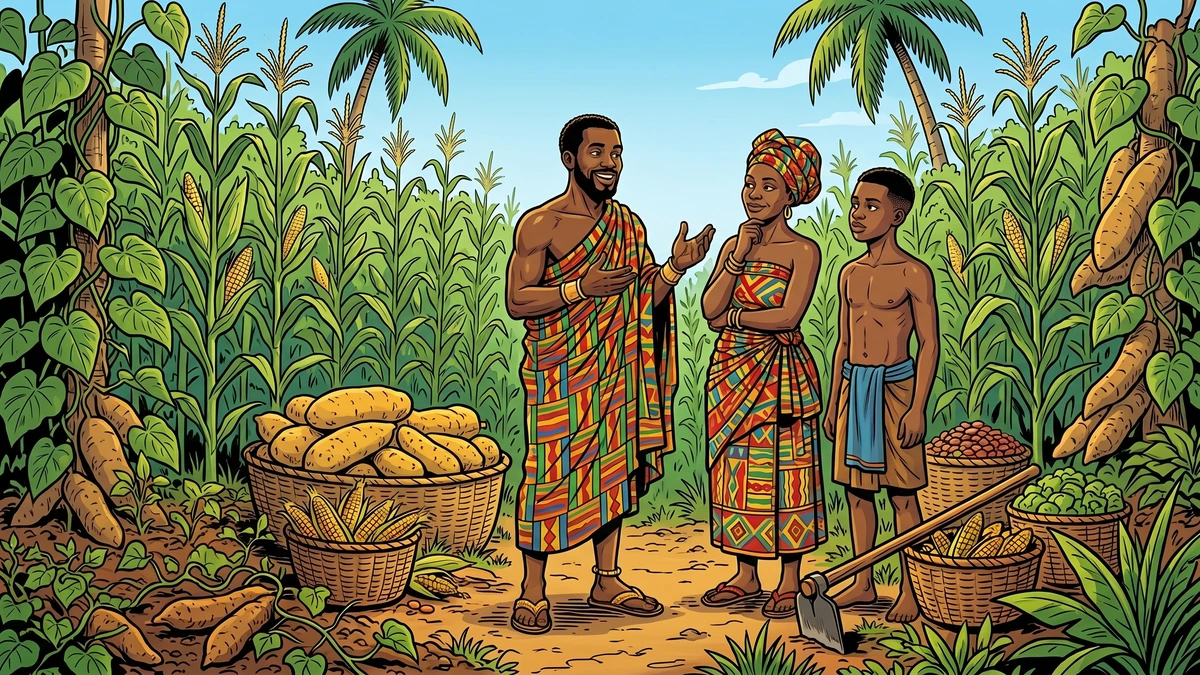
Egya Anansi was a very skilful farmer. The title Egya is an Akan term of respect, roughly “Father” or “Master” — and the storyteller grants it to Anansi with a touch of irony, for the tale is about to show how little he deserves it. One year Anansi, together with his wife and his son, set to work to prepare a farm far larger than any they had cleared before. They planted yams, maize, and beans, and the rains were kind. Their harvest came in ten times richer than any they had ever known, and Anansi looked over his swelling barns of corn and beans with deep satisfaction.
But Anansi was an exceedingly selfish and greedy man. He never liked to share anything — not with a neighbour, not with a friend, not even with the wife and son who had broken the same ground and pulled the same weeds beside him. Looking at the harvest their three pairs of hands had won, he began at once to plot how he alone might enjoy it.
So he called his wife and son to him and spoke in the warm, reasonable voice that greedy people keep for their cleverest lies. They had all worked very hard, he said, and the fields had repaid them well. Now they should gather the harvest into the barns and then rest. He proposed that his wife and son return to the family home in the village and take their ease there for two or three weeks, while he himself travelled down to the coast on urgent business. When he returned, he promised, the whole family would come back to the farm together and share a well-earned feast. His wife and son thought this a sensible and generous plan, and they agreed to it gladly. They walked home to the village, leaving Anansi to begin his journey — a journey he had not the slightest intention of making.
The Secret Feast
The moment his family was out of sight, Anansi set his real plan in motion. Instead of travelling anywhere, he built himself a snug little hut close to the farm. He stocked it with cooking pots and every utensil he needed, carried in a great store of corn and vegetables from the barns, and settled down to a long, solitary feast. Day after day he ate alone in his hidden hut, helping himself again and again to the grain that three people had grown.
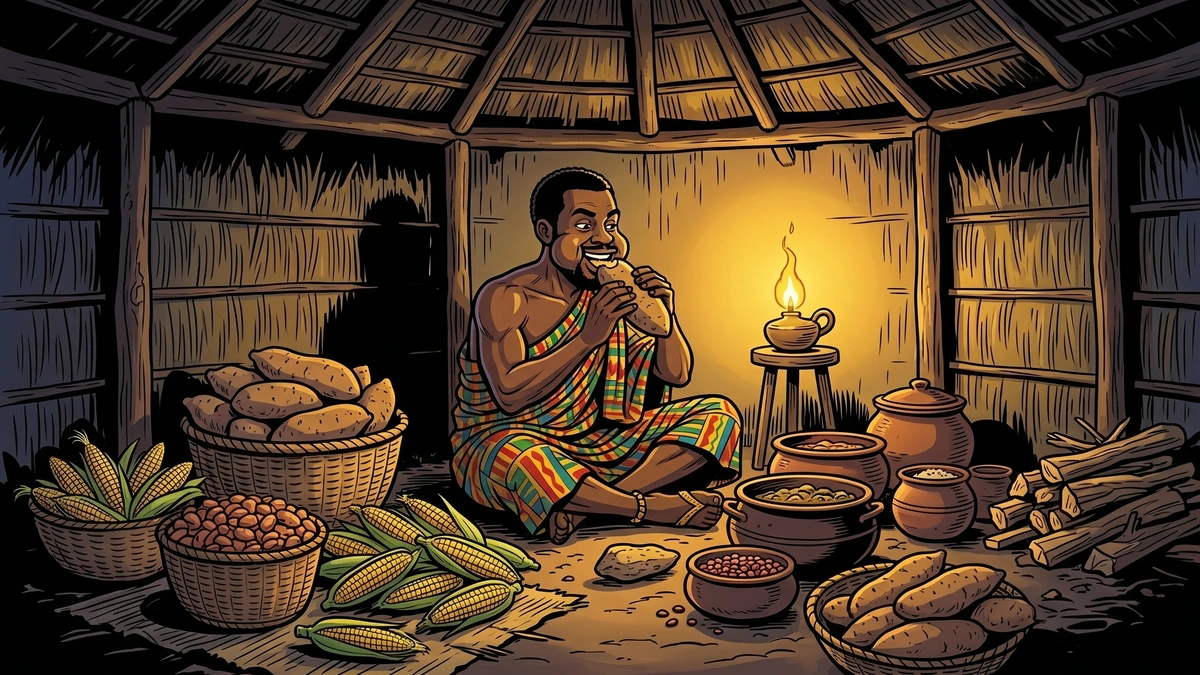
This went on for a full fortnight. There is a particular loneliness in the picture the storyteller draws here — a man surrounded by more food than he can possibly eat, and no one at all to share it with. The Akan listener was meant to feel it: the feast is supposed to be a punishment disguised as a pleasure. Anansi has exactly what he wanted, and exactly what he wanted turns out to be a small, dim hut and the sound of his own chewing.
The Rubber-Man in the Field
After two weeks had passed, Anansi’s son began to worry that the farm would be choked with weeds if no one tended it. Being a dutiful young man, he walked back out to the fields and spent several hours pulling weeds. As he passed one of the barns, he happened to glance inside — and stopped in dismay. More than half of their magnificent harvest was gone. Robbers, he thought; thieves had found the unguarded barns and were carrying off the family’s wealth. He hurried back to the village to raise the alarm.
The villagers listened, and together they devised a trap. They built a rubber-man — a life-sized figure of a man coated all over in sticky, gummy latex tapped from the forest trees. When evening fell they carried this silent, glistening figure out to the farm and stood it upright in the middle of the fields, where any thief was bound to meet it. Then Anansi’s son and some of the young men of the village hid themselves in one of the barns to keep watch through the night.
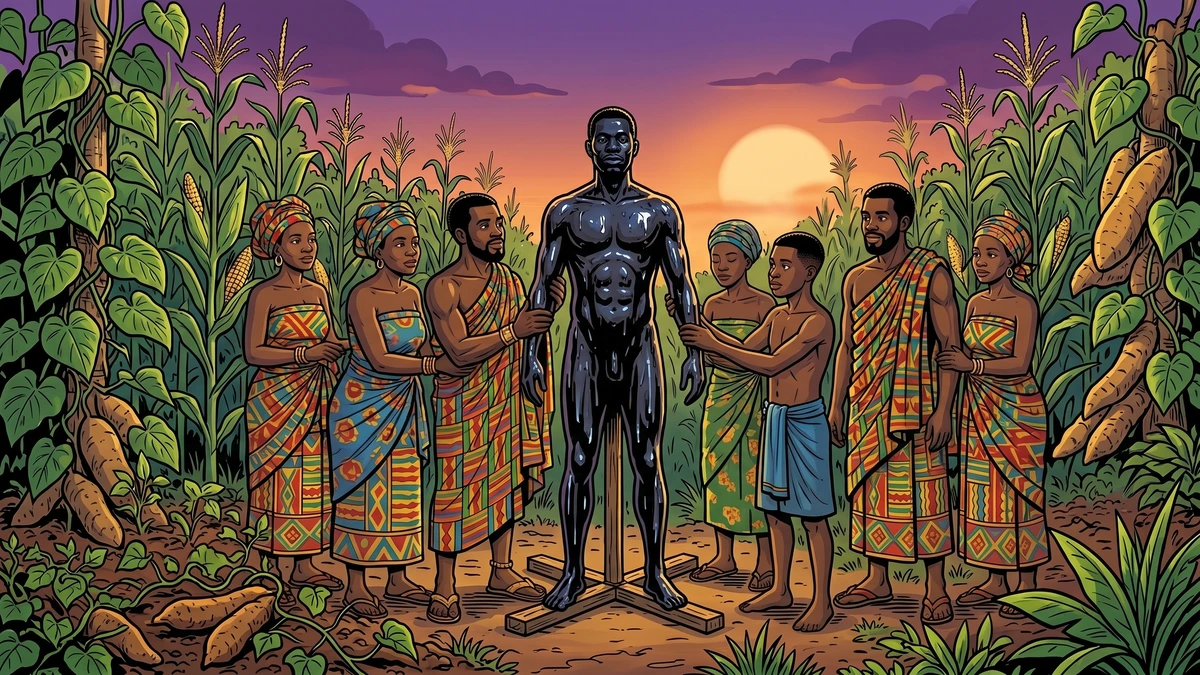
When full darkness came, Egya Anansi crept out of his hiding-place as usual to fetch another load of food. He had no idea the village knew anything. Halfway to the barn he saw the figure of a man standing in his path, and for a moment fear seized him. But the stranger did not move, and Anansi’s courage came creeping back. He marched up to the figure and demanded, “What do you want here?” There was no answer. He asked again, louder. Still nothing. Now genuinely angry, Anansi struck the figure across the cheek with his right hand — and his hand stuck fast.
“How dare you hold my hand!” he shouted. “Let me go at once, or I shall hit you again!” He swung with his left hand, and that stuck too. He shoved against the figure with his knees, and they stuck. He pushed with his chest, and that stuck. He butted with his head, and soon hands, arms, knees, body, and head were all glued helplessly to the rubber-man. There Anansi remained, fixed in the dark field, until the first grey light of dawn.
The Shame That Made a Spider
At daybreak Anansi’s son and the villagers came out, expecting to catch a stranger. Instead they found, stuck fast and squirming in the cold morning light, Egya Anansi himself — the farm’s own master, the man who had wept about urgent business on the coast, the father who had sent his family away so he could eat their harvest alone.
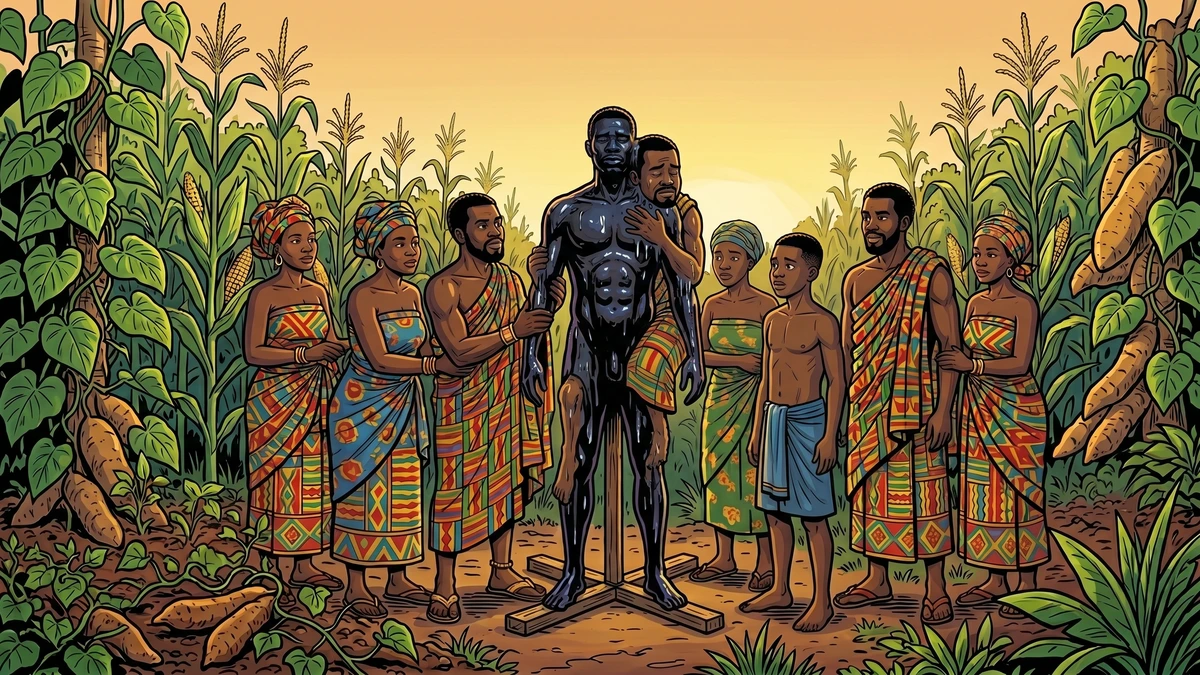
No one needed to say a word. The shame of being seen — caught in the very act of his greed, exposed before his son and his whole village — was more than Anansi could bear. He could not stand to have their eyes on him. And so, the tale says, he changed himself into a spider and scuttled away into a dark, dusty corner of the ceiling, where no one would look at him and where he could hide his face from the people he had cheated. From that day onward, the storyteller concludes, spiders have always been found in the high, shadowed corners of ceilings — not because the corners are comfortable, but because that is where shame goes to hide.
The Anansi Cycle and the Gold Coast Storytellers
Anansi (also spelled Ananse or Kwaku Ananse) is the most beloved and most complicated figure in Akan oral literature. He is a trickster: clever, hungry, lazy, vain, sometimes a hero and very often a fool. The same body of stories that praises his cunning also punishes his greed, and an Akan audience felt no contradiction in this — Anansi is a mirror, and a mirror shows you whatever you bring to it. Children laughed at him; elders used him to teach. The tales were performed in the evenings, frequently with songs, call-and-response, and a formal disclaimer at the start and end — “We do not really mean, we do not really mean, that what we are about to say is true” — which freed the storyteller to speak hard truths inside a comforting fiction.
When the British educator W. H. Barker, working in the Gold Coast, gathered these tales with Cecilia Sinclair for their 1917 collection, they were preserving a tradition that had already travelled astonishingly far. During the centuries of the transatlantic slave trade, enslaved Akan people carried Anansi with them across the ocean. He survived the Middle Passage in memory and became “Aunt Nancy” in the American South and “Anansi” throughout the Caribbean, where his stories remain central to Jamaican folklore to this day. Few folktale characters have proven so portable, or so stubbornly alive.
The Tar-Baby: A Trap That Crossed an Ocean
The most striking feature of this tale is the rubber-man — the sticky figure that captures the thief by holding fast to every blow struck against it. Folklorists recognise this at once as the “tar-baby” motif (catalogued as motif K741, “Capture by tar-baby,” and associated with international tale-type ATU 175). It is one of the most widely distributed plot devices in all of world folklore, appearing in West African, Caribbean, and African-American storytelling — most famously in the Brer Rabbit tales recorded in nineteenth-century North America, which descend directly from this same African root.
The motif works because it dramatises a deep moral idea in a single physical image: the trap does not grab the thief — the thief grabs the trap. Every time Anansi strikes out in anger, he binds himself more tightly. His own aggression is the glue. A listener does not need the lesson explained; they have watched a greedy man build his own cage out of his own bad temper, one furious blow at a time.
The Moral
This tale teaches that greed isolates the greedy. Anansi begins the story rich, surrounded by family, respected enough to be called Egya. He ends it alone in a ceiling corner, hiding from everyone he knows. He did not lose his community to bad luck or to an enemy — he traded it away, deliberately, for the chance to eat a harvest by himself. The story’s quiet genius is that it never needs to invent a punishment for him. His greed is the punishment. The solitary feast he schemed so hard to win is the very thing that makes him wretched.
The Akan have a famous proverb, carried in one of their best-known Adinkra symbols, the Funtunfunefu Denkyemfunefu — the two-headed crocodile with a single shared stomach:
“Funtunfunefu, denkyemfunefu, wǫwǫ yafunu koro; nso wo didi a, na worefom efisɛ aduane no yɛ dɛ no, ǫfaako.”
— Twi proverb: “The two crocodiles share one stomach, yet they fight over food — for the sweetness of the food, each tastes it in his own throat.” The image rebukes selfishness: those who are truly bound together gain nothing by competing, because what feeds one feeds all.
Anansi never learned what the crocodiles teach. He treated his own wife and son as rivals at the harvest rather than as the other heads of a single body, and the tale makes sure he discovers, too late, that a feast eaten alone is no feast at all.
Why This Story Has Lasted
A pourquoi tale survives because it ties a moral lesson to something a listener can see with their own eyes for the rest of their life. Long after the plot details fade, the spider in the ceiling corner remains — and every time a child notices one, the story is quietly retold. The tale turns an ordinary household sight into a permanent, gentle reminder: this is what greed looks like; this is where it ends up.
It lasts, too, because its psychology is exact. The story understands that the sharpest consequence of being caught doing wrong is not the punishment but the shame — the unbearable weight of being seen. Anansi is not jailed or beaten. He simply cannot endure the eyes of the people he wronged, and so he removes himself from the human world entirely. Generations of listeners, from the Gold Coast forests to the Caribbean and the Americas, have recognised that feeling instantly. The tale endures because it is true to how wrongdoing actually feels from the inside — and because it offers, underneath the humour, a hopeful counter-lesson: that belonging is worth more than abundance, and that the surest way to be left alone is to refuse to share.
Reading This Tale With Children
This is an unusually rich story to read aloud, because its lesson is waiting on the ceiling of almost every room a family will ever sit in. After the story ends, a parent can simply point upward at the next spider’s web and ask, “Do you remember why he’s up there?” That single gesture turns a piece of furniture-corner clutter into a living moral lesson the child will carry for years.
The tale also rewards pausing partway through. When Anansi sends his family back to the village with his honeyed speech, a young listener can be asked: “Do you believe him? Does his family believe him?” Children are often quicker than adults to sense the lie, and naming it aloud lets them feel the difference between Anansi’s reasonable-sounding words and his real intentions. Later, when the rubber-man appears, a child can be invited to predict what will happen — most will guess the trap will catch the thief, and the satisfaction of being right deepens their attention to the ending. The closing question worth asking is the gentlest one: “Anansi got the whole harvest he wanted. Was he happy?” The answer — that he ended up alone, hiding, ashamed — is the entire teaching of the tale, and it lands far harder when a child arrives at it themselves than when an adult announces it.
Frequently Asked Questions
Where does the tale “Why Spiders Are Always Found in the Corners of Ceilings” come from?
It is a traditional pourquoi (origin) tale of the Akan peoples of the Gold Coast — modern Ghana — and part of the great Anansi spider-trickster cycle known in Twi as Anansesem. The widely read English version comes from West African Folk-Tales, collected and arranged by W. H. Barker and Cecilia Sinclair and published by George G. Harrap & Co. in 1917, where it appears among the opening Anansi stories.
Who is Egya Anansi?
Anansi is the most famous trickster of West African folklore — a spider who is also, in many tales, a man. He is clever, greedy, vain, and funny, sometimes a hero and just as often a fool. The prefix Egya is an Akan title of respect meaning roughly “Father” or “Master,” used here with quiet irony, since the story is about to reveal how unworthy of respect Anansi’s conduct is.
What is the “rubber-man” and why does it catch Anansi?
The rubber-man is a life-sized human figure coated in sticky latex tapped from forest trees, set up in the fields as a trap for the thief. Folklorists call this the “tar-baby” motif (motif K741, tale-type ATU 175). It catches Anansi because he attacks it: every angry blow he strikes glues another limb fast, so his own aggression becomes the trap that holds him.
What is the moral of the story?
The tale teaches that greed isolates the greedy. Anansi schemes to enjoy an entire harvest alone and succeeds — but the solitary feast he wins is exactly what makes him miserable, and being caught in his greed shames him so deeply that he hides from his whole community forever. The story shows that belonging and sharing are worth more than abundance, and that selfishness ultimately punishes itself.
How is this tale connected to the Brer Rabbit stories?
Directly. During the transatlantic slave trade, enslaved Akan people carried the Anansi tales — including this tar-baby trap — across the ocean. The motif resurfaced in the African-American Brer Rabbit stories of the nineteenth-century South and in Caribbean folklore, where Anansi became “Aunt Nancy” and remains a central figure, especially in Jamaica. This story is one root of a storytelling tradition that now spans three continents.
You May Also Like
 African Folk Tales
Ages 6-8
African Folk Tales
Ages 6-8
How Wisdom Became The Property Of The Human Race
How Wisdom Became The Property Of The Human Race. Long ago, wisdom belonged only to a few. Learn how one person changed everything by sharing knowledge.
 African Folk Tales
Ages 6-8
African Folk Tales
Ages 6-8
Elephant and Tortoise
A southern African Bushman tale: proud Elephant quarrels with Rain, claims the last water of a drought-stricken plain, and is undone by the patient wit of Tortoise.
 African Folk Tales
Ages 6-8
African Folk Tales
Ages 6-8
How The Tortoise Got Its Shell
How The Tortoise Got Its Shell: A few hundred years ago, the chief Mauri (God) determined to have a splendid yam festival. He therefore sent his messengers to