Why The Lizard Continually Moves His Head Up And Down
Why The Lizard Continually Moves His Head Up And Down: In a town not very far from Anansi’s home lived a great king. This king had three beautiful daughters
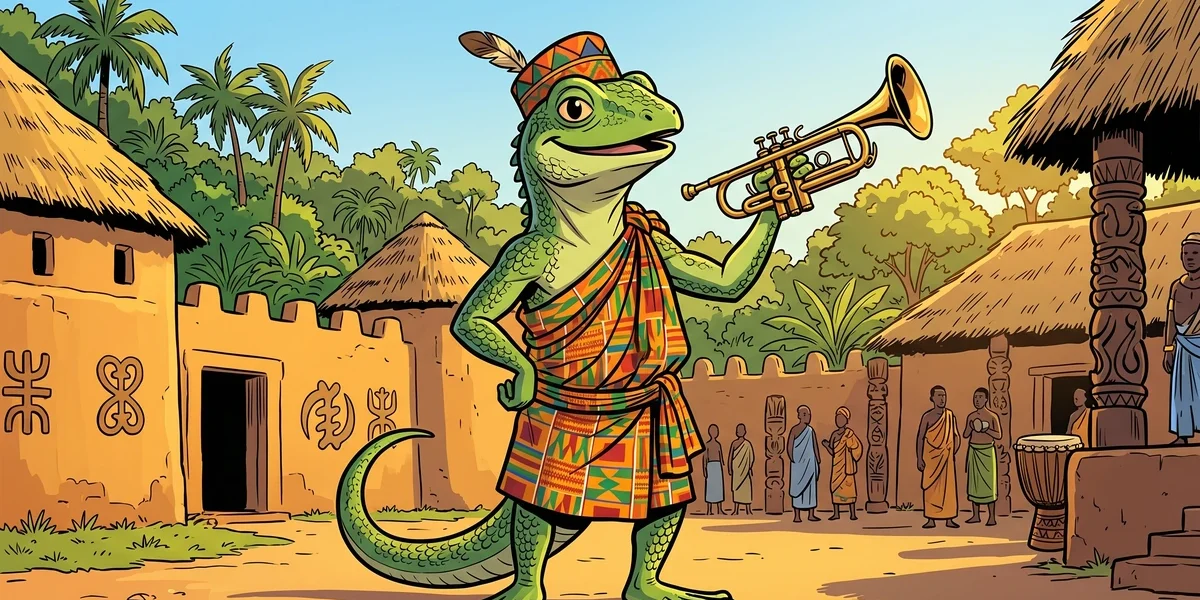
Few creatures of the West African forest are watched with such quiet amusement as the lizard. He darts across a sun-warmed wall, halts, and then begins the curious gesture that everyone in the Gold Coast countryside knows by heart — a slow, steady bobbing of the head, up and down, up and down, as though he were forever agreeing with some unseen speaker or forever asking a question no one will answer. To the Akan storytellers who first shaped this tale, that nodding was not an accident of anatomy. It was the lasting mark of an old injustice, the visible scar of a day when a trusting friend was silenced and a clever spider walked away with everything he wanted. Why the Lizard Continually Moves His Head Up and Down is the story of that day.
This is a pourquoi tale — an etiological story that explains why the natural world looks and behaves as it does — and it belongs to one of the richest storytelling traditions on the African continent: the cycle of Anansi the spider. Beneath its gentle humour lies a sharp warning about trust, gratitude, and the danger of handing your secrets to someone who has not earned them.
A Pourquoi Tale from the Anansi Cycle of the Akan People
This story was recorded in West African Folk-Tales, compiled by William H. Barker and Cecilia Sinclair and published in London by George G. Harrap & Company in 1917. Barker, an educationist who worked in the Gold Coast (modern Ghana), gathered the tales with Sinclair to preserve the oral literature of the Akan peoples — principally the Ashanti (Asante) and Fanti communities — for young readers both in Africa and abroad. The collection is one of the standard early printed sources for the Anansi cycle in English.
In Akan culture these stories are called Anansesem, literally “spider stories” or “words about Ananse.” The term came to mean folktales in general, so central was the spider to the whole tradition. The hero-trickster is Kwaku Ananse, a figure who is part man, part spider, and entirely unpredictable — sometimes a culture hero who wins wisdom and stories for humankind, and sometimes, as here, a greedy schemer whose cleverness curdles into cruelty. Carried across the Atlantic during the era of the slave trade, Anansi survived in the Caribbean and the Americas as Anancy, Aunt Nancy, and Brer Anansi, making him one of the most widely travelled characters in world folklore.
Folklorists classify the tale by its working parts. The contest to discover the princesses’ hidden names turns on motif H521, “Test: guessing a person’s name,” the same narrative engine that drives the European tale of Rumpelstiltskin (Grimm, ATU 500). The cruel second half rests on motif K2155, “False evidence,” and motif K401, “Blame for theft fastened on a dupe,” in which a guilty trickster plants stolen goods on an innocent victim. The closing explanation belongs to the broad etiological family A2470–A2479, “Why animals have particular habits.” The tale therefore weaves a riddle-contest, a frame-up, and a pourquoi ending into a single, tight piece of moral instruction.
The Riddle of the Three Secret Names
In a town not far from Anansi’s home there lived a great king who had three daughters, each more beautiful than the last. Their names were guarded as a treasure; no one outside the royal household was permitted to know them. One day the king made a proclamation that rang through the markets and the farms: any man who could discover the names of all three princesses would be given them as his wives.
For most men this was an impossible challenge, and they let it pass. But Anansi the spider heard the proclamation and made up his mind at once. Where others saw a locked door, Anansi saw a puzzle, and Anansi loved a puzzle far more than he loved honest work. He did not ask the king for a hint, nor did he court the princesses openly. Instead he sat in the cool of his web and thought, turning the problem over with the patience of a creature who spins all day, until a plan as fine and as strong as spider-silk had taken shape in his mind.
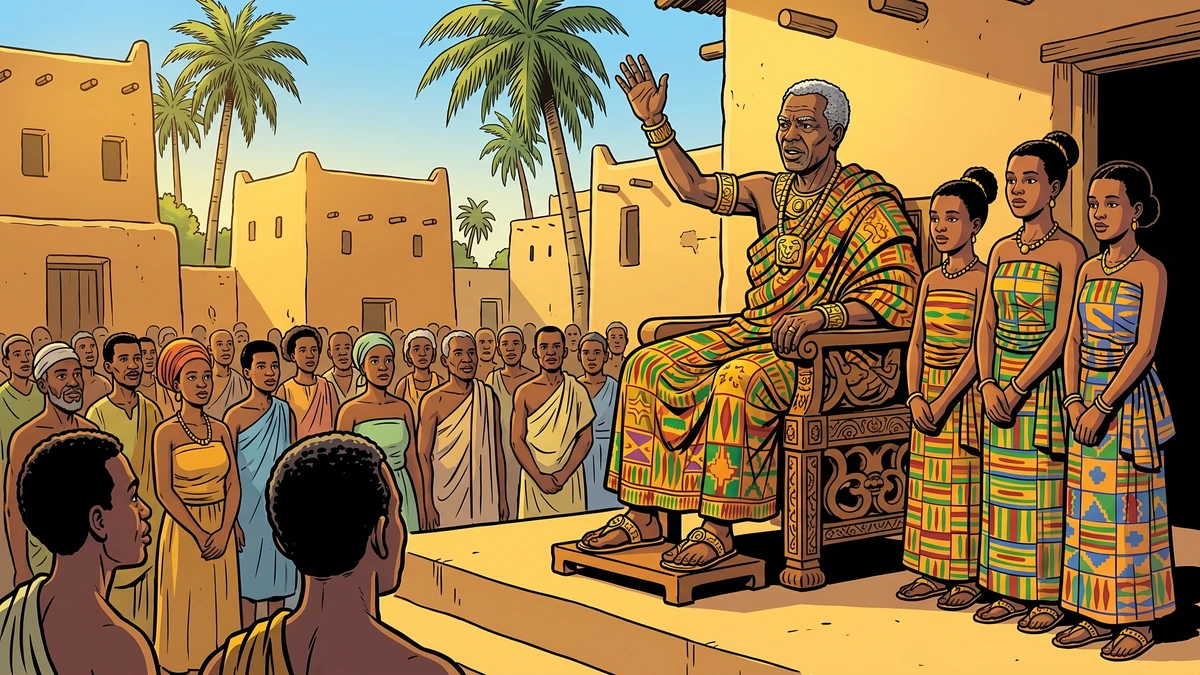
The riddle of the names is the moral heart of the opening. A name, in Akan thought as in many traditions, is not a mere label but a piece of a person’s identity and power. To know a name is to hold something of its owner. The king has built his contest on the reasonable belief that a secret kept inside one family is a secret safe. The story is about to show how fragile that belief can be when a determined trickster decides to break it — and how the breaking of a secret rarely stops with the one who first lets it slip.
Honey on the Fruit, Names on the Wind
Anansi’s plan was a small masterpiece of patience. He bought a large jar of honey and carried it to the bathing-place by the river where the king’s daughters came each day. There he climbed a tree heavy with fine ripe fruit, picked the best of it, and poured the honey thickly over each piece. Then he settled among the leaves and waited, as still as a knot of bark.
When the three princesses approached, Anansi let a single honeyed fruit drop to the ground. The eldest thought it had simply fallen of its own accord, and she ran to pick it up. The moment she tasted its astonishing sweetness she could not keep the delight to herself — she called out to her sisters by name, urging them to come and taste. Anansi, hidden above, heard the first name and held it. He dropped a second fruit. The second princess seized it, and she in her turn cried out the names of the other two. By the time the third fruit had fallen, Anansi the spider knew, beyond any doubt, every one of the three guarded names.
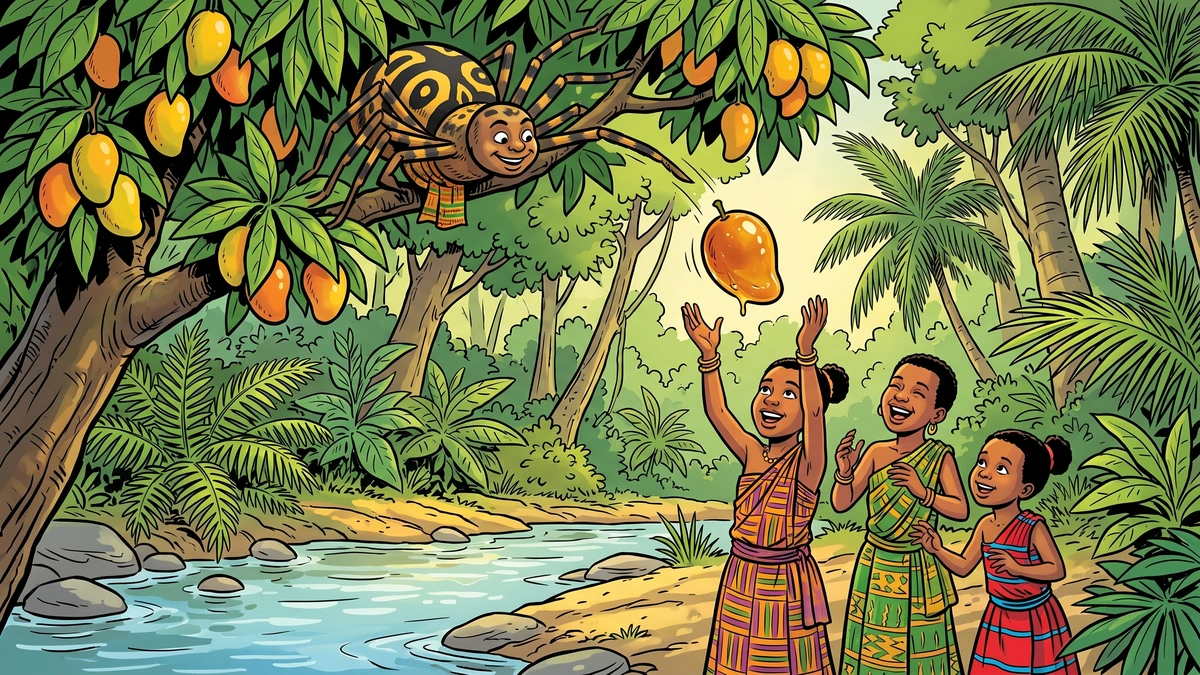
It is worth pausing on how the secret is actually lost. The king’s walls did not fail. No spy crept into the palace. The names escaped because of an entirely human, entirely innocent impulse: a girl tasting something delicious wanted to share her joy, and joy is loud. Anansi did not steal the secret so much as he built a small trap of sweetness and let the princesses’ own happiness spring it. This is the trickster’s deepest art — not force, but the careful arrangement of circumstances so that his victims do his work for him. The tale quietly warns that the things we let slip in our most unguarded, generous moments can be gathered up by watchful ears.
The Herald Who Won the Brides
Now Anansi made his single, fateful mistake — though he would not have called it that. Knowing the names was not enough; he wanted them announced before the whole court with proper ceremony, so that his triumph would be public and undeniable. So he went to his friend the Lizard and asked him to serve as herald. Lizard owned a fine trumpet and had a herald’s carrying voice. Anansi told Lizard the three secret names and instructed him to sound them through the trumpet when the court was assembled.
Early the next morning the king and his courtiers gathered, and the great men of the town came as Anansi had summoned them. Anansi stated his business and reminded the king of his promise. The king demanded to hear the names — and it was Lizard, not Anansi, who lifted the trumpet to his lips and sounded all three, clear and true, through the assembly. The court was astonished. And the king, bound by his own royal word, could not break the promise he had made to the man who named his daughters. He looked at the herald who had spoken the names aloud, and he gave all three princesses to Mr Lizard.
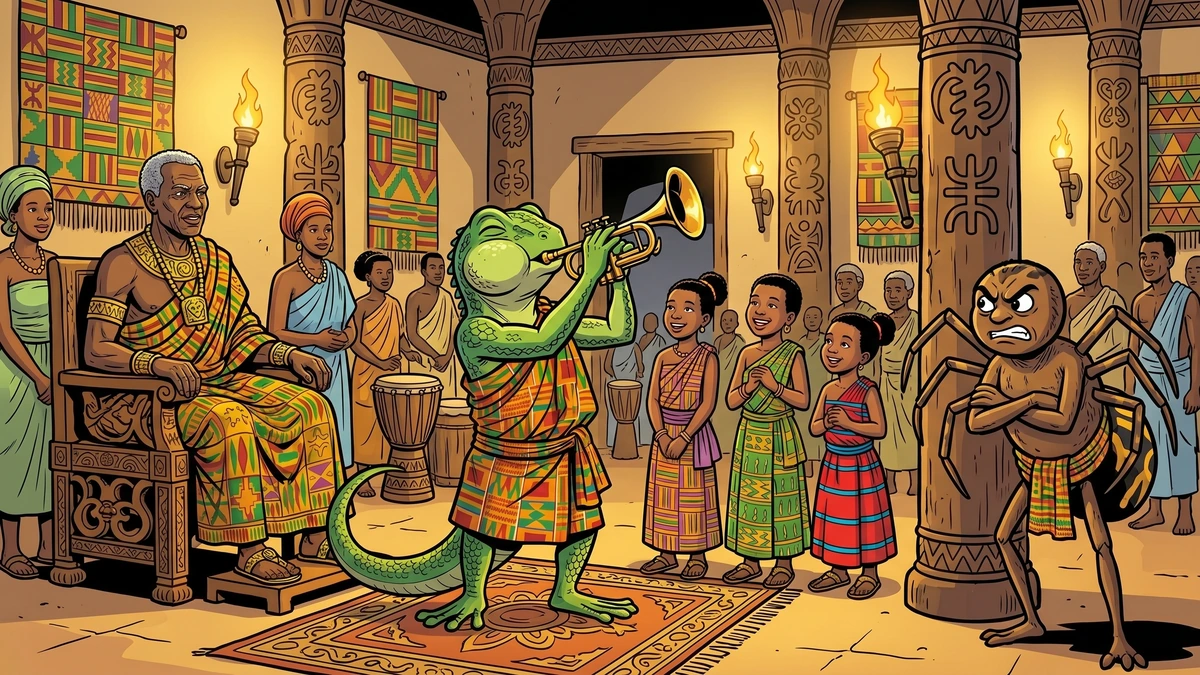
Anansi was furious. He protested that he had discovered the names, that Lizard had only repeated what he was told, that he deserved at least two of the brides and would graciously allow Lizard the third. The king refused. Anansi begged for even one. The king refused again. The proclamation had said the prize would go to the man who found out the names — but the court had heard them from Lizard’s trumpet, and the king’s word was law. Anansi went home in a black temper, vowing revenge on the friend he believed had stolen his wives.
There is a rough justice in this twist that the Akan audience would have relished. Anansi is not robbed by an enemy; he is undone by his own vanity. Had he sounded the names with his own voice, the brides would have been his. He wanted a herald, a spectacle, a stage — and the law gave the prize to the creature on the stage. The trickster is caught in a trap of his own design, and the tale lets us enjoy that for a moment before it turns dark.
Anansi’s Revenge and the Silenced Tongue
Anansi turned his cleverness, which might have been spent on anything, entirely toward harming the friend who had wronged him only by obeying. He went to the king and announced that he was leaving on a long journey at first light, and he asked a favour: would the king command his fine cock — the bird whose crowing woke the palace at dawn — to crow especially early, so Anansi would not oversleep? The king readily agreed.
That night Anansi crept to the cock’s roosting-place, seized the bird, and killed it. He carried it to Lizard’s house, where the whole household lay asleep. Quietly he cooked the cock, hid its feathers beneath Lizard’s bed, and set a dish of the meat within easy reach of Lizard’s hand. Then the wicked spider did the cruellest thing of all: he took boiling water and poured it into the sleeping Lizard’s mouth, scalding him so badly that he could no longer speak. Lizard was struck dumb.
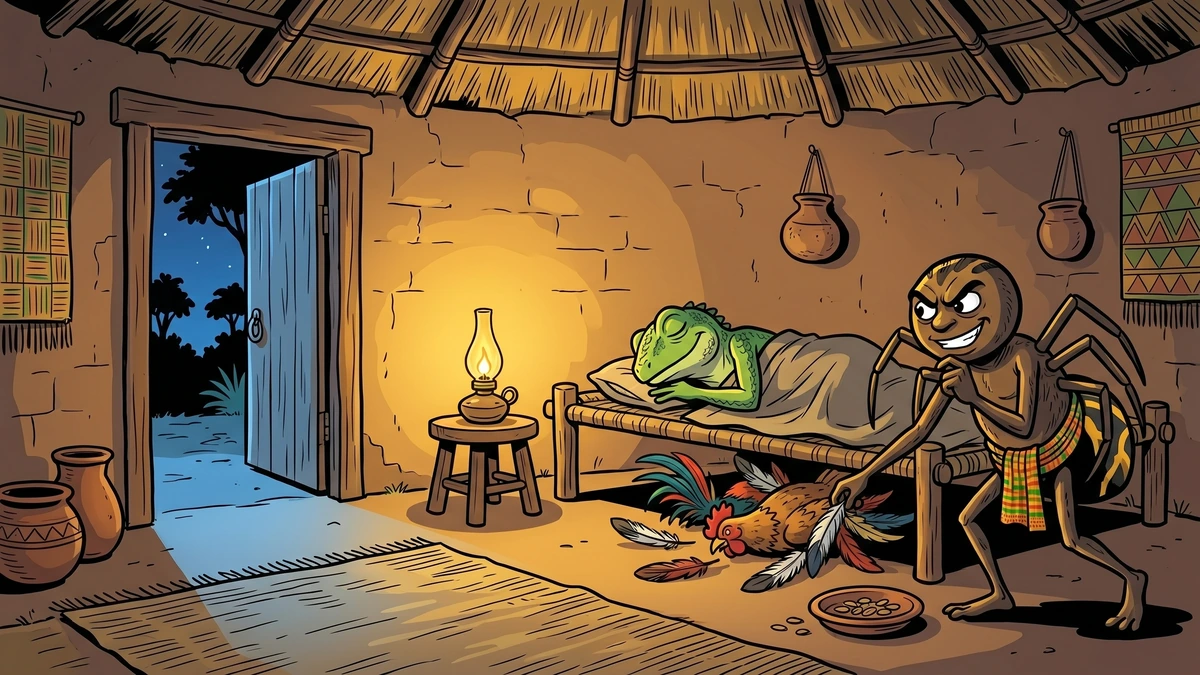
When morning came, Anansi went to the king and reproached him because the cock had not crowed. The astonished king sent a servant to fetch the bird; the servant returned empty-handed. The king ordered a search for the thief, and Anansi, all wide-eyed innocence, suggested that the rogue Lizard — who had, after all, “stolen” Anansi’s wives — might well be the culprit. The men searched Lizard’s house and found exactly what Anansi had planted: the cooked remains of the royal cock and its feathers hidden beneath the bed.
They questioned Lizard. He could not answer. He tried with all his strength to speak, to explain, to defend himself — and not one word would come. He could only move his head, helplessly, up and down. His accusers took the silent nodding for stubborn refusal and dragged him before the king. To every question the king put to him, Lizard could return only that same desperate motion of the head. The king, who did not know that Anansi had robbed the poor creature of his voice, grew angry at what he thought was insolence. Lizard was judged guilty of theft. His punishment was the loss of the three princesses, who were taken from him and given, at last, to Anansi.
And from that day forward, the storytellers say, lizards have always moved their heads ceaselessly up and down — still trying to speak, still trying to clear an innocent name, and still, in their silent way, asking the question the first Lizard could never put into words: how can anyone be so foolish as to trust Anansi?
The Trickster Anansi: Hero and Villain in One Skin
To a reader meeting Anansi for the first time, this tale may seem to present a straightforward villain. But within the larger Anansesem tradition, Anansi is far more complicated — and that complexity is the point. In many beloved stories he is a culture hero: it is Anansi who buys all the stories of the world from the sky-god Nyame and gives them to humankind, Anansi who carries wisdom, Anansi whose nerve and wit allow the small and weak to outmanoeuvre the strong. The Akan audience did not expect their trickster to be consistent. They expected him to be instructive.
When Anansi triumphs over a cruel king or a greedy giant, the tale celebrates intelligence as the weapon of the powerless. When Anansi behaves as he does here — lying to a king, framing a friend, maiming an innocent for the crime of obedience — the very same intelligence becomes a mirror held up to the listener’s own temptations. The trickster is a teaching tool precisely because he is not safe. This story shows the dark face of the spider, and it does not soften the ending: Anansi gets the brides. He is not punished. The tale refuses the comfort of poetic justice, and in that refusal it becomes more honest, and more memorable, than a tidy fable would be.
The Lizard’s Nod: Reading Etiology in Folklore
The pourquoi or etiological tale is one of humanity’s oldest storytelling forms, found on every inhabited continent. Such stories take a feature of the observable world — why the tortoise has a cracked shell, why the sea is salt, why mosquitoes buzz in our ears — and supply it with a narrative cause. They are not science, and the cultures that told them did not mistake them for science. They are something else: a way of stitching the human moral world into the natural one, so that a child watching a lizard on a wall is also, without effort, remembering a lesson about trust.
The genius of this particular tale is the rightness of its chosen image. A lizard’s head-bob is real, constant, and faintly comic; it genuinely looks like an attempt at speech that never resolves into words. By tying that motion to a friend who was silenced and could not defend himself, the storyteller turns an everyday sight into a permanent memorial. The natural world becomes a noticeboard on which the community’s ethics are posted. Every lizard, forever, is the wronged herald — and every nod is the question the tale wants its listeners never to forget.
The Moral: What I Hear, I Keep
This tale carries two lessons braided together. The first is a caution about secrets and trust. Anansi’s downfall — and Lizard’s ruin — both flow from the same act: a secret passed to someone who had no need to hold it. The princesses lost their names to a moment of careless delight; Anansi lost his brides by handing the names to a herald instead of speaking them himself. A secret, once it leaves you, travels by its own laws and may return as a weapon.
The Akan honour exactly this virtue in one of their most cherished Adinkra symbols, Mate Masie — which means simply, “What I hear, I keep.”
“Mate Masie.” — Akan (Twi): “What I have heard, I have kept.” The Adinkra emblem of wisdom, prudence, and discretion — the quiet understanding that knowledge is best held with care.
The second lesson is darker and concerns ingratitude and the abuse of cleverness. Lizard did Anansi a favour and was repaid with mutilation and disgrace. Anansi’s intelligence, which could have built or discovered anything, was bent wholly toward revenge against a friend whose only fault was helpfulness. The tale insists that cleverness is not the same as goodness. A sharp mind in the service of a resentful heart does not produce justice; it produces a scalded, silent victim and a guilty creature who escapes. The lizard’s endless nod is the story’s verdict on that bargain.
Why This Tale Has Lasted
More than a century after Barker and Sinclair set it in print, and far longer than that in the oral memory of the Akan, Why the Lizard Continually Moves His Head Up and Down still holds its listeners. It lasts, first, because it is anchored to something every child can see. A fable about an abstract virtue is easily forgotten; a fable welded to the daily, comic, undeniable bobbing of a real animal is renewed every time a lizard crosses a wall.
It lasts, too, because of its moral courage. The story does not flinch. It allows the wrongdoer to win, and it lets the innocent stay punished, because it trusts its listeners to feel the injustice and carry the feeling with them. That ache is the lesson. A neater ending would have closed the wound; this one leaves it open on purpose, so that the question — how can anyone be so foolish as to trust Anansi? — keeps being asked.
And it lasts because Anansi himself is immortal. The spider who schemes in this Gold Coast tale is the same spider who became Anancy in Jamaica and Aunt Nancy in the American South, carried in the memory of enslaved Africans as a precious, portable inheritance. To tell an Anansi story today is to keep a thread unbroken across oceans and centuries — and to remind one more listener that the cleverest creature in the forest is also the one you should watch most closely.
Frequently Asked Questions
What is the moral of “Why the Lizard Continually Moves His Head Up and Down”?
The tale teaches two braided lessons. The first is a caution about secrets and trust: both the princesses and Anansi lose what they value by letting a secret pass to someone who had no need to hold it, so knowledge should be guarded with care. The second concerns ingratitude and the misuse of cleverness: Lizard does Anansi a favour and is repaid with mutilation and disgrace, showing that a sharp mind in the service of a resentful heart produces cruelty, not justice. The Akan honour the opposite virtue in the Adinkra symbol Mate Masie, ‘What I hear, I keep.’
Where does this folktale come from and who is Anansi?
The story was recorded in West African Folk-Tales (1917), compiled by William H. Barker and Cecilia Sinclair, preserving the oral literature of the Akan peoples of the Gold Coast, modern Ghana. Anansi, or Kwaku Ananse, is the spider trickster at the centre of the Akan storytelling tradition known as Anansesem, ‘spider stories.’ He is part man, part spider, sometimes a culture hero who wins wisdom for humankind and sometimes, as here, a greedy schemer. Carried across the Atlantic during the slave trade, he survived as Anancy and Aunt Nancy in the Caribbean and the Americas.
Why does the lizard move his head up and down in the story?
In the tale, Lizard serves as Anansi’s herald and announces the princesses’ secret names through his trumpet, which wins him the brides. The furious Anansi takes revenge by framing Lizard for stealing the king’s cock and pouring boiling water into his mouth, scalding him dumb. When Lizard is questioned by the king he cannot speak a word and can only move his head helplessly up and down. The story says lizards have moved their heads that way ever since, still trying to clear an innocent name and silently asking how anyone could be foolish enough to trust Anansi.
Is Anansi a hero or a villain in Akan folklore?
He is deliberately both. Across the Anansesem cycle Anansi is sometimes a culture hero who buys the world’s stories from the sky-god Nyame and gives them to humankind, his wit allowing the weak to outmatch the strong. In other tales, including this one, his cleverness curdles into cruelty. The Akan audience never expected the trickster to be consistent; they expected him to be instructive. He is a teaching tool precisely because he is not safe, mirroring both the listener’s admiration for intelligence and their temptation to misuse it.
What is a pourquoi tale?
A pourquoi tale, also called an etiological story, explains why the natural world looks or behaves as it does, such as why the tortoise has a cracked shell or why the lizard nods its head. Found on every inhabited continent, these stories supply a narrative cause for an observable feature of nature. They are not science and were not mistaken for science; they are a way of stitching the human moral world into the natural one, so that an everyday sight becomes a permanent reminder of a community’s ethics.
You May Also Like
 African Folk Tales
Ages 9-12
African Folk Tales
Ages 9-12
Why We See Ants Carrying Bundles As Big As Themselves
An Akan pourquoi tale from West African Folk-Tales (Barker & Sinclair, 1917): the trickster Anansi, condemned to carry an enchanted box for ever, deceives the honest Ant into bearing his punishment - which is why we see ants carrying bundles as big as themselves.
 African Folk Tales
Ages 6-8
African Folk Tales
Ages 6-8
The Girl Who Could Not Be Eaten
The Zulu tale of Untombinde, a king's proud daughter, and the swallowing monster of the haunted pool - who devours a whole nation and cannot keep a single soul down.
 African Folk Tales
Ages 9-12
African Folk Tales
Ages 9-12
Why White Ants Always Harm Man’S Property
A West African (Akan) pourquoi tale from the Anansesem spider-story tradition: how Spider's greed, a broken promise, and one hasty mistake turned the white ant into the eternal enemy of every home.