Lion And Jackal
Lion and Jackal is a southern African folk tale from James A. Honey's South-African Folk-Tales (1910): a lion and a jackal agree to hunt on shares, the jackal hoards the meat, and the cheated, prideful lion is destroyed by his own greed.
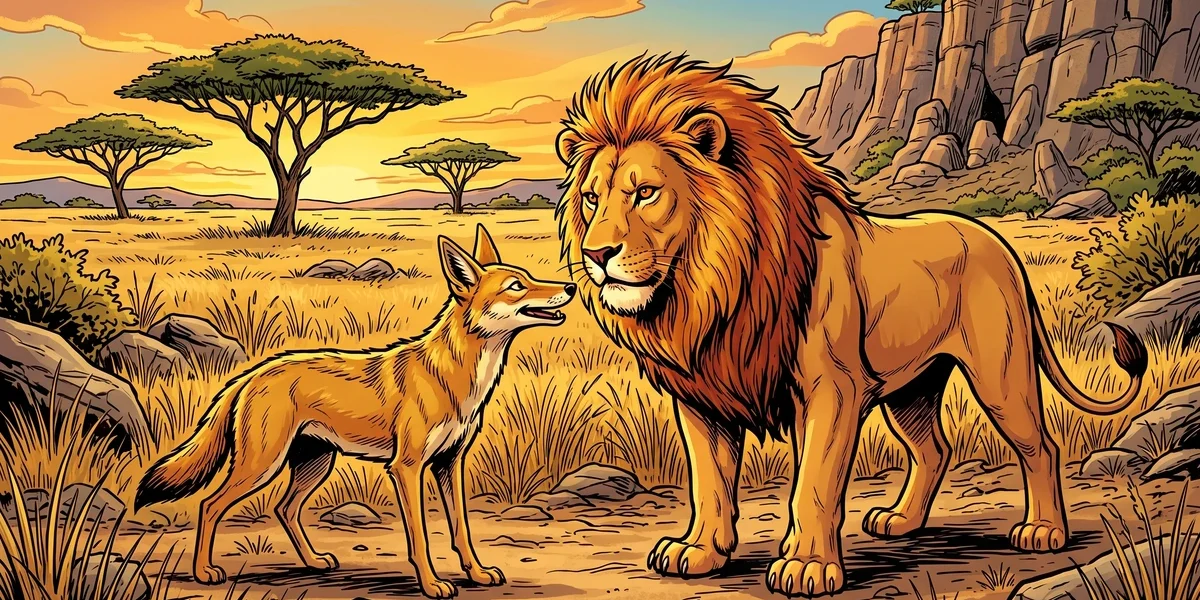
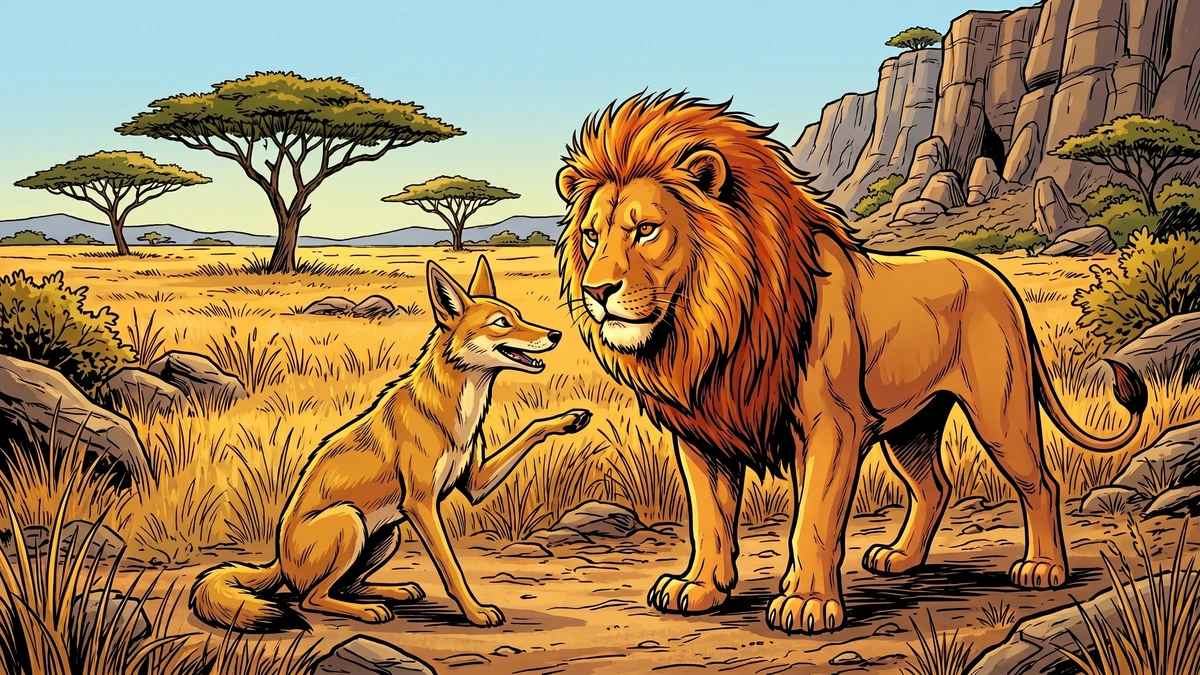
High on the dry uplands of the South African veld, where thorn trees throw thin shadows and the rock faces drop away into sudden cliffs, there lived two hunters who decided that the safest way through a hard winter was to work together. One was the Lion, vast and tawny, the unrivalled killer of the plains. The other was the Jackal, lean and quick-eyed, a creature who had survived a hundred dangers not by strength but by the restless cleverness of his mind. Their bargain seemed sensible. It would end, as such bargains often do in the folk tales of the Cape, in betrayal, laughter, and a death no one quite mourned.
“Lion and Jackal” is one of the most widely retold animal tales of southern Africa, set down for English readers in James A. Honey’s South-African Folk-Tales (New York, 1910), where it stands as the fourteenth story in the collection. It belongs to a long cycle of Cape narratives in which the small trickster, the jackal, outwits the great brute, the lion — a cycle that scholars trace back through Khoikhoi and San oral tradition and through Wilhelm Bleek’s pioneering Reynard the Fox in South Africa (1864). What follows is a faithful retelling of the tale, followed by a close look at where it comes from and why it has refused to be forgotten.
A Partnership for the Winter
The Lion and the Jackal agreed to hunt on shares, meaning that whatever they brought down would be split between their two families so that neither household would go hungry through the cold months. Because the Lion was by far the stronger and more expert hunter, the Jackal proposed a neat division of labour. The Lion would do the killing. The Jackal would carry the carcasses home. And the work of preparing, cutting, and drying the meat into biltong would fall to the wives — Mrs. Lion and Mrs. Jackal together — so that, the Jackal promised warmly, the Lion’s family would never want for anything.
It was a generous-sounding plan, and the Lion, who trusted the arrangement because it flattered his pride as the great provider, agreed to it at once. The hunt began, and it went splendidly. Day after day the Lion ran down eland and antelope, and day after day the Jackal trotted off with the spoils, assuring everyone that the stores were being shared fairly and that all was well.
It was not well. The Jackal carried nearly every scrap of good meat to his own cliff-top den, where his wife and children grew sleek, round, and glossy with fat. To the Lion’s family he gave only a few entrails, doled out in portions so small they barely kept the lionesses and cubs alive — and each time he handed over those miserable scraps, he sighed that the hunting had been wretched and the season cruel. The first beat of the story is therefore a quiet one, almost domestic: a contract honestly offered and secretly broken, with the betrayal hidden behind a smile and a sympathetic word.
The Lion Discovers the Theft
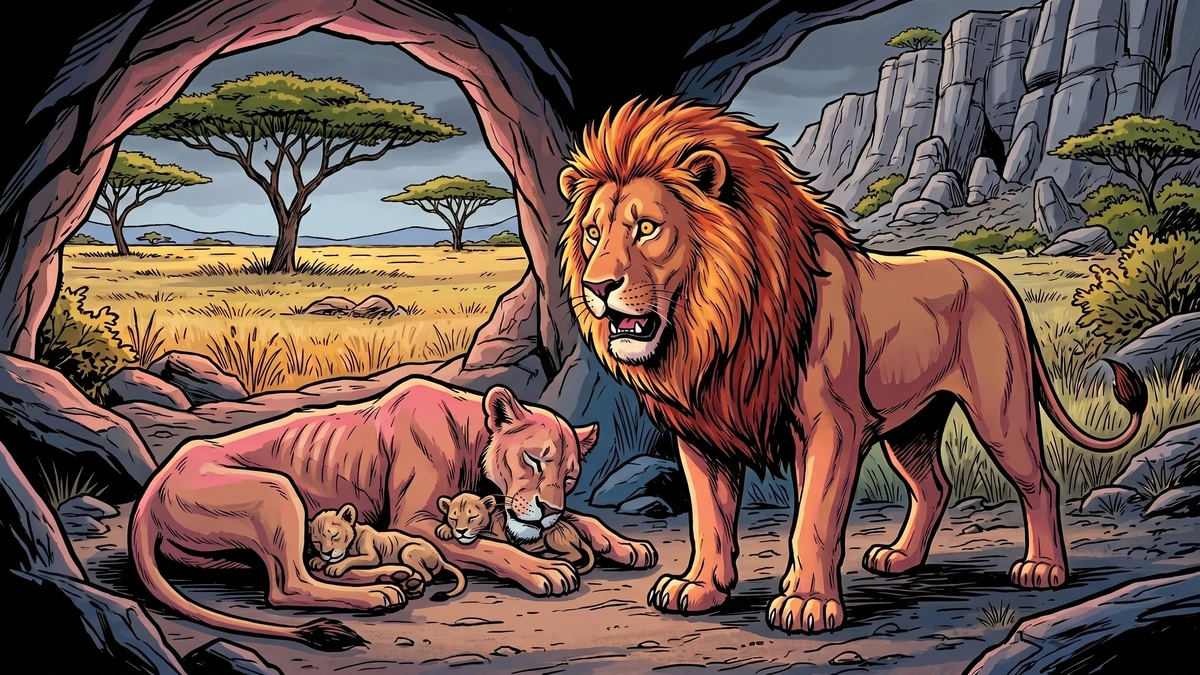
The deception held only as long as the Lion stayed away. When at last he returned home, expecting to find his den heaped with dried meat and his family thriving, he found instead a scene of horror. Mrs. Lion and every one of the young lions lay close to death, gaunt with hunger and wretched in a mangy, neglected state. The truth came out in a rush. While the Jackal’s household had been feasting and fattening all season, the Lion’s own family had been starving on a thief’s leftovers.
For the Lion this was an unbearable insult, not merely a wrong but a humiliation. He had killed honestly. He had trusted the bargain. And he had been made a fool of by a creature a fraction of his size. He set off at once in a towering, thunderous fury, vowing certain death to the Jackal and to every member of the Jackal’s family, wherever in the world he should find them.
The Jackal, however, was not a creature to be caught unready. Long aware that a storm of this kind must one day break over him, he had already moved his entire household — wife, children, and all his stores of stolen meat — to the top of a krantz, a sheer cliff of the kind that scars the South African highveld. The summit could be reached only by a single difficult and winding path, and the Jackal alone knew the way. When he saw the Lion raging far below, he leaned over the edge and called down, with insolent cheerfulness, “Good morning, Uncle Lion.”
The Beating of the Hide and the Cutting of the Reim
“How dare you call me uncle, you impudent scoundrel,” the Lion roared, “after the way you have behaved to my family!” But the Jackal had a performance prepared. “Oh, Uncle, how shall I explain it? It was that beast of a wife of mine!” And with that he began to thrash a dry hide stretched out beside him, beating it with a stick so that the cracks rang out like blows. Mrs. Jackal, coached beforehand, shrieked in mock agony at every stroke, and the little jackals joined in a chorus of pitiful howls, until the listening Lion — softened in spite of himself — begged the Jackal to stop flogging his poor wife.
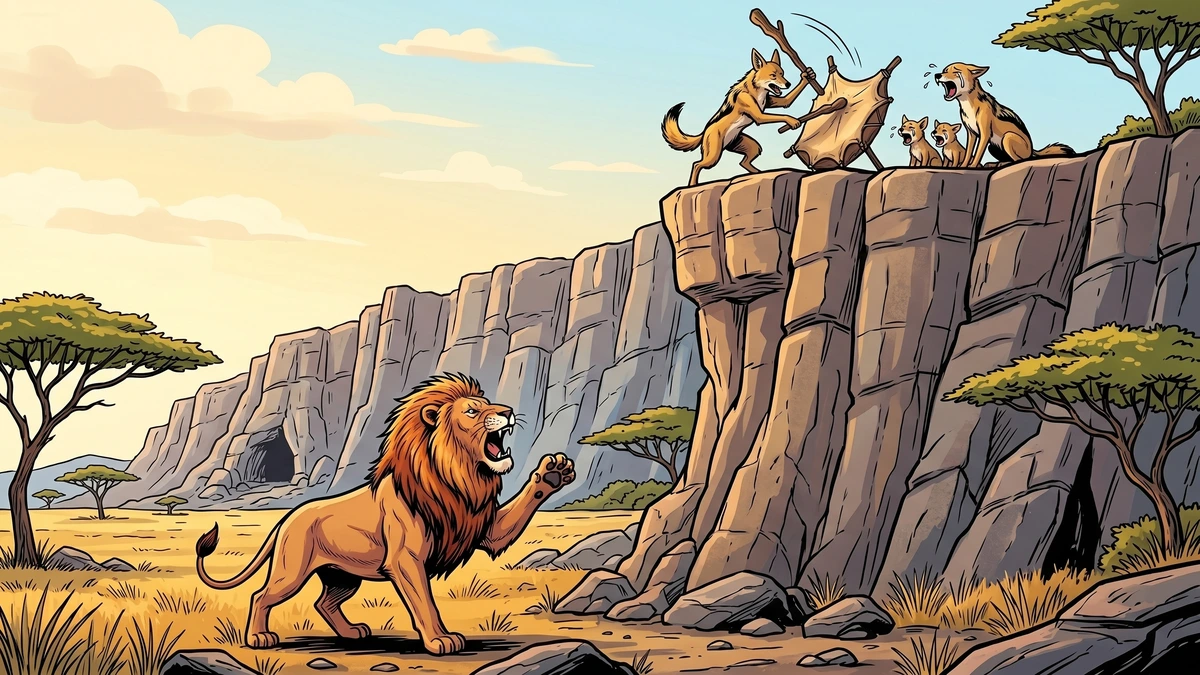
Having turned the Lion’s rage into pity, the Jackal invited his “uncle” up to share a meal. The Lion tried again and again to scramble up the cliff and failed every time. So the Jackal, ever helpful, suggested lowering a reim — a strong leather thong — to haul him up. The whole jackal family pulled together, and when the Lion had been drawn about halfway up the rock face, the Jackal quietly cut the reim. Down crashed the Lion, badly hurt. The Jackal at once fell upon the hide again, “punishing” his family furiously for daring to supply such a rotten thong, while the wife and cubs screamed convincingly. A second, stronger buffalo-hide reim was lowered. Again the Lion was hauled up — high enough this time to see the cooking pots and the rows of drying biltong that proved how thoroughly he had been robbed — and again, at the last moment, the reim was cut, and again the great beast fell, this time stunned senseless on the rocks below.
The Fat Morsel and the Red-Hot Stone
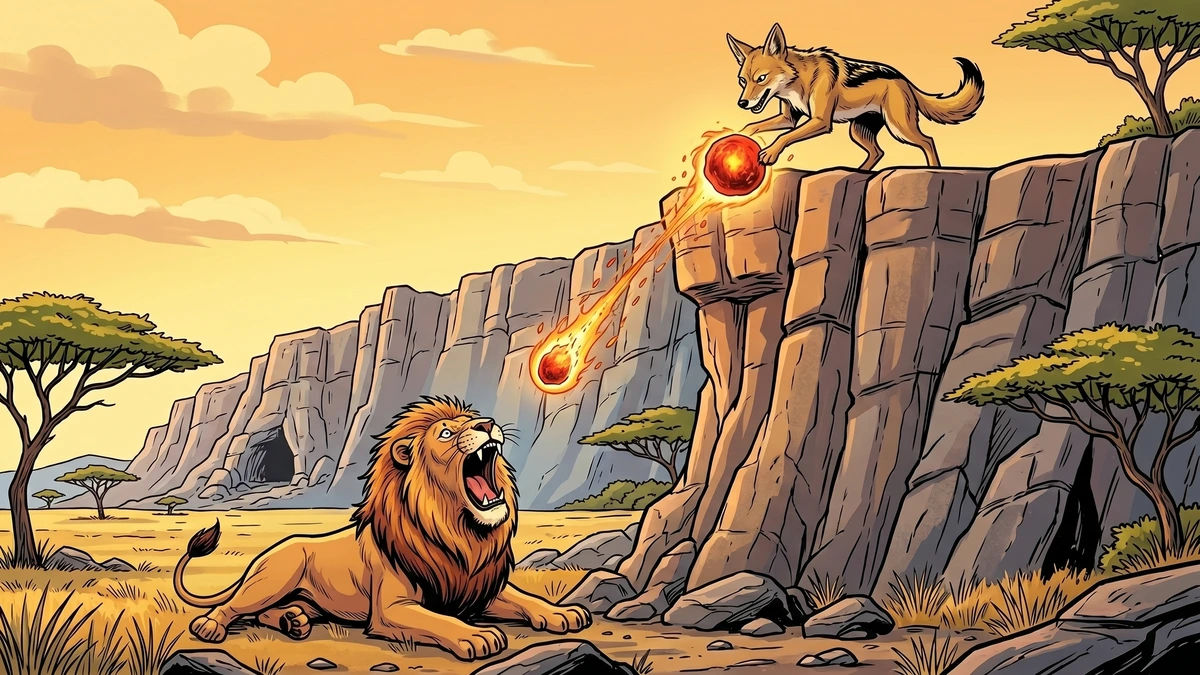
When the Lion came back to his senses, the Jackal spoke in his most sympathetic, sorrowful voice. It was no use, he said, trying to haul Uncle Lion up such a treacherous cliff; the kindest thing would be to roast a fine fat piece of eland’s breast and simply drop it down into the Lion’s open mouth. The Lion, half-famished and aching all over, accepted gratefully and lay back with his great jaws stretched wide.
The Jackal had something else in mind. He took a round stone and heated it red-hot in the fire, then packed a thick coat of suet and inside-fat around it until it looked exactly like a savoury ball of roasted meat. He carried it to the cliff edge, took careful aim at the Lion’s gaping mouth, and let it fall. The Lion swallowed it whole. The burning stone seared straight through him and killed him on the spot. That night, the folk tale tells us with a kind of grim cheerfulness, there was great rejoicing on the precipice — the trickster had survived, and the strong fool who had vowed to destroy him lay dead at the foot of his own ambition.
The Moral of “Lion and Jackal”
On its surface this is a triumphant trickster tale, and southern African audiences certainly enjoyed it as one — the jackal’s nerve and theatrical genius are meant to delight. But the moral underneath is sharper and less comfortable. The partnership between Lion and Jackal does not fail by accident or by outside misfortune. It fails because each animal brings a different vice to the contract. The Jackal brings dishonesty; the Lion brings a pride so large that it cannot imagine being cheated by a lesser creature. A formal agreement — to “hunt on shares” — turns out to be no protection at all when the characters of the partners are flawed.
The tale also delivers a hard lesson about flattery. Every time the Jackal calls the Lion “Uncle,” every time he beats the hide and lets his family scream, he is offering the Lion an easy, pleasing story to believe instead of the painful truth. And every time, the Lion takes the bait. The Cape Dutch tradition that carried this story preserved a proverb that fits it exactly:
“Wie ’n kuil vir ’n ander grawe, val self daarin.”
— Cape Dutch / Afrikaans proverb: “He who digs a pit for another falls into it himself.”
The Lion set out vowing certain death for the whole jackal family, and it was the Lion who died. His destruction was not really the Jackal’s doing; it was the natural end of his own greed and his own refusal to look honestly at what was in front of him.
Origins: South-African Folk-Tales and the Cape Jackal Cycle
“Lion and Jackal” was published in James A. Honey’s South-African Folk-Tales, issued in New York by the Baker & Taylor Company in 1910. Honey, a South African–born physician, gathered a compact collection of forty-four tales, drawing heavily on stories that had circulated for generations among the Khoikhoi (then called “Hottentot”) and San (“Bushman”) peoples of the Cape, as well as on the Cape Dutch farming communities who had absorbed and retold them. The vocabulary of the story betrays this layered origin: a krantz is a cliff, a reim is a rawhide thong, biltong is wind-dried meat, and the eland is the great antelope of the veld — all words from the Afrikaans and Khoikhoi worlds in which the tale was told.
The jackal-versus-lion contest was not invented by Honey. It was already a vast, well-mapped tradition. The German linguist Wilhelm H. I. Bleek, working in the Cape from the 1850s, had collected and published Reynard the Fox in South Africa; or, Hottentot Fables and Tales in 1864 — the first serious scholarly treatment of these stories. Bleek recognised that the southern African jackal occupied the same narrative role that the fox plays in European Reynard literature: the weak, witty schemer who repeatedly humiliates a powerful, slow-thinking antagonist. Honey’s “Lion and Jackal” is one episode in this enormous cycle, and the same collection contains several neighbouring jackal-and-lion tales, evidence of just how many variations the storytellers spun from the single satisfying idea of brain defeating brawn.
Tale Type, Motifs, and the Trickster Tradition
Folklorists classify the opening situation of “Lion and Jackal” with international tale type ATU 9, “The Unjust Partner,” in which two animals agree to share the produce of common labour and one secretly keeps the lion’s share for himself — a type known across Europe, Asia, and Africa, usually starring a fox or jackal as the cheat. The story then moves through a chain of classic trickster motifs catalogued in the Aarne–Thompson–Uther motif index: the deceptive “beating” performance staged to win sympathy; the treacherous rope deliberately cut to drop the dupe (motif K963, “rope cut to drop dupe”); and the lethal trick of the disguised hot object swallowed by the greedy victim, a relative of motif K1035, in which a dupe is fed a burning or otherwise deadly substance hidden inside ordinary-looking food.
What makes the southern African version distinctive is its setting and its tone. The action is rooted in a recognisable real landscape — the cliffs, the drying biltong, the eland breast, the rawhide reim — and the storytelling is unsentimental. The trickster is not punished. There is no tidy restoration of justice in which the Lion gets his meat back. Instead the strong, foolish animal simply dies, and the cliff-top family celebrates. This realism is part of the cycle’s purpose: these were tales told by communities who knew very well that power and fairness do not always travel together, and that survival sometimes belongs to whoever thinks fastest.
The Jackal Among the World’s Tricksters
The jackal of the Cape tales belongs to one of the most widespread character types in all of human storytelling: the trickster, the physically weak figure who survives and prospers through wit, nerve, and performance. Across the African continent the same role is filled by a remarkable range of animals. In West African and Caribbean tradition it is Anansi the spider; among the Akan and many Bantu-speaking peoples it is often Hare or Tortoise; in the Khoikhoi and San south it is the Jackal. The European reader meets the identical figure as Reynard the Fox — which is precisely why Bleek titled his 1864 study Reynard the Fox in South Africa. He was signalling to scholars that the southern African jackal cycle was not a curiosity but a regional branch of a worldwide narrative family.
What unites these tricksters is not simple mischief but a particular social function. Trickster tales let a community rehearse, in safe and entertaining form, the uncomfortable truth that the powerful are not always the wise, and that justice often has to be improvised by those with little official power. In “Lion and Jackal” the Jackal has no court to appeal to, no stronger ally, no way to compel the Lion to honour the original bargain. His theatre of the beaten hide and the cut reim is, in a hard sense, the only justice available to him. The tale does not pretend this is admirable. It s
You May Also Like
 African Folk Tales
All Ages
African Folk Tales
All Ages
Quarcoo Bah-Boni
Quarcoo Bah-Boni: Once upon a time in a certain village lived a man and his wife who were childless. One day, however, when the husband was away hunting, the
 African Folk Tales
Ages 9-12
African Folk Tales
Ages 9-12
The Monkey’s Fiddle
A scholarly retelling of the southern African folk tale "The Monkey's Fiddle", in which a poor monkey, falsely condemned for theft by a corrupt animal court, escapes the gallows by playing a charmed fiddle that forces the whole court to dance.
 African Folk Tales
Ages 9-12
African Folk Tales
Ages 9-12
How the Leopard Got His Spots
The canonical story of how the leopard got his spots: Rudyard Kipling's pourquoi tale from Just So Stories (1902), retold with full scholarly attribution.