Story Of Lion And Little Jackal
A string of clever escapes from southern African oral tradition: the small black-backed jackal outwits the mighty lion again and again, proving that wit, not muscle, rules the veld.

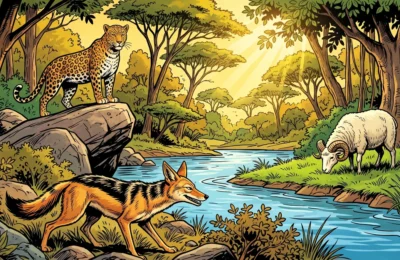
On the dry, sun-bleached plains of southern Africa, no animal is loved by storytellers quite like the little jackal. He is thin where the lion is heavy, quiet where the lion is loud, and quick where the lion is slow. In tale after tale he is matched against the king of beasts — and in tale after tale the small, laughing jackal walks away with the meat, the water, and the last word. “Story of Lion and Little Jackal” is one of the most beloved of these contests, a string of clever escapes that has been told around southern African night-fires for many generations.
It is, at heart, a story about the oldest argument in the world: does strength rule, or does wit? The lion has every advantage that muscle and fear can give. The jackal has nothing but a fast mind and a faster pair of legs. By the end of the tale, the great king has been outwitted so many times that he can no longer even climb a rope without falling — and the plains have a new, unlikely hero.
Origin & Canonical Attribution
“Story of Lion and Little Jackal” is a southern African animal trickster tale. It appears as a titled tale in James A. Honey’s collection South-African Folk-Tales (New York: Baker & Taylor, 1910), pp. 56–61. Honey’s preface places his tales in the line of the first great printed gathering of the region’s animal fables — W. H. I. Bleek’s Reynard the Fox in South Africa; or, Hottentot Fables and Tales (London: Trübner & Co., 1864), a set of forty-two narratives. Honey describes his stories as “mainly from the Bushmen” (San), with shaping influence from the Khoikhoi (then called Hottentots) and from Nguni-speaking neighbours. The tale has no single Aarne–Thompson–Uther type number because it is a trickster cycle — a chain of episodes — but its opening dishonest-division episode belongs to ATU 9, “The Unjust Partner,” and the closely related reflection-in-the-well episode of the same jackal-and-lion tradition is classified as ATU 92, “The Lion in the Water.” Its building blocks sit in chapter K (Deceptions) of the Thompson Motif-Index of Folk-Literature, and its hero belongs to motif J1117, the animal as trickster. Reading time: about 10 minutes.
Where the Story Comes From
The jackal of these tales is the black-backed jackal, Canis mesomelas — a small, sharp-faced wild dog with a rusty coat and a dark “saddle” of black fur across its shoulders. Across the dry country of South Africa, Namibia and Botswana, this animal became the great trickster of oral tradition: the figure who is weak in body but rich in cunning, and who therefore stands in for the listener who has no power except cleverness. When the German philologist Wilhelm Bleek published the first full collection of these fables in 1864, he gave his book the title Reynard the Fox in South Africa precisely because the jackal occupies the same role in Khoikhoi storytelling that the sly fox Reynard holds in the medieval beast-epics of Europe. In each tradition a small, quick animal makes a fool of the large and powerful ones.
Bleek, working in Cape Town, is best remembered for the vast archive of |Xam San narratives he and Lucy Lloyd recorded in the 1870s. But his 1864 Reynard volume came first, and it is the foundation stone of the printed record of southern African animal fable. James Honey, writing his own collection nearly half a century later, openly tied his work to Bleek’s: in his preface he notes that his book is the first complete collection “since Dr. Bleek published his stories in 1864,” and that he had been gathering the tales for ten years because he feared that, as the country changed, “the native races will either be swept away or so altered as to lose many of their ancient habits, customs, traditions.” “Story of Lion and Little Jackal” is one of the animal tales he set down to preserve.
What gives the story its particular flavour is that it is not a single neat plot but a cycle — one trick after another, each a small comic crisis with its own escape. This loose, repeating shape is exactly how trickster tales work in live performance: a skilled teller can add an episode, drop one, or stretch a favourite, because the spine of the story is simply “the jackal outwits the lion, again.” What follows is a faithful retelling of Honey’s 1910 text, with its sequence of contests kept whole.
An Unequal Bargain on the Hunt
One morning Little Jackal went out hunting and met Lion on the plain. Lion, who liked the idea of help but not the idea of sharing, proposed a partnership. “Let us hunt together,” he said grandly. “If a small antelope is killed, it shall be yours. If a large animal is killed, it shall be mine.” It was a bargain dressed up as fairness, and Little Jackal saw straight through it — but he smiled and agreed all the same.
The first animal they brought down was a great eland, the largest antelope on the veld. Lion was delighted. “I will keep hunting,” he told Little Jackal. “Run to my house and tell my children to come and carry the meat home.” Little Jackal said yes, of course, and trotted off — but not to Lion’s house. He went to his own den and called his own children. “Lion takes me for a fool,” he said, “if he thinks I will fetch his cubs while my own children go hungry.” His children carried every scrap of the eland up to their home on the top of a high rock, a place that could only be reached by a rope.
When Lion came home empty-pawed and asked his wife where the meat was, she told him there was none — that Little Jackal had never come, and that the cubs were still hungry. Lion understood at once that he had been cheated, and his great pride curdled into anger. The hunt had taught him the first lesson of the tale: a bargain that is unfair on its face will be answered with a trick.

“That Is Not My Tail, It Is a Root”
Lion went straight to Little Jackal’s rock, but for all his strength he could not climb it, so he settled down by the waterside to wait. Sooner or later, he knew, the jackal would come down to drink. He was right. Little Jackal came for water, saw the lion too late, and bolted. Lion sprang after him. The jackal dived into a hole beneath a tree — but not quite fast enough. Lion’s paw closed on his tail.
Now came the trick that has made children laugh for a century. Little Jackal, half in the hole and perfectly calm, called back over his shoulder: “That is not my tail you are holding. It is only a root of the tree. If you do not believe me, fetch a stone and strike it — you will see that no blood comes.” Lion, who was strong but not clever, let go of the tail and went off to find a stone to test the “root.” By the time he came back, Little Jackal was deep inside the earth and far out of reach.
Lion lay down by the hole and waited again, hidden and silent. After a long while the jackal crept to the entrance to see if the way was clear. He could see no lion — but, taking no chances, he sang out cheerfully, “Ho! I see you, my master, even though you are hiding!” If a lion had been there, the bluff would have flushed him out. None stirred, so Little Jackal knew the path was safe and slipped away. Later, cornered on open ground with no hole to dive into, he tried one more bluff: “Be still — do you not see that bushbuck behind the rock? Wait here, and I will drive it to you.” Lion crouched obediently to ambush a bushbuck that did not exist, and the jackal walked free. Strength, the story shows, can always be sent off to chase a stone or a shadow.

Horns of Beeswax at the Great Meeting
There came a day when all the animals were called to a great meeting, with Lion presiding as chief. Little Jackal badly wanted to attend — but a rule had been made that no creature could enter unless it had horns. The jackal, of course, has no horns. So he found a bees’ nest, took out a lump of wax, and moulded himself a fine curving pair, fastening them firmly to his head. Disguised as a horned and respectable animal, he walked into the meeting, and Lion, looking right at him, did not know him.
All might have gone well — but Little Jackal sat down too close to the meeting fire. The warmth softened his beeswax horns, and slowly, in front of everyone, they drooped and melted down the sides of his face. Lion stared, recognised the trickster under the disguise, and lunged. But the jackal was already moving. He darted out and threw himself flat under an overhanging rock, crying out in terror, “Help! Help! This rock is falling on me — it will crush me!” Lion, alarmed and wanting his enemy alive to punish, ran off to find a stout pole to prop up the “falling” rock. While the king braced a rock that had never been in danger of falling, Little Jackal slid out from under it and was gone.
It is the same shape as the stone and the bushbuck: the jackal never fights, never even argues. He simply hands the lion a job — test the root, ambush the buck, save me from the rock — and the lion’s own seriousness does the rest.

The Rope of Mouse-Skins
After all this, strangely enough, the two became companions once more — for trickster tales love to set the same pair back at the start — and went hunting together again. This time they killed an ox. Lion took charge of dividing it. “I will guard the meat,” he said. “You carry the pieces away.” He handed the jackal the breast and said, “Take this to my wife.” Little Jackal carried it to his own wife instead. Lion handed him a thin shin-bone and said, “Take this one to your wife.” Little Jackal carried the poor shin to Lion’s house — and when Lion’s wife refused such a mean scrap, the jackal answered her rudely and stamped back for more. Piece by piece the whole ox went the wrong way: the good meat to the jackal’s family, the leavings to the lion’s, until nothing was left.
When Lion finally reached home he found his family weeping, and learned how every choice cut had been carried off and how unkindly his wife had been treated. His anger was now beyond cooling, and he marched to the foot of Little Jackal’s rock. From the safe height above, the jackal leaned over and, instead of answering, buried him in questions: “Who are you? What is your name? Whose son are you? Where are you from? Where are you going? Whom do you want, and what do you want him for?” Lion, holding his temper, said only that he had come for a visit and asked for the rope to be let down.
So Little Jackal let down a rope — but he had woven it out of nothing sturdier than the skins of mice. Lion began to climb. The flimsy rope of mouse-skins stretched, frayed, and snapped, and the king of the plains fell hard to the ground and limped away home, beaten not by teeth or claws but by a trick of weaving. The tale ends as trickster cycles like to end: the powerful one bruised and grumbling, the small one safe on his rock, and the listeners delighted.

The Moral of the Tale
“Story of Lion and Little Jackal” carries a moral that the southern African veld has always understood: cunning is the strength of those who have no other strength. The lion is bigger, louder and far more dangerous, and never once in the story does the jackal try to meet that power on its own ground. He does not fight. He bargains, bluffs, disguises, flatters and weaves — and every escape is really the lion’s own pride and slow wit turned against him. The tale is also a quiet warning to the powerful: a king who is sure that nothing small can ever matter to him is exactly the king a jackal can lead by the nose.
The wisdom of these tales settled, over the centuries, into the everyday speech of the Cape. An old Afrikaans proverb — grown from exactly this jackal-and-lion tradition — puts it plainly:
“Jakkals verloor sy hare, maar nie sy streke nie.”
— Cape Afrikaans proverb: “A jackal loses its hair, but never its tricks.” The jackal’s cleverness is not a passing mood; it is the very nature that lets the weak survive among the strong.
The Jackal as Trickster — Reynard of the Veld
The little jackal does not stand alone. He belongs to a great family of trickster heroes that the world’s storytellers have made out of small, clever creatures: Anansi the spider of the Akan people of West Africa; Br’er Rabbit, carried across the Atlantic and retold in the American South; the hare who tricks the lion in many other African tales; and Reynard the Fox of medieval Europe. Each of these figures speaks for the listener who is not rich, not strong and not in charge — and each wins, again and again, by being the cleverest animal in the room.
The same plot travelled, too. The contest of a small clever animal against a proud lion is told all across Africa and far beyond it. In India, the most famous cousin of this story is the Panchatantra tale of the lion and the hare, in which a little hare leads a tyrant lion to a well, lets him mistake his own reflection for a rival, and watches him leap in to fight himself. That reflection-trick — the one folklorists label ATU 92, “The Lion in the Water” — is the closest single-episode relative of our jackal cycle, and many southern African tellers fold a well-and-reflection scene into their own jackal-and-lion stories. Wherever the tale is told, the lesson holds steady: the giant is undone not by a stronger giant, but by a smaller, sharper mind.
Why This Story Has Lasted
“Story of Lion and Little Jackal” has lasted because it gives its listeners something both very old and very useful. For the children who first hear it, it is pure comedy — a lion testing a root with a stone, propping up a rock that was never falling, splashing about while the jackal calls down polite questions from a rock. The repeated shape makes it easy to remember and irresistible to retell, which is how a tale survives in a world without books.
But under the laughter is a serious gift. The story tells anyone who feels small — anyone outmatched by something louder and more powerful — that there is a way through, and that the way is to think faster than your trouble can act. That is why Bleek and Honey believed these jackal tales were worth rescuing from the fading firelight, and why the black-backed jackal still trots through southern African storytelling today, thin and rusty and grinning, the undefeated champion of wit over weight.
You May Also Like
 African Folk Tales
Ages 6-8
African Folk Tales
Ages 6-8
The Tiger, The Ram, And The Jackal
A Panchatantra tale where a clever jackal's lies to tiger and ram destroy his own plans.
 African Folk Tales
Ages 6-8
African Folk Tales
Ages 6-8
Why the Sun and Moon Live in the Sky
An Efik pourquoi tale from southern Nigeria: the Sun and his wife the Moon welcome their friend the Water too well, are flooded out of the great house they built, and are driven up to live in the sky forever.
 African Folk Tales
Ages 6-8
African Folk Tales
Ages 6-8
Honourable Minū
Honourable Minū: It happened one day that a poor Akim-man had to travel from his own little village to Accra - one of the big towns on the coast. This man