Honourable Minū
Honourable Minū: It happened one day that a poor Akim-man had to travel from his own little village to Accra - one of the big towns on the coast. This man
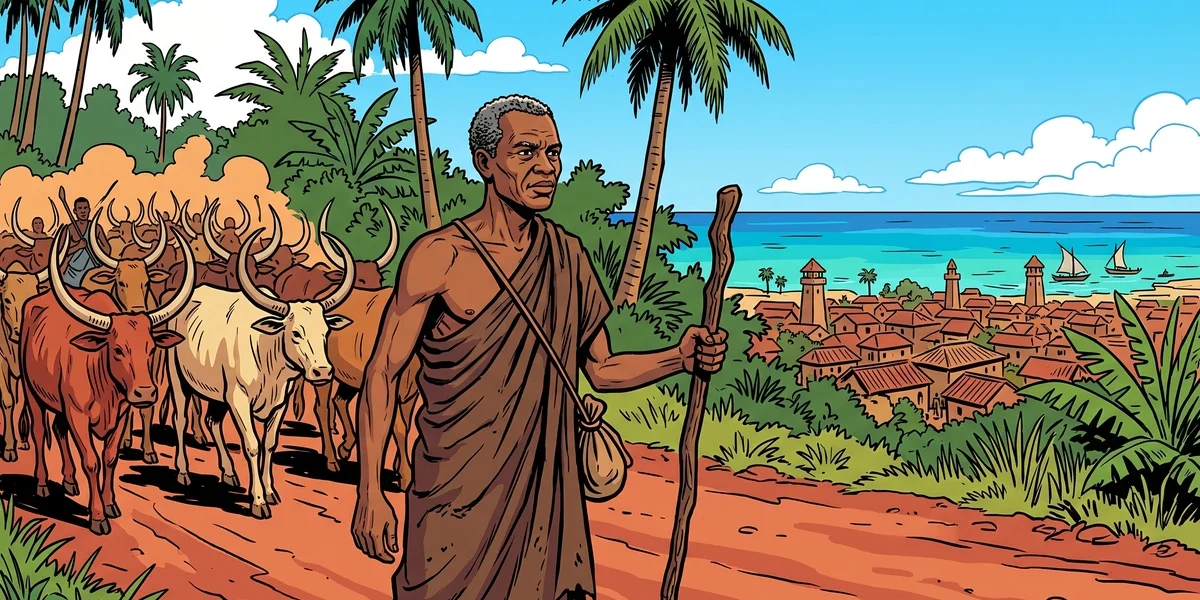
A poor man from the Akim hills once walked down to the coast on an errand, and came home having learned the whole town’s history from a single word he had misheld. “Honourable Minū” is a West African comic tale from the Gold Coast — modern Ghana — in which a traveller who cannot speak the language of Accra mistakes the phrase “I do not understand” for the name of the richest man alive. It is a small story with a long reach: a joke about language that turns, in its last lines, into a quiet meditation on wealth, mortality, and the contentment of an ordinary life.
Where This Story Comes From
“Honourable Minū” was collected and published in West African Folk-Tales, compiled by William H. Barker — then Vice-Principal of the Government Training College at Accra — together with Cecilia Sinclair, who also supplied the volume’s illustrations. The book was issued in London by George G. Harrap & Co. in 1917, gathering tales told in the villages and towns of the Gold Coast, principally among the Akan peoples, for whom evening storytelling was a settled institution of community life.
The tale’s traveller is described as an “Akim-man” — a member of the Akyem (Akim), one of the Akan groups of what is today Ghana’s Eastern Region. His mother tongue is Twi, the Akan language. Accra, the coastal town he visits, was historically the home of the Ga people, who speak a wholly different language. That single fact — two neighbouring peoples of one country who cannot understand one another — is the hinge on which the entire story turns. Unlike the famous anansesem spider tales of Kwaku Ananse, “Honourable Minū” has no trickster and no magic. It is a jest tale, the kind of short humorous anecdote that village storytellers used to close an evening on a light note while still smuggling in a lesson.
A Stranger on the Accra Road
The story begins with a journey. A poor Akim-man has business that compels him to leave his own little hill village and travel down to Accra, one of the great towns of the coast. He speaks only the language of his village, which the men of the town do not understand — and he knows it, yet he goes anyway, because the errand cannot wait.
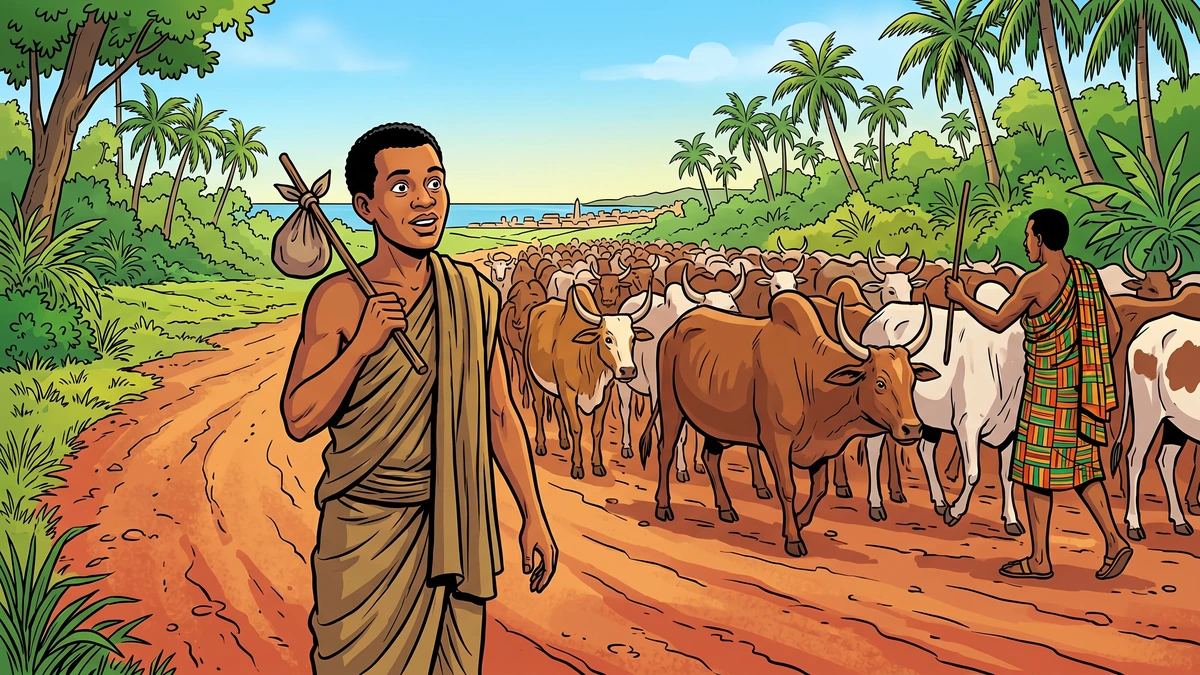
As he nears the town he meets an enormous herd of cattle, more cows than he has ever seen gathered in one place. Astonished, he wonders who could possibly own such a multitude, and puts the question to the herdsman walking beside them: to whom do these cows belong? The herdsman does not speak Twi. He answers with the only honest thing he can say — “Minū,” meaning “I do not understand” — and the traveller, hearing a word he does not recognise, takes it for a man’s name. “Mr Minū,” he concludes, “must be very rich.” With that single misunderstanding the whole comedy is set in motion, and the traveller walks on into Accra entirely satisfied that he has learned something true.
The Houses of the Honourable Minū
Inside the town the misunderstanding compounds itself. The Akim-man passes a fine large building and asks who owns it; the man he asks cannot understand the question, and answers “Minū.” “Dear me,” cries the traveller, “what a rich fellow Mr Minū must be!” A little further on he comes to a still grander house, ringed with beautiful gardens, and again he asks, and again the answer is “Minū.” “How wealthy Mr Minū is,” he marvels.
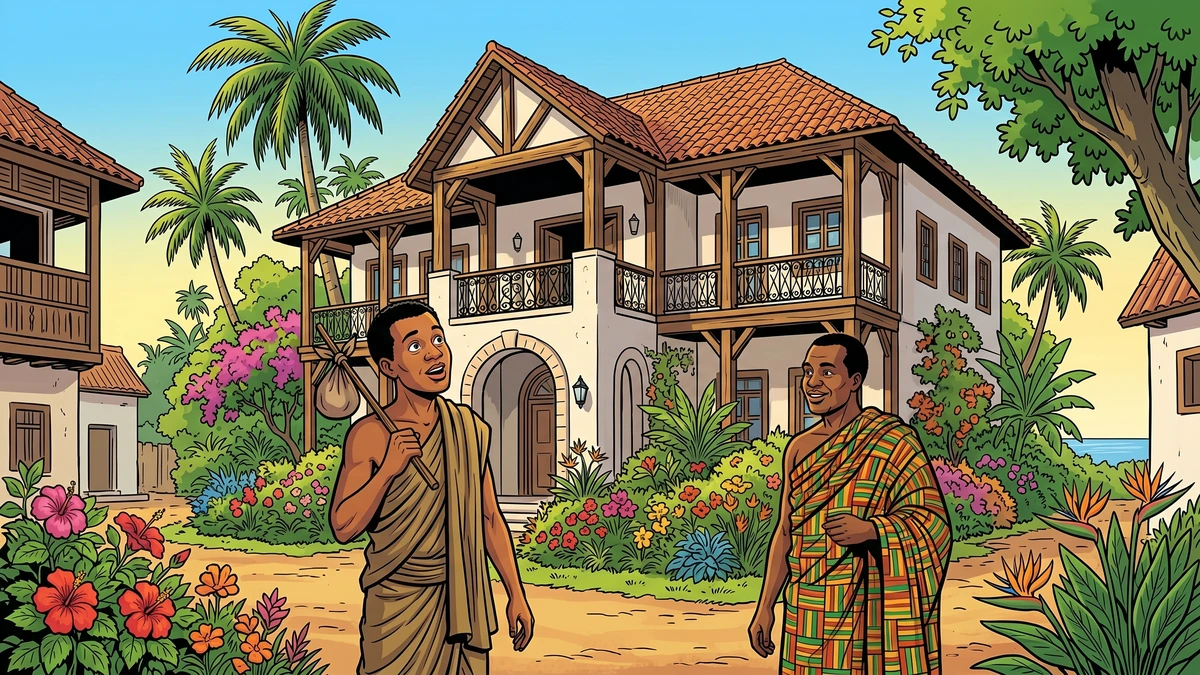
This is the engine of the tale, and it is worth pausing on its mechanism. Every person the traveller meets is telling him the exact, literal truth — I do not understand you — and every time, he hears confirmation of a fortune. The joke works because the listener knows what the traveller does not, and because the traveller’s error is not stupidity but a perfectly reasonable guess made with incomplete information. He has built, out of nothing but a repeated foreign word, an entire imaginary millionaire: the Honourable Minū, owner of herds and mansions and gardens, growing richer with every street the traveller walks.
A Steamer in the Harbour
The traveller reaches the beach, and there the imaginary fortune reaches its height. In the harbour a magnificent steamer is being loaded, and the Akim-man watches an astonishing cargo go aboard. He asks a bystander to whom the fine vessel belongs. “Minū,” replies the man. “To the Honourable Minū also!” the traveller exclaims. “He is the richest man I ever heard of!”
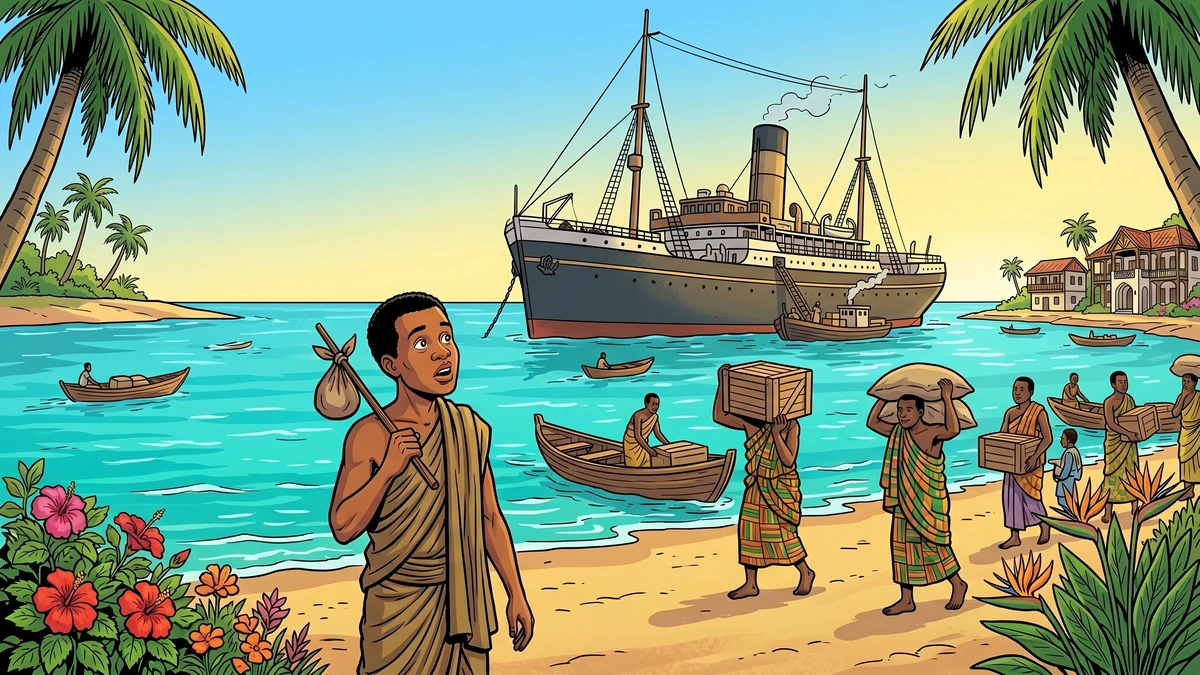
The detail of the steamer fixes the story in its own moment. In the early twentieth century the surf-beaten shore of Accra had no deep harbour; ocean-going ships anchored offshore and were loaded by canoe and lighter, carrying out the cocoa, palm oil and timber on which the Gold Coast’s colonial economy ran. To a man from the inland hills, such a vessel was the very image of unimaginable wealth — and so the fictitious Minū, having already acquired cattle and houses, now acquires the grandest thing on the coast. The traveller has, without noticing, talked himself into believing in a single man who owns the entire visible world of Accra.
The Funeral of Mr Minū
Then comes the turn. His business in the town finished, the Akim-man sets out for home. Passing down one of the streets he meets men carrying a coffin, followed by a long procession of mourners all dressed in black. He asks the name of the dead person and receives, inevitably, the usual reply: “Minū.”
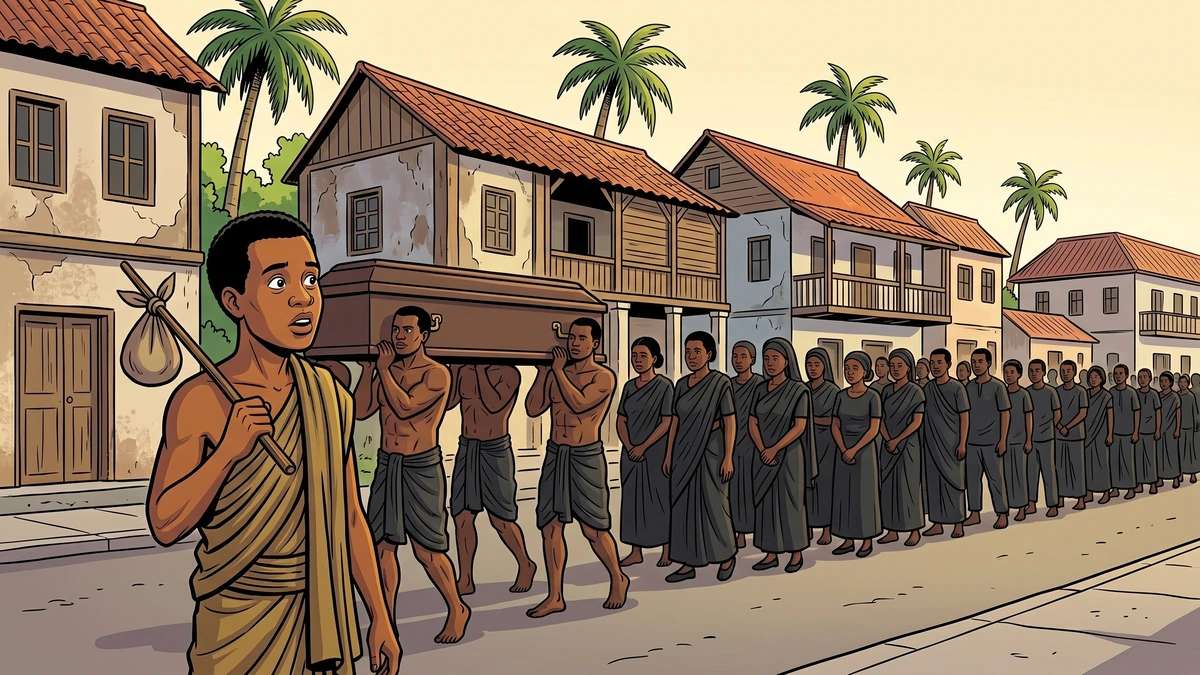
And here the comedy gives way to something gentler and graver. “Poor Mr Minū!” the traveller cries. “So he has had to leave all his wealth and beautiful houses and die just as a poor person would do!” The imaginary millionaire, owner of herds and mansions and a steamer, has come at last to the one possession no fortune can buy off — a coffin and a grave, exactly like the poorest man’s. And the Akim-man draws his lesson aloud: “Well, well — in future I will be content with my tiny house and little money.” He goes home quite pleased, back to his own hut, carrying away a peace of mind he did not have when he set out.
A Word That Means “I Do Not Understand”
The pleasure of “Honourable Minū” is built entirely on a linguistic accident, and folklorists have a precise place for it. The tale belongs to international tale type ATU 1699, “Misunderstanding Because of Ignorance of a Foreign Language,” in the Aarne–Thompson–Uther index — the standard catalogue of folktale types first compiled by Antti Aarne in 1910, revised by Stith Thompson, and expanded by Hans-Jörg Uther in 2004. Stories of this type appear all over the world: a traveller asks questions in a language he does not share with the locals, mishears their reply, and constructs an elaborate fantasy on the foundation of his own error.
What makes the West African version so neat is that the misheard word is not random noise but a meaningful phrase — and a poignant one. “Minū” does not mean “yes” or “go away”; it means, with perfect honesty, “I do not understand.” The herdsmen and townspeople of Accra are not deceiving the traveller. They are confessing the truth of their situation, and he mistakes their confession of incomprehension for an answer. The story thus contains a sly second joke, available to the thoughtful listener: the one piece of information the traveller most needed — that nobody could understand him — was the very thing he was being told, again and again, and the very thing he never heard.
The Shape of a Jest Tale
Part of the durability of “Honourable Minū” lies in its architecture, which is built for the voice rather than the page. The story advances by a strict, audible pattern: a question, a baffling reply, a delighted exclamation — repeated, with rising stakes, four times over. First a herd of cattle, then a fine house, then a grander house with gardens, then a steamer in the harbour. Each repetition is a little larger than the last, so that the imaginary fortune visibly swells while the listener, who is in on the joke, waits with growing pleasure for the inevitable deflation.
This is the craftsmanship of oral storytelling. The pattern is easy for a teller to hold in memory and easy for an audience to follow, and its very predictability is the source of its comedy: the listener knows what the next answer will be, and the fun is in watching the traveller not know. The teller could lengthen the tale by adding another grand possession, or shorten it by dropping one, without harming its shape — a flexibility that let the story survive countless retellings in countless villages. And the final beat, the funeral, lands all the harder for arriving in exactly the same rhythm as the jokes that preceded it: the same question, the same reply, “Minū” — but this time the answer is not a boast but an epitaph.
The Tale Among Its Cousins
Versions of the foreign-word misunderstanding turn up in many traditions. European jest-books tell of travellers who take the local word for “I don’t know” or “what?” as a personal name and then trace that name through a town’s cattle, houses and finally a funeral, exactly as the Akim-man does. The structure is remarkably stable wherever it appears: a rising series of three or four questions, each producing the same baffling reply, each interpreted as proof of one person’s greatness — followed by the deflating funeral that reveals the supposed great man to be mortal after all.
That the Gold Coast should have its own well-worn version is no surprise. West Africa is one of the most linguistically dense regions on earth; a journey of a single day could carry a traveller across several mutually unintelligible languages. A tale about the comedy and the humbling of crossing a language border was not an exotic fancy there but an observation drawn from ordinary life. Barker and Sinclair, recording it in 1917, preserved a joke that the people of the Gold Coast had every reason to find both funny and familiar.
The Wisdom of the Foolish Traveller
The Akim-man is, on the surface, the fool of the story — the outsider who cannot speak the language, who mishears every answer, who walks the streets of Accra constructing a millionaire out of thin air. Village audiences would have laughed at him without cruelty, the way listeners everywhere laugh at the stranger who gets everything slightly wrong. Yet the tale hands its closing wisdom to this very fool, and that is deliberate. He is the only character who learns anything, and what he learns he learns precisely because of his mistake.
Had the traveller understood the language, he would have walked through Accra seeing a herd, some houses and a ship — ordinary things, owned by ordinary, separate people — and gone home unchanged. It is only because he believed in the single, towering figure of the Honourable Minū that the funeral could strike him as it does. His error built the idol; the funeral broke it; and in the wreckage he found a truth that the clever, fluent townspeople, going about their business, never paused to notice. The story quietly suggests that wisdom is not the same thing as cleverness, and that an honest fool who is willing to be taught by what he sees may come home richer than the people who understood every word and learned nothing.
The Moral of the Tale
For all its lightness, “Honourable Minū” ends by teaching something the Akim-man states plainly himself. He set out envying a man who did not exist, and he came home content with the small life that does. The story’s lesson is the vanity of measuring a person by possessions, and the great leveller that waits for rich and poor alike. The funeral does to the imaginary Minū exactly what it will one day do to everyone: it strips away the herds, the houses, the gardens and the steamer, and leaves a coffin no different from any other.
“So he has had to leave all his wealth and beautiful houses and die just as a poor person would do! Well, well — in future I will be content with my tiny house and little money.”
— the Akim-man’s reflection, West African Folk-Tales, W. H. Barker & C. Sinclair, 1917
An Akan proverb states the same truth in the older, sterner voice of the elders: Owuo atwedeɛ baako nforo — “the ladder of death is not climbed by one person alone.” Death is the one road every traveller walks, and the wealth that seems to set the Honourable Minū so far above his neighbours buys him not one step off that road. The tale does not scold the listener for being poor, nor does it sneer at the rich; it simply asks each person to weigh what is lasting against what is not, and to notice — before a funeral notices it for them — that a contented hut may hold more than an envied mansion.
Why the Story Has Lasted
“Honourable Minū” has survived because it does two difficult things at once and makes them look easy. It is genuinely funny — the rising absurdity of one word building a millionaire is a joke that works on a child at first hearing — and it is genuinely wise, closing on a thought grave enough for the oldest listener in the room. A village storyteller could tell it to send an evening’s audience home laughing, and yet leave each of them with the same small, useful unease the Akim-man carried back to his hut.
It has lasted, too, because its central situation never dates. Human beings still cross borders of language, still guess at what they cannot understand, and still build confident stories on the thin foundation of a misheard word. And every one of those confident stories, like the legend of the Honourable Minū, runs at last into the same plain fact. The tale’s lesson — that wealth is borrowed, that death is shared, and that contentment is the one fortune a poor man can carry home — is as steady now as it was on the Accra road a century ago.
Frequently Asked Questions
Where does “Honourable Minū” come from?
It is a West African folk tale of the Gold Coast — modern Ghana — published in West African Folk-Tales, collected by William H. Barker and Cecilia Sinclair and issued by George G. Harrap & Co. in London in 1917. It descends from the oral storytelling tradition of the Akan peoples, told as a short humorous “jest tale.”
What does the word “Minū” actually mean?
“Minū” is the reply given by the townspeople of Accra and means “I do not understand.” The traveller, an Akim-man who speaks only Twi, cannot understand the language of the coastal Ga people, so every time he asks a question the honest answer is that the listener does not understand him. He mistakes this repeated phrase for the name of a single very rich man.
Why does the traveller think Minū is so wealthy?
Because he asks four people — about a herd of cows, two fine houses, and a great steamer — and every one of them answers “Minū.” Hearing the same word each time, he assumes one person owns all of it, and concludes that “the Honourable Minū” must be the richest man he has ever heard of.
What is the moral of the story?
The tale teaches the vanity of envying wealth and the great leveller of death. When the traveller sees a funeral and is told the dead man is “Minū,” he realises that even the richest man must leave his possessions behind and die like anyone else. He goes home content with his tiny house and little money — and that contentment is the story’s lesson.
What tale type does “Honourable Minū” belong to?
It belongs to international tale type ATU 1699, “Misunderstanding Because of Ignorance of a Foreign Language,” in the Aarne–Thompson–Uther index. Stories of this type, found across many cultures, turn on a traveller mishearing a foreign phrase — often “I don’t understand” or “what?” — as a name or an answer, and building an elaborate misunderstanding upon it.
You May Also Like
 African Folk Tales
Ages 9-12
African Folk Tales
Ages 9-12
The Monkey’s Fiddle
A scholarly retelling of the southern African folk tale "The Monkey's Fiddle", in which a poor monkey, falsely condemned for theft by a corrupt animal court, escapes the gallows by playing a charmed fiddle that forces the whole court to dance.
 African Folk Tales
All Ages
African Folk Tales
All Ages
Quarcoo Bah-Boni
Quarcoo Bah-Boni: Once upon a time in a certain village lived a man and his wife who were childless. One day, however, when the husband was away hunting, the
 African Folk Tales
Ages 6-8
African Folk Tales
Ages 6-8
How Wisdom Became The Property Of The Human Race
How Wisdom Became The Property Of The Human Race. Long ago, wisdom belonged only to a few. Learn how one person changed everything by sharing knowledge.