Why the Sun and Moon Live in the Sky
An Efik pourquoi tale from southern Nigeria: the Sun and his wife the Moon welcome their friend the Water too well, are flooded out of the great house they built, and are driven up to live in the sky forever.

Look up on any clear evening and you will see them both — the sun sinking gold into the west, the moon already pale and waiting in the east — two great lights that share the sky and never once come down to walk among us. The Efik people of the Cross River, on the southeastern coast of Nigeria, have an answer to the question a child is bound to ask: why do the sun and the moon live so far up, and never here below? Their answer is one of the most beloved “why” stories in all of African folklore, and it begins, as so many of the best stories do, with a friendship and a feast.
“Why the Sun and Moon Live in the Sky” is a pourquoi tale — a story told to explain how some feature of the world came to be the way it is. But it is also, underneath, a quiet and good-humoured story about hospitality, about the danger of inviting more than your house can hold, and about the strange courtesy of a host who would rather lose his home than turn a guest away. It is short enough to tell beside a fire in a few minutes, and large enough to have travelled from a Nigerian fishing village into the picture books and classrooms of the whole world.
Origins and Canonical Attribution
This tale belongs to the Efik people — and, more broadly, to the closely related Efik–Ibibio communities — of the Cross River estuary in what is now Cross River State and Akwa Ibom State, in the far southeast of Nigeria. The Efik are a coastal, riverine, trading and fishing people, and it is no accident that their explanation for the sun and moon turns on the rising of water: theirs is a world shaped by tide and flood, by the great brown river and the sea beyond it. For centuries the story lived only in performance — recited in the evening, in Efik, by storytellers who began such tales with a traditional call-and-response and shaped each telling to their listeners — long before any of it was written down.
Origin & Canonical Attribution
Tradition: A folk tale of the Efik (Efik–Ibibio) people of the Cross River estuary, southeastern Nigeria — a pourquoi or etiological tale explaining why the sun and the moon dwell in the sky.
Principal printed source: Elphinstone Dayrell, Folk Stories from Southern Nigeria, West Africa (London: Longmans, Green and Co., 1910), where it stands as the opening tale of the collection. Dayrell, a British District Commissioner in Southern Nigeria, set down the stories as they were told to him; the book carried an introduction by the folklorist Andrew Lang.
Best-known retelling: Why the Sun and the Moon Live in the Sky, retold by Elphinstone Dayrell and illustrated by Blair Lent (Boston: Houghton Mifflin, 1968) — a picture book named a Caldecott Honor Book in 1969 for Lent’s illustrations, through which the tale became famous worldwide.
Story type: A pourquoi (etiological) tale. Because the international Aarne–Thompson–Uther index catalogues ordinary folk tales rather than creation and origin myths, the story is not assigned a discrete ATU number; it belongs to the worldwide family of celestial-origin stories.
Principal motifs: Stith Thompson’s motifs of the heavens — A736, the sun as a person; A753, the moon as a person; A700–A799, the origin and nature of the celestial bodies; together with A1010, the rising or overflow of water, and the etiological motif explaining the present dwelling-place of sun and moon.
The story reached print, and the English-speaking world, through Elphinstone Dayrell, who served as a District Commissioner in Southern Nigeria in the first years of the twentieth century. Dayrell collected folk tales from the peoples among whom he worked and published forty of them in 1910 as Folk Stories from Southern Nigeria, West Africa. He placed this tale first in the book, and Andrew Lang — the great Victorian compiler of the “coloured” fairy books — supplied an introduction. More than half a century later the American illustrator Blair Lent gave the tale its most famous form: his 1968 picture book of bold, mask-like figures earned a Caldecott Honor and carried this small Efik story onto library shelves across the globe. Yet through every retelling the shape of the tale has stayed exactly as the Cross River storytellers framed it — a friendship, an invitation, a flood, and a sky.

Two Friends, and a Visit Never Returned
In the time before the world was finished, the story says, the Sun and the Water were great friends, and both of them lived here on the earth. They were near neighbours on the wide Cross River coast, where the white sand meets the green of the palms and the brown river runs down at last into the sea. The Sun was a warm and open-hearted being, generous and full of light, and he loved the company of his friend.
So the Sun went very often to visit the Water. He would walk down to where the Water lay broad and shining, and the two would pass the day together in easy talk, and the Sun would go home again well content. This happened again and again, season after season — the Sun calling on the Water, the Water always glad to receive him. But in all that long friendship one thing never happened: the Water never once came to call on the Sun in return.
At first the Sun thought nothing of it. But a friendship in which only one friend ever crosses the threshold begins, in time, to feel uneven, and at last the Sun decided to ask the question outright. “My friend,” he said to the Water, “I am always glad to come to you, and I will keep on coming. But tell me — why is it that you never come to visit me? In all this time you have never once set foot in my house. I should so like to welcome you there, as you have always welcomed me here.”
The Water did not answer lightly. He was quiet for a while, the way a deep river is quiet, and when he spoke it was plain that he had thought about this himself, and had a real reason, and was not refusing out of rudeness or pride. What he said next is the hinge on which the whole story turns.
The Reason, and the Great House
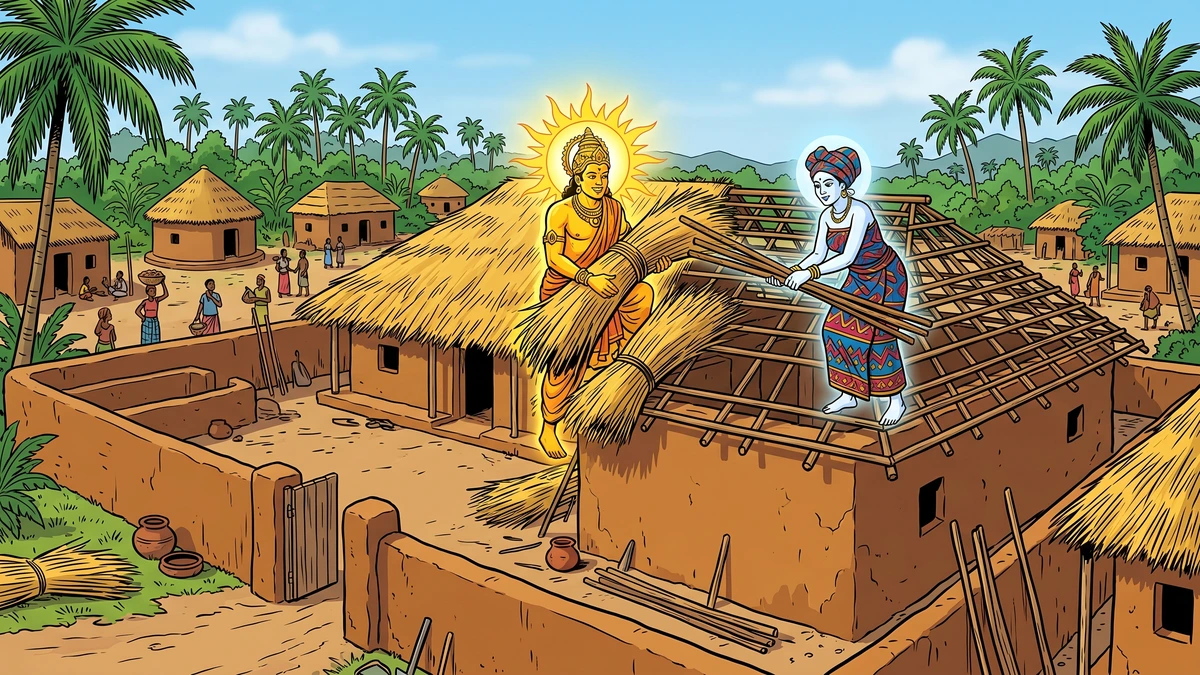
“I would dearly like to visit you,” the Water told the Sun. “But the truth is that your house is not large enough — and you must understand that I cannot come alone. Where the Water goes, all the Water’s people go too: the fish and the crabs, the river-creatures and the sea-creatures, every living thing that dwells in me. We are a vast household. If I were to come to your house with all my people, we should crowd you out of your own home, and drive you and your family clean off your land. I would do you harm without meaning any. That is why I have never come. But if you truly wish me to visit you — then go, and build a house big enough to hold us, a house with a very great compound, and send me word, and I will come.”
The Sun heard this with delight rather than dismay. Far from being discouraged, he was glad — for now he knew that his friend had wanted to visit him all along, and that only the smallness of his house had stood in the way. That, surely, was a thing a friend could fix. So the Sun promised the Water that he would build a house grand enough and wide enough to receive the whole watery household, and that as soon as it was ready he would send the invitation.
The Sun went home full of the plan, and there to greet him, as she always did, was his wife, the gentle Moon. The Moon was a calm and shining presence, soft where the Sun was bright, and she came to her husband with a smile and asked what had passed that day. The Sun told her everything — the old friendship with the Water, the question he had finally asked, the Water’s reason, and the promise he had made. And the Moon, who loved her husband and was as hospitable of heart as he was, agreed at once that they must build the great house and welcome their friend properly.
So the two of them set to work, and it was no small labour. They cleared a wide stretch of ground and they built, not an ordinary dwelling, but an enormous house with a compound vast enough — they were certain — to hold the Water and every one of the Water’s people. They worked until the great house stood finished and waiting under the sky. And when it was ready, the Sun sent word to his friend the Water: Come. The house is built. You and all your people are welcome. Come and visit us at last.
The Day Water Came to Visit
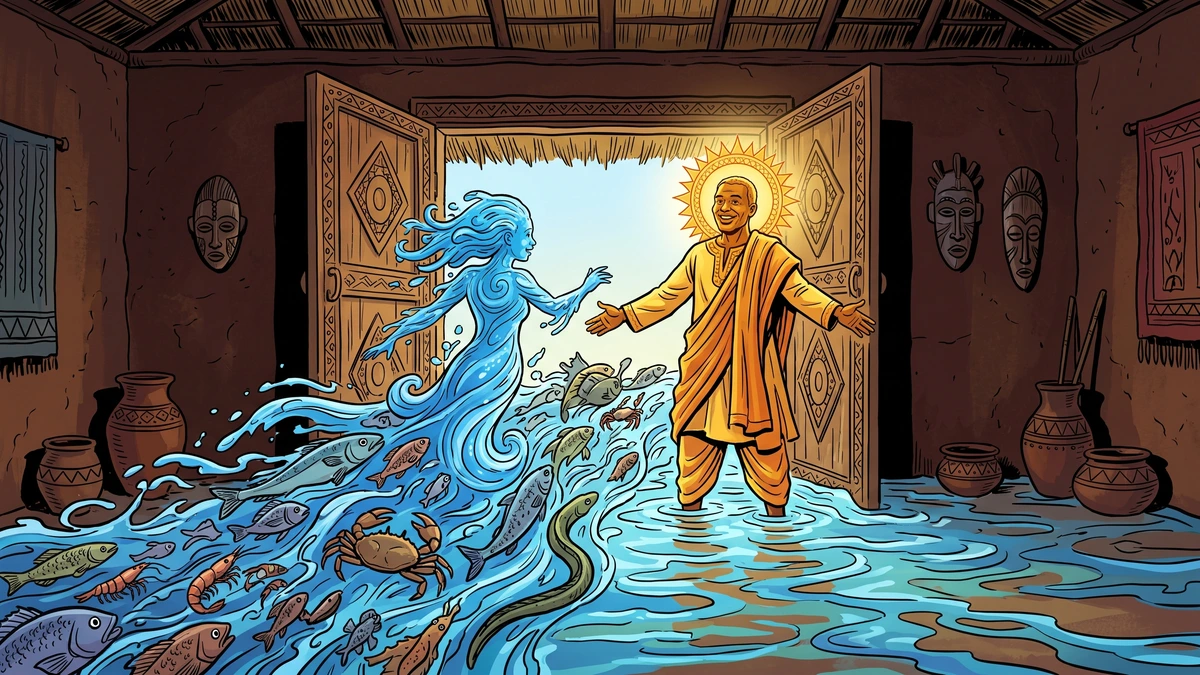
The day arrived, and the Water came to call. But the Water, courteous even now, did not simply pour himself inside. He came up to the threshold of the great new house and he called out to his friend, asking whether it was safe for him to enter — whether the house could truly hold him. And the Sun, standing proud in the doorway of the house he and the Moon had built with such care, called back warmly that yes, it was quite safe; the Water was welcome; let him come in.
So the Water began to flow into the house, and with him came his people. In they came — the fish, the crabs, the lobsters and the eels, the shining river-creatures and the strange creatures of the deep sea, the whole vast household of the Water, each of them welcomed as a guest. For a while all was well. But the Water kept coming, as a tide keeps coming, and soon he had risen knee-deep across the floor of the great house.
The Water paused, and again he called to his friend — for he had warned the Sun honestly, and he would not flood him without asking. “Is it still safe?” the Water asked. “Shall I keep coming? Do you wish more of us to enter?” And the Sun — who had given his word, who had promised his friend a true welcome, and who would not now go back on it — answered again that yes, it was safe; yes, let the rest come in.
So the Water rose higher. He came up level with a tall man’s head, and still more of the Water’s people streamed in through the doorway, and still the great house received them. Once more the Water paused and asked his courteous question, and once more the Sun, keeping faith with his promise, told him to come. The house that the Sun and the Moon had been so sure was large enough was filling now to the very rafters — and the Water had not yet brought in all his people.
Driven Up Into the Sky
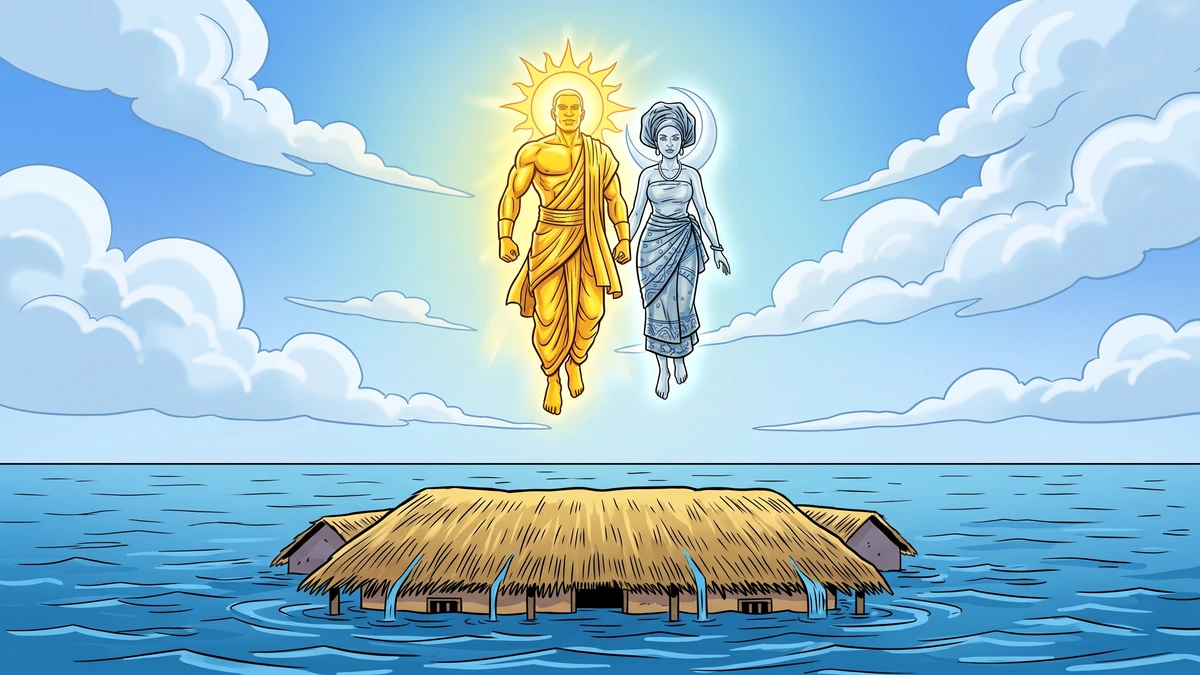
The Water rose and rose. Soon it stood so deep in the great house that the Sun and the Moon could no longer keep their feet on the floor at all, and the two of them were forced to climb up and perch on the top of the roof, looking down at the water and the fishes filling the home they had built. And even then the Water called up his courteous question — was it still safe, should he go on? — and even then the Sun, who had promised, said yes.
So the Water came on. He rose above the roof itself. He overflowed the top of the great house, until there was no longer any dry place anywhere for the Sun and the Moon to stand. And so, with their whole home given over to the Water and the Water’s people, the Sun and the Moon were lifted up — up off their roof, up off the earth altogether — and they went up into the sky.
And there, the Efik storytellers say, the Sun and the Moon have remained from that day to this. They never came back down. The earth below had been given, in the end, to the Water; and the sky above became the home of the two bright friends who had kept their promise and lost their house for it. That is why, when you look up, the sun is always overhead by day and the moon by night — because long ago they welcomed a friend too well, and the rising water sent them to live in the sky forever.
The Moral of Why the Sun and Moon Live in the Sky
A pourquoi tale exists first of all to explain something — here, the plainest and oldest of facts, that the sun and the moon are up in the sky — and we should be honest that its “moral” is gentler and more open than the sharp lesson of a fable. But this story has always carried more than its explanation. On its surface it is a warning about measure: about the danger of issuing an invitation grander than your house can honour, of promising a welcome before you have reckoned the true size of what you are welcoming in. The Sun, in his open-hearted eagerness, never paused to ask how vast the Water’s household really was. He built what he believed was a great house — and the thing he had invited was simply larger than any house could be.
“A stream coming down will not let you swim up against it.”
— A traditional Efik proverb of the Cross River, recorded among the Efik sayings set down by Richard F. Burton in Wit and Wisdom from West Africa (1865).
That old Efik proverb catches the heart of the tale exactly. There are forces — a flooding river, an ocean tide, the whole household of the Water — that cannot be resisted once they are in motion and once they have been let in; the only wisdom is to know their size beforehand. Yet the story is far too kind to leave the Sun looking merely foolish. Read again, and its deeper note is one of honour. The Water behaves throughout with perfect courtesy, asking at every stage whether he should go on; and the Sun, having given his word that his friend was welcome, simply will not break it — not when the water is knee-deep, not when it reaches his head, not when he and the Moon are clinging to the roof. He keeps faith with his promise though it costs him his home. The tale holds both truths at once, without forcing us to choose: be careful what you invite, for some things cannot be un-invited — and yet a promise of welcome, once truly given, is a serious and even a noble thing, worth honouring at a price.
Why This Pourquoi Tale Has Lasted
Stories that explain the sky are among the oldest things human beings make, and almost every people on earth has one. What has carried this particular Efik tale so far — out of the Cross River villages, into Dayrell’s 1910 collection, onto a Caldecott Honor and into classrooms on every continent — is the sheer elegance of its mechanism. It does not simply assert that the sun and moon are in the sky; it shows them being moved there, step by rising step, by a cause we can all picture and all feel. Anyone who has watched a tide come in, or a river climb its banks in the rains, understands in their body exactly how the Sun and Moon were driven upward. The explanation is satisfying because it is built out of something true.
It has lasted, too, because of its gentle wisdom about people. The tale never makes a villain of the Water — he warns his friend honestly, again and again, and floods the house only because he is told to come on. It never makes a fool of the Sun, either; his fault, if it is a fault, is an excess of welcome, and the story plainly loves him for it. This is folklore in a generous key: a story about a misjudgement that is really a story about friendship, hospitality, and the keeping of one’s word. Children remember the marvellous picture of the rising water and the two bright figures climbing to the roof; older listeners catch the quieter lesson about promising within your means.
Above all the story has lasted because it does what the very best pourquoi tales do: it makes the ordinary sky overhead feel like the last page of a story. Once you have heard the Efik tale, the sun and the moon are no longer merely lights in the heavens — they are two old friends who built a great house, welcomed the Water too well, and were lifted up to live above us forever. Every evening, when the sun goes down and the moon comes up, the tale is quietly retold. And that is the truest sign of a folk story that will not die: that the world itself keeps performing it, night after night, long after the fire has gone out.
You May Also Like
 African Folk Tales
Ages 6-8
African Folk Tales
Ages 6-8
The Lion And The Wolf
The Lion And The Wolf: A certain old lady had a very fine flock of sheep. She had fed and cared for them so well that they became famous for their fatness. The
 African Folk Tales
Ages 9-12
African Folk Tales
Ages 9-12
How the Leopard Got His Spots
The canonical story of how the leopard got his spots: Rudyard Kipling's pourquoi tale from Just So Stories (1902), retold with full scholarly attribution.
 African Folk Tales
Ages 6-8
African Folk Tales
Ages 6-8
Anansi And Nothing
Anansi And Nothing: Near Anansi’s miserable little hut there was a fine palace where lived a very rich man called Nothing. Nothing and Anansi proposed, one