Anansi And Nothing
Anansi And Nothing: Near Anansi’s miserable little hut there was a fine palace where lived a very rich man called Nothing. Nothing and Anansi proposed, one

In the folklore of the Akan peoples of West Africa, the spider Anansi is the cleverest creature alive — and the most dangerous to himself. He out-talks chiefs, out-thinks the sky-god, and out-manoeuvres animals ten times his size. Yet the tale of Anansi and Nothing shows the other face of that cleverness: a mind so practised in deception that it cannot stop scheming even when scheming has already won, and so turns at last upon its owner. It is a story about a borrowed cloak, two roads that fork at a crossroads, a pit lined with knives, and a grief so wide it had to be shared with every child in the district. By its final sentence it has stopped being a tale about a spider at all and become an explanation of something every listener has seen: a child weeping, and no one able to say quite why.
The Tale’s Origins: A Spider Story from the Gold Coast
Anansi and Nothing reaches us in print through West African Folk-Tales, collected by William H. Barker — Vice-Principal of the Government Training College at Accra — together with Cecilia Sinclair, and published in London by George G. Harrap & Co. in 1917. Barker gathered the tales on the Gold Coast, the colonial territory that is now the Republic of Ghana, transcribing stories told in Akan communities and rendering them into English for an early twentieth-century readership. The collection sits alongside R. S. Rattray’s later and more scholarly Akan-Ashanti Folk-Tales (1930) as one of the foundational printed records of a tradition that had, until then, lived entirely in performance.
That performance tradition has its own name. Among the Akan, spider stories are called anansesem — literally “Ananse words” or “spider matter” — and the word came to mean storytelling itself, whether or not a particular tale featured the spider. The trickster at their centre is Kwaku Ananse, and he is far more than a folk character: in older Akan cosmology he is associated with the keeping of stories themselves, which the sky-god Nyame is said to have handed into his care. To tell an anansesem was to step, for an evening, into Ananse’s custody. The tales travelled with the Akan and neighbouring peoples across the Atlantic during the centuries of the slave trade, surviving as Anansi in Jamaica, Aunt Nancy in the Carolinas, and a wider Caribbean and African-American storytelling lineage — which is why a tale recorded by a colonial schoolmaster in Accra in 1917 belongs, in truth, to several continents.
In the international indexes of folk narrative, Anansi and Nothing is not a clean fit for any single Aarne–Thompson–Uther tale type; like much of the anansesem corpus it is a cluster of motifs rather than a migratory plot. Its engine is the deception of borrowed finery — a trickster motif in the Thompson index range of deceptive exchanges and false appearances — and its tail is an etiological coda, the kind of “and that is why…” ending that the Thompson index classes among origin and explanatory motifs. The marriage of the two is what makes the story characteristically Akan: a moral fable that ends by pointing not at a moral abstraction but at a thing the listener can still hear today.
Beat One: Two Neighbours and a Borrowed Cloth
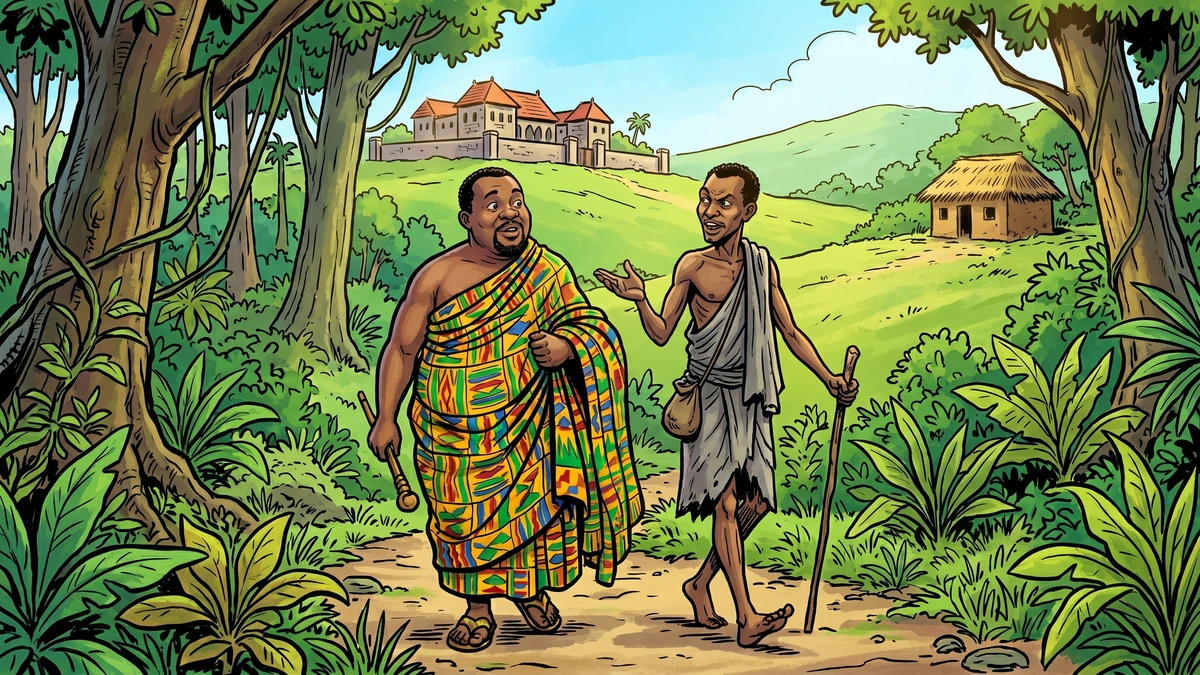
The tale opens on an inequality plainly drawn. Beside Anansi’s “miserable little hut” stands a fine palace, and in the palace lives a very rich man whose name is Nothing. The name is the story’s first and quietest joke, and also its deepest device: a man called Nothing who in fact possesses everything, set against a spider who possesses almost nothing yet is determined to be taken for a man of substance.
One day the two neighbours agree to travel together to a neighbouring town to seek wives. They set out side by side, and the contrast walks with them. Nothing, being wealthy, wears a magnificent velvet cloth; Anansi wears a ragged garment of cotton. Anansi cannot bear the comparison. On the road he begins to work on his companion — would Nothing not lend him the fine velvet, just for a little while? Anansi promises, with the easy certainty of the practised deceiver, to return it before they reach the town gate. Nothing, good-natured and unsuspecting, agrees.
The promise, of course, is never meant to be kept. As the town draws near Anansi finds one pretext, then another, to delay the exchange. Each excuse is small and reasonable; together they carry the travellers all the way through the gate with the cloths still swapped. It is worth noticing how modest the original sin is. Anansi does not steal the cloth outright. He borrows it, and simply declines, politely and indefinitely, to give it back. The whole catastrophe of the tale grows from a loan that is never recalled — a deception so mild it can pass, for a while, as forgetfulness.
Beat Two: The Town of Wives
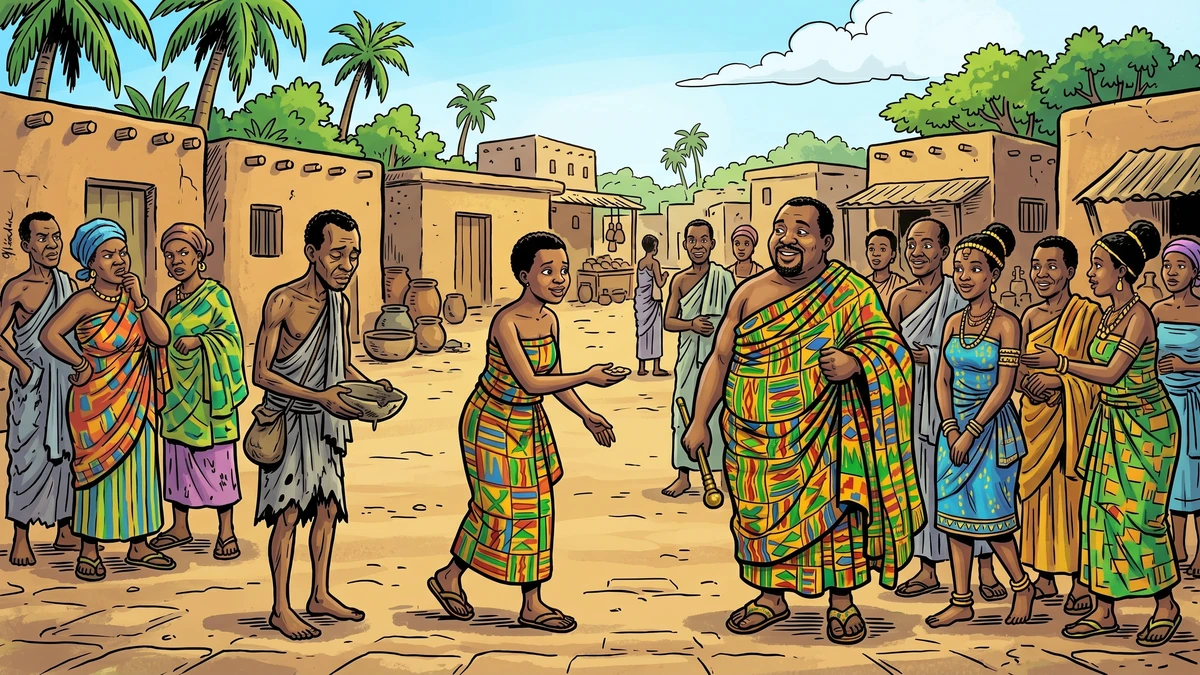
In the town the borrowed velvet does its work at once. Dressed in a rich man’s cloth, Anansi is received as a rich man. He has no difficulty securing as many wives as he wishes; families compete to be allied with so evidently prosperous a visitor. Nothing, meanwhile, stands in Anansi’s discarded rags and is met with open contempt. The same eyes that bow to the velvet sneer at the cotton. For a long while the wealthy man cannot obtain even a single wife.
At last one woman looks past the rags. Taking pity on the quiet, shabby stranger, she gives him her daughter in marriage. The young woman is laughed at heartily by Anansi’s new wives for choosing so plain a husband — but she, the tale says pointedly, “wisely took no notice of their scorn.” It is a small line, easily passed over, yet it plants the story’s counter-argument early. One person in the crowd declines to read a man by his cloth. The narrative will reward her for it, and the reward will be enormous.
Beat Three: The Parting of the Roads
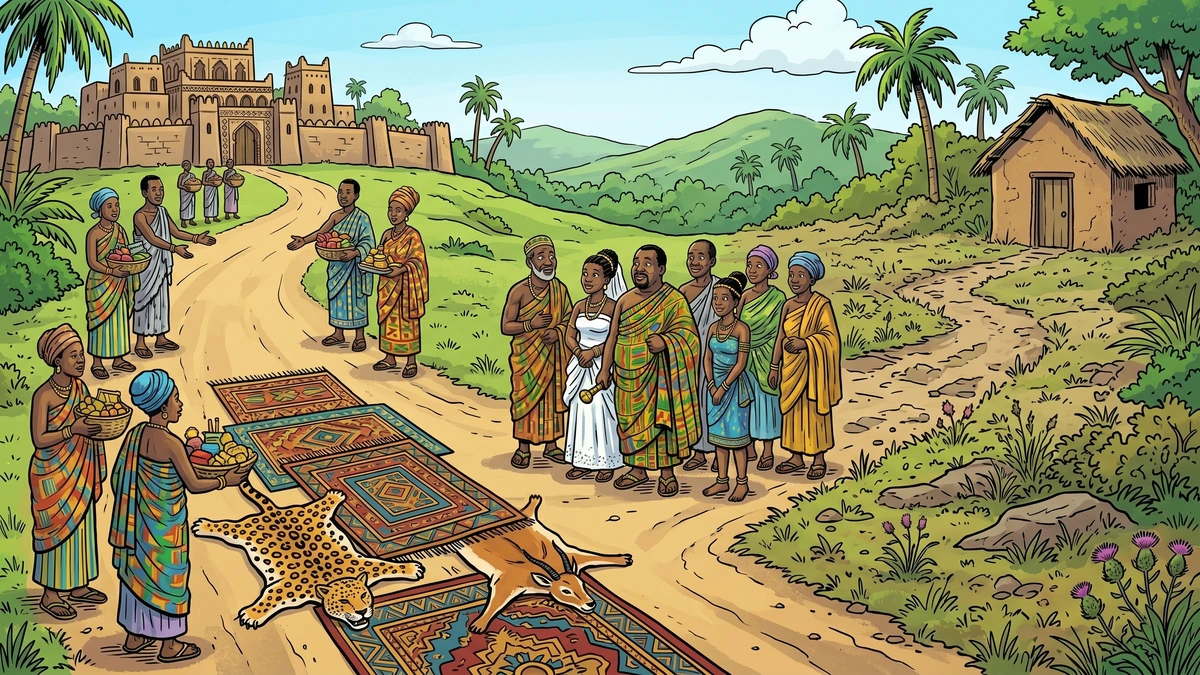
The wedding party sets off for home, and the journey delivers the tale’s great reversal. Where the path divides — at the crossroads between Anansi’s quarter and Nothing’s — the truth that the borrowed velvet had hidden is suddenly, physically visible. The road toward Anansi’s house is only half cleared, rough and unfinished. The road toward Nothing’s palace is wide and well made, and his servants have strewn it with beautiful skins and carpets to welcome their master home. Attendants wait there with fine clothes for Nothing and his bride. For Anansi and his many wives, no one waits at all.
The contrast that the cloth had inverted now rights itself, and it rights itself in the most concrete terms the tale can find: not in a speech, but in the surface of two roads. Nothing’s wife becomes, in effect, queen of the whole district, with everything her heart could desire. Anansi’s wives cannot get even proper food; they are reduced to living on unripe bananas and peppers. When Nothing’s wife hears of her neighbours’ wretched state she does not gloat. She invites Anansi’s wives to a great feast in the palace — and they are so taken with what they see, and so weary of bananas and peppers, that they simply stay. They refuse to return to Anansi’s hut. The deceiver is left with the rags he schemed his way out of, and with an empty house.
Beat Four: The Pit of Knives
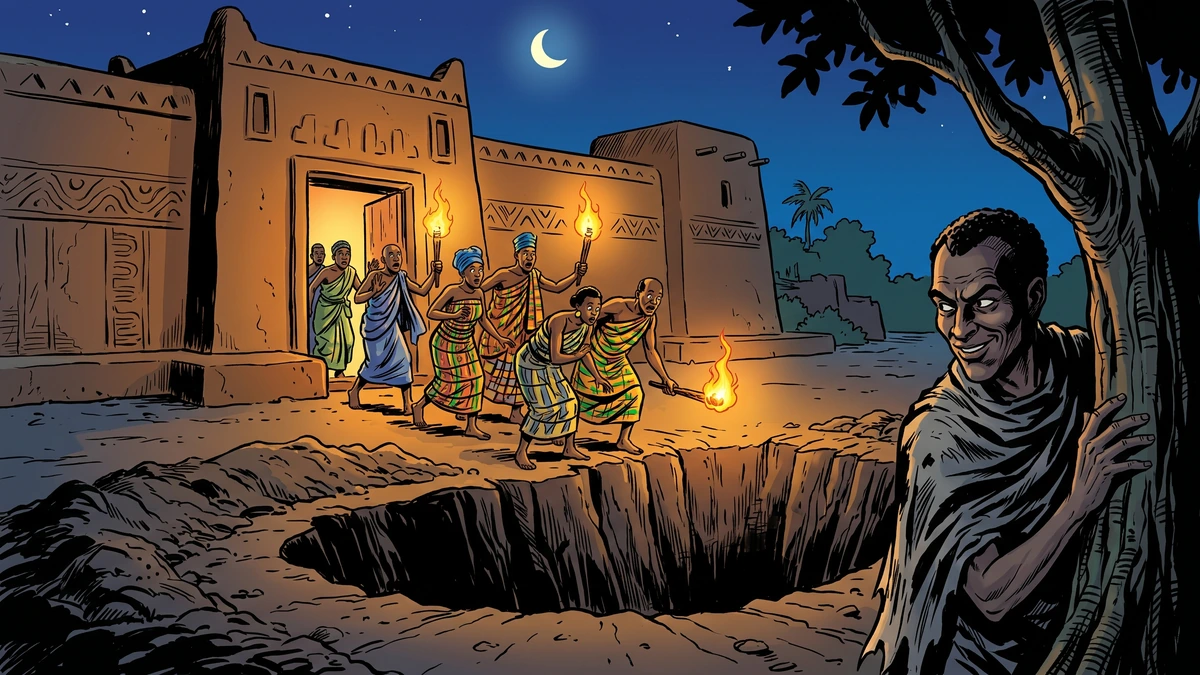
Here the tale takes its darkest and most revealing turn. Anansi has, by any reasonable measure, already lost; and a wiser trickster would cut his losses. But cleverness, once it has become a habit, does not know how to stop. Consumed with envy, Anansi sets himself not to recover what he has lost but to destroy the man who has it. He tries many times to kill Nothing and fails. At last he persuades a band of rat friends to dig a deep tunnel directly in front of Nothing’s door. He lines the pit with knives and broken bottles, and smears the palace steps with okro — okra — until they are treacherously slippery. Then he withdraws a little way and waits.
When he judges the household asleep, Anansi calls out into the dark, urging Nothing to come into the courtyard and see something. Nothing’s wife — the same woman who had once looked past the rags — dissuades her husband from going. Anansi calls again, and again, and each time she bids him not to listen. But the calling wears the rich man down. At last Nothing resolves to go out and see this thing for himself. His foot meets the smeared step; he slips; and he falls into the knife-lined pit. The noise wakes the house. Lights are fetched, and Nothing is found in the ditch so badly wounded that he soon dies.
It is a brutal ending for the tale’s gentlest character, and the brutality is deliberate. The story refuses to let the moral comedy of cloths and crossroads soften into something harmless. Anansi’s deception was mild; his envy is murderous; and the tale insists the listener feel the distance between the two — and feel, too, that the wife’s caution was right, and that the good-natured trust which made Nothing lend the cloak in the first place is also, in the end, what kills him.
The Moral: Envy That Devours the Envier
On its surface the lesson of Anansi and Nothing is the familiar warning that greed and deceit lead to ruin. But the tale is sharper than that. Anansi’s downfall does not come from his original trick. The borrowed velvet, dishonest as it was, had already cost him his wives and his standing — the deception had run its course and failed on its own. What destroys Anansi is what he does after losing: he cannot accept the loss, and turns a survivable defeat into a capital crime. The story’s true subject is envy, and specifically envy’s refusal to let go.
The Akan have a proverb that frames this exactly. Where a written text would have a fixed “original” line to quote, an anansesem lives only in performance — so the Akan-language moral frame for this tale is best heard in the proverb a storyteller might set against it:
“Ani bere a, ɛnso gya.”
“Though the eye reddens with envy, it does not emit fire.” — Akan (Twi) proverb
The proverb’s counsel is restraint: envy may redden the eye, but it has no power of itself to burn another person — unless the envier reaches, as Anansi does, for knives and broken bottles to give the red eye teeth. Read beside the tale, the proverb becomes almost a diagnosis. Anansi’s eye reddens at the carpets on Nothing’s road and the food in Nothing’s palace; and rather than let the redness fade, he builds it a pit. The fire that finally burns is not the eye’s. It is the trap’s. And a knife-lined pit, the story knows, does not care who dug it; envy that arms itself is a danger first of all to the one who picks up the weapon.
Anansi and the Anansesem Tradition
To an Akan audience, a great deal of this tale’s meaning lives in the simple fact that its villain is Anansi. The spider is not a stock evildoer; he is the tradition’s most beloved figure, the small clever creature who in dozens of other stories wins the listener’s delighted sympathy precisely because he tricks the strong. The folklorist Paul Radin, in his 1952 anthology African Folktales and Sculpture, drew attention to exactly this doubleness: Anansi is at once admired hero and cautionary example, and the same audience that cheers his cunning on Monday is meant to wince at it on Tuesday.
Anansi and Nothing is a Tuesday tale. It uses the listeners’ affection for the spider against them. Because we are fond of Anansi, his slide from a charming clothes-swap into a murderer’s ambush lands with a weight a stranger’s crime never could. The anansesem tradition was, among many other things, a school: Ashanti raconteurs used these stories to teach children about property, ambition, hospitality and the obligations of kinship, embedding a demanding ethics inside a form children would beg to hear again. A tale that let Anansi be simply wicked would teach nothing. A tale that lets the children’s favourite go too far teaches a great deal.
The choice to name the rich man “Nothing” belongs to the same pedagogy. It is a piece of deliberate paradox-craft. The abstraction lets the story pun its way to its ending, but it also quietly makes a point about value: the man called Nothing is the one who actually has everything worth having — a good nature, a wise wife, a community that prepares his road — while the spider who schemed so hard to seem like Something ends with an empty hut. Akan storytelling delighted in such reversals of name and substance, and trusted child listeners to feel the irony long before they could have explained it.
Why “Crying for Nothing” — the Etiological Turn
The final movement of the tale is its most distinctive, and the reason it has been remembered. Nothing’s wife is left in terrible grief. She does something a Western fable would almost never do: she makes her mourning communal and practical. She boils a great quantity of yams, mashes them, and carries a large dish of the food around the whole district. To every child she meets she gives a portion — so that the child, in return, will help her cry for her dead husband. And so, the storyteller concludes, if you come upon a child weeping and ask the reason, you will often be told that the child is “crying for Nothing.”
This is the etiological hinge, the “and that is why” that turns a fable into an origin story. The pun is exact and untranslatable-feeling in its neatness: the child cries for Nothing the dead man, and the phrase survives into ordinary speech as the child who cries “for nothing” — for no reason anyone can name. The tale thereby anchors itself in a sound the listener already knows. Every future instance of an inexplicably weeping child becomes a tiny re-performance of the story. This is one of folklore’s oldest and most powerful techniques: rather than ending with an abstract maxim, the tale fastens its memory to a recurring feature of daily life, so that the world itself keeps the story alive. It also, more gently, makes a last point about grief — that sorrow shared out, like mashed yam, among a whole district of children is sorrow a widow can survive.
Why This Story Has Lasted
Anansi and Nothing has endured for the same reasons the whole anansesem tradition endured the catastrophes of colonialism, enslavement and diaspora: it is portable, it is funny before it is frightening, and it carries a lesson too useful to discard. Its warning — that envy left unmastered will arm itself, and that an armed envy destroys the envier first — needs no footnote in any century. Its quieter teaching is just as durable: that a person should not be measured by a borrowed cloth, that the woman who looks past the rags is the one who ends as queen of the district, and that the things truly worth having, like a well-made road home and neighbours who wait for you, cannot be put on like velvet.
And the tale lasts, finally, because it gave itself a hiding place in everyday language. A maxim can be forgotten. A phrase that a whole community uses every time a child weeps cannot. Each time someone says a child is “crying for nothing,” the spider, the borrowed cloak, the forked roads and the pit of knives are all carried forward one more time — which is exactly the immortality a storyteller, custodian of Ananse’s words, would have wished for the tale.
Frequently Asked Questions
Who collected the tale “Anansi and Nothing” and where does it come from?
The tale was published in West African Folk-Tales (George G. Harrap & Co., London, 1917), collected by William H. Barker, Vice-Principal of the Government Training College at Accra, with Cecilia Sinclair. It belongs to the anansesem (“spider stories”) tradition of the Akan peoples of the Gold Coast, in what is now Ghana.
Why is the rich man called “Nothing”?
The name is a deliberate paradox. The man called Nothing actually possesses everything that matters — wealth, a good nature, a wise wife and a welcoming community — while Anansi, who schemes to seem like “something,” ends with an empty hut. The name also sets up the tale’s closing pun, in which a grieving child is said to be “crying for Nothing.”
What is the moral of “Anansi and Nothing”?
The tale warns against envy that refuses to let go. Anansi’s first deception had already failed and cost him everything; what destroys him is that he cannot accept the loss and turns a survivable defeat into murder. As the Akan proverb says, a red eye does not by itself emit fire — envy only becomes deadly when the envier arms it, and an armed envy harms its owner first.
How does the story explain why children “cry for nothing”?
After Nothing dies, his widow boils and mashes yams and carries the food around the district, giving it to every child she meets so they will help her weep for her husband. Because the dead man’s name was Nothing, a crying child is said to be “crying for Nothing” — an etiological ending that ties the tale to an everyday sight.
Who is Anansi in West African folklore?
Anansi, or Kwaku Ananse, is the spider trickster of Akan oral tradition and one of the most beloved figures in West African and African-diaspora folklore. He is a doubled character — admired for outwitting the powerful, yet also used in cautionary tales like this one to warn against cunning that loses its conscience.
You May Also Like
 African Folk Tales
All Ages
African Folk Tales
All Ages
Lion Who Took A Woman’s Shape
A chilling Khoikhoi folk tale from Great Namaqualand: a lion devours a woman, pulls on her skin, and walks into her family's kraal disguised as their daughter — until the cattle, a frightened child, and a single coarse hair betray him.
 African Folk Tales
Ages 9-12
African Folk Tales
Ages 9-12
How Beasts And Serpents First Came Into The World
How Beasts And Serpents First Came Into The World: The famine had lasted nearly three years. Kweku Tsin, being very hungry, looked daily in the forest in the
 African Folk Tales
Ages 6-8
African Folk Tales
Ages 6-8
Anansi The Blind Fisherman
Anansi the Blind Fisherman: A Tale of Cleverness and Justice In a village near a great river in Africa, there lived a spider named Anansi. Unlike...