The Dance For Water Or Rabbit’s Triumph
A Khoikhoi trickster tale from the Cape of Good Hope: during a drought the animals dance water out of a dry riverbed, and the rabbit who scorned the work is trapped on a pitch-covered tortoise, then escapes by reverse psychology - an African root of the Tar-Baby tale.

Tradition: Khoikhoi (Khoekhoe) animal trickster cycle, Cape of Good Hope, southern Africa.
First printed source: James A. Honeÿ, South-African Folk-Tales (New York: Baker & Taylor, 1910), tale 20, “The Dance for Water, or Rabbit’s Triumph” (pp. 80–83). Honey gathered his Cape material in the documentary line opened by W. H. I. Bleek’s Reynard the Fox in South Africa; or, Hottentot Fables and Tales (London: Trübner, 1864).
Tale type: ATU 175, “The Tarbaby and the Rabbit” — the most widely travelled African tale type in the world. Key motifs: K741 (capture by tar-baby / sticky figure), K581.1 and K551.3 (the bluffed-preference or “briar-patch” escape), A2231 (etiological loss of fur).
Reading time: about 10 minutes.
Some folk tales belong to a single village. This one belongs to half the planet. “The Dance for Water, or Rabbit’s Triumph” is a Khoikhoi tale collected at the Cape of Good Hope, but its central device — a clever animal glued fast to a sticky decoy — is the same device that powers the Tar-Baby story of the American South, the “sticky prince” tales of India, and dozens of versions across West Africa and the Caribbean. When James A. Honey printed it in South-African Folk-Tales in 1910, he was setting down on paper a story that had already crossed oceans inside the memories of enslaved and migrating people. To read it now is to hold one bright thread of a web that spans continents.
The version below follows Honey’s 1910 text closely. It opens, as so many African tales do, not with a hero but with a problem the whole community must solve together: there is no water, and the land is dying.
The Drought and the Dance
A frightful drought had settled over the veld. The rivers shrank to cracked clay, the springs gave nothing, and every animal — Lion, Elephant, Jackal, Wolf, Tortoise, Rabbit — wandered the burning country in search of a drink and found none. So they did the thing communities in crisis have always done: they called a great gathering. Plan after plan was offered and rejected, until one animal proposed a strange remedy. Let every creature go down into the dry river bed and dance; let them stamp and tread the parched earth until the water was pounded back up to the surface.
It is worth pausing on how African this image is. The dance is not magic for its own sake; it is collective labour given rhythm. Across southern Africa, communal work — threshing, building, rainmaking — was traditionally organised through song and synchronised movement, because shared rhythm makes hard effort bearable and binds a group into one body. The tale dramatises a real social truth: the water rises only when everyone treads together.

Everyone agreed at once — everyone except Rabbit. He folded his arms and refused. “I will not go and dance,” he announced. “All of you are mad to attempt to get water from the ground by dancing.” And so, while Rabbit sat apart and sneered, the other animals went down into the river bed and danced. They danced and danced, hour upon hour, until — exactly as the plan had promised — the water seeped, then welled, then ran. The community drank its fill and rejoiced. Only one rule was passed: because Rabbit had refused the work, Rabbit would receive none of the water.
Rabbit’s Defiance and the Theft
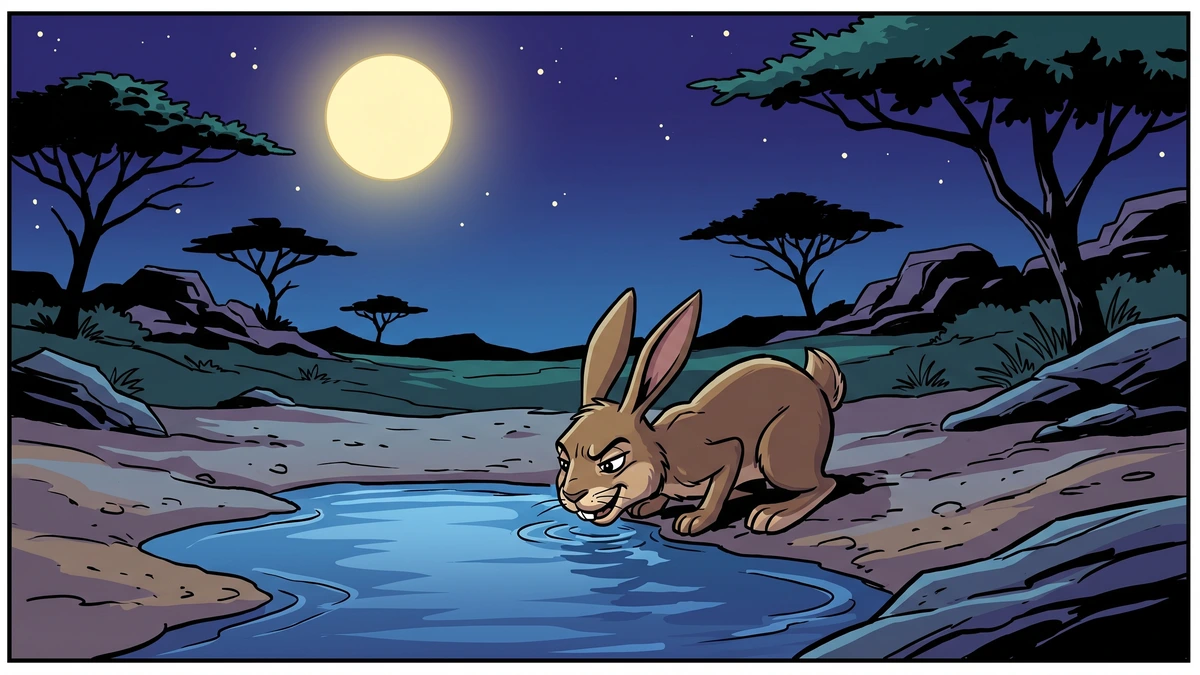
Rabbit was unmoved. “I will nevertheless drink some of your water,” he laughed. And that evening, while the other animals slept, he strolled down to the river bed at his leisure and drank as much as he pleased. He did not even hide it. The next morning the animals found his footprints pressed deep in the mud, and Rabbit himself called out across the veld, mocking them: the water, he said, had been most refreshing and had tasted fine.
This is the moment the tale shifts from a parable about cooperation into a true trickster story. Rabbit is not merely lazy; he is insolent. He breaks the community’s rule and then advertises the breach. In Khoikhoi storytelling the small clever animal — Rabbit here, elsewhere Jackal — occupies an unstable place: the audience laughs with him at the pompous and the powerful, yet the tale never lets him off entirely. A trickster who flaunts his cleverness is always, sooner or later, walking toward a trap. The animals, furious, gathered again to ask the hardest question of all: how do you catch a creature faster and craftier than yourself?
The Tar-Trap: Old Tortoise Has a Plan
Every animal had a scheme, and every scheme was useless — until old Tortoise came forward, moving slowly, foot by foot, and said simply, “I will catch Rabbit.” The others jeered: You? How? What do you think of yourself? But Tortoise had understood something the swift animals had missed. You do not catch a trickster by being faster than he is. You catch him by being patient, and by letting his own appetite do the work.
“Rub my shell with pitch,” said Tortoise, “and I will go to the edge of the water and lie down. I will resemble a stone, so that when Rabbit steps on me his feet will stick fast.” The plan was praised, the shell was coated thick with sticky black pitch, and Tortoise crept down to the water’s edge, drew in his head, and became, to all appearances, an ordinary stepping-stone.
That night Rabbit arrived for his stolen drink and was delighted. “Ha!” he chuckled. “They are, after all, quite decent — here they have placed a stone, so now I need not unnecessarily wet my feet.” He set his left forefoot on the stone, and it stuck. Tortoise put out his head. What follows is one of the great comic sequences of African oral literature, and it is built on a rule of three carried to five. Indignant rather than frightened, Rabbit threatens the “stone” with his right forefoot — stuck. With a hind foot — stuck. With his other hind foot — stuck. He hammers with his head — stuck. He lashes with his tail — stuck. Each blow is delivered with a fresh boast, and each boast leaves him more helpless than before. The audience already knows how it ends; the pleasure is in the rhythm.

This is the heart of the story, and it is far more than a punchline. The sticky-decoy episode is the defining scene of ATU 175, “The Tarbaby and the Rabbit,” and folklorists have traced it through an enormous family of tales. The same trap appears in West African and Bantu narratives, in the Bahamas and the Caribbean, and — most famously to English-language readers — in the Tar-Baby story that Joel Chandler Harris published in Uncle Remus: His Songs and His Sayings in 1880. The genius of the device is psychological: the trap does nothing on its own. It is the victim’s own pride and temper that bind him. Every limb Rabbit commits to the fight is a limb he loses. Tortoise simply waited, and let arrogance finish the job.
His task done, Tortoise turned himself slowly round and, foot by patient foot, carried the helpless Rabbit on his back to the waiting council of animals, who roared with laughter: “Insolence does not pay after all!”
The Trickster’s Triumph
Now the animals debated Rabbit’s death. Beheading was proposed; severe penalties were proposed. At last they asked the prisoner himself: “Rabbit, how are we to kill you?” Rabbit answered with apparent meekness. He did not mind dying, he said — only, please, not a shameful death. And what shameful death did he fear? “To take me by my tail,” he begged, “and dash my head against a stone — that I pray and beseech you do not do.”
The animals heard a desperate plea and did exactly what desperate pleas invite: the opposite. It was decided that Rabbit should die precisely that way. Lion, as the strongest, was chosen to carry out the sentence. He took Rabbit firmly by the tail and swung him hard against the stone — and the white skin slipped clean off Rabbit’s body, leaving Lion holding nothing but a scrap of fur and hide while Rabbit himself bounded away, free.

This is the bluffed-preference escape, motif K581.1, the same trick English-speaking readers know as “please don’t throw me in the briar patch.” Rabbit, who was caught because he could not stop boasting, escapes because he finally learns to lie quietly — to disguise the thing he wants as the thing he dreads. The tale also slips in a small etiological flourish: the lost white skin is a folk explanation of the rabbit’s appearance and his vulnerable, easily-shed pelt. The trickster wins, but the story makes him pay for the win with his own hide. Cleverness saves him; it does not leave him unmarked.
The Moral
“The Dance for Water” refuses to hand us a single tidy lesson, and that refusal is part of its honesty. It condemns Rabbit’s arrogance — his contempt for shared work nearly costs him his life — yet it also lets his quick wit save him at the end. The tale admires intelligence while warning that intelligence used only for oneself, paraded and gloated over, will eventually find its tar-trap. The escape is not a reward; it is a narrow, skin-of-the-teeth survival.
“Slim vang sy baas.”
— Cape Afrikaans proverb of the Khoikhoi storytelling country: “The clever one catches its master” — cunning eventually meets, and is caught by, a cunning greater than its own. Rabbit catches the council; Tortoise catches Rabbit.
The deepest lesson sits in the contrast between the two clever characters. Rabbit’s cleverness is loud, selfish, and contemptuous of the group. Tortoise’s cleverness is quiet, patient, and offered in the community’s service. Both are clever; only one is wise. The tale leaves the listener to feel the difference rather than be told it.
A Tale That Crossed the Ocean
No African story has travelled further than this one. The tar-trap episode is the spine of a tale family that folklorists number among the most widespread on Earth. Its African versions are dense and old, recorded among the Khoikhoi, the Yoruba, the Hausa, the peoples of the Congo basin and beyond. During the centuries of the Atlantic slave trade, those stories were carried — in memory, since nothing else could be carried — to the plantations of the Caribbean and the American South. There they survived, adapted, and resurfaced in the Brer Rabbit cycle that Joel Chandler Harris transcribed in 1880.
For a long time the origin of the Tar-Baby tale was debated, with some scholars proposing Native American or even Indian sources. The modern scholarly consensus, supported by the sheer depth and antiquity of the African material, recognises sub-Saharan Africa as the principal home of the type. The Khoikhoi “Dance for Water” is one of the clearest windows we have onto that African original: a version recorded at the southern tip of the continent, structurally complete, and untouched by the plantation retellings. When a modern reader meets Brer Rabbit and the Tar-Baby, they are meeting the great-grandchild of a story exactly like this one.
The Veld and Its Storytellers
To understand why this tale opens with a drought, it helps to picture the country that produced it. The Khoikhoi were a pastoral people of the arid western and southern reaches of what is now South Africa and Namibia — a land of thornbush, low rocky koppies, dry watercourses and immense skies, where rain is never guaranteed and the failure of the springs is the oldest fear a community knows. A story that begins “there was a frightful drought” was not, for its first listeners, a fantasy premise. It was the recurring shape of real life. The tale’s solution — gather, debate, work together, share what the work produces — encoded a survival ethic that the desert itself enforced. To refuse the common labour, as Rabbit does, was not merely rude; in a drought it was the kind of choice that could unravel a whole band.
The animal cast carries the same realism. Lion, Elephant, Jackal, the creature Honey calls “Wolf” (the brown hyena of the Cape), Tortoise and Rabbit were the everyday neighbours of Khoikhoi herders, and each had a settled character in the storytelling. Lion is power without subtlety; Jackal and Rabbit are the small, quick wits who survive among the strong; and Tortoise — slow, armoured, unhurried — is the figure of patience that outlasts speed. Khoikhoi tales of this kind were performed, not merely recited: a skilled teller acted the voices, stretched the comic repetitions, and invited the audience to chant along with the refrains. The fivefold “and there it stuck” sequence on Tortoise’s back is built for exactly that participation. What Honey captured on the page in 1910 is the cooled ember of something that, in performance, blazed.
Why This Story Still Matters
“The Dance for Water” has lasted because it works on every level at once. For a small child it is a funny story about a rabbit who gets stuck and wriggles free. For an older listener it is a sharp meditation on community and the freeloader who scorns shared labour, on the difference between cleverness that serves and cleverness that struts, and on the way pride converts every blow we throw into another limb we lose. And for anyone curious about history, it is a living artefact — proof that a story told around a fire at the Cape of Good Hope could survive a forced ocean crossing and still be recognisable two centuries and two continents later.
That endurance is the real triumph of the tale — greater even than Rabbit’s. The water in the story was treaded up by many feet dancing together; the story itself was carried forward by many mouths telling it together. Both are communal achievements. And both remind us, gently, that what survives a drought — or a diaspora — is what a community is willing to make and keep alive together. Rabbit nearly learned that lesson the hard way. The story makes sure we do not have to.
You May Also Like
 African Folk Tales
Ages 6-8
African Folk Tales
Ages 6-8
How Mushrooms First Grew
How Mushrooms First Grew — a tale of brothers, trickery, and transformation. Two brothers with bad habits deceived their community, changing the land.
 African Folk Tales
Ages 6-8
African Folk Tales
Ages 6-8
The Leopard And The Ram
The Leopard And The Ram: A ram once decided to make a clearing in the woods and build himself a house. A leopard who lived near also made up his mind to do the
 African Folk Tales
Ages 6-8
African Folk Tales
Ages 6-8
Abiyoyo: The Monster and the Boy
Abiyoyo: The Monster and the Boy: In a small South African village nestled at the edge of the high veld, where grasslands stretched endlessly toward a horizon