How Mushrooms First Grew
How Mushrooms First Grew — a tale of brothers, trickery, and transformation. Two brothers with bad habits deceived their community, changing the land.
How Mushrooms First Grew is one of the best-loved chain tales of the West African coast — a short, fast-moving story in which a single misfortune is handed on from creature to creature down a chain of accidents until it finally explains something a child can see with their own eyes. It belongs to the storytelling tradition of the Akan-speaking peoples of the Gold Coast (modern Ghana), and in particular to the Ashanti, whose oral repertoire of anansesem — literally “spider stories”, the general Akan word for folk tales whether or not Anansi the spider actually appears in them — was among the first African corpora to be carefully written down for English readers. The tale was published in West African Folk-Tales, collected and edited by William H. Barker, sometime Vice-Principal of the Government Training College at Accra, together with Cecilia Sinclair, and issued in London by George G. Harrap & Co. in 1917. Barker gathered the stories directly from Gold Coast schoolchildren and their families during his years as an educationist on the coast, and the volume remains one of the standard early sources for Akan oral narrative in English. The story is in the public domain and the full 1917 text is freely available through Project Gutenberg.
Folklorists place How Mushrooms First Grew at the meeting point of two great international categories. In structure it is a cumulative or chain tale, the family the Aarne–Thompson–Uther index gathers under the “Formula Tales” heading (ATU 2000–2199), where a small set of events is repeated and extended in a rhythmic, memorisable sequence — the same architecture that carries The House That Jack Built, The Old Woman and Her Pig, and the Russian Turnip. In purpose, however, it is a pourquoi tale or aetiological myth: a story that exists to answer the question “why is the world the way it is?” — here, “where did mushrooms come from?” The relevant motif is Stith Thompson’s A2611, “origin of plants from a transformation”, with the chain itself echoing the blame-and-debt sequences catalogued under the cumulative Z21–Z49 formulae. Few short tales do so much at once: it teaches a moral, exercises a child’s memory, and ends with a fact about the natural world that the listener can go outside and verify.
I. The Two Brothers, the Debt, and the Ruined Farm
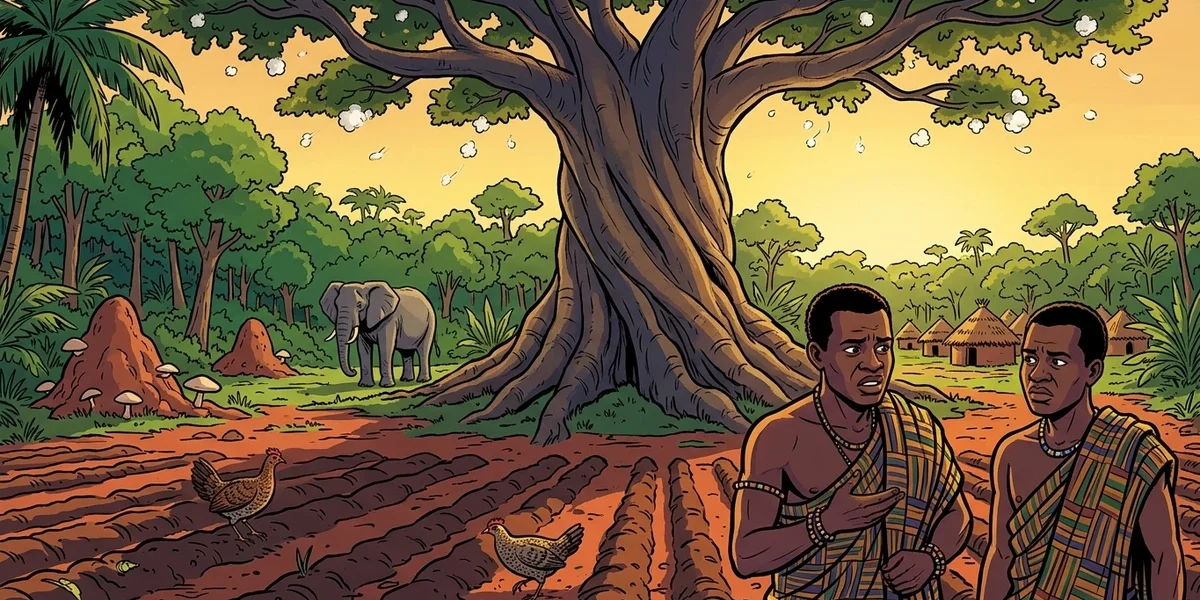
The story opens, as so many Akan tales do, in a town — not a wilderness but a settled community with neighbours, creditors and obligations, because Akan storytelling is almost always interested in how a person stands with the people around them. Two brothers live there, and Barker is blunt about the cause of their trouble: their own bad habits. Day by day they slide deeper into debt. Their creditors give them no peace. In Akan society this is a serious matter; debt (ka in Twi) was not a private embarrassment but a public bond that could pull in a whole lineage, and a debtor who could not pay risked pawn-service or the loss of standing for his entire family. The brothers do not face their obligation. They run away into the forest and become highway robbers — trading one wrong for a worse one.
But the tale is careful to tell us that the robbery does not satisfy them. “They were not happy. Their minds were troubled by their evil deeds.” This single sentence is the moral hinge of the whole story. The brothers are not monsters; they are ordinary people who have made bad choices and still possess a conscience. They decide, at last, to do the honest thing: go home, clear a large farm, raise a corn crop, and pay their debts off gradually from the harvest. It is the right decision, and the listener is meant to feel a flush of relief. They work hard. The soil is good. A fine field is planted, and the brothers go home for the night already counting the money the harvest will bring.
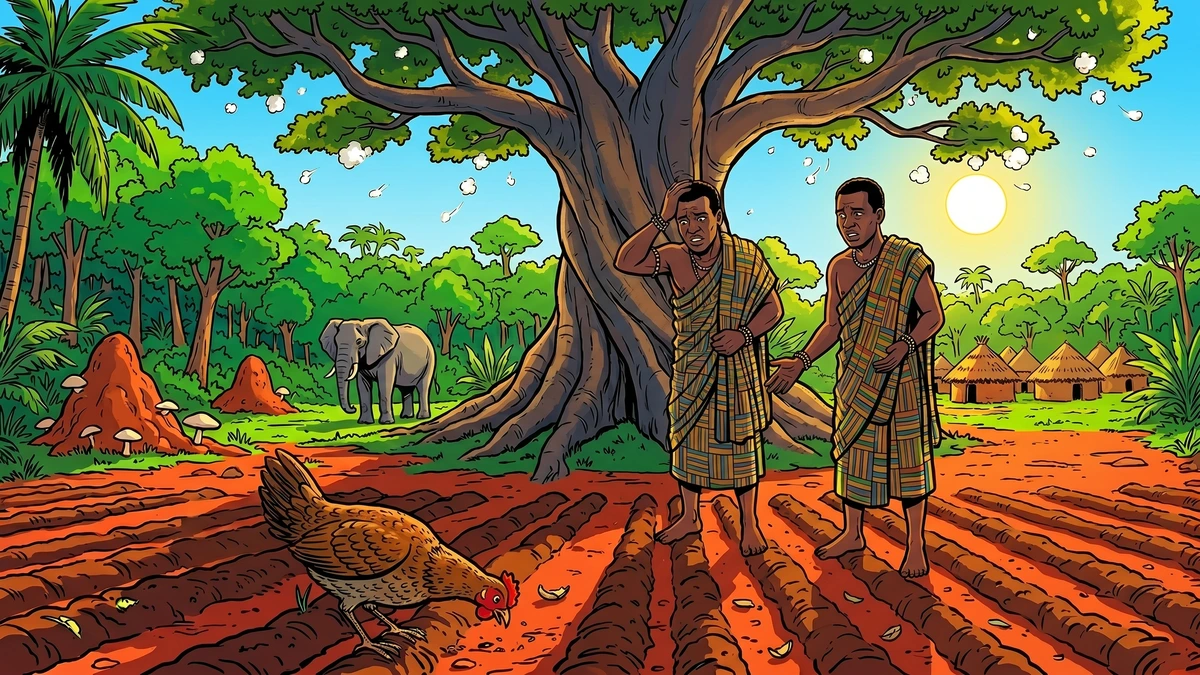
Then the tale springs its trap. That very same day — before the brothers’ honest plan has had even one night to ripen — a hungry bushfowl (the francolin, a ground-feeding game bird of the West African scrub) wanders onto the field and scratches up and eats every newly planted seed. The brothers return the next morning to find their labour erased. Here the storyteller makes a quiet, deliberate choice that drives everything to come. The brothers set a trap, catch the bird — and instead of simply accepting the loss, they pronounce a sentence: because the bushfowl destroyed their means of paying, the debt is now transferred to the bird. A burden born of human folly is loaded, in an instant, onto the back of a creature that knew nothing of debt at all.
II. The Bushfowl, the Broken Eggs, and the Silk-Cotton Tree
The bushfowl accepts the verdict — in chain tales the chain is never argued with; it simply runs — and tries honestly to discharge what it now owes. It builds a nest beneath a great silk-cotton tree and begins to lay eggs, meaning to hatch the chicks and sell the young birds for money. This is the engine of the cumulative form: each new bearer of the debt is given a sympathetic plan, and each plan is destroyed by the next link before it can succeed. The bird’s plan is destroyed by the weather. A hurricane tears through the forest, a branch of the silk-cotton tree crashes down, and every egg in the nest is smashed. By the tale’s own iron logic, the bushfowl transfers the debt onward — to the tree, whose branch did the breaking.
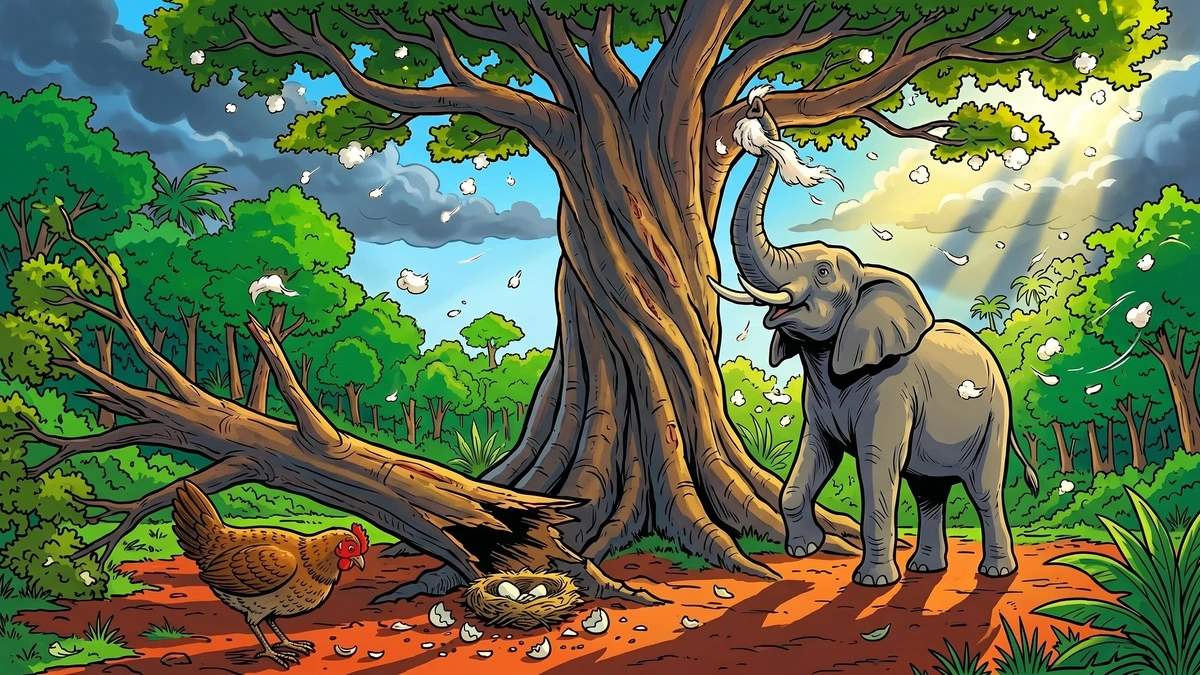
The choice of tree is not incidental, and an Akan listener would have felt its weight at once. The silk-cotton tree — onyina in Twi, the giant Ceiba pentandra — is the most charged tree in the whole West African forest. It is the tallest tree of the canopy, often left standing alone when farmland is cleared because the people consider it dangerous and powerful to fell; it is widely regarded as a dwelling place of spirits, and its pale, weightless seed-floss (the kapok of commerce) drifts through the air like something not quite of this world. To make the onyina a debtor is a small marvel of folk imagination: the storyteller takes the grandest, most awe-inspiring being in the landscape and shows even it caught in the same web of obligation as two ruined men. The tree, dismayed at owing “such a big sum of money”, sets to work doing the only thing it can — producing as much silk cotton as possible, to sell. And then an elephant, knowing nothing of any of this, ambles up, finds the tree heavy with cotton, and strips every pod from its branches. The debt passes to the elephant.
III. The Elephant, the Hunter, and the Stump in the Road
With the elephant the tale reaches its largest and most sorrowful figure. The greatest animal of the African forest wanders away into the desert, “very sad”, turning over in its mind some way to raise money, and able to think of none. There is real pathos here, and West African audiences would have heard it: the elephant is strength itself, and strength is exactly no use against a debt. It can carry anything except this. As the elephant stands quietly beneath a tree, a poor hunter creeps up, can hardly believe his luck at finding so fine a beast standing so still, and shoots it. With its dying breath the elephant speaks the formula — the debt now belongs to the hunter.
The hunter is “much grieved”, for he has no money at all, and he walks home through the dark forest worrying at the problem. Here the chain delivers its sharpest irony. The hunter, distracted by the very debt he is trying to solve, fails to see a tree-stump — one the road overseers had cut and left in the path — trips over it in the darkness, and breaks his leg. By the tale’s logic the debt is transferred to the stump. The story has now passed its burden through human beings, a bird, a tree, the mightiest of beasts, and a man again — and it is about to hand it to the smallest creatures of all, who will be the only ones clever enough to do something genuinely new with it.
IV. The White Ants, the Linen, and the First Mushrooms
The next morning a party of white ants — termites, the great pale builders and wood-eaters of the tropical forest floor — arrives at the stump and begins, as termites do, to eat it. When they have gnawed it nearly to the ground, the dying stump pronounces the formula one last time: the debt is theirs, for they have killed it.
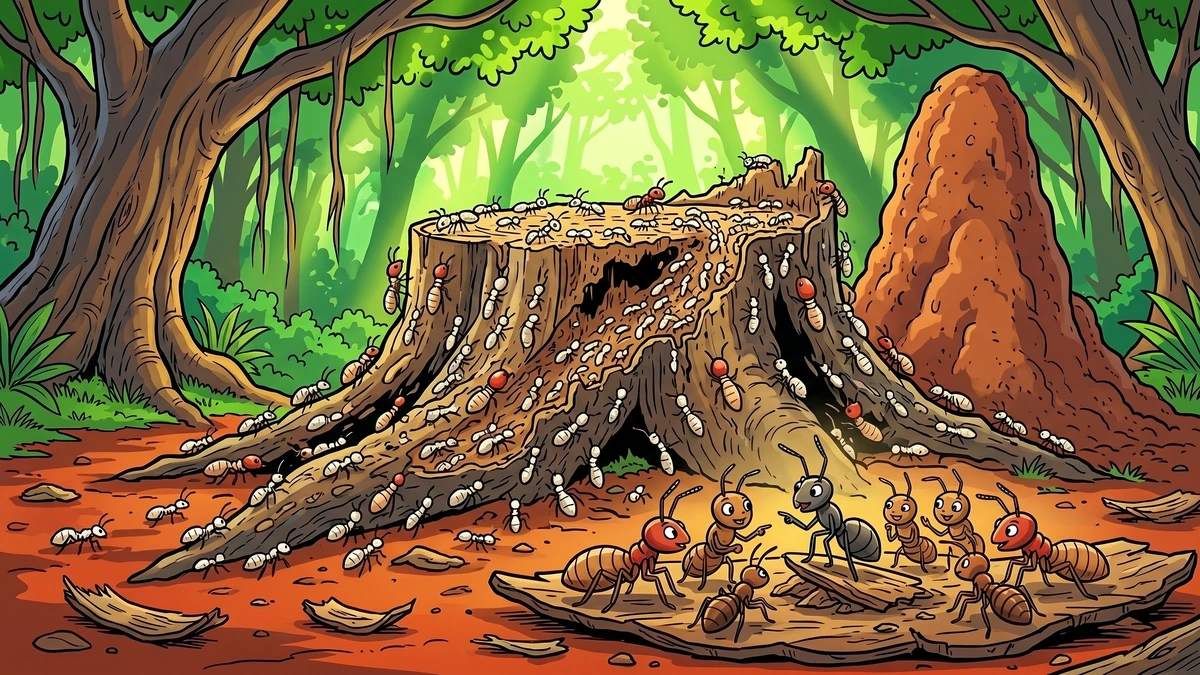
And now the story turns. Every previous bearer of the debt acted alone, and every solitary plan failed. The white ants do the one thing none of the others thought to do: they hold a council. Barker’s text calls them “very wise”, and their wisdom is precisely social. They meet, they deliberate together, and they agree that each ant will contribute as much as it possibly can to a common fund. With the pooled money a young ant is sent to the nearest market to buy pure linen thread; the colony will weave the thread into cloth, sell the cloth, and from the profits at last pay down the long-travelled debt. Weaving, it is worth noting, is a craft of deep prestige among the Akan — the source culture of kente, the famous strip-woven cloth — so the ants’ chosen trade is the trade of dignity and skilled cooperation.
The colony prospers, and from time to time, exactly as a careful weaver would, the ants bring out their stock of finished linen and spread it in the sunshine over their earthen mounds to keep it fresh and bright. And here the chain tale arrives, with a small click of delight, at the fact it set out to explain. When people walking through the bush see that pale cloth spread out on the ant-hills, they call it “mushroom” — and they gather it for food. The soft, pale, papery caps that push up overnight on and around termite mounds, after rain, in the forests of Ghana are, in the world of the story, the white ants’ linen, still laid out to dry, still being woven to settle a debt that began with two brothers’ bad habits long, long ago.
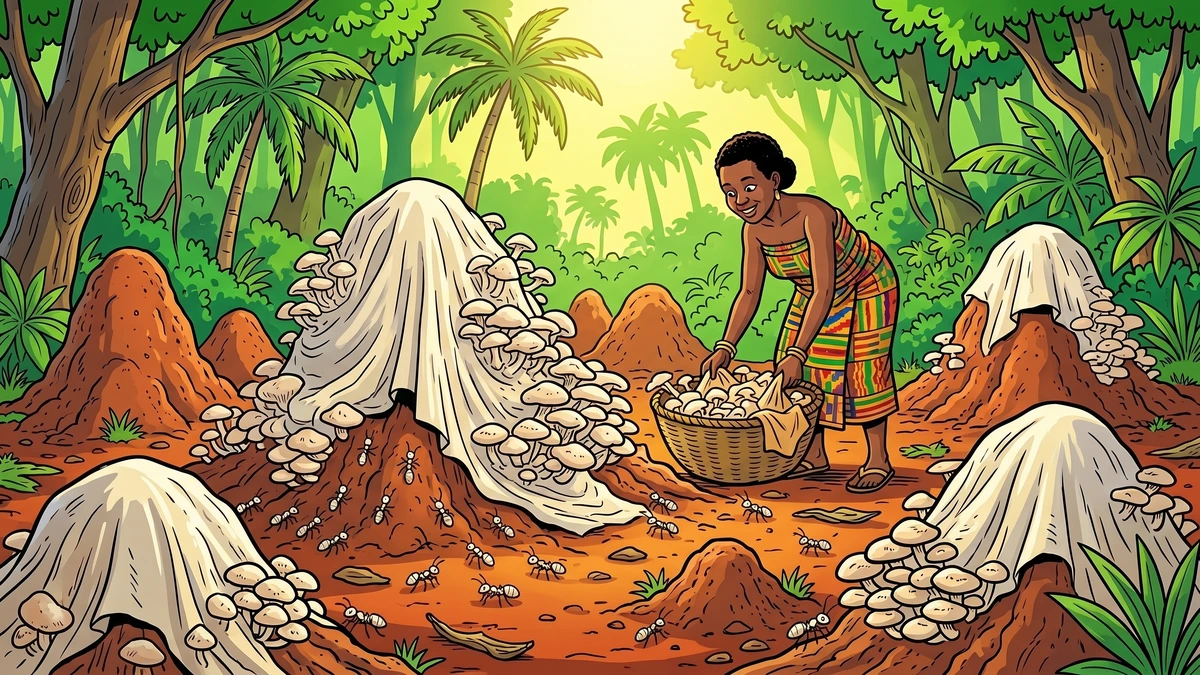
The tale is, at this last turn, also good natural history dressed as fancy. The most prized edible mushrooms of the West African forest genuinely do fruit on termite mounds: the giant Termitomyces mushrooms grow only in partnership with fungus-farming termites, which cultivate the fungus inside their nests. The storytellers did not know the mycology, but they had watched the world closely enough to tie the mushroom to the termite — and then to wrap that true observation inside a moral fable. That is the chain tale doing all of its jobs at once.
The Moral: A Burden Passed Down a Chain, and Lifted by a Council
On its surface How Mushrooms First Grew is a comedy of blame — everyone passes the parcel, no one will hold it — but underneath it is a serious Akan teaching about debt, consequence and community. The two brothers’ first sin is not poverty; it is the refusal to face an obligation honestly. Everything that follows is the long, branching shadow of that one evasion, travelling through an entire ecosystem and never landing for good until someone finally does the thing the brothers would not: takes the burden seriously, and shares it. The solitary bearers — bird, tree, elephant, hunter — each fail, because each tries to carry the whole weight alone. The white ants succeed because they sit down together, pool what they have, and turn a debt into honest, skilled, cooperative work. The story’s deepest claim is the one the Akan make again and again in their proverbs: that no creature is complete in itself, and that what one person cannot lift, a community can.
“Onipa nye abe na ne ho ahyia ne ho.”
— Akan (Twi) proverb: “A human being is not a palm tree, that he should be complete and self-sufficient on his own.” A person needs other people; what cannot be carried alone can be carried together.
There is a second, gentler lesson folded inside the first. The tale never lets the listener forget that the suffering is real — the bird grieves, the tree is dismayed, the elephant is sad, the hunter is grieved — and yet it ends not in punishment but in something useful and good: food, growing freely, for anyone who walks the bush. The debt is not erased; it is transformed. Honest cooperative labour does not undo the original wrong, but it converts the wreckage of it into a gift. For a child, that is a hopeful and a practical thing to learn.
Why It Lasted: The Memory-Shape of the Chain Tale
Cumulative tales like this one are among the oldest and most widespread story-forms on earth, and they have survived for a very concrete reason: their shape is a memory aid. Each link recalls the last; the repeated formula (“the debt was transferred to…”) gives the teller a rhythmic handrail and the listener a pattern to anticipate. A child who hears How Mushrooms First Grew twice can tell it a third time, because the architecture does half the remembering for them. In a culture that carried its entire literature in living memory, that was not a charming feature — it was the survival mechanism of the story itself.
The pourquoi ending gave the tale a second anchor. A story that finishes with a visible fact — and that is why mushrooms grow on ant-hills — is renewed every single time the listener later walks past a termite mound after rain and sees the pale caps pushing up. The world keeps re-telling the story on the storyteller’s behalf. Between the memory-shape and the living proof, a tale like this needs almost nothing to stay alive across centuries, which is exactly why it was still being told to Gold Coast schoolchildren when William Barker wrote it down a hundred years ago, and why it still reads as fresh today.
Iconography: How to Picture the Tale
Illustrators of How Mushrooms First Grew work with one of the most generous sequences in African folklore, because every link of the chain is a complete picture. The classic images are four. The ruined field: the two brothers standing aghast at the edge of their corn plot at dawn, the bushfowl scratching among the bare furrows. The broken nest: the great silk-cotton tree towering against a hurricane sky, a snapped branch fallen across the bushfowl’s nest of shattered eggs. The fallen elephant: the huge, dignified beast brought down beneath a forest tree, the small hunter approaching — an image the tale itself charges with sorrow rather than triumph. And the ants’ market: the council of white ants, and the pale linen cloth spread to dry over the rounded earth of the termite mounds, with mushrooms reading, to the eye, as both cloth and fungus at once. A good illustrator lets that final picture hold its lovely double meaning: the viewer should not be quite sure whether they are looking at washing on a line or at mushrooms in a field, because the whole point of the tale is that they are the same thing.
Reading the Story With Children
This is an almost perfect read-aloud tale for young listeners, and its chain structure gives a parent a built-in game. Each time the debt is about to pass on, pause and ask: “Who do you think will have to carry it next?” Children quickly learn the rhythm and start calling out predictions, which turns a passive listening into active, delighted anticipation. Because the formula repeats, even a very young child can soon take over the telling.
The story also opens easy doors to bigger conversations. With younger children, the natural question is the kind one: “Was it fair to blame the bird? Was anything that happened really the bird’s fault, or the tree’s, or the elephant’s?” — a gentle first lesson in the difference between an accident and a wrong. With older children, the richer question is about the ending: “Why did the white ants succeed when everyone before them failed?” Guide them toward the answer the tale is quietly proud of — the ants were the only ones who worked together. And for any age, the closing wonder is free for the taking: the next time the family is walking somewhere after rain and passes a mushroom, someone can say “there is the white ants’ linen”, and the whole story comes back in an instant. That is the chain tale’s last gift — it leaves a marker in the ordinary world that re-tells it forever.
A Note on Sources
The version preserved on this page follows the standard text of William H. Barker and Cecilia Sinclair, West African Folk-Tales (London: George G. Harrap & Co., 1917), where How Mushrooms First Grew appears among the Gold Coast stories Barker collected during his years as an educationist in the Accra training college. The volume is in the public domain and the complete text is freely available through Project Gutenberg (ebook no. 66923) and the Internet Archive. For the comparative folklore, the standard references remain Hans-Jörg Uther, The Types of International Folktales (FF Communications 284–286, Helsinki, 2004), for the cumulative-tale family (ATU 2000–2199); and Stith Thompson, Motif-Index of Folk-Literature (revised edition, Indiana University Press, 1955–58), for the aetiological motif A2611 (“origin of plants from transformation”) and the chain formulae Z21–Z49. For the Akan cultural background — the anansesem storytelling tradition, the sacred status of the silk-cotton tree (onyina, Ceiba pentandra), and the prestige of weaving — the foundational study is R. S. Rattray, Akan-Ashanti Folk-Tales (Oxford: Clarendon Press, 1930), still the indispensable scholarly companion to any Gold Coast tale. The natural history of mushrooms fruiting on termite mounds — the genuine Termitomyces partnership the storytellers observed without naming — is well described in modern surveys of West African ethnomycology.
Read time: about 10 minutes. Suitable for reading aloud from age 5, and for independent reading from age 8; the hunter’s shooting of the elephant may be told, for the youngest listeners, simply as “the elephant’s long journey came to its end.”
You May Also Like
 African Folk Tales
All Ages
African Folk Tales
All Ages
The Lion And Jackal
A Khoikhoi trickster tale of the Cape: Lion and Jackal hunt on shares, but Jackal cheats Lion's family of the winter meat and, cornered at last on a krantz, destroys the great beast with a red-hot stone disguised as a ball of fat.
 African Folk Tales
Ages 9-12
African Folk Tales
Ages 9-12
Why White Ants Always Harm Man’S Property
A West African (Akan) pourquoi tale from the Anansesem spider-story tradition: how Spider's greed, a broken promise, and one hasty mistake turned the white ant into the eternal enemy of every home.
 African Folk Tales
Ages 9-12
African Folk Tales
Ages 9-12
Story Of Lion And Little Jackal
A string of clever escapes from southern African oral tradition: the small black-backed jackal outwits the mighty lion again and again, proving that wit, not muscle, rules the veld.