How Beasts And Serpents First Came Into The World
How Beasts And Serpents First Came Into The World: The famine had lasted nearly three years. Kweku Tsin, being very hungry, looked daily in the forest in the
In the years when the Gold Coast forest still pressed close against every village, a starving man followed three lost palm-kernels down a hole in the ground and walked into a town no living person had heard of. “How Beasts and Serpents First Came into the World” is a West African origin tale that explains, through the courtesy of one man and the arrogance of another, why lions, leopards and snakes roam wild in the great forests instead of serving humankind. It belongs to the Akan peoples of the Gold Coast — modern Ghana — and it carries the unmistakable mark of their most famous story-cycle: the trickster Anansi and the discipline of obedient listening.
Where This Story Comes From
“How Beasts and Serpents First Came into the World” was collected and published in West African Folk-Tales, compiled by William H. Barker — then Vice-Principal of the Government Training College at Accra — together with Cecilia Sinclair, who also drew the volume’s illustrations. The book was issued in London by George G. Harrap & Co. in 1917, and it gathers the evening tale-telling of the Gold Coast peoples, principally the Akan.
The story sits inside the great Akan cycle of anansesem — literally “spider stories” — the tales told and retold around Kwaku Ananse, the spider-trickster. The name itself is a piece of Akan culture: Kwaku is the kradin, or soul-name, given to a male child born on a Wednesday, and the tale’s two human figures both carry such day-names — the dutiful son Kweku Tsin and his greedy father Anansi. As the folklorist Paul Radin observed in his study The Trickster (1956), the trickster is “at one and the same time creator and destroyer, giver and negator, he who dupes others and is always duped himself.” This tale shows Anansi in exactly that double role: the figure whose folly, once and for all, fills the earth with dangerous animals.
In structure the story is an etiological tale — a “pourquoi” story, one that explains why the world is as it is. In the terms of the Aarne–Thompson–Uther index it belongs to the worldwide “kind and unkind” family of tales (the pattern catalogued around ATU 480 and ATU 750A), in which one character earns a magical reward through courtesy and obedience while a second, imitating without humility, earns disaster. Stith Thompson’s Motif-Index of Folk-Literature supplies the working parts: J2415, “foolish imitation of the lucky man”; D1211, the magic drum; D1472, food supplied by a magic object; and the broad A1700–A2199 band, “creation and origin of animals,” within which this tale explains the appearance of every wild beast and serpent at a single stroke.

A Hole in the Forest Floor
The famine had lasted nearly three years. Kweku Tsin, weak with hunger, searched the forest daily for anything to eat, and one fortunate day he found three palm-kernels lying on the ground. He gathered two stones to crack them — but the first nut slipped from under his blow and rolled into a hole behind him, and so did the second, and so did the third. Vexed at losing the only food he had found in days, Kweku climbed down into the hole after them.
What he discovered there astonished him. The hole was the entrance to a whole town, one he had never heard named, and over it lay an absolute silence. “Is there nobody in this town?” he called — and a voice answered him. Following it, he came to a house where an old woman sat alone. She asked why he had come, and he told her plainly and honestly of the famine and his hunger. The old woman was kind, and she was sympathetic, and she promised to help him — on one condition, the same condition that runs through the whole tale: “You must do exactly as I tell you.”
The Old Woman’s Three Tests
Her instructions were strange, and each one was a quiet test of whether Kweku could set aside his own judgement and trust hers. First she sent him into the garden to listen to the yams, which spoke as he passed. He was to ignore any yam crying “Dig me out, dig me out!” and to take instead the one that said “Do not dig me out.” Kweku obeyed. She told him to peel that yam, throw the inside away, and boil only the rind — and as it boiled, the discarded-seeming rind became sweet yam, and they had a meal. Before eating, she asked him not to watch her while she ate; being polite and obedient, he kept his eyes away.
In the evening came the third test. Among the drums standing in the garden, he was to choose one that sounded “Ding-ding” when touched and never one that sounded “Dong-dong.” Again Kweku followed her word exactly. The old woman was pleased, and she told him the secret of his reward: whenever he or his people were hungry, he had only to beat the drum, and food in plenty would appear. He thanked her warmly and climbed back into the daylight. At home he beat the drum, and food of every kind spread before his household; the next day he gathered the whole village into the Assembly Place and beat it again, so that every family ate its fill. The starving village was saved, and all of it thanked Kweku Tsin.

Anansi’s Greed and Defiance
But Kweku’s father, Anansi, was not glad. It galled him that the village should be grateful to his son, and he decided that he too must have such a drum — so that the people would thank him instead. He pressed Kweku for the story until he had the whole of it, then hurried to the hole, carrying an old nut to throw down so that he could follow it as his son had done.
In the silent town he found the old woman, and from his first words he was the opposite of his son in every particular. “Hurry up, old woman, and get me something to eat,” he ordered. When she told him to choose the yam that said “Do not dig me out,” he laughed in her face — “You surely take me for a fool” — and dug out the one that wished to be taken. Told to throw away the inside and boil the rind, he scoffed at the waste, boiled the inside instead, and watched it turn to stones. He called her a witch. He refused the low table set for him, took her seat, and when she would not eat under his stare he ate her dinner as well as his own. At every fork in the road where Kweku had chosen obedience, Anansi chose contempt.
The Drum That Loosed the Beasts
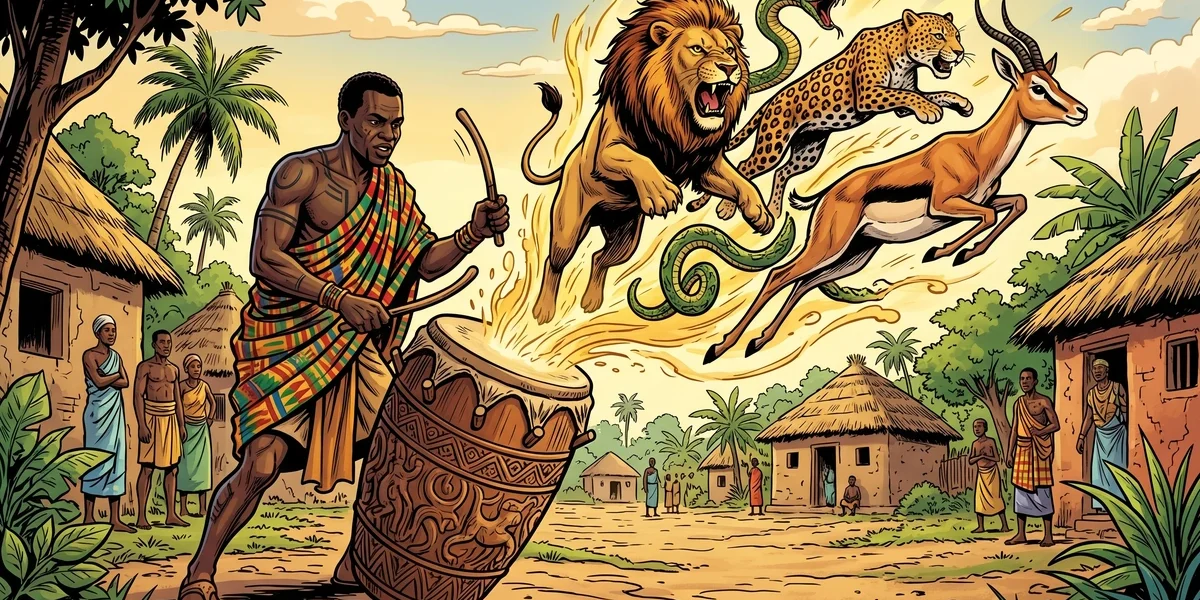
The last test was the drum. “Do not take one which sounds ‘Dong-dong,'” the old woman said; “only take one which says ‘Ding-ding.'” Anansi, certain she was tricking him, deliberately chose the “Dong-dong” drum and marched home without a word of thanks. He summoned the whole village to the Assembly Place, told the people to bring dishes and trays, and — proud in the middle of the crowd — began to beat his drum.
No food came. Instead, rushing straight at him, came beasts and serpents of every kind, creatures the earth had never seen before. The people scattered and fled in terror; only Anansi stood frozen, too afraid to move, and he received the punishment his disobedience had earned. Kweku, with his mother and sisters, had been at the edge of the crowd and escaped to safety. The animals ran off in every direction into the great forests — and there, the tale says, they have remained wild ever since.
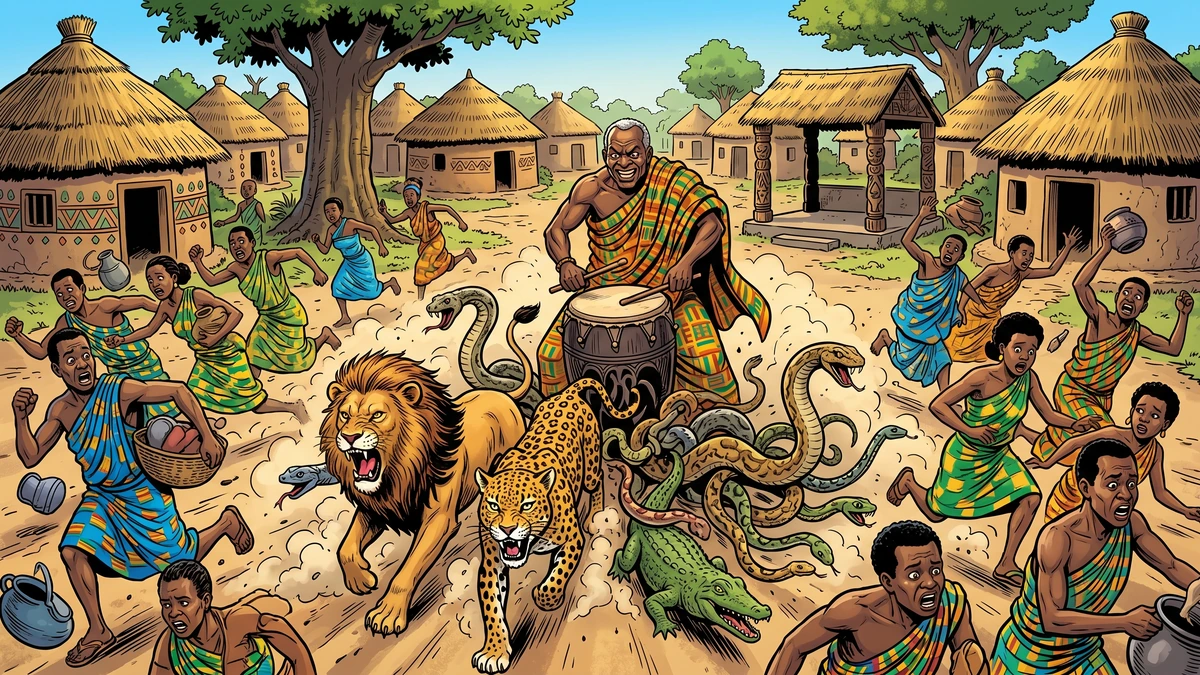
So the story closes not with a single family’s misfortune but with a permanent change to the whole world. Before Anansi struck his drum, the tale implies, the earth had no wild beasts and no serpents at all. His one act of pride did not merely cost him a meal; it released the lions, the leopards and the snakes into the forests for all time, and every generation after him has had to live among them.

The Trickster Who Dupes Himself
What makes this an Anansi story is not that the spider-trickster outwits anyone — here he outwits no one. It is that he is, in Radin’s exact phrase, the one “who dupes others and is always duped himself.” Anansi believes the old woman is trying to cheat him, and so he overturns every instruction to defeat the trick he imagines. But there is no trick. The instructions were the gift. By “defeating” them he defeats only himself, and the drum that should have fed a village empties the wild kingdom onto it instead.
The tale is built on one of the oldest architectures in world folklore: the kind-and-unkind contrast. Two characters meet the same supernatural figure and receive the same offer; the difference between blessing and catastrophe is entirely a difference of character. Kweku listens, defers, thanks; Anansi orders, scorns, and helps himself. The old woman never changes her terms. She tells Anansi precisely what she told his son — the speaking yams, the boiled rind, the “Ding-ding” drum — and his ruin is composed, item by item, of his refusals. Folklorists label this pattern J2415, “foolish imitation of the lucky man,” and it recurs from West Africa to Japan to the Grimms’ Germany, because every farming and hunting society has needed to teach the same thing: that you cannot copy another person’s good fortune while discarding the conduct that produced it.
Why Disobedience Becomes a Flood of Beasts
An origin tale must answer a question, and this one answers a hard pair of them at once: where did wild animals come from, and why must humans live in danger from them? The story’s reply is morally pointed. The beasts are not part of the world’s original design and not an accident of nature — they are the lasting consequence of a single human failure of character. The danger in the forest, the tale says, has a cause, and the cause is pride.
This is why the punishment is so much larger than the crime. Anansi wanted only to be thanked; what he loosed was permanent and universal. The disproportion is the lesson. In the moral imagination of the tale, disobedience is never a private matter — Kweku’s obedience fed an entire village, and Anansi’s disobedience endangered that same village and every village after it. The “Dong-dong” drum is the perfect emblem of the idea: a wrong choice that looked, to the chooser, like cleverness, and that could never afterward be undone. The world the listener actually lives in — a world with serpents in it — is offered as proof that the tale is true.
The Tale Among Its Cousins
“How Beasts and Serpents First Came into the World” sits comfortably among the kind-and-unkind stories of many traditions. The Brothers Grimm’s “Mother Holle” (KHM 24) sends two girls down a well to the same otherworldly mistress, rewarding the diligent one with gold and the idle one with pitch; Japanese tradition tells of the kind old man and the envious neighbour who copies him and reaps disaster. What unites this scattered family is a single conviction: that fortune is conditional, that the condition is conduct, and that an imitator who keeps the action but drops the virtue will reproduce the form of the lucky man’s path and none of its luck.
Yet the African setting reshapes the inherited pattern. The reward is not gold but food itself — the one thing a village three years into a famine cannot live without — and the punishment is not personal poverty but a permanent alteration of the natural world. Where a European kind-and-unkind tale usually ends inside one household, this one ends with the creation of every wild animal on earth, folding a moral fable and a creation myth into a single shape. And its villain is no ordinary envious neighbour but Anansi himself, the culture’s central trickster, which gives the story an extra and characteristically Akan edge: even the great spider, the cleverest figure in the tradition, is undone the moment cleverness curdles into contempt.
The Moral of the Tale
The story carries a layered lesson. On its plainest level it is about obedience and humility: Kweku Tsin “did exactly as he was told” and saved a village, while Anansi, certain he knew better, destroyed the safety of the world. Beneath that lies a lesson about courtesy — the old woman’s gift flowed toward the guest who was polite and away from the one who was rude — and beneath that again the sober truth that some consequences cannot be reversed. The “Dong-dong” drum, once beaten, could not be un-beaten.
“Tikɔro nkɔ agyina.”
“One head does not go into counsel.” — Akan (Twi) proverb
— a wisdom echoed in West African Folk-Tales, W. H. Barker & C. Sinclair, 1917
The Akan proverb sharpens the point. A single head, deliberating alone, reaches no sound counsel; wisdom is something one accepts from others. Kweku set his own judgement aside and trusted the counsel he was given, and a starving village ate. Anansi trusted no head but his own — and a man who will hear no counsel, the tale warns, endangers far more than himself.
Why the Story Has Lasted
More than a century after Barker and Sinclair set it in print, “How Beasts and Serpents First Came into the World” still travels — read aloud in classrooms, retold in folklore anthologies, carried far beyond the Gold Coast forests where it was first spoken. It lasts, in part, because it does two jobs at once: it satisfies the child’s question about where the animals came from, and it delivers, in the same breath, a lesson about conduct that an adult can still feel. Origin stories of this kind are among the oldest forms of human teaching, and this one survives because its explanation is also a warning.
It lasts, too, because it refuses to soften its ending. Anansi is not forgiven, the beasts are not called back, and the world the listener inherits is permanently the more dangerous for one man’s pride. That refusal gives the tale the weight of something true. And it lasts because its central figure is Anansi — proof that the tradition was honest enough to let even its beloved trickster fail, and wise enough to know that the most useful lesson about arrogance is the one that spares no one.
Frequently Asked Questions
Where does “How Beasts and Serpents First Came into the World” come from?
It is a West African folk tale of the Akan peoples of the Gold Coast — modern Ghana — published in West African Folk-Tales, collected by William H. Barker and Cecilia Sinclair and issued by George G. Harrap & Co. in London in 1917. It belongs to the Akan cycle of anansesem, the “spider stories” told around the trickster Kwaku Ananse.
Who are Kweku Tsin and Anansi in the story?
Anansi is Kwaku Ananse, the spider-trickster at the centre of Akan folklore, and Kweku Tsin is his son. Both names carry Akan day-names: Kwaku and Kweku are soul-names given to a male child born on a Wednesday. In this tale the obedient son is rewarded and the arrogant father is ruined.
Why did Anansi’s drum produce beasts instead of food?
The old woman told him to choose a drum that sounded “Ding-ding” and to avoid one that sounded “Dong-dong.” Convinced she was tricking him, Anansi deliberately took the “Dong-dong” drum. When he beat it before the village, it released beasts and serpents of every kind instead of food — the direct consequence of his disobedience.
What kind of folk tale is this?
It is an etiological or “pourquoi” tale — a story that explains why the world is as it is, here accounting for the origin of every wild animal. It is also a “kind and unkind” tale, in which a courteous character is rewarded and an imitator who lacks humility is punished — a pattern folklorists label J2415, “foolish imitation of the lucky man.”
What is the moral of the story?
Listen, obey wise instruction, and treat others with courtesy. Kweku Tsin did exactly as he was told and saved his village from famine; Anansi, certain he knew better, defied every instruction and loosed wild beasts upon the world. The tale also teaches that some consequences, once set in motion by pride, can never be undone.
You May Also Like
 African Folk Tales
Ages 9-12
African Folk Tales
Ages 9-12
The Omanhene Who Liked Riddles
The Omanhene Who Liked Riddles: The Omanhene is the chief of a village. A certain Omanhene had three sons, who were very anxious to see the world. They went to
 African Folk Tales
Ages 6-8
African Folk Tales
Ages 6-8
The Hunter And The Tortoise
The Hunter And The Tortoise: A village hunter had one day gone farther afield than usual. Coming to a part of the forest with which he was unacquainted, he was
 African Folk Tales
Ages 6-8
African Folk Tales
Ages 6-8
Anansi And Nothing
Anansi And Nothing: Near Anansi’s miserable little hut there was a fine palace where lived a very rich man called Nothing. Nothing and Anansi proposed, one