The Tail Of The Princess Elephant
The Tail Of The Princess Elephant: There once lived a woman who had three sons. These sons were very much attached to their mother and always tried to please
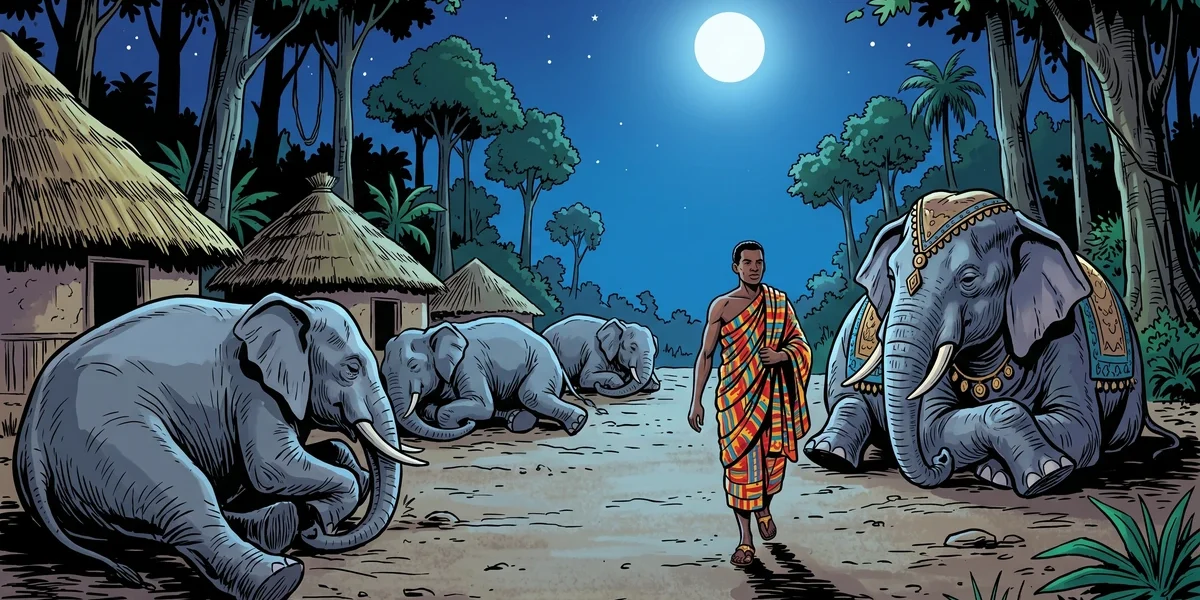
Among the folk tales of the Akan people of West Africa, “The Tail of the Princess Elephant” is a story that begins in tenderness and ends in terror. It opens with three sons searching for a way to honour their dying mother, and it closes with a young man fleeing for his life from the very bride he has won. Between those two points lies a quest, a theft, a magical chase, and a marriage that turns murderous in the dark. It is a tale about devotion carried to a reckless extreme, about the protective power a person carries hidden upon themselves, and – in its final line – about why the hawk forever circles the smoke of a fire.
Origins in the Oral Tradition of the Gold Coast
This story was set down in print in West African Folk-Tales, a collection compiled by William H. Barker and Cecilia Sinclair and published in London by George G. Harrap & Company in 1917. It appears there as the twenty-second tale, under the title “The Tail of the Princess Elephant.” William H. Barker, who held a B.Sc. and had served as Principal of the Government Training Institution at Accra, gathered the narratives during his years as an educational administrator on the Gold Coast – the British colony that became modern Ghana. His collaborator Cecilia Sinclair, who also drew the book’s frontispiece and its twenty-three illustrations, helped arrange and shape the tales. The book preserved in English a body of storytelling that had until then lived almost entirely in the spoken word, passed from elder to child around the evening fire.
The tale belongs to the Akan peoples – the Fante, Ashanti and related groups whose languages and customs spread across the forest country of southern Ghana. Barker noted in his introduction that throughout the Gold Coast Colony and southern Ashanti the stories told by the various tribes were essentially the same, a shared inheritance of the wider Akan world. The hero’s name itself confirms the setting: Kwesi is an Akan “day name,” the name given automatically to a boy born on a Sunday. To an Akan listener, the protagonist is not a stranger from a far-off land but a recognisable village neighbour, named the way every Akan child is named, for the day of the week on which he came into the world.
Like many Akan narratives, this is an etiological tale – a story that explains how some feature of the natural world came to be. Folklorists use the term for any tale whose purpose is to account for an origin, and the closing sentence of this one delivers exactly that: it explains why hawks are so often seen wheeling and hovering in the smoke that rises from fires. The body of the story, however, is built from two of the most travelled motifs in world folklore. The chase in which the fugitive throws objects behind him that swell into obstacles is the “obstacle flight,” catalogued in Stith Thompson’s Motif-Index as D672; and the duel of shapes between the hunted man and his pursuer, in which each in turn becomes something new, is the “transformation flight,” motif D671. These same patterns appear in the international tale type known to scholars as the Magic Flight, ATU 313, found from Europe to the Pacific. What makes the Akan telling its own is the texture around those bones: the matrilineal love of sons for a mother, the hidden personal “juju,” and the elephant herd that keeps a princess.
A Mother’s Last Days and Three Reckless Vows
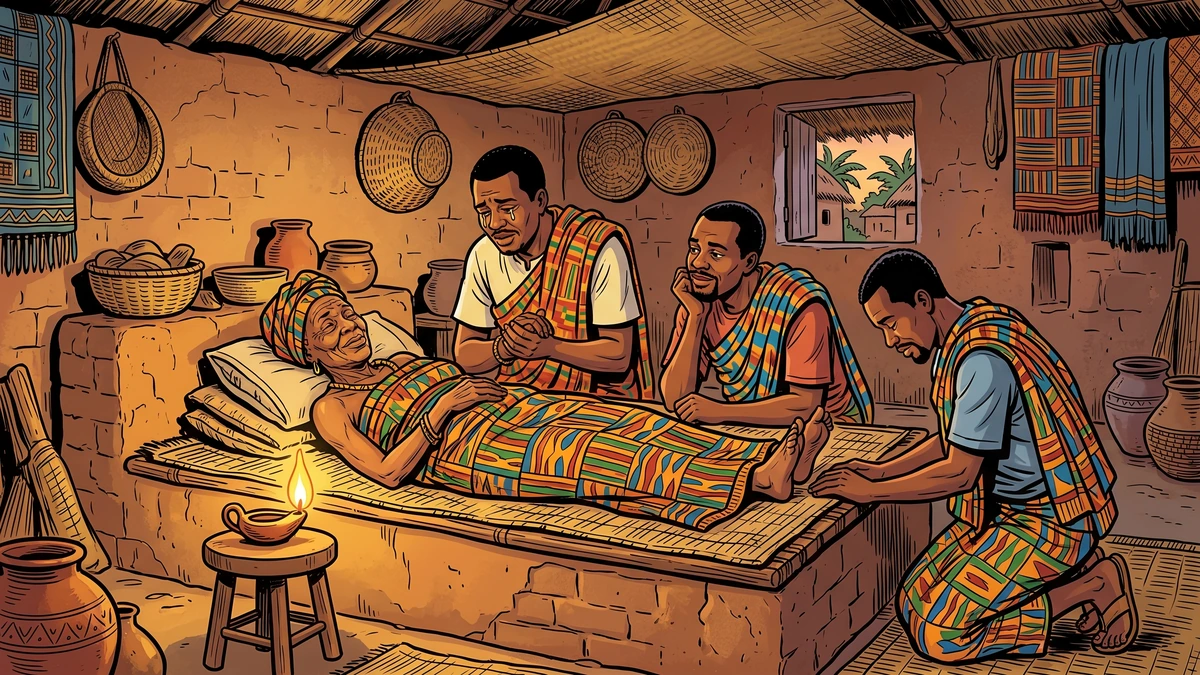
The story begins with a woman who had three sons. They were sons of an unusually loving kind, much attached to their mother, forever looking for some way to please her. But the years pressed on her, and she at last grew very old and very feeble, and the three young men understood that her time was short. So they began to think – each in his own way – what they might do to give her a great and lasting pleasure.
The eldest spoke first. When their mother died, he said, he would cut a fine sepulchre for her out of stone, a tomb worthy of her memory. The second son answered that he would build her a beautiful coffin, made with all the care his hands could give. Then the youngest spoke, and his promise was of a different order altogether. He would go, he said, and get the tail of the princess elephant, and lay it in the coffin beside her.
It is worth pausing on the strangeness of that third vow. The two elder brothers had promised things that were grand but achievable – stonework and carpentry, the ordinary crafts of honouring the dead. The youngest had promised something that no one in the village had ever seen, something he did not know how to find, in a place he could not name. The Akan storyteller marks the promise plainly as the hardest of the three to keep. Yet there is no scolding in the telling, no elder stepping forward to call the boy foolish. The tale lets the vow stand, because the whole story is about to grow out of it, the way a great tree grows from one buried seed.
That the sons should compete in devotion to their mother is not incidental detail; it is the cultural heart of the opening. The Akan are a matrilineal people, who trace descent, kinship and inheritance through the mother’s line. A person’s abusua, the clan that defines who they are, is the mother’s clan. To honour one’s mother, in this world, is to honour the very source of one’s identity and place in society. The three brothers are not merely sentimental; they are doing what their culture holds to be the deepest of duties. Soon after they had spoken, their mother died, and the youngest son set out at once upon his impossible search.
The Hidden Village of the Elephants
The young man travelled without a map and without a destination, for he had not the least idea where the tail of a princess elephant might be found. He walked for three long weeks. At the end of that time he came upon a small village, and there he met an old woman who stared at him in open astonishment. No human creature, she told him, had ever come to that place before.
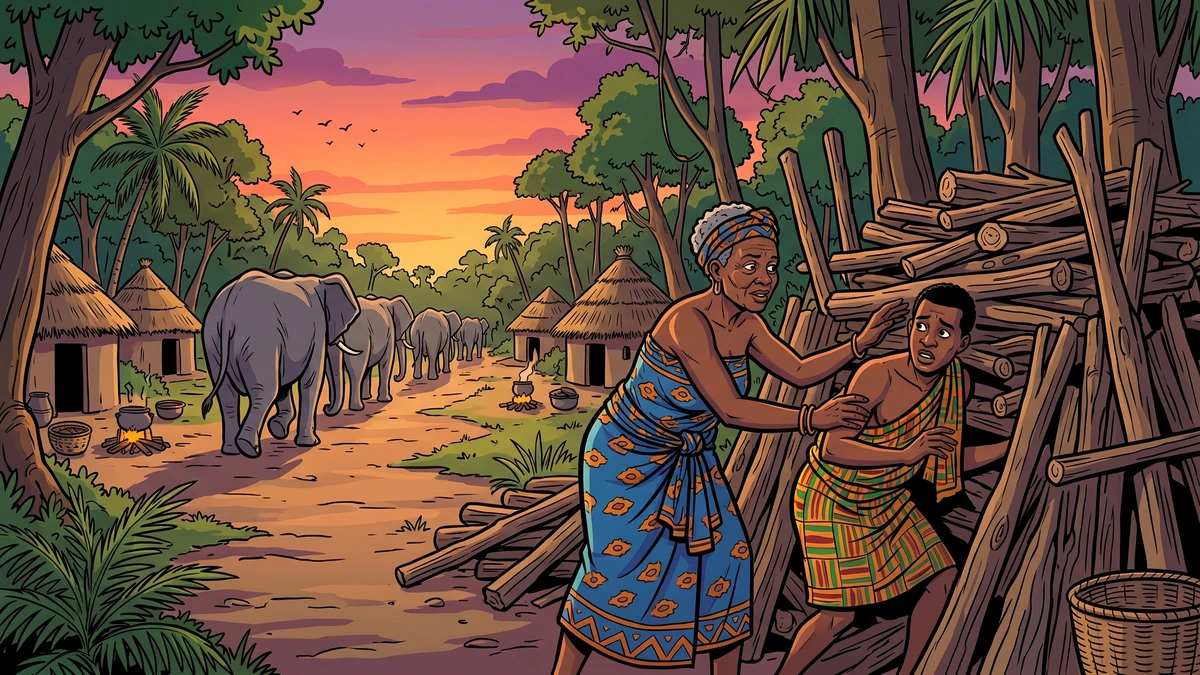
The boy told her his errand – the dying mother, the vow, the search for the princess elephant. The old woman’s answer was the answer he had walked three weeks to hear and dreaded to hear: this village was the home of all the elephants, and the princess herself slept there every single night. But she warned him plainly. If the animals caught sight of him, they would kill him without hesitation. The young man begged her to hide him, and she did – she concealed him inside a great pile of firewood.
Then she taught him exactly what he must do, and her instructions carry the curious logic that runs through so many folk tales. When the elephants were all asleep, he was to rise and go to the eastern corner of the village. There he would find the princess. He must walk boldly across to her, cut off the tail, and return in the very same manner – openly, without fear. If instead he crept and stole along, moving stealthily as a thief moves, the elephants would wake and seize him. In this story, as in many, it is the confident step and not the timid one that passes unnoticed; fear itself is what betrays the fearful.
The elephants came home as darkness fell. At once they declared that they smelt a human being among them. The old woman soothed them, assured them they were mistaken, and set their supper before them; they ate, and went to their beds. In the dead middle of the night the young man rose from the woodpile. He walked boldly across the sleeping village to the eastern corner, found the princess, cut off her tail, and walked boldly back. Then, carrying his terrible prize with the greatest care, he set out for home.
The Obstacle Flight and the Juju Called Depor
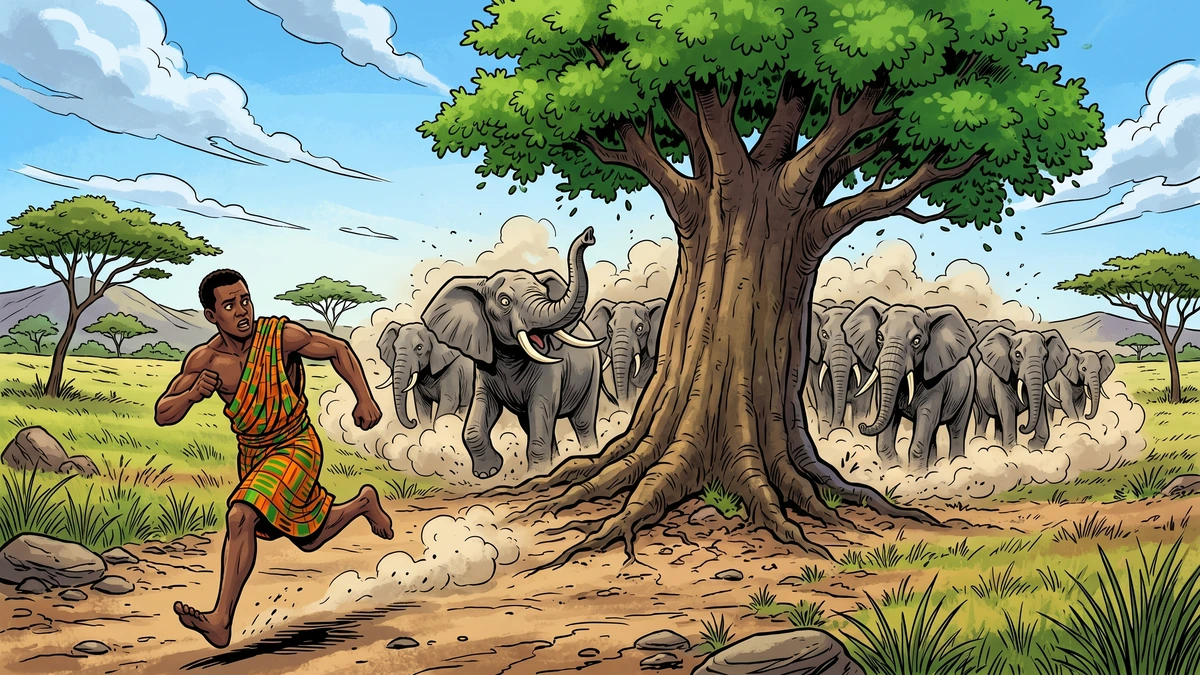
Morning broke over the elephant village, and the animals woke. One of them announced that he had dreamed a strange dream – that the princess’s tail had been stolen in the night. The others fell upon him and beat him for thinking so dark a thought. Then a second elephant said that he too had dreamed the very same dream, and he too was beaten for it. At last the wisest of the elephants made a calmer suggestion: rather than punish the dreamers, why not simply go and see whether the dream were true? They went, and found the princess fast asleep, entirely unaware that her tail was gone. They woke her, and the whole herd set off thundering after the young man.
Elephants travel faster than a man on foot, and within a few hours they had him in sight. Seeing them bearing down upon him, the young man was filled with fear, and he called upon the one help he carried with him. Hidden in his hair he always kept a small idol, a favourite personal charm, and to it he cried: “O my juju Depor! What shall I do?”
The word juju – used by the early collectors for a charm or protective object – here names what Akan tradition would call a suman: a personal amulet believed to hold a guarding spirit, carried close to the body to ward off harm. Depor is not a distant god prayed to in a temple. Depor rides in the hero’s hair, secret and near, and answers him directly in his hour of need. The charm told him to throw the branch of a tree back over his shoulder. He did so, and where it fell it sprang up instantly into a huge tree, blocking the whole path of the elephants. The herd was forced to halt and eat its way through the trunk and branches, and that cost them time.
When they broke through and came on again, the young man called a second time: “O my juju Depor! What shall I do?” Throw the corn-cob behind you, the charm answered. He threw it, and it grew at once into a wide field of standing maize. Again the elephants were forced to eat a path through the obstacle, and again it cost them precious time. When the herd at last pushed clear of the maize, they found the boy had reached his home and passed beyond their reach. The elephants gave up the chase and turned back to their village – all but one. The princess herself refused to go home. “I will return,” she said, “when I have punished this impudent fellow.”
The Vengeful Bride and the Making of the Hawk
The princess elephant did not pursue her enemy with tusks and weight. She chose a subtler revenge. She changed herself into a very beautiful young woman, took up a calabash cymbal in her hand, and walked into the young man’s village. All the people came out to admire so lovely a stranger. She had it proclaimed that whoever could shoot an arrow and strike the cymbal would have her for his bride. The young men of the village tried, one after another, and every one of them failed. Then an old man standing in the crowd remarked that if only Kwesi – the very man who had cut off the princess elephant’s tail – were present, he could surely hit the mark. “Then Kwesi is the man I will marry,” the maiden answered at once, “whether he hit the cymbal or not.”
So Kwesi was fetched from the field where he was ploughing and told of his good fortune. He was not glad to hear it. He suspected the beautiful stranger of some trick. Nevertheless he came, and he shot, and his arrow struck the very centre of the cymbal; and so the two were married. All the while, the bride was quietly preparing her revenge.
On the first night of the marriage, while Kwesi slept, the princess turned back into an elephant and made ready to kill him. But Kwesi woke in time, and cried out, “O my juju Depor! Save me!” The charm turned him into a grass sleeping-mat lying upon the bed, and the elephant could not find her husband anywhere. In the morning she demanded to know where he had been all night. “While you were an elephant,” Kwesi told her, “I was the mat you lay upon.” At once she gathered every mat from the bed and burned them. The next night she became an elephant again, and again Depor saved Kwesi, this time changing him into a needle she could not find; and when she learned of it in the morning, she made up her mind to seize the idol itself and destroy it.
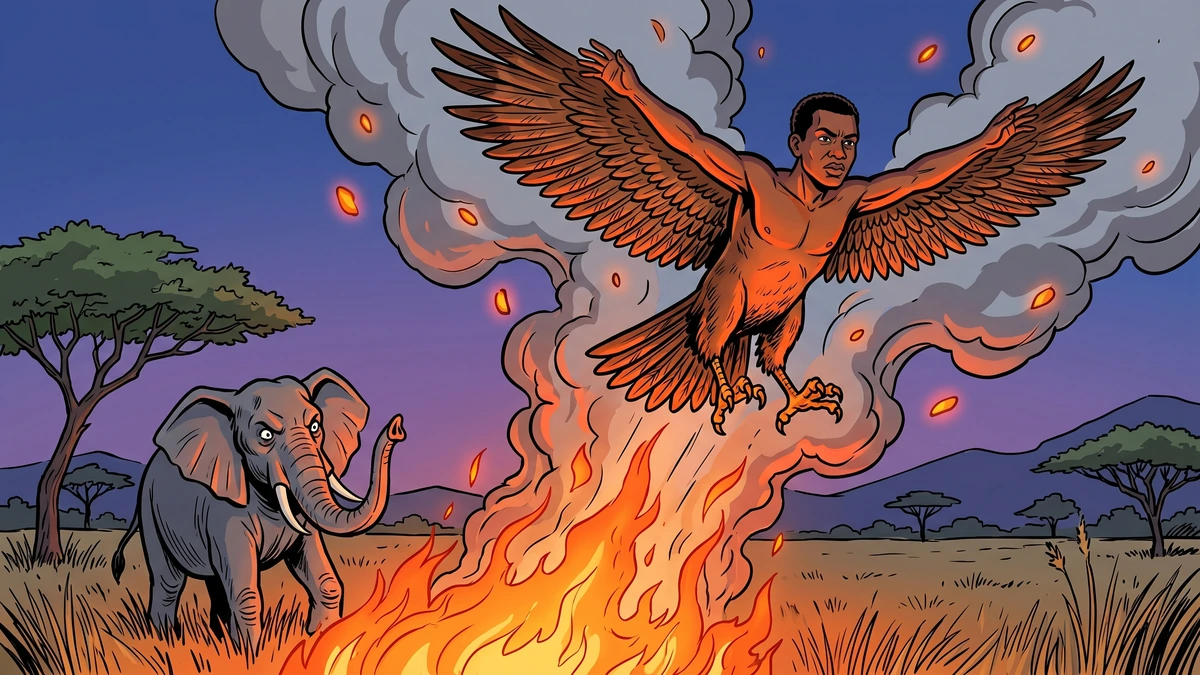
The chance came in the field. Kwesi had gone out to plough, and asked his wife to bring his food to the resting-place. When he had eaten, she told him to lay his head in her lap and sleep. Kwesi, for once, forgot that his juju was hidden in his hair. As soon as he slept, she drew the idol out and threw it into a great fire she had built ready. Kwesi woke to find her an elephant once more, and cried for Depor’s help – but the only answer came from within the flames: “I am burning, I am burning, I am burning.” He called again, and the burning voice gave him one last instruction: lift up your arms as though you meant to fly. Kwesi raised his arms, and turned into a hawk, and rose away into the air. And that, the tale ends, is the reason why hawks are so often seen flying in the smoke of fires – for they are searching, still, for their lost juju.
The Moral of the Tale
“The Tail of the Princess Elephant” refuses to hand its listener a single tidy lesson, and that refusal is part of its honesty. At its centre lies a warning about devotion that outruns wisdom. The youngest son’s love for his mother was real and admirable, but the vow he made in that love was reckless – a promise to take by force a thing that belonged to a powerful creature, made without counsel and without thought of the cost. His grief was pure; his plan was not. The Akan have a proverb that fits the brothers’ competition exactly, a saying that explains why three young men would risk so much for one old woman:
“Sɛ wo na wu a, na wo abusua asa” – When your mother dies, your family is at an end.
In a matrilineal society, the mother is the trunk from which the whole clan branches; to lose her is to feel the lineage itself shaken. The proverb tells us why the sons grieved as they did and why they reached so high. But the story sets a second truth beside the first. Honour owed to the dead must not be paid with a wrong done to the living. The tail was not the young man’s to take, and the long terror that follows – the chase, the murderous marriage, the burning of Depor – is the price of a theft committed even for a loving reason. The tale also quietly praises the help we carry with us: Depor, the small charm hidden in the hair, saves Kwesi again and again, and is lost only when Kwesi grows careless and forgets it. Protection kept close and respected endures; protection taken for granted is thrown into the fire.
Why the Tale Has Endured
Stories last when they can be enjoyed on more than one level at once, and this Akan tale has always offered several. For a child listening by the fire, it is pure adventure – a hidden village of elephants, a daring midnight raid, a chase outrun by a tree and a field of maize that bloom from nothing, a wife who is secretly a beast, and a hero who escapes by becoming a mat, a needle, and at last a hawk. The pace never slackens, and every danger is answered by a wonder. For an older listener, the same tale is a meditation on the limits of love, the danger that wears a beautiful face, and the thin line between honouring the dead and wronging the living.
Its final gift is the one the Akan storyteller saved for last. Like the best etiological tales, it sends the listener back out into the ordinary world with the ordinary world slightly changed. After this story, a hawk turning slow circles in the grey smoke above a burning field is no longer only a bird. It is Kwesi, still aloft, still hunting through the smoke for the charm that saved his life three times and then was lost. The tale has reached up into the everyday sky and left its mark there, so that the smoke of every fire carries, for anyone who has heard it, a small thread of memory. That is the quiet machinery by which oral tradition works: it ties its meanings to things a person cannot help seeing, and so the story is retold, silently, every time a hawk climbs the smoke.
Frequently Asked Questions
Where does the folk tale “The Tail of the Princess Elephant” come from?
It is an Akan folk tale from the Gold Coast, now Ghana, in West Africa. It was printed in English in West African Folk-Tales, compiled by William H. Barker and Cecilia Sinclair and published in London by George G. Harrap & Company in 1917, where it appears as the twenty-second story. Barker had served as Principal of the Government Training Institution at Accra and gathered the narratives during his years as an educational administrator on the Gold Coast. Before that the tale lived purely as oral tradition, told by Akan elders around the evening fire. The hero’s name, Kwesi, is itself an Akan day name, the name given to a boy born on a Sunday.
Why does the youngest son promise to fetch the elephant’s tail?
As their mother lay dying, three devoted sons each vowed a way to honour her. The eldest promised a fine stone sepulchre, the second a beautiful coffin, and the youngest promised to lay the tail of the princess elephant in her coffin. The Akan are a matrilineal people who trace their clan, the abusua, through the mother’s line, so honouring a mother is honouring the source of one’s identity. The story marks the youngest son’s vow as by far the hardest to keep, and the whole adventure grows out of that one reckless, loving promise.
What is the “juju Depor” that Kwesi carries?
Depor is the small personal idol or charm that Kwesi keeps hidden in his hair. The early collectors used the word juju for such a charm; in Akan tradition it corresponds to a suman, a personal amulet believed to hold a protecting spirit and worn close to the body to ward off harm. Depor is not a distant temple god but an intimate guardian that answers Kwesi directly. It saves him three times, advising the obstacle flight and turning him into a mat and then a needle, and it is lost only when Kwesi grows careless and his elephant wife throws it into the fire.
What does “The Tail of the Princess Elephant” explain about hawks?
The tale is an etiological story, meaning a story that explains the origin of something in the natural world. Its closing line accounts for why hawks are so often seen flying and circling in the smoke that rises from fires. When the princess elephant burns the charm Depor, the idol’s voice from the flames tells Kwesi to lift up his arms as if to fly, and he turns into a hawk and escapes. According to the tale, hawks still wheel through the smoke of fires because they are searching for their lost juju.
What is the moral of “The Tail of the Princess Elephant”?
The tale warns against devotion that outruns wisdom. The youngest son’s love for his mother was genuine, but the vow he made in his grief was reckless, a promise to seize by force what belonged to a powerful creature, made without counsel. Honour owed to the dead must not be paid with a wrong done to the living, and the long terror that follows is the price of that theft. The story also praises protection that is kept close and respected: the charm Depor saves Kwesi again and again, and is lost only when he forgets it. The Akan proverb ‘Se wo na wu a, na wo abusua asa’, meaning ‘When your mother dies, your family is at an end’, explains why sons would risk so much for one mother in a society where the lineage runs through her.
You May Also Like
 African Folk Tales
Ages 6-8
African Folk Tales
Ages 6-8
Thing To Do
A young person learns that the most important accomplishments are the small, caring things we do.
 African Folk Tales
Ages 6-8
African Folk Tales
Ages 6-8
The Lost Message
A southern African folk tale: the many kinds of ants fail to agree at their council, and the saving message of unity, entrusted to the slow Beetle, never arrives.
 African Folk Tales
Ages 9-12
African Folk Tales
Ages 9-12
Thunder And Anansi
Thunder And Anansi: There had been a long and severe famine in the land where Anansi lived. He had been quite unable to obtain food for his poor wife and