The Judgment Of Baboon
A mouse tears the tailor's cloak, and when every creature blames the next, Baboon the judge turns the chain of excuses into a chain of punishment - a Khoikhoi tale from Namaqualand explaining why the cat hunts the mouse and the baboon walks on all fours.
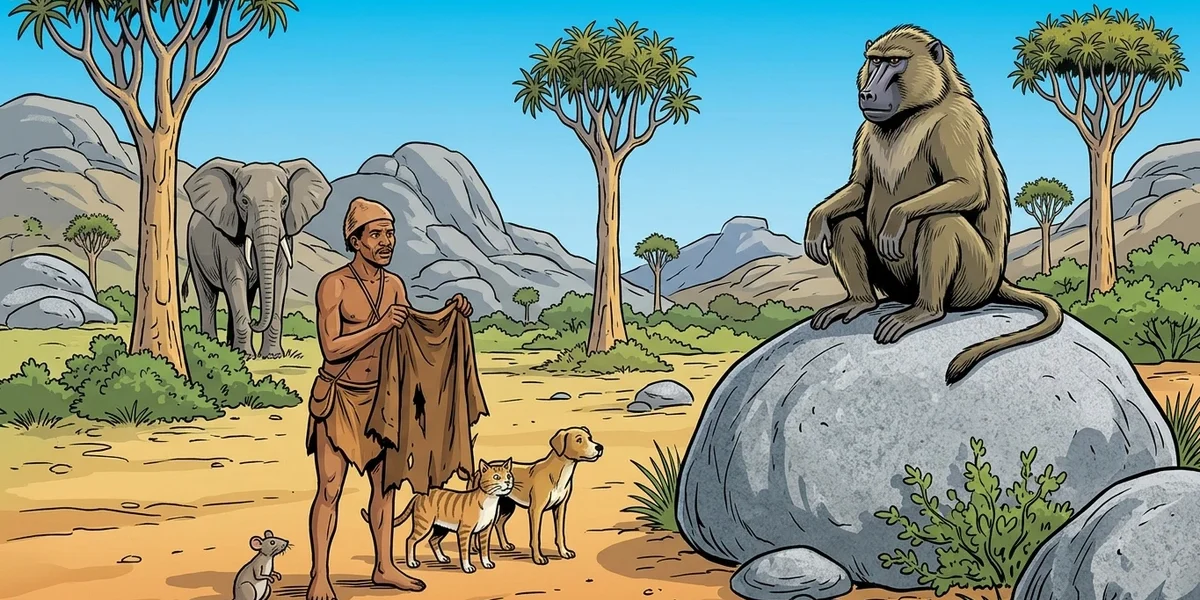
Tradition: Khoikhoi (Khoekhoe) folk narrative of Namaqualand, southern Africa — a tale of the Nama people of the arid north-western Cape.
First printed source: the tale was first written down by the philologist Wilhelm H. I. Bleek in Reynard the Fox in South Africa; or, Hottentot Fables and Tales (London: Trübner, 1864), where it appears as “The Judgment of the Baboon,” described as a Namaqualand fable. Bleek drew his material from manuscripts in the library of Sir George Grey, Governor of the Cape Colony (1854–1861). It was carried to a wider readership by James A. Honeÿ in South-African Folk-Tales (New York: Baker & Taylor, 1910), “The Judgment of Baboon.”
Tale type & motifs: a cumulative or “chain” tale (Aarne–Thompson–Uther cumulative-tale group, ATU 2000–2100, akin to the ATU 2030 chain of coercion) closing in an etiological key. Central motifs: Z40–Z49 cumulative formula; A2494 “why certain animals are enemies”; and an animal-gait etiology explaining why the baboon walks on all fours.
Reading time: about 10 minutes.
“The Judgment of Baboon” is one of the most quietly ingenious tales the Khoikhoi of southern Africa ever told. On its surface it is a courtroom comedy: a tailor whose clothes have been torn drags a whole crowd of suspects before a judge, and every single one of them blames the next. Beneath that comedy it is something larger — an explanation of why the cat hunts the mouse, why fire eats wood, why water drowns fire, and why the baboon, alone among the apes, no longer walks upright. It is a story that begins with a small domestic grievance and ends by accounting for the structure of the entire living world.
The tale comes from Namaqualand, the dry, granite-strewn country straddling what is now the border of South Africa and Namibia, and it was first set down in the 1860s by Wilhelm Bleek, the founding figure of southern African folklore studies. The retelling below follows Honey’s 1910 text closely; the discussion around it tries to show why a people would build so much meaning into so short and so funny a story.
The Tailor and the Torn Cloth
It begins, as the Khoikhoi storytellers liked to begin, with an ordinary wrong. A mouse had torn the clothes of Itkler the tailor. In a world where cloth was scarce and a garment was the work of many patient hours, this was no trifle — it was damage, and damage demanded redress. So Itkler did what an aggrieved person in any settled community does: he did not take revenge with his own hands. He went to law.
The judge he chose was Baboon. And here the tale tells us something important about the society that produced it. The Khoikhoi were herders and hunters who lived under recognised headmen and settled disputes by assembly and arbitration, not by private vengeance. Itkler does not chase the mouse. He does not set a trap. He carries his complaint to a figure of authority and asks for a hearing — “Assemble the people,” he says, “and try them, in order that I may get satisfaction.” The whole tale, for all its talking animals, rests on a thoroughly human institution: the public court.
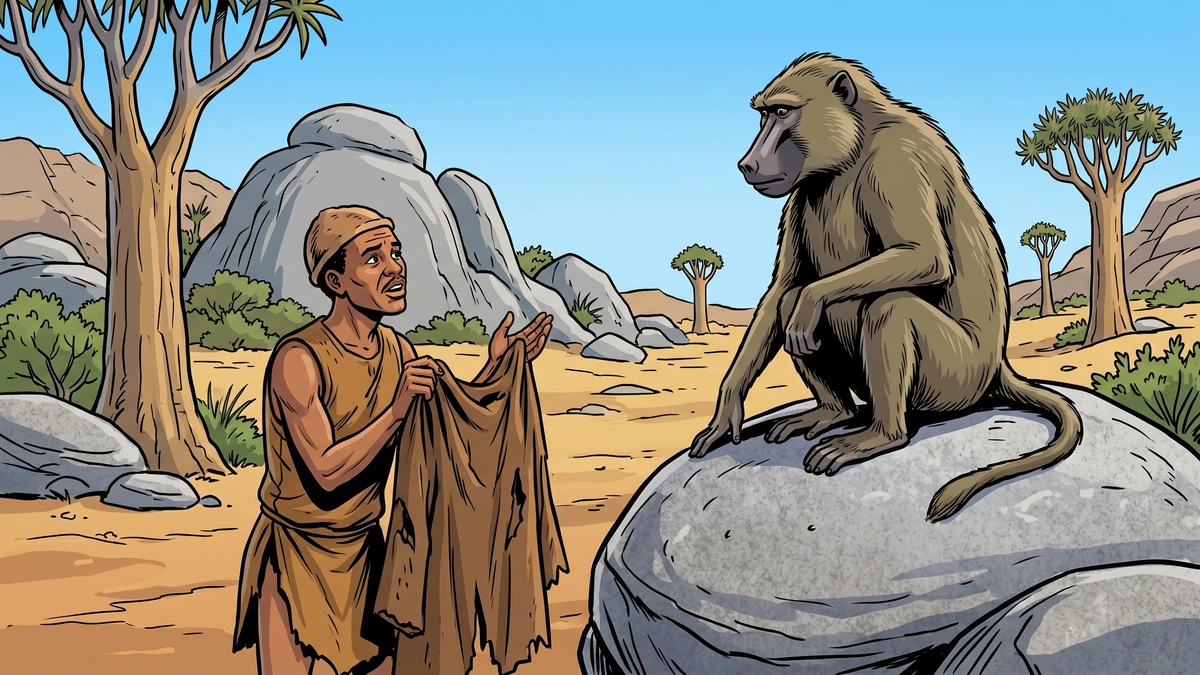
What Itkler lays before Baboon, though, is not a simple accusation. It is already a tangle. The mouse, he reports, will not admit the deed and accuses the cat; the cat protests her innocence and names the dog; the dog denies everything and blames the wood; the wood throws the blame on the fire; the fire says the water did it; the water points to the elephant; and the elephant says it was the ant. Before the trial has even opened, the guilt has been passed down a chain of eight, and nobody is holding it. Itkler has not brought Baboon a culprit. He has brought him a refusal — the collective refusal of a whole community to own a single small fault.
A Chain of Excuses
This is the heart of the tale, and it is worth slowing down over, because the chain of blame is doing something cleverer than it first appears. Notice who is in it. It begins with creatures — mouse, cat, dog — the familiar animals of a Khoikhoi homestead. Then it slides, without a flicker of explanation, into things that are not creatures at all: wood, fire, water. Then it returns to the animal world at its largest and grandest, the elephant, before ending on the very smallest thing that can still be said to act — the ant.
The storyteller has, in a single breath, drawn the entire visible world into one quarrel. Domestic animals, the elements, the greatest beast of the veld and the least insect underfoot are all suddenly neighbours in a single dispute, all equally able to speak, all equally able to lie. A child listening would feel the boundaries of the ordinary world quietly dissolve. Everything, it turns out, is connected; everything can be called to account; and everything, given the chance, would rather not be.
And every link in the chain says the same thing. Each accused party makes “the same excuse” — it was not I; it was the next one. The repetition is the joke, and the repetition is also the indictment. The tale is holding up a mirror to a failure the Khoikhoi knew as well as any people: when a fault is small enough and shared widely enough, the temptation is for everyone to point past themselves until the blame travels so far it seems to belong to no one. The chain of excuses is a portrait of a community talking itself out of responsibility.
Baboon Assembles the Court
Baboon does exactly what Itkler asked. He summons every party to the dispute and holds the trial. And at once he runs into the problem the chain was designed to create: he questions them one after another, and one after another — mouse, cat, dog, all of them — each “denied the charge.” There is no confession to be had. There is no thread to pull. The ordinary machinery of justice, which depends on someone admitting something, has jammed completely.
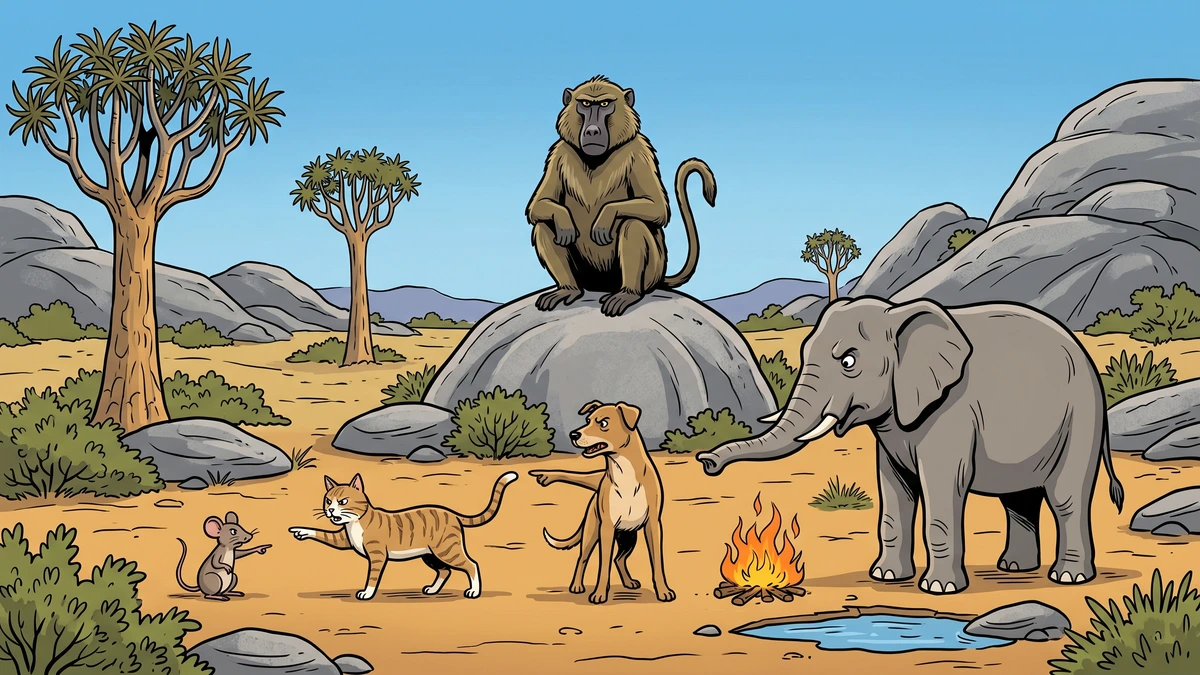
A lesser judge would have given up, or picked a scapegoat, or sent everyone home. Baboon does something far more interesting. He accepts that he cannot discover the guilty party — and he stops trying. The tale puts it with beautiful economy: Baboon “did not see any other way of punishing them, save through making them punish each other.” If no one will accept the consequence, then the consequence will simply be passed along the very same chain the excuses travelled — only this time it will not stop.
So Baboon begins to issue his orders. “Cat, bite Mouse,” he says — and the cat does. He questions the cat; she exculpates herself; “Dog, bite Cat,” says Baboon — and the dog does. Down the line the judgment runs. Then, gathering the rest of the chain in one sweeping sentence, he commands them all together: “Wood, beat Dog. Fire, burn Wood. Water, quench Fire. Elephant, drink Water. Ant, bite Elephant in his most tender parts.” The court does not end with a verdict. It ends with an instruction — and the instruction sets the whole world in motion against itself.
The Judgment That Set the World at War
What Baboon has done is the cleverest stroke in the tale, and also the most unsettling. He has not found the truth. He has not punished the wrongdoer, because the wrongdoer was never found. Instead he has taken the chain of evasion and turned it into a chain of retribution, link for link. The ant bites the elephant; the elephant swallows the water; the water quenches the fire; the fire consumes the wood; the wood beats the dog; the dog bites the cat; and the cat bites the mouse. Everyone is punished. Everyone is also a punisher. And — this is the line the storyteller drives home — “since that day they cannot any longer agree with each other.”
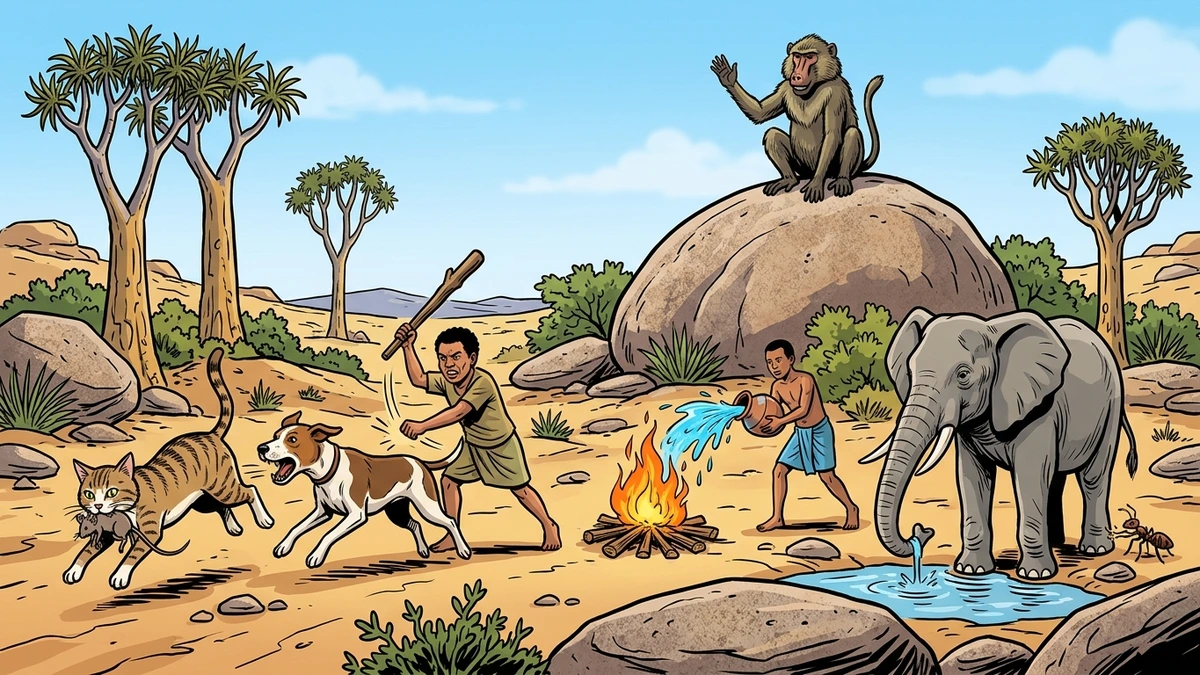
Here the small courtroom comedy turns suddenly enormous. The judgment does not end when the trial ends. It becomes permanent. It becomes the way things are. The cat still chases the mouse; fire still devours wood; water still drowns fire; the ant still torments the elephant. What began as a one-day quarrel over a torn coat has hardened into the standing enmities of the natural world — the food chain, the war of the elements, the endless give-and-take of predator and prey. The Khoikhoi listener is being told, with a perfectly straight face, that the reason nature is full of hunting and burning and drowning is that, once upon a time, eight neighbours could not bring themselves to say I am sorry, it was me.
This is the deep wit of the tale. It takes the largest and most frightening fact a child can notice — that living things devour one another, that the world is arranged as a chain of eating — and it traces that fact back not to cruelty, not to the gods, but to a failure of honesty in a courtroom. The violence of nature, the story says, is unowned responsibility, grown old and gone hard.
Why the Baboon Walks on All Fours
The tale has one more turn to give, and it is the gentlest and the funniest. Itkler, watching the judgment run its course, is satisfied at last. He thanks Baboon warmly and with great courtesy: the judge has “exercised justice” on his behalf and given him redress. By the rough arithmetic of the court, the case is closed. Someone, somewhere down the chain, has now been bitten for the torn coat.
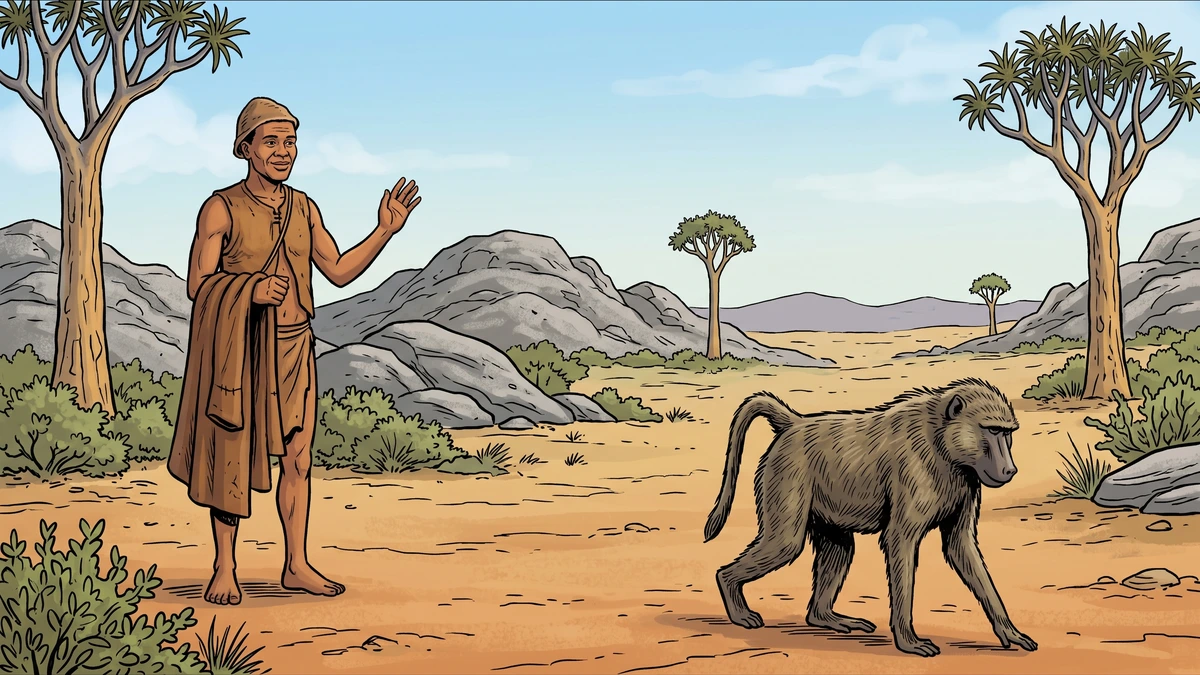
But the storyteller will not quite let Baboon enjoy his triumph. In the older Khoikhoi telling the judge had been an upright, dignified figure — and the tale ends by stripping him of that dignity. Baboon announces, oddly, that he will no longer be called by his old homestead name, “Jan,” but only “Baboon” from now on. And from that day, the tale says, the baboon walks on all fours — “having probably lost the privilege of walking erect through this foolish judgment.”
That word — foolish — is the storyteller’s sly last word, and it changes everything that came before. The judgment that seemed so clever, the verdict that set the order of nature, is in the same breath called a folly that cost the judge his upright stance. The tale admires Baboon’s ingenuity and mocks it at once. He solved the case — but he solved it by spreading the harm instead of stopping it, by making everyone a victim rather than holding one wrongdoer to account. And for a judgment that clever and that wrong, a judge might well come down off his two feet and never stand tall again. It is a piece of teaching disguised as a punch-line: cleverness that multiplies suffering is not wisdom, and the elders want the children to know the difference.
A Cumulative Tale, and What Its Shape Means
“The Judgment of Baboon” belongs to one of the oldest and most widespread story-shapes on earth: the cumulative, or “chain,” tale. These are the stories built like a string of beads, in which each element calls up the next in a lengthening, rhythmic list — the house that Jack built, the old woman whose pig would not jump the stile, the gingerbread man pursued by an ever-growing crowd. Folklorists gather them in the cumulative-tale range of the international tale index, and the African continent is especially rich in them.
What is striking about the Khoikhoi version is its economy. Many chain tales grow the chain slowly, link by link, so that the listener feels it stretch. Here the whole chain is delivered twice, swiftly, almost as a chant — once as the chain of excuses and once, in reverse, as the chain of punishments — so that the second recital answers the first like the closing half of a song. For young listeners this doubled, mirrored structure was a gift: it was easy to memorise, satisfying to anticipate, and impossible to get wrong. A chain tale is, among other things, a teaching device. It trains a child’s memory and sense of sequence while it entertains, and it hands the next generation a story they can carry forward unbroken.
The doubling also carries the tale’s meaning. The first chain runs downward — blame sliding away from each speaker. The second runs back along the same path — consequence returning to find everyone. Laid side by side, the two chains say something no single sentence could: that responsibility evaded does not vanish. It only travels. And sooner or later it comes back down the line.
The Moral — Responsibility and the Web of Consequence
For all its fantastical machinery, the lesson at the centre of “The Judgment of Baboon” is plain, practical, and aimed squarely at the way people actually behave. It is a tale about the passing of the buck — and about what it costs a community when everyone passes it.
Had any one of the accused simply owned the small fault — yes, it was I; I will make it good — the chain would have snapped at the first link and the matter would have ended there, quietly, with a torn coat mended. Instead each one shrugged the blame onto a neighbour, and the unowned wrong rolled on until it had drawn in fire and flood and the great elephant himself, until a judge had to set the whole world biting and burning to bring the thing to any kind of close. The harm did not shrink by being shared. It multiplied. That is the warning the Khoikhoi elders folded into the comedy: a fault denied does not disappear — it spreads, and it spreads wider than anyone evading it could ever foresee.
“Wie kaats, moet die bal verwag.”
— Cape Afrikaans proverb: “He who strikes the ball must expect it back.” Every act sends a consequence travelling; in time it returns along the line to the one who set it moving.
There is a second lesson, quieter, meant for anyone who is ever asked to judge. Baboon is clever — cleverer than the dispute that defeats him — but his cleverness is not the same thing as justice. A true judgment would have found the one who tore the cloth and asked that one to mend it. Baboon could not, so he did the next thing: he made the harm general. And the tale, by costing him his upright walk for it, marks the difference. To resolve a quarrel by spreading the injury until everyone is equally wounded is not to end the quarrel. It is only to make it permanent. Real justice mends; it does not multiply.
Why the Tale Has Lasted
“The Judgment of Baboon” has survived a century and a half in print, and far longer in the mouths of Namaqualand storytellers, because it does an enormous amount of work in a very small space. It is, first, simply delightful — a brisk courtroom farce with a cast of eight, a rhythm a child can chant, and a baboon judge whose verdict is too clever by half. Stories that are this much fun to tell do not die.
But it lasts, too, because it answers the questions children genuinely ask. Why does the cat chase the mouse? Why does water put out fire? Why does the baboon go on four legs when other creatures of his kind sit up? The tale gathers all of these into one explanation and ties them to a single, human, moral root: the day the world’s creatures would not own their faults. That is the genius of the etiological folk tale — it makes the order of nature memorable by making it a consequence of character.
And it lasts because its warning never expires. Every generation rediscovers the chain of excuses — in playgrounds, in workplaces, in the great affairs of nations — the small wrong that no one will claim, passed hand to hand until it has grown too large for anyone to mend. The Khoikhoi told that truth as a comedy about a torn coat and a baboon on a judge’s seat. When Wilhelm Bleek wrote it down in the 1860s and James Honey carried it to the world in 1910, they were preserving a piece of wisdom as durable as the granite koppies of Namaqualand: own the small fault early, while the chain is still short enough to break.
You May Also Like
 African Folk Tales
All Ages
African Folk Tales
All Ages
Crocodile’s Treason
A scholarly retelling of “Crocodile’s Treason,” a South African veldt folk tale from James A. Honeÿ’s South-African Folk-Tales (1910) — the story of the weeping crocodile and the origin of the phrase “crocodile tears.”
 African Folk Tales
Ages 9-12
African Folk Tales
Ages 9-12
Maku Mawu And Maku Fia
Maku Mawu And Maku Fia: I will die God’s death’ and ‘I will die the King’s death’ Once upon a time there were two men who were such great friends that they
 African Folk Tales
Ages 6-8
African Folk Tales
Ages 6-8
The Squirrel And The Spider
A fast squirrel and a patient spider discover that every creature has special and valuable talents.