Tit For Tat
Tit For Tat: There had been a great famine in the land for many months. Meat had become so scarce that only the rich chiefs had money enough to buy it. A
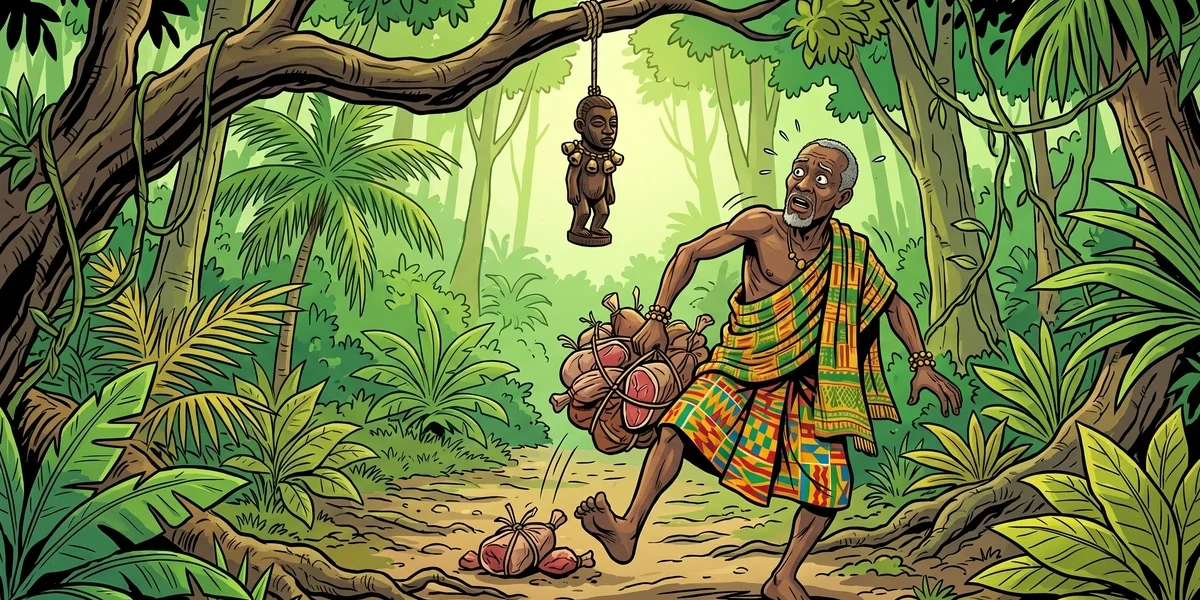
Tit for Tat is one of the spider tales of the Akan people of the Gold Coast — modern Ghana — and reaches English readers through West African Folk-Tales (London: George G. Harrap & Co., 1917), collected and arranged by William H. Barker with retellings and drawings by Cecilia Sinclair. Barker, a science graduate who served as an inspector of schools on the Gold Coast, worked with Sinclair to set down the Anansesem — the “spider stories” that Twi-speaking families told around the evening fire. In the collection it stands as Tale VI, in the opening section devoted entirely to Anansi, falling between “Why the Lizard Continually Moves His Head Up and Down” and “Why White Ants Always Harm Man’s Property.” It is a story about famine, about a father who steals from his own child, and about a son who answers theft not with violence but with a small wooden image that nods.
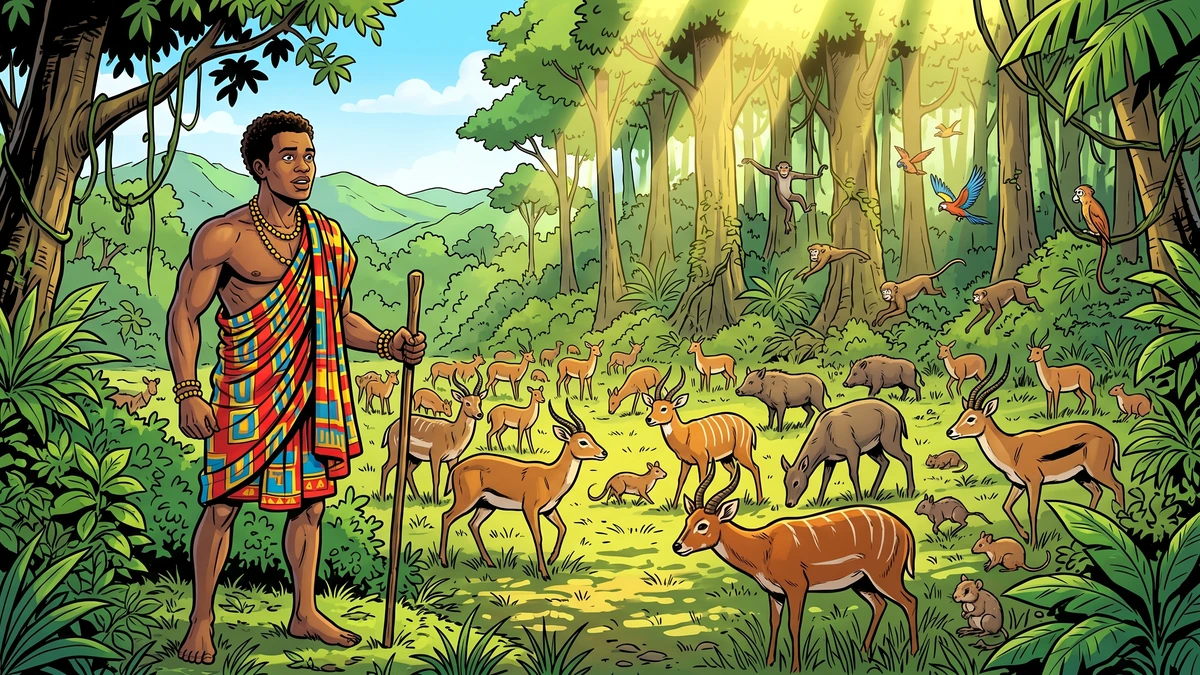
A Famine, a Forest Full of Game, and a Secret Kept
A great famine had lain over the land for many months. Meat had grown so scarce that only the rich chiefs could afford to buy it, and the poor were starving. Anansi the spider and his family were among the most miserable of all, for Anansi’s cleverness, which might have fed them, was always bent toward shortcuts and never toward honest work.
It was Anansi’s eldest son, Kweku Tsin, who broke the family’s hunger. Searching the forest, he found a hidden place where game was still plentiful, and he began to hunt there in secret. Day after day he carried meat back to the village and sold it at a good price to households as hungry as his own. Kweku told no one where the place lay — least of all his father. He knew Anansi too well. He knew that a secret shared with Anansi was a secret already spent.
This is the quiet hinge on which the whole tale turns. Kweku’s silence is not unkindness; it is hard-won knowledge. A child who must hide good fortune from his own father has already learned something bitter about the household he was born into. The famine sets the stakes — in a season of starvation, the forest clearing is not a luxury but a lifeline — and Kweku’s caution tells us, before Anansi has done a single thing, exactly the kind of man we are dealing with.
The Trail of Ashes
Anansi soon noticed that his son returned to the village loaded with meat and silver, and at once he wanted the secret for himself. He asked; Kweku wisely refused. So Anansi decided to take by trickery what he could not get by asking.
One night, while Kweku slept, Anansi crept into his son’s room and cut a tiny hole in the corner of the hunting-bag the young man always carried. Into the bag he poured a quantity of ashes, then set it back exactly where he had found it. The next morning Kweku slung the bag over his shoulder and set off, never knowing that at every stride a thin line of ash was sifting out behind him and settling on the forest floor.
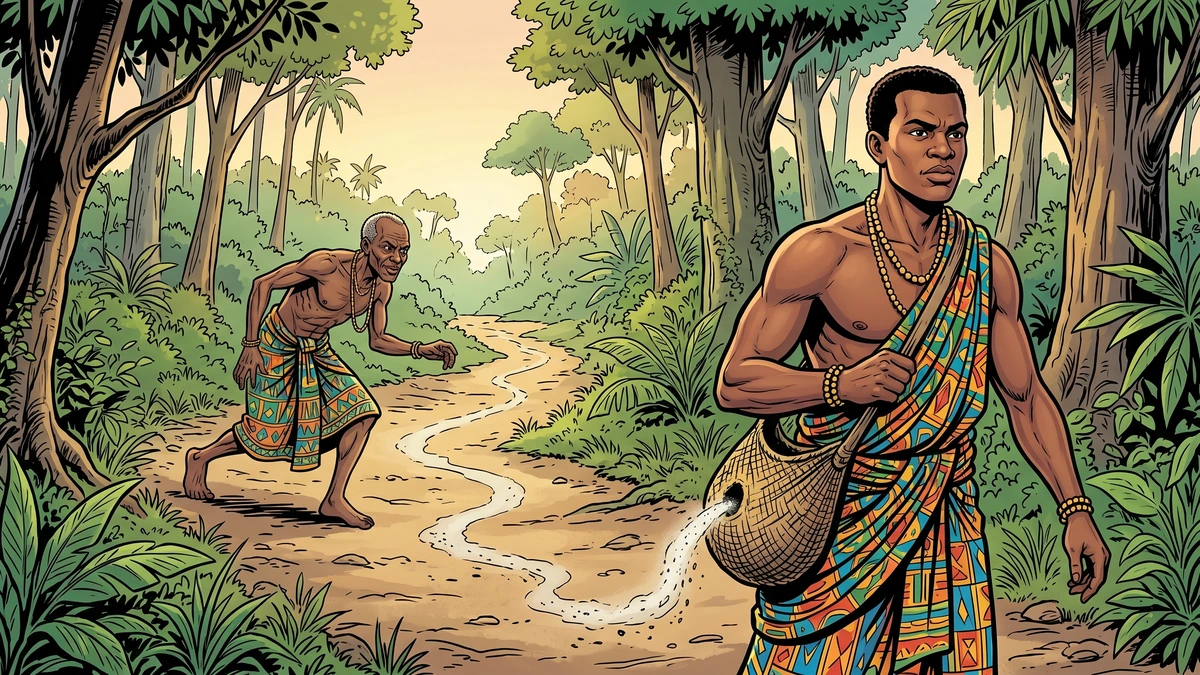
An hour later Anansi followed the pale trail straight to the hidden clearing. He found Kweku already at work among the animals — and he drove his own son away from it, declaring that by the law of the land the hunting-ground now belonged to him. It is a stunning moment of nerve. Anansi does not merely steal the place; he steals it and then dresses the theft in the language of law and right, as though custom itself had handed him what he took by cutting a hole in a sleeping boy’s bag. Kweku saw exactly how he had been tricked, and he made up his mind to win the meat back.
The Image That Nodded and Shook
Kweku did not go home to sharpen a weapon. He went home to make a small wooden image. Around its neck he hung a string of little bells, and to its head he tied a long, fine thread. Carrying the image back toward the hunting-ground, he stopped halfway along the path, hung the figure from the branch of a tree so that it dangled over the road, and hid himself in the bushes nearby with the loose end of the thread held in his hand.
Meanwhile Anansi, greedy and tireless, had killed every animal he could find, skinned them, and prepared the flesh to sell in the neighbouring villages. Shouldering his first heavy load, he set out for home — and came to the place where the little image hung in his way. Believing it to be one of the gods, he stopped short.
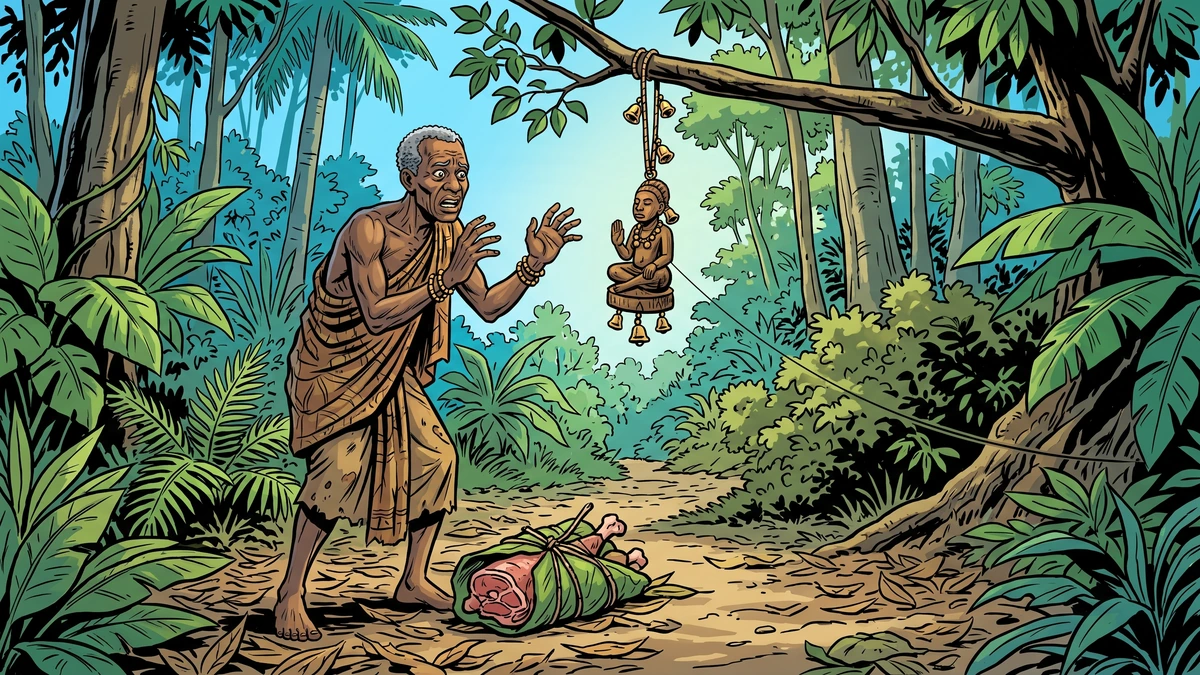
As Anansi drew near, Kweku pulled the thread, and the image shook its head vigorously. To Anansi this could only mean that the gods were angry. Anxious to please them, he offered a bargain. “May I give you a little of this meat?” The head shook. “May I give you half of this meat?” The head shook again. “Do you want the whole of this meat?” he shouted — and this time Kweku let the head nod, as though the figure were well satisfied. “I will not give you all my meat,” Anansi cried — and at that the image shook in every limb as if in a terrible temper. Anansi was so frightened that he flung the whole load to the ground and ran. As he fled he shouted back where he meant to hunt the next day: “To-morrow I shall go to Ekubon — you will not be able to take my meat from me there, you thief.”
The genius of the trick is that it uses nothing but Anansi himself. Kweku supplies a carved figure and a thread; everything else — the dread, the bargaining, the surrender — Anansi brings on his own. The same fearful, scheming mind that cut the hole in the bag now fills an empty piece of wood with a god. A man who lives by deceiving others, the tale suggests, has already trained himself to be deceived.
Day After Day, and a Feast of Laughter
Anansi’s parting shout was his undoing. Each evening he announced exactly where he would go next, and each day Kweku simply carried the image ahead of him and hung it in the new path. Again and again the nodding figure stopped the greedy father; again and again he abandoned his whole load and fled. So it continued, day after day, until every animal in the wood had been killed and carried off — by Kweku.
By the end of it Kweku Tsin had grown rich, while Anansi remained as poor as ever, reduced to walking to his son’s house each day to beg for food. When the famine at last lifted, Kweku gave a great feast and invited the whole village. There, with everyone gathered, he told the story aloud — how his father had stolen the hunting-ground with a trail of ashes, and how a wooden image with bells had quietly stolen it back. The villagers roared with laughter, and Anansi, scorched with shame, promised his son on the spot that he would give up his wicked tricks for good.
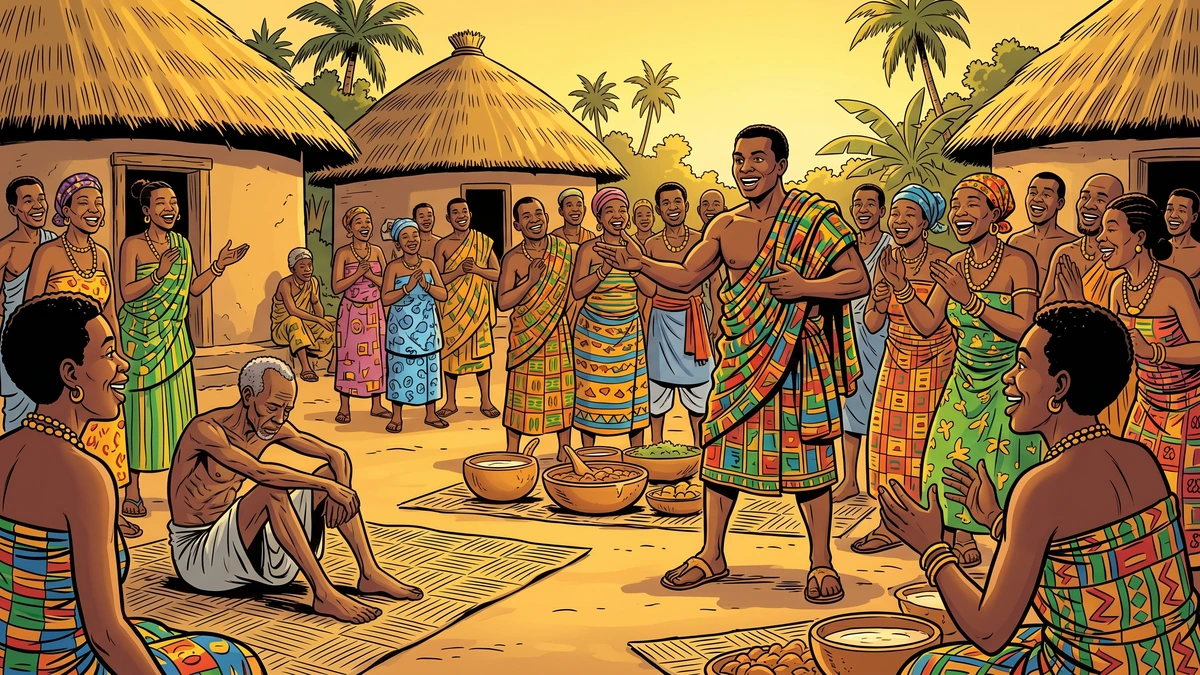
Then comes the line that lifts the tale from a simple comeuppance into something wiser and sadder. Barker’s text records, with no comment and no flourish, that the promise “he did not long keep.” The story refuses the tidy ending in which the trickster is cured. Anansi is shamed, not reformed. The feast settles one account; it does not change a character. That small, unsentimental closing is the most grown-up thing in the tale.
The Moral of the Tale
The English title names the lesson plainly. Tit for tat is the principle of measured return — the wrong you do is the wrong that finds its way back to you, in its own shape and time. Anansi steals by trickery, and it is by trickery that he is stripped bare. He weaponises the language of law to seize the clearing; he is undone by the language of religion, the fear of the gods, turned against him.
Yet the tale is careful about how the return is made. Kweku, the wronged party, never raises a hand and never tells a direct lie — he hangs up a carved figure and lets his father’s own greed and superstition do the rest. The justice here is not revenge in the crude sense but a kind of mirror: Anansi is made to meet himself. The story closes with a clear eye on human nature.
This caused great merriment among the villagers. Anansi was so ashamed that he readily promised Kweku to refrain from his evil tricks for the future. This promise, however, he did not long keep.
That last clause is the moral’s sharp edge. The tale teaches that wrongdoing is repaid — but it also teaches, without bitterness, that shame is a weak teacher. The cunning that fed on a famine is punished within the story; whether it is cured is left, honestly, in doubt.
Origins, Source, and Tale-Type
Tit for Tat belongs to the Anansesem, the body of spider stories of the Akan-speaking peoples of the Gold Coast — the Ashanti, Fante, Akuapem and related Twi-speaking communities of present-day Ghana. The very word means “spider stories,” and in Akan tradition it was the recognised name for folk narrative as a whole, so closely was the trickster spider Anansi (Kwaku Ananse) bound up with the art of storytelling itself.
The text given here follows West African Folk-Tales, collected and arranged by William H. Barker and retold with original drawings by Cecilia Sinclair, published in London by George G. Harrap & Co. in 1917. Barker worked on the Gold Coast as an inspector of schools, and the collection was shaped in part as reading material for Gold Coast pupils, which accounts for its plain, brisk narrative line. “Tit for Tat” appears as the sixth tale, within the volume’s opening section, “Anansi, or Spider, Tales.” The fuller scholarly record of Akan oral tradition is the work of the government anthropologist R. S. Rattray, whose Ashanti Proverbs (1916) and Akan-Ashanti Folk-Tales (1930) preserve the stories in Twi with facing translation and set the bell-image episode beside dozens of related trickster narratives.
In the international classification of folk narrative, the tale sits within the broad trickster family rather than under a single tidy type-number. Its decisive episode is a well-travelled motif: a hidden person speaks or moves a lifeless figure so that a victim mistakes it for a divine being — catalogued in Stith Thompson’s Motif-Index of Folk-Literature as K1971, the man behind a statue or idol who passes himself off as a god, alongside the wider motif K1700, deception through bluffing. Framing the whole story is one of the oldest patterns in world folklore, the deceiver deceived, or “the biter bit” — the trickster who is at last out-tricked, often by a younger, quieter figure. In the Anansi cycle that quieter figure is repeatedly Kweku Tsin, Anansi’s clever eldest son, whose recurring role across several Barker tales is precisely to be the measured intelligence that answers his father’s greed.
Kweku Tsin, the Bell-Image, and the Craft of the Telling
What makes Tit for Tat distinctive within the Anansi cycle is that Anansi is not the hero of his own story. Usually the spider is the engine of the plot — clever, hungry, amoral, and more often than not successful. Here he is the target, and the engine is his son. The shift is deliberate. By handing the cleverness to Kweku, the tale separates two things that the spider usually keeps fused: intelligence and greed. Anansi has both; Kweku has the intelligence without the greed, and the story quietly insists that the difference is everything.
The two tricks are built to rhyme. Anansi’s ashes are silent, secret, and worked on a sleeping victim — a theft in the dark. Kweku’s image is its mirror: it works in daylight, in the open path, and it takes nothing that Anansi has not first stolen. The ashes track a body through the forest; the bell-image tracks a conscience. One trick exposes where a man has been; the other exposes what a man is. A storyteller could hold a whole compound of listeners on the comedy of the second scene alone — the puffed-up Anansi haggling with a piece of wood, raising his offer, losing his temper, and finally bolting down the road — while every child present knows exactly who is pulling the thread.
The detail of the bells repays attention. Among the Akan, carved figures and the sound of bells belonged to the world of shrines and the gods; Kweku borrows that visual and aural language and aims it straight at his father. He does not argue that Anansi is a thief. He stages a small theatre in which Anansi, given a carved figure and a jingle of bells, convicts and sentences himself. The tale’s comedy and its ethics are the same mechanism: a man is undone exactly to the measure of his own greed and his own fear.
Why the Tale Has Lasted
“Tit for Tat” has outlived its 1917 schoolbook for reasons that have little to do with print. It is, first, genuinely funny, and its comedy is the durable kind — built from character rather than from a single joke. It is also morally honest in a way children recognise long before they could explain it: the wrong is repaid, the greedy man is humbled, and yet the story declines to pretend he is reformed. That refusal of the tidy ending is what keeps the tale feeling true.
It carries, too, a quiet dignity for the powerless. Kweku is the younger and the wronged, robbed by the very person who should have protected him; and he wins without a weapon, without a lie told to anyone’s face, and without ever stooping to his father’s cruelty. He wins by understanding the man who wronged him better than that man understands himself. For generations of listeners on the Gold Coast and, later, for readers far beyond it, that is a deeply satisfying shape: intelligence joined to restraint, outlasting intelligence joined to greed. The famine fades, the feast ends, the laughter dies down — and the small wooden image with its string of bells goes on nodding in the memory, a reminder that what a person sends out into the world has a way of finding the path home.
Frequently Asked Questions
Where does the story “Tit for Tat” come from?
It is an Akan spider tale (Anansesem) from the Gold Coast, modern Ghana, told traditionally among the Twi-speaking Ashanti, Fante and related peoples. The English text used here is from West African Folk-Tales, collected and arranged by William H. Barker and retold and illustrated by Cecilia Sinclair, published in London by George G. Harrap & Co. in 1917, where it appears as Tale VI.
Who is Kweku Tsin?
Kweku Tsin is the clever eldest son of Anansi the spider, and a recurring figure across several tales in Barker and Sinclair’s collection. He typically represents level-headed, measured intelligence, and his role is repeatedly to answer or undo the greed and trickery of his father. In “Tit for Tat” he is both the wronged party and the quiet engine of the plot.
What is the moral of “Tit for Tat”?
The title states it: a wrong returns to the one who commits it, in its own shape. Anansi steals his son’s hunting-ground by trickery, and by trickery he is stripped of everything he gains. The tale adds a sharper, more honest note at the close — Anansi is shamed but not reformed, promising to give up his evil tricks and soon breaking that promise.
Why does Anansi believe the wooden image is a god?
Among the Akan, carved figures and the sound of bells belonged to the world of shrines and the gods. When Kweku hangs a bell-strung image in the path and twitches a hidden thread to make it nod and shake, Anansi — superstitious and guilty — reads its movements as the anger of the gods. The trick works because it borrows a familiar religious language and turns Anansi’s own fear against him; it is catalogued in folklore studies as motif K1971, the figure mistaken for a god.
How does this tale fit among other Anansi stories?
Most Anansi tales make the spider the clever winner. “Tit for Tat” is one of the stories in which he is out-tricked instead — an example of the worldwide “deceiver deceived” or “biter bit” pattern. By giving the cleverness to Kweku Tsin, it separates intelligence from greed and shows that the two are not the same thing, a theme that runs through the wider Anansesem tradition recorded more fully in R. S. Rattray’s Akan-Ashanti Folk-Tales (1930).
You May Also Like
 African Folk Tales
All Ages
African Folk Tales
All Ages
Quarcoo Bah-Boni
Quarcoo Bah-Boni: Once upon a time in a certain village lived a man and his wife who were childless. One day, however, when the husband was away hunting, the
 African Folk Tales
Ages 6-8
African Folk Tales
Ages 6-8
Tink-Tinkje
The southern African folk tale 'Tink-Tinkje', the Cape form of the worldwide 'election of the king of birds' fable, in which the smallest bird wins the crown by cleverly riding unfelt on the soaring vulture's wing.
 African Folk Tales
Ages 6-8
African Folk Tales
Ages 6-8
Anansi and the Pot of Wisdom
The Akan (Ashanti) trickster tale of how Kwaku Anansi the spider tried to hoard all the wisdom of the world in one clay pot - and how his own small son taught him the lesson that scattered wisdom across the whole earth.