Lion’s Share
Lion's Share is a Khoikhoi (Khoekhoe/Nama) folk tale of the South African Cape, from the jackal trickster cycle first printed in W.H.I. Bleek's Reynard the Fox in South Africa (1864). Lion and Jackal hunt as partners, and the cunning jackal outwits the powerful lion meal by meal.
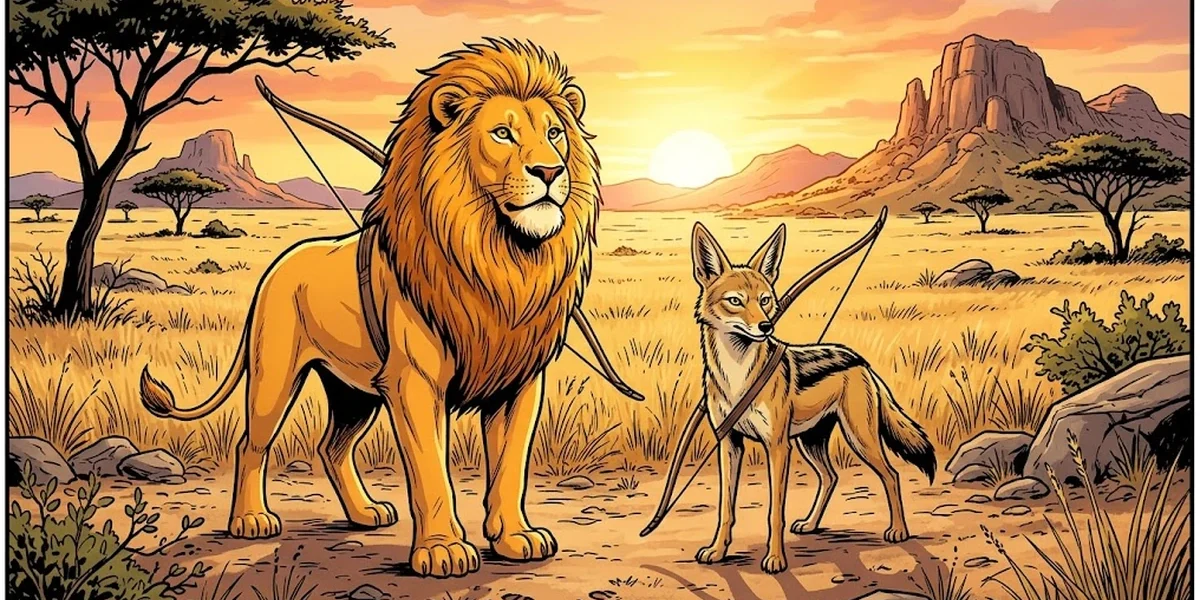
Two hunters set out together at dawn: the Lion, broad-shouldered and certain of his own greatness, and the Jackal, lean, quick-eyed, and forever calculating. They were partners. They called each other kin — Jackal addressed the Lion as “dear uncle,” and the Lion’s cubs greeted Jackal as “cousin.” In the dry country of the Cape, where game was scarce and the cold months long, a hunting partnership was a serious bond, almost a contract. What this story tells, with a storyteller’s relish, is how one partner emptied that bond of everything but its polite words — and walked away laughing.
It is worth noticing the title before the tale begins. “The lion’s share” is an English phrase that comes from an Aesop fable in which a lion, hunting in company, claims every portion of the kill by sheer intimidation. The phrase has been borrowed here as a label, because this Khoikhoi tale, too, turns on the unequal division of a hunt. But the engine of the story is the opposite of Aesop’s. The Aesopic lion takes the lion’s share by being strong. The Khoikhoi lion loses the lion’s share by being slow — outwitted, meal by meal and stone by stone, by a partner who never once raises a paw against him.
The False Trail
The hunt opens with a small, telling lie. Both animals shoot; the Lion’s arrow falls short, and it is Jackal’s arrow that strikes the game. Jackal cries out in triumph — and then, catching the Lion’s two great eyes turning slowly toward him, instantly changes his story. “No, uncle, I mean to say that you have hit.” In a single breath the trickster has read the danger, surrendered the credit, and flattered the powerful. It is the whole tale in miniature: Jackal will let the Lion keep every appearance of mastery while quietly stripping him of every reality.
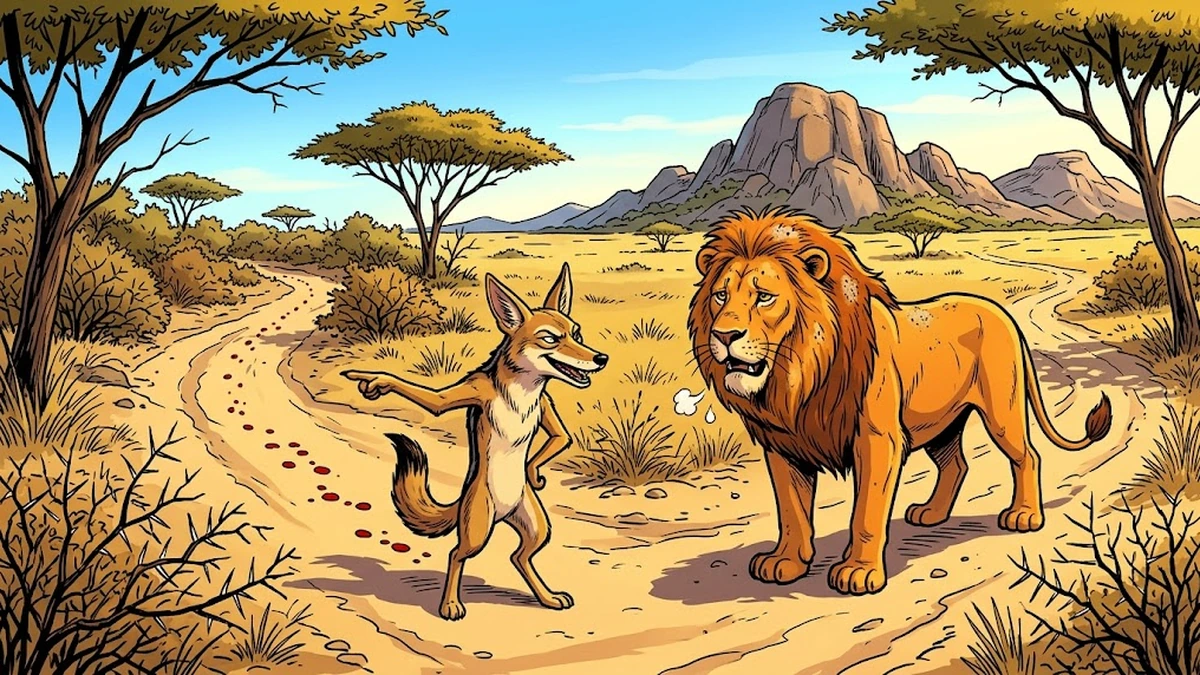
When they reach a fork in the path, Jackal plays on the one thing the Lion cannot deny — his age. “Dear uncle, you are old and tired; stay here.” Then Jackal does something coldly inventive. He runs a little way down the wrong track, strikes his own nose until it bleeds, and lets the drops fall along the path like the blood-spoor of wounded game. Returning, he reports a false trail and sends the trusting Lion off to follow it. The partnership’s first principle — shared knowledge, shared search — has been converted into a private map that only the trickster can read.
Inside the Carcass
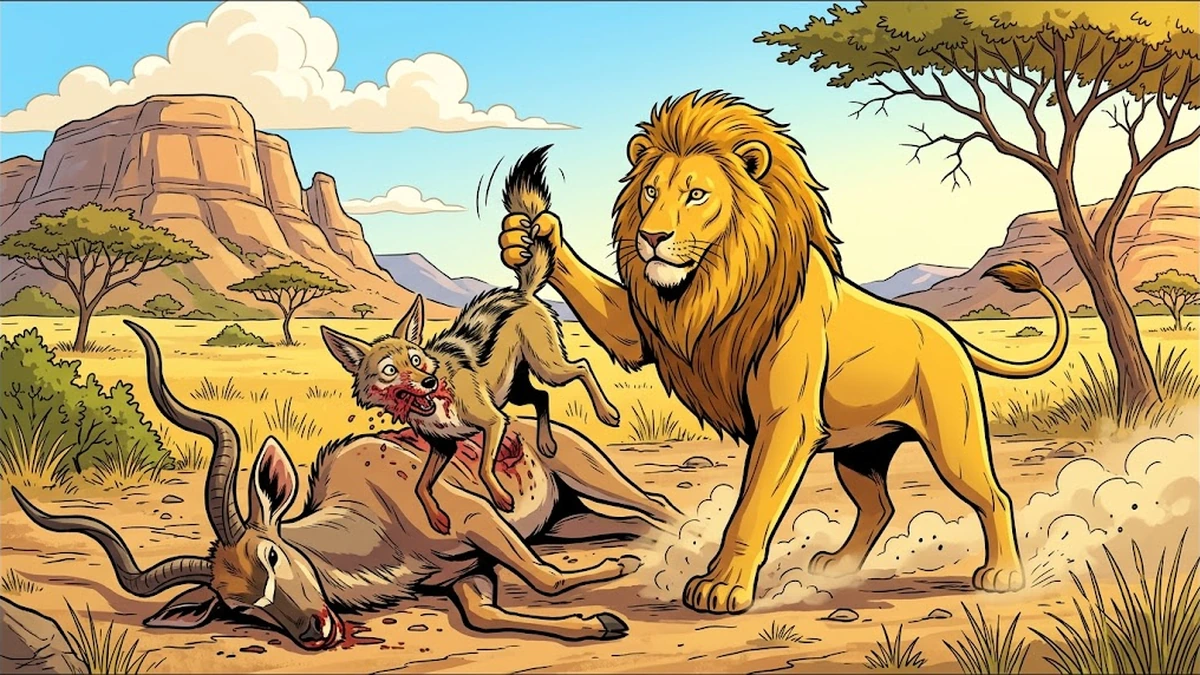
While the Lion lumbers down the false trail, Jackal finds the true kill. What he does next is the boldest image in the story: he does not merely take the best meat, he climbs inside the carcass and devours the choicest portion from within, hidden by the very body of the prey. The Khoikhoi audience would have laughed and winced at once — it is gluttony made literal, the cheat so deep inside the spoils that he has disappeared into them.
But the trickster overreaches, as tricksters in these tales always eventually do. His tail hangs out of the carcass. The Lion arrives, seizes the tail, hauls Jackal into the daylight, and throws him to the ground with a single contemptuous word: “You rascal!” For one bright moment the strong animal has caught the cunning one red-handed. And here the story makes its sharpest point about power. The Lion has the proof, the strength, and the right — and he does nothing with them. Jackal simply rises, brushes himself off, complains about the “rough handling,” and claims with wounded dignity that he was only “busy cutting out the best part” — for the Lion, naturally. The Lion lets it go. A grievance noticed but not enforced is no protection at all.
The Crooked Share
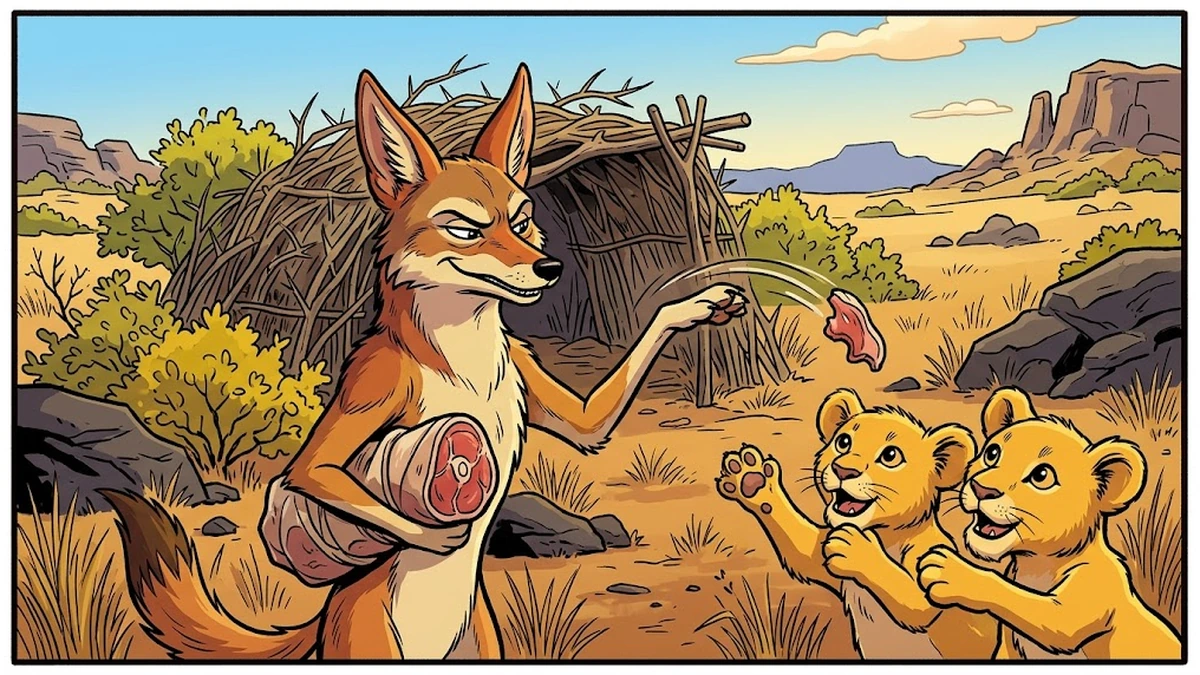
Now comes the division that gives the tale its name. It is time to carry meat home to the two families, and Jackal appoints himself the carrier — the one job that lets him control who eats what. He takes two portions: the worst cut he carries to the Lioness and her cubs, and the best he reserves for his own wife. When the Lion’s delighted children run to meet him clapping their hands — “There comes cousin with flesh!” — Jackal flings them the poor scraps with an open insult: “There, you brood of the big-eyed one!” The courteous word “cousin” and the contemptuous phrase “brood of the big-eyed one” are spoken about the same family within minutes of each other. That gap between Jackal’s manners and Jackal’s meaning is the moral temperature of the entire story.
Jackal then manages the families themselves. He tells his own wife to break camp at once and move to the kill; he forbids the Lioness to do the same, insisting the Lion will come to fetch her himself. When he nears the carcass with his family, he throws himself into a thornbush, tears his own face until it bleeds, and presents the wounds to the Lion as evidence: your wife did this to me when I tried to bring her. The Lion, humiliated and now angry at his own innocent mate, stalks off home alone. Jackal has wounded himself twice now — once on the nose, once on the face — and each self-inflicted injury has been spent buying a lie. The trickster pays in his own blood, but he always makes the dupe carry the cost.
The Tower and the Burning Stone
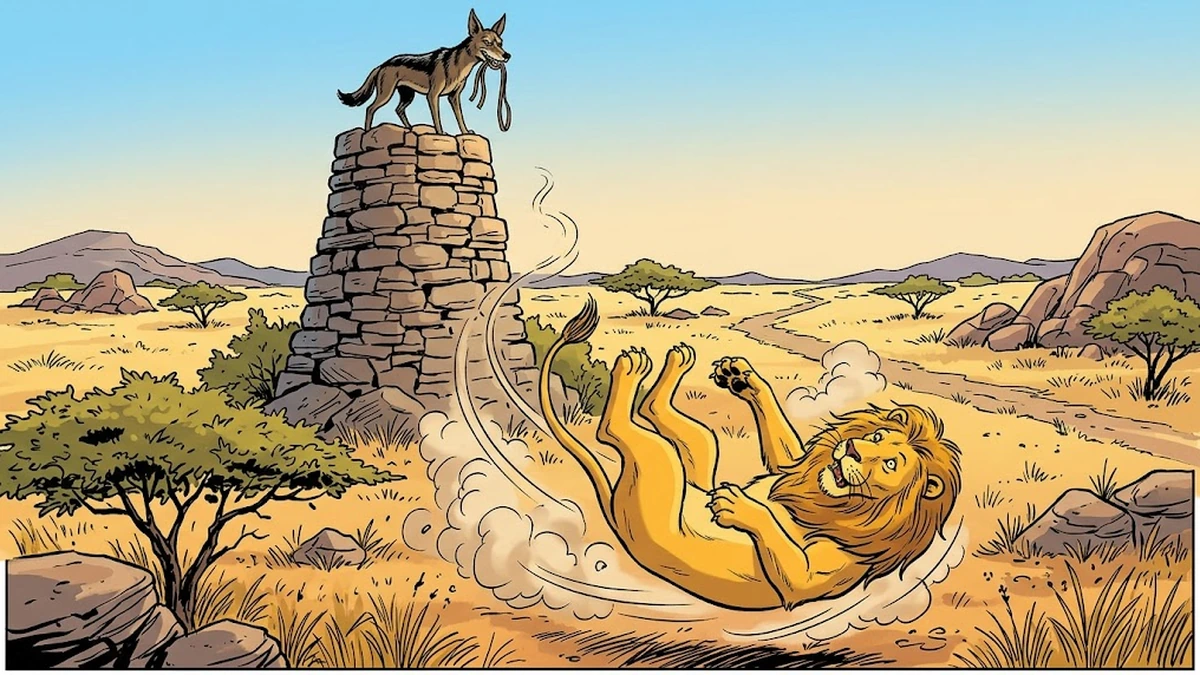
With the Lion gone, Jackal builds his trap. “Quick, let us build a tower,” he tells his family, and they pile stone upon stone, stone upon stone, until it is high enough to carry everything — meat, wife, children — up out of the Lion’s reach. When the Lion returns with his own family, Jackal greets him from the top with a friendly excuse: the tower was built “to be better able to see game.” The Lion asks, reasonably, to be let up. And Jackal, all helpfulness, lowers a thong.
Three times the Lion ties the thong about his body; three times Jackal hauls him almost to the summit, calls out how dreadfully heavy his dear uncle is — and cuts the rope. Twice the Lion crashes to the ground, the second fall leaving him groaning and badly hurt. Each time Jackal blames his wife for fetching a faulty thong, scolding her loudly for the Lion to hear while muttering the truth to her aside. On the third attempt Jackal changes the trick. He has his wife heat a round stone red-hot and wrap it in fat so that it looks like a generous roasted morsel. He draws the famished, broken Lion just high enough, tells him kindly to open his mouth for a mouthful at last — and drops the burning stone down his throat.
The Lion falls to the earth a final time, pleading only for water, while the Jackal climbs quietly down the far side of his tower and vanishes into the veld. The strong animal ends the tale flat on the ground, scorched from the inside, abandoned. The weak animal ends it free, fed, and gone. No arrow ever touched the Lion. He was destroyed entirely by his own trust, his own pride, and his own unwillingness to act on what he plainly saw.
The Moral
Khoikhoi storytellers told the jackal tales with obvious delight, and listeners were meant to enjoy Jackal’s nerve. Yet the tale is not a simple cheer for cleverness. It is a double-edged thing. On one face it warns the powerful: strength that will not use itself — a Lion who catches the cheat and lets him go, who hears the insult and swallows it, who is fooled three times by the same rope — is no strength at all. Authority that refuses to enforce its own agreements invites its own ruin. On the other face it warns the community about the trickster himself: a partner who treats kinship as a costume, who says “cousin” while thinking “brood of the big-eyed one,” corrodes the very bonds that let a hard country survive. The Cape carries an Afrikaans proverb that holds both edges at once:
“Slim vang sy baas.”
— Cape Afrikaans proverb: “Cleverness catches its master” — cunning is admired, but a community that lets it run unchecked will, in the end, be caught by it.
The genius of the tale is that it refuses to make the lesson comfortable. The cheat wins. The honest, trusting partner is left burned and begging. Children who heard this around a Nama fire were not handed a tidy reward-the-good ending; they were handed a hard question. How do you live alongside a Jackal? The answer the story implies is unsentimental: watch what partners do, not what they call you; act the first time you catch a cheat, not the third; and never confuse a polite word for a kept promise.
Historical & Cultural Context
The Khoikhoi were the herding peoples of the South African Cape and Namaqualand, speakers of Khoekhoegowab, with one of the oldest continuous oral cultures on the continent. In their stories the jackal — small, fast, a scavenger living by its wits at the edges of larger predators’ kills — is the great trickster, the figure who survives a dangerous world not by force but by reading it faster than anyone else. The lion, by contrast, is strength without subtlety: magnificent, dangerous, and reliably outmanoeuvred.
This particular story reached the printed page through a colonial chain. Nama narrators told it; the missionary Georg Krönlein wrote versions down in Great Namaqualand; the philologist Wilhelm Bleek translated and edited a collection of forty-two such narratives, publishing them in 1864 as Reynard the Fox in South Africa. Bleek chose that European title deliberately: he had recognised that the Khoikhoi jackal cycle — a sly underdog endlessly humiliating a powerful, slower beast — was structurally the African cousin of the medieval European Reynard the Fox epic. James A. Honey carried the tale into his widely read 1910 anthology, where it acquired the English label “Lion’s Share.” Modern readers should hold the chain in mind: the wit and the worldview are Khoikhoi, but every word we read has passed through a missionary’s notebook and two editors’ hands.
The hunt itself dates the world of the story. Lion and Jackal hunt with arrows, not firearms — a detail that places the narrative imaginatively in a pre-colonial economy where a successful kill had to be shared by agreed protocol because no single family could be sure of the next one. In that economy, the cheating of a hunting partner was not a private quarrel. It was an attack on the rule that kept everyone alive through the winter. The tale’s villain is frightening precisely because his weapon is not violence but the quiet emptying-out of trust.
Jackal Among the World’s Tricksters
The Khoikhoi jackal belongs to a worldwide family of trickster figures — small, weak, hungry creatures who turn cleverness into a survival strategy against the strong. West African tradition has Anansi the spider; the African American plantation tales have Br’er Rabbit, who carried much of the same trickster logic across the Atlantic; Native North American storytellers have Coyote; and medieval Europe had Reynard the Fox, whose cycle Wilhelm Bleek invoked by name when he titled his 1864 collection. Each of these figures shares the jackal’s essential grammar: the contest is never strength against strength, but wit against weight, and the audience is invited to side — a little guiltily — with the underdog.
Yet the Khoikhoi jackal has his own distinct flavour. He is colder than the playful Anansi and more ruthless than the often-foolish Coyote. He injures himself deliberately, twice, to manufacture evidence; he insults children to their faces; he leaves his trusting partner scorched and begging for water and feels nothing. Folklorists reading the cycle have noted that the Cape jackal tales are unusually unsentimental — they decline to soften the trickster or to guarantee his com
You May Also Like
 African Folk Tales
Ages 6-8
African Folk Tales
Ages 6-8
Anansi and the Pot of Wisdom
The Akan (Ashanti) trickster tale of how Kwaku Anansi the spider tried to hoard all the wisdom of the world in one clay pot - and how his own small son taught him the lesson that scattered wisdom across the whole earth.
 African Folk Tales
Ages 6-8
African Folk Tales
Ages 6-8
How Wisdom Became The Property Of The Human Race
How Wisdom Became The Property Of The Human Race. Long ago, wisdom belonged only to a few. Learn how one person changed everything by sharing knowledge.
 African Folk Tales
Ages 9-12
African Folk Tales
Ages 9-12
The Calabash Children
A traditional Chaga folk tale from Mount Kilimanjaro, Tanzania: a lonely widow grows children from calabash gourds, then loses them to one careless, cruel word.