The Monkey’s Fiddle
A scholarly retelling of the southern African folk tale "The Monkey's Fiddle", in which a poor monkey, falsely condemned for theft by a corrupt animal court, escapes the gallows by playing a charmed fiddle that forces the whole court to dance.
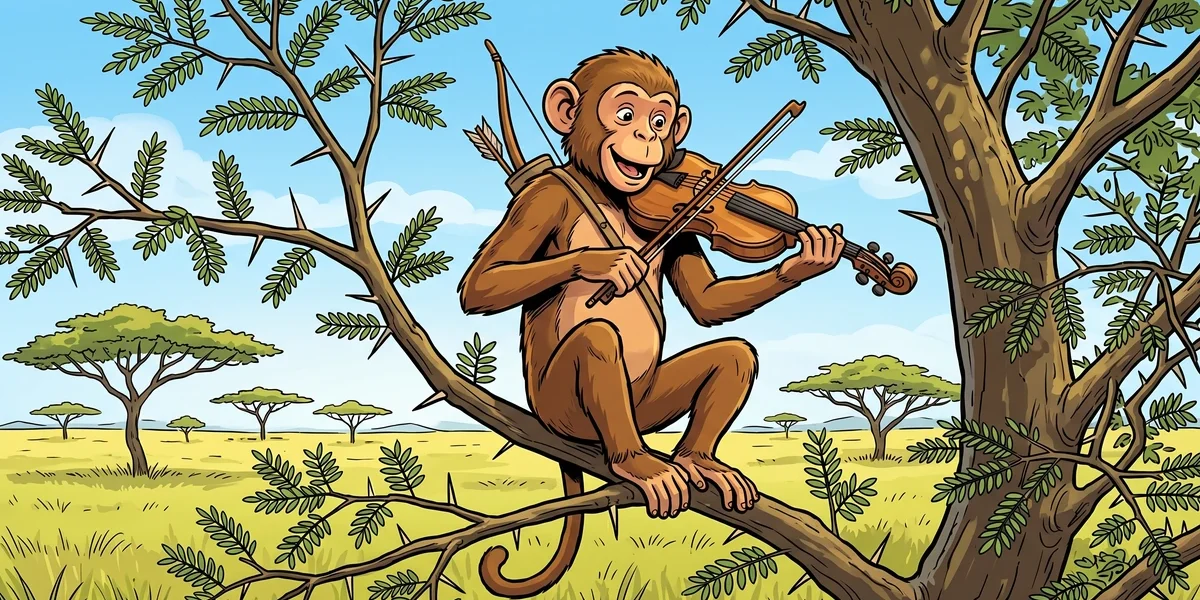
On the dry, bright veld of southern Africa, where bulbs and earth-beans must be dug from hard ground and a lean season can empty a whole countryside, the storytellers kept a small, mischievous fable about a hungry musician. It begins in want and ends in laughter, and between those two points it passes through a courtroom — a courtroom where the testimony is crooked, the judges are hungry, and the verdict is settled long before the evidence is heard. The Monkey’s Fiddle is a story about a poor creature who owns nothing the powerful want to respect, and who is saved, at the very foot of the gallows, by the one possession none of them thought to take seriously: his art.
The tale is sly about where it places our sympathy. Monkey is no spotless hero; he is simply small, and honest enough, and unlucky in his neighbours. Ranged against him are Wolf, who repays a shared meal with a lie, and Jackal, who turns the office of judge into a tool for his own theft, and a whole court of beasts content to hang a weak defendant rather than weigh a hard case. Against brute strength and crooked power Monkey has only a borrowed bow that never misses and a fiddle that no living thing can hear without dancing. The story’s quiet argument is that, in the right hands, the second of those gifts is the more dangerous — that a tune, played well, can overturn a verdict that an army could not.
Origins and Canonical Attribution
This fable belongs to the great body of southern African animal stories collected and printed in the nineteenth and early twentieth centuries. Its best-known form appears in South-African Folk-Tales, the slim anthology compiled by the American physician James A. Honey and published in New York in 1910. Honey was not a field collector; his book openly assembles and retells material from earlier and more scholarly hands — above all the work of Wilhelm Heinrich Immanuel Bleek, the German-born philologist whose Reynard the Fox in South Africa; or, Hottentot Fables and Tales (London, 1864) was the first published collection of indigenous southern African literature. “The Monkey’s Fiddle” carries the unmistakable furniture of that Cape tale-cycle: the cast of Wolf, Jackal and Lion, the animal court that settles disputes, and the dry comic timing of a storytelling tradition shaped by Khoikhoi narrators and Cape Dutch farmers alike.
Origin & Canonical Attribution
Tradition: Southern African oral narrative, Cape region — an animal-court fable of the Khoikhoi-influenced “Wolf, Jackal and Lion” cycle, here built around an imported magic-fiddle climax.
Primary printed source: James A. Honey, South-African Folk-Tales (New York: Baker & Taylor, 1910), “The Monkey’s Fiddle.”
Antecedent collection: W. H. I. Bleek, Reynard the Fox in South Africa; or, Hottentot Fables and Tales (London: Trübner & Co., 1864), the foundational anthology of Cape oral literature on which later compilers drew.
Tale type: The dancing climax belongs to international tale type ATU 592, “The Dance Among Thorns” — the magic instrument that compels involuntary dancing, best known from the Brothers Grimm’s “The Jew Among Thorns” (KHM 110). The Cape tale grafts that ATU 592 climax onto a local animal-tribunal frame.
Principal motifs: D1233, magic fiddle; D1415.2.5, magic musical instrument compels dancing; the unfailing magic bow and arrow (magic weapon, D1080–D1101); K2100, false accusation of theft; K551, respite from death granted for a last request; the trickster’s escape.
The double pedigree is worth pausing on, because it explains why the story feels at once so local and so familiar. The frame — a quarrel between animals carried before a court of beasts presided over by Lion — is purely of the Cape, the same machinery that drives dozens of Bleek’s Khoikhoi fables. But the ending is a traveller. The motif of the condemned musician who asks to play one last tune, and whose music forces judge and hangman and crowd to dance until they grant him anything he asks, is the spine of a tale told all across Europe and western Asia; folklorists catalogue it as ATU 592, and English readers know it best from the Grimms’ grim little story of the fiddler and the thorn-bush. Somewhere on the long road of oral transmission — through sailors, soldiers, missionaries and farm servants — that European dancing-fiddle climax reached the Cape, and a southern African storyteller fitted it, perfectly, onto the back of a home-grown animal-court tale. “The Monkey’s Fiddle” is, in miniature, a record of how folklore actually moves: not as a sealed inheritance but as a living thing, borrowed, re-clothed, and made new.
Hunger and the Borrowed Gift
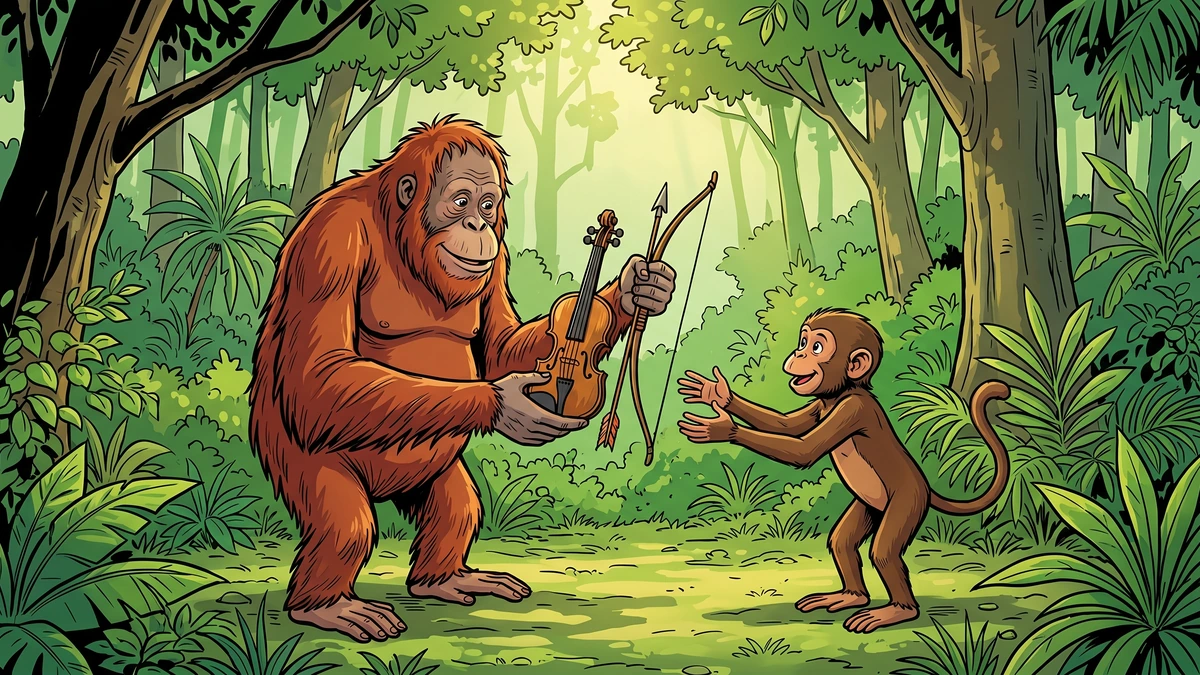
The story opens, as so many veld tales do, with an empty stomach. Hunger and want, the storyteller says plainly, forced Monkey one day to leave his own land and to seek work elsewhere among strangers. The bulbs and earth-beans, the scorpions and insects and small wild foods on which he had always lived, were completely exhausted in his own country; a hard season had scraped the land bare. So Monkey did what the poor of every age have done — he travelled to where the work was, and for a time he found shelter and employment with a great-uncle of his, an old Orang-Outang who lived in a distant part of the country.
Monkey worked, and worked well, for a long while. When at last he wished to return home, his great-uncle did not send him away empty-handed. As the wages of his labour the old Orang-Outang gave him two things, and explained the virtue of each. The first was a bow and arrow, and with it, the uncle promised, Monkey could strike and bring down anything he desired — it would never miss its mark. The second was a fiddle, and its power was stranger still: with it Monkey could force any living thing to dance. A weapon that always kills and an instrument that always compels: the tale lays its two gifts side by side at the very start, like two tools on a workbench, and the whole of what follows is a quiet argument about which of them is worth more.
It is worth noticing how honestly the gifts are come by. Monkey does not steal them, trick them out of anyone, or stumble on them by magic luck. He earns them, with months of plain work, and they are given freely by an elder of his own family. This matters, because the plot is about to turn on a false charge of theft, and the storyteller wants the listener to be in no doubt at all: whatever Wolf and Jackal will later say, the bow and the fiddle are Monkey’s honest property, the wages of his hunger and his patience. With his two gifts on his back, Monkey set out on the long road home.
The Ungrateful Wolf
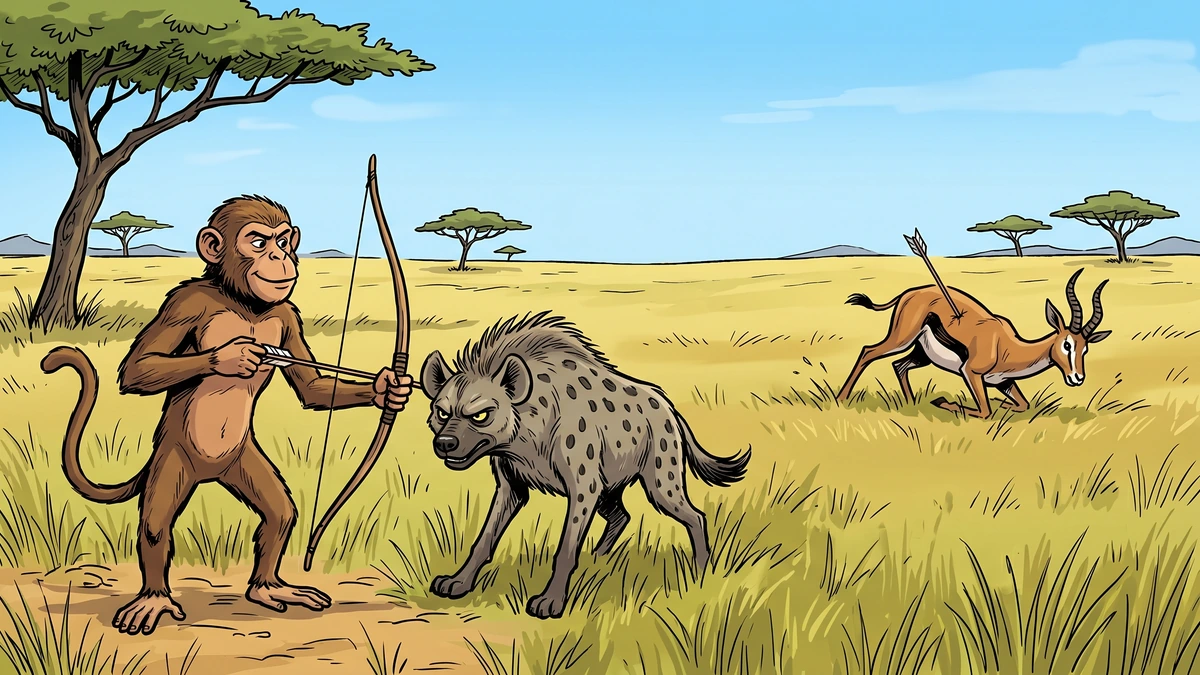
The first creature Monkey met on his return was Wolf — the brown, skulking “wolf” of the Cape stories, the hyena-like rascal who turns up in tale after tale as the strong, slow-witted bully of the veld. Wolf was full of news, and full of complaint: since early morning, he grumbled, he had been trying to stalk a deer, and all his creeping and crouching had come to nothing. Monkey, generous and perhaps a little proud of his new possessions, told Wolf all the wonders of the bow and arrow he carried, and promised that if Wolf would only point the deer out to him, he would bring it down on the spot. Wolf showed him the deer; Monkey was as good as his word; and down the animal fell at a single shot.
The two of them made a good meal together, and there the tale could have ended happily. It does not, because Wolf’s full stomach did not make him grateful — it made him greedy. Watching that effortless, unfailing shot, jealousy overmastered him, and he began to beg Monkey for the bow and arrow. Monkey, reasonably enough, refused to give away the hard-earned wages of his labour. And so Wolf reached for the argument of every bully in every story ever told: he began to threaten, reminding Monkey of his own far greater strength, leaning the whole weight of his body on a claim his case could not support.
This is the tale’s first hard truth, and it is delivered without a raised voice. Strength, left to itself, does not feel the smallest obligation to be fair. Wolf has been fed by Monkey’s gift; he has taken the meal and felt the kindness; and none of it weighs an ounce against his appetite for the bow. When mere threats did not move Monkey, Wolf simply changed the story. A passing traveller gave him his chance: when Jackal came trotting by, Wolf turned to him at once and announced — flatly, shamelessly — that Monkey had stolen his bow and arrow. The lie was now loose in the world, and lies, once loose, travel fast.
The Court of Beasts
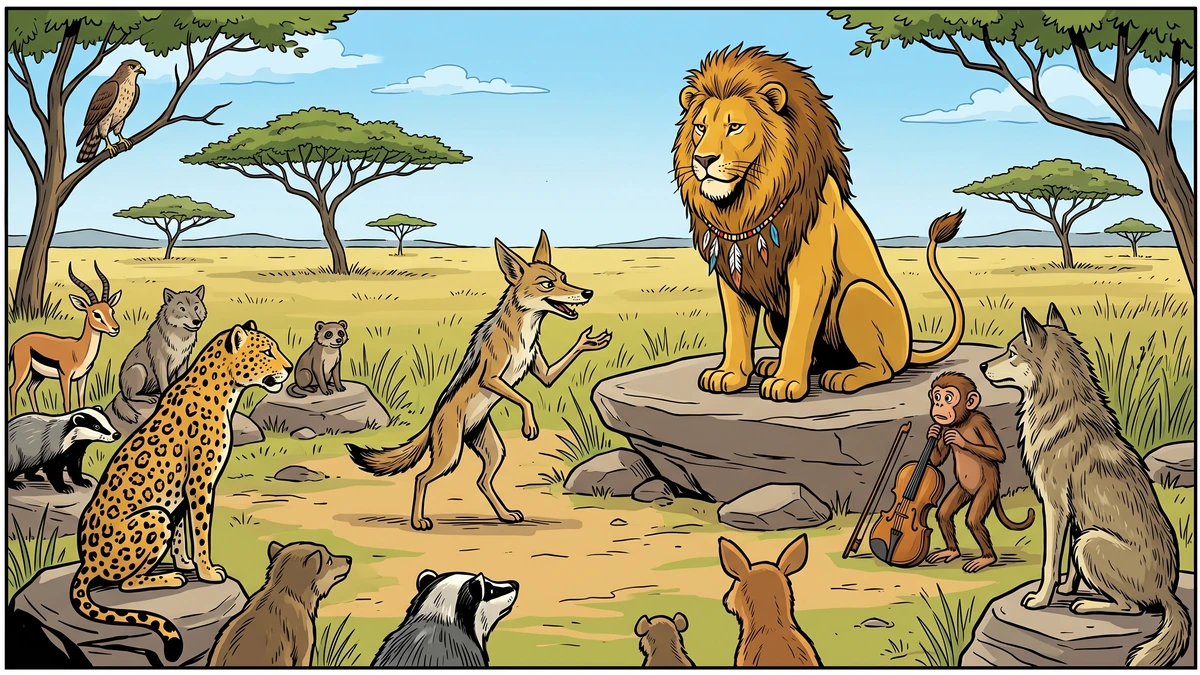
Jackal — lean, clever, and in these Cape tales never once to be trusted — listened to both animals and then made a great show of fairness. He could not, he declared, settle so weighty a case by himself; it must go before the proper court of Lion, Tiger and the other animals. In the meantime, purely for safekeeping, he would take charge of the disputed bow and arrow, so that the cause of the quarrel could not be lost or misused while the law took its course. It was a speech of perfect, oily reasonableness, and it was a robbery. The moment the weapon was in his paws, Jackal began to bring down everything eatable in sight, and the storyteller notes drily that there was a long and comfortable season of slaughter before either Monkey or Wolf could get the affair into court at all.
When the court at last convened, it was less a tribunal than a trap. Monkey’s evidence, the tale admits, was weak — he was poor, he was small, he had no witness but himself. And it was made fatally worse by Jackal, who testified squarely against him. Jackal’s motive is laid bare with cold precision: he reasoned that if Monkey were convicted, it would be far easier afterwards to coax or bully the bow and arrow away from Wolf and keep the prize himself. The judge of the case was its true thief. And so the sentence fell. Theft, the court intoned, was a very great wrong — and for that great wrong Monkey must hang.
It is a savage little portrait of how power can dress itself as justice. Every form is observed: there is a court, there are judges, there is testimony, there is a solemn principle gravely recited about the wickedness of theft. And the whole apparatus is rotten, because the witness is corrupt, the judges are indifferent, and the one creature in the clearing who has actually stolen anything is the one running the trial. The tale offers no appeal, no higher court, no rescuing technicality. Monkey is condemned, the rope is ready, and the law of the strong has had its way — or so it seems. For Monkey still had one possession the court had never thought to confiscate. The fiddle was still at his side.
The Charmed Tune of “Cockcrow”
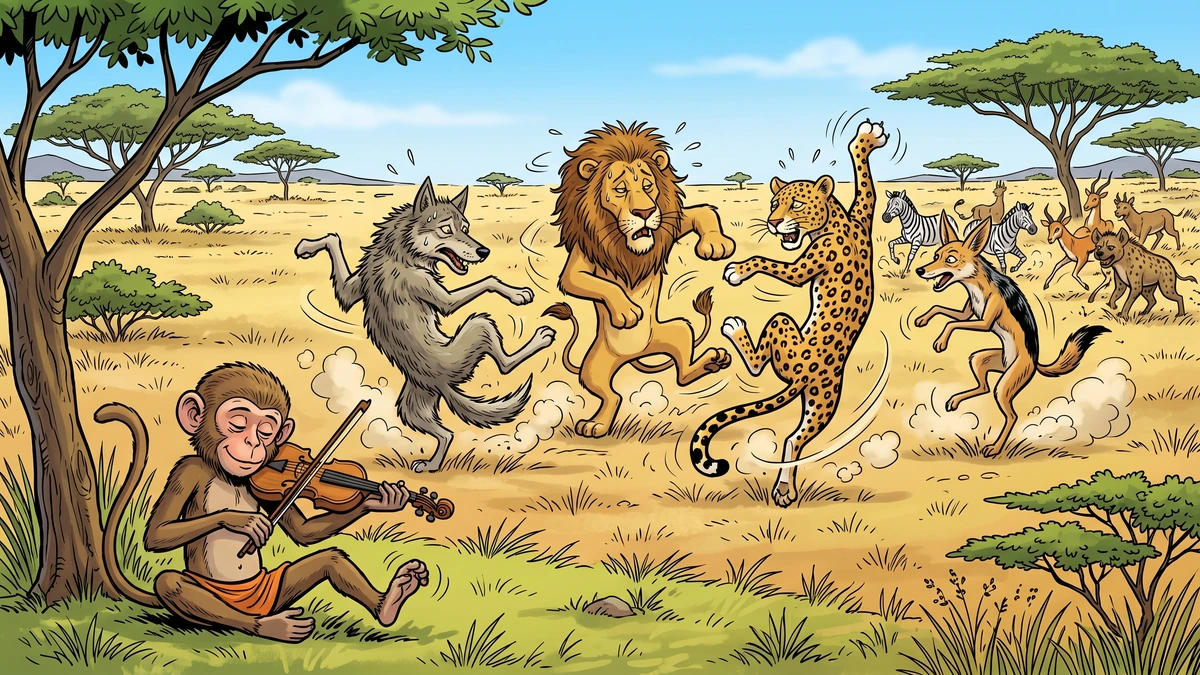
As a last favour before the sentence was carried out, the court granted Monkey the right to play one tune upon his fiddle. It seemed a harmless mercy — a small kindness to a doomed creature, the sort of gesture that costs a court nothing. It cost them everything. For Monkey was a master player of his time, and to his own skill was joined the wonderful power of the charmed instrument. He set his head lovingly against the fiddle, half closed his eyes, and struck the first note of an old tune called “Cockcrow.”
At once the courtroom changed. Before Monkey had even reached the first waltzing turn of the tune, an unusual and spontaneous liveliness had taken hold of the whole assembly; and a moment later judge, witness, hangman and crowd were dancing like a whirlwind. Over and over, quicker and quicker, the resistless waltz of “Cockcrow” sounded across the clearing. Some of the dancers, worn out, dropped where they stood — and still their exhausted feet kept moving. And Monkey, lost in his music, his head against the wood and his foot keeping perfect time, seemed to hear and see nothing of the chaos he had unleashed.
Now the bargaining began, and the tale relishes every reversal of it. Wolf was the first to break, gasping out between leaps, “Please stop, Cousin Monkey! For love’s sake, please stop!” Monkey did not so much as hear him. Then Lion himself, the king, began to tire; after one more breathless circuit with his young lion wife he growled, as he passed the player, that his whole kingdom was Monkey’s if only he would stop. And here Monkey at last spoke — not to accept a crown, but to name his real price. He did not want the kingdom, he said. He wanted the sentence withdrawn; he wanted his bow and arrow returned; and he wanted Wolf, aloud and before them all, to confess that he had stolen them. “I acknowledge, I acknowledge!” Wolf cried, in the same instant that Lion shouted that the sentence was lifted.
So the truth was not discovered by the court; it was danced out of it. The verdict that solemn testimony could not shake, a tune shook loose in a matter of minutes. Monkey gave the company a few last turns of “Cockcrow” for good measure, gathered up his bow and arrow, and climbed high into the nearest camel-thorn tree — and the court and all the other animals, terrified that he might begin again, scattered in such haste that they spread themselves to entirely new parts of the world. The weak, hungry defendant walks away with his property, his life and his good name; the powerful flee. It is the oldest and most satisfying shape a story can take.
The Meaning of the Tale
On its surface, “The Monkey’s Fiddle” is a pure trickster triumph — the small clever creature outwitting the large stupid one — and as such it belongs to a family of stories told on every continent. But the Cape version sharpens that familiar shape into something more pointed. Monkey does not win by cunning schemes or disguises; he wins because he possesses a genuine skill, patiently mastered, and because the powerful, in their contempt, did not think that skill worth taking away. The court confiscated the weapon — the obvious instrument of power — and left the fiddle, the instrument of art, hanging at the prisoner’s side as a thing of no account. Their whole defeat is folded into that single careless decision. The tale argues, gently and with a grin, that what the strong dismiss as harmless is very often the most powerful thing in the room.
There is a second strand, darker and just as clear, running through the courtroom scenes: this is a story about justice corrupted, and about how. The wrong done to Monkey is not done by a monster. It is done by a procedure — by a court that keeps every outward form of fairness while the witness lies and the judge steals and the verdict is settled by the relative size of the parties. Folk audiences across southern Africa, who knew well enough what it was to stand small before a powerful tribunal, would have heard that scene with a particular attention. And they would have heard, too, the comeuppance the tale grants: that the lie of the strong, however confidently sworn, does not get the last word. The Cape farmers who traded these animal stories had a blunt proverb for exactly that hope, and it stands as the truest moral the fiddle plays:
“Al is die leuen nog so snel, die waarheid agterhaal hom wel.”
— Afrikaans proverb: “However swift the lie may be, the truth will overtake it in the end.”
Wolf’s lie is swift; it convinces Jackal, it carries the court, it brings Monkey to the very foot of the gallows. But it is overtaken — not by clever argument, but by a tune that strips every dancer of dignity and self-control until the truth simply falls out of Wolf’s own mouth. There is a deep folk wisdom in making the confession involuntary. The tale does not pretend that Wolf repents, or that Lion’s court grows wise. It claims something humbler and more durable: that truth has a way of surfacing, that crooked verdicts are less permanent than they look, and that a gift honestly earned and patiently practised can, on the right day, outweigh all the brute strength and borrowed authority arranged against it.
Why This Story Has Endured
“The Monkey’s Fiddle” has lasted because it works on two levels at once, and never lets the second spoil the first. For a child, it is simply a wonderful, funny story: a magic bow, a magic fiddle, a wicked wolf, a whole solemn court of animals reduced to a helpless, exhausted, undignified jig. The image of the lion king pleading for mercy in the middle of a waltz is the kind of picture a young listener carries for life. The tale moves quickly, its justice is clean, and its ending — the powerful scattering in fright to the far corners of the earth — has the bright, decisive snap that the best children’s stories share.
For an older listener, the same story opens into something graver. It is a clear-eyed little parable about how injustice actually operates — not as open villainy but as captured procedure, the forms of law turned into a tool for the powerful — and about the resources the weak still have when the procedure has been captured. Its central reversal, the borrowed dancing-fiddle climax, ties this small Cape fable to a vast international family of tales stretching across Europe and Asia, and so the story doubles as a quiet lesson in how folklore itself travels, borrows and adapts. A listener who meets the Grimms’ thorn-bush fiddler years later feels a flicker of recognition: the same enchanted tune, in a different forest, among different trees.
Most of all it endures because its promise is one people never tire of hearing. We do not all command armies or courts. But the tale insists that the things the powerful overlook — a craft, an art, a patiently earned skill, the small honest possessions of the poor — are not nothing; that they can, in the decisive moment, turn the whole board over. That is why the story is still told to children on this site and elsewhere: it sends them away laughing, and it leaves behind, almost without their noticing, the steadying belief that a lie does not get the last word, and that what you have truly learned to do well can save you when nothing else will.
Frequently Asked Questions
What is the moral of “The Monkey’s Fiddle”?
The fable carries two linked lessons. The first is that the things the powerful dismiss as worthless can be the most powerful of all: the court confiscates Monkey’s weapon but leaves him his fiddle, thinking music harmless, and that single act of contempt undoes them. The second is that a lie, however confidently sworn, does not get the last word. Wolf’s false charge of theft carries Monkey all the way to the gallows, yet the charmed tune forces Wolf to confess the truth aloud. The story teaches that an honestly earned skill, patiently practised, can outweigh brute strength and corrupt authority, and that justice denied by a crooked court can still be reclaimed.
How does Monkey escape being hanged?
Condemned to hang for a theft he never committed, Monkey is granted one last favour: the right to play a single tune on his fiddle. The instrument is charmed — anything that hears it must dance — and Monkey is a master player. He strikes up an old tune called “Cockcrow,” and within moments the entire court, judges and witness and crowd alike, is dancing helplessly like a whirlwind. He plays on, deaf to their pleading, until Lion withdraws the death sentence and Wolf publicly confesses that he stole the bow and arrow. Monkey then collects his property, climbs a camel-thorn tree to safety, and the terrified animals scatter.
Where does this folk tale come from?
It is a southern African animal fable from the Cape region, printed in James A. Honey’s “South-African Folk-Tales” (New York, 1910). Honey’s anthology retold material from earlier Cape collectors, above all the philologist W. H. I. Bleek, whose “Reynard the Fox in South Africa; or, Hottentot Fables and Tales” (London, 1864) was the first published collection of indigenous southern African literature. The tale’s cast of Wolf, Jackal and Lion and its animal court are typical of that Khoikhoi-influenced Cape cycle, while its dancing-fiddle climax is an imported motif found across European and Asian folklore.
Why is the magic fiddle more important than the magic bow?
Monkey is given two gifts that the story deliberately sets side by side: a bow and arrow that never miss, and a fiddle that forces any living thing to dance. The bow is the obvious instrument of power, and it is exactly what everyone covets and fights over — Wolf demands it, Jackal steals it under cover of “safekeeping,” and the court confiscates it. The fiddle is dismissed as a mere toy and left in the prisoner’s hands. Yet it is the fiddle, not the bow, that saves Monkey’s life and overturns the verdict. The tale’s quiet point is that art and skill, which the powerful underestimate, can prove mightier than any weapon.
What is tale type ATU 592, and how is it connected to this story?
ATU 592, “The Dance Among Thorns,” is an international folktale type catalogued in the Aarne–Thompson–Uther index. Its core is a magic instrument whose music compels everyone within earshot to dance until they grant the player whatever he demands; English readers know it best from the Brothers Grimm’s “The Jew Among Thorns” (KHM 110), in which a condemned man fiddles his accusers into a frenzy and wins a reprieve. “The Monkey’s Fiddle” takes that same dancing-fiddle climax — the condemned musician, the last tune, the helpless court, the bargain struck mid-dance — and grafts it onto a home-grown Cape animal-court tale, a clear example of how folk motifs migrate between cultures and are re-clothed in local dress.
You May Also Like
 African Folk Tales
Ages 6-8
African Folk Tales
Ages 6-8
Why the Sun and Moon Live in the Sky
An Efik pourquoi tale from southern Nigeria: the Sun and his wife the Moon welcome their friend the Water too well, are flooded out of the great house they built, and are driven up to live in the sky forever.
 African Folk Tales
Ages 9-12
African Folk Tales
Ages 9-12
Why The Moon And The Stars Receive Their Light From The Sun
Why The Moon And The Stars Receive Their Light From The Sun: Once upon a time there was great scarcity of food in the land. Father Anansi and his son, Kweku
 African Folk Tales
Ages 6-8
African Folk Tales
Ages 6-8
The Grinding-Stone That Ground Flour By Itself
A poor brother borrows a magic mill — and that is why, to this very day, the sea tastes of salt.