The Hare and the Hyena
An East African Swahili trickster tale: during a famine the clever hare Sungura outwits the greedy hyena Fisi, eating their shared honey-store under cover of invented naming-feasts. Tale type ATU 15.
Origin & Canonical Attribution
A trickster tale of the East African (Swahili) coast, drawn from the great oral cycle of Sungura na Fisi — the Hare and the Hyena. Its principal printed source is Edward Steere, Swahili Tales, as Told by Natives of Zanzibar (London: Bell & Daldy, 1870), whose collection records the hare and the hyena as a fixed comic pair of the Zanzibar storytelling tradition. The hare-trickster cycle is surveyed by Alice Werner in Myths and Legends of the Bantu (London: George G. Harrap & Co., 1933), ch. XVII, “Brer Rabbit in Africa,” which traces the clever hare across Central, Eastern and Southern Africa. The central episode retold here — the trickster who is repeatedly “called away to a naming-feast” and so eats the common store unobserved — is the international tale type ATU 15, “The Theft of Food by Playing Godfather.” Thompson motifs: K372 (“Playing godfather”: the trickster eats the stores), J1117 (animal as trickster), K341 (owner’s attention distracted while goods are stolen). Swahili / Bantu oral tradition; no single author.
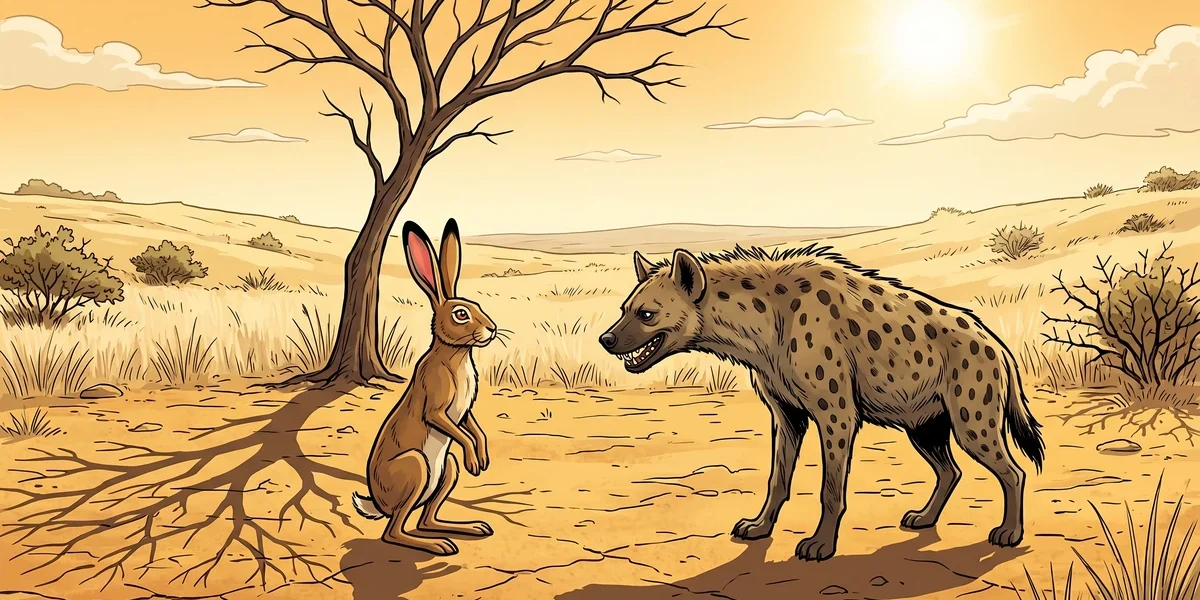
In the old days, before the lorries and the tarmac roads, the coast country of East Africa knew years so dry that the grass turned the colour of an old lion’s hide and the rivers shrank to threads of mud. The Swahili storytellers of Zanzibar and the Mrima shore have always said that hard years are the season of Sungura — the Hare — for a hard year asks not who is strongest but who is cleverest. And in every telling, walking a pace behind the Hare with his sloping back and his hungry laugh, comes Fisi, the Hyena: big, greedy, and forever certain that this time he will not be fooled.
This is one of the oldest stories of that pair. It was written down by the missionary-scholar Edward Steere in 1870, almost word for word as the people of Zanzibar told it to him, and storytellers along the coast have been telling it by firelight for very much longer than that.
The Famine and the Pact
There came a famine such as the old people had not seen. The maize stood stunted in the gardens; the wells gave up only a brown trickle; even the baobab, which stores water in its swollen trunk, seemed to grow thin. Animals that had never spoken to one another now met on the cracked riverbeds and asked, “Have you eaten? Where did you eat?”
So it was that the Hare and the Hyena met under a leafless acacia, and each saw at once how lean the other had grown. The Hyena’s ribs showed like the rafters of a hut; the Hare’s bright eyes had sunk into his head.
“Friend Fisi,” said the Hare, “a famine is no time to walk alone. Two who search together find twice as much, and what one finds, the two shall share. Shall we make a pact?”
The Hyena, who could think of nothing but his belly, agreed before the Hare had finished speaking. “A pact, a pact! We share everything, equally and honestly,” he said, and he laughed his hungry laugh, already tasting the food they had not yet found. The Hare looked at that laugh for a long moment, and said only, “Equally. Yes.”
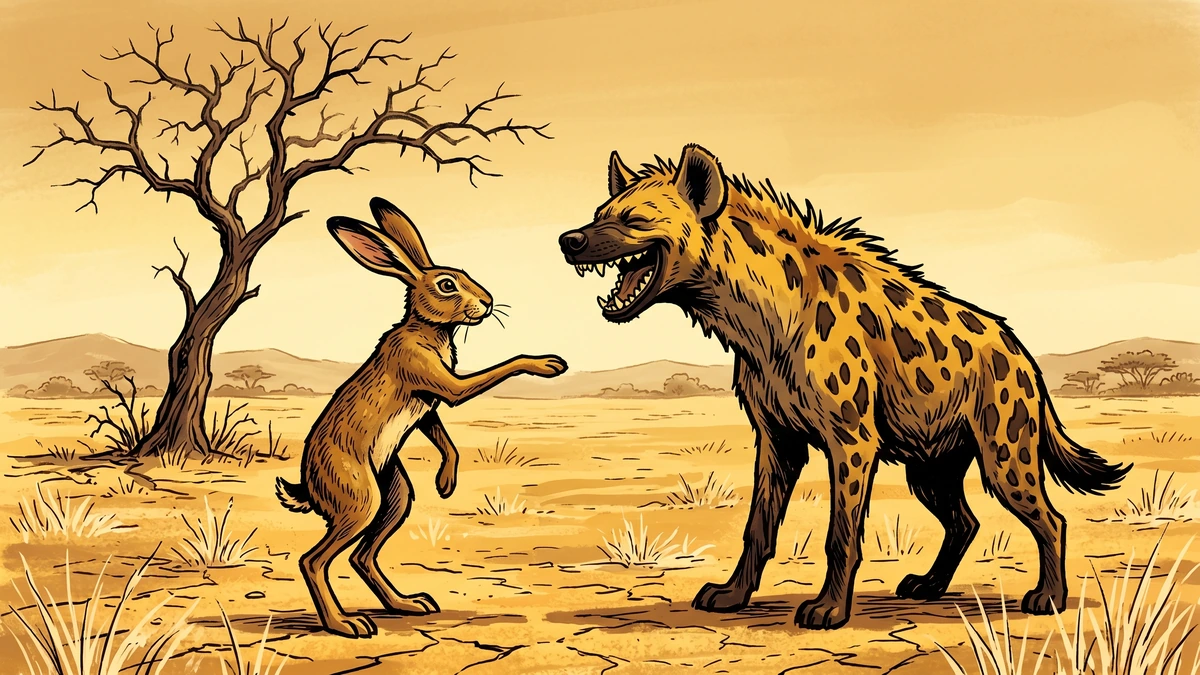
They travelled together for three days through the dust. The Hyena complained at every step — of his feet, of the sun, of the emptiness inside him — while the Hare said little and watched everything. And it was the Hare, of course, who first caught the scent on the wind: the rich, sweet, unmistakable scent of stored food.
The Hidden Store
The scent led them to a hollow baobab at the edge of an abandoned garden. Inside, where some careful farmer had hidden it against exactly such a year, stood a great clay pot — sealed, cool, and full to the brim with ground simsim and honey, a paste so rich that a handful would keep a creature alive for a week.
The Hyena’s eyes rolled. He lunged for the pot, but the Hare stepped neatly in front of him.
“Patience, friend,” said the Hare. “If we gulp it all today we are fools, and tomorrow we starve again. Here is wisdom: we shall guard this pot together and eat from it a little each day, until the rains return. We will not touch it otherwise. Agreed?”
It was sensible, and even the Hyena could see it was sensible, so he agreed — though it cost him something close to pain to step back from that pot. They sealed the baobab with a flat stone and lay down in its shade to rest.
But the Hare had no intention of waiting. That very evening, as the Hyena dozed, the Hare sat up, pricked his long ears, and cried out as though he had been called from far away.
“Do you hear that, Fisi? Someone is calling me. It is a neighbour of mine — a child has been born and they want me to stand as godfather and give the baby its name. I must go. I will not be long.”
The Hyena, half asleep, only grunted. The Hare slipped behind the baobab, rolled the stone aside, and ate from the pot — not greedily, but enough. Then he sealed it again and came back yawning, brushing his paws.
“A fine ceremony,” he said, settling down. “They asked me to name the child. I named it Just-Begun.”
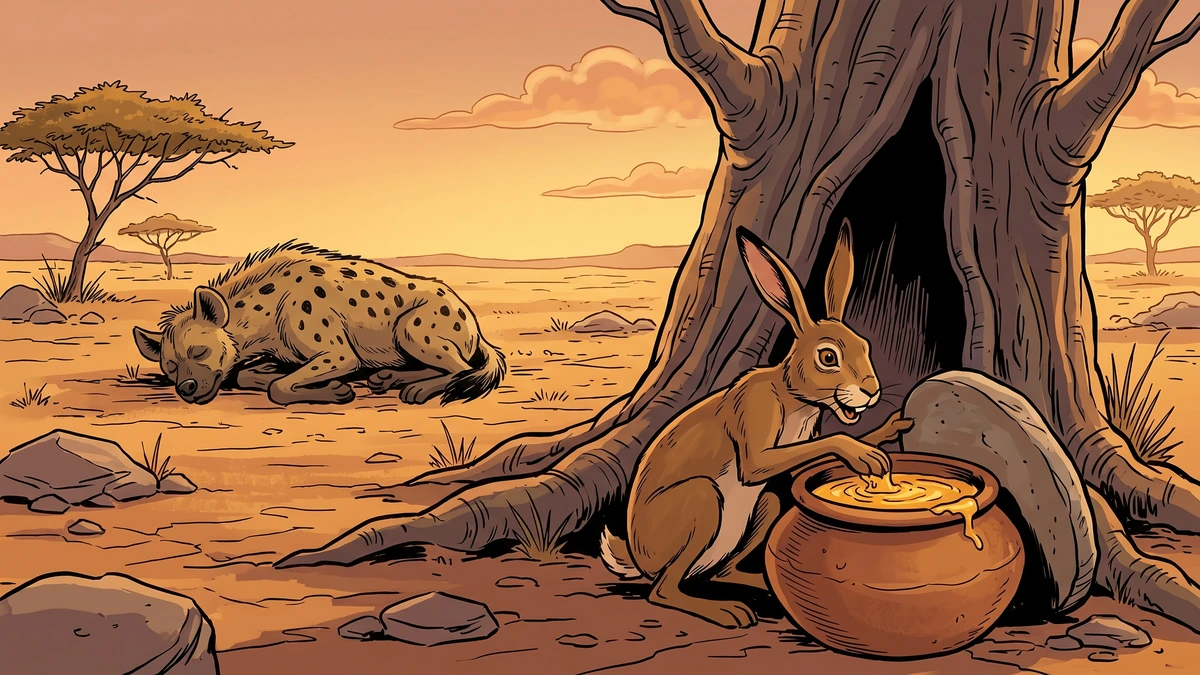
The next night the Hare was called away again — another naming-feast, he said — and this time he named the child Half-Done. And on the third night he went a third time, and came back rubbing his stomach, and told the drowsy Hyena that the newest child had been given the name All-Gone. The Hyena, who never thought to wonder why one small hare had so many friends with so many babies, slept on.
The Empty Pot
On the fourth morning the famine bit so hard that even the Hyena’s patience snapped. “Today,” he announced, “we eat our proper share. Roll back the stone.”
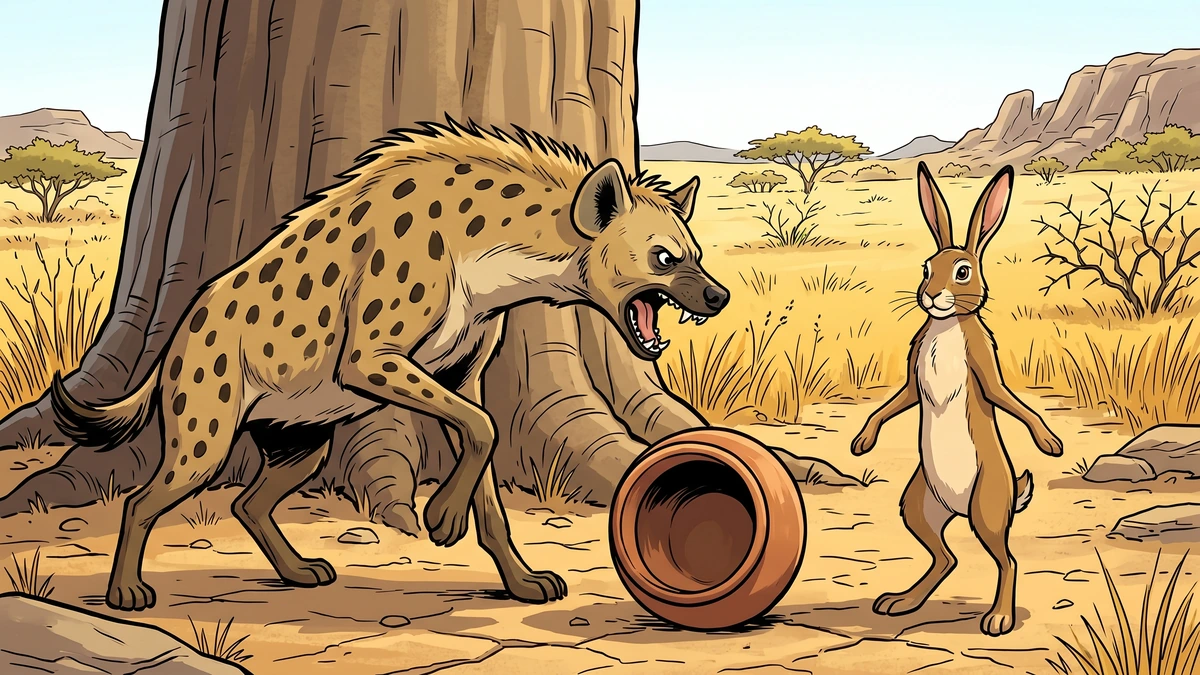
They rolled it back. The great clay pot stood exactly where they had left it — and it was empty, scraped clean, with only the sweet smell left clinging to the clay like a memory.
The Hyena howled. He rounded on the Hare, his teeth bared. “Thief! You have eaten it all! Those were no naming-feasts — you crept behind the tree and robbed me!”
The Hare drew himself up with the wounded dignity of a perfectly innocent creature. “I, Fisi? I went to honour my neighbours’ children. You were here the whole time; you could have followed me. Besides — how do I know it was not you who ate it, dreaming and chewing in your greedy sleep? A thief always shouts loudest. But come — let us not quarrel like children. Let us find the truth honestly.”
“And how,” growled the Hyena, “do we do that?”
“Simply,” said the Hare. “Honey and simsim are rich food. Whoever ate the pot has the fat of it in his body still, and the sun will sweat it out of him. Let us both lie out on that flat rock in the noonday heat. The innocent one will stay dry. The guilty one will sweat grease — and then we shall know.”
The Sun’s Judgement
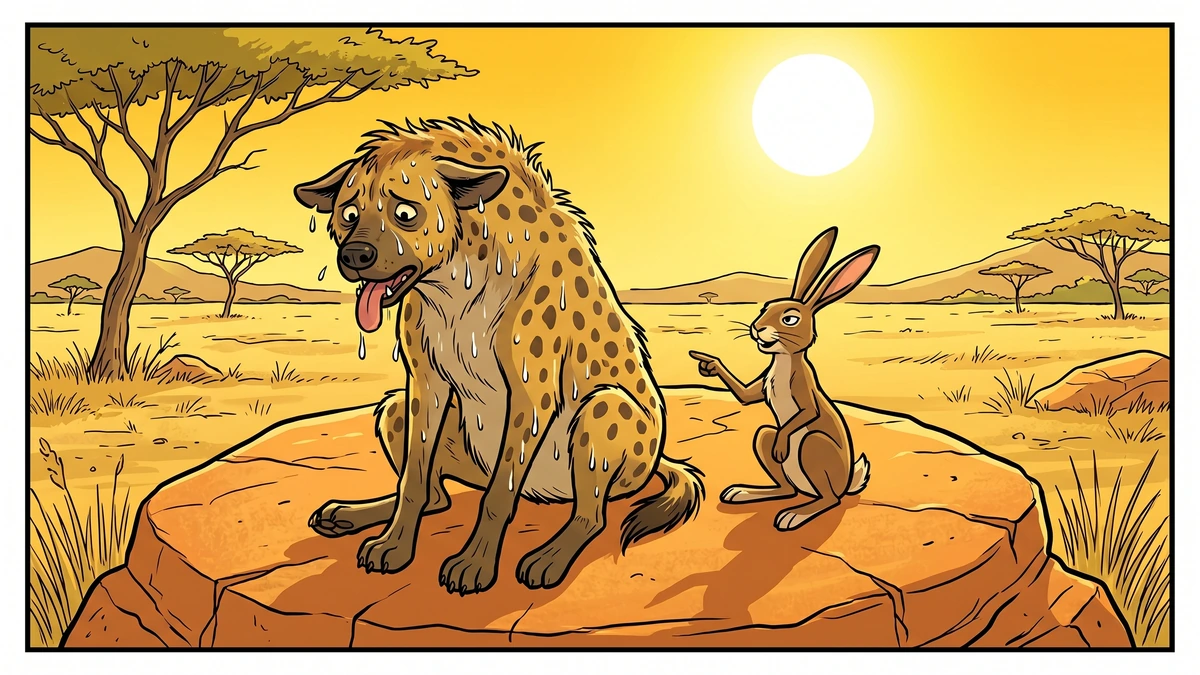
So the two of them climbed onto the broad flat rock and lay down side by side in the full blaze of the noon sun. And here the Hare’s cleverness showed its true edge — for he had eaten only a little each night, slowly, and his small dry body carried scarcely any fat at all. The Hyena, large and heavy and forever hungry, was a different creature entirely. Within the hour the sweat ran off the Hyena in streams, and because every hungry beast of the bush carries the smell of old fat in its coat, that sweat shone and smelled of grease.
The Hare sat up, cool and dry as a leaf, and pointed a solemn paw.
“Look, Fisi. Look at yourself. The grease runs out of you while I stay dry as the dust. The sun has spoken, and the sun does not lie. You ate the pot in your sleep, and your own body has confessed it.”
The Hyena stared down at his own dripping, shining coat. He could not understand it — he was sure, he was almost sure, that he had not eaten the honey — and yet here was the proof, sweating out of his own skin, and the small dry Hare beside him with nothing to hide. Slow of thought and quick to doubt himself, the Hyena hung his head. “Then… then it was me,” he muttered. “Forgive me, friend Hare. I did not know my own greed.”
And the Hare forgave him very graciously indeed.
The storytellers of the coast end the tale with a smile. It is said that this is why, to this very day, the Hyena slinks along with his back sloping low and his head down, as though he carries a shame he cannot name; and why he laughs that strange, broken, guilty laugh in the dark; and why he scavenges alone, trusting nobody — for once, long ago in a famine year, his own body told a lie against him, and he has never again been quite sure of anything. As for the Hare, he walked out the famine on his wits, and was waiting, sleek and bright-eyed, when the first rain clouds at last came rolling in from the sea.
The Moral of the Story
To the listening children, the elders of the coast point two lessons out of this single tale, and they are not quite the same lesson. The first belongs to the Hyena: that greed makes a creature easy to fool. The Hyena was beaten not really by the Hare but by his own appetite — it was his hunger that made him agree to anything, his laziness that kept him from following, and his readiness to think the worst of his own belly that made him believe a lie told by the sun. A mind ruled by the stomach can be led anywhere.
The second lesson belongs to the Hare, and the Swahili put it in three words that any child on the coast can recite:
“Akili ni mali.”
— Swahili proverb: Wits are wealth. In a year when strength and size could not fill a single belly, it was the small creature’s cleverness that proved to be the only true riches.
The tale does not pretend the Hare is good — he lies, and he eats more than his share, and a careful listener notices it. That is the honest old morality of the trickster story: it does not ask the weak to be saints. It asks them to be awake. In a world where the strong take what they want, the tale tells the small and the powerless that the mind is a weapon no famine and no bully can take away from them.
Why This Tale Has Lasted
The Hare and the Hyena belong to one of the largest and oldest story-cycles on the African continent. From the Swahili coast where this version was collected, the clever hare runs west across the savannah and the forest, changing his name but never his nature, until — carried across the Atlantic in the memory of enslaved Africans — he surfaces in the Americas as Brer Rabbit. Alice Werner recognised this kinship a century ago when she titled her chapter on the African hare “Brer Rabbit in Africa.” The trickster who is small, weak, and clever is one of humanity’s most enduring inventions, and East Africa gave the world one of its finest examples in Sungura.
The story has lasted, too, because it is built for performance. The three naming-feasts — Just-Begun, Half-Done, All-Gone — are a child’s puzzle hidden inside the plot: young listeners work out the trick a beat before the Hyena does, and the delight of knowing more than the fool on the rock is the whole pleasure of the tale. A good Zanzibar storyteller draws the three departures out, lets the children call the names back, and turns the famine year into a game.
And it has lasted because it is true to something. Anyone who has been small in a world of large and hungry powers understands the Hare at once. The tale was first written down in 1870, but the famine it describes — and the choice it offers, between the strength that fails and the wit that endures — is older than any book, and has not gone out of date.
Frequently Asked Questions
Where does the folk tale “The Hare and the Hyena” come from?
It is a trickster tale of the East African (Swahili) coast, part of the great oral cycle of Sungura na Fisi — the Hare and the Hyena. Its principal printed source is Edward Steere's Swahili Tales, as Told by Natives of Zanzibar (London: Bell & Daldy, 1870), a collection recorded almost word-for-word from Zanzibar storytellers. The hare-trickster cycle is surveyed more broadly in Alice Werner's Myths and Legends of the Bantu (1933). The tale belongs to Swahili and wider Bantu oral tradition and has no single author.
Who are Sungura and Fisi in East African folklore?
Sungura is the Swahili word for the Hare, the central trickster of East African animal tales — small, weak in body but unmatched in cleverness. Fisi is the Hyena, the cycle's recurring dupe: large, greedy and slow-witted, forever certain he will not be fooled and forever fooled again. The two form a fixed comic pair, and their stories celebrate wit as the weapon of the powerless against the strong.
What tale type is “The Hare and the Hyena”?
The central episode — the trickster repeatedly claiming to be called away to a naming-feast so that he can secretly eat the shared store — is the international tale type ATU 15, “The Theft of Food by Playing Godfather.” The same type appears across Europe as the fox-and-bear story, with the trickster naming the stolen helpings “Just-Begun,” “Half-Done” and “All-Gone.” Relevant Thompson motifs include K372 (playing godfather to eat the stores), J1117 (animal as trickster) and K341 (the owner's attention distracted while goods are taken).
What is the moral of “The Hare and the Hyena”?
The tale carries two lessons. The Hyena's downfall warns that greed makes a creature easy to fool — a mind ruled by the stomach can be led anywhere. The Hare's survival teaches the opposite: that intelligence is the truest wealth. Swahili storytellers sum it up in the proverb “Akili ni mali” — wits are wealth. In a famine year, when strength and size could not fill a single belly, it was cleverness that endured.
How is the East African hare connected to Brer Rabbit?
The clever hare of East Africa is one expression of a story-cycle that spans the whole continent. The same trickster runs west across savannah and forest, and — carried across the Atlantic in the memory of enslaved Africans — resurfaces in the Americas as Brer Rabbit. The folklorist Alice Werner recognised this kinship a century ago when she titled her chapter on the African hare “Brer Rabbit in Africa.”
You May Also Like
 African Folk Tales
Ages 9-12
African Folk Tales
Ages 9-12
The World’s Reward
The World's Reward is the Cape South African form of the Bremen Town Musicians: seven cast-off old animals join forces, frighten a band of robbers out of their house, and keep it for themselves.
 African Folk Tales
Ages 6-8
African Folk Tales
Ages 6-8
Anansi The Blind Fisherman
Anansi the Blind Fisherman: A Tale of Cleverness and Justice In a village near a great river in Africa, there lived a spider named Anansi. Unlike...
 African Folk Tales
Ages 9-12
African Folk Tales
Ages 9-12
The Girl and the River Spirit
The Girl and the River Spirit — a Yoruba folk tale of Nigeria in which the devoted girl Adeola crosses a dangerous river and is tested by the river goddess Osun through three trials of kindness, honesty and love.