Anansi The Blind Fisherman
Anansi the Blind Fisherman: A Tale of Cleverness and Justice In a village near a great river in Africa, there lived a spider named Anansi. Unlike...
Anansi the Blind Fisherman: The Akan Tale of Pride That Would Not Be Helped
Most stories of Anansi the spider end with the trickster slipping free, his belly full and his rivals fuming. Anansi the Blind Fisherman is the rare West African tale that ends the other way. Here Kwaku Ananse is not the nimble schemer of the marketplace but an old man whose sight has failed him, and whose cleverness has curdled into something far more dangerous: a pride so brittle it cannot bear to be helped. It is a short, stark story from the Gold Coast — the kind of tale told in the evening to a child who has just snapped at an elder — and its ending is one of the bleakest in the whole Anansi cycle.
The tale belongs to the body of anansesem, the “spider stories” of the Akan-speaking peoples of what is now Ghana. Within that tradition Anansi is endlessly adaptable: he is by turns hero, fool, glutton, culture-bringer and warning. This story uses him as a mirror. Strip away the eight legs and the spinning, and what remains is a portrait of every person who has ever rejected a steadying hand because admitting the need for it felt worse than the danger of going without.
Origin, Source and Canonical Attribution
“Anansi the Blind Fisherman” was set down in print in West African Folk-Tales, a collection gathered by William H. Barker — Vice-Principal of the Government Training College at Accra — together with Cecilia Sinclair, and published by George G. Harrap & Co. of London in 1917. Barker and Sinclair drew their material directly from the living oral repertoire of the Gold Coast, transcribing tales that had been told aloud for generations before any of them reached a page. The volume opens with the famous account of how spider tales came to be named after Anansi at all, and “Anansi the Blind Fisherman” sits among the early Anansi chapters, between “Why Spiders are Found in Corners” and “Adzanumee and her Mother.”
Anansi himself — properly Kwaku Ananse, “Anansi who was born on a Wednesday” — is the great trickster of Akan folklore, a figure carried across the Atlantic by the transatlantic slave trade and re-rooted throughout the Caribbean and the wider African diaspora, where he survives as Anansi, Anancy, Aunt Nancy and Ananse. In the Akan worldview the spider tales are not merely entertainment: they encode social teaching, and a tale in which Anansi loses carries a moral the audience is meant to feel in the gut. Folklorists place this story within the international motif cluster of ingratitude punished (Stith Thompson motifs W154, “ingratitude,” and Q281, “ingratitude punished”) crossed with the motif of vanity and pride brought low (W116) — the same moral machinery that drives cautionary tales the world over, here compressed into a single grim afternoon on the water.
The Old Spider Who Could No Longer See
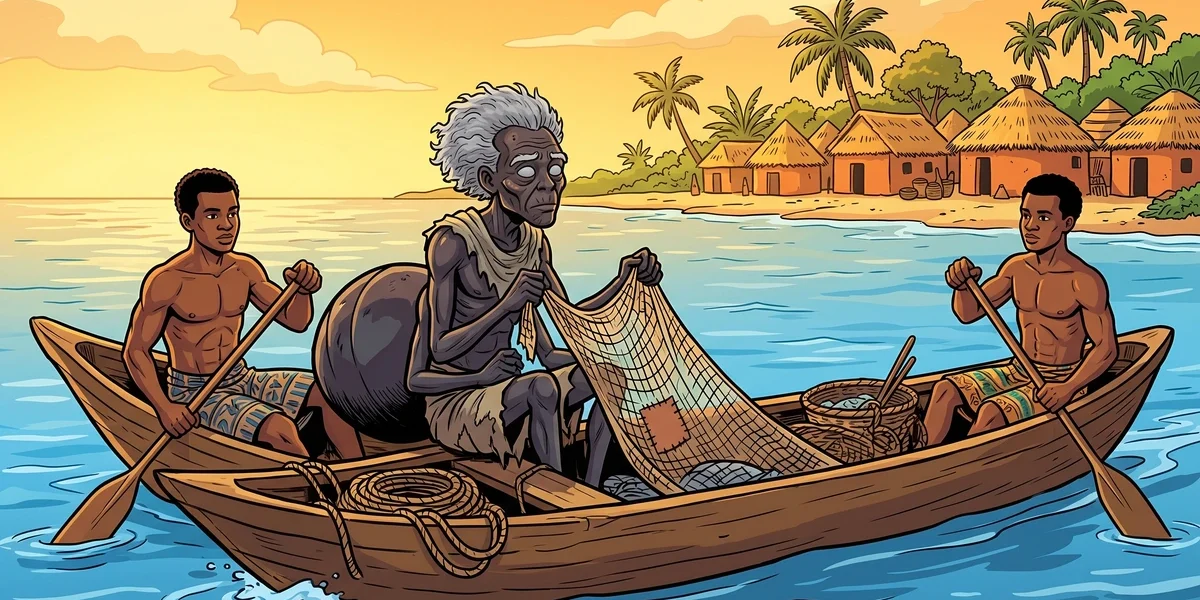
Anansi, the tale begins, came late to fishing. It was the work of his old age — a quieter trade than the scheming of his younger years — and he took to it on the long coast of his country, where wooden canoes were dragged each dawn down the sand and out through the surf. But he had not been a fisherman long when his sight began to fail. It dimmed slowly, the way an evening dims, until at last it was gone altogether and Anansi was quite blind.
He did not, however, give up the sea. He was still very strong — strong in the arms and the back, strong in the stubborn way that had always defined him — and he was determined to go on fishing. So he continued, with the help of two men who went out with him in the canoe. And here the story sets its trap quietly, in a single fact the listener is meant to hold onto: Anansi could not have fished at all without them. His strength was real, but it was useless on the water without eyes to point it. The two men were those eyes.

It is worth pausing on how gently the tale treats the blindness itself. There is no mockery in it. Blindness is simply Anansi’s circumstance, the plain condition of his old age, and the story passes no judgement on it whatsoever. The tale is entirely uninterested in punishing Anansi for what he cannot see. What it watches, with a cold and steady eye, is something else — the thing Anansi chooses to do about a circumstance that is no fault of his own.
The Two Kind Men and the Daily Insult
The two helpers were, by every measure the tale offers, good men. They were “exceedingly kind” to Anansi and aided him in every possible way. Each morning they led him down to the beach and settled him into the canoe. Out on the fishing-ground they told him exactly where to spread his net and exactly when to haul it in. And when the day’s work was done and the canoe came back to land, they told him precisely where and when to step out — so carefully timed, so exactly judged, that the blind old spider did not so much as get his feet wet.
Consider what that means. Day after day, two men arranged the whole world so that Anansi could keep his trade and his dignity both. They turned his blindness into a thing that cost him nothing — not a stumble, not a soaking, not a single lost catch. It was, in its undramatic way, an act of sustained generosity, the kind that asks for nothing back but the smallest acknowledgement.
That acknowledgement never came. Instead of gratitude, Anansi gave them insolence. When they told him where to cast his net, he would snap back, “I know. I was just about to put it there.” When they guided him to step from the boat, he would retort, “Oh, I know perfectly well we are at the beach. I was just getting ready to step out.” Every piece of help was met as an insult to his competence; every kindness was answered as if it were a slight. And it did not stay level. Day by day, the tale says, Anansi grew “ruder and ruder,” until the two men could no longer bear the way he treated them.

This is the psychological heart of the story, and it is unnervingly true to life. Anansi cannot tolerate the visible fact of his own dependence. Every “I know” is an attempt to erase the help even as he receives it — to claim the guidance as something he had already thought of himself. He wants the benefit of being helped and the appearance of needing no help, and he is willing to wound the very people keeping him alive in order to maintain that illusion. The blindness took his sight. His pride is busy taking everything else.
The Patience That Finally Broke
The two men endured it for a long time — longer, the tale implies, than most would. But patience is not endless, and theirs at last ran out. They “determined, when opportunity offered, to punish him for his ingratitude.”
The next day began like every other. Anansi came down with them to the beach, and when the canoe was ready they told him to step in. “Do you think I am a fool?” he said. “I know the canoe is there.” They said nothing. They simply got in and pulled patiently out toward the fishing-ground. When they told him where to spread his net, he answered with so much abuse that whatever doubt remained in them dissolved. There and then, on the water, they made their decision final.

The canoe filled with fish — a good catch, the ordinary reward of an ordinary day — and the two men turned to row home. But this time they did not row all the way. A little way out from shore, with deep water still beneath the hull, they stopped. And they said to Anansi the thing they had said truthfully a hundred times before: “Here we are at the beach.”
It is a quietly terrible moment. The men do not lay a hand on Anansi. They do not push him or strike him or abandon him with a curse. They use only his own words against him — they offer him, one last time, the guidance he has spent so long despising, and they let him do with it exactly what he has always done. The punishment is not something done to Anansi. It is Anansi, finally, being allowed to act on his own conviction that he knows better.
The Deep Water and the Long Swim
Anansi did with their words precisely what he had always done. He told the two men they were very foolish — foolish to tell him a thing he knew so well — and he heaped on so many rude and insulting remarks that the men were thoroughly, finally angry. Then, proudly, certain of the sand he would find beneath his feet, he jumped out of the canoe.
There was no sand. To his great astonishment the old spider found himself sinking into deep water. The two men did not reach for him. They rowed quickly away and left him to struggle.

Anansi did not drown at once. Like all the men of that coast he was a strong swimmer, and his arms were still powerful. He struck out for shore. But here the story closes its trap completely, and the full weight of everything that came before falls at once. Anansi was blind. He could swim — but he could not see where the land lay. He had no way to know which direction held the beach and which held the open sea, and the two men who had always been his eyes were gone. So he swam. He swam hard, and he swam well, and he swam in directions he could not choose. He swam until he was completely tired out. And then, the tale ends with a flat and final simplicity, “he was drowned.”
The horror of the ending is in its arithmetic. Strength without sight is not enough. Anansi’s powerful arms only let him exhaust himself more thoroughly. The single thing that could have saved him — a voice calling the direction of the shore — was the exact thing he had spent the whole story teaching two good men to stop offering.
The Moral: Help Refused Is Help That Stops Coming
“Anansi the Blind Fisherman” is, on its plainest level, a tale against ingratitude. The two helpers do everything a person could ask, and Anansi answers them with contempt; the story makes sure the listener feels that contempt as the genuine offence it is. But the tale reaches deeper than simple ungratefulness. Its true subject is the particular pride that cannot survive being seen to need help — the pride that would rather drown competent than be guided safe.
Anansi’s blindness is never his failing. His failing is his refusal to act blind: his insistence on pretending to a knowledge he does not have, on claiming every rescue as his own idea, on treating honest assistance as an accusation. And the tale’s quiet, devastating logic is that such pride teaches the helpers their lesson long before it teaches Anansi his. Kindness, met with enough scorn, eventually withdraws. The two men do not become cruel; they simply stop. Anansi spends the whole story training the world to leave him alone, and at the end the world, exactly as trained, leaves him alone in deep water.
“Ahomasõõ de animguaseε ba.”
— Akan (Twi) proverb: “Pride brings disgrace.” The arrogance that cannot bear to be corrected does not protect a person — it strips away the very help that keeps them safe.
There is also a lesson here aimed gently at the helpers, and at everyone who has ever helped: the tale does not call the two men wicked for their final act, but it does not quite call them wise either. They reach the end of their patience and answer cruelty with a cruelty of their own, and a man dies. A listener may close the story feeling that ingratitude is a poison that spreads — that it corrodes not only the ingrate but the goodwill of everyone around him, until kindness itself runs dry. That is the sober warning the anansesem storyteller leaves hanging in the evening air.
Why This Tale Has Lasted
Most Anansi stories have survived because Anansi wins — because audiences delight in watching the small, weak, clever spider outmanoeuvre the strong. “Anansi the Blind Fisherman” has survived for the opposite reason. It is the cautionary shadow of all those triumphs, the tale that exists to remind listeners that cleverness curdled into arrogance is no cleverness at all.
It has lasted, too, because its moral needs no translation. Every culture knows the person who will not be helped: the elder who waves away the offered arm and falls, the patient who ignores the careful instruction, the friend who treats every word of advice as an insult. The tale gives that universal figure a shape and an ending, and it does so with the economy of true oral storytelling — not a wasted sentence, the trap laid and sprung in a few hundred words. Carried out of the Gold Coast and across the diaspora alongside the brighter Anansi tales, it endures as the necessary dark thread in the spider’s web: a story that loves its trickster too honestly to pretend his pride could never cost him everything.
Frequently Asked Questions
Where does the tale “Anansi the Blind Fisherman” come from?
It is a West African folk tale from the Akan-speaking peoples of the Gold Coast, modern Ghana. It was recorded in print in West African Folk-Tales, collected by William H. Barker — Vice-Principal of the Government Training College at Accra — and Cecilia Sinclair, and published by George G. Harrap & Co. in London in 1917. Before that it lived for generations in the oral anansesem tradition of spider stories.
Why is this Anansi story so different from the others?
In most tales Anansi is a clever trickster who wins through wit. Here he is old, blind and undone by his own pride rather than triumphant. The story belongs to the cautionary side of the Anansi cycle: it uses the familiar trickster as a warning figure, showing what happens when cleverness hardens into arrogance and ingratitude.
What is the moral of “Anansi the Blind Fisherman”?
The tale teaches against ingratitude and destructive pride. Anansi insists he needs no help and treats his two kind guides with contempt, claiming every rescue as his own idea. By rejecting honest assistance he teaches the people who keep him safe to stop helping — and that withdrawal of help, not his blindness, is what destroys him. Help refused for the sake of pride is help that eventually stops being offered.
Is Anansi’s blindness the cause of his death?
No. The tale is careful never to blame Anansi for his blindness, which is simply a circumstance of old age. What kills him is his refusal to act on it — pretending to knowledge he lacks, rejecting guidance, and abusing the two men who served as his eyes until they finally stopped guiding him. His blindness is his condition; his pride is his choice.
Who is Anansi and why do so many cultures tell his stories?
Anansi, properly Kwaku Ananse, is the spider trickster of Akan folklore in Ghana. Through the transatlantic slave trade his stories spread across the Caribbean and the African diaspora, where he survives as Anansi, Anancy and Aunt Nancy. He endures because he is endlessly adaptable — hero, fool, culture-bringer and, as in this tale, a sober warning — and because the spider stories carry social teaching as well as entertainment.
You May Also Like
 African Folk Tales
Ages 6-8
African Folk Tales
Ages 6-8
The Girl Who Could Not Be Eaten
The Zulu tale of Untombinde, a king's proud daughter, and the swallowing monster of the haunted pool - who devours a whole nation and cannot keep a single soul down.
 African Folk Tales
Ages 6-8
African Folk Tales
Ages 6-8
The Lioness And The Ostrich
The Lioness and the Ostrich is a Khoikhoi folk tale of southern Africa from Bleek's Reynard the Fox in South Africa (1864) and Honey's South-African Folk-Tales (1910). A lioness accepts an ostrich as her equal, then lets her cubs' flattering scorn break that bond - and dies of it.
 African Folk Tales
Ages 6-8
African Folk Tales
Ages 6-8
Tink-Tinkje
The southern African folk tale 'Tink-Tinkje', the Cape form of the worldwide 'election of the king of birds' fable, in which the smallest bird wins the crown by cleverly riding unfelt on the soaring vulture's wing.