The Hunt Of Lion And Jackal
A Khoikhoi trickster tale from the Cape of Good Hope: the jackal cheats his hunting partner the lion out of an eland's fat with a false blood-trail, talks his way out of being caught, and escapes scot-free with his family.
Tradition: Khoikhoi (Khoekhoe) animal trickster cycle, Cape of Good Hope, southern Africa.
First printed source: James A. Honeÿ, South-African Folk-Tales (New York: Baker & Taylor, 1910), “The Hunt of Lion and Jackal.” Honey reprinted Cape material first written down by Wilhelm H. I. Bleek in Reynard the Fox in South Africa; or, Hottentot Fables and Tales (London: Trübner, 1864), the earliest substantial published collection of Khoikhoi narrative.
Tale type & motifs: a jackal-trickster tale of the southern African “Lion and Jackal” cycle. It belongs to no single ATU number; folklorists group it among the deception tales (motif family K), turning on a false blood-spoor, a blame-shifting denial (motif K400 family), and the trickster who escapes with the spoils.
Reading time: about 10 minutes.
Most folk tales reward the good and punish the wicked. This one does neither. “The Hunt of Lion and Jackal” is a short, sharp Khoikhoi tale from the Cape of Good Hope in which the cheat lies, steals, insults his partner’s children to their faces, and then walks away unpunished — wife and children at his side, the best of the meat in his arms. It is not a story that teaches children to be good. It is a story that teaches them something harder and older: that raw power is not the same thing as cleverness, and that the strong are forever one step behind the quick.
To modern readers raised on tidy morals, the tale can feel almost scandalous. That discomfort is the point. The version below follows Honey’s 1910 text closely, and the discussion around it tries to explain why a people would tell, and re-tell, and treasure a story in which the trickster wins outright.
The Shot and the Dispute
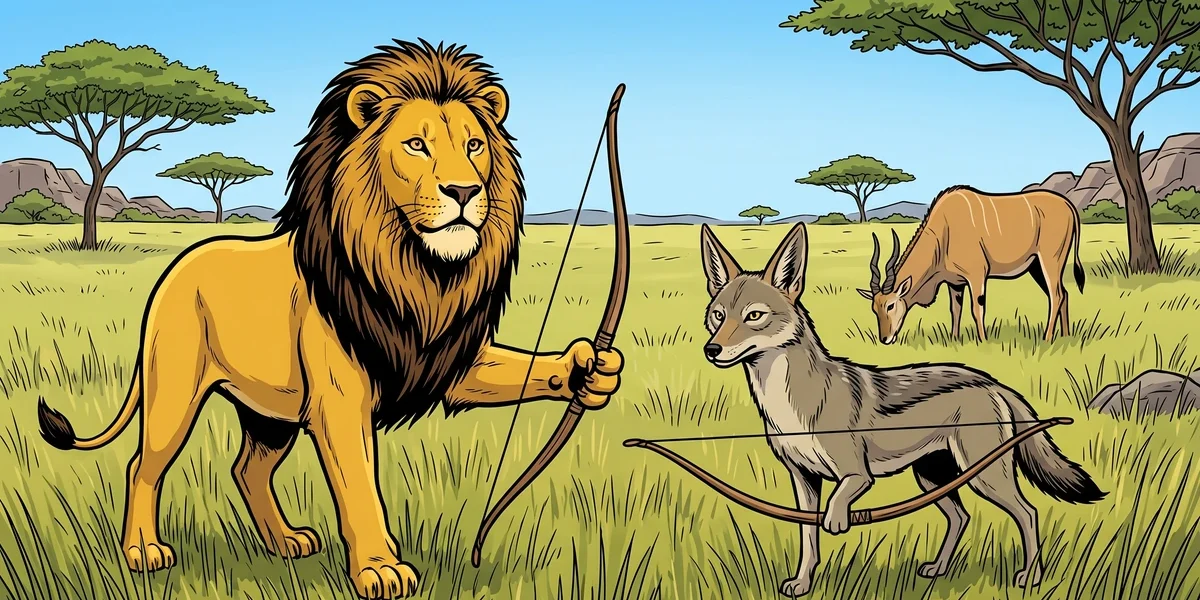
Lion and Jackal, it is said, were one day lying in wait for eland. In the world of these tales the animals hunt as the Khoikhoi themselves hunted — with a bow, from cover, reading the wind and the grass. Lion drew first. Lion shot, and Lion missed. Then Jackal loosed his arrow, and Jackal hit, and the little hunter could not help himself: he sang out in triumph, “Hah! hah!”
Lion turned at once. “No,” he said, “you did not shoot anything. It was I who hit.” And here the tale gives us, in a single exchange, the whole machinery of what is to come. Jackal does not argue. Jackal does not insist on the truth, though the truth is plainly his. Jackal bows: “Yea, my father, thou hast hit.”
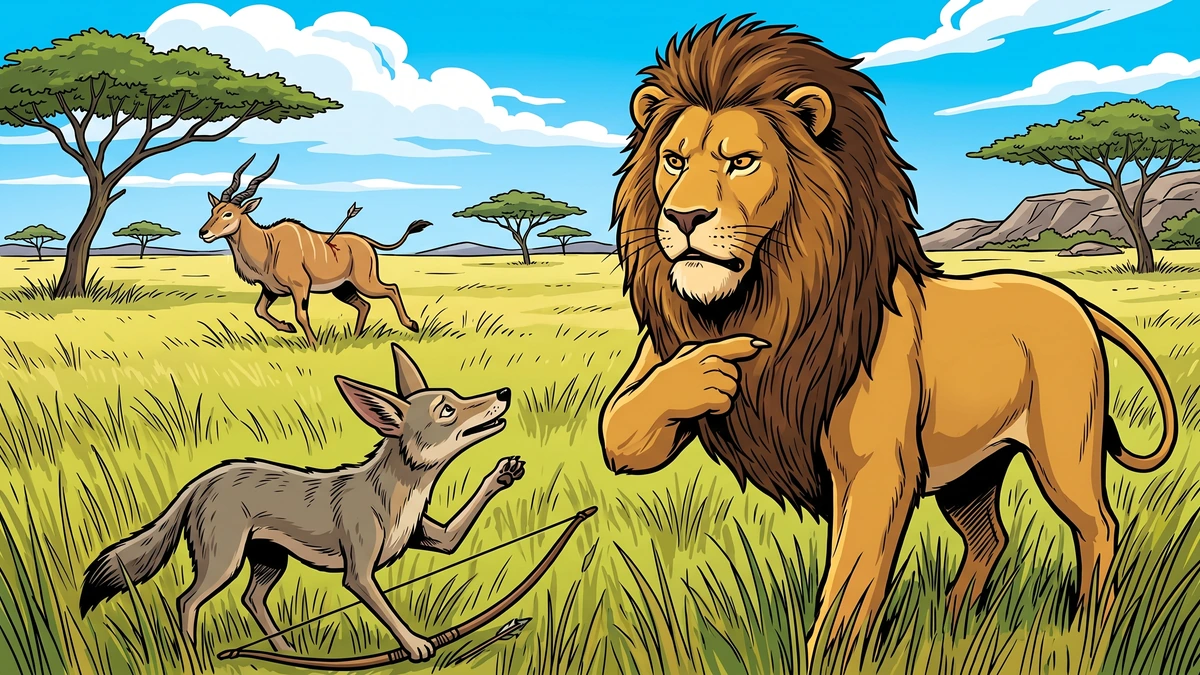
That word — father — is the key to the trickster’s art. By calling Lion “my father,” Jackal accepts a place beneath him, flatters the larger animal’s pride, and defuses a quarrel he could only lose. A weaker creature who contradicts a lion does not live to enjoy being right. So Jackal yields the credit at once — cheerfully, lavishly — while quietly keeping his eye on the thing that actually matters: the eland, and the fat inside it. The audience understands immediately that Jackal has not surrendered. He has simply chosen a different battlefield, one where strength counts for nothing and patience for everything. The dispute over the arrow is a decoy. The real hunt has only just begun.
The False Blood-Trail
The wounded eland staggered off to die, as wounded game does, and the two hunters turned for home, agreeing to come back when the animal was dead and cut it up together. That is the lawful way: a shared kill, a shared carcass, a fair division at the end. Lion walked home expecting exactly that.
Jackal had no such intention. Unknown to Lion, he turned back. Then he did something that has made this small tale unforgettable to everyone who hears it: he struck his own nose until it bled, and he walked the eland’s trail letting his blood fall drop by drop onto the ground. He was forging a spoor. He was writing a false trail in his own blood, so that anyone tracking the eland would be led away from the carcass and off into the empty veld.
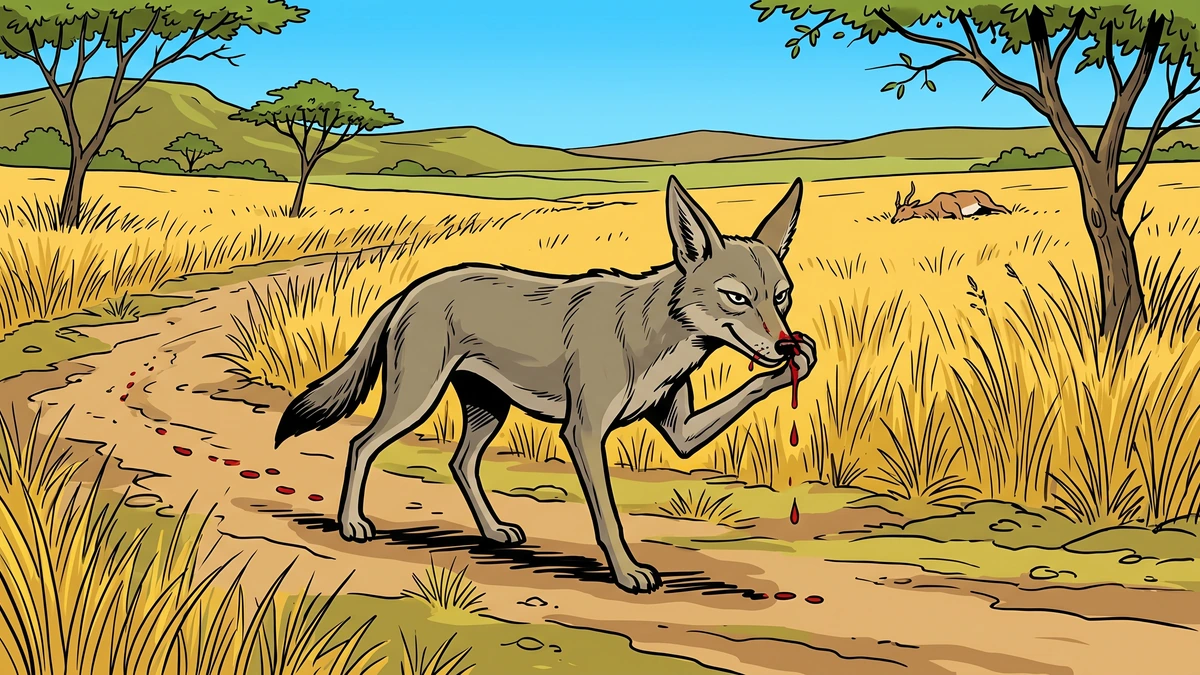
It is worth pausing on how brilliant, and how costly, this trick is. A spoor — a trail of prints and blood — was the most trusted form of knowledge a Cape hunter had. To read a spoor was to read the truth of what had passed. Jackal’s genius is to corrupt that truth at its source: he turns the one sign Lion cannot help but believe into a lie pointing the wrong way. And he pays for it out of his own body, with his own blood, hurting himself on purpose so that the deception will look natural. The trickster, this detail tells us, is not lazy. He works harder at his cheating than an honest animal works at an honest hunt. When the false trail was laid, Jackal looped back by another road to the dead eland, cut it open, crept bodily inside the carcass, and set about carving out all the fat — the richest, most prized part of the kill — for himself.
Pulled Out by the Tail
Meanwhile Lion came back to claim his half. He found the blood and the trail and followed it, certain it was the eland’s, walking further and further into country where no carcass waited. Only after a long, hungry march did the truth break over him: he had been deceived. There was no eland at the end of this road. There was only Jackal’s cleverness, leading him by the nose.
Lion turned around. He went back along Jackal’s real spoor this time, and at last he reached the eland — and there was the cheat himself, still busy inside the carcass, up to his ears in stolen fat. Lion seized him by the tail and drew him out with one furious swing.
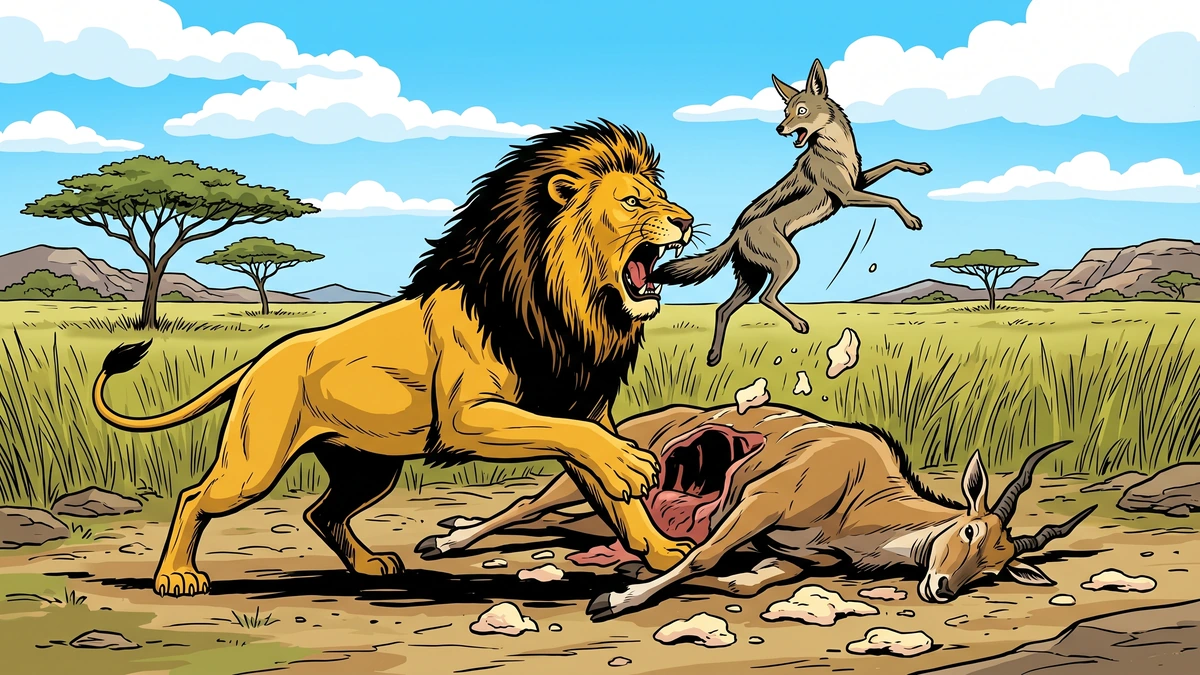
“Why do you cheat me?” Lion demanded. It is the plainest line in the tale, and the most honest: caught, dangling, helpless in the grip of an animal many times his size, Jackal has run clean out of road. Strength has finally cornered cunning. And this is the moment the story turns — not on muscle, but on nerve. Jackal does not flinch, does not confess, does not beg. He simply changes the story. “No, my father, I do not cheat you,” he says smoothly. “You may know it, I think. I prepared this fat for you, father.”
It is a magnificent, shameless lie, and it works. Jackal takes the very crime he was caught committing — hollowing out the carcass and hoarding the fat — and re-labels it as devoted service: he was not stealing the fat, he was readying it, for his dear father Lion. The accusation is simply turned inside out. And Lion, whose pride is always the loose thread the trickster pulls, would rather believe he is being served than admit he is being robbed. He lets it pass. He even rewards it: take the fat, he says, and carry it home to your mother, the Lioness — and he hands Jackal the lungs as well, the poorer meat, to take to Jackal’s own wife and children.
The Insult and the Escape
So the parcels are made up and the roles assigned. Lion’s instruction is clear and, in its way, generous: the good fat is to go to Lioness; the lungs are Jackal’s family’s portion. Jackal sets off carrying both.
He delivers neither as he was told. When Jackal reached the dens he gave the rich fat not to Lioness but to his own wife and his own children. The lungs — the lesser meat — he handed to Lioness. And then he went further than theft. He took the leftover lungs and flung them at Lion’s little cubs, pelting the helpless children of the king and jeering as he threw: “You children of the big-pawed one! You big-pawed ones!”
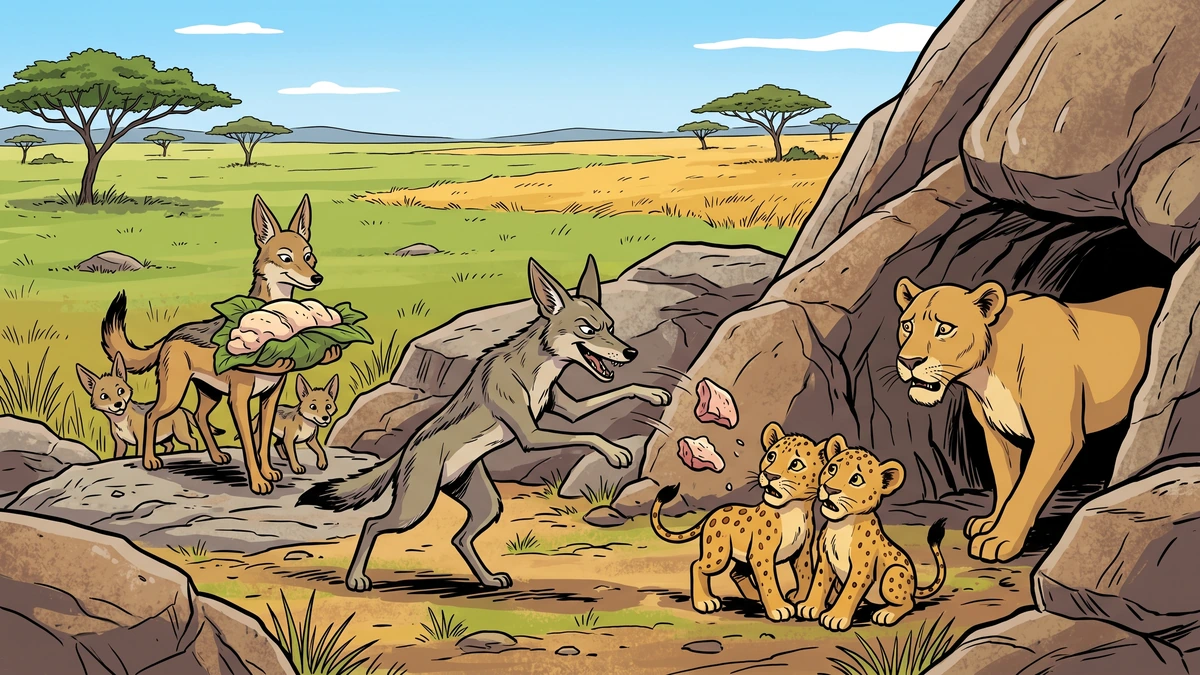
This is the tale’s most startling beat, and the storyteller plainly relished it. It would have been enough for Jackal to keep the fat. Instead he mocks Lion’s authority in Lion’s own home, in front of Lion’s wife, by abusing Lion’s children — turning even the shape of a lion’s paw, that great symbol of strength, into a schoolyard taunt. “Big-pawed” means clumsy, heavy, slow: everything the small swift jackal is not. The insult is a thesis. It says that size is a kind of stupidity.
Then Jackal covers his retreat with one last lie. “I go to help my father,” he told Lioness sweetly — as though he were off to do Lion a good turn. And with that he gathered up his wife and his children and the stolen fat and went far, far away, beyond the reach of any lion’s anger. The tale ends there. No punishment arrives. No justice catches up. The cheat simply wins, and the curtain falls on his laughter.
Why a People Would Cheer the Cheat
A reader meeting this story for the first time often asks the same uneasy question: what is the moral? Where is the comeuppance? The answer is that “The Hunt of Lion and Jackal” is not a fable in the tidy Aesopic sense. It is a trickster tale, and trickster tales obey a different and more ancient logic.
The Khoikhoi were a herding and hunting people of the Cape, and across southern Africa the jackal — small, nocturnal, clever, always circling the edges of the lion’s kill — became the great folk image of the survivor who has no power and must live by wit alone. To an audience that knew, intimately, what it meant to be small in a world ruled by the strong, a story in which the jackal out-thinks the lion at every turn was not a lesson in bad behaviour. It was a release. It was the powerless laughing, safely, at power — and a reminder, told as comedy, that the mighty are not invincible, only big.
Read that way, the tale does carry a lesson, but it is aimed at the lion, not the jackal. Lion fails three times, and never once because he is weak. He fails because he is proud. He claims a shot he did not make; he believes a blood-trail without thinking; and at the carcass he chooses the flattering lie over the obvious truth because his vanity prefers it. Cunning does not defeat strength in this story. Cunning simply waits for strength to defeat itself — and it always does, because the strong so rarely think they need to be careful.
“Jakkals verloor sy hare, maar nie sy streke nie.”
— Cape Afrikaans proverb: “The jackal loses his hair, but never his tricks.” A creature may be worn down, cornered, even caught by the tail — but cunning itself is never lost.
There is, all the same, a quiet warning folded inside the comedy, and Khoikhoi listeners would have heard it. Jackal’s last act before he escapes is the insult — pelting the cubs, jeering at the king. He did not need to do it. The fat was already his. The trickster’s one true weakness, in tale after tale across the world, is exactly this: he cannot resist the flourish, cannot stop at winning, must also be seen to win. This time Jackal gets clean away. But the same cycle of stories that lets him triumph here will, in other tales, let that very vanity drag him into a trap of his own. Cleverness, the elders are saying, keeps you alive. Showing it off is how clever animals die.
Why the Tale Has Lasted
“The Hunt of Lion and Jackal” has survived because it is honest about a thing gentler stories prefer to soften: the world is not arranged so that the deserving always win. Sometimes the cheat gets the fat. A child who hears this tale is not being taught to lie. The child is being handed something more useful — a clear-eyed map of how power, pride, flattery, and quick thinking actually move against one another in the real world.
The story also lasts because it is genuinely, durably funny. The blood-soaked false trail, the jackal hauled out of a carcass by his tail, the outrageous “I prepared this fat for you, father,” the cubs pelted with lungs — this is physical comedy, broad and bright, the kind that survives any number of retellings around any number of fires. And it belongs to one of the oldest documented storytelling traditions on the African continent: when Wilhelm Bleek began writing down Khoikhoi tales in the 1860s, and James Honey gathered them for English readers in 1910, they were preserving a jackal who had already been outwitting lions in the Cape for longer than anyone could count. He is outwitting them still.
You May Also Like
 African Folk Tales
Ages 3-5
African Folk Tales
Ages 3-5
Why Mosquitoes Buzz in People’s Ears
West African pourquoi chain-tale — a mosquito’s lie, a forest of fright, Mother Owl, and a guilty buzz — ages 3–5 / 6–8.
 African Folk Tales
Ages 6-8
African Folk Tales
Ages 6-8
Why the Sun and Moon Live in the Sky
An Efik pourquoi tale from southern Nigeria: the Sun and his wife the Moon welcome their friend the Water too well, are flooded out of the great house they built, and are driven up to live in the sky forever.
 African Folk Tales
Ages 6-8
African Folk Tales
Ages 6-8
The Lion, The Jackal, And The Man
The Khoikhoi folk tale of a boastful lion whom a clever jackal humbles by leading him to meet a man — and the man, armed with dogs, fire and steel, proves the strongest creature of all.