The Tortoise and the Baboon
The African Bantu fable of a baboon who invites a tortoise to a feast hung out of reach in a tree, and the tortoise's patient revenge laid across a stretch of fire-blackened ground - the reciprocal-inhospitality story, international tale type ATU 60.
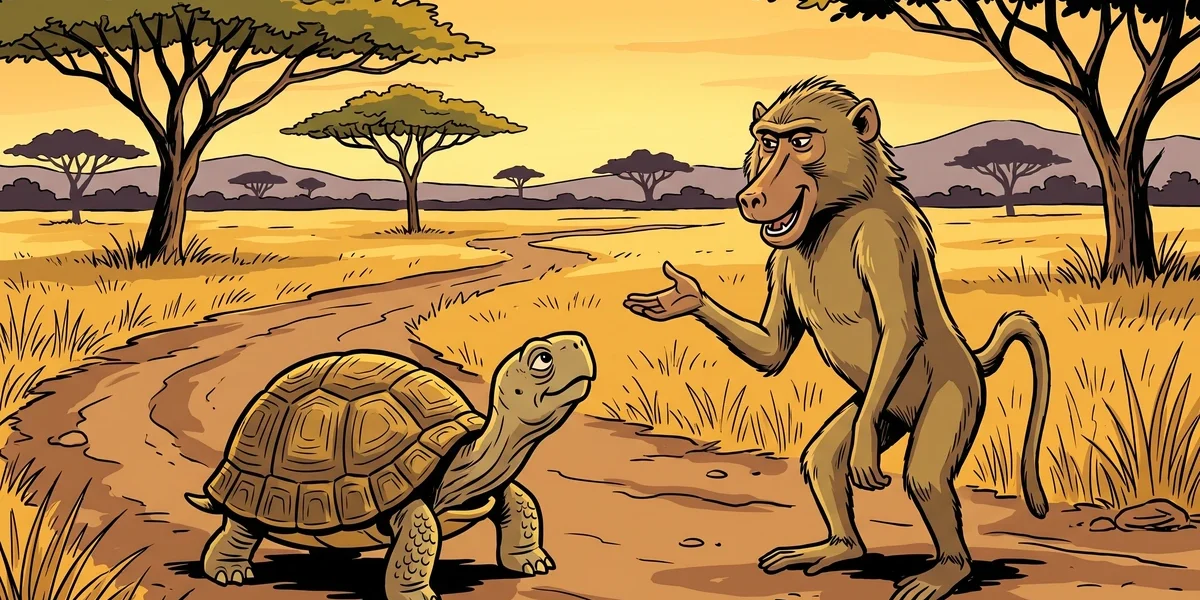
Among the animal stories of Bantu Africa there is a small, sharp comedy of bad manners that has outlived every fashion of storytelling: a baboon invites a tortoise to supper, and a tortoise invites a baboon, and neither guest ever gets a mouthful. The Tortoise and the Baboon is a fable about hospitality — about the difference between an invitation that is offered and an invitation that can actually be accepted — and it makes its point not through a speech but through a perfect, closed piece of plotting. The baboon hangs the feast where his guest cannot climb; the tortoise lays the feast where his guest cannot stay clean. The trick is the same trick, turned around, and the second telling of it is the moral of the first.
Origin & Canonical Attribution
Tradition: Bantu oral tradition of eastern and southern Africa — one of the great cycle of tales in which the slow, small tortoise is not a figure of weakness but the supreme animal of patient cunning
Principal printed source: Alice Werner, Myths and Legends of the Bantu (London: George G. Harrap & Co., 1933), Chapter XVIII, “Legends of the Tortoise,” where Werner retells the meal-for-a-meal story and herself notes its close kinship with the Aesopic fable of the fox and the crane
Tale type: international type ATU 60, “Fox and Crane Invite Each Other” (the reciprocal-inhospitality tale) — the African telling substitutes the tree-climbing baboon and the burnt-ground-crossing tortoise for the long-necked crane and the flat-dished fox
Motifs & kin: Stith Thompson J1565.1 (“Fox and crane invite each other”) and J1565 (“Ungracious hospitality repaid in kind”); cognate with Aesop’s “The Fox and the Stork” (Perry 426) and with the wider African tortoise-trickster cycle in which the tortoise out-thinks the larger, stronger animal
An Evening Meeting on the Path
The tale begins at the close of a day, on a path through the bush, with the two characters walking toward one another — and the storyteller has chosen them with care. The baboon is quick, strong, agile, a natural climber, a creature entirely at home in the high branches; he is also, in the older Bantu telling, a known trickster, an animal who likes to take advantage of others for the pleasure of it. The tortoise is his exact opposite: slow almost beyond patience, earthbound, unable to climb so much as a low rock, carrying his house on his back and his wits inside it. When the two meet on the path one evening, the imbalance between them is the whole situation.
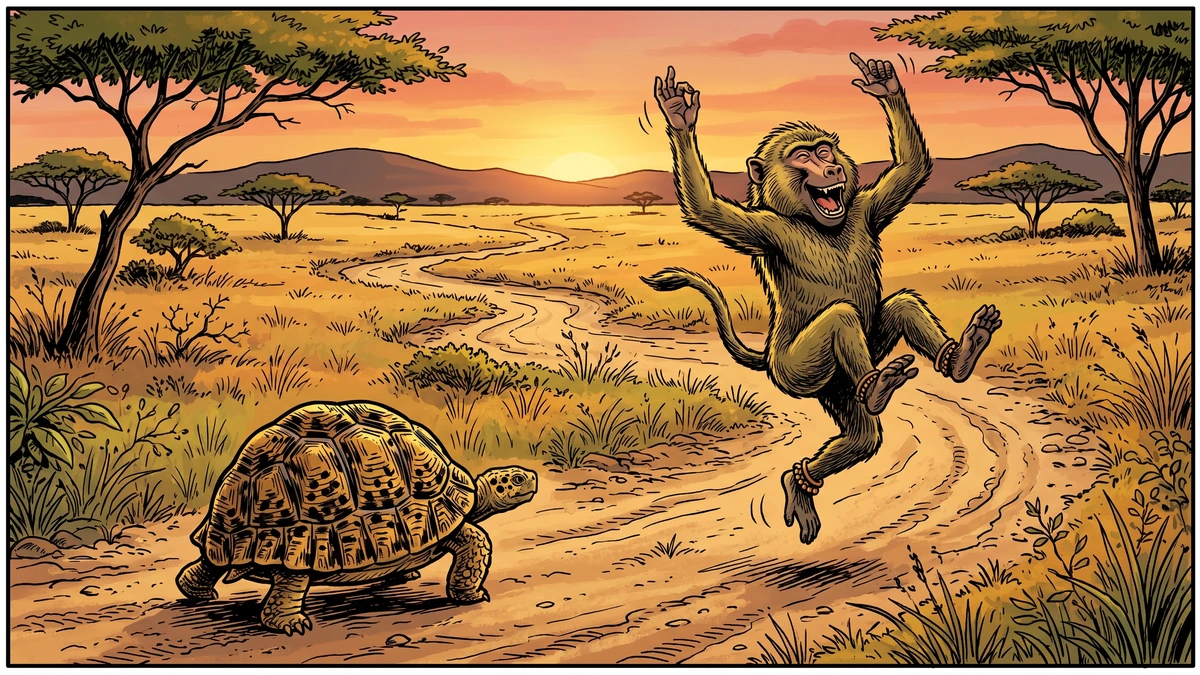
The baboon greets the tortoise warmly — “Have you found much to eat today?” — and the tortoise answers honestly that he has found very little. It is at this point that the baboon’s idea arrives, and the story is careful to show us that it arrives as a joke: he dances up and down, chortling to himself, delighted by something the tortoise cannot yet see. Then he issues his invitation. Follow me home, poor old tortoise, and supper will be ready for you. The words are generous. The laughter underneath them is not.
The tortoise, who has no reason yet to suspect anything, is simply grateful, and he sets off after his host. The journey is its own small ordeal — the baboon bounds gaily ahead while the tortoise plods, slow on the level ground and slower still uphill, stopping once or twice to rest when the bumpy ground disheartens him, kept going only by the picture in his mind of the wonderful feast waiting at the end. That picture, held so vividly through such effort, is what the baboon intends to break. A cruelty planned in advance and dressed as kindness is the particular cruelty this fable is interested in.
Three Pots of Millet-Beer in the Branches
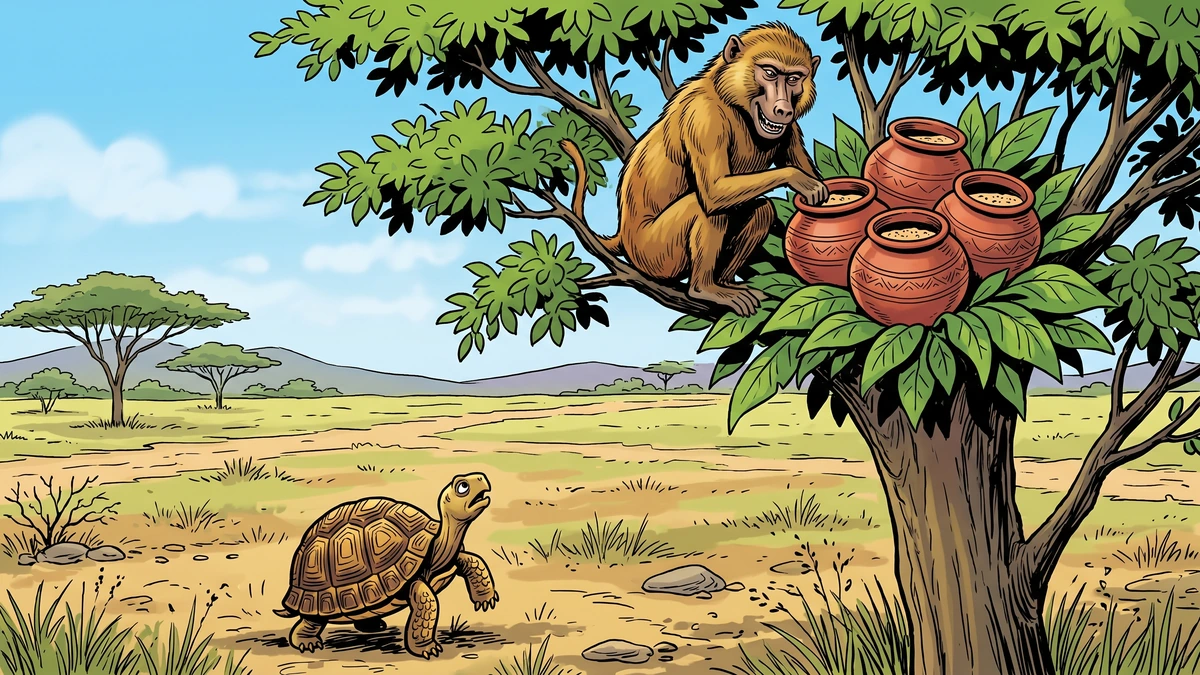
When the tortoise at last reaches the baboon’s home in the bush, the host is leaping about and grinning, and his first words are a mockery dressed as welcome: what a long time you have taken, he cries, it must be tomorrow already. The tortoise, puffing after his journey, answers with quiet dignity — you have surely had plenty of time to prepare the supper, so do not grumble at me. He still believes the feast is real. The baboon assures him it is. Supper’s all ready, he says, rubbing his hands together; all you have to do is climb up and get it.
And he points to the top of a tree. There, wedged high among the branches, sit three pots of millet-beer — brewed, the baboon declares, especially for his guest. The cruelty is now complete and visible. The tortoise looks up at the pots he can see perfectly and reach not at all, and the story states the matter with flat exactness: he knew he could never get them, and the baboon knew that too. The feast has not been withheld. It has been displayed. It has been put precisely where it will torment a guest who cannot climb.
The tortoise asks the only thing he can ask — bring one down for me, there’s a good friend — and the baboon springs up the trunk in the twinkling of an eye and calls down the rule that turns the whole evening into a mockery: anybody who wants supper with me must climb up to get it. It is a rule that sounds perfectly fair and is perfectly designed to exclude one particular guest. So the tortoise begins the long journey home with an empty stomach, and the story lets us hear him on the way, plodding back through the dark and cursing his inability to climb trees. The baboon has had his joke. What he has not noticed is that he has handed his victim something more useful than a meal: a grievance, and the whole slow journey home in which to think about it.
The Tortoise’s Plan and the Burnt Ground
Here the fable turns, and it turns on the tortoise’s great and characteristic gift. He cannot climb; he cannot run; he cannot overpower anyone. What he can do is think slowly and well, and use the world exactly as he finds it. As he trudges home hungry, he works out what the story calls a splendid plan — not a plan to punish the baboon with violence, and not a plan to shame him with a lecture, but a plan to do to the baboon precisely what the baboon did to him, and to let the baboon discover the lesson with his own hands and feet.
A few days later an invitation reaches the baboon: come and eat with the tortoise. The baboon is surprised, but not for long. He is sure he understands the tortoise — slow, good-natured, the sort of fellow who saw the joke and bears no malice — and he decides to go along and see what he can get out of him. That misjudgement is the baboon’s real undoing. He cannot imagine that a creature so slow could be planning anything, and so he walks into the plan without a flicker of suspicion.
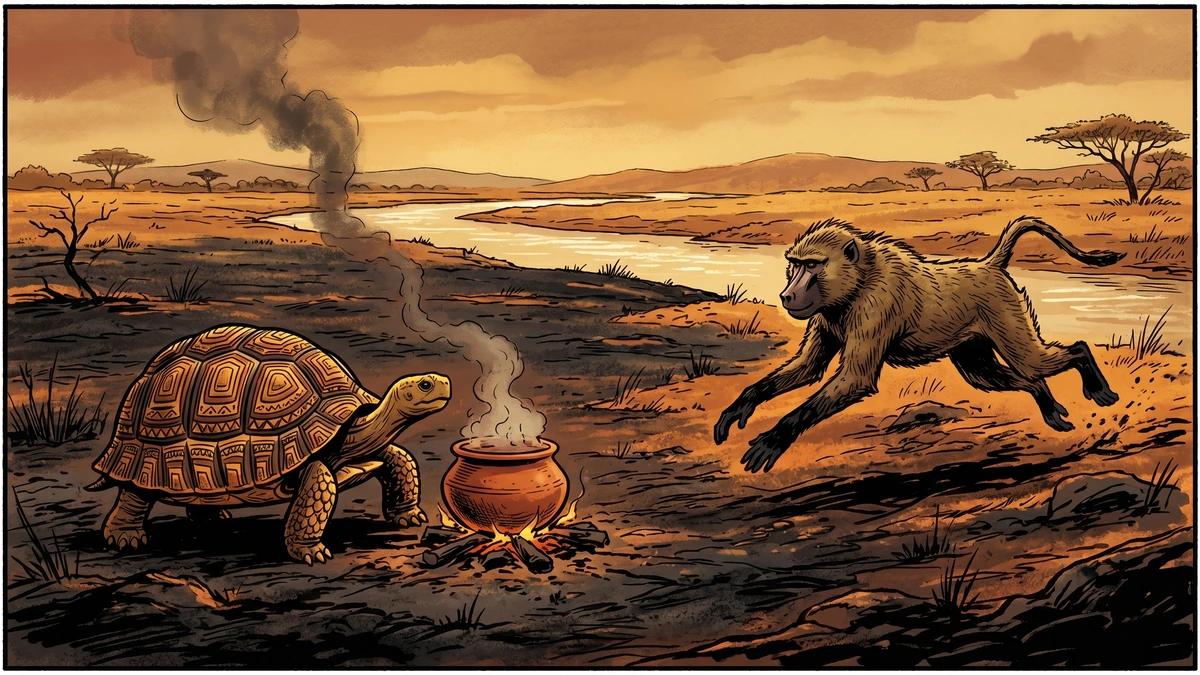
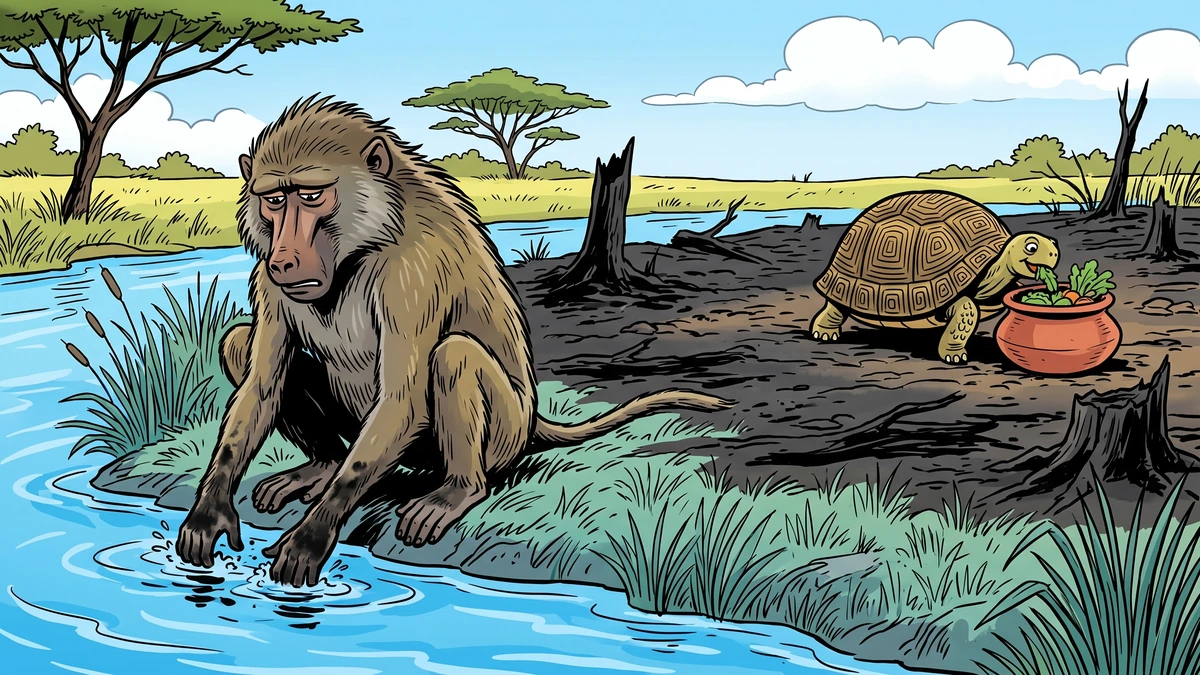
The tortoise has chosen his moment as carefully as the baboon chose his tree. It is the dry season, the time of bush fires, when wide stretches of grassland are burned to scorched and blackened earth. The tortoise sets his cooking pot, full of the most savoury-smelling food, on a spot just beyond the river — a spot a guest can reach only by crossing a broad band of burnt, sooty ground. The baboon bounds across the black earth toward the wonderful smell, and arrives with his hands and feet filthy. He has walked, without knowing it, straight into the shape of his own trick.
Wash Your Hands: The Baboon Repaid
The tortoise greets his guest warmly — he is very pleased to see him — and then, like a perfect host, points out a small difficulty. Did the baboon’s mother never teach him to wash his hands before a meal? Just look at them: black as soot. Run back to the river and wash, says the tortoise, and when you are clean I will give you some supper. The rule is courteous, reasonable, and impossible to argue with — exactly as the baboon’s “climb up and get it” had been.
And exactly like that rule, it is a trap. The baboon scampers back across the burnt ground to the river, washes himself clean — and then has to cross the burnt ground a second time to return, arriving as black as before. That will never do, says the tortoise; you may only eat with me if you are clean; go back and wash again. And he adds the small twist of the knife: you had better be quick, because I have started my supper already. He says it with his mouth full.
So the journey begins again, and again, and again. The baboon goes back to the river time after time, washing each time, blackening each time on the return, while the tortoise eats steadily through the savoury food, refusing every soot-stained arrival. At last the tortoise swallows the final morsel, and the baboon, looking at the empty pot, understands at last that he has been tricked — tricked by the slow, good-natured fellow he was so sure he had measured. With a cry of rage he crosses the burnt ground one last time and runs all the way home. Behind him the tortoise, well fed and contented, withdraws into his shell for a long night’s sleep, and says only this: that will teach you a lesson, my friend.
The Moral: Hospitality Repaid in Kind
The fable’s lesson is built into its perfect symmetry, and it is worth saying plainly. An invitation is not a kindness simply because it uses kind words. The baboon offered a feast and a welcome; what he actually offered was an evening of effort rewarded with humiliation, because the feast was placed where his guest could not reach it. True hospitality is measured not by what the host displays but by what the guest can actually receive. A gift that cannot be taken is not a gift — it is a taunt with good manners painted over it.
The second half of the lesson belongs to the tortoise, and it is sterner. The tortoise does not forgive the insult and he does not escalate it. He returns it — in its own exact shape, measure for measure, so that the baboon is taught not by being told but by being made to feel, in his own tired legs and sooty hands, precisely what he had inflicted. The Swahili-speaking world of these Bantu tales has a proverb that states the principle the tortoise is enacting:
“Asiyefunzwa na mamaye, hufunzwa na ulimwengu.”
“He who is not taught by his mother will be taught by the world.” — Swahili proverb
The baboon was never taught, by anyone gentle, that a joke at a helpless creature’s expense is a cruelty. So the world — in the patient, unhurried person of the tortoise — teaches him. The tale does not pretend this is sweet. It is satisfied, rather than kind. But it draws a careful line: the tortoise inflicts no wound the baboon had not first invented, and asks for no revenge larger than the original wrong. The punishment is the crime, handed back. That restraint is what keeps the story a fable of justice rather than a fable of spite.
Frequently Asked Questions
Where does “The Tortoise and the Baboon” come from?
It is a Bantu animal fable from eastern and southern Africa, belonging to the large body of tales in which the tortoise is the hero of slow cunning. Its best-known scholarly retelling is in Alice Werner’s Myths and Legends of the Bantu (London: George G. Harrap & Co., 1933), in the chapter “Legends of the Tortoise,” where Werner gives the meal-for-a-meal story and points out its likeness to the Aesopic fable of the fox and the crane. The tale has since been retold widely in popular African folk-tale collections, sometimes loosely attributed to one people or another, but its roots lie in the Bantu tortoise-trickster cycle.
Why does the baboon put the food up a tree?
Because the whole point of his “invitation” is that it cannot be accepted. The baboon is a natural climber and the tortoise cannot climb at all, so by wedging the three pots of millet-beer high in the branches the baboon creates a feast that is fully visible and completely unreachable. He even frames a rule — anyone who wants supper must climb up for it — that sounds fair while being precisely designed to exclude this one guest. It is cruelty disguised as hospitality, and the disguise is the part the story wants us to notice.
How does the tortoise get his revenge?
By doing to the baboon exactly what the baboon did to him, using the dry-season landscape instead of a tree. The tortoise sets his feast on a spot that can only be reached by crossing a wide stretch of fire-blackened ground, then politely insists that the baboon wash his sooty hands before eating. Each time the baboon washes in the river and returns, he must re-cross the burnt earth and arrive filthy again — so he can never satisfy the “reasonable” rule, and the tortoise eats the entire meal while he shuttles back and forth.
Is this the same story as Aesop’s “The Fox and the Stork”?
It is the same tale type. Folklorists classify the reciprocal-inhospitality story as international type ATU 60, “Fox and Crane Invite Each Other.” In Aesop’s Greek version the fox serves soup on a flat dish the long-billed stork cannot use, and the stork retaliates with food in a tall narrow jar the fox cannot reach. The African fable keeps the identical structure — two hosts, two unreachable feasts, a trick returned in kind — but recasts it with a tree-climbing baboon and a burnt-ground-crossing tortoise. Alice Werner herself drew the comparison when she recorded the Bantu tale.
What is the moral of the tortoise and the baboon?
That hospitality is real only if the guest can actually receive it, and that a cruelty offered as a joke tends to be repaid in its own coin. The baboon mistakes the slow, good-natured tortoise for a creature who cannot plan, and learns — in his own aching legs and blackened hands — that patience and cunning outlast quickness and strength. The tortoise’s revenge is exact rather than excessive: he hands the insult back in the same shape he received it, no larger, which makes the tale a story about fair return rather than about spite.
Why This Story Has Lasted
“The Tortoise and the Baboon” has survived because it is built like a well-made box: every piece of the second half answers a piece of the first, and when the lid closes the click is deeply satisfying. The tree answers nothing — until the burnt ground answers it. The baboon’s smiling “climb up and get it” answers nothing — until the tortoise’s smiling “go and wash your hands” answers it exactly. A child hearing the tale feels the symmetry before being able to name it, and that felt symmetry is the moral; the story does not need to stop and explain itself.
It has lasted, too, because it belongs to one of the most beloved figures in African storytelling: the tortoise who wins. In a world of faster, stronger, higher-climbing animals, the tortoise is the listener’s natural ally — the small, slow, patient creature who is underestimated by everyone and outwits them anyway. The baboon’s fatal error is not cruelty alone; it is contempt, the assumption that something slow must also be stupid. The fable lasts because that error is timeless, and so is the pleasure of watching it corrected. Be a true host, the story says, and offer only what your guest can truly take — and never mistake a quiet, unhurried mind for one that is not, at this very moment, working out a splendid plan.
You May Also Like
 African Folk Tales
Ages 6-8
African Folk Tales
Ages 6-8
The Lost Message
A southern African folk tale: the many kinds of ants fail to agree at their council, and the saving message of unity, entrusted to the slow Beetle, never arrives.
 African Folk Tales
Ages 9-12
African Folk Tales
Ages 9-12
The Omanhene Who Liked Riddles
The Omanhene Who Liked Riddles: The Omanhene is the chief of a village. A certain Omanhene had three sons, who were very anxious to see the world. They went to
 African Folk Tales
Ages 6-8
African Folk Tales
Ages 6-8
Anansi The Blind Fisherman
Anansi the Blind Fisherman: A Tale of Cleverness and Justice In a village near a great river in Africa, there lived a spider named Anansi. Unlike...