Elephant and Tortoise
A southern African Bushman tale: proud Elephant quarrels with Rain, claims the last water of a drought-stricken plain, and is undone by the patient wit of Tortoise.
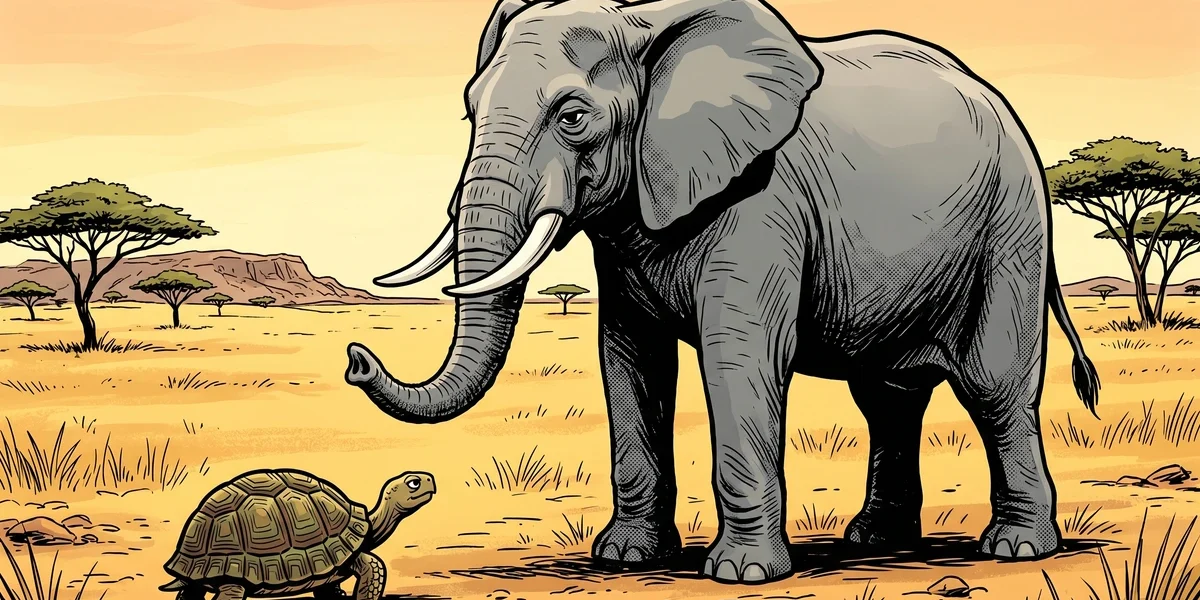
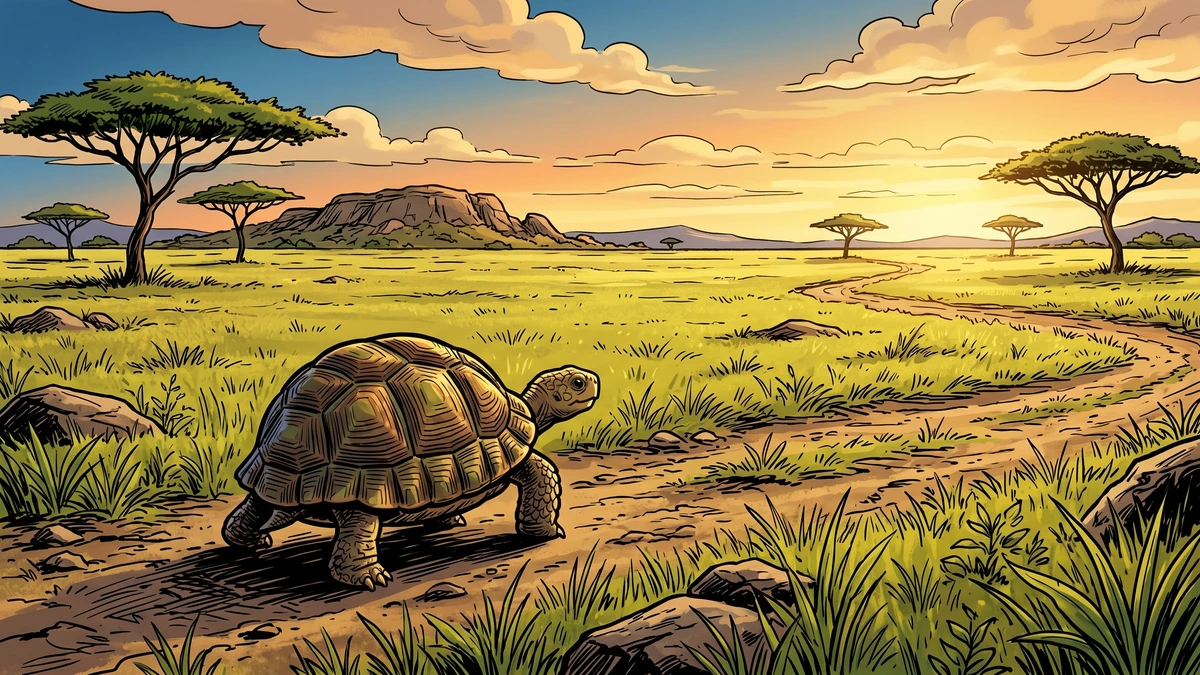
Long ago, on the wide dry plains of southern Africa, two great powers fell to quarrelling — Elephant, the largest beast that walked the earth, and Rain, the soft and silent giver of all life. Their argument dried the rivers, cracked the waterholes, and brought every animal in the land to the edge of thirst. And when the last water of all was left in a single lagoon, it was not the strong who saved the plain, but the smallest and slowest creature upon it: a patient tortoise with a hard round shell, who proved that wit outlasts weight and that no power, however mighty, can stand entirely alone.
A Bushman Tale from the Dry Heart of Southern Africa
“Elephant and Tortoise” is one of the oldest stories of southern Africa, told for untold generations by the San — the hunter-gatherer peoples once widely called Bushmen — and shared, in time, with their Khoikhoi neighbours, the herders of the same vast plains. It belongs to a land where water is the rarest treasure of all: a country of long droughts and sudden showers, of cracked clay pans that hold a season’s hope in a single shallow pool. To the peoples who first told this tale, Rain was not mere weather. Rain was a being — wilful, generous, easily offended — and the most powerful character in any story it entered.
The tale is also, in its quiet way, a pourquoi story and a trickster story braided together. It explains something about the order of the world — that the proud and the powerful are not the masters they imagine themselves to be — and it does so through the oldest comic figure of African storytelling: the small, slow, clever animal who brings down the giant. Across the continent that figure wears many shapes; here, on the southern plains, it is Tortoise, armoured in patience, who teaches Elephant the lesson the proud must always, in the end, be taught.
The Quarrel of Elephant and Rain
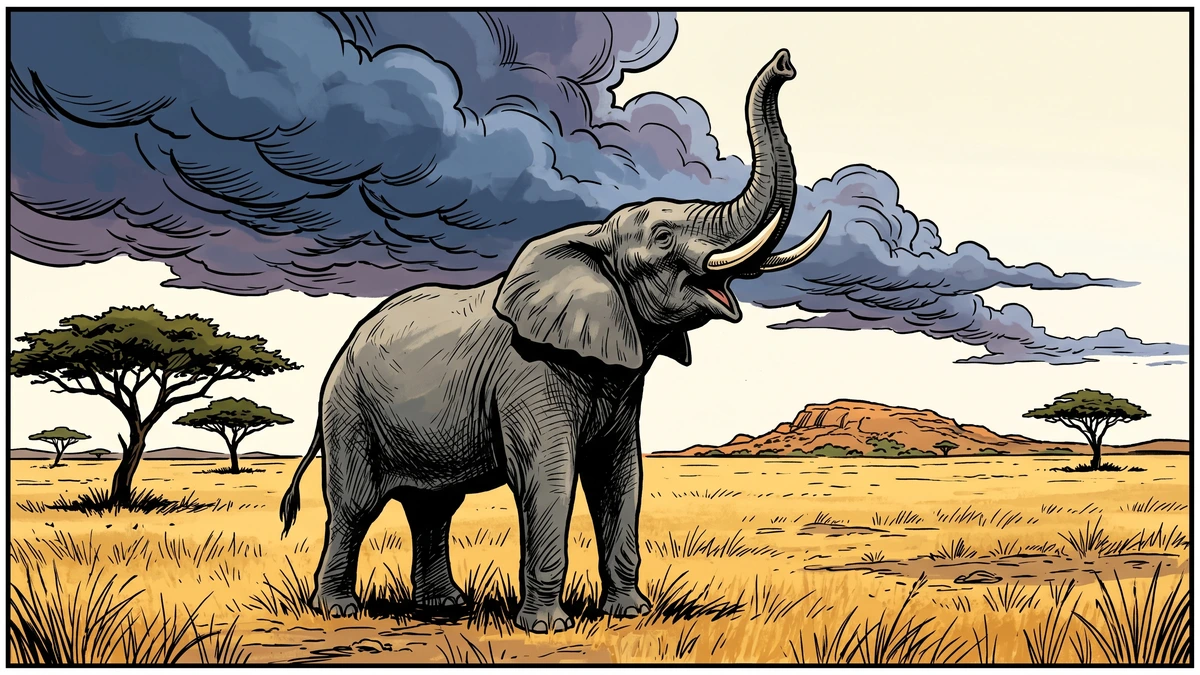
It began, as so many troubles do, with a boast. One hot afternoon Elephant and Rain stood talking on the plain, and Elephant lifted his great trunk and asked who, of all the powers of the land, kept the animals alive. He answered his own question without waiting. It was he, Elephant, with his enormous strength: he pushed down trees so that smaller beasts could reach the high leaves, he opened paths through the thick bush, he broke a road for the whole company of the plain. Without Elephant, he declared, the animals would starve.
Rain listened, and then answered softly, in the way that Rain has of saying enormous things quietly. If Rain were to go away, Rain asked, would Elephant and all his animals not simply die? It was not a boast. It was a plain question, and it carried the weight of plain truth. But Elephant was in no mood for truth. He snorted. He called Rain a mere drizzle, a little wetness, a thing he did not need. And Rain, offended past speaking, said nothing more at all. Rain only turned and walked away across the sky — and the clouds went with it.
What followed was slow and terrible. The sun grew white and hard. Day after day no rain fell. The tall grasses yellowed and bent; the trees let their leaves drop; the streams shrank to threads and then to nothing. The rivers became roads of cracked mud. Elephant, who had needed no one, now wandered a dying country, and even his great strength could not push a single drop of water out of the baked ground. He had won the argument and lost the land.
The Last Water and the Tortoise Set to Guard It
In his thirst Elephant went begging for help. He asked Vulture to bring back the rain, and Vulture would not. He asked Crow — and Crow, after some persuading, worked a small spell of his own, and a thin scatter of drops fell from a passing cloud. It was not much. But it was enough to gather, trickling and pooling, into one shallow lagoon hidden between two low hills. Every other pan on the plain stood empty and dry. This single lagoon was now the whole hope of every living thing in the country.
And here Elephant made his second mistake, which was worse than the first. Instead of seeing the lagoon as a gift to be shared, he saw it as a possession to be owned. “This water is mine,” he announced. “I shall drink of it, and no other animal shall touch it.” Then, because he wished to go hunting and could not stand guard himself, he looked about for a sentry, and his eye fell on Tortoise. “Tortoise,” he commanded, “you are slow, but your shell is hard and you cannot be frightened off. Stay here and watch my water. If any animal comes to drink, send it away.”
So Tortoise was left alone beside the last water in the world, a small armoured creature given an impossible duty by a master who had not asked whether the duty was just. And one by one the thirsty animals of the plain came down between the hills to the lagoon’s edge: Giraffe stepping carefully, Zebra and Gemsbok, Wildebeest, the small swift Springbok and the Roodebok — all of them parched, all of them humble, all of them asking only for a mouthful of water to stay alive.
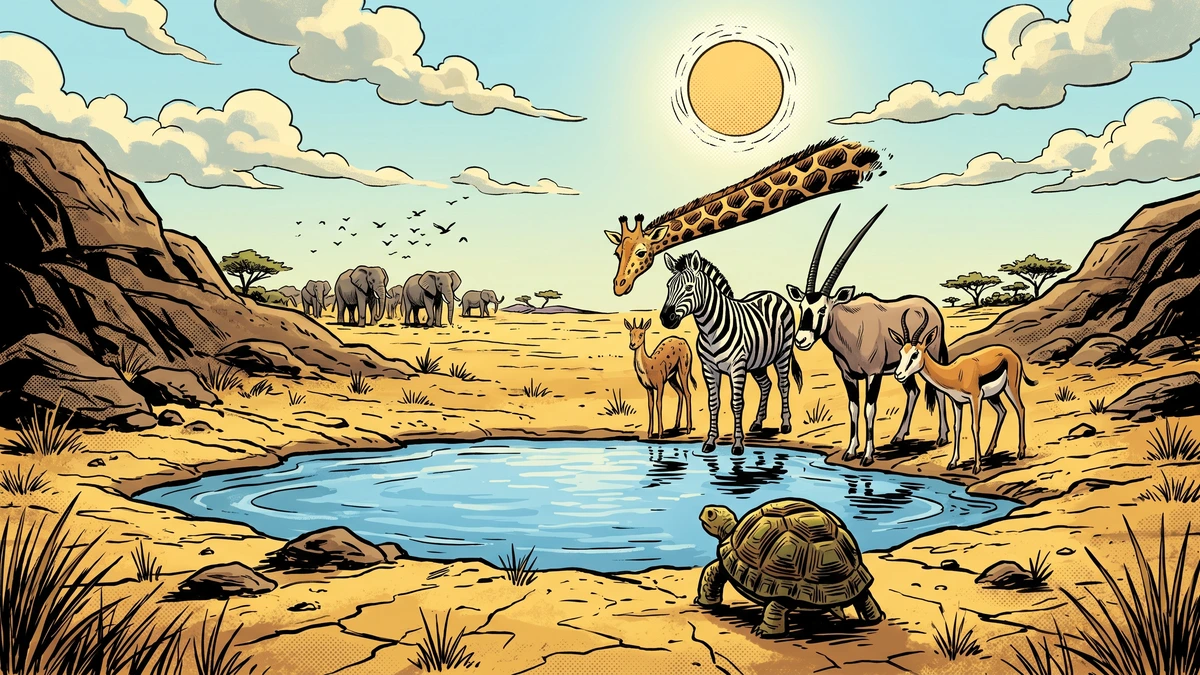
To each of them Tortoise gave the same patient answer. The water, he said, belonged to Elephant; Elephant had forbidden it; he could not let them drink. The animals pleaded, and Tortoise pitied them, but he had been set to a task and he kept to it. The thirsty herds turned away from the water and went, dry-mouthed, back into the dying bush. It is one of the quiet cruelties of the tale that Tortoise is not its villain. He is only a small creature obeying a large one — and the story lets us feel how a single beast’s selfishness, once it is given the force of a command, can spread its harm through every honest servant who carries it out.
Lion at the Waterhole
Then came Lion. Lion was thirsty like the rest, but Lion was not in the habit of being refused. When Tortoise gave him the answer he had given all the others — that the water was Elephant’s, and forbidden — Lion did not plead and did not turn away. He fell upon the little sentry, beat him, knocked him aside, and drank his fill of the lagoon while Tortoise lay tumbled and helpless on the bank. Then Lion went his way, and the water that Elephant had claimed for himself alone had been taken, in the end, by the one animal strong enough simply to seize it.
There is a sharp truth tucked into this turn of the tale. Elephant had built his whole plan on strength — on the idea that whatever is guarded firmly enough belongs to the guard. But strength is a game that someone can always play better, and a thing held only by force will be lost the moment a greater force arrives. Lion did to Elephant exactly what Elephant had tried to do to the plain: he treated the shared gift of water as a prize for the powerful. The lagoon taught the same lesson twice.
When Elephant came back from his hunt and found his water disturbed and his sentry battered, he was furious. He demanded to know who had dared to drink. Tortoise told him plainly: Lion had come, and Lion had beaten him, and Lion had drunk. But Elephant, swollen with his own pride, would not hear that the fault was Lion’s, or that it was his own for setting one small creature to guard a treasure from the strongest beast on the plain. He wanted someone near at hand to punish, and Tortoise was near at hand.
Swallowed — and the Trickster’s Quiet Victory
Elephant loomed over the little sentry in his rage. “Tortoise,” he thundered, “shall I chew you, or shall I swallow you whole?” It was the question of a bully who believes he has already won — who cannot imagine that a creature so small could have any answer worth hearing. But Tortoise, who had been thinking quietly inside his hard shell the whole time, gave the cleverest answer of the tale. “Swallow me, if you please,” he said.
It sounded like surrender. It was nothing of the kind. Elephant, delighted to be obeyed even in this, opened his great mouth and swallowed Tortoise down whole — shell and all — and felt, no doubt, that the matter was satisfactorily closed. But Tortoise was now exactly where his patient mind had aimed to be: not crushed, not chewed, but safe inside his armour and inside the giant, carried into the very centre of all that strength. And there, slowly and steadily, in the way that Tortoise does everything, he set to work, until at last mighty Elephant sank down upon the plain and moved no more. When all was still, Tortoise crept out of the fallen giant unhurt, and walked away across the country wherever he wished to go — the smallest creature on the plain, and the last one standing.
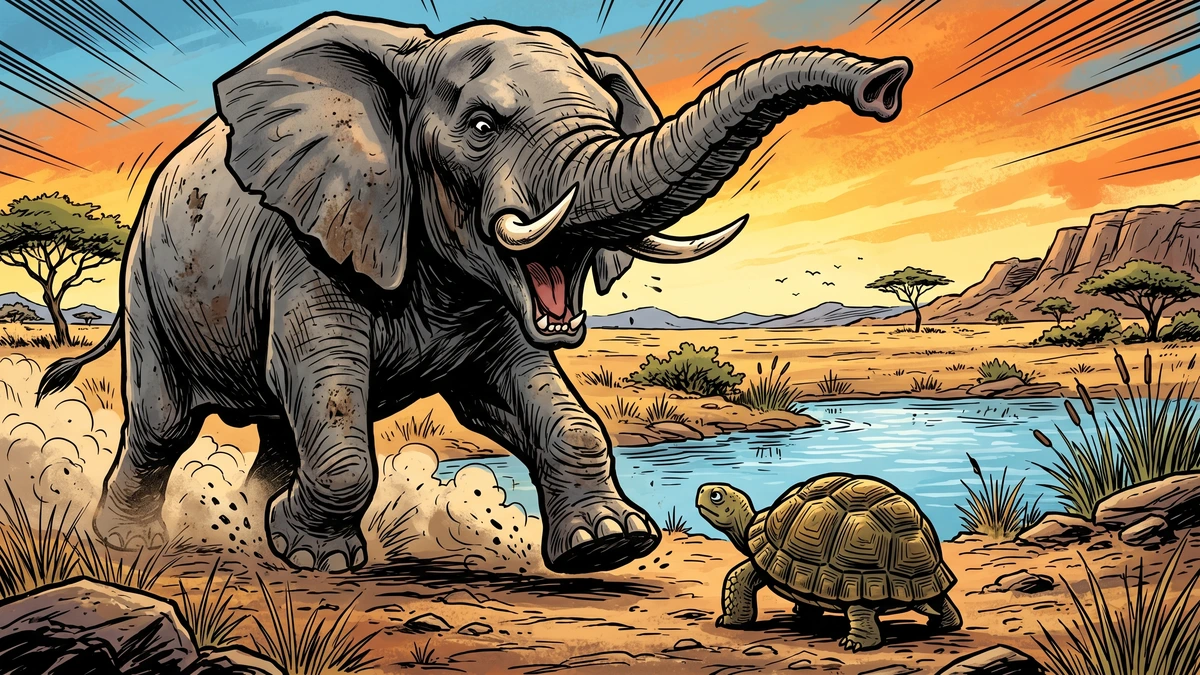
It is worth pausing on how the tale arranges its ending. Tortoise never matches Elephant strength for strength; he never even tries. He cannot push down a tree or break a path or frighten a lion. What he can do is wait, and think, and turn his enemy’s own appetite into the instrument of his enemy’s undoing. Elephant is beaten not by a greater giant but by his own greed — the same greed that swallowed the water of the plain now swallows the one creature it should have feared. The story-tellers of the dry country did not need to add a sermon. They simply let the proud beast eat the lesson, and let the small wise one walk free.
The Moral of the Tale
“Elephant and Tortoise” carries its teaching on two levels, and both still hold. The first is the lesson Rain offered Elephant at the very beginning, before any of the trouble started — the lesson of how living things truly depend upon one another. In the old text of the tale, when Elephant boasts that he alone keeps the animals alive, Rain answers with a question that the whole story then spends itself proving true:
“If you say that I do not nourish you, when I go away, will you not die?”
— Rain to Elephant, in South-African Folk-Tales (1910)
Elephant’s pride could not bear that question, and so he learned its answer the hard way, in a country turned to dust. No power stands alone. The strongest beast on the plain still drinks the rain’s water, still eats the grass the rain has grown; the mightiest is held up, every single day, by the gifts of others he is too proud to thank. To boast that one needs no one is not strength at all. It is the beginning of ruin.
The second lesson belongs to Tortoise, and it is the lesson the small have always loved best: that cleverness and patience outlast brute force. The plain in this story is ruled, from beginning to end, by creatures who trust in power — Elephant who owns, Lion who seizes. Both are answered by a slow armoured creature who never raises his voice and never wins a fight, and who is, at the close of the tale, the only one of the three still walking. The story does not despise strength. It simply refuses to be impressed by it. Real mastery, it says, lies in knowing how to wait, how to think, and how to turn a mightier opponent’s own nature against him.
There is, too, a warning folded in for everyone who is neither an Elephant nor a Tortoise. The thirsty animals — Giraffe, Zebra, Springbok, all the humble herds — suffer most in this tale, and they suffer because one beast decided that a shared gift was private property. Selfishness, the story shows, is never a private sin: when the powerful hoard, it is the gentle and the many who go without. The water of the plain was never Elephant’s to own. It belonged, like the rain itself, to everything that lived and thirsted under that hard bright sky.
Origins: James A. Honey and “South-African Folk-Tales”
This tale was set down in print in South-African Folk-Tales, a collection compiled by James A. Honey and published in New York in 1910. Honey gathered the stories of the southern African plains — tales of the San (Bushmen), the Khoikhoi (then called Hottentots), and their Zulu and other neighbours — and rendered them into English for readers far from the dry country where they were born. He was open about the layered history of his material: many of the stories, he noted, were Bushman tales at their root, carried over time into the keeping of the Khoikhoi and other peoples, so that a single tale might belong, truly, to more than one nation at once. “Elephant and Tortoise” sits in exactly that ancient shared layer.
Honey’s collection did not stand alone. It drew on, and stands beside, the pioneering nineteenth-century work of the philologist Wilhelm H. I. Bleek, whose Reynard the Fox in South Africa; or, Hottentot Fables and Tales (1864) first brought the animal stories of the Khoikhoi to a wide European audience, and whose later labours with Lucy Lloyd preserved the language and lore of the ǀXam Bushmen in one of the most precious folklore archives ever assembled. Through that lineage, “Elephant and Tortoise” reaches back into one of the oldest continuous storytelling traditions on earth — the narrative heritage of peoples whose ancestors had walked, and watched the rain, and told tales of it, on those same plains for many thousands of years.
In the international system used by folklorists to compare stories across cultures, the tale gathers up several widespread motifs. Its closing turn — a small creature swallowed alive who destroys the swallower from within and emerges unhurt — belongs to the family catalogued as Motif F912, “Victim kills swallower from within,” and the related Motif K952, “Animal (ogre) killed from within,” ideas found in story traditions across the world, from the biblical Jonah to countless trickster tales. Its larger shape — the slow, weak, clever animal who overcomes a mighty opponent — is the great motif group L315, “Small animal overcomes large,” and the broad theme of L300–L399, “Triumph of the weak.” And its opening, the quarrel over who is truly the stronger, is a debate-tale: a contest of pride between the visible giant and the invisible giver, settled not by argument but by the slow verdict of a dying land.
Why This Tale Has Lasted
“Elephant and Tortoise” has survived for so long, and travelled so far, because it is built around a truth that never goes out of date. Every generation produces its Elephants — the powerful who mistake their power for independence, who imagine that because they are large they are owed the world, who say to the quiet givers around them, “I do not need you.” And every generation watches, sooner or later, the dry country that such pride creates. The tale gives that recognisable folly a shape a child can hold: a great grey beast, a vanished cloud, a plain of cracked mud.
It has lasted, too, because it offers the listener the deep satisfaction of the small triumphant. Most people, most of the time, are not the strongest creature in the room. The story of Tortoise speaks straight to that ordinary condition and turns it into a kind of hope: you need not be mighty to prevail; you need only be patient, watchful, and wise enough to let a bully’s own nature defeat him. There is a reason this same figure — the tiny clever animal who brings down the giant — appears in the folklore of nearly every people on earth. It tells the truth about how the weak actually survive.
And finally the tale has lasted because of its first and largest idea — that all life is bound together, that no creature feeds itself alone, that the proud who deny their dependence are simply the last to understand it. The peoples of the dry southern plains knew this in their bones, because they lived where the rain’s coming and going was the difference between plenty and death. They wrapped that knowledge in a story funny enough for children and true enough for elders, and sent it down the centuries: a quarrel, a drought, a last lagoon, and a small armoured creature walking away alive. It is a tale about water, and about pride, and about patience — and the country that first told it knew, better than anyone, that the soft grey rain is mightier than the elephant, and that the slow can outlast the strong.
You May Also Like
 African Folk Tales
Ages 6-8
African Folk Tales
Ages 6-8
Tink-Tinkje
The southern African folk tale 'Tink-Tinkje', the Cape form of the worldwide 'election of the king of birds' fable, in which the smallest bird wins the crown by cleverly riding unfelt on the soaring vulture's wing.
 African Folk Tales
Ages 6-8
African Folk Tales
Ages 6-8
The Lion And The Wolf
The Lion And The Wolf: A certain old lady had a very fine flock of sheep. She had fed and cared for them so well that they became famous for their fatness. The
 African Folk Tales
Ages 6-8
African Folk Tales
Ages 6-8
How Wisdom Became The Property Of The Human Race
How Wisdom Became The Property Of The Human Race. Long ago, wisdom belonged only to a few. Learn how one person changed everything by sharing knowledge.