The Lioness And The Ostrich
The Lioness and the Ostrich is a Khoikhoi folk tale of southern Africa from Bleek's Reynard the Fox in South Africa (1864) and Honey's South-African Folk-Tales (1910). A lioness accepts an ostrich as her equal, then lets her cubs' flattering scorn break that bond - and dies of it.
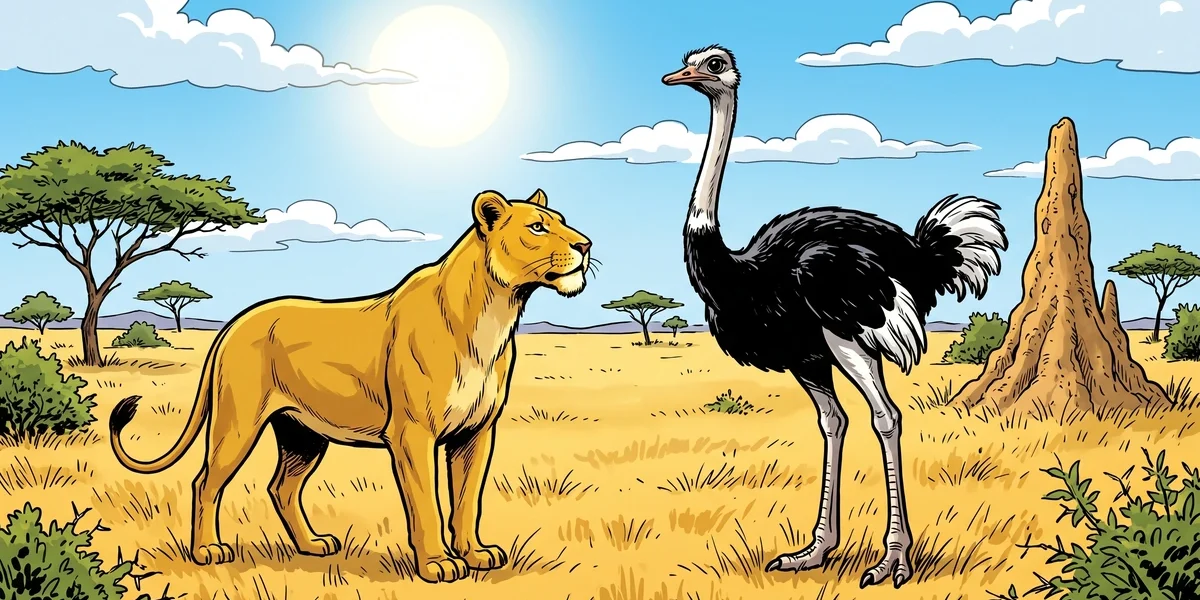
On the wide dust-pale plains of the Cape interior, where thornbush throws its thin shade and ant-hills rise like clay towers from the cracked earth, there once lived a lioness who believed there was no creature on the veld her equal. The tale of how she learned otherwise — from a tall, flightless bird with a single curved claw and not one tooth in her head — is among the most quietly devastating of the Khoikhoi animal fables. It is short, almost terse in the telling, yet it carries one of the oldest warnings folklore has ever offered: that scorn for an acknowledged equal is the surest road to ruin, and that the most dangerous strength is the strength you cannot see.
Origin & Canonical Attribution
Tradition: Khoikhoi (Khoekhoe / “Hottentot”) animal fable of southern Africa, drawn from the older Bushman (San) oral stratum of the Cape and Great Namaqualand.
Earliest printed source: Wilhelm Heinrich Immanuel Bleek, Reynard the Fox in South Africa; or, Hottentot Fables and Tales (London: Trübner & Co., 1864), chiefly translated from original manuscripts in the library of Sir George Grey, K.C.B.
Anthology used here: James A. Honey, South-African Folk-Tales (New York: Baker & Taylor Company, 1910), where “The Lioness and the Ostrich” appears at page 62, between “The Lost Child” and “Crocodile’s Treason.”
Tale type: No single Aarne–Thompson–Uther (ATU) type fits this episode; it belongs to the Khoikhoi cycle of contest-and-conflict animal fables. Closest motif anchors: B263 (war between groups of animals) and the “duel of two animals” pattern, together with J950 (presumption of the strong), K2369 (deception in the duel — the ant-hill feint), and the recognition-and-reversal structure common to San predator tales.
Read time: about 10 minutes.
Honey’s 1910 collection gathers forty-odd tales “mainly from the Bushmen,” many of them — as he frankly notes in his preface — originally San stories “taken over by Hottentots or Zulus.” “The Lioness and the Ostrich” is one of these border tales: its bone structure is San, its surviving voice is Khoikhoi, and it reaches the modern reader only because Bleek — the German-born philologist who would later, with his sister-in-law Lucy Lloyd, compile the great |xam Bushman archive — set it down from a written manuscript in the 1850s. The English is plain to the point of starkness because Bleek translated faithfully rather than prettily, and Honey reprinted him without ornament. What looks like simplicity is in fact fidelity: this is very close to how a Khoikhoi narrator would have shaped the tale around an evening fire.
The Meeting of Equals
The fable opens not with a journey or a wish but with a sound. A lioness roars; far off, an ostrich roars back. The lioness, intrigued and perhaps affronted that anything on her plains should answer her, walks toward the source of the voice. They meet. And here the story does something subtle and important: the lioness does not attack. She asks for a demonstration. “Please to roar,” she says — and the ostrich roars. Then the lioness roars. The narrator’s verdict is four words long: “The voices were equal.”
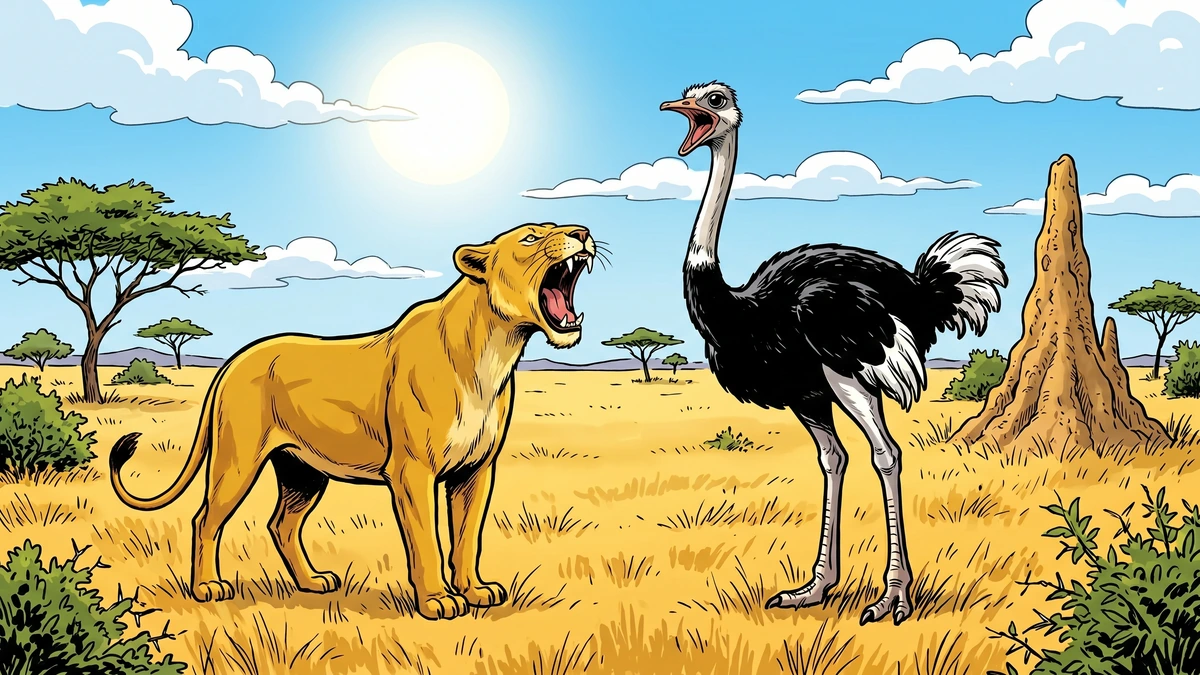
That the ostrich can “roar” at all is a piece of close natural observation folded into the fable. The male ostrich does produce a deep, resonant, booming call — a low boo-boo-booo-hooo that carries for kilometres across open country and has genuinely been mistaken, by travellers and herders alike, for the voice of a lion. The Khoikhoi storyteller knew this; the tale is built on it. The lioness’s response, “You are my match,” is therefore not flattery and not a trap. It is an honest appraisal between two large, loud, formidable creatures of the same landscape. The fable has, in its first paragraph, established a contract of equality — and the entire tragedy that follows is the story of that contract being broken.
The Joint Hunt
Equality acknowledged, the lioness proposes partnership: “Let us hunt game together.” They sight eland — the largest of the African antelopes, a worthy quarry — and close in. The result is quietly humbling for the lioness. She catches one. The ostrich, striking with “the claw which was on his leg,” kills a great many. When the two partners regroup over the carcasses, the lioness sees plainly that the ostrich has out-hunted her.
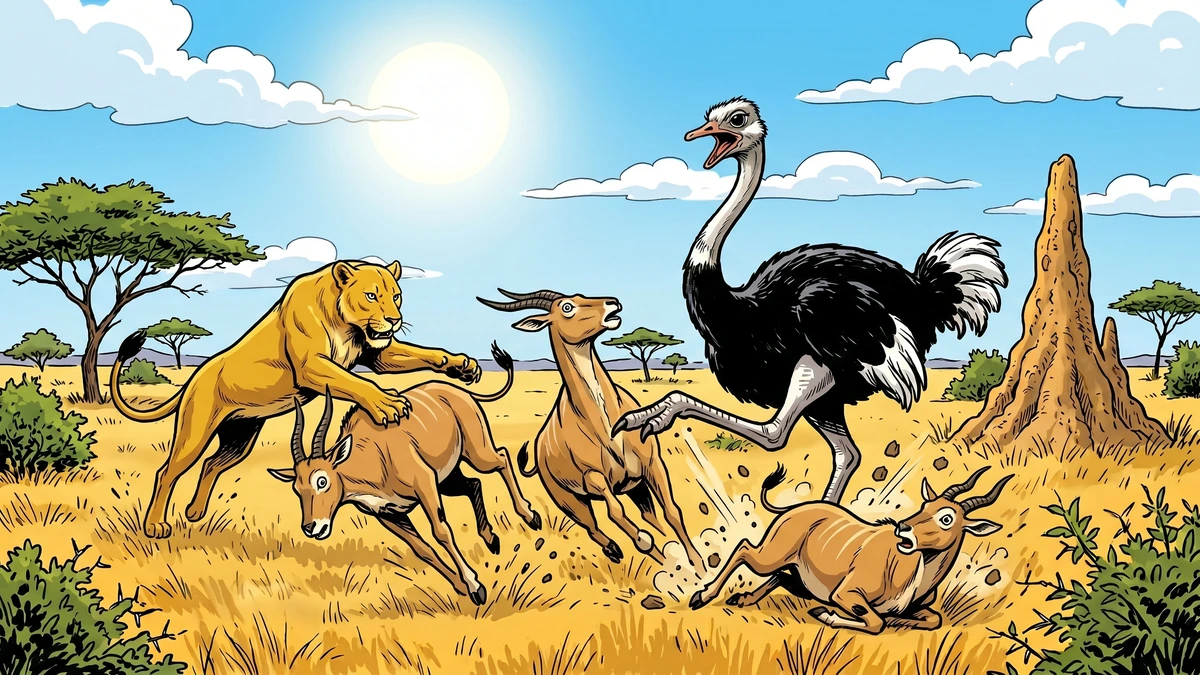
This is the tale’s second act of accurate natural history. The ostrich is the only bird on earth with just two toes, and the inner toe carries a broad, blunt, formidable nail — a claw that, delivered with the force of a forward kick from the most powerful running leg in the animal kingdom, can disembowel a predator. Rangers and farmers in southern Africa still treat a cornered ostrich with real caution for exactly this reason. The fable does not invent the ostrich’s weapon; it simply notices it, and asks what it would mean if the bird used it as a lion uses claws and teeth. The answer the story gives is unsettling: the toothless, flightless bird is the deadlier hunter. The lioness has now been shown, twice over, that her partner is not merely her match but in some respects her superior. A wiser creature would have absorbed the lesson. The lioness files it away as a grievance.
The Cubs’ Discovery
After the hunt the partners share the kill in a curious, telling way. The lioness rips the carcasses open and eats the flesh with her cubs; the ostrich, who cannot chew, eats only the blood. Then, full and easy, they sleep through the heat in the shade. It is the most peaceable moment in the fable — two equals at rest, the cubs tumbling about — and it is precisely here that the story turns.
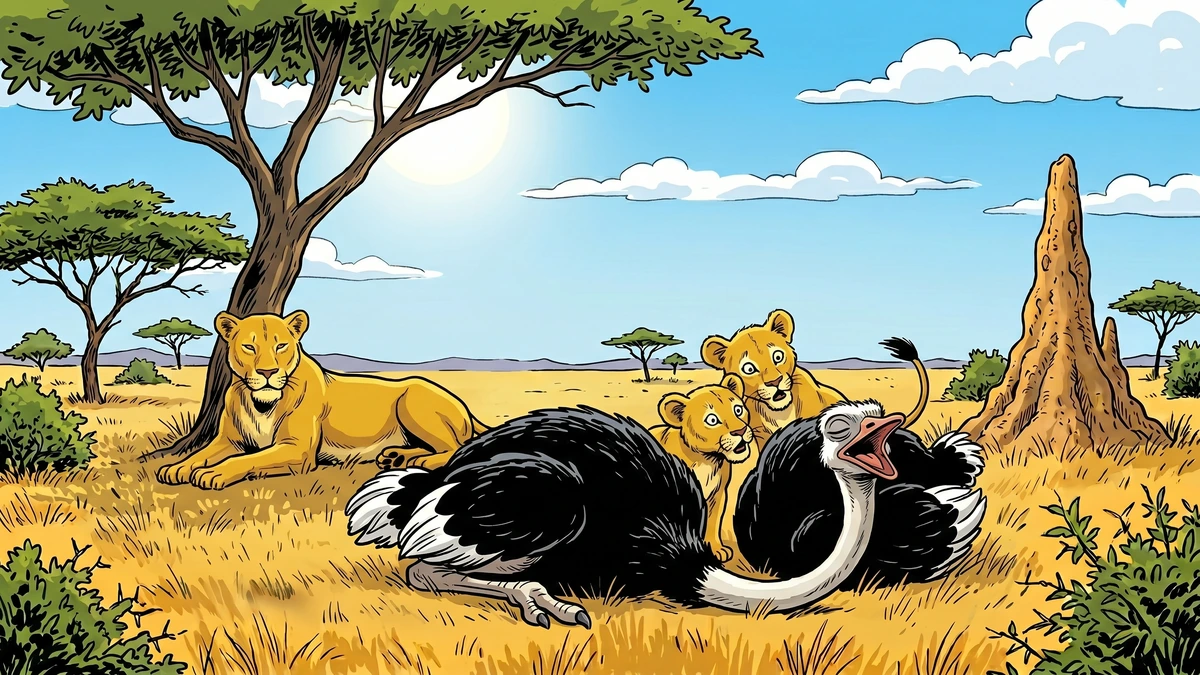
The cubs, playing, wander over to the sleeping ostrich. The bird sleeps with her beak open, and the young lions look inside and see something that astonishes them: the great roaring hunter has no teeth. They run to their mother with the discovery dressed as an accusation: “This fellow, who says he is your equal, has no teeth; he is insulting you.” The genius of the tale is concentrated in that sentence. The cubs have observed something true — the ostrich is indeed toothless — but they have drawn from it something false. They mistake a difference for a weakness, and a weakness for an insult. And the lioness, who has twice seen the ostrich kill in numbers she cannot match, chooses to believe the children rather than the evidence of her own hunt. Pride supplies the conclusion that vanity has been waiting for. She rises and goes to wake the bird with the worst sentence in the story: “Get up, let us fight.”
The Duel at the Ant-Hill
The ostrich does not plead, does not argue the broken contract, does not remind the lioness that they had agreed to be equals. The bird simply accepts the challenge and proposes the ground: “Go to that side of the ant-hill, and I will go to this side of it.” The duel is brief. The ostrich first strikes the ant-hill itself, sending a mass of earth toppling toward the lioness — a feint, a screen of dust and clay that the lioness must contend with. Then, with the second blow, the ostrich strikes home: into a vulnerable spot near the liver. The lioness falls dead.
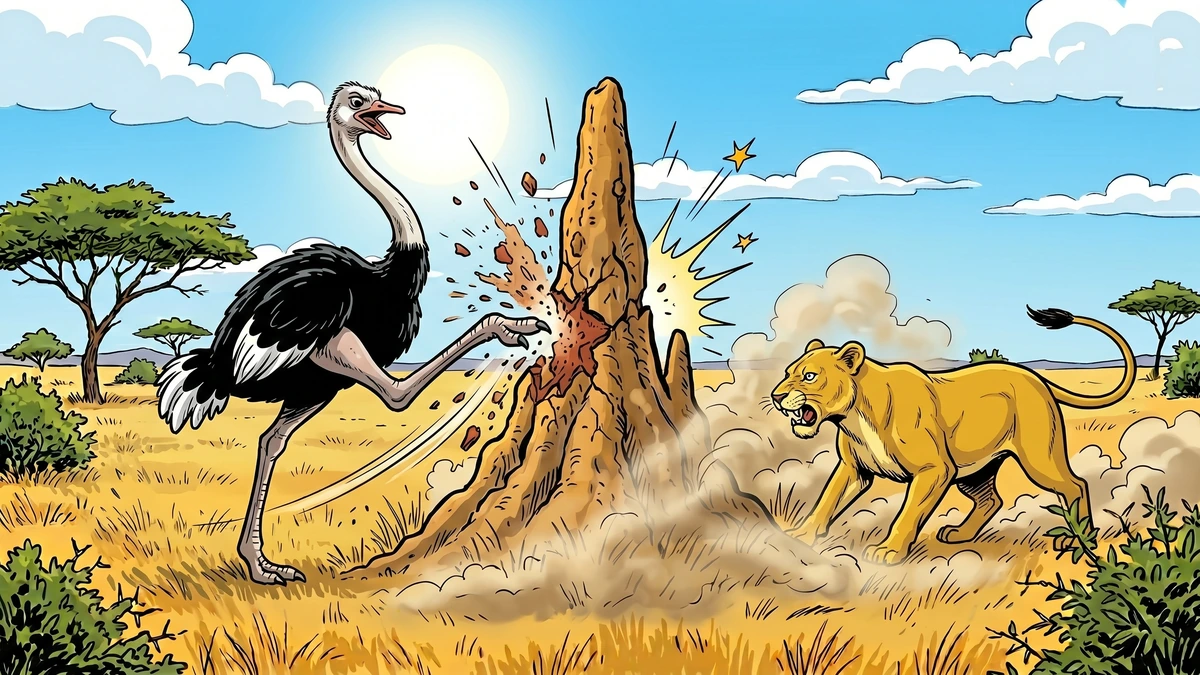
It is worth dwelling on how unsentimental the ending is. The ostrich wins not by magic, not by trickery in any moral sense, and not by superior virtue, but by the same claw that had already killed a great many eland — used now with one tactical flourish, the ant-hill thrown as a distraction. The toothlessness the cubs mocked was never the measure of the bird. The lioness died of a category error: she let her young define strength as teeth, when the ostrich’s strength had always been in the leg and the claw, in plain sight, demonstrated on the hunt she herself had watched. The fable refuses to soften this. There is no reconciliation, no restored friendship, no lesson spoken aloud by a surviving character. There is only a body near an ant-hill and a silence the listener is left to fill.
The Moral of the Tale
Khoikhoi fables rarely append an explicit moral; they trust the shape of the story to deliver it. “The Lioness and the Ostrich” carries at least three lessons folded into one another. The first is about respecting a proven equal: the lioness and the ostrich had freely entered a contract of equality, tested and confirmed it, and the lioness destroyed herself the moment she let pride break that bond. The second is about the danger of judging strength by its visible signs: teeth look like power, and so the cubs — and then the lioness — assumed their absence meant weakness, when the real weapon was the unglamorous claw on the bird’s foot. The third, and perhaps the sharpest, is about whose counsel a leader chooses to trust: the lioness had her own eyes, her own memory of the hunt, and the testimony of inexperienced cubs — and she chose the cubs, because they told her what her vanity wished to hear.
The old Cape Afrikaans proverb that southern African storytellers reach for when a quiet thing turns out to be deadly catches the fable exactly:
“Stille waters, diepe grond — onder draai die duiwel rond.”
“Still waters, deep ground — underneath, the devil turns about.” What is calm and unremarkable on the surface may run dangerously deep; never mistake quietness for harmlessness.
The ostrich is the still water of this proverb: toothless, flightless, easy for cubs to laugh at — and entirely capable of killing the queen of the plains.
Cultural and Scholarly Context
To read this fable well, it helps to know where it sits. The Khoikhoi and the San (Bushmen) were the oldest inhabitants of southern Africa, and their oral literatures overlap and interpenetrate. Bleek, working in Cape Town from the 1850s, recognised that many of the “Hottentot” tales he was translating had a deeper San substratum, and he made the recording of that literature his life’s work — culminating in the famous Bleek and Lloyd |xam archive, now a UNESCO Memory of the World collection. Reynard the Fox in South Africa (1864) was his first major publication of the Khoikhoi material, and it gave English readers their earliest organised glimpse of the southern African animal fable: jackal and lion, tortoise and ostrich, lion and ostrich, each story compressed and unsentimental.
“The Lioness and the Ostrich” belongs to a recognisable sub-group within that corpus: the contest of seeming equals. In the better-known Khoikhoi fables the jackal triumphs over the lion through cunning — the trickster outwitting brute force. This tale inverts the expectation. There is no trickster here. The ostrich never deceives the lioness about what she is; she roars honestly, hunts openly, declares plainly that the lioness should rip the carcass while she takes the blood. The deception in the story comes not from the ostrich but from the cubs, who deceive themselves and then their mother. The fable thus belongs less to the trickster tradition than to the older, harder San vein of etiological realism — stories that explain why animals are dangerous, why they fight, and what their bodies can do. It sits naturally beside “Tortoises Hunting Ostriches” a few pages later in Honey’s book, another tale that treats the ostrich with wary, knowing respect.
There is also a strong ecological intelligence at work. Everything the fable asks the listener to accept is true: the ostrich’s booming call really can be mistaken for a lion’s; the ostrich’s clawed inner toe really is a lethal weapon; the ostrich really is toothless and swallows grit and prey-blood rather than chewing; and lion and ostrich really do share the same dry, open habitat. A Khoikhoi child hearing this story was being taught natural history and social ethics in the same breath — how the veld actually works, and how a person ought to behave within a partnership.
Even the duelling ground is chosen with care. The ant-hill — in southern Africa, a towering termite mound, sun-baked nearly to the hardness of brick — is one of the most familiar landmarks of the open veld, and the fable uses it as both stage and weapon. When the ostrich strikes the mound and sends its mass toppling toward the lioness, the listener who has walked that country understands at once how much earth that is and how it would blind and stagger an opponent. The detail is not decoration; it is the storyteller showing that the ostrich fights with intelligence as well as force, reading the terrain and turning a feature of the landscape into part of the attack. A creature that can do that is no one’s harmless inferior, whatever its mouth may lack.
It is worth noting, too, how the tale handles its female protagonists. Both the lioness and, in Honey’s telling, the ostrich are written with the weight of mothers and providers: the lioness has cubs to feed, and the partnership is, at heart, a working arrangement about food and survival. The fable’s tragedy is therefore domestic as much as heroic. It is a household that destroys itself — a mother undone by listening to her children’s flattery instead of her own hard-won experience — and that intimate, recognisable scale is part of why the story still lands.
Why This Tale Has Lasted
Many folk tales survive because they are charming. “The Lioness and the Ostrich” has survived for the opposite reason: it is bracing. It is one of the rare fables in which the proud, powerful, beautiful character is simply wrong, and dies of being wrong, and is not redeemed. For a hundred and sixty years it has kept its grip on readers because that refusal to comfort feels honest. We all know the lioness. We have all watched someone — sometimes ourselves — receive a flattering misreading from people who do not know better, and prefer it to the harder evidence of our own experience.
The tale also lasts because its central image is unforgettable and portable. A creature judged harmless because it lacks the obvious weapon — no teeth, no flight — and turns out to carry a hidden one: that is a pattern the human mind never tires of. It is the underestimated newcomer, the quiet colleague, the small nation, the soft-spoken rival. Every generation rediscovers the ostrich. And every generation rediscovers the cubs, too — the cheerful, confident voices that report a true observation and a false conclusion in the same sentence, and are believed because believing them is pleasant.
That is the enduring gift of this short, severe Khoikhoi fable. It does not tell us to be kind, exactly, or clever, or brave. It tells us something stranger and more useful: that the contract of equality, once honestly made, is dangerous to break; that strength wears disguises; and that the most expensive mistake a powerful creature can make is to let vanity choose which counsel to believe.
Frequently Asked Questions
Where does the folk tale “The Lioness and the Ostrich” come from?
It is a Khoikhoi (Khoekhoe, formerly called “Hottentot”) animal fable of southern Africa, drawn from the older Bushman (San) oral tradition of the Cape and Great Namaqualand. It was first set down in print by the philologist W. H. I. Bleek in Reynard the Fox in South Africa; or, Hottentot Fables and Tales (1864), translated from manuscripts in Sir George Grey’s library, and was reprinted in James A. Honey’s anthology South-African Folk-Tales (1910), where it appears at page 62.
How can an ostrich “roar” like a lion in the story?
This is accurate natural history folded into the fable. The male ostrich produces a deep, resonant booming call that carries for kilometres across open country, and it has genuinely been mistaken by travellers and herders for the voice of a lion. The Khoikhoi storyteller knew this, and the whole plot rests on it: because the two voices truly are “equal,” the lioness honestly accepts the ostrich as her match.
Why is the ostrich able to kill the lioness if it has no teeth?
The ostrich’s weapon was never its mouth. The ostrich is the only bird with just two toes, and the inner toe carries a broad, formidable claw. Delivered with a forward kick from the most powerful running leg of any animal, that claw can disembowel a predator. In the tale the ostrich uses it first to kill many eland on the joint hunt and finally to strike the lioness in a vulnerable spot near the liver. Rangers in southern Africa still treat a cornered ostrich with real caution for this reason.
What is the moral of “The Lioness and the Ostrich”?
The fable carries three intertwined lessons: respect a proven equal once a contract of equality has been honestly made; never judge strength only by its visible signs, because the ostrich’s real weapon was the unglamorous claw on its foot, not teeth; and choose carefully whose counsel you trust. The lioness died because she believed her inexperienced cubs, who reported a true observation (the ostrich is toothless) and a false conclusion (therefore it is weak), over the evidence of the hunt she had watched herself.
How is this tale different from the famous Khoikhoi jackal-and-lion fables?
Most well-known Khoikhoi fables are trickster stories in which the cunning jackal outwits the powerful lion. “The Lioness and the Ostrich” has no trickster. The ostrich never deceives the lioness about what she is; she roars honestly and hunts openly. The only deception comes from the lion cubs, who deceive themselves and then their mother. The tale therefore belongs to the older San vein of etiological realism, which explains why animals are dangerous and what their bodies can really do, rather than to the trickster tradition.
You May Also Like
 African Folk Tales
Ages 9-12
African Folk Tales
Ages 9-12
The Story Of Hare
The Story of Hare is a Xhosa folktale from South Africa. Five careless watchmen die guarding the animals' fat from the monstrous inkalimeva, until the clever hare alone outwits the beast by its own trick - then nearly undoes himself through greed.
 African Folk Tales
Ages 6-8
African Folk Tales
Ages 6-8
The Squirrel And The Spider
A fast squirrel and a patient spider discover that every creature has special and valuable talents.
 African Folk Tales
Ages 6-8
African Folk Tales
Ages 6-8
King Chameleon And The Animals
An African folk tale about how the animals once chose a king by race — and why a clever little chameleon beat the swift hare to the stool of power.