The Story Of Hare
The Story of Hare is a Xhosa folktale from South Africa. Five careless watchmen die guarding the animals' fat from the monstrous inkalimeva, until the clever hare alone outwits the beast by its own trick - then nearly undoes himself through greed.
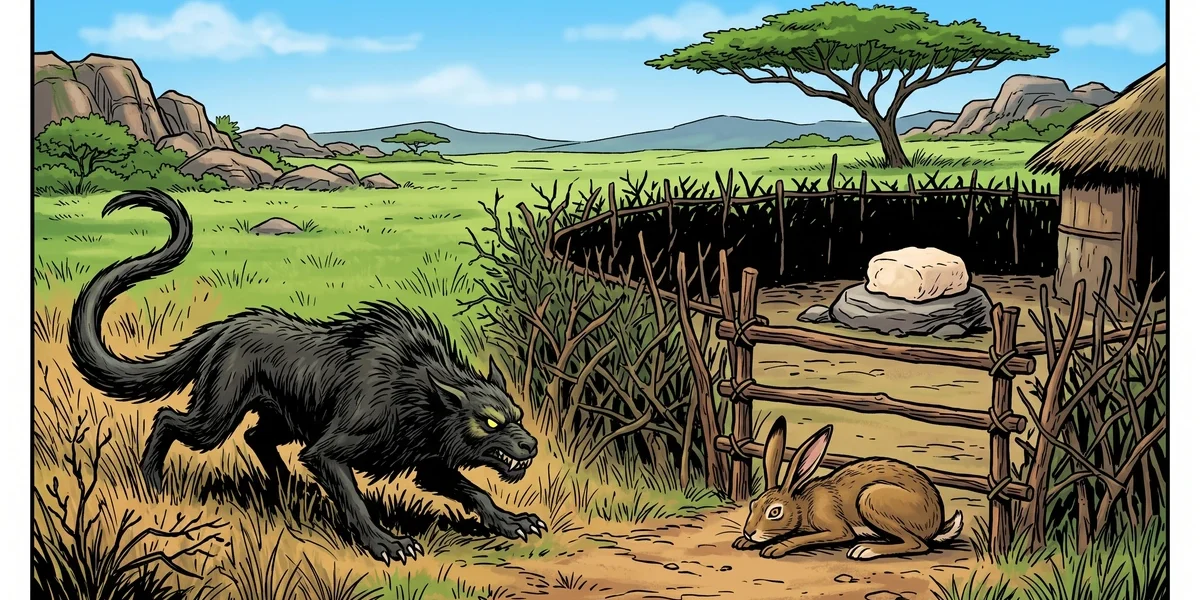
Among the animal tales of the amaXhosa of the Eastern Cape, The Story of Hare is one of the most quietly unsettling. It begins as a simple fable about a stolen store of fat and a succession of careless watchmen, and it ends as something stranger and darker — a portrait of a trickster whose cleverness saves him from one death only to drive him deeper into trouble. Collected from Xhosa narrators in the nineteenth century, the tale carries the unmistakable voice of the African hare-trickster, the small, sharp-witted creature whose descendants would later cross the Atlantic and reappear in the Americas as Brer Rabbit.
Origin & Canonical Attribution
Tradition: amaXhosa (Xhosa) oral tradition, Eastern Cape, South Africa
Earliest printed source: George McCall Theal, Kaffir Folk-Lore: A Selection from the Traditional Tales Current Among the People Living on the Eastern Border of the Cape Colony (London: Swan Sonnenschein, Le Bas & Lowrey, 1882; 2nd ed. 1886) — modern reissues titled Kaffir (Xhosa) Folk-Lore
Widely circulated reprint: James A. Honey, South-African Folk-Tales (New York: Baker & Taylor Company, 1910), where it appears as “The Story of Hare”
Tale family: African hare-trickster cycle; structurally a “succession of doomed watchmen” chain tale
Key motifs: K700–K735 capture by deception; K713 deception into allowing oneself to be bound; J2400-type foolish imitation; the false-reciprocity binding trick
The Animals’ Kraal and the Five Doomed Watchmen
In the time when the animals still held councils together, they built a kraal and laid up a store of fat inside it. Fat was wealth: it was food, medicine, ointment, and the substance of feasts, and the animals agreed it must be guarded. One of their number, they decided, would stay behind as keeper of the gate while the rest went about their business. The duty seemed light. It would not stay light for long.
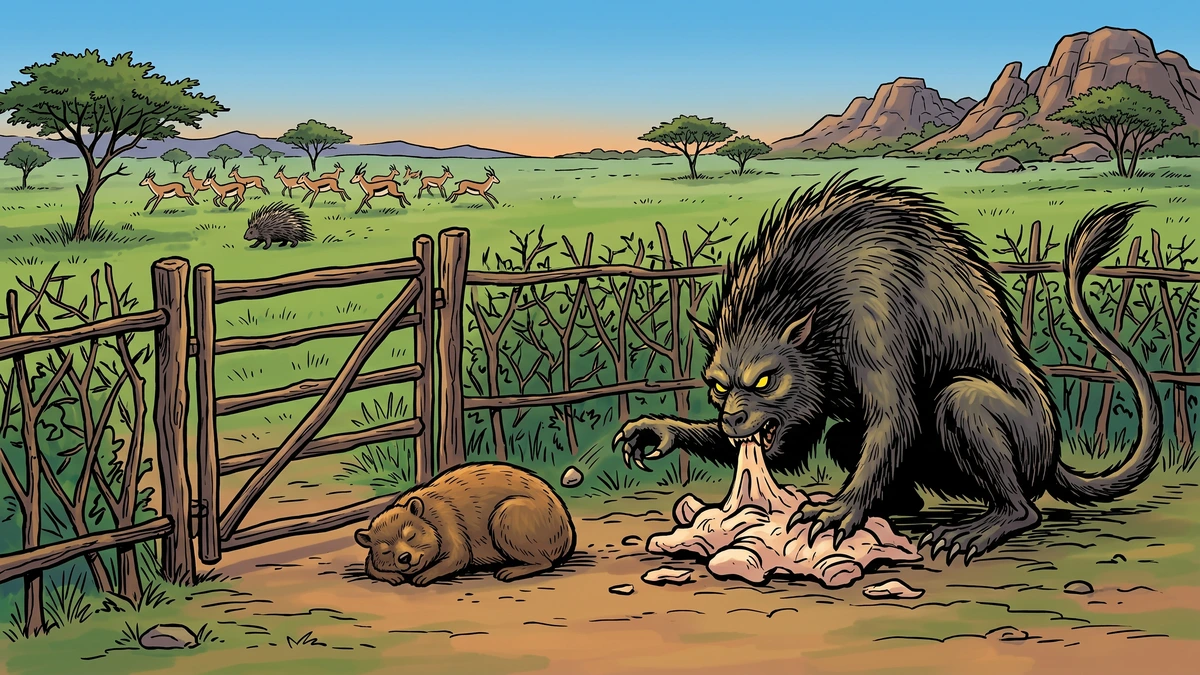
The first watchman was the coney — the imbila, the little rock-dassie of the koppies. He took his post, the animals dispersed, and within a short while the warmth of the day pulled his eyes shut. While he dozed, the inkalimeva — a fabulous, monstrous animal of Xhosa belief — slipped through the gate and devoured every scrap of fat. Then, with a cruelty that would become its signature, it tossed a small stone at the sleeping coney. The dassie woke, saw the empty store, and raised the cry that echoes through the whole tale: “The fat belonging to all the animals has been eaten by the inkalimeva!” The animals came running — and when they saw the loss, they killed the coney for failing them.
So began a grim pattern. The fat was replaced, and the polecat — the muishond, the ingaga — took the gate. The inkalimeva came again, this time bearing honey, and while the polecat ate the sweet gift his guest emptied the store behind his back. The stone, the cry, the returning animals, the killing of the watchman: the sequence repeated exactly. Then came the duiker, lured into a game of hide-and-seek until he wore himself out and slept. Then the bluebuck, soothed into drowsiness while the inkalimeva “scratched his head” in a show of friendship. Then the porcupine, tired out by races the inkalimeva deliberately let him win. Five watchmen, five identical betrayals, five killings. The inkalimeva never used force; it used flattery, generosity, play, and companionship — the very things a lonely guard most wants — and each gift was the bait of a trap.
The Hare Who Would Not Be Fooled
When the animals replaced the fat for the sixth time, they came to the hare — the umvundla. And the hare, alone of all of them, said no.
“The coney is dead,” he reminded them, “and the muishond is dead, and the duiker is dead, and the bluebuck is dead, and the porcupine is dead — and you will kill me also.” Here is the hinge of the whole story. The five watchmen before him had each treated the gate as a fresh task with no history; not one of them had learned from the corpse of the watchman before. The hare refused to be that kind of fool. He had watched, he had counted the dead, and he understood the shape of the danger before he ever met it. Only after the animals promised — with much persuasion — that they would not kill him did he agree to keep the gate.
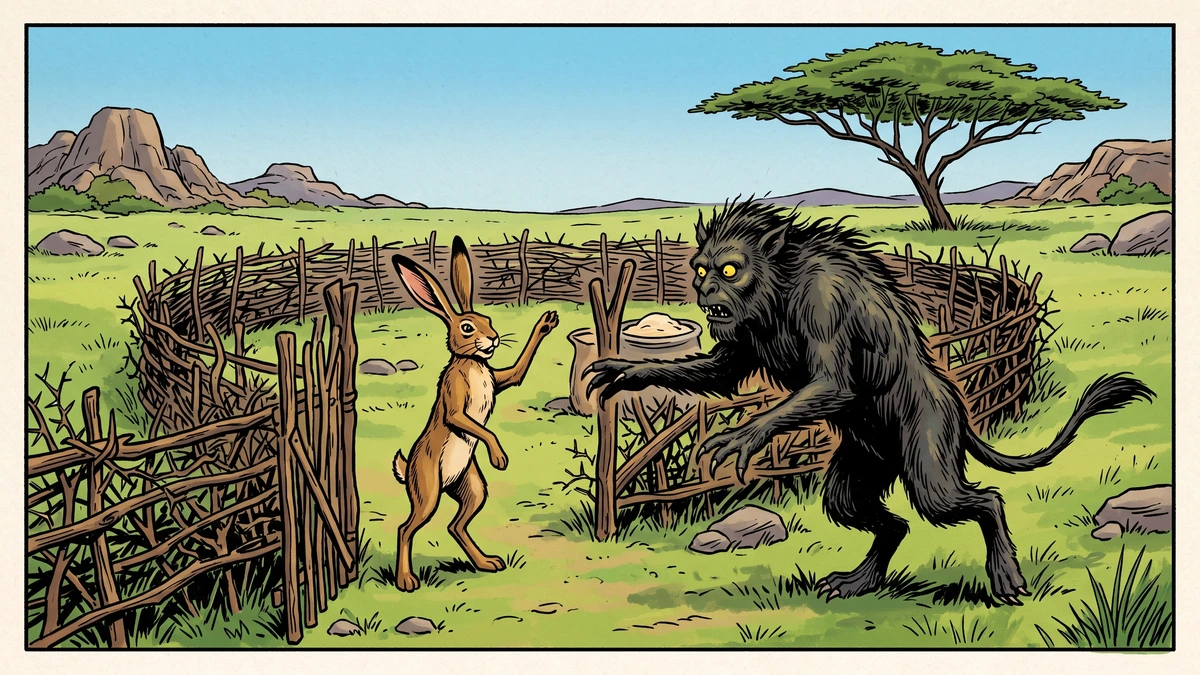
And then he did the one thing none of the others had done. When the animals had gone, he lay down at the gate exactly as a tired, careless watchman would — but he only pretended to sleep. The inkalimeva, seeing the familiar slumped figure, came confidently in and reached for the fat. “Let the fat alone,” said the hare, wide awake.
“Please let me have this little bit only,” the monster wheedled, falling back on the soft, coaxing voice that had undone five guards.
“Please let me have this little bit only,” the hare answered — mocking it, echoing its words straight back. It is a small, brilliant moment. The inkalimeva’s whole power lay in being charming and persuasive; the hare disarmed it simply by refusing to take the charm seriously, by turning its honeyed speech into a joke. The monster, thrown off balance, abandoned the theft and instead proposed friendship: let us be companions. The hare agreed — and a contest of two tricksters began.
The Trick of the Tied Tails
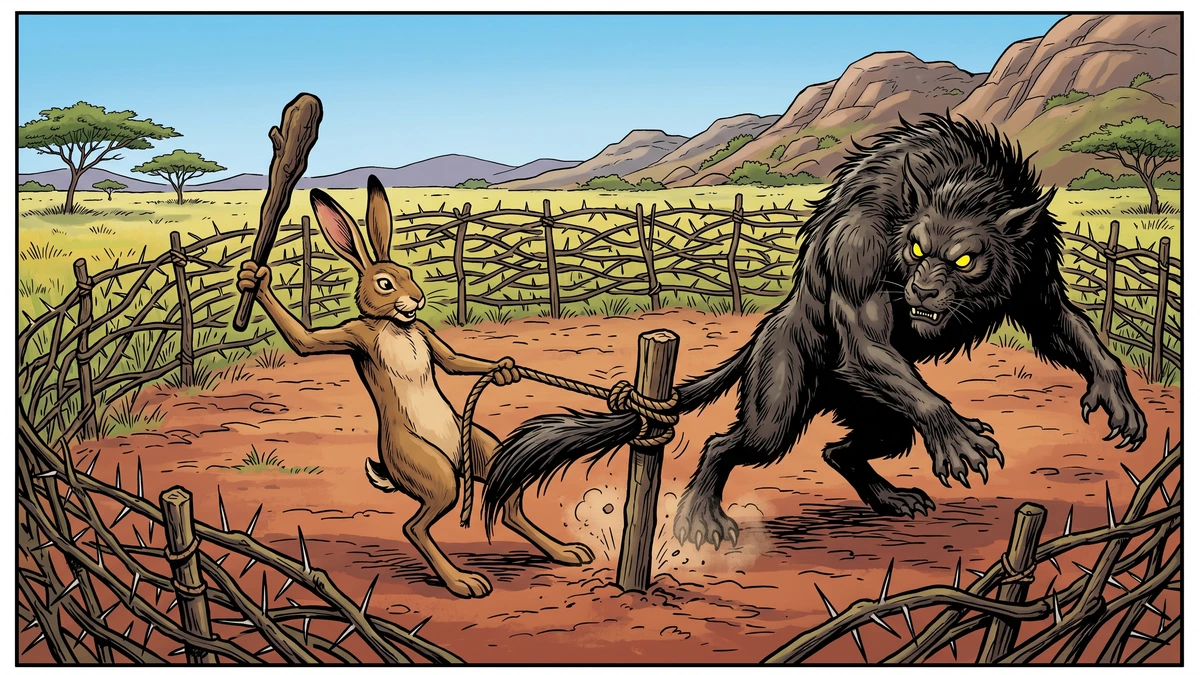
It was the hare who proposed the fatal game. Let us fasten each other’s tails together, he suggested — a gesture of binding companionship, the kind of playful pact the inkalimeva itself had always used to lull its victims. The monster, perhaps flattered to be offered its own sort of game, agreed at once.
The inkalimeva tied the hare’s tail first. “Do not tie my tail so tight,” the hare protested — and the monster, still in the mood of friendly play, loosened its knot and left the hare’s tail only lightly fastened. Then it was the hare’s turn. He bound the inkalimeva’s tail, and bound it, and drew the knot brutally fast. “Do not tie my tail so tight,” the inkalimeva said — the same words the hare had used. But the hare made no answer at all. He simply finished the knot until the monster was held immovably in place, took up his club, and killed it.
This is the structural heart of the tale: the trick of false reciprocity. The game looked perfectly fair — each animal would tie the other — but fairness was the disguise. The hare exploited a courtesy the inkalimeva had every reason to extend and no reason to suspect, because the inkalimeva would never have shown such courtesy itself. The monster that had conquered five watchmen through fake friendship was destroyed by a fake friendship of exactly the same kind. The hare did not out-fight the inkalimeva; he out-tricked the trickster, and he did it by studying how the trickster worked.
The Hidden Tail and the Long Flight
Here the tale takes its sharp, characteristic turn — for the hare is not a hero, and the story has no intention of letting us mistake him for one. With the inkalimeva dead, the hare ate its tail. All of it, save one small piece, which he tucked secretly into the fence. Then he raised the familiar cry, and the animals came running. Finding the monster slain at last, they rejoiced — and asked the hare for the inkalimeva’s tail, which by right should be carried to the chief.
“The one I killed had no tail,” the hare said.
It was a foolish lie, and the animals knew it — how can an inkalimeva be without a tail? They searched, found the hidden piece in the fence, and carried the proof to the chief. The hero of the kraal became a fugitive in a single sentence. The chief commanded that the hare be brought; the animals chased him; and the hare, who had been clever enough to kill a monster, was not wise enough to keep from eating the one trophy that would have made him safe. His appetite undid his cunning.
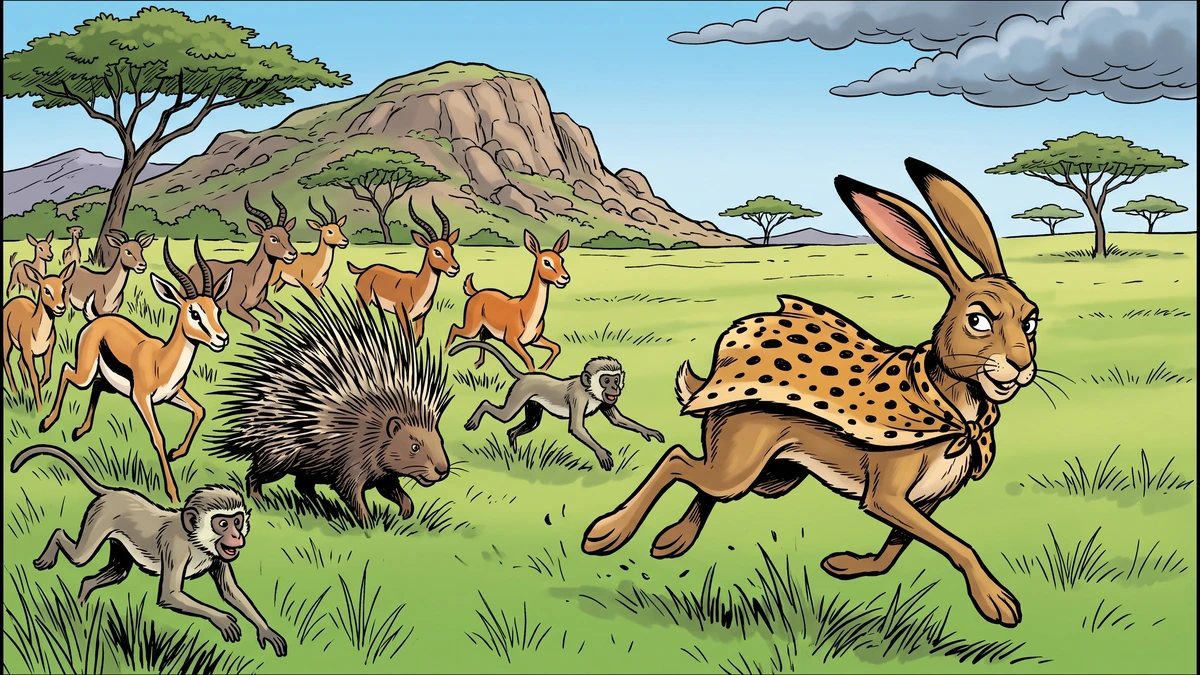
He fled into a hole. The animals set a snare at its mouth and went away, and the hare lay trapped underground for many days before slipping the snare and escaping. From there the tale becomes a loose, open-ended trickster ramble — the kind of episodic chain that African hare-cycles characteristically trail off into. He found a bushbuck building a hut, with meat in a pot on the fire; warned not to touch it, he ate it all anyway, then whistled up a hailstorm that killed the bushbuck and took its skin for a mantle. He went into the forest for weapons, was pelted with leaves by mocking monkeys, called them down to fight him, and killed them all. The story ends not with justice or with a settled lesson but with the hare alive, armed, cloaked in a stolen skin, and still moving — exactly as a trickster cycle should end, because such a creature is never finished.
The Moral of the Tale
The Story of Hare carries two lessons folded into one, and the second is sharper than the first. The opening lesson belongs to the five dead watchmen: danger that has already struck once will strike again, and the only watchman who survives is the one who studies the fate of those before him. The hare lived because he refused to treat the gate as a task without a history. He counted the corpses, named them aloud, and walked in already knowing the enemy’s method. Xhosa storytellers framed exactly this idea in one of their most enduring proverbs:
“Isala kutyelwa siva noolopu.”
— “The one who will not be told learns only when trouble overtakes him.” The hare took the telling; the five before him did not.
But the tale will not let the trickster keep his victory. The second lesson is aimed squarely at the hare himself: the same mind that is sharp enough to outwit a monster can be careless enough to be ruined by a single greedy bite. The hare studied the inkalimeva’s weakness perfectly and ignored his own completely. He won the hard contest and then lost the easy one, undone not by a stronger enemy but by his own appetite and a needless lie. Cleverness, the story warns, is not the same thing as wisdom. Wit can win a battle in an afternoon; only self-restraint can keep what wit has won.
Origin, Collection, and Canonical Sources
The Story of Hare belongs to the amaXhosa, the Xhosa-speaking peoples of the Eastern Cape of South Africa. The Xhosa-language animal names embedded in the narrative — imbila (the rock-dassie), ingaga (the polecat), impunzi (the duiker), inputi (the blue duiker), incanda (the porcupine), umvundla (the hare), and imbabala (the bushbuck) — identify it unmistakably as a tale of the eastern frontier of the Cape Colony rather than of the Khoikhoi traditions further west.
Its earliest printed home is Kaffir Folk-Lore, compiled by the colonial historian and magistrate George McCall Theal and published in London in 1882, with a second edition in 1886. Theal gathered twenty-three tales directly from Xhosa narrators living on the eastern border of the colony, recording them in isiXhosa and rendering them into English while preserving the indigenous animal names and the characteristic repetitive structure of oral performance. Because the title of Theal’s book contains a word that has since become a grave racial slur, modern libraries and reprints catalogue the collection under the corrected titles Kaffir (Xhosa) Folk-Lore or simply Xhosa Folk-Lore.
The tale reached a far wider readership through James A. Honey’s South-African Folk-Tales (New York, 1910), an anthology that drew together material from Theal’s Xhosa collection and from W. H. I. Bleek’s Khoikhoi Reynard the Fox in South Africa (1864). It is in Honey’s widely reprinted volume that most readers since have met “The Story of Hare,” which is why the tale is often loosely labelled simply “South African” — but its taproot is specifically and demonstrably Xhosa.
Tale Type and Motifs
The Story of Hare does not map neatly onto a single Aarne–Thompson–Uther tale type, and that resistance is itself informative: it is a genuine product of African oral tradition rather than a local retelling of a migratory European plot. Structurally it is built from two well-known African storytelling shapes welded together. The first half is a chain tale of doomed watchmen — a fixed scene (the theft of the fat) repeated with incremental variation through five guardians, a cumulative pattern that makes the story easy to memorise and electrifying to perform aloud. The second half is an open-ended trickster ramble, the loose episodic chain into which hare-cycles characteristically dissolve.
Its central deception is the motif folklorists index in the K700–K735 range — capture by deception — and specifically the trick of luring a victim into being bound (motif K713, deception into allowing oneself to be tied). The inkalimeva’s own method, the repeated luring of guards through false friendship, belongs to the same deception family, so the climax is a deliberate mirror: the trickster is destroyed by its own favourite device. The hare of this tale is a true representative of the African hare-trickster, the small clever animal who is the direct ancestral cousin of the trickster rabbits of the African diaspora — Brer Rabbit in the Joel Chandler Harris tales of the American South and Compair Lapin in the Creole stories of Louisiana and the Caribbean.
Frequently Asked Questions
What is the inkalimeva in The Story of Hare?
The inkalimeva is a fabulous or monstrous animal of Xhosa belief — not a real species but a creature of the imagination, as Theal’s text expressly notes by glossing it “a fabulous animal.” In the tale it functions as a cunning predator whose weapon is never brute force but persuasion: it lulls each watchman with honey, games, flattery, or false friendship before stealing the fat. Its mythical status lets the story treat it as pure embodied trickery, the perfect adversary for a trickster hero.
Why were the first five watchmen all killed?
Each of the first five guardians — the coney, the polecat, the duiker, the bluebuck, and the porcupine — failed in the same way: they accepted the inkalimeva’s gifts and games and let their guard down, and the fat was stolen on their watch. The animals killed them for that failure. Crucially, not one of the five learned from the watchman killed before him. Their shared fate is what makes the hare’s survival meaningful: he alone treated their deaths as information.
How does the hare defeat the inkalimeva?
The hare first refuses to truly sleep — he only pretends to, so the inkalimeva walks into a trap rather than an easy theft. He then mocks the monster’s coaxing speech instead of being charmed by it, and proposes a game of tying each other’s tails. The inkalimeva ties the hare’s tail loosely at his request; the hare then ties the inkalimeva’s tail brutally tight, ignores its identical plea, and clubs the bound monster to death. He defeats the trickster by using the trickster’s own method of false friendship.
Is the hare the hero of the story?
Not in any simple sense. The hare is the clever survivor, but the tale deliberately refuses to let him be admired. The moment the monster is dead he eats its tail, hides the evidence, lies to the animals about it, and is found out — turning himself from saviour into hunted fugitive. He is a trickster, a morally mixed figure whose intelligence is real and whose self-control is not. The story celebrates his wit and warns against his greed at the same time.
Where does The Story of Hare come from?
It is a Xhosa (amaXhosa) folktale from the Eastern Cape of South Africa, first printed in George McCall Theal’s Kaffir Folk-Lore (1882) from tales he collected directly from Xhosa narrators, and later reprinted in James A. Honey’s South-African Folk-Tales (1910). The Xhosa-language animal names preserved throughout the text confirm its specifically Xhosa origin.
Why This Story Has Lasted
The Story of Hare has endured for the same reason it once travelled so easily from one fireside to the next: its shape is built for memory and its meaning refuses to settle. The repeated scene of the doomed watchmen is a piece of oral engineering — five near-identical episodes that a storyteller can perform with mounting suspense and a listener can recall without effort. But what gives the tale its long afterlife is its honesty about cleverness. It would have been simple to end with the hare triumphant, the monster slain, the lesson tidy. Instead the story follows its trickster one bite too far, and watches his own appetite turn the kraal’s hero into its quarry.
That double movement — admire the wit, then distrust it — is why the tale still speaks. We live surrounded by the celebration of cleverness: the quick answer, the sharp deal, the elegant shortcut. The Story of Hare grants that cleverness is genuinely powerful; the hare really does save the animals where five others died. And then, in the same breath, it reminds us that a mind sharp enough to defeat a monster can still be careless enough to be ruined by a small greedy lie. The five watchmen teach us to learn from the misfortune of others. The hare teaches us the harder lesson — to keep watch, last of all, on ourselves.
You May Also Like
 African Folk Tales
Ages 9-12
African Folk Tales
Ages 9-12
Maku Mawu And Maku Fia
Maku Mawu And Maku Fia: I will die God’s death’ and ‘I will die the King’s death’ Once upon a time there were two men who were such great friends that they
 African Folk Tales
Ages 9-12
African Folk Tales
Ages 9-12
Lion And Jackal
Lion and Jackal is a southern African folk tale from James A. Honey's South-African Folk-Tales (1910): a lion and a jackal agree to hunt on shares, the jackal hoards the meat, and the cheated, prideful lion is destroyed by his own greed.
 African Folk Tales
Ages 6-8
African Folk Tales
Ages 6-8
Why Tigers Never Attack Men Unless They Are Provoked
An Akan pourquoi tale from West African Folk-Tales (Barker & Sinclair, 1917): a hunter and a leopard become friends, and a feigned death tests whether the friendship is true — explaining why the great cats leave men in peace unless provoked.