Maku Mawu And Maku Fia
Maku Mawu And Maku Fia: I will die God’s death’ and ‘I will die the King’s death’ Once upon a time there were two men who were such great friends that they
A Tale of Two Names
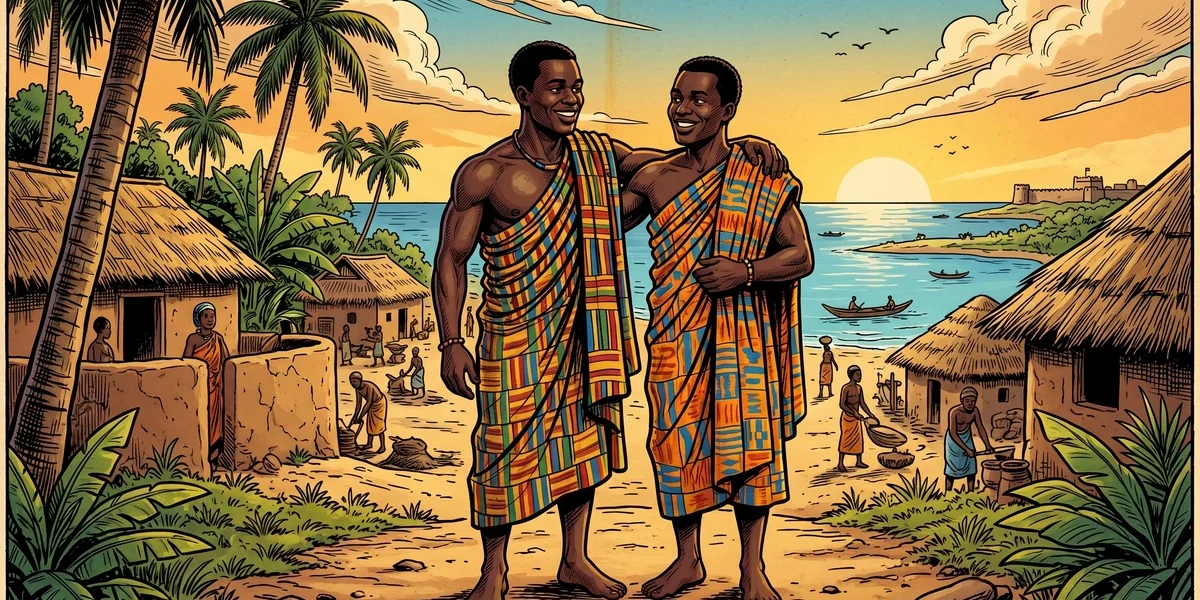
In the villages of the Ewe people, along the lagoons and palm groves of the old Slave Coast, a child’s name was never an idle thing. A name could carry a prayer, a grievance, a memory of the day of birth, or a quiet declaration of where a person had placed their trust. Maku Mawu and Maku Fia is, before it is anything else, a story about two such names – and about the strange way a name, once spoken aloud and repeated long enough, can begin to shape the very life it describes.
Two friends, inseparable since boyhood, give one another secret names. One calls himself Maku Mawu, ‘I shall die God’s death’; the other, Maku Fia, ‘I shall die the King’s death.’ The names are meant only for the two of them, a private joke between companions. But names have a way of escaping. The village hears them, then the whole country, and at last the King himself – and what began as friendly wordplay becomes a contest between two ideas of where safety truly lies: in the favour of an earthly ruler, or in the unhurried will of heaven.
It is one of the gentlest and most quietly subversive tales in the West African repertoire. No monster is slain, no trickster cheats a rival; instead a powerful king spends the entire story trying, and failing, to engineer the death of an innocent man – and the failure itself is the moral.
Origin and Canonical Attribution
This tale is preserved in West African Folk-Tales, collected by William H. Barker – Vice-Principal of the Government Training College at Accra on the Gold Coast – together with Cecilia Sinclair, and published by George G. Harrap & Co., London, in 1917 (with a companion edition issued the same year through the Bookshop in Lagos). The volume gathers stories told across the Gold Coast and its eastern neighbours, and remains one of the most cited early printed sources for the oral literature of the region.
While the bulk of Barker and Sinclair’s collection belongs to the Akan anansesem (spider-story) tradition, Maku Mawu and Maku Fia betrays a different homeland in its very vocabulary. The two key words are Ewe: Mawu, the name of the supreme creator deity of the Ewe and Fon peoples, and fia, the ordinary Ewe word for a chief or king. The tale therefore belongs to the Ewe storytelling tradition of the southeastern Gold Coast and the lands stretching into present-day Togo and Benin – the heartland of Ewe settlement.
In the international classification of folk narrative, the story sits within the family of fate tales – ATU 930, “The Prophecy”, in which a ruler strives to avert a destiny he has heard foretold and is undone by the very means he chooses to prevent it. Its single most recognisable narrative unit is the recovery of a lost ring from inside a fish, catalogued by folklorist Stith Thompson as motif N211.1, “Lost ring found in fish” – the so-called “Ring of Polycrates” motif, one of the most widely travelled images in world story. Around it cluster the motifs of the persecuted innocent (the king who seeks a pretext to destroy a guiltless subject) and of inexorable fate (motif N101), the conviction that what heaven has appointed no human power can revoke.
The Two Friends and Their Strange Names
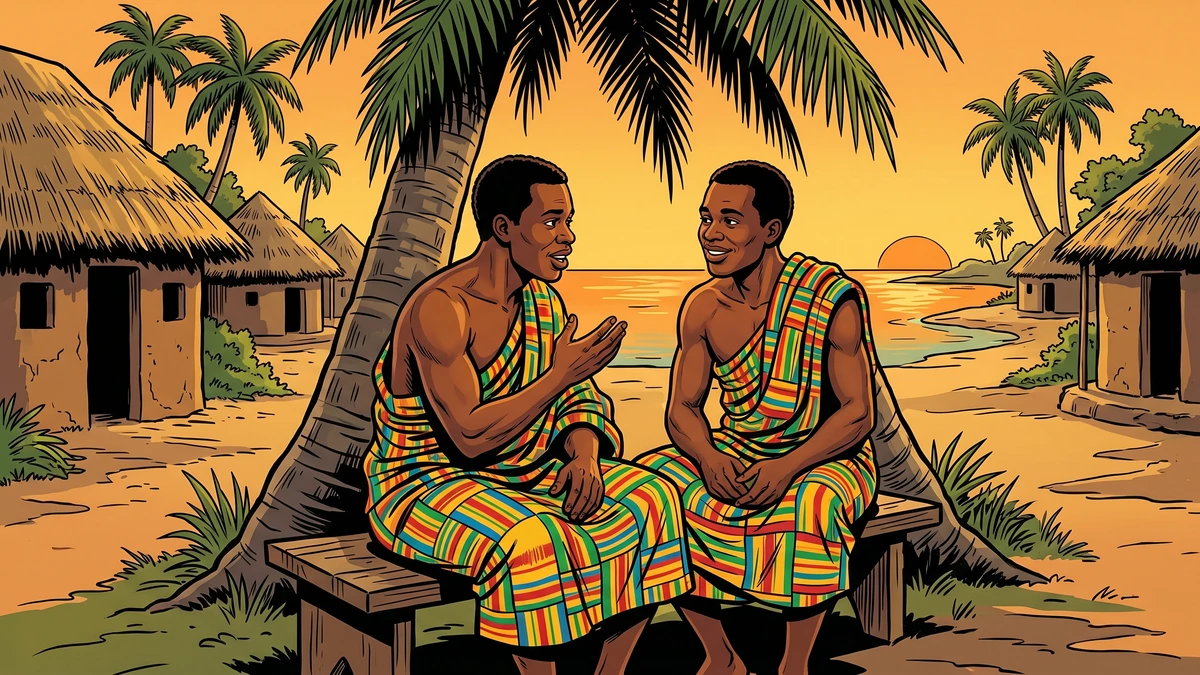
Once, the storytellers say, there lived two men whose friendship was the talk of their village. Where one was seen, the other was certain to be near; they ate from the same bowl, walked the same paths, and shared every thought. To mark the closeness between them, they invented private names – titles to be used by no one but themselves.
The first man named himself Maku Mawu: ‘I shall die God’s death.’ By this he meant that his life and his death lay in the hands of Mawu alone, and that whatever end heaven had set aside for him was the only end he would meet. The second named himself Maku Fia: ‘I shall die the King’s death,’ declaring that his fortunes rose and fell with the favour of his earthly ruler.
For a while the names stayed secret. But a good name, like a good story, will not be kept indoors. The villagers overheard them, found them striking, and soon used the nicknames in preference to the men’s real names. The fame of the two travelled outward, village to village, until it reached the ears of the King of that country, who was curious to meet the men who had chosen such bold titles for themselves.
He summoned them to his court, and they came together, as they did everything. The King studied them. He was thoroughly pleased with Maku Fia – here was a man wise enough to know where power lay, a man who honoured the throne above all things. But the other man’s name irritated him. To place one’s trust in God rather than in the King seemed to him almost an insult, a quiet denial of his own importance. From that hour the King resolved to find a means of punishing Maku Mawu – and of proving, before the whole country, that a man’s life depended on royal favour and nothing else.
The Yam and the Stone
The King masked his displeasure with courtesy. He invited both friends to a great feast to be held three days later, and as they took their leave he gave each of them a parting gift. To his favourite, Maku Fia, he handed a small round stone. To Maku Mawu – the man he meant to ruin – he gave a fine, large yam, the kind of yam any household would be glad of.
It seemed a careless, even a generous, mistake. In truth it was the opposite. The King had hidden a treasure of beautiful ornaments inside the stone, intending the wealth to fall to the man he loved. The yam was merely a yam.
On the road home, Maku Fia grew unhappy with his gift. “What use is a stone to me?” he complained. “I cannot eat it. How I wish it were a yam, so that I might cook it for my dinner.” Maku Mawu, generous as ever and tired of carrying his heavy load, answered at once: “Then let us exchange. Take my yam, and give me your stone.” They traded gifts on the spot and parted, each content, for the lagoon and the palms.
Maku Fia carried the yam home, cut it up, and cooked it. Maku Mawu broke his stone in two – and the ornaments the King had buried there spilled bright into his hands. He understood at once what had happened, and being a man of some humour, he told no one. He would let the King discover it for himself.
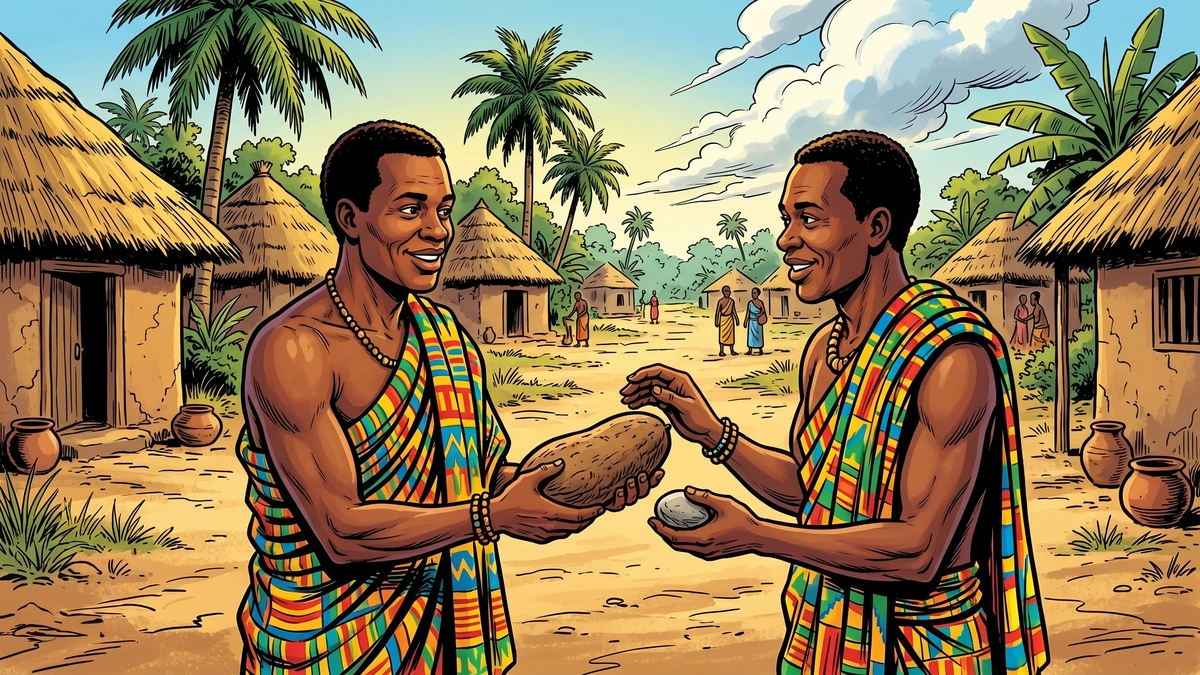
On the day of the feast, Maku Mawu dressed himself in every ornament from the stone and walked to the palace gleaming with the King’s own treasure. Maku Fia came dressed as plainly as any other day. The King looked from one to the other and was astonished – and then quietly furious. The wealth he had meant for his favourite now adorned the man he despised. When he questioned Maku Fia and learned of the exchange on the road, he could find no fault to charge against Maku Mawu, for the man had done nothing wrong at all. The first scheme had failed. The King began, at once, to plan a second.
The King’s Ring and the Hidden Wall
This time the King chose a trap with a noose already in it. Pretending to be delighted with Maku Mawu after all, he drew a fine ring from his own finger and presented it to him as a token of esteem. Then came the condition. Maku Mawu must return to the palace in seven days and show the ring again, to prove it had not been lost. If he could not produce it – he would lose his head.
The King’s design was simple and cruel. He would find a way to take the ring back in secret, so that on the seventh day the innocent man would stand before the whole assembly with empty hands and a forfeit life. Maku Mawu, however, was no fool. He read the trap clearly. He made a small hole in the wall of his room, placed the ring inside, and plastered the surface over so smoothly that no eye could tell the wall had ever been touched.
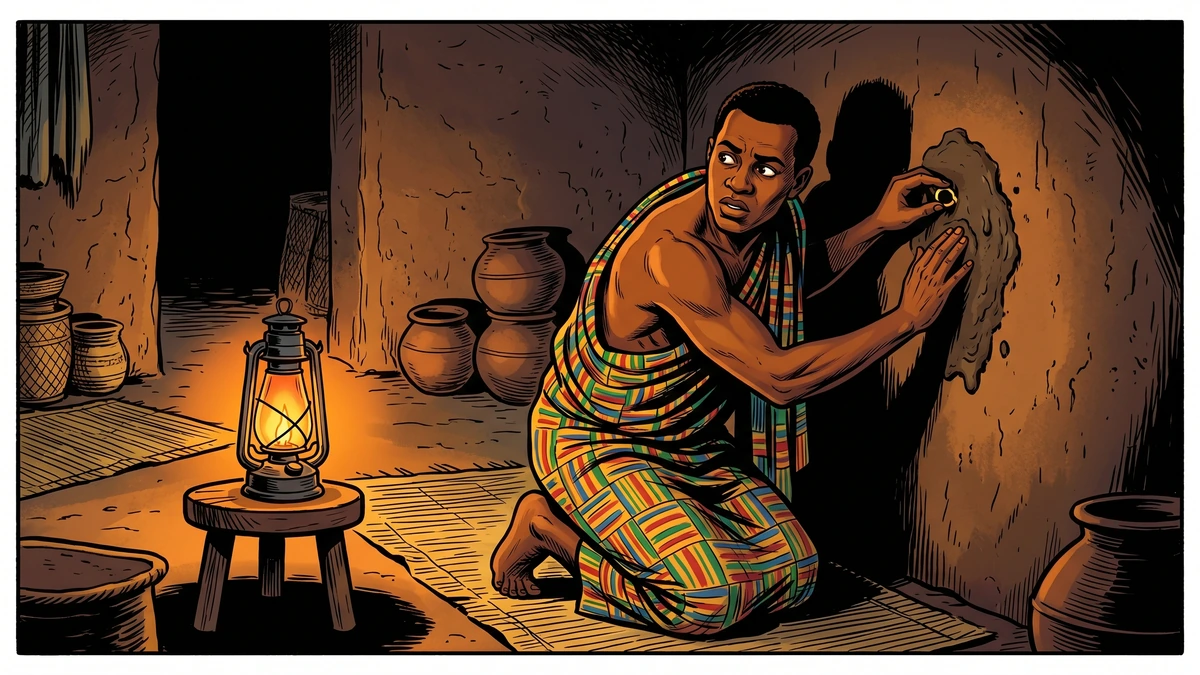
Two days passed. Then the King summoned Maku Mawu’s wife and asked her to find the ring, offering her a large sum of money in exchange – and saying nothing of what would befall her husband if the ring were gone. The woman searched her home diligently, once and then again, and found nothing. At last she asked her husband outright what he had done with it. Suspecting no harm, loving and trusting her, he told her plainly: it was hidden in the wall. The next day, while he was away, she searched until she found the spot, drew the ring out, and carried it joyfully to the palace. She took the promised money and went home – never once dreaming that she had sold her own husband’s life.
On the sixth day a royal message reached Maku Mawu, bidding him prepare for the morrow. He went to the wall to be sure of his treasure – and found the hole empty. He questioned his wife, his neighbours; all denied any knowledge of it. There was nothing left to conclude. He made up his mind that he must die.
The Fish and the Ring
But the King, having won the ring, grew careless with it. He set it down in one of the dishes in his private rooms and promptly forgot it was there. When the seventh morning came he sent messengers far and wide to summon the people to watch a man punished for disobeying the King’s command. Then he ordered his servants to set the palace in order and to carry out the dishes and wash them.
The servants, in their haste, never looked to see whether the dishes were empty. They carried them all down to a pool nearby – and among them the dish that held the ring. As that dish was rinsed, the ring slipped out, unseen, and sank into the water.
When the palace stood ready, the King went to fetch the ring for the great display of his power. It was nowhere to be found. Search as he might, he was forced at last to go to the assembly without it.
Before the gathered crowd, Maku Mawu was called forward. He knelt before the King and spoke without flinching: “The ring is lost, and I am ready to die. Grant me only a few hours to set my house in order.” Reluctantly the King allowed him four hours. The condemned man went home, put his affairs in order, and then, feeling hungry, thought to himself: “I may as well eat once more before I die. I shall go and catch a fish.”
He took his net and his bait and went down – as fate would have it – to the very pool where the King’s dishes had been washed. Before long he drew out a fine, large fish. And when he cut it open to clean it, there, inside, lay the lost ring.
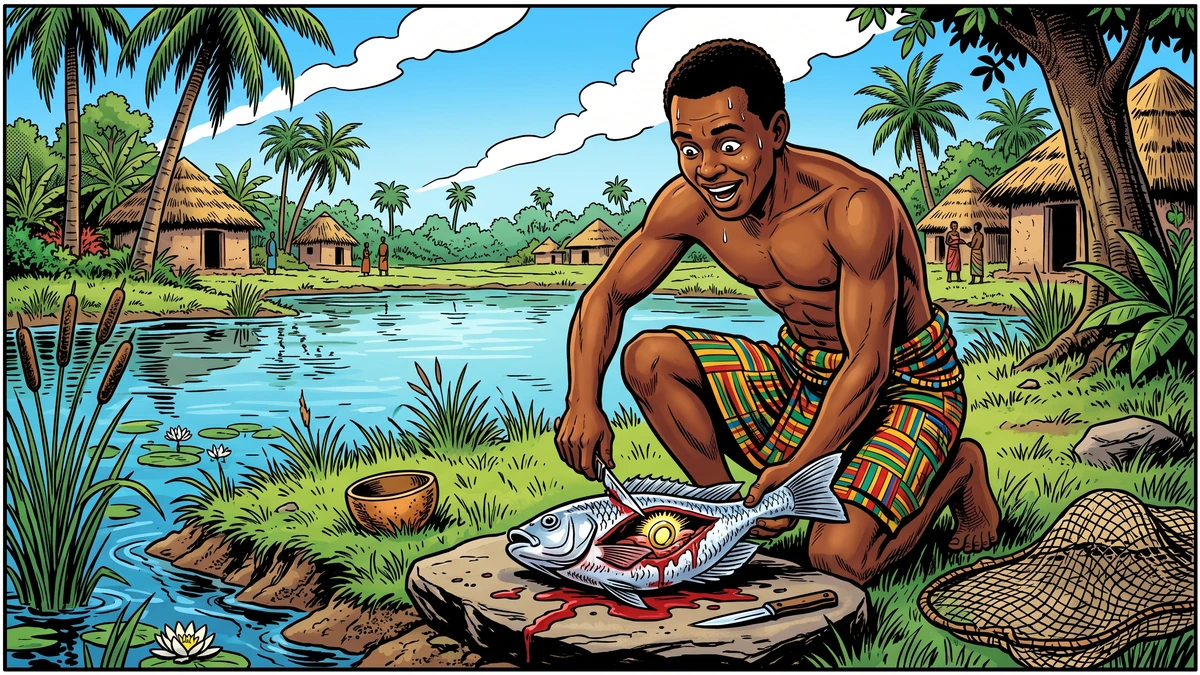
He ran to the palace crying, “I have found the ring! I have found the ring!” When the people understood, they raised a great shout of joy: he had named himself rightly. The death that God had appointed for him – and that death only – was the death he would die. The King had no pretext left. Maku Mawu walked free, and the country never forgot the day the King’s whole power was overturned by a fish.
The Moral of the Tale
The lesson of Maku Mawu and Maku Fia is carried in the two names themselves, and the Ewe words make the contrast exact:
Maku Mawu — ‘maku’, I shall die; ‘Mawu’, God: “I shall die God’s death.”
Maku Fia — ‘maku’, I shall die; ‘fia’, the chief: “I shall die the chief’s death.”
The story does not mock Maku Fia, nor does it punish him; he keeps his yam, keeps the King’s favour, and comes to no harm. What the tale does instead is far subtler. It shows that the man who anchored his life to royal favour was, without knowing it, anchored to something that could shift, forget, and fail – the King mislaid the very ring on which a life hung. The man who anchored his life to Mawu found that the appointed end could be neither hurried nor invented by any ruler, however determined. Trust placed in earthly power is trust placed in something changeable; trust placed in heaven rests on something that does not lose the ring. That is the quiet wisdom the Ewe storyteller leaves in the listener’s hands.
Mawu and Fia: The Cosmology Behind the Names
To feel the full weight of the two names, a listener needs to know who Mawu is. Among the Ewe of Ghana, Togo and Benin – and among their Fon neighbours of Dahomey – Mawu is the supreme being, the creator, often paired with Lisa as a single complementary creative force and addressed simply as Mawu, “God,” in the broadest sense. Mawu is associated with the sky, with the moon, with the making of humankind and the keeping of universal order. To say “I shall die God’s death” is therefore not a small saying. It is a confession that one’s lifespan is held in the hands of the highest power there is, beyond the reach of courts and kings.
Fia, by contrast, is the Ewe word for a chief or king – a real, powerful, but entirely human authority. Ewe society was organised around chiefdoms, and a fia could indeed command wealth, justice, and the fate of his subjects. To name oneself after the fia was to bet one’s security on human politics. The tale never says that this is foolish on its face – chiefs were genuinely powerful – but it gently demonstrates the difference in kind between an authority that can forget and an authority that cannot.
The Ring in the Fish: A Motif That Travelled the World
The image at the heart of this story – a lost ring recovered from the belly of a fish – is one of the oldest and most widely shared in human storytelling. The Greek historian Herodotus tells it of Polycrates, the tyrant of Samos, whose ring, thrown into the sea to break a run of excessive good fortune, returns to him inside a fish a few days later. Folklorists know the image as motif N211.1, “Lost ring found in fish,” and it surfaces independently in tales from Europe, the Middle East, India, and across Africa.
What makes the Ewe version distinctive is the moral charge it places on the motif. In many tellings the returning ring signals that fortune cannot be cheated. Here it signals something warmer and more specific: that a righteous life under threat is under the protection of heaven, and that the fish does not merely return a ring – it overturns a tyrant’s plot and vindicates a man’s faith. The motif is the same the world over; the meaning is shaped by the people who tell it.
The Storytelling Tradition of the Ewe
Ewe tales of this kind were told in the evening, after the work of the day, often by an elder to a circle of children and adults gathered in the cool air of a compound. Stories were not simply entertainment; they were the community’s school of conduct, carrying lessons about trust, generosity, the limits of power, and the proper ordering of a life. A tale like Maku Mawu and Maku Fia would have done several things at once: it amused, with the comedy of the swapped gifts and the gleaming ornaments; it instructed, on where lasting security is to be found; and it reassured, telling the powerless that even a king’s malice has a ceiling.
When Barker and Sinclair set the tale in print in 1917, they froze one version of a story that had surely been told in many shapes across many compounds. The printed page preserved it – but the living tradition was always the performance: the pauses, the proverbs, the listeners who shouted the ending before the storyteller could reach it, exactly as the villagers in the tale shout their joy when the ring is found.
Why This Tale Has Lasted
Maku Mawu and Maku Fia has outlived the court it describes because it answers a question that never goes out of date: when the powerful turn against you, where can you stand? Its answer is not defiance and not despair, but a steady, almost cheerful confidence – the conviction that there is an order to things deeper than the moods of rulers, and that an honest life is not finally at the mercy of an angry throne.
The tale also lasts because it is fair. It does not caricature the man who trusted the King; it simply lets the events speak. And it lets its hero win not by cunning or violence but by being generous on a dusty road, calm under a death sentence, and hungry enough, at the last, to go fishing. There is something deeply reassuring in a story where goodness is rewarded not with a sword but with a quiet meal that turns out to hold a miracle. That is why, more than a century after it was written down and far longer since it was first spoken aloud, the country in the story – and every listener since – still remembers the day a fish proved a man’s name true.
Frequently Asked Questions
What is the folk tale “Maku Mawu and Maku Fia” about?
It is a short West African folk tale about two inseparable friends who gave each other secret names: Maku Mawu, meaning ‘I shall die God’s death,’ and Maku Fia, meaning ‘I shall die the King’s death.’ When the King hears the names he favours Maku Fia and resents Maku Mawu, and sets out to engineer his death. He gives Maku Mawu a yam and his favourite a treasure-filled stone, but the friends innocently swap gifts and the hidden wealth falls to Maku Mawu. The King then presents him with a ring and threatens beheading if it is ever lost. Through a chain of accidents the ring is lost, washed into a pool, and swallowed by a fish — which Maku Mawu catches and cuts open just hours before his execution, finding the ring and proving that no king can hasten a death heaven has not appointed.
Which culture and source does the story of Maku Mawu and Maku Fia come from?
It belongs to the Ewe people of the old Slave Coast — the lands of southeastern Ghana, Togo and Benin. Its two key words are Ewe: Mawu is the name of the supreme creator deity of the Ewe and Fon peoples, and fia is the ordinary Ewe word for a chief or king. The earliest published English version appears in West African Folk-Tales, collected by William H. Barker — Vice-Principal of the Government Training College at Accra on the Gold Coast — together with Cecilia Sinclair, and published by George G. Harrap & Co., London, in 1917, with a companion edition issued the same year through the Bookshop in Lagos.
What do the names Maku Mawu and Maku Fia actually mean?
Both names are built on the Ewe phrase ‘maku’, meaning ‘I shall die.’ Maku Mawu joins this with Mawu, the supreme God of the Ewe, so the name means ‘I shall die God’s death’ — a declaration that one’s life and death rest in heaven’s hands alone. Maku Fia joins ‘maku’ with fia, the word for a chief or king, giving ‘I shall die the King’s death’ — a declaration that one’s fortunes rise and fall with royal favour. The whole tale turns on the contrast between these two kinds of trust, and on the strange power of a name to shape the life that bears it.
How does Maku Mawu escape the King’s death sentence?
He escapes not by cleverness or force but through a chain of providential accidents. The King schemes to steal back the ring whose loss would cost Maku Mawu his head, and succeeds in retrieving it through the man’s own unsuspecting wife. But the King then sets the ring down carelessly in a dish, which his servants carry to a pool and wash, spilling the ring unseen into the water. Granted four hours before his execution to set his house in order, Maku Mawu goes fishing in that very pool to eat a last meal, catches a large fish, and finds the lost ring inside it — reaching the assembly with the ring just in time.
What is the moral or lesson of Maku Mawu and Maku Fia?
The tale teaches that trust placed in earthly power rests on something changeable, while trust placed in the divine rests on something that cannot fail. The man who anchored his life to royal favour was, without knowing it, depending on a king who could forget, mislay a ring, and lose control of events; the man who said ‘I shall die God’s death’ found that the appointed end could be neither hurried nor invented by any ruler, however determined. The story never punishes Maku Fia or mocks his choice — it simply shows, through events, the difference in kind between an authority that can forget and one that cannot.
You May Also Like
 African Folk Tales
Ages 6-8
African Folk Tales
Ages 6-8
The Squirrel And The Spider
A fast squirrel and a patient spider discover that every creature has special and valuable talents.
 African Folk Tales
All Ages
African Folk Tales
All Ages
Quarcoo Bah-Boni
Quarcoo Bah-Boni: Once upon a time in a certain village lived a man and his wife who were childless. One day, however, when the husband was away hunting, the
 African Folk Tales
Ages 6-8
African Folk Tales
Ages 6-8
Adzanumee And Her Mother
Adzanumee And Her Mother. A girl chooses between magic and memories. Learn why love and memories are worth more than anything else in the world.