Quarcoo Bah-Boni
Quarcoo Bah-Boni: Once upon a time in a certain village lived a man and his wife who were childless. One day, however, when the husband was away hunting, the
Among the spider-stories and pourquoi-tales of the Gold Coast there is one that does something the others rarely dare: it makes the trickster a child, and it refuses to let him be charming. “Quarcoo Bah-Boni” — the name means, plainly, “Quarcoo the Bad Boy” — was collected in the Akan-speaking communities of the Gold Coast (modern Ghana) and published by W. H. Barker and Cecilia Sinclair in West African Folk-Tales (George G. Harrap & Co., London, 1917), the same anthology that carried the great Anansi cycle into print. The tale belongs to the Akan oral repertoire of anansesem — “spider-words,” the catch-all name for the evening fireside stories — yet its hero is no spider and no admirable rogue. He is a wonder-child of frightening strength and no conscience at all, and the story watches him with a cold, unblinking eye until it has explained, through him, why the animals of Africa no longer share a single roof.
It is at once a spirit-child story, a strong-hero story, and a pourquoi tale, and its power comes from refusing to soften any of the three. Where the Anansi tales invite a child to laugh with the trickster, this one asks the harder question that every storytelling culture must eventually face: what do we make of cleverness and power when they arrive in someone who has no use for kindness?

The Child Who Named Himself
In a certain village there lived a man and his wife who had no children, and the want of them was the great sorrow of the house. Then one day, while the husband was far away on a hunting journey, the woman bore a son. She was glad and troubled at once — glad of the child, troubled that she had no way to send word to her husband, for among the Akan it is the father who confers the name on the eighth day of life, at the outdooring, and the eighth day was coming on fast with no father in sight.
As the woman sat wondering aloud what name she could possibly give the child if her husband did not return, the infant himself answered her. “My name,” he said, “is Quarcoo Bah-Boni.” He was seven days old. The next morning he gave her a second wonder: hearing her grumble that there was no one to fetch food from the farm, the baby announced, “I will go to the farm” — and went, and came back, and the work was done.
The marvels curdled quickly. Laid down to sleep while his mother worked, the infant would vanish; and within minutes older boys came complaining that her son had been beating them and abusing them in the street. She went indoors to prove the charge absurd — and found the bed empty. Again and again the child slipped out, worked his mischief, and was back asleep before she could catch him. At last she could bear it no longer. She turned him out of the house and forbade him ever to return, and Quarcoo Bah-Boni walked away from his mother’s door in great glee, as though banishment were a holiday.
The opening does the quiet work that Akan storytelling expects of a beginning. A child who speaks at a week old and names himself is, in the worldview of the tale, no ordinary child — he carries something of the uncanny, the kind of arrival the Akan associate with spirits who slip into the world of the living. And the name he chooses is a confession. He does not hide what he is. The horror of Quarcoo is not that he deceives anyone about his nature; it is that he tells the truth about it and the truth changes nothing.
Service Among the Five Animals
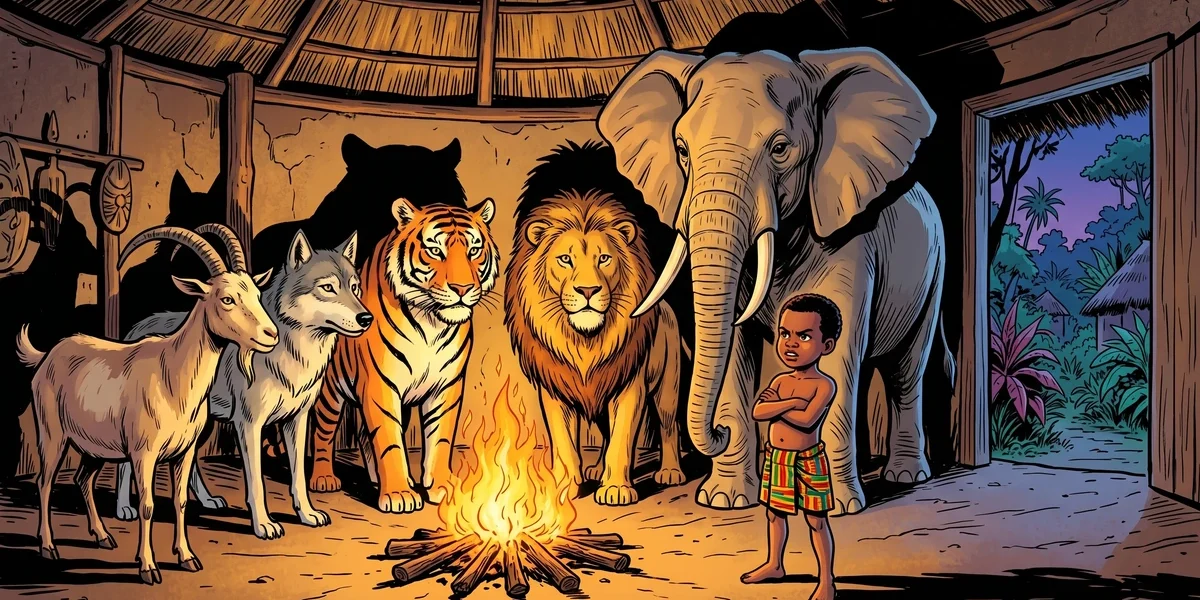
A few miles from the village stood a house where five animals — a goat, a wolf, a tiger, a lion, and an elephant — lived together in peace, sharing one fire and one farm. To this household the wandering child came, and with many polite speeches begged to be taken on as a servant, since he was, he said, motherless and alone. The animals talked it over and agreed; the goat, being youngest and burdened with the housework, was especially glad of the help. Quarcoo was given a seat and a meal, and he ate it with great relish.
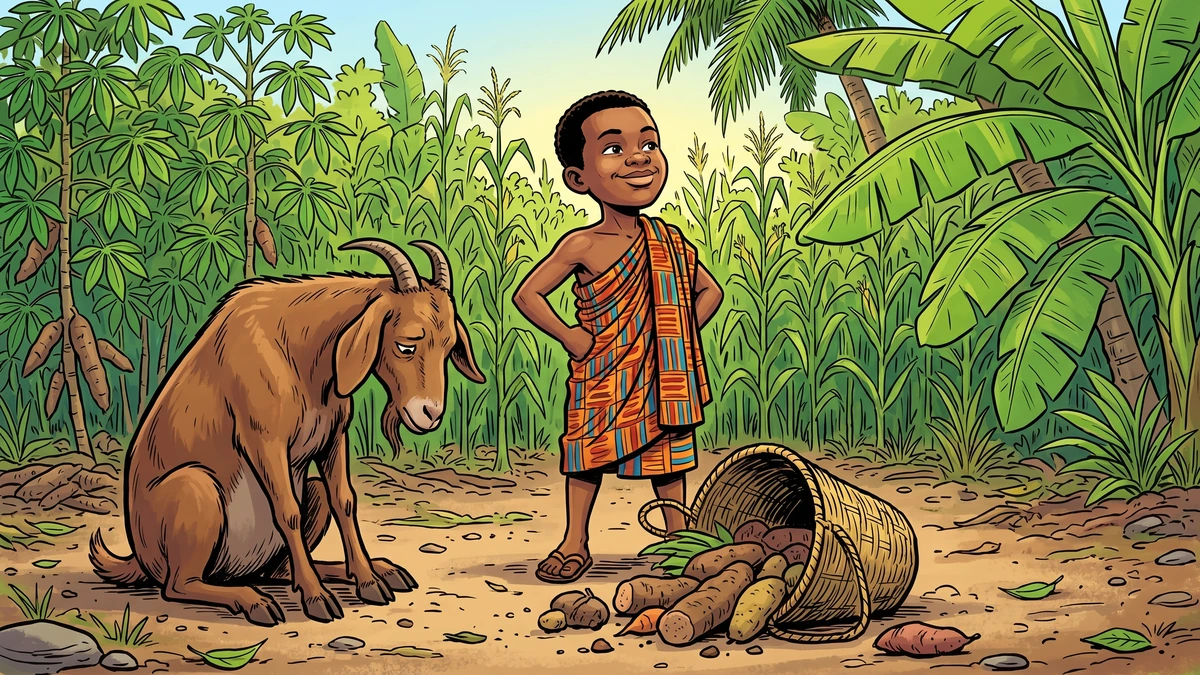
Each morning one of the five walked out to the distant farm to bring back the day’s food, and on the first morning it was the goat’s turn. He took Quarcoo along to carry the load. But at the farm the boy set down the basket and ran off to play, deaf to every call for help. When the exasperated goat came and boxed the child’s ears, Quarcoo struck back a single blow that knocked the goat flat, and then beat him without mercy until the goat promised to finish the work, carry the load home, and tell no one what had happened. The goat reached the cottage bruised and swollen, and explained to the others that he had stumbled into a swarm of bees.
The next day it was the wolf’s turn, and the wolf came home in the same battered state, and told the same kind of lie. Then the tiger, then the lion, then the elephant — each in turn carried the basket, each met the boy’s astonishing fists, each came home swollen and silent. One by one the great animals of the bush, any of whom could have killed the child with a careless step, were reduced to nursing their faces and inventing excuses. The tale lingers on this with grim patience, because the repetition is the point: power without restraint is not impressive, it is merely a machine, and it will grind through goat and lion with exactly the same indifference.
The Boy in the Basket
When the five compared their bruises they understood at last that they shared one tormentor, and they met in council to be rid of him. Their plan was simple and cowardly and reasonable all at once: they would rise before dawn, pack a great basket of food, and steal away together, leaving the dreadful boy in sole possession of the house. They prepared the basket and set it ready.
But Quarcoo had overheard every word. While the animals slept he fetched a broad leaf, rolled himself up small inside it — for he was very tiny — and lay down among the food in the basket. At first light the five crept out, the goat shouldering the load, all of them giddy with relief at their escape, none of them dreaming they carried their trouble on their own backs.
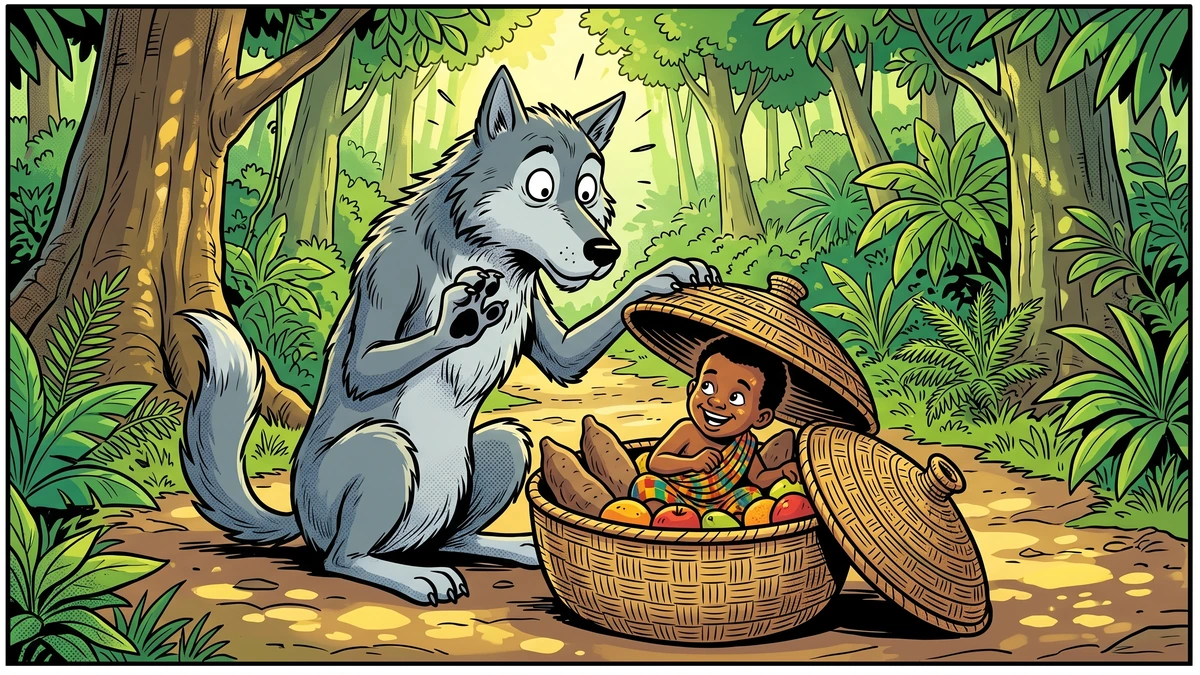
The journey became a slow comedy of greed punished. The goat, hot and tired, sat down to rest, waited for the others to walk on, and opened the basket to sneak a private mouthful — and was met by a terrible blow and the whispered order to shut the basket and say nothing. Shaken, he hurried after the others and at once begged the wolf to take a turn with the load. The wolf carried it a little way, thought of the good things inside, found his own shady excuse to rest — and was greeted exactly as the goat had been. So it went down the line. Each animal, certain he was stealing unobserved, opened the basket; each was struck by the unseen boy; each passed the load along without daring to explain. The basket itself had become a small court of justice, and every traveller who reached a greedy hand into it was sentenced on the spot.
At last the elephant, whose turn it was, grew tired of the weight and asked to be relieved. “If you do not want to carry it,” the others cried, “throw it away.” He threw it down, and the whole company took to their heels and ran, mile after mile, until they reached a huge tree and dropped, breathless, into its shade.
The Scattering of the Animals
Quarcoo, of course, was already there. He had stepped out of the abandoned basket, cut across country by a shorter path, and guessed that the exhausted animals would rest beneath exactly this tree. So he had climbed into the branches and hidden among the leaves, and now he sat above them, listening, while they argued on the ground below.
They fell, as frightened people do, to blaming one another, and the blame settled on the goat — it was the goat, they said, who had wanted the servant in the first place. The goat denied it hotly. “If I am really to blame for bringing Quarcoo among us,” he declared, “then let him appear before us.” And Quarcoo dropped out of the tree and stood in their midst.
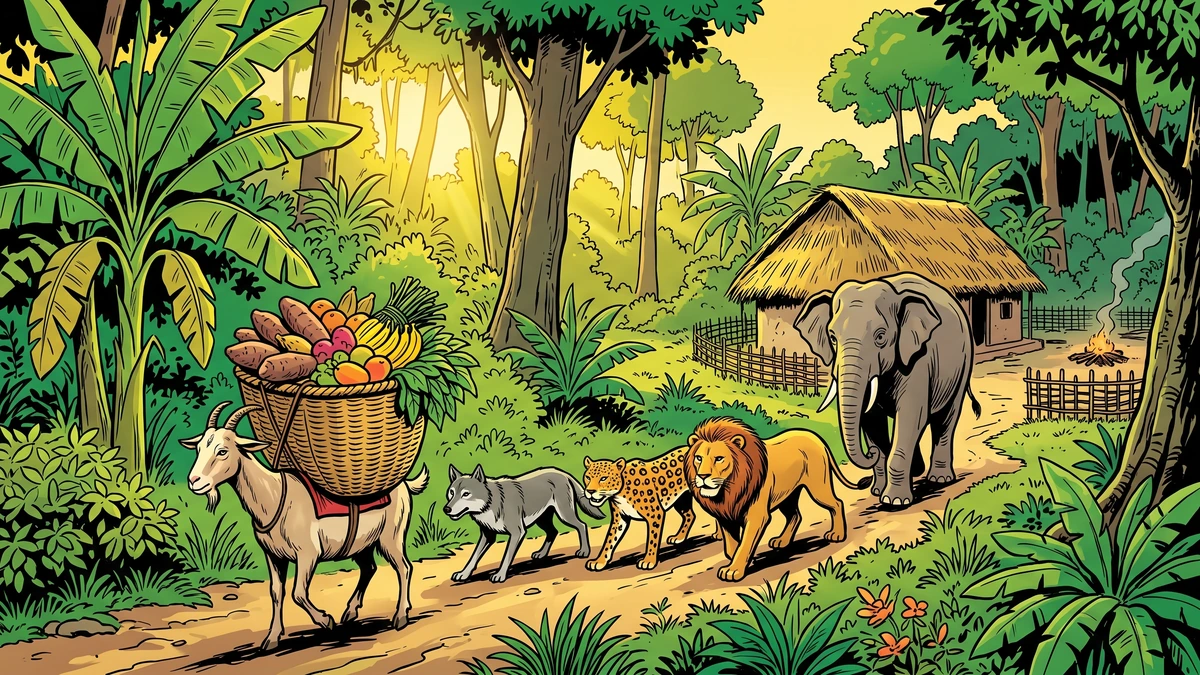
The animals did not fight him and did not reason with him. They scattered. The wolf bolted for the woods, the tiger for the deep forest, the elephant ran all the way to Nigeria, the lion fled into the desert, and the goat ran to the dwellings of human beings — and that, the storyteller says, is the reason the animals live apart today in these separate places, instead of sharing one house and one fire as they did before Quarcoo Bah-Boni came knocking at their door.
It is a startling ending, and a very Akan one. The pourquoi tale does not promise that the wicked are punished; Quarcoo is never beaten, never shamed, never reformed. What the tale offers instead is an explanation of cost. The world we live in — a world in which goat and lion and elephant keep their distance from one another and from us — is presented as the scar left behind by one unchecked child. Evil in this story does not get its comeuppance. It gets a monument: the scattered map of the animal kingdom itself.
The Moral of the Tale
The lesson of “Quarcoo Bah-Boni” is sharper than the comfortable rule that bad behaviour is punished, because here it is not. The tale teaches instead that cleverness and strength are not virtues. They are tools, and a tool in a cruel hand does cruel work with perfect efficiency. Quarcoo is genuinely gifted — quick, brave, resourceful, never once outwitted — and every gift is turned to the single purpose of making others suffer and lie. The story sets him deliberately beside the beloved trickster Anansi so that a listening child will feel the difference: Anansi’s cunning, for all its mischief, finally serves survival and community and laughter, while Quarcoo’s serves nothing but Quarcoo. The Akan name carries the whole judgement. In Twi, ɔba means “child” and bɔne means “bad” or “evil”; the boy is, in the most literal sense, named for what he is.
Ɔba bɔne sɛe abusua.
“A bad child destroys the family.” — an Akan saying that names the danger at the heart of the tale: gifts without goodness do not merely fail to help — they break the household that shelters them.
That is the warning the elders aimed at the children by the fire. The question to carry away is not “was the bad boy caught?” — he never is — but “what does a community become when it houses cruelty and hopes it will simply leave?” The answer the tale gives is the scattered, wary, divided world the children already live in.
Tale Type and Folkloristic Motifs
“Quarcoo Bah-Boni” braids together three recognisable strands of world folklore, which is part of why it feels so dense for so short a story. The first is the precocious wonder-child: Stith Thompson’s Motif-Index of Folk-Literature records motif T585, “Precocious infant,” with its sub-forms for the child who speaks at birth and the infant who performs feats of strength — a pattern that runs from the Hindu Krishna to the Ojibwe and Akan strong-child tales. The second is the supernaturally strong servant: the boy who hires himself into a household and overpowers everyone in it belongs to the family of international tale type ATU 650, “Strong John” (Starker Hans), in which a young hero of impossible strength serves a master and thrashes all comers — here turned dark, with the strength uncoupled from any heroic purpose.
The third and governing strand is the pourquoi or aetiological tale, the “why” story that ends by explaining a visible feature of the world. African oral tradition is especially rich in these, and collectors have catalogued whole clusters of them under Thompson’s “A” motifs for the creation and ordering of the animal world — why the animals are dispersed, why they fear one another, why this beast lives in the desert and that one near human beings. “Quarcoo Bah-Boni” uses the dispersal of the goat, wolf, tiger, lion, and elephant as its closing aetiology, and the choice of the goat — the one animal that runs toward humankind — quietly explains the goat’s place as a domestic animal at the human hearth. The tale also leans on the widespread concealment-and-eavesdrop motif (the hidden listener who overhears a plot, then the hero who travels concealed in a basket or vessel), a deception pattern found across West African, European, and Asian story traditions.
The Akan World: Day-Names, Spirit-Children, and the Trickster’s Shadow
“Quarcoo” is not a personal name in the way English readers expect; it is a day-name. The Akan give every child a name fixed by the day of the week on which it is born, and the boy’s day-name for Wednesday is Kwaku — rendered by Barker and Sinclair, in the spelling of their day, as “Quarcoo” or “Quaco.” Wednesday-born children, in Akan folk belief, were sometimes thought to carry a restless or contrary temperament, and a great many trickster tales attach themselves to a Kwaku precisely for that reason — the spider hero himself is often called Kwaku Ananse. To an Akan listener, then, the name “Quarcoo” already hums faintly with trickster associations before the word Bah-Boni — “the Bad” — lands on top of it like a verdict.
The child’s uncanny arrival — speaking at seven days old, vanishing from his bed, possessed of strength no infant could own — would have struck the tale’s first audiences as the mark of a being not entirely of the ordinary human world. West African belief holds a place for the child who is something other than it seems, the wonder-infant whose presence unsettles the household. The tale does not name Quarcoo a spirit outright; it simply lets the marvels accumulate until the listener understands that this is a story about an uncanny visitor, and that the mother’s decision to put him out of doors is less cruelty than self-defence.
Above all, the story is the deliberate shadow-portrait of the trickster. Akan oral tradition adores Ananse and forgives him almost everything, because his cunning, however selfish in the moment, keeps weaving the community’s life forward — he wins fire, or stories, or food, and the world is richer for his scheming. “Quarcoo Bah-Boni” exists to mark the boundary. It shows the same quickness, the same daring, the same gift for hiding in a basket and turning a journey into a trap — and it strips away the saving purpose. By telling this tale beside the Ananse cycle, Akan elders taught children to admire wit without worshipping it, and to ask of any clever person the only question that finally matters: clever for what?
How the Tale Was Collected
West African Folk-Tales appeared in London in 1917 under the imprint of George G. Harrap & Co., compiled by William H. Barker, an educator who worked on the Gold Coast, together with Cecilia Sinclair. The volume gathered tales told in the Akan communities of the Gold Coast — the territory that became independent Ghana in 1957 — and it remains one of the most widely read early printed collections of West African oral narrative, the book through which generations of readers outside Africa first met Anansi the spider.
Like every colonial-era collection, it should be read with its history in view. The tales reached print in English translation, arranged and smoothed for a British readership, and the spellings of names — “Quarcoo,” “Bah-Boni” — reflect the collectors’ ear rather than any modern Twi orthography. The animal cast itself shows the collectors’ hand: a “tiger,” which has never lived in Africa, sits in the household beside the genuinely African lion and elephant, almost certainly an English substitution for the leopard of the original telling, exactly the kind of slippage that happens when an oral story crosses into a second language and a second continent. None of this empties the tale of its value. The narrative architecture — the self-naming child, the chain of battered animals, the basket-court, the final scattering — is unmistakably the work of a sophisticated oral tradition, and “Quarcoo Bah-Boni” survives as a real window onto how Akan storytellers used the trickster’s dark twin to teach the difference between admirable wit and corrosive cruelty.
Why This Story Has Lasted
“Quarcoo Bah-Boni” has outlived a century of retellings because it is honest about something most children’s stories prefer to hide: that cleverness is not the same as goodness, and that the gifted are not automatically the good. A child raised only on tales where the quick-witted hero is also the kind one will be poorly prepared for a world that hands brilliance and strength to cruel people as readily as to gentle ones. This tale closes that gap. It lets a child admire Quarcoo’s daring — the leaf, the basket, the shortcut to the tree — and feel, in the same breath, the chill of watching all that talent spent on making a goat lie about bee-stings.
It lasts, too, because its ending is brave. The storyteller could have arranged a beating, a banishment, a tidy punishment, and sent everyone home satisfied. Instead the tale lets Quarcoo walk away untouched and shows the listener the wreckage he leaves: a household broken, friends scattered to desert and forest and the edges of human settlement, a whole animal kingdom rearranged around the memory of one unchecked child. That refusal to comfort is what gives the story its staying power. It tells the young listener a true and useful thing — that the damage done by cruelty is often permanent, that you cannot always count on the bad boy being caught, and that the real safeguard is not punishment after the fact but a community wise enough not to take cruelty in as a servant and hope it will simply, one quiet morning, let itself out.
You May Also Like
 African Folk Tales
Ages 6-8
African Folk Tales
Ages 6-8
Honourable Minū
Honourable Minū: It happened one day that a poor Akim-man had to travel from his own little village to Accra - one of the big towns on the coast. This man
 African Folk Tales
Ages 9-12
African Folk Tales
Ages 9-12
How Beasts And Serpents First Came Into The World
How Beasts And Serpents First Came Into The World: The famine had lasted nearly three years. Kweku Tsin, being very hungry, looked daily in the forest in the
 African Folk Tales
Ages 6-8
African Folk Tales
Ages 6-8
Anansi and the Pot of Wisdom
The Akan (Ashanti) trickster tale of how Kwaku Anansi the spider tried to hoard all the wisdom of the world in one clay pot - and how his own small son taught him the lesson that scattered wisdom across the whole earth.