Why We See Ants Carrying Bundles As Big As Themselves
An Akan pourquoi tale from West African Folk-Tales (Barker & Sinclair, 1917): the trickster Anansi, condemned to carry an enchanted box for ever, deceives the honest Ant into bearing his punishment - which is why we see ants carrying bundles as big as themselves.
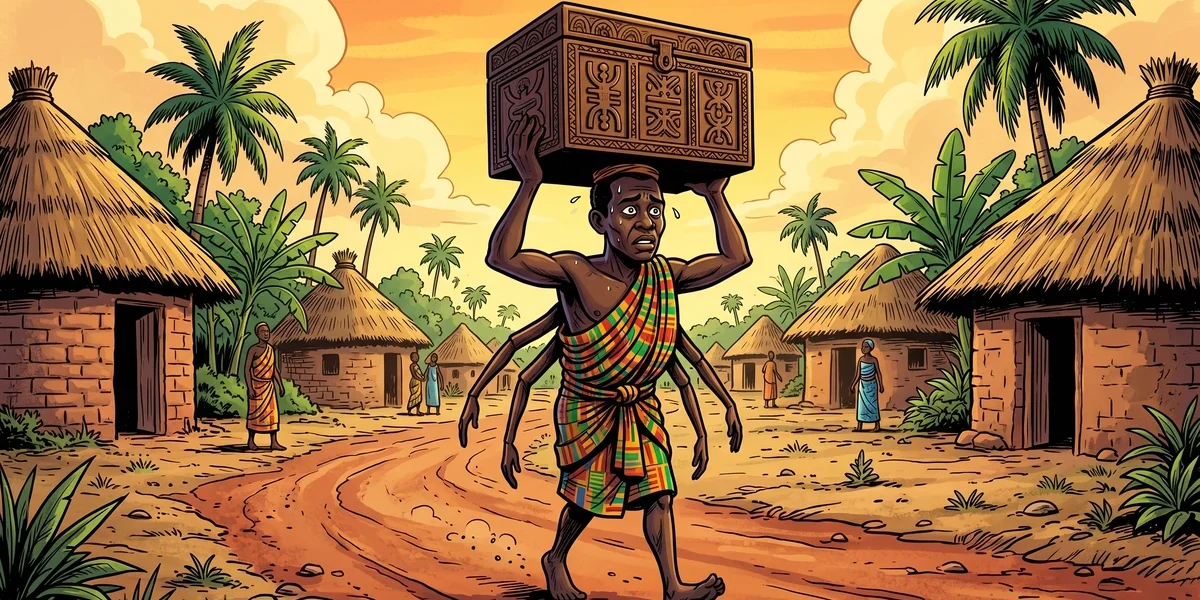
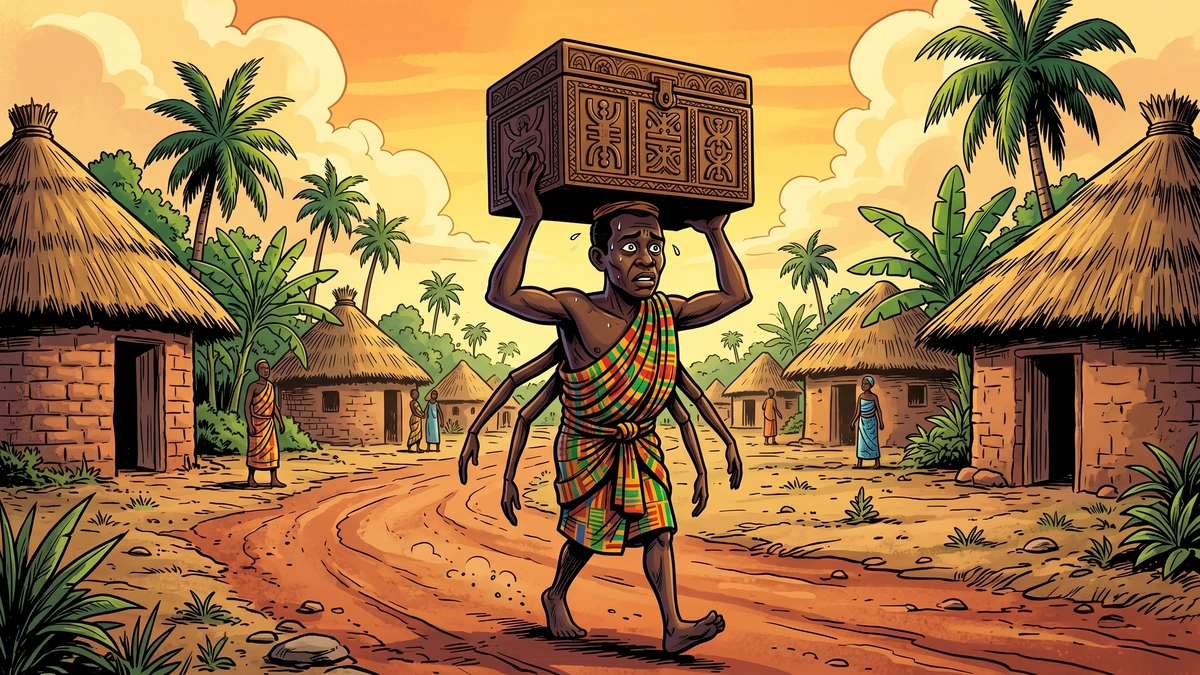
If you have ever stopped to watch a line of ants crossing a path, you will have seen something that looks almost impossible: each tiny creature hurrying along beneath a crumb, a seed, or a leaf-fragment as large as its whole body. The Akan storytellers of the Gold Coast had an answer for that small daily wonder, and it is not a lesson in insect biology. It is a story about greed, a broken promise, and an honest creature who paid for another’s lie. Why We See Ants Carrying Bundles As Big As Themselves is a pourquoi tale – a story that explains why the world looks the way it does – and at its centre stands the most famous figure in all West African storytelling: Kweku Anansi, the trickster spider.
On the surface the tale answers a child’s question about ants. Beneath that question lies the lesson the elders most wanted the young to carry: that a clever lie does not simply vanish once it is told. It becomes a weight, and that weight has to be carried by somebody. The whole sorrow of the story turns on the fact that the somebody is rarely the liar himself.
A Year the Rain Forgot the Farms
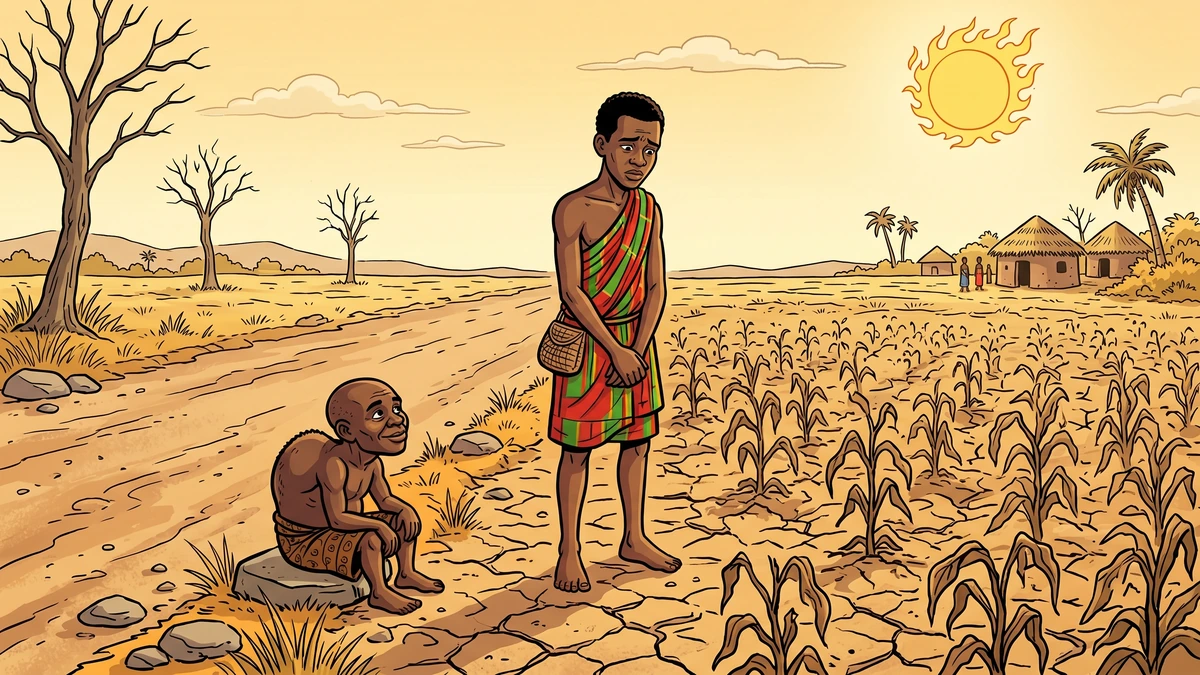
Kweku Anansi and his son, Kweku Tsin, were both clever farmers, and in most years their fields gave fine harvests. But one season the rain failed. The seeds lay in the dry, cracked earth for more than a month, and it began to look as though nothing would sprout at all. Walking sadly through his bare fields one day, Kweku Tsin came upon a tiny hunchbacked dwarf seated by the roadside.
The little man asked why he looked so troubled, and the young farmer told him about the drought. The dwarf promised to help. He told Kweku Tsin to fetch two small sticks and tap him gently upon his hump while he sang a rain-song:
“O water, go up, O water, go up,
And let rain fall, and let rain fall.”
Kweku Tsin did exactly as he was asked – gently, with two small sticks – and to his joy the rain began at once. It fell until the ground was soaked through. Within days the seeds germinated and the crops promised well. Notice how the tale opens: the honest son asks for nothing more than help, follows the instructions exactly, and uses no more force than he is told to use. His success is quiet, and it is complete.
Anansi and the Two Big Sticks
It was not long before Anansi heard that his son’s crops were thriving while his own fields still lay hard and bare. He went straight to Kweku Tsin and demanded an explanation, and the young man, being honest, told him everything – the dwarf, the small sticks, the rain-song.
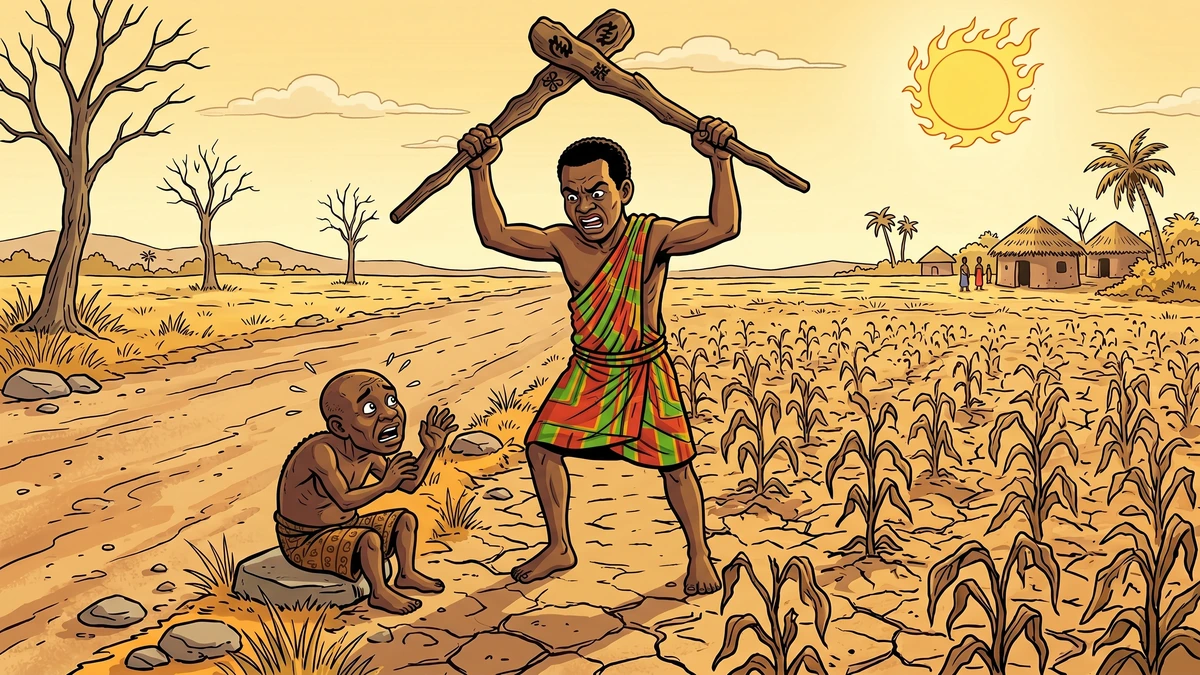
Here the story turns on a single, fatal piece of reasoning. As Anansi set out for his own farm, he cut not two small sticks but two big, strong ones, telling himself: My son made the dwarf work with little sticks. I will make him do twice as much with big ones. This is the trickster’s whole character in one thought. He cannot simply receive a gift; he must squeeze it. He treats a kindness as a machine to be driven harder, and he assumes that more force must always mean more reward.
When the dwarf appeared and asked Anansi his trouble, Anansi hid the big sticks and listened as the little man gave the same instructions: two small sticks, a gentle tapping. But Anansi brought out his heavy sticks and beat the dwarf so hard that the poor creature fell down dead. And now the greedy farmer was truly frightened, for the dwarf was the King’s own jester and a great favourite at court.
The Trick Beneath the Kola Tree
A liar’s first instinct is not to confess but to find someone else to blame, and Anansi was a master of it. He carried the dwarf’s body to a kola-tree, laid it across one of the highest branches, and sat down beneath to wait. Before long Kweku Tsin came along to see whether his father had managed to bring rain.
“Did you not see the dwarf, father?” the young man asked. “Oh yes,” said Anansi smoothly, “but he has climbed this tree to pick kola. I am waiting for him to come down.” Kweku Tsin offered to climb up and fetch him. As soon as the young man’s head touched the body, of course, it tumbled to the ground – exactly as Anansi had planned.
“Oh, what have you done, you wicked fellow!” cried Anansi at once. “You have killed the King’s jester!” But Kweku Tsin saw the trick for what it was, and he answered it with a trick of his own. “That is all right,” he said calmly. “The King is angry with the jester and has promised a bag of money to anyone who kills him. I will go and collect the reward.” The moment greed heard the word reward, it could not help itself. “No, no, no!” shouted Anansi. “The reward is mine – I killed him, with two big sticks. I will take him to the King myself.” “Very well,” said his son. “As you killed him, you may take him.” And so Anansi, who had schemed to pin the blame on Kweku Tsin, was neatly tricked into claiming it – out of his own mouth, in front of a witness, for the sake of money that did not exist.
The Box That Could Never Touch the Ground
Anansi set off for the King’s court, well pleased, certain a bag of money was waiting. He found instead a King grieving bitterly for his favourite. There was no reward. There was a sentence. The jester’s body was shut inside a great box, and Anansi was condemned to carry that box upon his head for ever. The King laid an enchantment on it so that it could never be set down upon the ground. There was only one way Anansi could ever be free of it: he had to persuade some other person to lift the box onto their own head – and, naturally, no one in the whole country was willing to do such a thing.
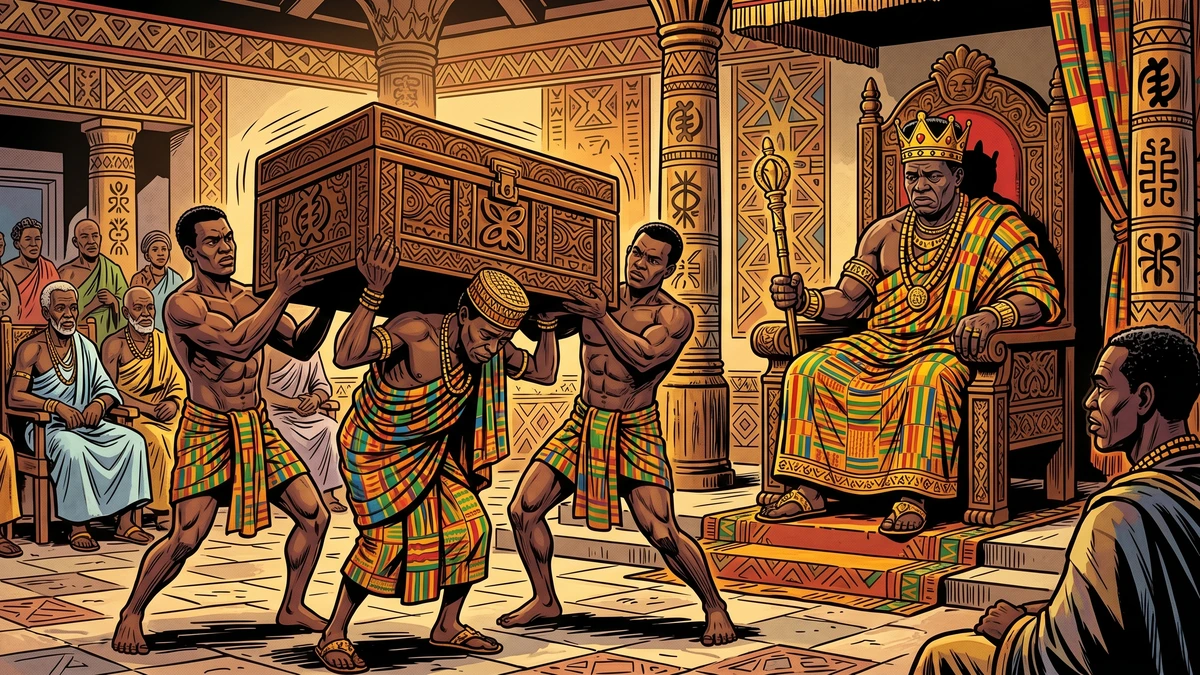
This is the moral engine of the whole tale. The punishment fits the crime with a kind of terrible precision. Anansi spent the whole story trying to make his burdens land on other people – the dwarf was to do double work, the blame was to fall on his son. Now the King answers that habit in its own language: a burden that only moves when it is passed to someone else. Anansi is not imprisoned and he is not killed. He is simply made to live, every moment, with the exact thing he kept doing to others.
The Honest Ant and the Broken Promise
For a long time Anansi staggered under the box, growing more weary with every day. At last, almost worn out, he met the Ant. “Will you hold this box for me,” he asked, “while I go to market and buy a few things I badly need?”
The Ant was no fool about Anansi’s reputation. “I know your tricks, Anansi,” he said. “You want to be rid of it.” “Oh no, indeed, Mr Ant,” Anansi protested. “I promise – I promise – I will come straight back for it.” And here is the heart of the sorrow. The Ant was an honest fellow who always kept his own promises, and because he kept his word, he believed that another creature would keep his. He measured Anansi by himself. He took the box up onto his head, and Anansi hurried away – with not the slightest intention of ever returning.
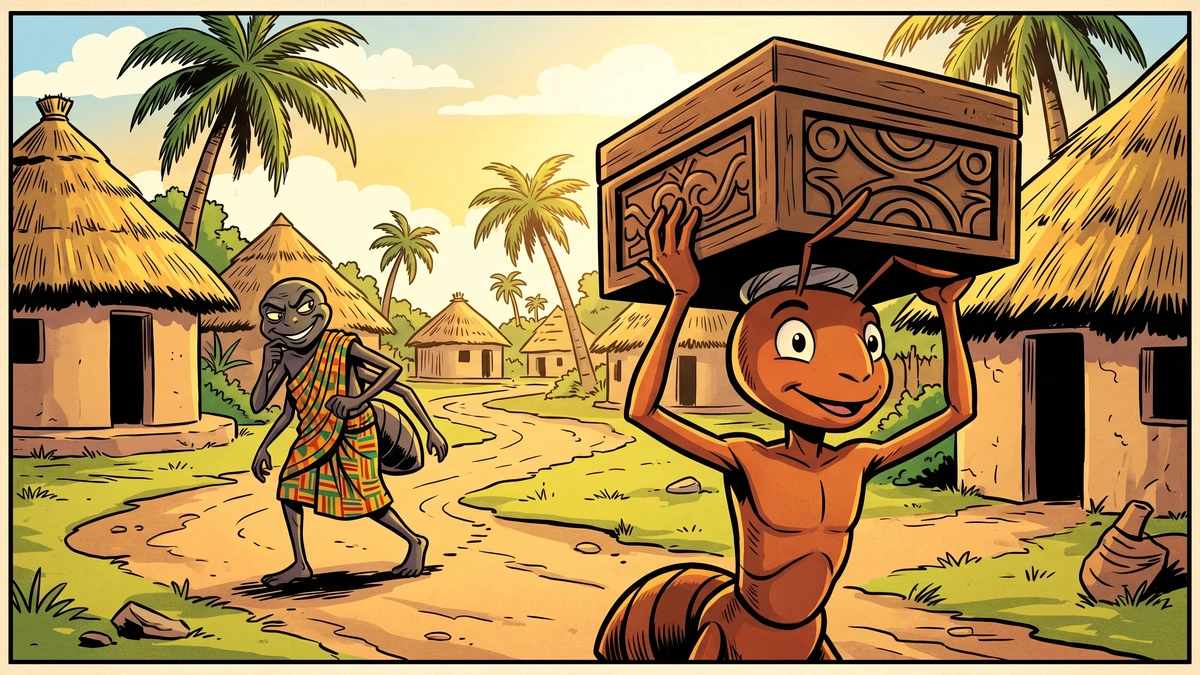
The Ant waited. He waited in vain, and he is waiting still. He was obliged to wander the rest of his life with the box upon his head, and his descendants after him – and that, the storytellers say, is the reason we so often see ants hurrying along beneath bundles as large as themselves. The tale ends not with the trickster punished but with the trickster escaped, and an innocent creature carrying his sentence for all of time. It is a deliberately uncomfortable ending, and the discomfort is the lesson.
A Pourquoi Tale from the Anansesem
This story was collected and arranged by William H. Barker and Cecilia Sinclair in West African Folk-Tales, published in London by George G. Harrap & Company in 1917. Barker served as a vice-principal at a training college on the Gold Coast – the British colony that in 1957 became the independent Republic of Ghana – and the volume gathers stories told among the Akan-speaking peoples, especially the Fante and Asante. Cecilia Sinclair, a Gold Coast woman, both helped assemble the tales and drew the original illustrations, so the collection carries a local hand throughout.
Tales of Anansi are known in Twi, the Akan language, as Anansesem – literally “spider stories.” The word came to mean folk tales in general, because the spider so dominated the storytelling tradition. Anansi is a shape-shifter who appears now as a spider and now as a man, and the names in this story mark him clearly as an Akan character: Kweku is a day-name given to a boy born on a Wednesday, and Anansi’s son shares it. Anansi is not a hero. He is the trickster – greedy, lazy, boastful, endlessly inventive – and the tradition uses him as a mirror held up to human weakness. We laugh at Anansi, and then we recognise ourselves, and that double movement is exactly how the stories teach.
In the way folklorists classify stories, this is a pourquoi or etiological tale: a narrative whose purpose is to explain a feature of the observable world – here the curious sight of ants carrying outsized loads. It belongs to the broad family of animal-characteristic motifs (the Aarne–Thompson–Uther motif range A2200–A2599, “origin of animal characteristics”), and it folds that explanation around two older folktale ideas: the enchanted burden that cannot be set down, and the trickster who frees himself only by deceiving an honest dupe. Many Anansi tales end with the spider getting his comeuppance. This one is darker and, in its way, more honest about how the world often works: sometimes the trickster simply walks away, and the bill is paid by whoever trusted him.
The Moral: Honest Hands and the Weight of a Lie
Set the two halves of the tale side by side and the lesson stands out plainly. Kweku Tsin asks for help, follows the instructions exactly, takes only what he needs, and his fields are saved. Anansi sees the same opportunity and tries to force it, to double it, to wring more from it than it was ever meant to give – and his greed kills the very creature who could have helped him. Honest, measured effort is rewarded; greedy, grasping effort destroys the gift it grabs at.
The second lesson is sharper still. A lie, the tale insists, does not disappear when it is told. It becomes a real and physical weight – the enchanted box – and it has to be carried by someone. Anansi’s whole genius is for making sure that someone is never himself. The Akan elders summed up this idea of a life shaped by one’s own conduct in a proverb:
“Sᵉ woforo dua pa a, na yᵉpia wo.”
“When you climb a good tree, you are given a push.”
The proverb teaches that the community will gladly lend its strength to a person whose undertaking is honest and good. Kweku Tsin climbs a good tree – honest farming, honest speech – and help comes to him freely. Anansi climbs a rotten one, and the only push he receives is the King’s enchantment pressing a box onto his head. The Ant, meanwhile, stands as the tale’s quiet warning: he does nothing wrong at all. His only mistake is to assume that a known trickster will behave as honestly as he himself would. Goodness, the story says soberly, is not the same thing as safety. An honest person must still keep his eyes open, because the world contains people who will spend that honesty like money.
Why This Tale Has Lasted
This little story has travelled a long way and lasted a long time, and it is worth asking why. It lasts, first, because of its perfect economy. In a few hundred words it links a drought, a dwarf, a kola-tree, a king’s court and a column of ants into one unbroken chain of cause and effect, so that by the end the reader feels the explanation rather than merely hearing it. Every time a child sees an ant beneath its bundle, the whole story is summoned in an instant.
It lasts, too, because it refuses to comfort us. A gentler tale would have caught Anansi and made him carry the box himself for ever. This one lets him slip away and leaves the honest Ant holding the weight – and any child who has been blamed for another’s mischief, or any adult who has cleaned up a colleague’s failure, knows that this is often exactly how things go. The tale does not pretend otherwise. Instead it does something more useful: it teaches the listener to recognise the trick before the box is on their head. Watch for the suspiciously urgent favour. Be wary of the promise that is repeated too many times. Remember that your own honesty is not proof of anyone else’s.
And it lasts because, underneath the warning, it still quietly honours what is good. Kweku Tsin and the Ant are not punished for their honesty – the tale clearly loves them both. It simply asks them, and us, to be honest and watchful at once. As long as people make promises, and as long as some keep them while others do not, the sight of an ant hurrying along beneath its enormous bundle will go on carrying this old Gold Coast lesson from one generation to the next.
You May Also Like
 African Folk Tales
Ages 6-8
African Folk Tales
Ages 6-8
The Judgment Of Baboon
A mouse tears the tailor's cloak, and when every creature blames the next, Baboon the judge turns the chain of excuses into a chain of punishment - a Khoikhoi tale from Namaqualand explaining why the cat hunts the mouse and the baboon walks on all fours.
 African Folk Tales
All Ages
African Folk Tales
All Ages
Quarcoo Bah-Boni
Quarcoo Bah-Boni: Once upon a time in a certain village lived a man and his wife who were childless. One day, however, when the husband was away hunting, the
 African Folk Tales
Ages 6-8
African Folk Tales
Ages 6-8
Anansi The Blind Fisherman
Anansi the Blind Fisherman: A Tale of Cleverness and Justice In a village near a great river in Africa, there lived a spider named Anansi. Unlike...