Anansi and the Pot of Wisdom
The Akan (Ashanti) trickster tale of how Kwaku Anansi the spider tried to hoard all the wisdom of the world in one clay pot - and how his own small son taught him the lesson that scattered wisdom across the whole earth.

Of all the stories the Akan people of Ghana have carried down the centuries, none is loved more, or told more often, than the tales of Kwaku Anansi, the spider — and of all the Anansi tales, few are as quietly profound as the story of the day he tried to own every scrap of wisdom in the world. “Anansi and the Pot of Wisdom” is a small comedy with an enormous idea inside it. In the space of a single fireside telling it sets the cleverest creature in West African folklore against the one thing his cleverness cannot finally master — the simple fact that no mind, however brilliant, can hold all that there is to know.
The tale belongs to a vast family of stories the Akan call Anansesem, “spider stories” — a body of oral literature so central to Akan culture that the word came to mean folktales of every kind, whether a spider appears in them or not. Anansi himself is a trickster: greedy, vain, endlessly inventive, forever scheming to get more than his share, and forever being undone by the very appetite that drives him. In this story his ambition is the grandest he ever conceives. He does not want gold, or food, or a kingdom. He wants wisdom — all of it, every last grain — and he wants no one else to have any.
Origins and Canonical Attribution
“Anansi and the Pot of Wisdom” is a traditional tale of the Akan peoples of Ghana — the Ashanti (Asante) above all, together with the Fante, Akuapem and other Twi- and Fante-speaking groups of the West African forest belt. It was never the work of a single author. Like all Anansesem, it lived for centuries entirely in performance: told at night, after the day’s work, by a storyteller who sang, mimed, drummed and drew the listening children into the telling with call-and-response. The story reached the printed page only when nineteenth- and twentieth-century collectors began to write the Akan repertoire down, and it reached the wider world along the cruel routes of the Atlantic slave trade, which carried Anansi to the Caribbean, where he became “Aunt Nancy” and “Anancy,” and into the African American tales of the United States.
Origin & Canonical Attribution
Tradition: Akan oral literature of Ghana — an Anansesem (“spider story”) of the Ashanti and wider Twi-speaking peoples; an etiological trickster tale.
Principal printed source: R. S. Rattray, Akan-Ashanti Folk-Tales (Oxford: Clarendon Press, 1930), the foundational scholarly collection of seventy-five Ashanti tales recorded in Twi and English in the Ashanti and Kwawu districts.
Later retellings: Peggy Appiah, Ananse the Spider: Tales from an Ashanti Village (1966); the tale is widely anthologised in collections of West African and Caribbean Anansi stories.
Story type: An etiological or “pourquoi” tale within the Anansi trickster cycle — a story that ends by explaining a feature of the real world, here why wisdom is dispersed among all peoples rather than held by any one of them.
Principal motifs: A1481, acquisition of wisdom (knowledge) by mankind; W117, boastfulness and the desire to monopolise; J2731, the foolish manner of carrying a burden; the trickster outwitted by a child.
The single most important source for the scholarly study of Anansi is Robert Sutherland Rattray’s Akan-Ashanti Folk-Tales, published by the Clarendon Press at Oxford in 1930. Rattray, a government anthropologist in the Gold Coast, set down seventy-five Ashanti tales as they were actually performed, printing the Twi text and an English translation side by side and adding notes on the gestures, songs and audience responses that no page can fully capture. His collection established that Anansesem were not children’s trifles but a sophisticated literature with its own conventions — and it preserved, among much else, the figure of Anansi as the Akan imagination truly conceived him: not a hero, not a villain, but the trickster through whom a whole people thought aloud about cleverness, greed, and the limits of both.
Anansi Gathers the Wisdom of the World
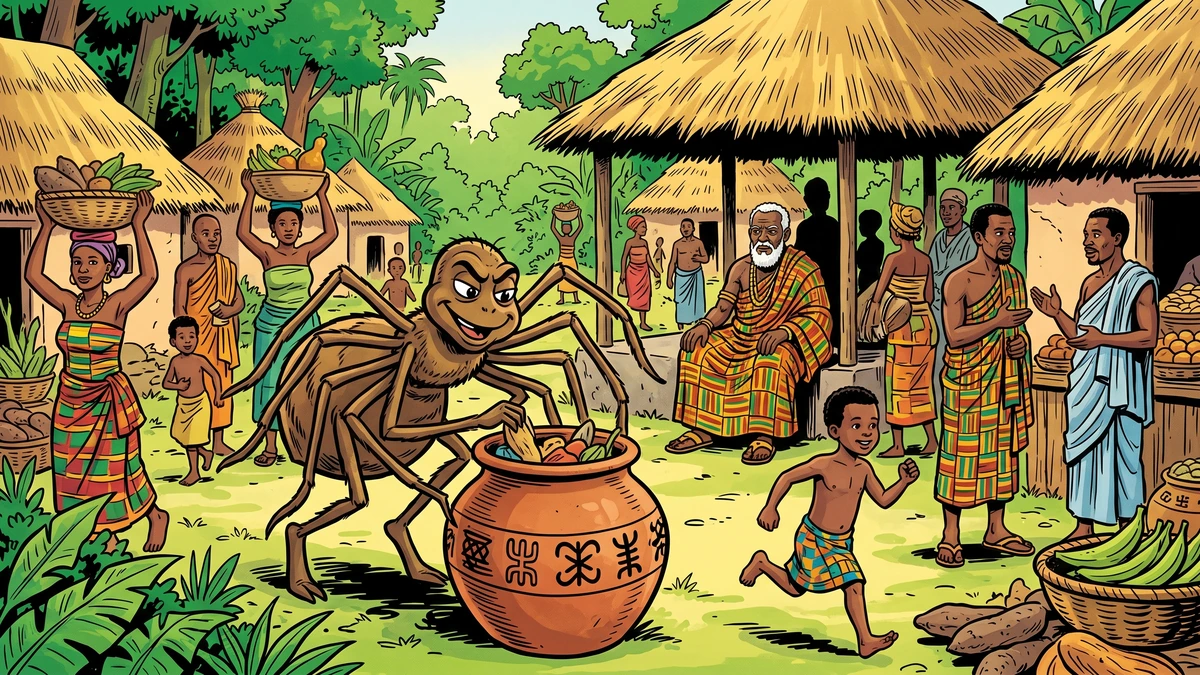
The story begins with a decision. Kwaku Anansi, the spider, looks about him at the world and sees how often people prosper by knowing things — when to plant and when to harvest, how to read the weather, how to settle a quarrel, how to tell a true friend from a false one. Wisdom, he concludes, is the most valuable thing there is; and being Anansi, he draws from that true observation an entirely crooked conclusion. If wisdom is so precious, then he, Anansi, must have all of it. Not most of it. All of it. He will gather every scrap of wisdom in the whole world and keep it where no one else can reach it — and then, whenever any man or woman or child needs to know anything at all, they will have to come to Anansi and ask, and Anansi will name his price.
So he sets to work. He takes a great earthen pot — a wide-mouthed clay pot of the kind that stands in every Akan household — and he begins to travel. Into every corner of the forest he goes, into every village and every market and every quiet place where an old person sits thinking. Wherever he finds a piece of wisdom — a proverb, a clever saying, a useful skill, a hard-won lesson — he gathers it up and tucks it carefully into his pot. He is patient and he is thorough, for Anansi’s patience, when his greed is engaged, is bottomless. Day after day, season after season, the pot grows heavier and fuller, until at last Anansi believes he has done it: every grain of wisdom that exists anywhere in the world is now inside his one clay pot, and the rest of creation has been left with none.
It is worth pausing on how strange and how recognisable this ambition is. Anansi does not want to use the wisdom — he wants to own it, and, just as much, he wants others not to have it. His scheme only works if everyone else is left ignorant. The story has put its finger, lightly and early, on something true about hoarding of every kind: the hoarder’s pleasure depends not only on his having much but on others having little. And it has set up the irony that the whole tale will turn on. A creature clever enough to collect all the world’s wisdom ought, surely, to be wise. We are about to watch him prove that he is not.
Hiding the Pot at the Top of the Tall Tree
Now Anansi faces the question of where to keep his treasure. A pot of all the world’s wisdom cannot simply be left by the doorstep. It must be hidden, and hidden high, somewhere no thief and no curious neighbour could ever climb to it. Anansi looks about and fixes on the tallest tree in the forest — a great smooth-trunked giant towering over the canopy — and decides that the pot shall live at the very top of it, cradled safe in the highest branches where only he will ever go.
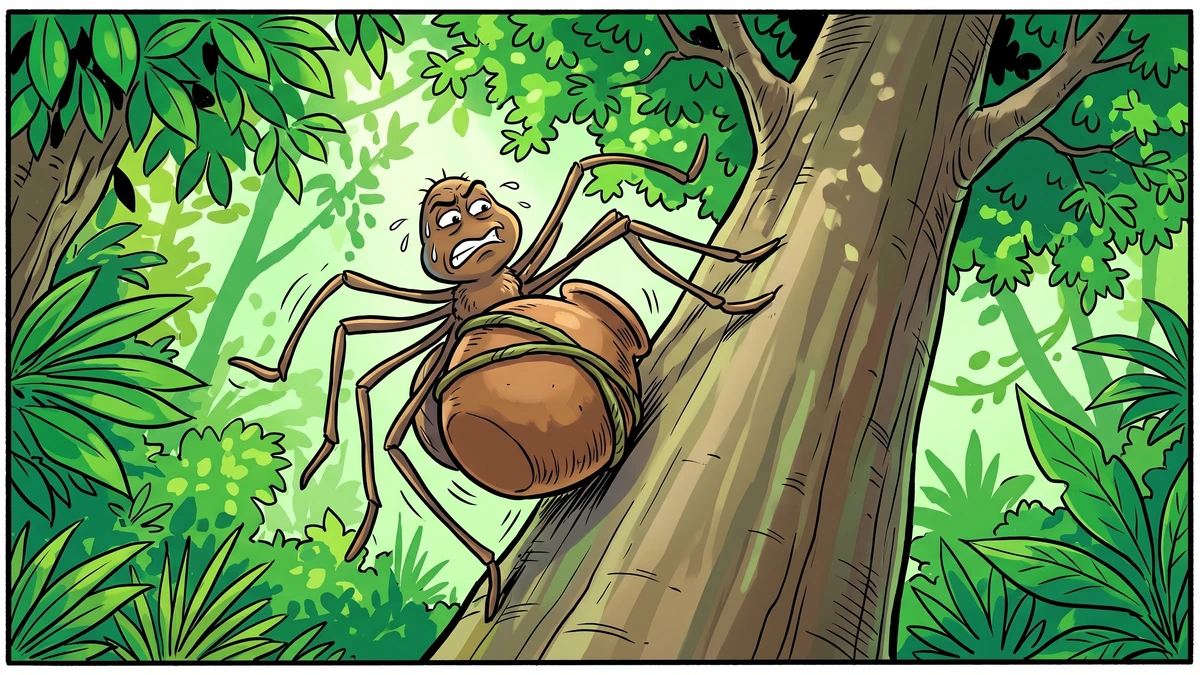
He ties the heavy pot to the front of his body, against his belly, with a length of strong vine, so that he can carry it and still have his eight legs free for climbing. And he begins to climb. But the climb does not go as he imagined. The fat round pot, lashed to his front, jams between Anansi and the trunk. It bumps against the bark; it pushes him outward; it slides and swings and gets in the way of every grip his legs try to take. He hauls himself up a little way and slithers back down. He tries again, scrabbling and straining, and again the pot wedges itself between his body and the tree and shoves him back. Again and again the cleverest creature in the forest flings himself at the trunk, and again and again the pot defeats him, and he slides down to the roots no higher than he began — sweating, furious, and utterly baffled.
What Anansi cannot see — what his pride will not let him see — is that the problem is not the tree and not the pot but the plan. He has tied the pot exactly where it must do the most harm, directly between himself and the thing he is trying to climb. Any solution would be simple. But Anansi is too busy being frustrated to think, and too certain of his own genius to imagine that the answer might be obvious. He has all the world’s wisdom strapped to his chest, and he cannot get up a tree.
The Question of the Spider’s Small Son
Anansi does not know it, but he has not been alone. His small son — in the Akan tellings the boy is Ntikuma, the youngest and least regarded of Anansi’s children — has followed his father into the forest and has been standing quietly to one side, watching the whole performance: the great pot, the great tree, and the great Anansi sliding back down the bark for the tenth and the twentieth time.
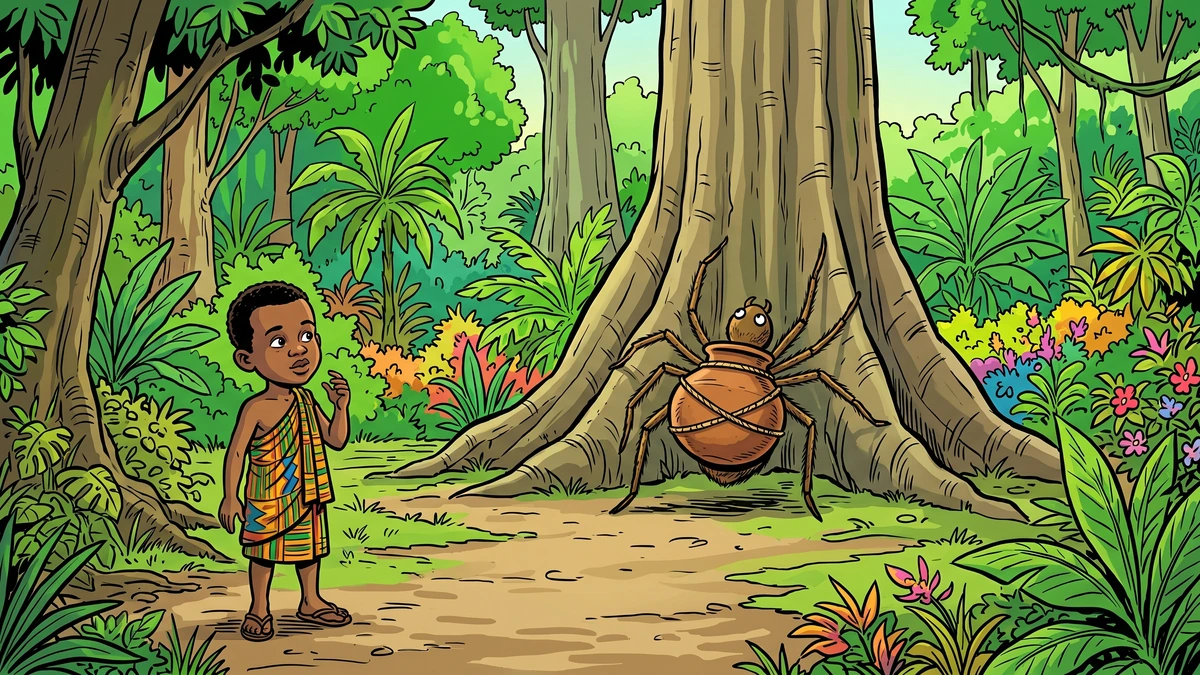
For a long while the child says nothing, because a child does not lightly correct his father, and Anansi is not a father who welcomes correction. But at last, watching the pot jam itself once more between his father and the trunk, the boy cannot hold the question in. “Father,” he says — and one can hear in the asking that he is honestly puzzled, not mocking — “why do you not tie the pot to your back instead of your belly? Then it would not be between you and the tree, and you could climb quite easily.”
Anansi stops. He looks at his small son. And the truth of it goes through him like cold water: the child is right. Of course the child is right. Tie the pot behind you and the trunk is clear and the climb is nothing. It is so simple, so immediately and undeniably obvious, that a little boy who had gathered no wisdom at all, who had travelled no roads and emptied no villages, had seen it in a moment from the side of the clearing. And Anansi — Anansi who had combed the entire world for every grain of cleverness and packed it all into the pot now strapped uselessly to his chest — had not. The wisdom he thought he had captured whole and entire had been sitting, all this time, in the head of his own youngest child, where he had never thought to look.
The Pot is Broken and Wisdom Scatters
What happens next happens fast, and it happens out of pure wounded pride. Anansi does not thank his son. He does not laugh at himself. He does not feel the small honest relief of a problem solved. He feels only the unbearable sting of it — that after all his labour the proof of his foolishness has come from a child — and the sting boils over into rage. In a fury of humiliation Anansi tears the pot loose and hurls it down.
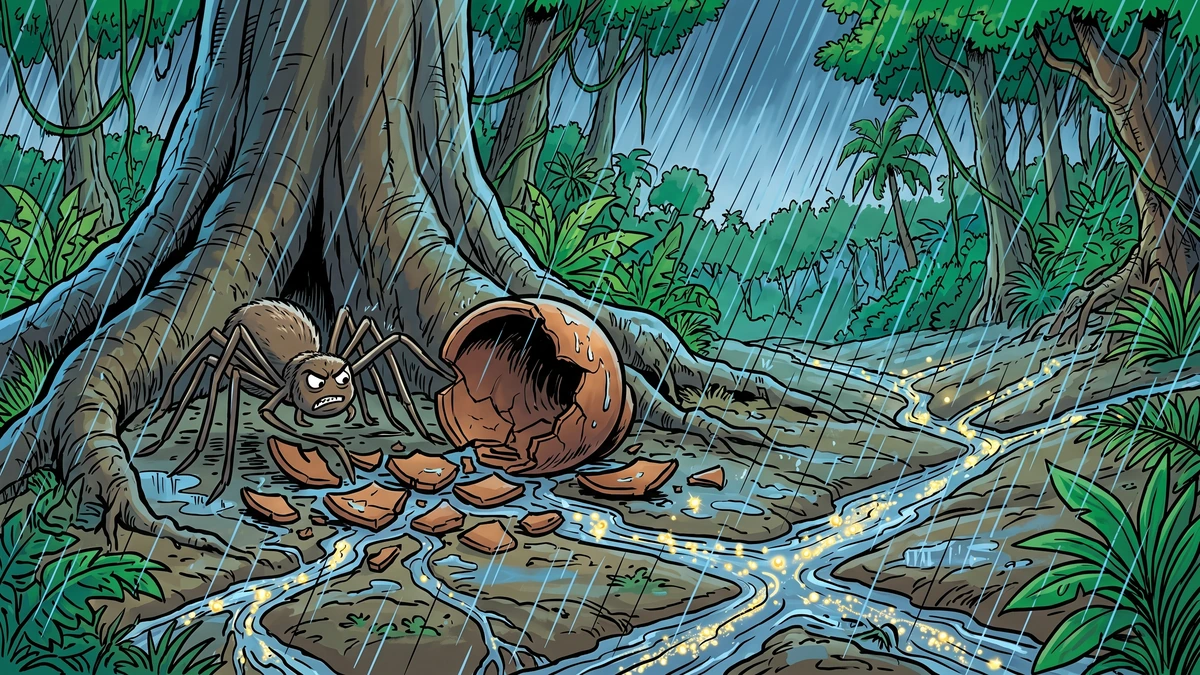
The great clay pot strikes the roots of the tall tree and shatters. And all the wisdom of the world — every proverb, every skill, every clever saying and hard-won lesson that Anansi had spent so long gathering — bursts out of the broken shards and spills across the ground. Then, as the old tellings have it, the rain comes. A great storm sweeps down through the forest, and the running water gathers up the scattered wisdom and carries it away — into the streams, and from the streams into the rivers, and from the rivers out across the whole earth and to the sea. Wherever the water ran, it carried a little wisdom with it; and wherever people lived along the water, they found their share washed up at their feet.
And that, the storyteller says, is why things are as they are. That is why wisdom is not piled up in any one place or locked in any one creature’s pot, but is scattered everywhere, in every land, among all the peoples of the world — a little here and a little there, in the old and in the young, in the great and in the small. No one has all of it. Everyone has some of it. Anansi, who set out to own the whole of it, ended by giving every grain of it away; and the world has been wiser, and fairer, for his failure ever since. As for Anansi himself, the tale leaves him at the foot of the tree among the broken pieces of his pot — not destroyed, never destroyed, for the trickster always lives to scheme another day, but taught, for once, a lesson he had gone to enormous trouble to avoid.
The Moral of Anansi and the Pot of Wisdom
On its surface the tale teaches the plain lesson every child takes from it at once: pride makes fools of the clever. Anansi is genuinely brilliant — brilliant enough to gather the wisdom of the whole world — and his brilliance saves him from nothing, because it is yoked to a vanity that will not let him see a simple thing simply, nor bear to be helped, nor stand to be taught by someone smaller than himself. The pot strapped to his chest is one of the great images in West African folklore: a person can carry all the knowledge in the world and still be defeated by it, if he carries it in the wrong way and for the wrong reason.
“Nyansa nni baako tirim.”
— Akan (Twi) proverb: “Wisdom is not in one person’s head.”
But the deeper moral — the one the etiological ending exists to deliver — is a quiet and generous statement about the nature of knowledge itself. Wisdom, the tale insists, was never meant to be hoarded, and in fact cannot be hoarded; the moment Anansi tries to own all of it, it breaks loose and spreads to everyone. Knowledge is not a treasure that grows more valuable the fewer people hold it. It is the opposite kind of thing: it does its work only when it is shared, passed on, scattered like the wisdom in the streams. And because no single mind can contain it all, every person we meet — the old neighbour, the stranger, the youngest child in the clearing — holds some grain of it that we lack. The proverb the Akan attach to this story says it exactly: wisdom is not in one head. The humble person, who knows this and listens to everyone, will keep on learning all their life. The proud person, who cannot bear to be taught, will stand for ever at the foot of the tree with the broken pot, no wiser than they began.
Why Anansi and the Pot of Wisdom Has Lasted
This little story has been told for centuries, and it has travelled further than almost any other African tale, and it shows no sign of being forgotten — and it is worth asking why. Part of the answer is simply Anansi. The spider is one of the great creations of world folklore, as alive and as morally complicated as any trickster anywhere: we are not asked to admire him, nor quite to despise him, but to recognise him — the cleverness, the greed, the vanity, the comic self-defeat — because there is a little of Anansi in everyone, and the tales know it and forgive it even as they laugh.
The story has lasted, too, because its central image is unforgettable and its lesson never goes stale. Every generation rediscovers, usually the hard way, that intelligence and wisdom are not the same thing; that the desire to monopolise knowledge is both ugly and self-defeating; and that the person too proud to be taught by a junior, a junior colleague, a younger sibling, a child, has shut the door on most of what they might still learn. In an age that talks endlessly about information — who owns it, who controls it, who is shut out from it — a tale about a clever creature who tried to put all the world’s knowledge in one pot, and discovered that knowledge will not be owned, reads as freshly as anything written this year.
And it has lasted because of the gift hidden in its ending. Many trickster tales end in pure comeuppance, the schemer humiliated and the listeners satisfied. This one ends in something better than comeuppance: it ends in a kind of grace. Anansi’s failure is not just his punishment — it is the world’s good fortune, the very reason wisdom now lies within everyone’s reach. The Akan storytellers who shaped this tale across the centuries built into its last lines a piece of genuine consolation: that the knowledge you need is not locked away at the top of an impossible tree, guarded by someone cleverer and greedier than you. It was scattered, long ago, into the streams of the whole earth — and some of it is always, already, near at hand.
You May Also Like
 African Folk Tales
Ages 6-8
African Folk Tales
Ages 6-8
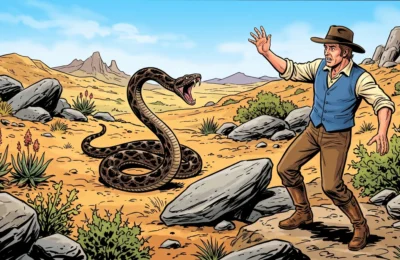
The White Man And Snake
The Khoikhoi fable of a man who frees a snake pinned under a stone, only for the snake to turn on him - until the clever Jackal restores her to the trap by asking her to prove her story. A Cape retelling of tale type ATU 155.
 African Folk Tales
Ages 9-12
African Folk Tales
Ages 9-12
Why We See Ants Carrying Bundles As Big As Themselves
An Akan pourquoi tale from West African Folk-Tales (Barker & Sinclair, 1917): the trickster Anansi, condemned to carry an enchanted box for ever, deceives the honest Ant into bearing his punishment - which is why we see ants carrying bundles as big as themselves.
 African Folk Tales
Ages 6-8
African Folk Tales
Ages 6-8
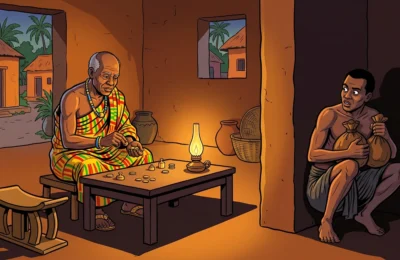
The Robber And The Old Man
The Robber And The Old Man: In a big town lived a very rich gentleman. The fame of his wealth soon spread. A clever thief heard of it and determined to have