The Robber And The Old Man
The Robber And The Old Man: In a big town lived a very rich gentleman. The fame of his wealth soon spread. A clever thief heard of it and determined to have
Among the folk tales gathered on the Gold Coast and published in West African Folk-Tales (London: George G. Harrap & Company, 1917) by William H. Barker and Cecilia Sinclair, “The Robber and the Old Man” stands out as a sharp little comedy of cunning. It belongs to the great Akan storytelling tradition of what scholars classify as Aarne–Thompson–Uther tale type ATU 1585, “The Lawyer’s Mad Client” — a trickster plot in which clever advice given for a fee is repaid with the very same cleverness, leaving the adviser cheated by his own scheme.
Barker, an inspector of schools, and Sinclair, a Cape Coast teacher, collected these stories so that Gold Coast children could read their own inherited literature in print. Like most Akan tales, this one would once have been told aloud in the evening, the audience answering, laughing, and predicting the ending. What makes it unusual is its moral honesty: it does not pretend that cleverness always rewards the deserving. Sometimes, the storyteller admits with a shrug, the trickster simply wins.

A Tale from the Gold Coast Storytellers
The Akan peoples of present-day Ghana — among them the Ashanti, Fante, and Akuapem — carried an immense body of oral narrative known as anansesem, “spider stories,” named for the trickster Ananse the spider who presides over the genre. Not every anansesem features Ananse himself; the word came to mean any tale of wit, deception, and reversal. “The Robber and the Old Man” is exactly such a tale: no spider appears, but the spirit of Ananse — the celebration of nimble intelligence over brute force or settled authority — runs through every line.
An anansesem was never a solitary performance. The teller opened with a formula, the audience answered with a formula, and throughout the night listeners interrupted with songs, corrections, and rival versions. A tale like “The Robber and the Old Man” would have been polished by hundreds of such evenings, every weak line worn smooth and every wasted word dropped. That communal editing is why the surviving text is so lean: it contains only what generations of listeners refused to let the storyteller cut.
The Akan also drew a careful distinction the printed page can blur. To enjoy a trickster’s wit inside a story was not to approve of trickery in life. The evening tale was a sealed space, marked off by its opening formula, in which dangerous behaviour could be admired safely — the way a community might laugh at a masked dancer who would never be tolerated unmasked. “The Robber and the Old Man” lives in exactly that sealed space: it lets the listener relish the “Moo” trick while the ending quietly reminds everyone that, outside the story, such a man is no friend to anyone.
The plot also travels far beyond West Africa. The same structure animates the medieval French farce La Farce de Maître Pathelin (around 1457), in which a shepherd, coached by a lawyer to answer every question in court with the bleat “Bée,” wins his case and then bleats the same nonsense when the lawyer demands his fee. From that play French gained the proverb “revenons à nos moutons” — “let us return to our sheep.” That a Gold Coast tale and a Parisian stage comedy should share a skeleton tells us something profound: the temptation to weaponize a hired man’s own cleverness against him is a human idea, not a regional one. Folklorists place both firmly within ATU 1585.
The Thief in the Dark Corner
The story opens with wealth, and wealth in folk tales is always a kind of bait.
In a big town lived a very rich gentleman. The fame of his wealth soon spread. A clever thief heard of it and determined to have some for himself.
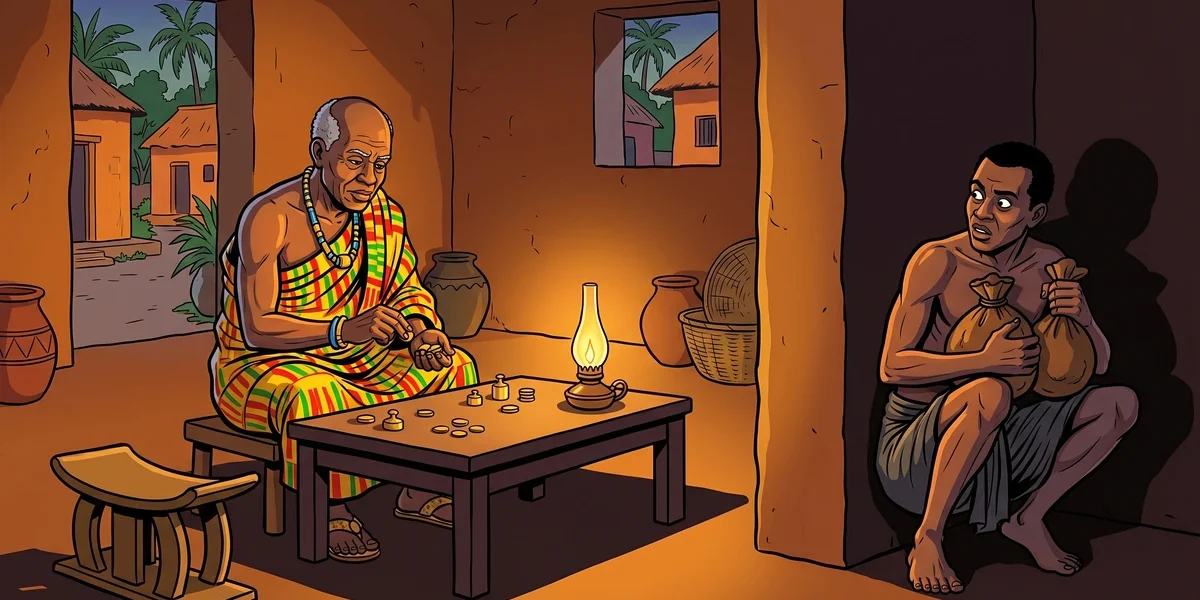
He managed to hide himself in a dark corner of the gentleman’s room — while the latter was counting his bags of money. As soon as the old gentleman left the room to fetch something, the thief caught up two of the bags and escaped.
The owner was astonished, on his return a few minutes later, to find two bags short. He could find no trace of the thief.
Notice how economical the storyteller is. There is no elaborate heist, no description of locks or guards — only patience and a dark corner. The thief’s gift is not strength but timing; he waits, watches, and seizes the single unattended moment. The rich man, for all his fame and counting, is undone by an ordinary lapse of attention. Already the tale is teaching its quiet lesson: in this world, the alert mind beats the heavy purse.

The Wise Man’s Bargain
Theft, in a close-knit town, is rarely the end of the matter. A face seen once is remembered.
Next morning, however, he chanced to meet the robber just outside the house. The dishonest man looked so confused that the rich man at once suspected he was the thief. He could not, however, prove it, so took the case before the judge.
The thief was much alarmed when he heard this. He sought a man in the village and asked his advice. The wise man undertook to help him — if he would promise to pay him half the money when he got off. This the robber at once said he would do.
The old man then advised him to go home and dress in rags. He must ruffle his hair and beard and behave as if he were mad. If any one asked a question he must answer “Moo.”
Here the tale plants the seed of its own punchline. The wise man drives a hard bargain — half of everything — and the robber agrees instantly, “at once.” A listener attuned to folk-tale logic should feel a small chill at that speed. A promise made too quickly, in these stories, is a promise made to be broken. The wise man, confident in his cleverness, never pauses to ask why a proven thief would honour a debt. He has sold a strategy without noticing that the strategy can be aimed back at himself.
It is worth pausing on the disguise itself. The wise man does not advise a clever lie, an alibi, or a bribe — he advises the abandonment of speech altogether. In a society where disputes were settled by a chief’s court built entirely on spoken testimony, public oratory, and the weighing of words, the counsel to say nothing intelligible is a kind of genius. It cannot be cross-examined. It cannot be caught in contradiction. The thief in rags, hair and beard wild, is not lying to the court; he is simply withdrawing from the conversation the court needs to function. That is why the strategy is unanswerable — and, fatally for the wise man, why it remains unanswerable after the trial ends.
“Moo,” Said the Madman
The advice is performed to the letter, and the courtroom becomes a stage.
The thief did so. To every question asked by the judge he said, “Moo, moo.” The judge at last grew angry and dismissed the court. The thief went home in great glee.
The single syllable “Moo” is the engine of the whole comedy. A court runs on questions and answers; testimony is the machinery of judgment. By refusing to supply answers — by replacing every reply with the same meaningless sound — the thief jams the machinery completely. The judge cannot convict a man who appears to have no mind to convict. Frustration mounts, the case collapses, and the disguise of madness becomes a perfect shield. The robber walks home “in great glee,” and the listener, half disapproving and half delighted, walks with him. This is the seductive middle of the tale, the point at which cleverness looks like triumph.

The Trick Turned Round
But the storyteller has one move left, and it is the move the wise man never saw coming.
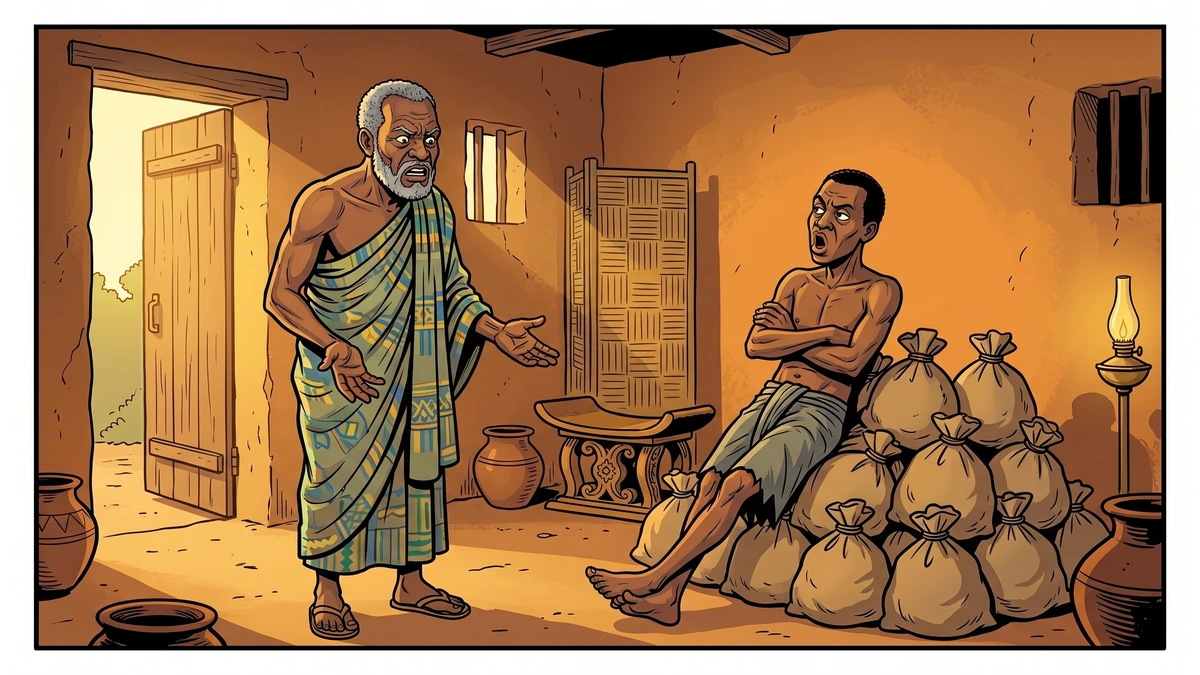
Next day, the wise man came to him for his half of the stolen money. But he could get no answer but “Moo” from the thief, and at last, in despair, he had to go home without a penny. The ungrateful robber kept everything for himself. The wise man regretted very much that he had saved the thief from his just punishment — but it was now too late.
The reversal is flawless. The thief does not invent a new trick; he simply keeps performing the old one. “Moo” defeated the judge, and now “Moo” defeats the wise man, because the wise man has no court, no power, and no way to compel a reply. He cannot sue an accomplice over stolen money; to do so he would have to confess his own part in the fraud. He is trapped inside his own scheme. The very silence he sold as a weapon is now turned against him, and he “had to go home without a penny.” The tale ends not with justice but with regret — the wise man’s late, useless understanding that he should never have rescued a thief from “his just punishment.”
The Moral of the Tale
“The Robber and the Old Man” refuses the comfortable ending. The thief is never caught; the wise man is never paid; the rich man never recovers his bags. What the story offers instead is a warning aimed squarely at the clever: the person who teaches deception should not be surprised to be deceived. Cleverness placed in the service of a dishonest cause has no loyalty — it serves whoever holds it last. The wise man’s real error was not poor strategy but poor judgment of character: he helped a thief and expected gratitude from a man who had already shown he had none.
The Akan tradition has a proverb that captures this exactly:
“Aboa a ɔbɛka wo no, ɔfiri wo ntoma mu.”
— “The creature that will bite you is the one inside your own cloth.”
The wise man wrapped the thief in his own cleverness as one wraps a cloth about the body — and was bitten by what he carried close. Betrayal, the proverb teaches, rarely comes from strangers; it comes from the schemes and the people we choose to keep against our own skin.
The Trickster Who Is Never Punished
Most of the world’s moral tales are built on a reassuring promise: do wrong, and the story will see you punished. “The Robber and the Old Man” deliberately breaks that promise, and its refusal is the source of its lasting bite. The thief steals, lies, feigns madness, cheats his helper — and ends the tale richer than anyone, “in great glee.” No judge touches him. No misfortune finds him. The storyteller looks the listener in the eye and declines to comfort them.
This is not a failure of the tale’s morality but its sharpest expression. By withholding the punishment we expect, the story forces the moral weight onto a different shoulder — the wise man’s. He is the figure who suffers, and he suffers for a specific, nameable mistake: he sold his cleverness to a cause he knew was crooked, and trusted a thief to keep a promise. The tale’s lesson is therefore aimed not at children tempted to steal, but at clever adults tempted to hire out their wits. You, the able and the quick-minded, are the ones this story warns. Lend your gift to dishonesty, and dishonesty will keep it.
The Akan trickster tradition is full of this moral ambivalence. Ananse the spider is admired and mistrusted in the same breath; his stories end as often in his humiliation as in his triumph. “The Robber and the Old Man” simply hands the spider’s role to an ordinary criminal and lets the pattern run to its colder conclusion. The result is a tale that entertains like a comedy and lands like a caution — which is precisely the balance the old storytellers prized most.
Talking About This Story
Because the ending is unsettled rather than tidy, “The Robber and the Old Man” is unusually good for conversation. A reader sharing it with a child might pause after the courtroom scene — while the thief is still winning — and ask whether the trick was clever, and whether clever is the same as good. Most children sense the difference immediately, and naming it is half the lesson.
The ending invites a harder question: who, in the end, deserves our sympathy? The thief keeps the money but has shown he will betray anyone. The wise man loses everything, yet he chose to help a criminal escape justice. The rich man never even learns what happened. Sitting with that discomfort — the realization that a story can refuse to reward anyone — is itself a kind of growing up. Folk tales like this one have always done that work: they prepare the young listener for a world that does not always settle its accounts, and they ask the older listener to guard their own talents more carefully than the wise man guarded his.
Why This Story Has Lasted
This little tale has survived because it tells an uncomfortable truth that politer stories avoid. Most moral fables promise that the dishonest will be punished and the wronged made whole. “The Robber and the Old Man” promises no such thing. It admits that a sufficiently shameless trickster can sometimes escape every consequence — and that the only person truly punished may be the one who chose to help him. For Gold Coast listeners, young and old, that was not cynicism but realism, a useful inoculation against the flattery of being asked to lend one’s wits to someone else’s wrongdoing.
It endures, too, because of the sheer craft of its design. A single repeated word, “Moo,” carries the entire plot, working first as a shield and then as a sword. The structure is so clean that it crossed oceans and centuries, surfacing in a French farce of the 1450s and in countless courtroom jokes since. Whenever someone observes that a clever trick, once taught, can always be turned on its teacher, they are retelling ATU 1585 — whether they have heard of Ananse, of Maître Pathelin, or of neither.
There is also a craftsman’s pleasure in how few characters the tale needs. A rich man, a thief, a wise man, a judge — four figures, no names, no scenery beyond a dark corner and a courtroom. Folk tales reach this spareness through long use; anything a listener did not need was eventually dropped. What remains is pure mechanism, a moral machine with no loose parts. A modern writer could study “The Robber and the Old Man” simply as a lesson in economy: every sentence advances the plot, and the plot turns entirely on one repeated, ridiculous syllable.
Read aloud today, the story still earns its laugh at the wise man’s expense and its small, sober chill at the end. That double effect — comedy and caution in the same breath — is exactly what the Akan storytellers intended. A good anansesem entertains first and instructs second, and trusts the listener to feel the difference between admiring a trick and approving of it. “The Robber and the Old Man” has been doing precisely that, in town squares and now on the page, for well over a century.
You May Also Like
 African Folk Tales
Ages 6-8
African Folk Tales
Ages 6-8
The Grinding-Stone That Ground Flour By Itself
A poor brother borrows a magic mill — and that is why, to this very day, the sea tastes of salt.
 African Folk Tales
Ages 9-12
African Folk Tales
Ages 9-12
Tit For Tat
Tit For Tat: There had been a great famine in the land for many months. Meat had become so scarce that only the rich chiefs had money enough to buy it. A
 African Folk Tales
Ages 6-8
African Folk Tales
Ages 6-8
The Lion’s Whisker
An Amhara wisdom tale from Ethiopia: a young stepmother, desperate to win her grieving stepson's love, is sent by a wise hakim to pluck a whisker from a living lion - and learns that patience, not magic, is the cure.