The Girl Who Could Not Be Eaten
The Zulu tale of Untombinde, a king's proud daughter, and the swallowing monster of the haunted pool - who devours a whole nation and cannot keep a single soul down.

There is a kind of folk tale that frightens children and yet leaves them braver than it found them, and the Zulu story sometimes called “The Girl Who Could Not Be Eaten” is one of the finest of them. It is the tale of Untombinde — the tall, high-born daughter of a great king — and of the vast, bearded swallowing monster of the haunted pool who devoured her, devoured her father’s warriors, devoured a whole nation of people and cattle and dogs, and could not, in the end, keep a single one of them down.
It is a story built from the oldest fear there is — the fear of being swallowed whole by something far larger than yourself — and it answers that fear not with a sword-stroke alone but with something stranger and steadier: the refusal of a proud girl to beg, and the conviction, deep in the heart of Zulu storytelling, that life itself cannot be permanently eaten. What goes down into the dark comes back up into the light. That is why, terrifying as it is, this is a tale told to children at the fireside, and why it has lasted for as long as anyone can remember.
Origins and Canonical Attribution
This is a folk tale of the amaZulu — the Zulu people of what is now KwaZulu-Natal in South Africa — and it belongs to one of the most widespread and important story-families on the African continent: the tales of the swallowing monster. Across Bantu-speaking Africa, from the Zulu and Xhosa of the south to peoples far to the north, storytellers tell of an enormous all-devouring creature that eats every living thing in the land, until at last it is brought down and its victims walk out alive. The Zulu form of that great theme is the story of Untombinde and the monster of the pool, and for centuries it lived only in the spoken word, performed in isiZulu in the evening hours by storytellers who shaped each telling to the children gathered around them.
Origin & Canonical Attribution
Tradition: A folk tale of the amaZulu (Zulu people) of KwaZulu-Natal, South Africa — the Zulu form of the pan-African “swallowing monster” tale, centred on the king’s daughter Untombinde and the devouring creature of the haunted pool.
Principal printed source: Henry Callaway, Nursery Tales, Traditions, and Histories of the Zulus, in Their Own Words, with a Translation into English, and Notes (Springvale, Natal: J. A. Blair; London: Trübner & Co., 1868) — the foundational nineteenth-century collection of Zulu oral narrative, in which the tales were set down in isiZulu from native narrators and translated.
Scholarly survey: Alice Werner, Myths and Legends of the Bantu (London: George G. Harrap & Co., 1933), Chapter XIV, “The Swallowing Monster,” which discusses Untombinde and the monster Isiqúqumadevu within the wider Bantu tradition of the all-devouring beast.
Story type: The “swallowing monster” tale — a distinct and very ancient African narrative type. It is not assigned a single Aarne–Thompson–Uther number, the ATU index being built largely from European material, but it is universally recognised by folklorists as a major type in its own right.
Principal motifs: Stith Thompson’s motifs F911.6, the all-swallowing monster; F911, a person swallowed alive; F912, the victims rescued from the monster’s body; F913, victims found alive in the belly of the swallower; together with the motif of the broken taboo — the forbidden pool entered against a warning — and C600, the one prohibition disregarded.
The tale reached the printed page through Henry Callaway (1817–1890), an English-born missionary and physician in colonial Natal who, almost uniquely for his time, treated Zulu oral literature as literature. Rather than summarising or sanitising the stories, Callaway took them down word for word in isiZulu from Zulu narrators and printed the Zulu text beside his English translation, with notes. His Nursery Tales, Traditions, and Histories of the Zulus of 1868 remains the bedrock source for Zulu folklore, and it is there that the story of Untombinde and the swallowing monster was first preserved for readers. More than sixty years later the folklorist Alice Werner, in her Myths and Legends of the Bantu, set the tale in its true context — as the Zulu chapter of a story told, in a hundred forms, all across the Bantu-speaking world.
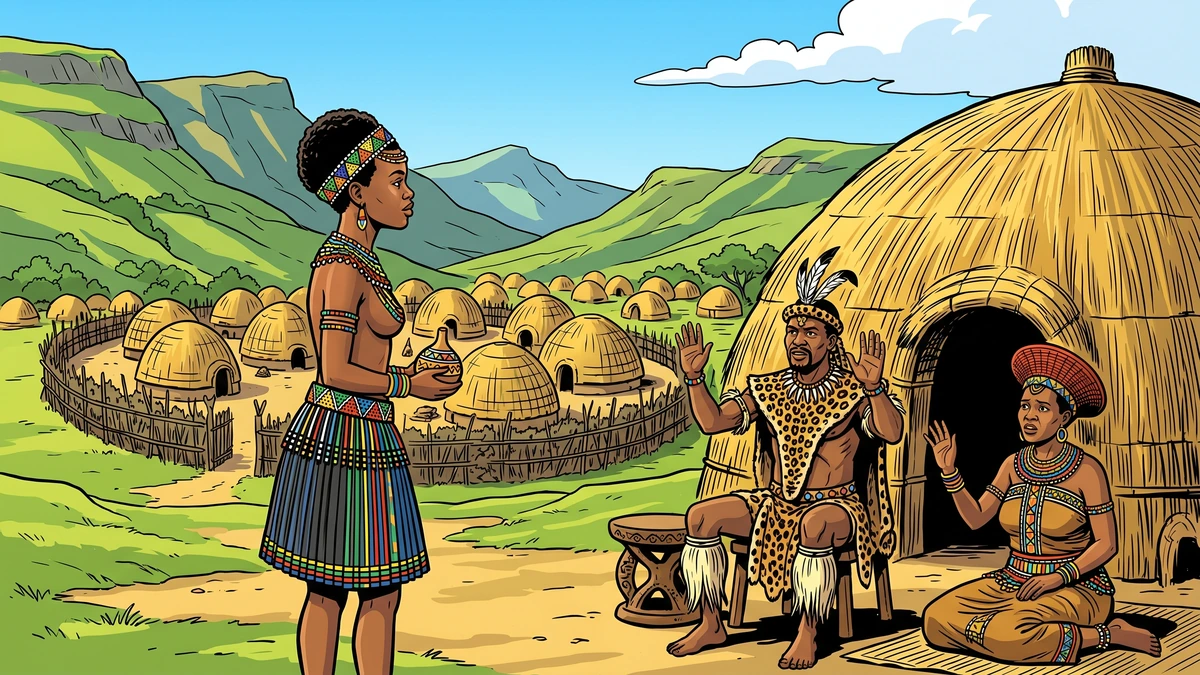
The King’s Tall Daughter and the Forbidden Pool
In the days of the tale there lived a great king, and the pride of his household was his daughter, whose name was Untombinde. The name itself tells you something: it means “the tall girl,” the high one, the maiden who stands above the rest — and Untombinde was indeed tall, and beautiful, and very conscious of being a king’s child. She carried her royal birth the way some people carry a lamp, holding it up so that no one could fail to see it.
Now in the king’s country there was a certain pool, a wide still pool in the river that the people called the Ilulange, and that pool was forbidden. Everyone knew it. Mothers warned their daughters; the old people spoke of it gravely. No one was to bathe there, for the pool was the dwelling of a monster — a thing called the Isiqúqumadevu, a name that carries the sense of a bloated, bearded, squatting creature, the lord of the haunted water. To go down to that pool was to walk knowingly past a warning, and warnings in a folk tale are never idle.
One day Untombinde announced that she wished to go and bathe in the river — in that river, in that pool. Her parents heard the wish with alarm, and they told her plainly what every child in the land was told: that the pool was the monster’s, that no good could come of it, that she must not go. But Untombinde was a king’s daughter, and being told that she could not do a thing was, for her, very close to being told that she must. She would go, she said. And being a princess, she did not go alone: she gathered a great company of maidens to go with her as her escort — two hundred of them, the story says, and then two hundred more — and at the head of that bright procession of girls she set out for the forbidden water.
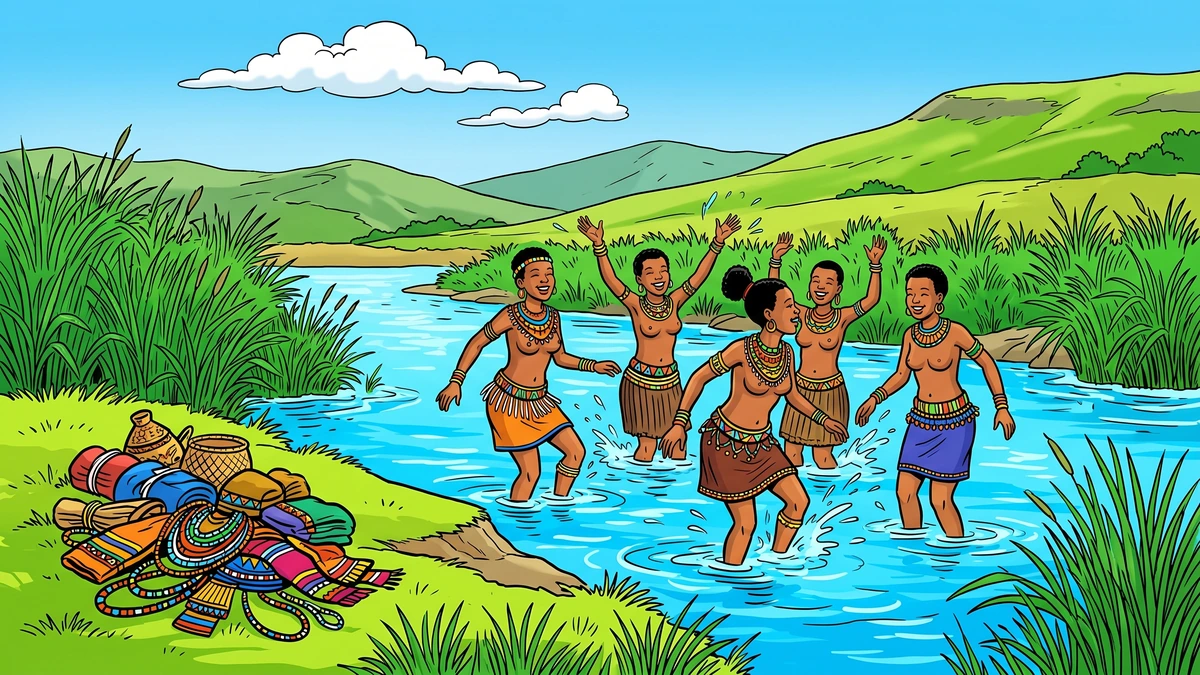
The Bathing, and the Pride That Would Not Bend
The company of maidens came down at last to the pool of the Ilulange, and the day was hot, and the water lay cool and tempting and still. The girls did exactly what the warnings had forbidden: they laid aside their clothing and their ornaments — their beads, their brass and copper rings, the bracelets and the finery that a chief’s daughters and their companions wore — and they went down laughing into the pool to bathe.
And while they swam and splashed and were happy in the water, the monster moved. The Isiqúqumadevu, the bearded lord of the pool, gathered up everything that the girls had left on the bank — every garment, every bead, every shining ring — and took it all. When the maidens came dripping out of the water, their belongings were simply gone.
There they stood, four hundred girls on the riverbank with nothing, and slowly they understood what had happened, and to whom they would have to speak. One by one, the maidens turned to the pool and addressed the monster. To get back what was theirs they had to ask the Isiqúqumadevu for it — and they had to ask politely, naming the creature respectfully, even flatteringly, humbling themselves before the dweller in the water. Girl after girl swallowed her fear and her pride, spoke the courteous words, praised the monster by its name, and asked for her things; and girl after girl, having asked properly, was given back her clothes and her ornaments and stepped away safe.
Then it came to Untombinde. And Untombinde would not do it. She would not name the monster respectfully; she would not flatter a thing of the water; she would not, above all, beg. “I am the daughter of a king,” she said, lifting her head. “I will not entreat the Isiqúqumadevu.” Her companions had bent, every one of them, and gone free. Untombinde stood straight — and the monster, which had returned four hundred bundles of finery to four hundred humble askers, reached out of the pool for the one girl who had refused to ask, and drew the king’s tall daughter down into the water and swallowed her whole.
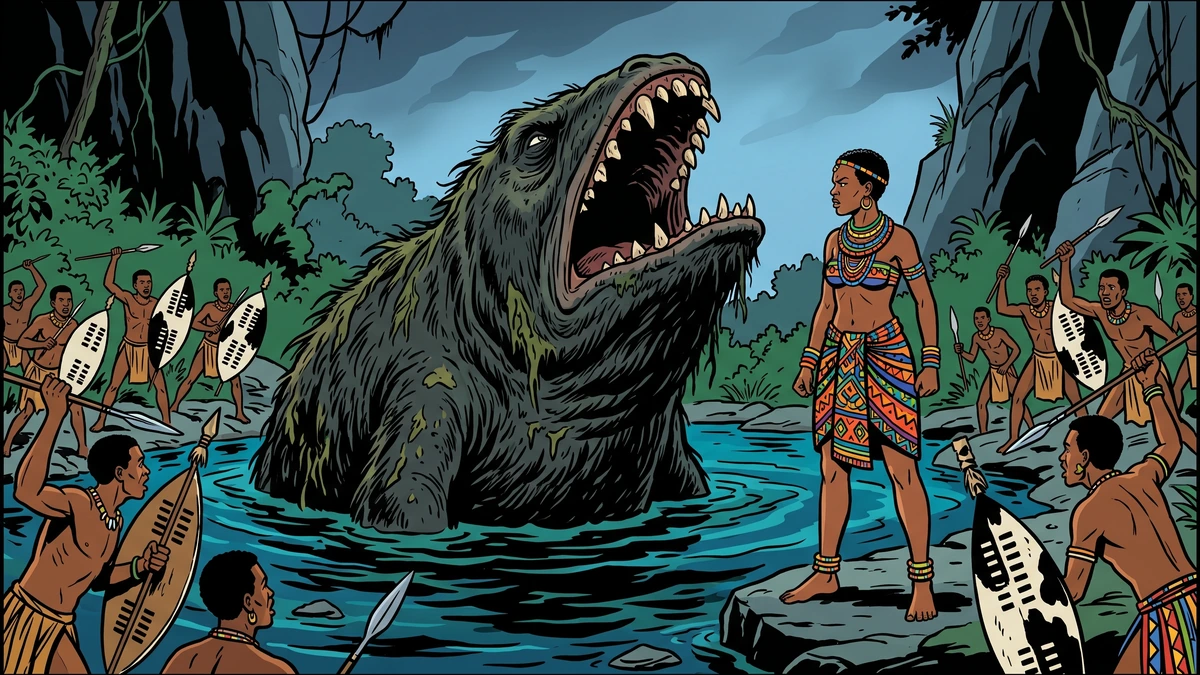
The Monster That Swallowed a Nation
The maidens fled home with the terrible news, and it came to the king that his daughter — his pride, his tall bright Untombinde — had been taken by the monster of the pool and was gone. The king did not weep and accept it. He was a king, and he had an army, and he sent that army out: a regiment of warriors marched down to the Ilulange under orders to find the Isiqúqumadevu and to kill it and to bring the princess back.
The warriors came to the pool. And the monster came up out of the pool to meet them — and the Isiqúqumadevu was not a thing that an army could fight. It was vast beyond reckoning, a mountain of a creature, and it opened its enormous mouth and it swallowed the king’s regiment whole. Every warrior, every shield and spear, went down into the dark of the monster’s body, and still the creature was not full.
For now the Isiqúqumadevu had a taste for swallowing, and it heaved its huge bulk up out of the water and went inland, following the trampled path the army had made, straight toward the homes of the people. It came to the herds in the grazing-grounds and it swallowed the cattle. It came to the homesteads and it swallowed the men and the women and the children. It swallowed the dogs in the yards. It swallowed, the storytellers say, every living thing it could find — an entire nation taken down into the belly of one devouring beast, until the green country stood empty and silent, and there was nothing left above ground at all but the monster, fat with a whole world, squatting in the stillness it had made.
This is the heart of the swallowing-monster tale, and Zulu children have always felt the size of it: not one death but the death of everything, the whole bright living world gone down into the dark at once. It is as frightening a picture as folklore contains. And it is told, every time, only so that the next part can be told.
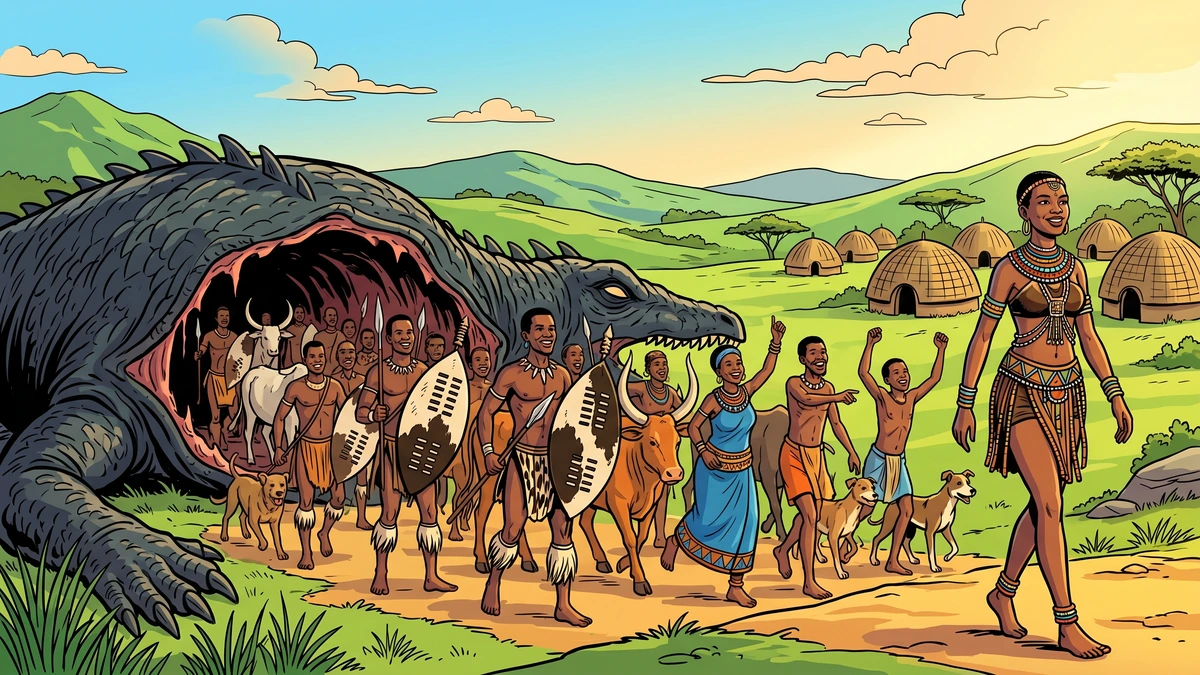
The Monster Undone, and the Girl Who Came Out Last
For the Isiqúqumadevu had swallowed more than it could ever hold. A creature may eat a nation; it cannot keep a nation. The monster was found and faced and brought down at last — in the Zulu telling its great body is opened, the way the swallowing monster is always opened in these tales, so that the dark inside it is split back into the light.
And then the most wonderful thing in the story happened. Out of the monster they came — alive. Not bones, not ruin: living people, walking out into the day. The cattle came lowing out of the dark and stood blinking in the grass. The dogs ran out. The warriors of the king’s regiment came out with their shields. The men and the women and the children of the swallowed nation climbed out of the beast and stood once more upon their own land, every one of them whole, none of them the worse for the terrible journey they had taken.
And last of all — last, as she had been last to bend, last to be taken — came Untombinde. The king’s tall daughter walked out of the monster that had swallowed her, and she was alive, and she was unharmed, and by every account she was exactly as proud as she had gone in. She had been eaten; she had not been beaten. She returned to her father’s house, and the nation that had gone down into the dark came home to its empty country and filled it again with life. The girl who could not be eaten had, in the deepest sense, proved her name.
Folklorists note that in the full Zulu tradition Untombinde’s story does not stop here — the maiden goes on to further adventures of courtship and trial, in the manner of the wider tale — but the swallowing-monster episode is complete and whole in itself, and it is this part that has always been told as “The Girl Who Could Not Be Eaten.”
The Moral of The Girl Who Could Not Be Eaten
This tale carries its meaning on two levels at once, and a good telling lets a listener feel both. On the first level it is a story about warnings. Untombinde and her four hundred maidens were told plainly not to go to the pool, and they went; the pool was forbidden for a reason, and the reason was real. Folk tales are patient teachers of this hard truth — that a prohibition is usually the compressed memory of a danger, and that the young, who feel a rule chiefly as an insult to their freedom, learn its wisdom only by walking past it.
“Isala kutshelwa sibona ngomopho.”
— A traditional Zulu proverb: “The one who will not be told learns when the blood flows” — that is, those who refuse to heed a warning come to understand it only through the disaster it foretold.
But the tale is far too wise to be only a scolding about obedience, and its second level is stranger and stronger. Untombinde’s refusal to beg the monster is not simple foolishness — it is also dignity, the unbroken backbone of a person who will not grovel even before the thing that can swallow her. The story does not punish that pride with death; it lets her be swallowed, and then it lets her walk out again, still herself. And around her the whole nation is swallowed and walks out too. That is the tale’s great consolation, and the reason it can be told to a frightened child: that the devouring dark — death, disaster, the monster in the pool — is real and enormous and must be respected, but it is not the last word. What is alive cannot be permanently eaten. The community that goes down into the night comes up again into the morning. Heed the warning, the tale says with one voice — and do not despair, it says with the other, for the belly of the monster is not a tomb.
Why This Zulu Tale Has Lasted
The swallowing-monster story is one of the most durable narratives Africa has produced, and it has lasted because it is built around an image that needs no explaining to anyone, anywhere. To be swallowed whole is a fear older than language — older than the Zulu, older than people. Every child has felt, in the dark, the nearness of a thing too big to fight. The genius of the tale is to take that nameless dread, give it a shape and a beard and a pool to live in, march it through its whole terrible appetite — and then turn it inside out and give everyone back. A story that can frighten a listener that deeply and then comfort them that completely will not be forgotten.
It has lasted, too, because of Untombinde herself. She is not a meek heroine who is rescued for being good; she is proud, headstrong, a little arrogant, and the tale neither fully condemns her nor pretends she was right. It simply lets her be vivid — the tall girl who would not beg — and a vivid character is remembered long after a moral is forgotten. Generations of Zulu listeners have argued, in effect, about Untombinde: was her refusal folly, or was it courage? The tale is great enough to hold both answers, and that is why people keep telling it.
Above all the story has lasted because of its shape — the plunge into the dark and the climb back into the light — which is one of the few story-shapes that seems to be carved into the human mind itself. We find it wherever people tell stories: the hero in the belly of the beast, the world swallowed by night and restored by morning, the descent and the return. The Zulu tellers of the tale of Untombinde gave that universal shape a particular and unforgettable form, and set it down by a still pool in the Ilulange. The monster eats the world; the world comes back. As long as human beings need to be told that the dark is survivable, a storyteller somewhere will draw breath and begin again: there was once a king, and the pride of his house was a tall daughter…
You May Also Like
 African Folk Tales
Ages 6-8
African Folk Tales
Ages 6-8
Jackal And Monkey
A captive jackal escapes a Cape farmer's wip snare by tricking a gloating monkey into taking his place - a dark South African trickster tale from the Khoikhoi jackal cycle, retold from James A. Honey's South-African Folk-Tales (1910).
 African Folk Tales
Ages 6-8
African Folk Tales
Ages 6-8
How We Got The Name ‘Spider Tales’
Anansi the spider climbs to the Sky God to buy the world's stories — and almost every folk tale in Africa now wears his name.
 African Folk Tales
Ages 9-12
African Folk Tales
Ages 9-12
The Tail Of The Princess Elephant
The Tail Of The Princess Elephant: There once lived a woman who had three sons. These sons were very much attached to their mother and always tried to please