How We Got The Name ‘Spider Tales’
Anansi the spider climbs to the Sky God to buy the world's stories — and almost every folk tale in Africa now wears his name.
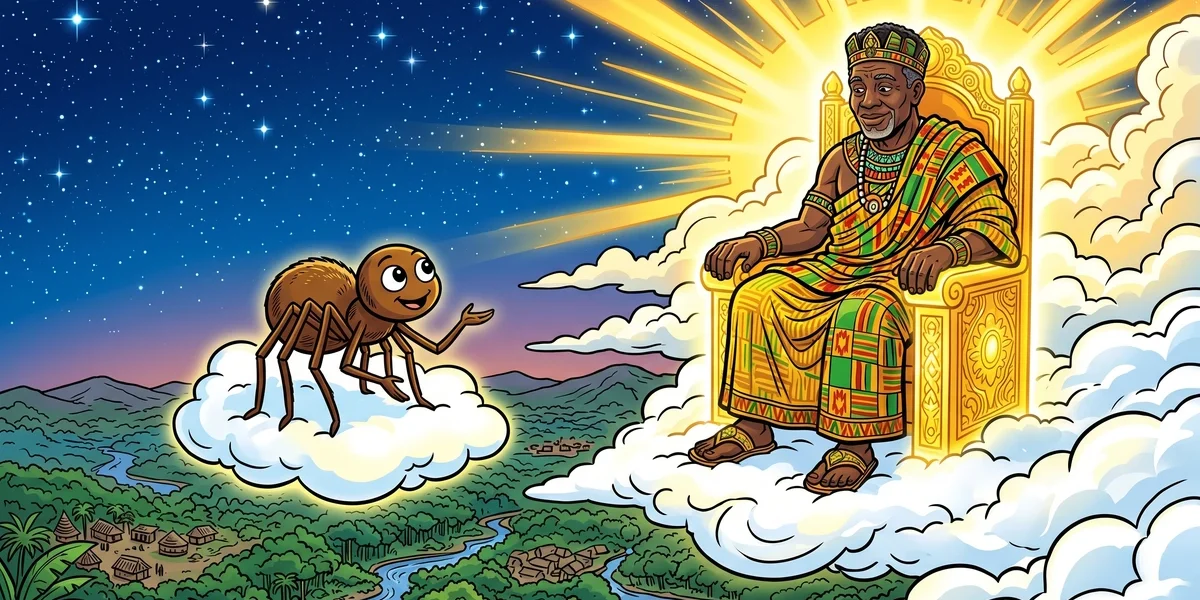
Across the forests and savannahs of West Africa there is an old habit of speech that puzzles outsiders and delights everyone who grows up inside it. When an Akan elder of Ghana settles by the evening fire to tell a tale, the tale is very often called not simply a story but an Anansesem — a “spider story.” Crying children, greedy kings, clever rogues, talking animals, the origins of the moon and the rain: whatever the subject, the story belongs, by name, to a small grey-brown spider. “How We Got the Name ‘Spider Tales’” is the tale that explains why. It is the account of how every other story came to be the property of Kwaku Anansi, the trickster spider, and it stands at the head of the West African storytelling tradition like a doorway through which all the rest must pass.
The earliest widely read English version opens West African Folk-Tales, collected and arranged by W. H. Barker and Cecilia Sinclair and published by George G. Harrap & Co. of London in 1917. Barker, an inspector of schools on the Gold Coast — the colonial territory that is now Ghana — gathered the tales from Twi- and Ewe-speaking storytellers and schoolchildren; Sinclair shaped them for a young readership. In that volume the tale is the very first entry, and it deliberately sets the terms for the thirty-odd tales that follow. A fuller and more famous Akan telling was recorded a little later by the government anthropologist R. S. Rattray in Akan-Ashanti Folk-Tales (Oxford, 1930), taken down directly in Twi from Ashanti narrators. The two versions agree on the essential shape — the spider buys the world’s stories from the sky — but differ in detail, and the difference is itself instructive. The story belongs to the great body of anansesem, the Akan trickster cycle. In the Aarne–Thompson–Uther framework it rests on motif A1481, “acquisition of culture,” joined to H1023, “performance of impossible tasks,” and the celebrated capture motif K741, “capture by tar-baby” — the sticky-doll trick that travelled with enslaved Africans across the Atlantic and resurfaced in the Caribbean Anansi tales and the Br’er Rabbit stories of the American South. The sky god is named Nyankonpon or Nyame (Barker spells it “Nyankupon”); the Akan term for the storyteller’s whole craft, Anansesem, means literally “Anansi-words,” the matters or sayings of the spider.
Setting: The Old Gold Coast and a Sky Full of Stories
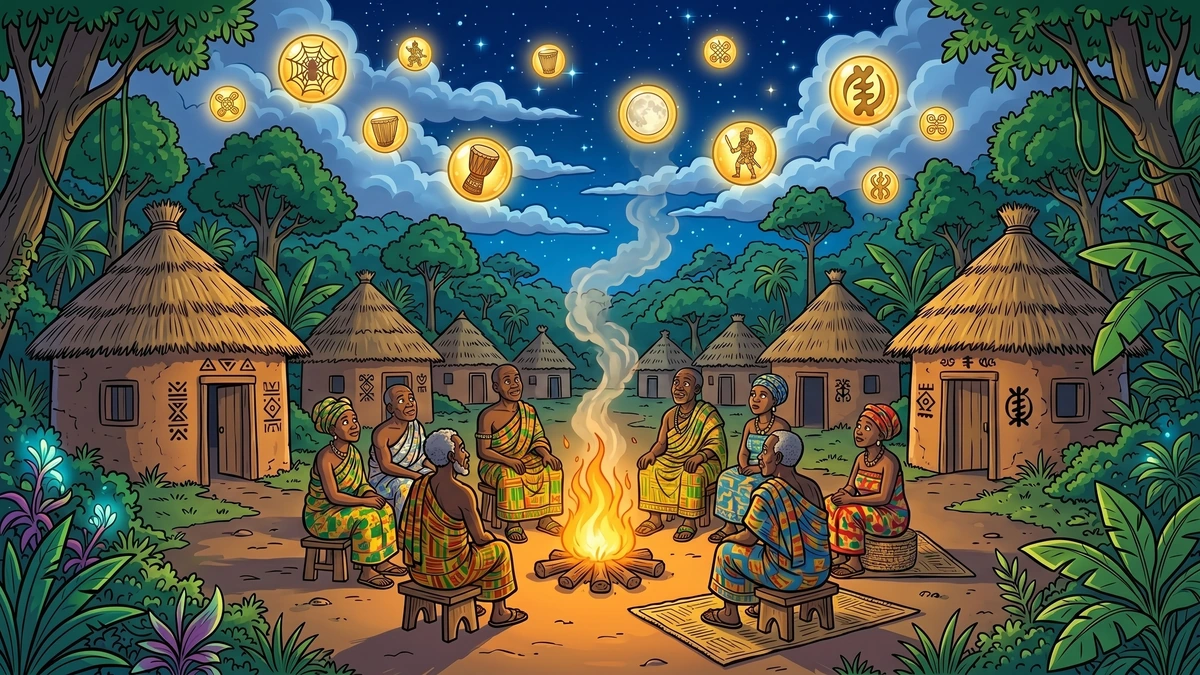
The tale is set in a time the Akan narrators place firmly before memory — the world as it was when the order of things was still being decided. The forest is the forest the listeners knew: tall silk-cotton trees, plantain groves, footpaths winding between villages of round thatched houses, drums carrying news from town to town, and the sudden hard rains of the wet season. But one thing is missing from that familiar world. There are no stories in it. Down on the earth, among people and animals, there is talk, work, song and quarrel — but no tales to be told when the day’s labour is done.
The reason is given at once, and it is the hinge of the whole narrative. Every story that exists belongs to Nyankupon, the sky god, the chief of all the gods, and he keeps them with him high above the clouds. When people tell of anything wonderful, they tell of Nyankupon, because the wonderful is his to dispense. The stories are not lost; they are simply locked away in the one place no ordinary creature can reach. To own a story, in this world, you must first reach the sky — and that detail, that the tales begin life as the private treasure of the most powerful being there is, is what gives the rest of the tale its quiet daring.
The Characters
Anansi — Kwaku Anansi, to give the spider his Akan day-name, the name of a male born on a Wednesday — is the smallest figure in the story and the one who matters most. He is a spider, thin-legged and easily overlooked, with a round body and a way of walking on ceilings and along the undersides of leaves. He is not strong; he is not fast; he is not feared. What he has, in abundance, is wit, patience, and a vanity large enough to make him want what no creature of his size has any business wanting. In Akan tradition Anansi is the trickster par excellence — sometimes hero, sometimes fool, often both within a single tale — and the great pleasure of the cycle is watching the weakest creature in the forest out-think everything larger than himself.
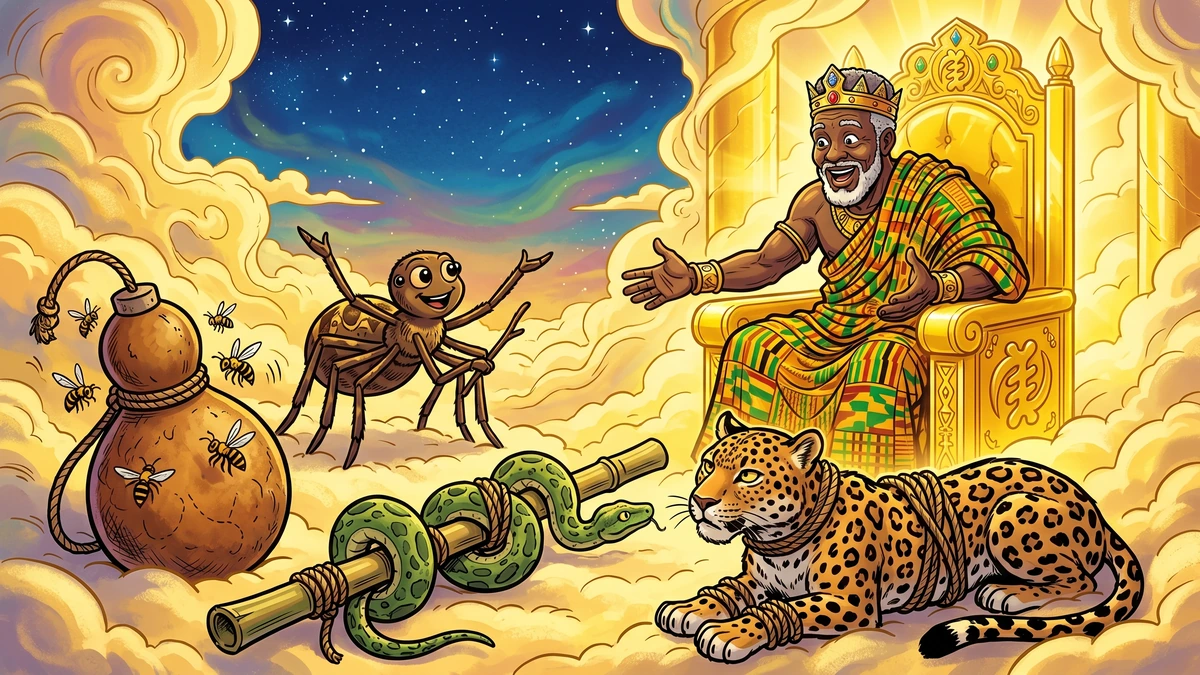
Facing him is Nyankupon, the sky god, remote and powerful, who owns the stories and is amused, rather than threatened, by the spider’s request. Between the two of them stand the creatures Anansi must master to win his prize: in Barker and Sinclair’s 1917 version, a jar of furious live hornets, a boa-constrictor, and a leopard. Rattray’s Ashanti version names them more precisely and adds a fourth — Onini the python, Osebo the leopard, the Mmoboro hornets, and Mmoatia, the elusive forest fairy or dwarf. Each is something Anansi cannot possibly overpower. Each, therefore, must be defeated by a trick fitted exactly to its nature, and it is in those four small comedies of deception that the story does its real work.
Anansi’s Bold Request
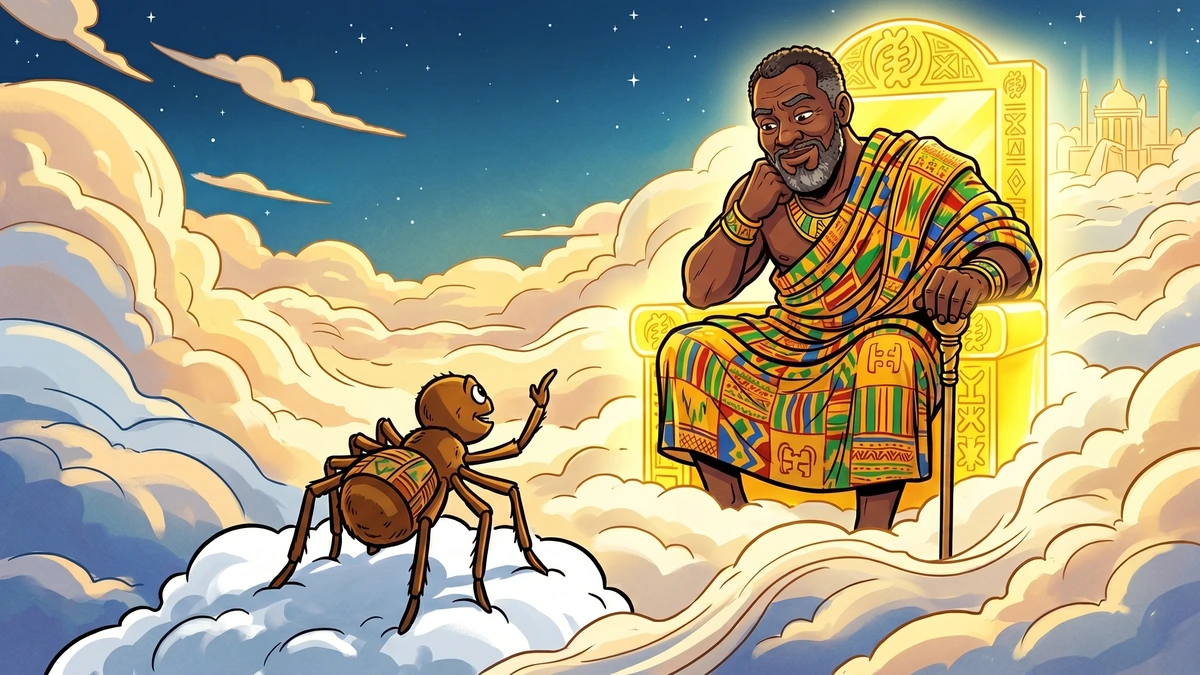
The story begins with an act of pure ambition. Anansi, who is conceited and tired of hearing every marvel credited to the sky god, climbs all the way up to Nyankupon and asks, plainly, that from this day forward the stories told by people on earth should be his stories — Anansi stories — and no longer Nyankupon’s. It is an outrageous request, and the narrator means it to sound outrageous: a spider, asking the chief of the gods to hand over the most valuable thing he owns.
Nyankupon does not laugh him away. Instead he does something far more interesting — he names a price. He will sell the stories, he tells Anansi, but only to a buyer who can deliver what even kings and warriors have failed to bring him. Anansi must capture and carry up to the sky a set of creatures so dangerous that the demand is plainly meant as a polite refusal. In the Barker version the price is three: a jar filled with living hornets, a boa-constrictor, and a leopard. Greater and stronger beings, Nyankupon implies, have wanted the stories and gone home empty-handed. The sky god is not cruel; he is simply certain. He has set a price he believes cannot be paid, and he settles back to watch the spider fail.
Anansi does not argue and does not boast. He goes down to the forest and goes to work — and the shift from the lofty bargain to the patient, practical scheming is the moment the listener leans in. The tasks are impossible by strength. They will have to be solved another way.
The Jar of Hornets
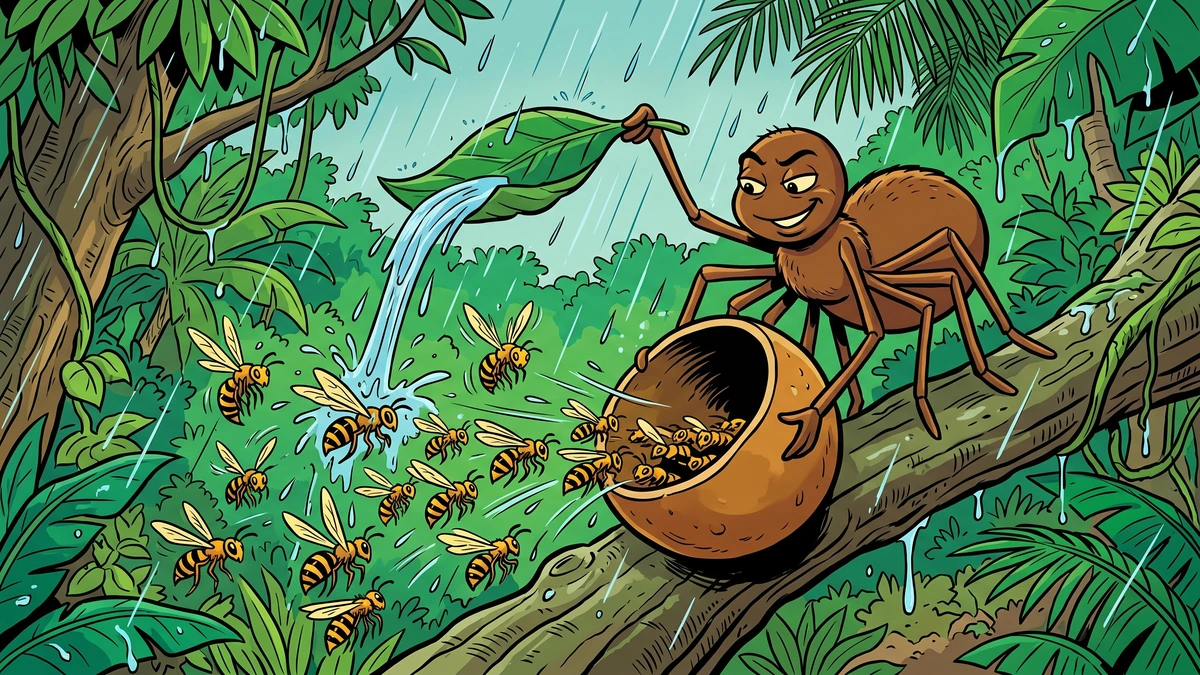
For the hornets, Anansi uses their pride against them. He takes a large gourd or calabash and a leaf, finds the swarm, and begins to pour water — some of it over the hornets, some over his own head — calling out as he does that the rains have come and the foolish hornets had better take shelter or be beaten down by the storm. To prove his good faith he holds out the dry, hollow gourd as a refuge. The hornets, eager to escape the “rain,” fly gratefully inside; and the instant the last of them is in, Anansi stops the mouth of the gourd with the leaf and has them, the whole angry swarm, sealed and harmless. The trick costs him nothing but a little water and a convincing voice. It works because he has understood the one thing about hornets that matters: frighten them, offer them safety, and they will imprison themselves.
The Boa-Constrictor Measured
The second creature — the great snake, called Onini the python in the Ashanti telling — is too long and too strong for any net. So Anansi attacks the one thing a python cannot resist: a question about its own size. He cuts a long, straight pole of bamboo and walks through the forest near the snake, talking loudly, as if to himself, in an argument he is pretending to have with his wife. His wife, he says, insists the python is longer than this pole. He himself is sure the python is shorter. It is a foolish quarrel — but it is exactly the kind of foolish quarrel that a proud creature longs to settle. The python, its vanity pricked, offers to lie down full length against the pole so that the matter can be proved once and for all. It stretches itself out, straining to be as long as it can; and while it lies there, rigid and concentrating, Anansi binds it to the pole, coil by coil, with bark rope, until the snake that could have crushed him is trussed from head to tail. He has caught the python by persuading it to hold still.
The Leopard, and the Climb to the Sky
The leopard — Osebo in the Ashanti version — is the most dangerous of all, and for the leopard Anansi digs a deep pit on a path the great cat is known to walk, covers it over, and waits. In the night the leopard falls in. When Anansi comes by in the morning he does not gloat. He puts on a face of sympathy, agrees that it is a terrible thing to be trapped, and offers to help the leopard climb out. He bends a tall green sapling down to the edge of the pit and asks the leopard to tie itself on so it can be lifted clear — and the moment the leopard is fastened, Anansi lets the sapling spring back upright, and the leopard is hauled into the air, bound and helpless. (In other tellings Anansi defeats a fourth creature, the forest fairy Mmoatia, with a doll smeared in sticky tree-gum: the fairy strikes the silent doll for its rudeness, sticks fast, and is carried off — the famous “tar-baby” trick.)
One by one Anansi carries his captives up the long way to the sky and lays them before Nyankupon: the sealed gourd loud with hornets, the python lashed to its pole, the bound leopard. The sky god looks at what no warrior or chief had ever managed to bring him, and he is astonished. A spider — the smallest, weakest creature in the forest — has paid the impossible price in full. Nyankupon keeps his bargain. He proclaims, before all who are present, that from this day the stories are Anansi’s: every old tale, every new one, every wonder told around every fire, shall be called a spider story. And so, the narrators say, it has been ever since.
How the Spider Tales Were Told
To understand why this particular tale was placed first — in Barker and Sinclair’s book and in the living tradition alike — it helps to know how anansesem were actually performed. They were not read; they were staged. An Akan storytelling evening was a communal event with its own etiquette. The teller did not simply begin. He or she would open with a set formula and a disclaimer, a verbal wink to the audience admitting that the tale was not literally true — “we do not really, really mean that what we are going to say is true,” in Rattray’s translation of the standard opening — so that no one need fear the marvels to come. The audience had a part to play too, answering back, supplying agreement, and sometimes interrupting with a song or a riddle before the narrator resumed.
Drumming, mime, and sung interludes called mmoguo broke up the spoken narrative, and a tale could expand or contract to fit the night. At the close came another fixed formula, a kind of modest bow: this is my story, the teller would say, and whether it is sweet or not sweet, let some of it go elsewhere and let some come back to me. Set inside that frame, “How We Got the Name ‘Spider Tales’” works almost as a charter. By explaining that all the evening’s tales are Anansi’s property, it licenses everything that follows and binds the whole performance — teller, audience, drum, and song — to the small triumphant spider whose name they are about to invoke again and again.
The Moral the Storyteller Leaves Behind
On its bright surface the tale is a comedy of cleverness. Its plainest lesson is the one the whole Anansi cycle exists to teach: that intelligence outranks force, that the weak need not stay powerless, and that a creature with no strength at all can still win the greatest prize in the world if it studies its opponents closely enough. Each capture is a small master-class in this. Anansi never fights. He watches — the hornets’ fear, the python’s vanity, the leopard’s panic — and lets each creature’s own nature do the work of defeating it. The child listening is being trained, gently, to think before reaching for the obvious tool, and to notice that the loud and the powerful are often the easiest to lead.
But there is a second, quieter lesson folded underneath, and it lives in the ending. Anansi sets out to own the stories — to make every tale glorify his own name. Yet the actual result of his success is the opposite of hoarding. The stories come down out of the locked sky and pass into the hands of every village and every grandmother on earth, free to be told and retold by anyone. Anansi’s vanity, by a turn the storyteller clearly enjoys, becomes the world’s good fortune. The treasure he tried to seize for himself could only be possessed by being given away. The Akan put the idea in a proverb that the elders attach to exactly this kind of tale:
“Nyansa nni baako tirim.”
“Wisdom is not found in one person’s head.” — Akan (Twi) proverb
While the stories sat with Nyankupon alone, the world was poorer for it; wisdom locked in one head, even a god’s, helps no one. Only when the tales were scattered among all people did they begin to do their work. That, the storyteller suggests, is what stories are for: not to be owned, but to be passed from hand to hand and mouth to mouth, gathering meaning as they go.
You May Also Like
 African Folk Tales
All Ages
African Folk Tales
All Ages
Crocodile’s Treason
A scholarly retelling of “Crocodile’s Treason,” a South African veldt folk tale from James A. Honeÿ’s South-African Folk-Tales (1910) — the story of the weeping crocodile and the origin of the phrase “crocodile tears.”
 African Folk Tales
Ages 9-12
African Folk Tales
Ages 9-12
How the Leopard Got His Spots
The canonical story of how the leopard got his spots: Rudyard Kipling's pourquoi tale from Just So Stories (1902), retold with full scholarly attribution.
 African Folk Tales
Ages 9-12
African Folk Tales
Ages 9-12
Thunder And Anansi
Thunder And Anansi: There had been a long and severe famine in the land where Anansi lived. He had been quite unable to obtain food for his poor wife and