How Wisdom Became The Property Of The Human Race
How Wisdom Became The Property Of The Human Race. Long ago, wisdom belonged only to a few. Learn how one person changed everything by sharing knowledge.
How Wisdom Became the Property of the Human Race
Among the spider stories of the Akan-speaking peoples of West Africa, few are loved as warmly, or repeated as often, as the tale of how Father Anansi tried to hoard every scrap of wisdom in the world inside a single clay pot, and how he failed so completely that wisdom was scattered to the ends of the earth and given, by accident, to all humankind. It is a story about greed and a story about cleverness, but more than either it is a story about the strange truth that knowledge, once it is grasped too tightly, slips away through the fingers. This retelling follows the version set down for English readers a little over a century ago, and restores to it the scholarly context that explains why a small fable about a spider and a pot still carries such weight.
Origins and Canonical Attribution
This tale belongs to the great body of West African trickster narrative known among the Akan as anansesem — literally “spider stories,” or “the words of Ananse.” The hero, Father Anansi, is Kwaku Ananse, the spider whose name is so bound up with storytelling that in the Twi language the very category of folk tale takes its title from him. In the version retold here, the action is placed in Fanti-land, the coastal Akan region of what was then the Gold Coast and is today the Republic of Ghana, and Anansi’s child is named Kweku Tsin — a recurring figure who, across many anansesem, quietly outshines his boastful father.
The text that carried this story to a wide English-reading audience is West African Folk-Tales, collected and arranged by William H. Barker and Cecilia Sinclair and published in London by George G. Harrap & Co. in 1917. Barker was for a time connected with the educational service of the Gold Coast, and Sinclair drew on tales current among Gold Coast pupils and storytellers; their volume gathered the spider cycle together with a wide range of pourquoi and animal tales for use in schools and homes. The collection has remained continuously available, and is today freely circulated through Project Gutenberg and similar archives, which is why the story can be retold here without restriction.
In the international classification of folk narrative, “How Wisdom Became the Property of the Human Race” is an etiological or pourquoi tale — a story whose purpose is to explain why the world has a particular feature, in this case why wisdom is not the possession of any one person but is dispersed among all. It draws on the universal trickster motif catalogued in the Aarne–Thompson–Uther and Stith Thompson Motif-Index as A1481, the acquisition of culture and knowledge by humankind, and on the trickster-outwitted pattern of motif group J2400, in which the schemer is undone by his own scheme. The container of concentrated wisdom — the sealed pot — is itself a recognisable narrative object, akin to the boxes and gourds of forbidden or hoarded power found in pourquoi traditions across the world.
Anansi belongs to a family of West African and African-diaspora tricksters. Carried across the Atlantic during the era of slavery, he survives in the Caribbean as Anansi or “Aunt Nancy,” and his narrative cousin in the American South is Brer Rabbit. Yet the spider remains most fully himself in the Akan homeland, where he is by turns a creator’s helper, a buffoon, a thief of stories, and — as here — a hoarder whose appetite for sole ownership is precisely what defeats him.
Anansi and the Spider Cycle
To understand why Anansi makes such a convincing hoarder of wisdom, it helps to know who he is across the rest of the anansesem. He is never a simple villain and never a simple hero. In one famous tale he goes up to the sky-god Nyame and bargains, through a chain of impossible tasks, to become the owner of all the stories in the world — which is why folk tales themselves are called “spider stories.” In others he cheats his neighbours out of a feast, plays dead to raid his own farm, or talks his way out of a punishment he has richly earned. He is small, he is greedy, he is boastful, and yet listeners forgive him, because his appetite is the same appetite they recognise in themselves and because his schemes so often rebound on his own head.
This story sits squarely in that pattern. The Anansi who wants to own every story is the same Anansi who wants to own every thought, and the logic of the anansesem demands that such greed be answered. The spider is not punished by a king or a god here; he is punished by the simple fact that wisdom is larger than any one creature can hold. His son Kweku Tsin, meanwhile, plays the role he plays in tale after tale — the patient, observant child whose plain good sense quietly corrects his father’s cleverness. The contrast between the two is the engine of the story: cunning that overreaches, set against ordinary, generous understanding that simply notices what is in front of it.
The Tale Retold
The Pot of All Wisdom
In the days the elders speak of, Father Anansi held all the wisdom of the world. Every clever thought, every useful skill, every shrewd answer to a hard question belonged to him alone, and the men of the country came to him whenever they were in difficulty. For a long while this pleased Anansi greatly, for nothing flatters a vain heart like being needed. But a vain heart is also a suspicious one, and after a time the people offended him — perhaps by complaining, perhaps by failing to thank him as fully as he believed he deserved.
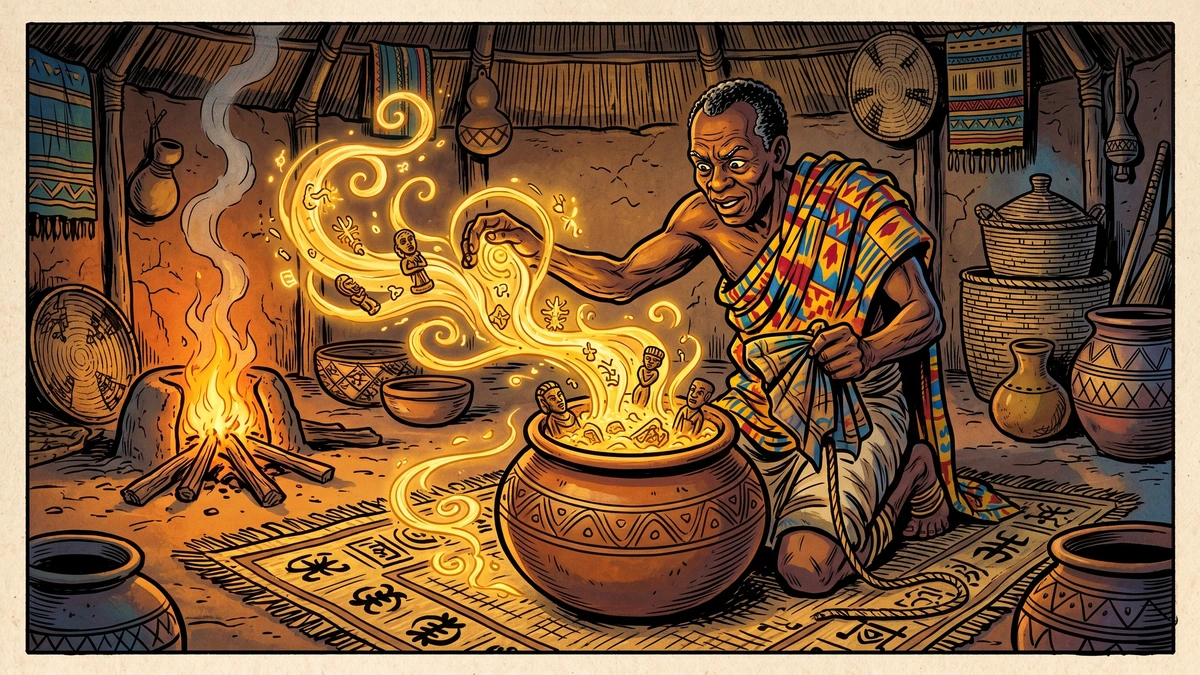
Anansi brooded over the slight, and at last he settled on a punishment crueller than any beating: he would take back the wisdom he had been lending out, gather it together, and hide it where no human being could ever reach it again. He fetched a great earthen pot and began to collect his wisdom into it — every proverb, every cunning trick, every secret of farming and fishing and building — until the pot was brimful. Then he sealed it with care and began to look about for a hiding place worthy of so precious a treasure.
The Climb of the Tall Tree
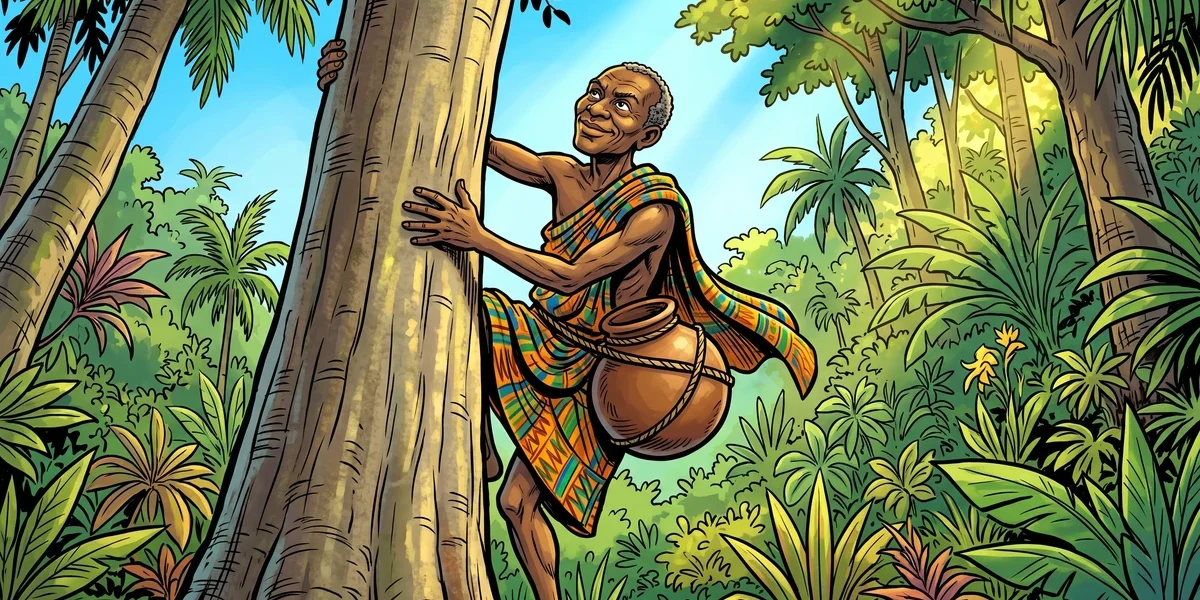
Anansi decided that the safest place in all the world was the very top of a tall, smooth-trunked tree at the forest’s edge. No one, he reasoned, would think to look for wisdom up among the highest branches, and even if they did, none could climb so far. So he took a length of strong cord, tied it around the great pot, and hung the pot in front of him against his belly. Then he set his hands and feet to the trunk and began to climb.
It was hopeless work. The pot swung and bumped against the bark, between his body and the tree, and every time he gained a little height the heavy thing dragged him back. He pressed himself flat to the trunk; the pot was crushed between. He held it out from his chest; it pulled him backward and away. Again and again he slid down, sweating and furious, and again and again he tried, certain that effort alone would carry him up. He did not stop to think — for Anansi, who owned all the wisdom in the pot, had sealed his own good sense inside it along with everyone else’s.
The Watching Son
Now Anansi had a son, Kweku Tsin, and the boy had noticed his father’s secrecy and followed him quietly to the foot of the tree. Hidden among the leaves, Kweku Tsin watched the whole struggle — the climbing, the slipping, the muttering and the rage — and at last he could not contain himself. He called out, in the gentle, reasonable voice of a child who means no harm:
“Father, if you tied the pot behind you instead of in front, you could hold the tree properly and climb with ease.”
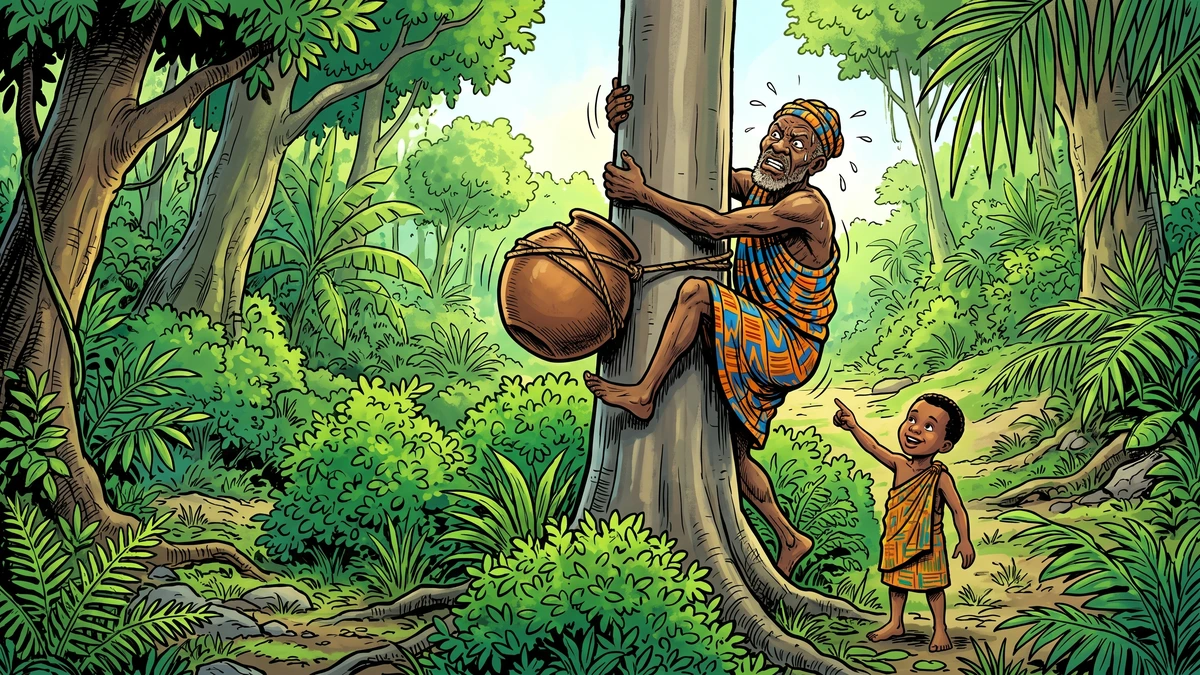
The words struck Father Anansi like cold water. Here was the simplest, plainest piece of wisdom imaginable — carry the burden where it does not block your hands — and it had come not from inside his sealed pot but from the free mind of his own small son. He had gathered, as he believed, every grain of wisdom in the world; yet wisdom had remained loose in the head of a watching child. The pot in front of him was suddenly not a treasure at all, but a proof of his foolishness.
The Breaking of the Pot
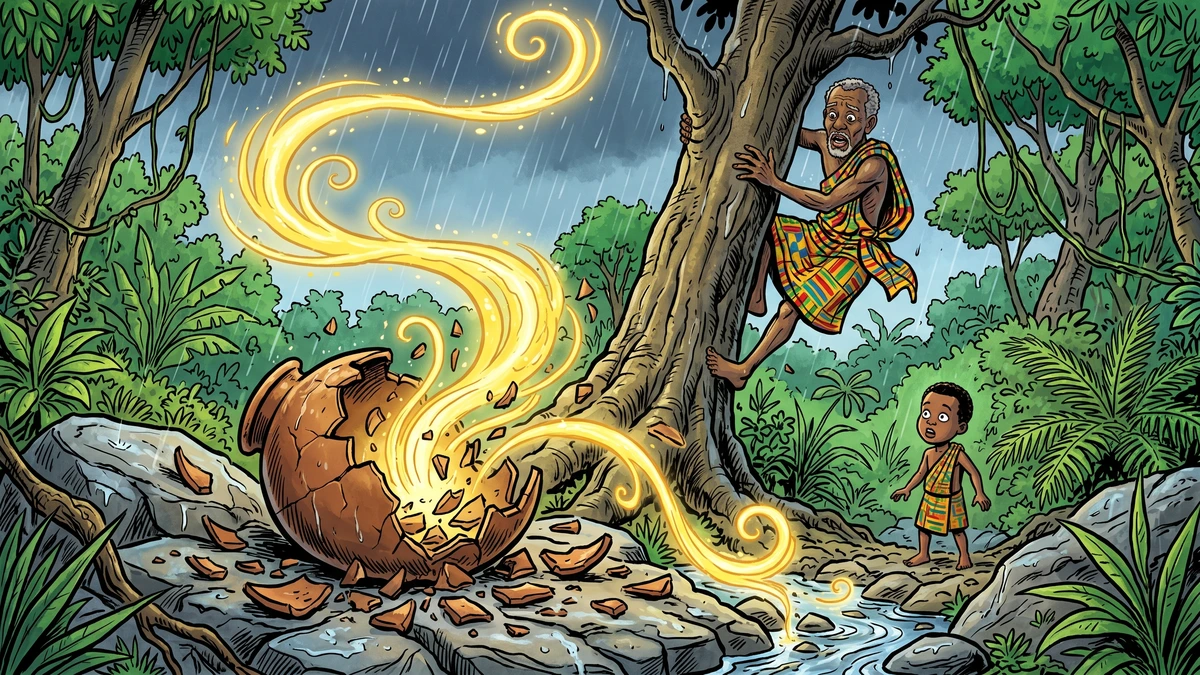
Anansi was overcome with anger and shame — anger that the boy had seen him fail, shame that he, the keeper of all wisdom, had been taught by a child. In that hot moment he forgot why he had climbed at all. He snatched the cord from the pot and flung the great vessel away from him.
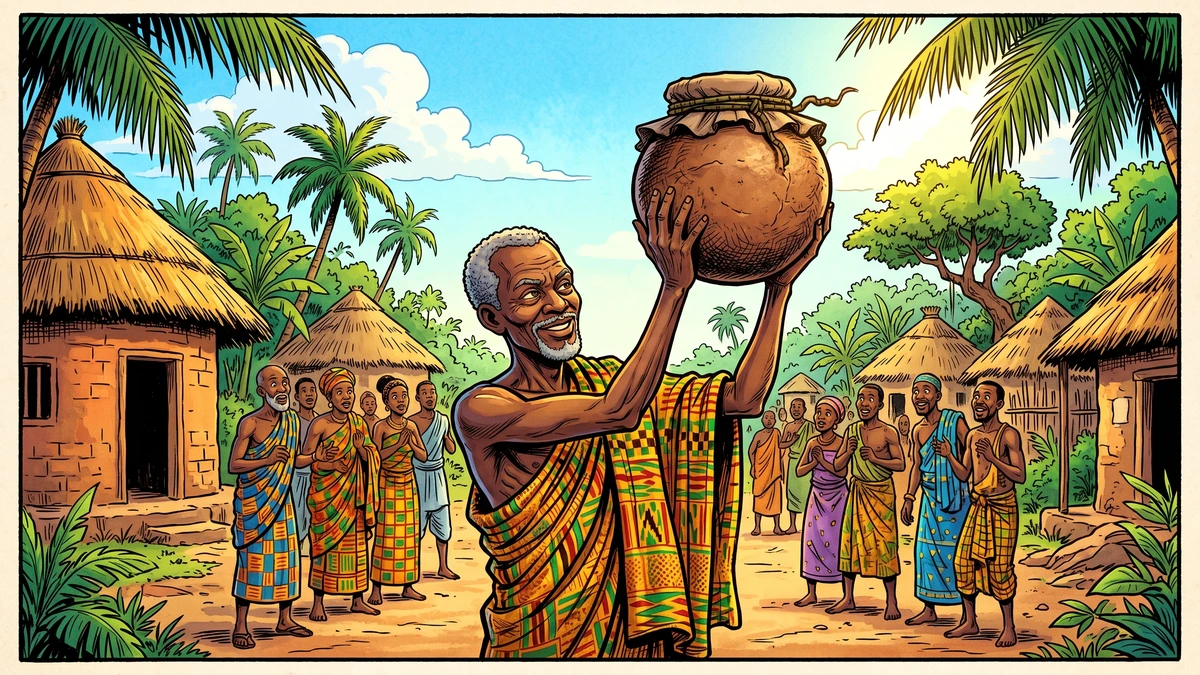
It fell, and it struck the rocks at the foot of the tree, and it broke. The wisdom that had been pressed and sealed inside it burst free all at once and scattered — some say a great rain came at that very hour and washed the wisdom down the hillside into the stream, and the stream carried it to the river, and the river carried it at last to the wide sea, so that it was spread to every shore. From that day no single person has ever held all the wisdom of the world. Instead a little of it lodges in every human mind, which is why one man knows what his neighbour does not, and why even the cleverest must still go to others to learn.
The Moral and Its Meaning
The lesson the Akan storyteller draws from this tale is not chiefly about Anansi’s greed, though greed is plainly punished. It is about the nature of wisdom itself. Wisdom cannot be hoarded; the very act of sealing it away destroys it, because wisdom that is never shared, questioned, or used soon ceases to be wisdom at all. And no one person, however gifted, can ever possess the whole of it. The proof walks behind Anansi up the tree in the shape of his own child: the moment he believes he owns all knowledge, a smaller, freer mind sees what he has missed.
The Akan express this directly in one of their most quoted proverbs:
“Nyansa nni baako tirim.”
“Wisdom is not in the head of one person.” — Akan (Twi) proverb
The story is the proverb made into narrative. It teaches the child who hears it three things at once: that pride blinds even the clever; that the humblest voice — a child’s, a stranger’s, a servant’s — may carry the answer one needs; and that knowledge withheld is knowledge wasted, while knowledge shared multiplies. There is also a quiet generosity in the ending. The breaking of the pot is told not as a tragedy but as the luckiest accident in the history of the world, for it is the moment ordinary people were given a share in something Anansi had meant to keep forever from them.
Telling the Tale: Performance and Context
An anansesem was never meant to be only read; it was meant to be performed, almost always after dark. Among the Akan, spider stories belonged to the evening, when the day’s work was done and families and neighbours gathered around a fire. A storyteller would open with a call-and-response formula, inviting the listeners to agree that what followed was a tale and not the truth — a courteous fiction that freed everyone to enjoy Anansi’s misbehaviour without taking it as an example to follow. Songs, gestures, and sudden shifts of voice carried the action, and children were not a passive audience but joined in the refrains and the laughter.
That setting shapes how the story of the broken pot should be heard. The comic climb is built for performance: a skilled teller would mime the pot swinging, the slipping grip, the spider’s growing fury, drawing out the moment until the children were helpless with laughter — and only then deliver the son’s quiet suggestion, so that the lesson landed in the silence after the joke. When Barker and Sinclair set the tale down in print in 1917, they preserved the words but necessarily lost the performance; a modern retelling tries to keep faith with both, holding on to the humour that made the story worth telling and the moral that made it worth remembering.
Why the Story Has Lasted
“How Wisdom Became the Property of the Human Race” has endured for the same reason the whole anansesem tradition has endured: it is short, it is funny, and it hides a serious idea inside a ridiculous picture. The image of a grown spider sweating his way up a tree with a pot banging against his stomach, while his child watches from the leaves, is the kind of comic scene a listener never forgets — and the laugh is the hook on which the moral hangs.
The tale also travelled. When Akan peoples were carried into slavery across the Atlantic, Anansi went with them in memory, and the spider stories took root in Jamaica, in other parts of the Caribbean, and in the folklore of the American South, where the trickster’s role passed in part to Brer Rabbit. Wherever the story landed, its central claim survived intact, because it is one of the few claims every culture recognises as true: that no one is wise alone. In a present-day world that prizes expertise and the hoarding of information, the spider’s broken pot reads almost as a parable for our own time — a reminder that wisdom locked away is wisdom lost, and that the knowledge worth having is the kind that has been allowed to scatter, like rain running down to the sea, into the keeping of everyone.
That a fable first written down for Gold Coast schoolchildren in 1917 should still answer a question people ask today — why must we learn from one another? — is the surest sign of a living folk tale. Father Anansi meant to keep wisdom for himself. By losing his temper, he gave it to the world, and the world has been repeating his story, gratefully, ever since.
You May Also Like
 African Folk Tales
Ages 6-8
African Folk Tales
Ages 6-8
The Lost Message
A southern African folk tale: the many kinds of ants fail to agree at their council, and the saving message of unity, entrusted to the slow Beetle, never arrives.
 African Folk Tales
All Ages
African Folk Tales
All Ages
Lion Who Took A Woman’s Shape
A chilling Khoikhoi folk tale from Great Namaqualand: a lion devours a woman, pulls on her skin, and walks into her family's kraal disguised as their daughter — until the cattle, a frightened child, and a single coarse hair betray him.
 African Folk Tales
Ages 9-12
African Folk Tales
Ages 9-12
Why White Ants Always Harm Man’S Property
A West African (Akan) pourquoi tale from the Anansesem spider-story tradition: how Spider's greed, a broken promise, and one hasty mistake turned the white ant into the eternal enemy of every home.