Tink-Tinkje
The southern African folk tale 'Tink-Tinkje', the Cape form of the worldwide 'election of the king of birds' fable, in which the smallest bird wins the crown by cleverly riding unfelt on the soaring vulture's wing.
Almost every people on earth has told some version of the same small, delicious joke: the day the birds tried to choose a king, and the tiniest creature in the sky walked off with the crown. Tink-Tinkje is the southern African telling of that joke, and it is one of the briskest and most perfect fables in the whole Cape repertoire. In barely four hundred words it stages a noisy parliament of birds, a five-day race toward the sun, a stowaway no larger than a thumb, a frantic chase, a sleeping sentinel, and — almost as an afterthought — two separate explanations for why two real South African birds behave as they do. It is a children’s tale, an etiological “why” story, and a sly piece of political comedy all at once.
The hero is the tink-tinkje itself, a real bird of the South African veld. James Honey, who first set the tale down in print, added a careful note for his readers: the tink-tinkje, he wrote, “is a bird belonging to the Finches,” and it is called tink-tinkje “more on account of its chirp than its small size” — the name imitates its thin, ringing, metallic tink…tink…tink of a call. It is one of the smallest birds a Cape child would ever see, and that is exactly the point. The fable hands the kingship of the air not to the strongest wing or the loudest voice or the most splendid plumage, but to the lightest body and the quickest mind — and then it refuses, with a grin, to let anyone enjoy the result.
Origins and Canonical Attribution
“Tink-Tinkje” reaches modern readers through South-African Folk-Tales, the anthology compiled by the American physician James A. Honey and published in New York in 1910. Honey’s slim book gathered forty-odd tales of the Cape — animal fables of the Bushmen (San), the Khoikhoi or “Hottentot” herders, and the Zulu — and drew openly on the pioneering nineteenth-century collections that came before it, above all the philologist Wilhelm Heinrich Immanuel Bleek’s Reynard the Fox in South Africa; or, Hottentot Fables and Tales (London, 1864), the first published collection of indigenous southern African oral literature. “Tink-Tinkje” belongs to the great Cape animal-fable strand of that tradition: a short, witty beast story in which the creatures of the veld hold councils, quarrel, scheme and outwit one another exactly as people do, and in which the natural world is quietly explained along the way.
Origin & Canonical Attribution
Tradition: Cape southern African oral animal fable — an etiological “king of the birds” tale from the Khoikhoi and settler storytelling of the Cape Colony.
Primary printed source: James A. Honey, South-African Folk-Tales (New York: Baker & Taylor, 1910), “Tink-Tinkje.”
Antecedent collection: W. H. I. Bleek, Reynard the Fox in South Africa; or, Hottentot Fables and Tales (London: Trübner & Co., 1864), the foundational anthology of Cape oral literature on which Honey drew.
Tale type: ATU 221, “The Election of the King of Birds” — the international type in which the smallest bird wins the kingship by hiding on a larger bird and flying a little higher. European cognates: Aesop’s “The Eagle and the Wren” and the Brothers Grimm, Kinder- und Hausmärchen no. 171, “Der Zaunkönig” (The Willow-Wren).
Principal motifs: B236, election of king of birds; L315.5, wren hides on eagle and so flies highest; L31, small animal overcomes large; K1041, riding the air on another’s back; A2426.2, why the owl is awake only at night; A2422, why a bird does not sing.
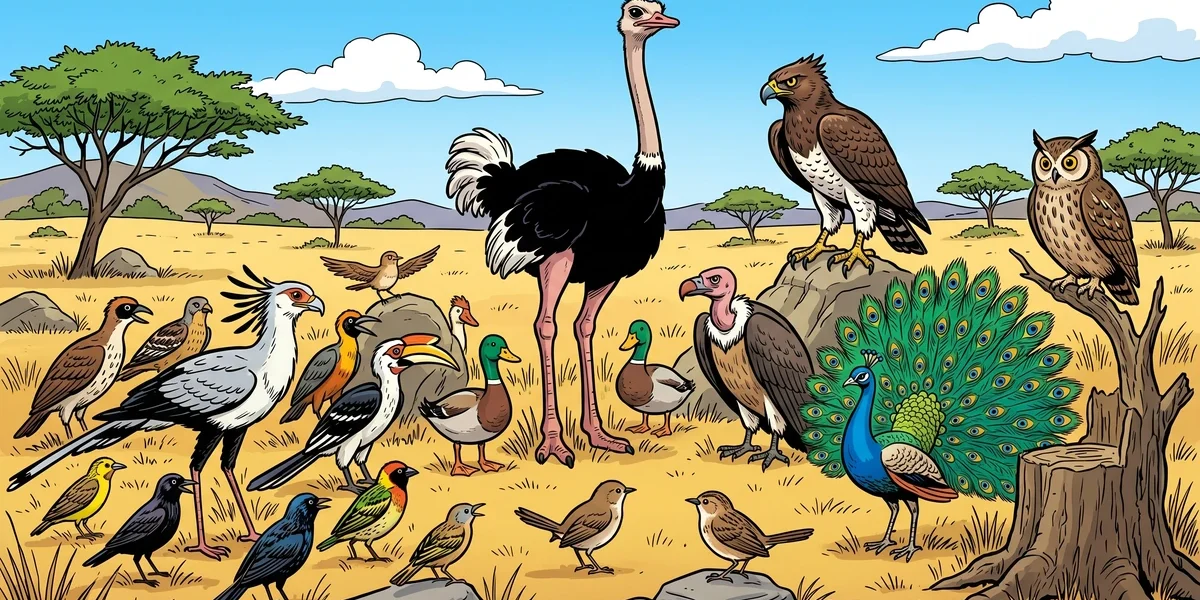
What makes “Tink-Tinkje” so remarkable is the company it keeps. Folklorists classify it as international tale type ATU 221, “The Election of the King of Birds,” and versions of it have been told all across Europe and Asia for well over two thousand years. The Greek fabulist tradition knew it as “The Eagle and the Wren”; the Brothers Grimm printed a German form, “Der Zaunkönig” (The Willow-Wren, KHM 171), in which the wren rides up unseen on the eagle’s back and then flutters higher to claim the title; the very Latin and Greek words for the wren — regulus, “little king,” and basiliskos — preserve the same ancient joke. The southern African telling keeps the bones of that worldwide story exactly, but re-clothes it entirely in the birds of the Cape: an ostrich too heavy to fly, a vulture spiralling toward the sun over the dry veld, an owl ashamed of daylight, and, in place of the European wren, the chirping little finch whose name gives the tale its title.
The Birds Want a King
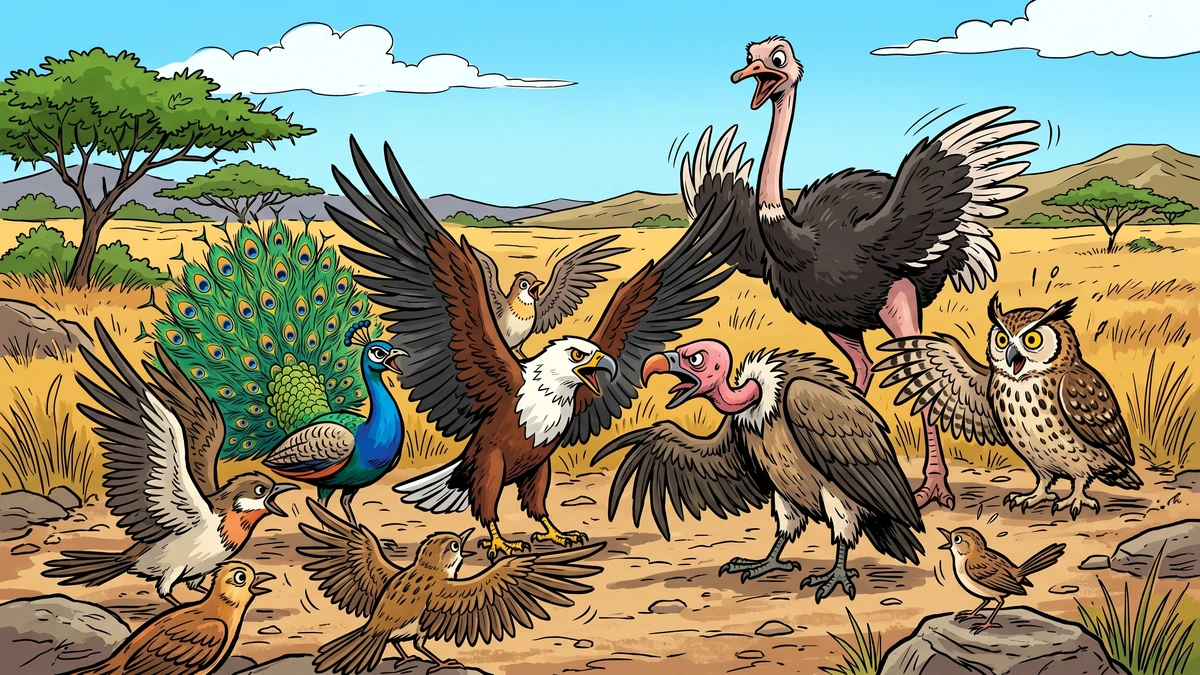
The fable opens with a wonderfully democratic grievance. The birds, the storyteller says, wanted a king. Men have a king, and so do the animals — and why, the birds asked themselves, should they alone go without one? So they all assembled, every winged creature of the veld together in one great noisy gathering, to settle the question by debate.
And the debate, of course, goes nowhere. It is a small masterpiece of comic timing. Each candidate is proposed for one obvious virtue and instantly demolished for one obvious flaw. The ostrich is put forward because he is the largest of all the birds — and rejected at once, because for all his size he cannot fly, and what kind of king of the birds cannot take to the air? The eagle is named for his strength — and dismissed as too ugly. The vulture is praised because he can fly the highest of any bird alive — and waved away because he is too dirty, and his odour is terrible. The peacock is nominated for his dazzling beauty — and voted down because his feet are ugly and his voice worse. The owl is suggested because he sees so well — and refused because he is ashamed of the light and will not come abroad by day. Every candidate has a gift; every candidate has a defect; and the assembly, weighing splendour against splendour, gets no further at all.
This opening is doing more than raising a laugh. It is quietly setting up the whole argument of the fable. The birds keep trying to crown a king for some single magnificent quality — bulk, strength, height, beauty, sharp sight — and every time the quality turns out to come bundled with a fault that cancels it. Greatness, the tale hints from its very first lines, is never as simple or as settled as it looks; and a parliament that can only think in terms of who is biggest and most impressive will argue itself hoarse and decide nothing. The birds need a different kind of test — and when one of them finally proposes one, it will hand victory straight to the one creature nobody in the debate ever thought to name.
He Who Flies the Highest
At last, out of the deadlock, one bird shouts the idea that breaks it: “He who can fly the highest will be king.” And the whole assembly seizes on it with relief — “Yes, yes,” they all scream — because it sounds like the fairest test imaginable. It needs no judges and no counting of votes; it cannot be argued with; the sky itself will decide. At a given signal every bird in the gathering launches straight upward, and the great race for the crown begins.
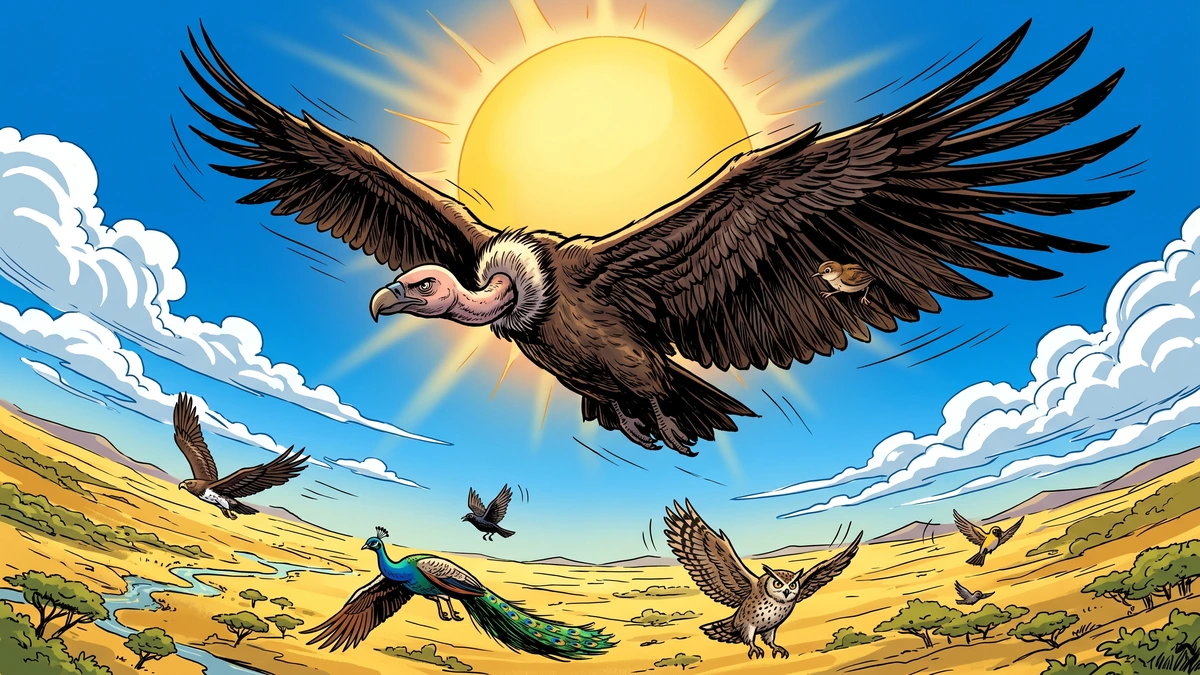
It is, almost from the first wingbeat, the vulture’s race. He was rejected in the debate for his dirtiness and his smell, but no one ever denied the one thing said in his favour: he can fly higher than any other bird. Now he proves it. The vulture climbs for three whole days without stopping, beating steadily up toward the sun, until every other bird is lost far below him in the haze. Then, certain at last that nothing alive can be above him, he cries aloud in triumph: “I am the highest, I am king!”
And out of the thin bright air directly above his head comes a sound that should not be there: “T-sie, t-sie, t-sie.” It is a tiny, ringing, mocking little chirp — and it is the tink-tinkje. The smallest bird at the whole assembly had quietly taken hold of one of the great wing-feathers of the vulture and clung there, and he was so light, so nearly weightless, that in three days of climbing the vulture had never once felt him. Now the little stowaway creeps out from his hiding place, flutters up the last few inches into the empty air above the exhausted giant, and pipes the vulture’s own boast back at him: “T-sie, t-sie, t-sie, I am the highest, I am king!”
The vulture will not believe it. He gathers himself and flies on — a fourth day, climbing again, calling out once more that he is highest and he is king. And once more, from just above him, comes the maddening little voice: “T-sie, t-sie, t-sie.” The tink-tinkje has tucked himself back under the wing and ridden up unfelt all over again. On the fifth day the vulture tries a last time, straining straight up into the air with the very last of his strength — and the little fellow is still there, still above him, still chirping the same words. The vulture is finished. Worn out and beaten, he turns and flies wearily back down to earth. The contest has been won, fairly by its own rules and outrageously against its own spirit, by the one bird who never flew high at all — he was simply carried, and then had the wit to climb the final hand’s breadth that mattered.
The Chase and the Mouse Hole
Down on the ground the other birds are not amused. They are, the tale says, mad through and through. The test had been meant to find the strongest flier in the kingdom, and instead it has been won by a trick — by a creature who hid in another bird’s feathers and let the vulture do five days of work for him. To the assembly this is not cleverness; it is cheating, and a cheat cannot be crowned. The verdict comes down hard and immediate: the tink-tinkje must die, because he had taken unfair advantage of the vulture’s feathers and hidden himself there. The whole flock rises at once and flies after him in a furious mob.
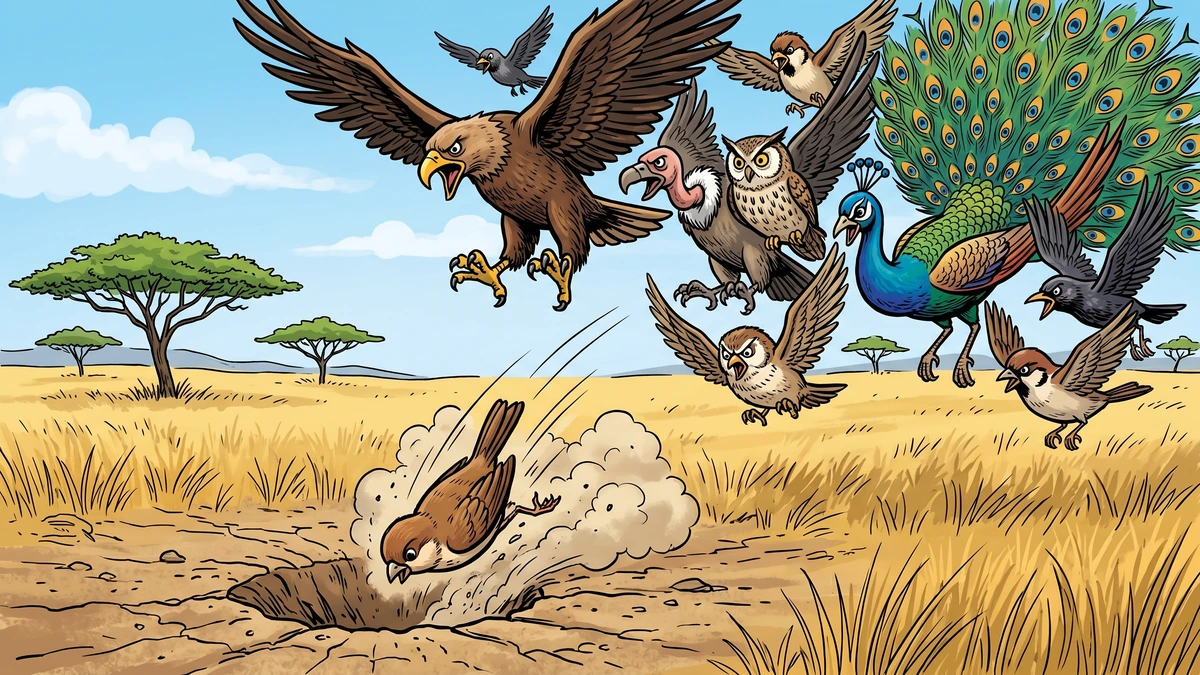
And here the tale springs its neatest reversal. The tink-tinkje cannot out-fly an angry sky full of bigger, stronger birds — so he does not try. He drops to the earth and darts into a mouse hole, a burrow far too small for any of his pursuers to follow him into. The very thing the assembly despised him for — his ridiculous smallness — is now the thing that saves his life. The eagle’s strength and the vulture’s high-soaring wings are suddenly worth nothing at all; not one of the great birds can reach a creature the size of a thumb who has tucked himself underground. The flock is left milling helplessly above a hole they cannot enter, exactly as their grand parliament had earlier argued itself to a standstill. They have power and splendour in abundance, and the one thing they need — a way to get at something very small — not one of them possesses.
So they fall back on a siege. If they cannot dig the tink-tinkje out, they will wait him out: someone must stand guard at the mouth of the burrow and seize the little vagabond the instant he dares to put his head into the daylight. The plan is sound. It needs only the right sentinel — a bird with eyes sharp enough never to miss the moment — and the assembly believes it knows exactly who that is.
The Sleeping Sentinel
“Owl must keep guard,” the birds decide; “he has the largest eyes; he can see well.” It is a choice that sounds unanswerable. If any bird in the veld can be trusted to watch a hole without missing anything, surely it is the owl, with those enormous, all-seeing eyes. The owl takes up his post directly in front of the burrow, fixes his great gaze on it, and the siege settles in.
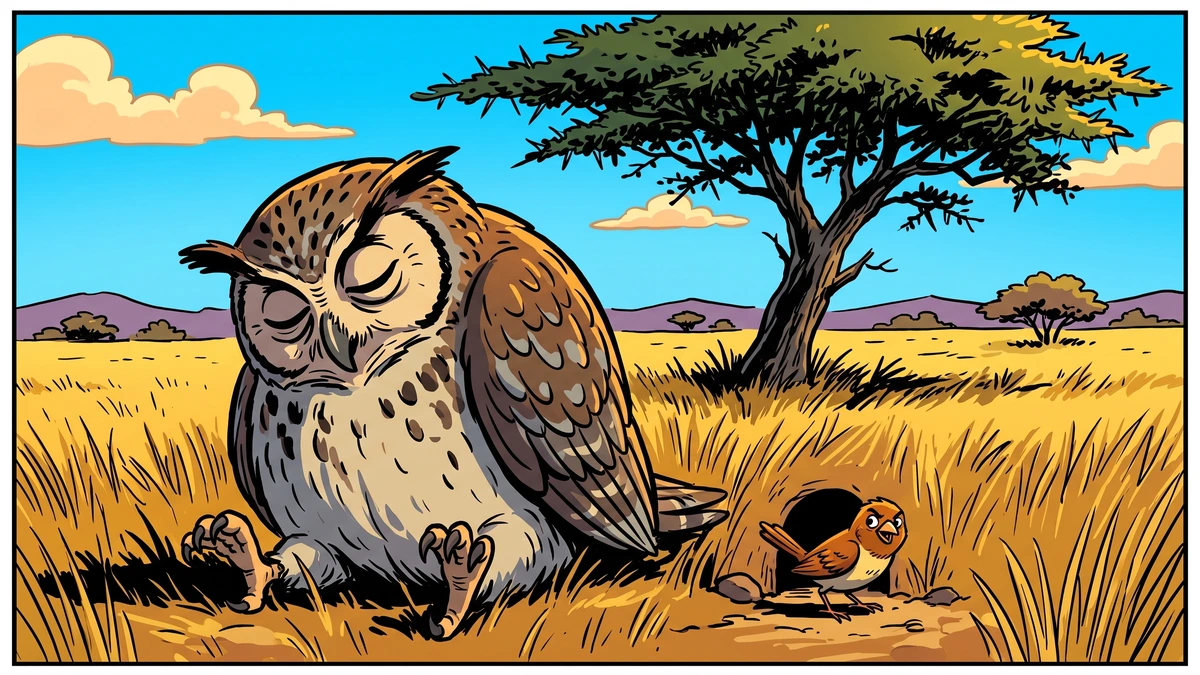
But the assembly has made exactly the same mistake all over again. Just as they once weighed candidates only by a single splendid quality, they have now chosen a guard for one famous gift — the owl’s magnificent eyes — and forgotten everything else about him. The owl’s eyes are built for the night. By day he is dazzled, drowsy, ill at ease; daylight is the very thing, the debate had said, that he is ashamed of. And now he must keep watch through the brightest hours of the afternoon. The Cape sun comes down warm and heavy on his feathers; his huge eyes grow heavier still; his head begins to nod. Presently the great-eyed sentinel of the birds is fast asleep at his post, in broad daylight, in front of the hole he was set to watch.
Inside the burrow the tink-tinkje is patient. He peeps out, sees the owl’s eyes shut and his guard fallen, and — z-zip — away he goes, out of the hole and up and gone before anyone can lift a wing. When the rest of the birds return to check on their prisoner they hear, from a nearby tree, the small bright unmistakable sound of the little vagabond himself: “T-sie, t-sie.” There he sits, comfortably at large, chirping. The siege has failed exactly as the parliament failed, and for exactly the same reason: the birds judged by reputation and never by fitness.
And here the fable does the thing the Cape animal tales love best: it turns, in its last breath, into an explanation of the real world. The story does not end with the tink-tinkje’s escape; it ends with the consequences written onto the birds themselves. The owl, who shamed himself by sleeping through his watch in the daylight, never lives it down — and that, the tale says, is why to this day the owl will not show himself by day at all, but keeps to the dark, hiding from the sunlight and from the memory of his disgrace. And the white-crow, looking on at the whole ridiculous affair, is so utterly disgusted by it that he announces he will not say a single word more — and he never does. From that day to this, the storyteller ends, the white-crow has never spoken; even if you strike him he makes no sound and utters no cry. A four-hundred-word comedy has quietly delivered two pieces of natural history: why the owl is a creature of the night, and why one Cape bird sits silent.
The Moral of Tink-Tinkje
On its bright surface “Tink-Tinkje” is the purest kind of underdog story — the smallest, lightest, least regarded creature in the sky carrying off the kingship from a whole assembly of its betters. Its first and plainest lesson is the one every child takes from it instantly: that size is not strength, that splendour is not the same as ability, and that a sharp mind in a tiny body can run rings around bulk and beauty and brawn. The vulture has the greatest wings; the ostrich the greatest size; the eagle the greatest power; the peacock the greatest beauty — and the crown goes to none of them. It goes to the one who thought.
“Wie nie sterk is nie, moet slim wees.”
— Afrikaans proverb of the Cape: “He who is not strong must be clever.”
But the fable is shrewder and more double-edged than a simple cheer for the little fellow. It never pretends the tink-tinkje is a hero. He wins by a trick; he rides up on another bird’s honest labour; the assembly’s anger that he “took advantage of Vulture’s feathers” is not wrong. The tale lets both things be true at once — that cleverness is admirable, and that cleverness used this way is also a kind of cheek — and it declines to tidy the contradiction away. Its deeper target, in fact, is not the tink-tinkje at all but the birds who keep mismanaging him. Twice the assembly judges by a single dazzling quality and forgets the rest: first when it tries to crown a king for size or strength or beauty alone, and then when it posts the owl as guard for his famous eyes alone and forgets that those eyes cannot bear the sun. Both times the gap between a creature’s reputation and its real fitness for the job swallows the plan whole. The truest moral of “Tink-Tinkje” is a piece of hard practical wisdom about judgement itself: look at the whole creature, and at the task in hand, and never be dazzled by one bright feather into forgetting all the rest.
Why Tink-Tinkje Has Lasted
“Tink-Tinkje” has survived, and travelled, and kept its place in storybooks for more than a century, because it does so much in so little. It is one of the most economical fables ever recorded: not a word is wasted, the laughs land one after another, and a child can hear the whole thing in three minutes and remember it for life. That compactness is itself a sign of how long it was polished in the telling — this is oral storytelling worn smooth as a river stone.
It has lasted, too, because it is genuinely many tales braided into one. It is an underdog comedy, and underdog comedies never go out of fashion. It is an etiological “why” story, and it answers not one natural-history question but two — why the owl keeps to the night, and why a Cape bird sits silent — which gave it real explanatory work to do in the world of the children who first heard it. It is a gentle satire on assemblies and committees and grand decisions, as sharp now, in an age of elections and boardrooms, as it was around a Cape fire. And it is a member of one of the most widespread story-families on earth: the listener who knows the European wren who out-soared the eagle, or Aesop’s same little bird, meets in the tink-tinkje an old friend in new feathers, and feels the deep pleasure of recognising a tale that humanity has clearly needed to tell itself everywhere, in every language, for as long as there have been birds to watch and kings to doubt.
Above all it has lasted because its joke is true. We still, all of us, mistake the loud for the able and the large for the strong; we still hand the watch to the owl because his eyes are famous, and forget to ask whether he can stay awake. “Tink-Tinkje” has been laughing at that particular human folly for well over a hundred years in print, and for who knows how long before that around the fires of the Cape — and it will go on laughing, in its small, bright, ringing voice, for as long as there are committees, and crowns, and creatures clever enough to climb the last inch that counts.
You May Also Like
 African Folk Tales
Ages 6-8
African Folk Tales
Ages 6-8
Anansi The Blind Fisherman
Anansi the Blind Fisherman: A Tale of Cleverness and Justice In a village near a great river in Africa, there lived a spider named Anansi. Unlike...
 African Folk Tales
Ages 9-12
African Folk Tales
Ages 9-12
Tit For Tat
Tit For Tat: There had been a great famine in the land for many months. Meat had become so scarce that only the rich chiefs had money enough to buy it. A
 African Folk Tales
Ages 9-12
African Folk Tales
Ages 9-12
How the Leopard Got His Spots
The canonical story of how the leopard got his spots: Rudyard Kipling's pourquoi tale from Just So Stories (1902), retold with full scholarly attribution.