The Girl and the River Spirit
The Girl and the River Spirit — a Yoruba folk tale of Nigeria in which the devoted girl Adeola crosses a dangerous river and is tested by the river goddess Osun through three trials of kindness, honesty and love.

Among the Yoruba people of southwestern Nigeria, water is never merely water. A river is a road, a boundary, a danger and a blessing all at once — and, in the oldest understanding, it is also a presence: a being with a will, a memory and a sense of justice. “The Girl and the River Spirit” belongs to that understanding. It is the story of a girl named Adeola who must cross a dangerous river to save her dying mother, and who finds, on the far bank, not a monster but a judge — a river spirit who will give her what she came for only if she first proves the quality of her heart.
It is one of the gentlest of the African folk tales, and one of the most searching. There is no trickster here, no clever escape, no battle of strength. The whole tale turns inward, onto a single question asked three times in three different shapes: when no one is watching and the stakes could not be higher, what kind of person are you? Generations of Yoruba storytellers have used exactly this kind of tale to teach children that character is something tested, not merely claimed — and that the river, like life, always knows the difference.
Origins and Canonical Attribution
“The Girl and the River Spirit” is not a single fixed text with a known author; it is a retelling that draws on a deep and genuine current of Yoruba oral tradition. The river spirit at its centre is recognisably Òṣun (Osun) — one of the most beloved òrìṣà of the Yoruba pantheon, the deity of fresh water, healing, fertility and prosperity, and specifically the goddess of the Osun River that winds through what is today Osun State in Nigeria. Her great shrine, the Osun-Osogbo Sacred Grove on the edge of the city of Osogbo, is one of the last stretches of primary high forest in southern Nigeria and was inscribed as a UNESCO World Heritage Site in 2005; every July and August the twelve-day Osun-Osogbo festival still draws worshippers and pilgrims to the river bank. A spirit who tests a desperate girl and rewards her with healing water is therefore not an invented fantasy but a story shaped around a living religious reality.
The shape of the plot — a virtuous young person who is tested by a supernatural figure at or across the water and rewarded for kindness, honesty and humility — is one of the most widely recorded patterns in world folklore. Folklorists classify it as international tale-type ATU 480, “The Kind and the Unkind Girls,” in the Aarne–Thompson–Uther index, and its African members are numerous: the Sotho tale of Selekana, who is rewarded by the River-Woman beneath the water, recorded by the missionary-folklorist Édouard Jacottet, is a close southern-African cousin. Yoruba religion and narrative were documented in detail by the American anthropologist William R. Bascom, whose mid-twentieth-century studies of Ifa divination and Yoruba society remain standard references. The retelling below keeps the Yoruba setting, the òrìṣà Osun, and the three-test structure in which the tale is most often told to children today.
Origin & Canonical Attribution
Origin: A Yoruba folk tale of southwestern Nigeria, built around the òrìṣà Òṣun (Osun), goddess of the Osun River, fresh water and healing; part of the pan-African and worldwide family of “kind girl rewarded by a water-spirit” tales.
Tale type: ATU 480, “The Kind and the Unkind Girls,” in the Aarne–Thompson–Uther index of international tale-types — the branch in which a supernatural helper at the water tests and rewards a virtuous child.
Motifs: Stith Thompson motif Q2, “Kind and unkind”; H1500, “Tests of endurance and character”; Q1.1, “Spirits in disguise reward hospitality and virtue”; F420, “Water-spirits.”
African analogue: The Sotho (Basotho) tale of Selekana and the River-Woman, recorded by Édouard Jacottet in his collections of Basotho oral lore (Morija, 1908).
Scholarly documentation: Yoruba òrìṣà religion and oral narrative were extensively recorded by the anthropologist William R. Bascom (1912–1981); the Osun-Osogbo Sacred Grove is a UNESCO World Heritage Site, inscribed 2005.
Setting of this retelling: A Yoruba farming village beside a great river in southwestern Nigeria.
Note on provenance: The named heroine Adeola and the exact sequence of her three tests are a modern literary retelling; the underlying pattern — a good child who crosses dangerous water and is tested and rewarded by its spirit — is a genuine and very old element of Yoruba and broader African tradition.
A Mother’s Fever and a Healer’s Counsel

In a Yoruba village where the forest pressed close to the houses and a great river ran broad and deep beyond the last of the farms, there lived a girl named Adeola. Her name meant “the crown brings honour,” but there was little of crowns or honour in her days — only hard work, and a love for her mother that filled the small mud-walled compound the two of them shared. Her mother, Oyinbo, had raised Adeola alone, and had raised her to believe that all living things were bound together, so that no kindness was ever wasted and no cruelty ever truly private.
Then the fever came. It settled into Oyinbo like a stone settling into mud, and it would not be moved. She lay on her sleeping mat of woven palm fronds, her skin gone waxy and strange, her breath coming in shallow gasps like a fish drawn up out of the water. The village healers did everything their craft allowed — poultices of bitter leaf, songs sung over her through the night, offerings carried to the shrines of the òrìṣà — and still the fever burned, and still Oyinbo grew weaker.
One grey morning the eldest of the healers, an old woman whose eyes had watched three generations grow and go, drew Adeola gently aside. “Child,” she said, “I will not lie to you, for you are old enough now for the truth. Your mother’s sickness is beyond the medicine that grows in our fields. There is one cure only, and it grows in the deep places of the river — and it is not a thing that can be taken. It can only be given, by the spirit who keeps those waters. You must cross the river at dawn, where it runs swift and dark, and you must find her, and you must ask. Know this, though: she will not simply hand you what you want. She will test you. Whatever she asks of you, answer it with your whole heart, for the river always knows when a heart is only half offered.”
The Crossing of the River at Dawn

Adeola did not sleep that night. She bathed herself clean in the stream behind the compound, and she wrapped herself in a fresh cloth of deep blue — the colour, the old women said, of water and of truth — and she sat beside her mother until the darkness began to thin. Then, before the first birds, she walked down past the silent farms to the edge of the great river.
The water was wrapped in mist, and it would not settle on a single colour: it shifted from grey to green to a black that seemed to have no bottom. Adeola was afraid — the river had taken strong men before now — but she thought of her mother’s shallow breathing, and she stepped in. The cold closed around her legs like a hand. She waded, then swam, the current dragging at her, and she kept her eyes fixed on the far bank and her mother’s face fixed in her mind, and she did not turn back.
As she came near the farther shore, the river began, impossibly, to glow — a soft blue light rising up through the dark water from somewhere far below. And then the light gathered itself, and rose, and became a woman. She was tall and calm and unbearably beautiful, her skin dark as polished ebony, her hair moving about her like the river’s own current, her garments seeming to be woven of reed and starlight together. This was the spirit of the river, Òṣun herself, keeper of the waters and guardian of every crossing. “Many come to my river,” she said, and her voice was the sound of water running over smooth stones, “and most of them come for themselves alone. Why have you come, child?” And Adeola, dripping and shivering and small before her, answered without a tremor: “Great spirit, I have come for my mother. She is dying, and the healers say that only your medicine can save her. I am not here to ask a gift. I am here to beg.”
Three Tests of the Heart

“Then I will set you three tasks,” said the river spirit, “and they will not be tasks of strength. Pass them with a true heart, and the medicine is yours.” At once a field appeared between them, a wide field of golden grain swaying in the dawn wind — but at one end a whole section had been trampled and broken, the stalks bent and ruined. “This grain feeds my people,” Osun said. “Most of it stands strong. That corner is spoiled. Tell me truly: would you leave the broken grain, and hurry on to save your mother — or would you stop and mend it, though mending it costs you precious time?” Adeola looked at the ruined corner, and then she knelt down in it. “My mother taught me that to walk past suffering is to leave a wound in the world,” she said, and she began to bind the broken stalks upright, splinting them with twine torn from her own blue cloth, until the spoiled corner stood straight again and had a chance to recover. It cost her an hour. The river spirit watched, and said only, “Good. Kindness to all things is the ground that character is built on.”
The field faded, and a marketplace stood in its place. A cloth-seller pressed into Adeola’s arms a bolt of fabric so fine, so deeply red and gold, that it was worth more than a labourer earned in three whole months. “A gift,” the woman said — but Adeola saw the river light behind her eyes and knew the spirit again. “Yet I must confess a thing. This cloth was promised to my sister, who was cruelly wronged and has nothing; with it she could begin a trade and stand on her own feet. You, meanwhile, need money for your mother’s cure. Will you keep the cloth and sell it — or give it back?” Adeola’s hands shook around the beautiful thing; it would have answered every difficulty she had. But she folded it and held it out. “I cannot build my mother’s healing on another woman’s loss,” she said quietly. “Her need for justice is as real as my mother’s need for medicine. Take it back to your sister.” And though her heart ached, she let the cloth go.
Then came the third test, and it was the hardest. The spirit led her to a pool of water so still it was a perfect mirror of the sky. “Look,” said Osun, “and you will see yourself five years from this dawn. In one reflection your mother is well, your family poor but whole, and you are surrounded by those who love you. In the other your mother is gone, but you are wealthy and comfortable, having traded love away for ease. The two cannot both be true. Choose which one you will carry home.” Adeola looked, and saw both lives unfold — her mother’s face bright with living, or her mother’s face erased; her own face warm with love, or hollow with success. She closed her eyes. “I choose my mother,” she said, “and love, and whatever poverty must come with them. A life of comfort without the people I love is not a life I would want to wake into.”
The Healing Water and the Long Telling

When Adeola opened her eyes, the river spirit was holding out a small clay vessel, and within it a medicine that gave off its own faint light, like moonlight caught in water. There were tears standing in Osun’s ageless eyes. “You have passed,” she said, “and you have passed with something rare. You stopped for the broken grain when no one would have blamed you for hurrying by. You returned the cloth when keeping it would have been so easy and so secret. You chose love over comfort when comfort was offered to you outright. Three drops of this in water, given at dawn, at noon and at sunset — and your mother will be well.”
Adeola carried the glowing vessel back across the river, and this time the current did not drag at her, and the water was not cold. She gave her mother the medicine as she had been told, three drops at dawn, three at noon, three at the falling of the light. By the third day the fever broke. By the seventh, Oyinbo could sit up. By the fourteenth she was at work again in the compound, her strength returning to her the way water returns to a riverbed after the dry season — slowly, and then all at once.
But that was not the end of the story, only the end of the danger. For Adeola did not keep what had happened to herself. As the years passed and she grew from a girl into a woman and at last into an old woman herself, she told the tale of the river spirit’s three tests to every child who would sit still long enough to listen. She told it because the spirit had asked her to, on the river bank, at the very end: tell the children, so they will know that the greatest medicine is not the kind that grows in the deep water — it is the kind that is carried, all along, inside an honest heart.
The Moral of the Story
“The Girl and the River Spirit” is a tale about the difference between what a person says they are and what a person actually is — and about the fact that the gap between the two is only ever closed by a test. Adeola never announces that she is kind, or honest, or loving. She is simply placed, three times over, in a situation where kindness is costly, honesty is unwitnessed, and love must be chosen against comfort — and three times over she chooses well. The river spirit does not reward her for her need, however desperate; she rewards her for her character, revealed under pressure. That is the heart of the story’s teaching, and it is a teaching the Yoruba hold close, summed up in one of their most quoted proverbs:
“Ìwà l’éwà.”
— Yoruba proverb: “Character is beauty” — it is good character, not appearance or fortune, that makes a person truly beautiful.
In Yoruba thought, ìwà — character, the settled habit of acting well — is the supreme human achievement, prized above wealth, above cleverness, above beauty of face. The river spirit’s three tasks are nothing other than three ways of looking at Adeola’s ìwà. Notice, too, that none of the tests can be passed by accident or by force. The damaged grain could have been ignored; the cloth could have been kept with no one the wiser; the comfortable future was offered as a genuine and open choice. Adeola passes them because, long before she ever reached the river, her mother had built her character — and the tale gently reminds every listening child that the work of becoming a good person is done quietly, day by ordinary day, so that it is ready when the great test finally comes.
Why This Tale Has Lasted
One reason this story has endured is that it takes a child seriously as a moral being. Many folk tales hand their young heroes a sword or a clever trick; this one hands Adeola nothing but her own conscience and asks whether that will be enough. Children listening to it are not invited to admire a hero’s strength from a safe distance — they are invited to stand in the cold river themselves and wonder, honestly, how they would answer the spirit’s three questions. A tale that makes its listener rehearse their own goodness is a tale that does real work, and that is why grandmothers keep telling it.
It has lasted, too, because it is woven from a living faith rather than a dead one. The Osun River still runs; the Sacred Grove at Osogbo still stands; the festival of Osun is still kept each year on the river bank. A story in which the river is wise and just and watchful is, for the communities who tell it, also a lesson in how to treat the river itself — with reverence, with care, and with the knowledge that water given freely to a whole people must be kept clean and shared. The tale carries an ethic of the environment inside its ethic of the heart, and both feel more urgent now, not less.
Finally, the story belongs to one of the great families of world folklore. The pattern of the good child rewarded and the selfish one left empty-handed — tale-type ATU 480 — surfaces on every inhabited continent, from the Sotho tale of Selekana and the River-Woman in southern Africa to the German “Mother Holle” and the French fairy at the well. That so many separate peoples, with no contact between them, arrived independently at the same shape of story tells us something quietly hopeful: that the conviction at its centre — that character is tested, that it matters, and that it is, in the end, seen — is not the property of one culture but something close to a shared human inheritance.
Frequently Asked Questions
Is “The Girl and the River Spirit” a real African folk tale?
Yes. It is a Yoruba folk tale from southwestern Nigeria, built around Òṣun (Osun), the òrìṣà or deity of the Osun River, fresh water and healing — a goddess still actively worshipped, whose sacred grove at Osogbo is a UNESCO World Heritage Site. The plot belongs to one of the most widely recorded patterns in world folklore, classified by folklorists as international tale-type ATU 480, “The Kind and the Unkind Girls.” The named heroine and the exact wording of the three tests are a modern retelling, but the underlying tradition is genuine and old.
Who is the river spirit in the story?
She is Òṣun (also spelled Osun or Oshun), one of the most beloved òrìṣà of the Yoruba pantheon. She is the goddess of fresh water, healing, fertility and prosperity, and specifically the deity of the Osun River in present-day Osun State, Nigeria. Her great shrine, the Osun-Osogbo Sacred Grove, was inscribed as a UNESCO World Heritage Site in 2005, and a twelve-day festival in her honour is held on the river bank every July and August.
What are the three tests, and what do they mean?
First, Adeola is shown a field of grain with one corner trampled and ruined, and asked whether she would stop to mend it though mending it costs her time — a test of kindness. Second, she is given a valuable cloth that she learns was promised to a wronged woman, and asked whether she will keep it or return it — a test of honesty when no one is watching. Third, she is shown two possible futures and asked to choose between her mother’s life with poverty and her own wealth without love — a test of what she values most. Together the three reveal her ìwà, her settled character.
What is the moral of the story?
That good character is tested, not merely claimed, and that it is, in the end, seen and rewarded. Adeola never declares herself kind or honest; she is placed in three situations where doing right is costly, secret or painful, and she chooses well each time. The Yoruba sum the lesson up in the proverb “Ìwà l’éwà” — “Character is beauty” — the conviction that it is goodness of conduct, not appearance or fortune, that makes a person truly beautiful.
How does this tale relate to other folk tales around the world?
It belongs to international tale-type ATU 480, “The Kind and the Unkind Girls,” a story pattern found on every inhabited continent in which a virtuous child is tested by a supernatural figure and rewarded, while a selfish one fails. Its close African cousin is the Sotho tale of Selekana, rewarded by the River-Woman beneath the water, recorded by the folklorist Édouard Jacottet. Further afield, the same shape underlies the German “Mother Holle” collected by the Brothers Grimm and the French “The Fairies” by Charles Perrault.
You May Also Like
 African Folk Tales
Ages 6-8
African Folk Tales
Ages 6-8
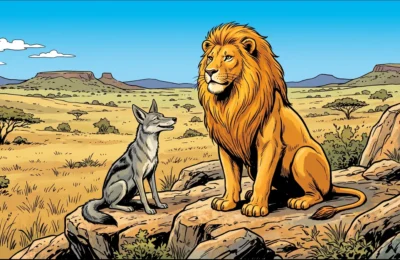
The Lion, The Jackal, And The Man
The Khoikhoi folk tale of a boastful lion whom a clever jackal humbles by leading him to meet a man — and the man, armed with dogs, fire and steel, proves the strongest creature of all.
 African Folk Tales
Ages 6-8
African Folk Tales
Ages 6-8
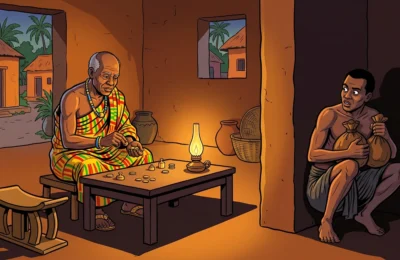
The Robber And The Old Man
The Robber And The Old Man: In a big town lived a very rich gentleman. The fame of his wealth soon spread. A clever thief heard of it and determined to have
 African Folk Tales
Ages 6-8
African Folk Tales
Ages 6-8
Honourable Minū
Honourable Minū: It happened one day that a poor Akim-man had to travel from his own little village to Accra - one of the big towns on the coast. This man