The Squirrel And The Spider
A fast squirrel and a patient spider discover that every creature has special and valuable talents.
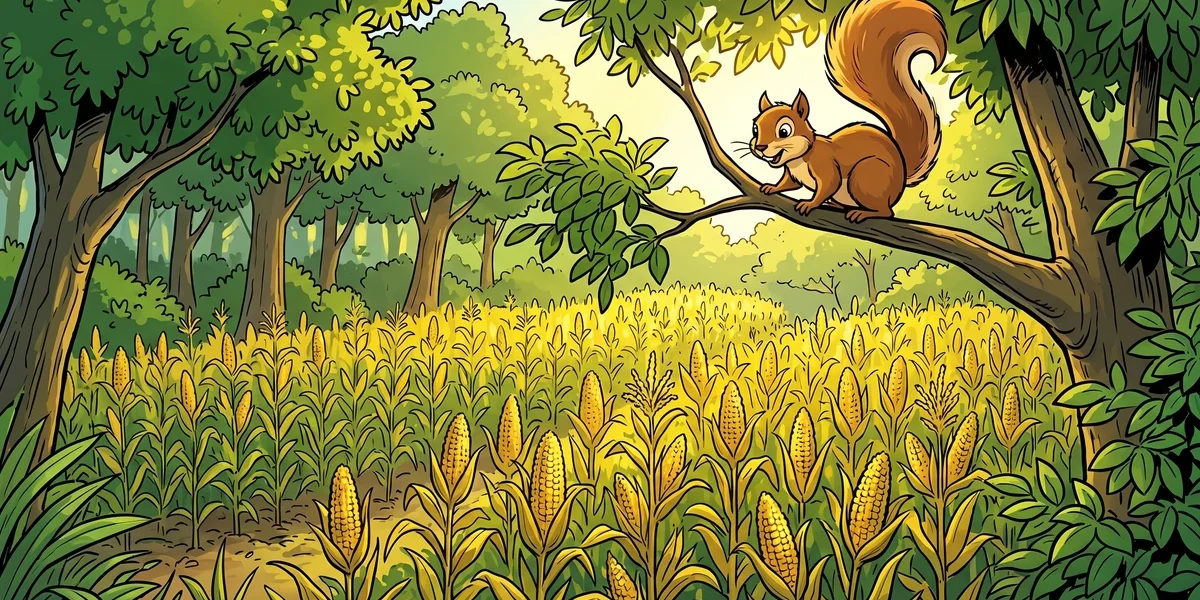
Among the spider stories of the Akan people of West Africa, “The Squirrel and the Spider” stands apart for a reason that has long delighted listeners: here the famous trickster does not win. Anansi the Spider, who in most tales escapes every trap by sheer cunning, is in this story beaten at his own game – cheated of stolen corn by the very argument he had used to steal it. It is a tale about labour and theft, about clever words twisted into a weapon, and about the quiet justice that catches up with the one who believes he has outwitted the world.
Origins in the Anansi Cycle of the Gold Coast
This tale was set down in print in West African Folk-Tales, compiled by William H. Barker and Cecilia Sinclair and published in London by George G. Harrap & Company in 1917. It appears there as the eighth story in the collection. William H. Barker (1882–1929) worked as an educational administrator on the Gold Coast – the British colony that became modern Ghana – and his Gold Coast collaborator Cecilia Sinclair helped gather and shape the tales from local storytellers. The book preserved in English a body of oral narrative that had until then lived almost entirely on the tongues of village elders and around evening fires.
The Spider of the title is no ordinary insect. He is Anansi (also written Ananse or Kwaku Ananse), the supreme trickster of Akan oral tradition, shared by the Ashanti, Fante and other Akan-speaking peoples. So central is he to the storytelling culture that the very word for folk tales in Twi, Anansesem, means literally “spider words” or “spider stories.” A companion tale in the same collection explains how Anansi won the right to have every story bear his name. To tell a tale at all, in the Akan view, is to tell a tale of Anansi.
Such tales were never simply read; they were performed. In the traditional Akan setting, Anansesem were told at night, after the day’s work, by a storyteller who expected the listeners to answer back, to sing the interludes, and to chant the formulas that open and close a tale. A story was a shared event, and its lesson was something the whole gathering arrived at together. “The Squirrel and the Spider” is short, but it is built for that setting: a clear injustice, a long pause of dismay, and a final turn that an audience can feel coming a heartbeat before it lands.
Anansi usually triumphs through wit, turning his smallness and weakness into advantage against the strong. That is exactly why “The Squirrel and the Spider” is so striking. It belongs to the family of “trickster outwitted” stories, catalogued by folklorists under Stith Thompson’s Motif-Index entry K1600, “Deceiver falls into his own trap” – the worldwide pattern of the “biter bit,” in which a swindle rebounds upon the swindler. The motif sits alongside the great cluster of trickster narratives found in the international tale-type tradition, but the Akan version gives it a sharply local flavour: the dispute turns not on a chase or a riddle but on a farm, a road, and a village court – the everyday institutions of Gold Coast agricultural life. When enslaved Akan people were carried across the Atlantic, Anansi travelled with them; in the Caribbean and the American South he survives as “Anancy” and “Aunt Nancy.” This particular story, however, reminds even his most devoted audiences that cleverness without honesty is a road that eventually loops back on the one who walks it.
The Squirrel’s Hidden Farm
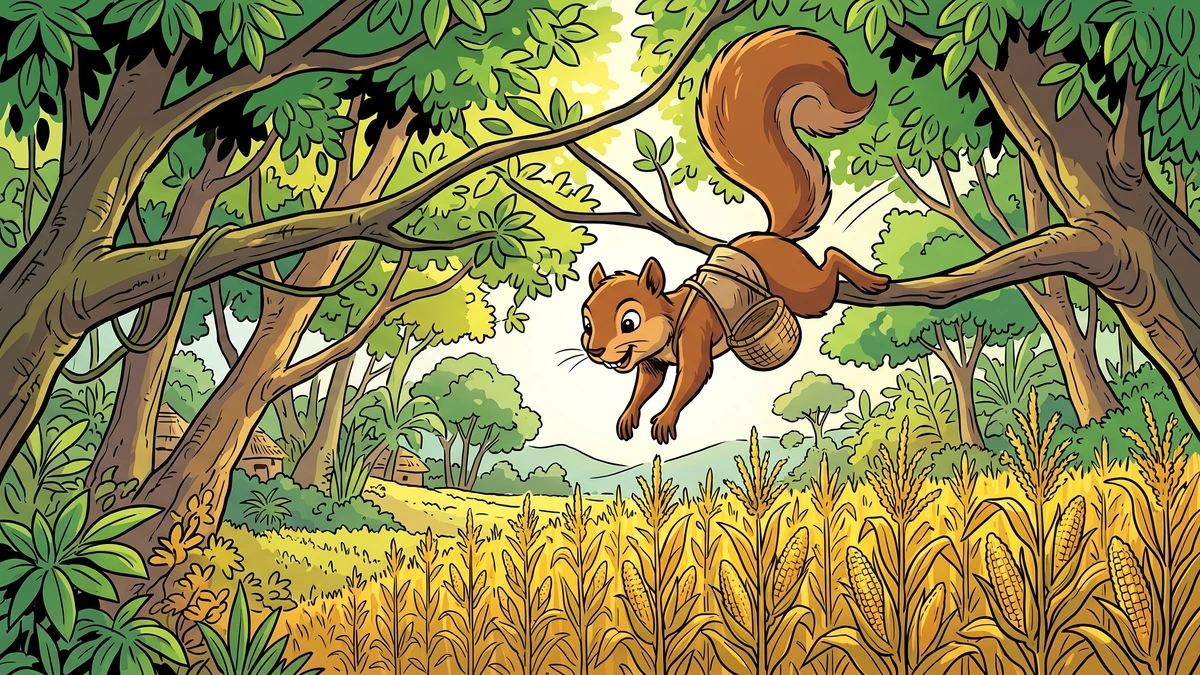
The story begins with honest, patient work. A hard-working squirrel had, after much labour, cleared the bush and cultivated a very fine farm. He had broken the ground, sown the seed, and tended the young corn through every stage of its growing. By the time the tale opens, the harvest stood very nearly ripe, the fields heavy and golden – the reward of many months of effort.
There was one curious thing about this farm. The squirrel, being a skilful climber, had never troubled to cut a roadway leading to it. He simply did not need one. He came and went through the canopy, leaping from branch to branch and dropping down into his fields from above. To him a path on the ground was a needless thing; the trees were his highway. This small detail – a farm without a road – seems unimportant at first. The Akan storyteller, however, plants it deliberately, the way a farmer plants a seed, knowing that everything which follows will grow out of it.
The squirrel’s way of life carries its own quiet lesson. He worked hard, he asked nothing of anyone, and he was content to reach the fruit of his labour by his own particular gift. He had no idea that his very independence – the absence of a visible road – would soon be turned against him by an enemy who valued appearances over truth.
There is a gentle irony built into this opening that an Akan audience would catch at once. The squirrel possesses something Anansi famously lacks: a settled, productive home earned by steady effort rather than by scheme. In most spider tales it is Anansi who has the surplus and others who covet it. Here the order is reversed. The trickster arrives as an outsider, hungry and empty-handed, looking down on a farm he had no part in making – and the audience already senses that a man who has built nothing is about to claim everything.
The Spider’s Cunning Road
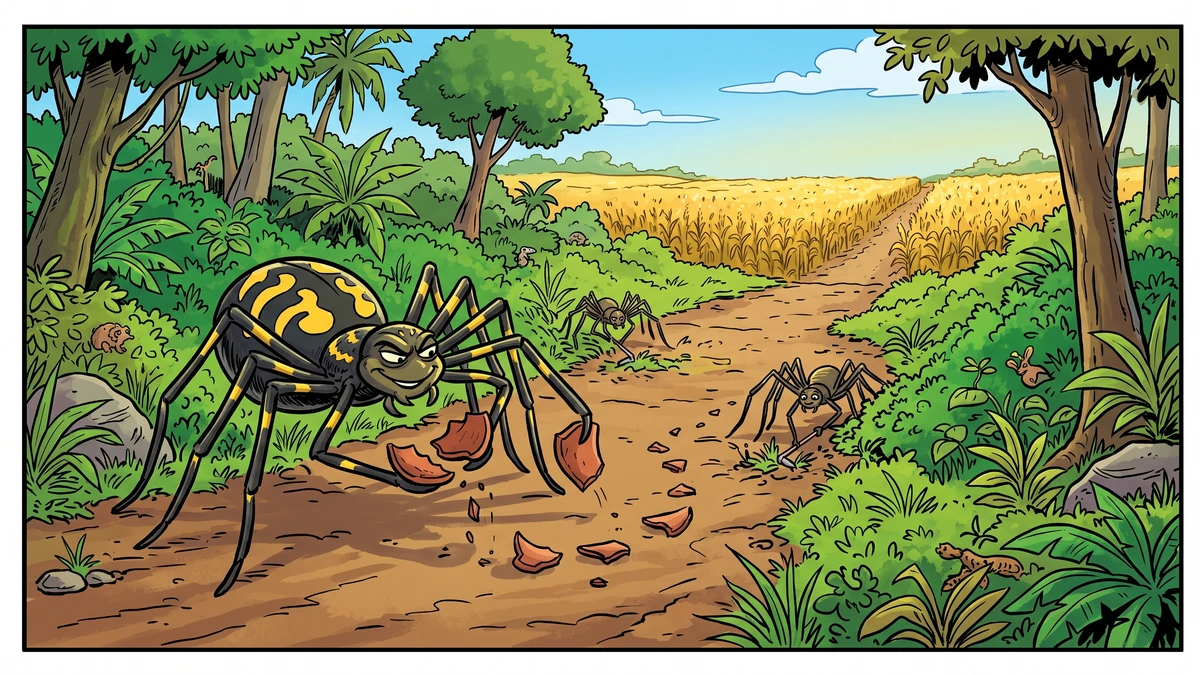
One day, while the corn was almost ready to cut, Spider went hunting through that part of the country. In his wanderings he came upon the squirrel’s farm and was greatly pleased by what he saw – broad fields ripening toward a rich harvest. At once his quick, calculating mind began to work. He searched all around for the roadway that would lead to such a farm, for in his experience every farm had a road. He found none. Puzzled but far from discouraged, he returned home and told his whole family about the splendid fields he had discovered.
The very next day the spiders all set out together for that fine place. They set to work immediately, and what they made was not a farm but the appearance of having made one. They cut a clear road leading straight to the fields. Then Anansi – cunning as ever – went along the new pathway dropping pieces of broken earthenware pot. He scattered the shards so that anyone passing would believe his children had carried food and water there day after day, breaking their pots through long labour. The road and the litter together would tell a false story: that the spiders had cleared and worked this land themselves.
It is worth pausing on what Anansi has actually done. He has not grown a single stalk of corn. He has not turned a single clod of earth in the fields. His entire effort has gone into manufacturing evidence – building a road and salting it with broken pottery – so that a lie will look like the truth. This is the trickster’s craft at its sharpest and its lowest: not cleverness used to survive, but cleverness used to take what another has earned.
With the stage set, Spider and his family began to cut down and carry away the ripe corn, helping themselves to the squirrel’s harvest as though it had always been theirs.
Judgement Without a Road
The squirrel soon noticed that his fields were being robbed. At first he could not discover the thief, for he came and went silently through the trees and the spiders came and went along their road. So he determined to watch and wait. Sure enough, before long Spider reappeared to carry off more of the harvest, and the squirrel confronted him, demanding to know what right he had upon these fields.
Here Anansi revealed the true purpose of his road. Instead of answering, he threw the same question straight back: what right did the squirrel have? “They are my fields,” said the squirrel. “Oh no, they are mine,” retorted the spider. “I dug them, and sowed them, and planted them,” said the poor squirrel, naming the plain facts of his labour. And then came the crafty reply that Anansi had been preparing all along: “Then where is your roadway to them?” The squirrel answered honestly that he needed no roadway – he came by the trees. Spider laughed that answer to scorn and went on using the farm as his own.
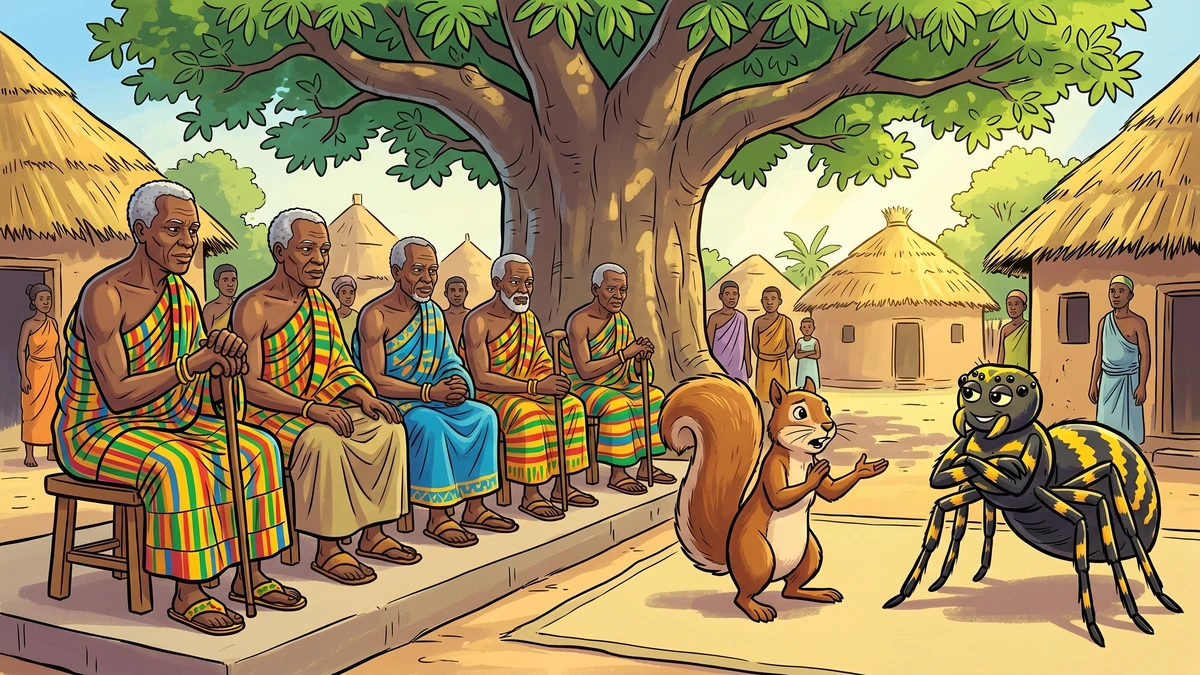
The squirrel, wronged and powerless against such impudence, appealed to the law. The case was brought before a court. But the court reasoned not from the truth of who had laboured, but from the custom of what a farm should look like: no one, the judges declared, had ever owned a farm without a road leading to it. Therefore, since the only road belonged to the spiders, the fields must be theirs. The honest worker lost; the manufacturer of false evidence won. In great glee, Spider and his family prepared to cut down all the harvest that still remained.
This is the dark centre of the tale, and the Akan storyteller does not soften it. Sometimes the formal machinery of justice, looking only at surfaces and customs, rewards the deceiver and abandons the one who did the real work. The story lets that injustice stand for a moment in full daylight – so that what comes next will land with its full weight.
Father Crow and the Roadside Bundles
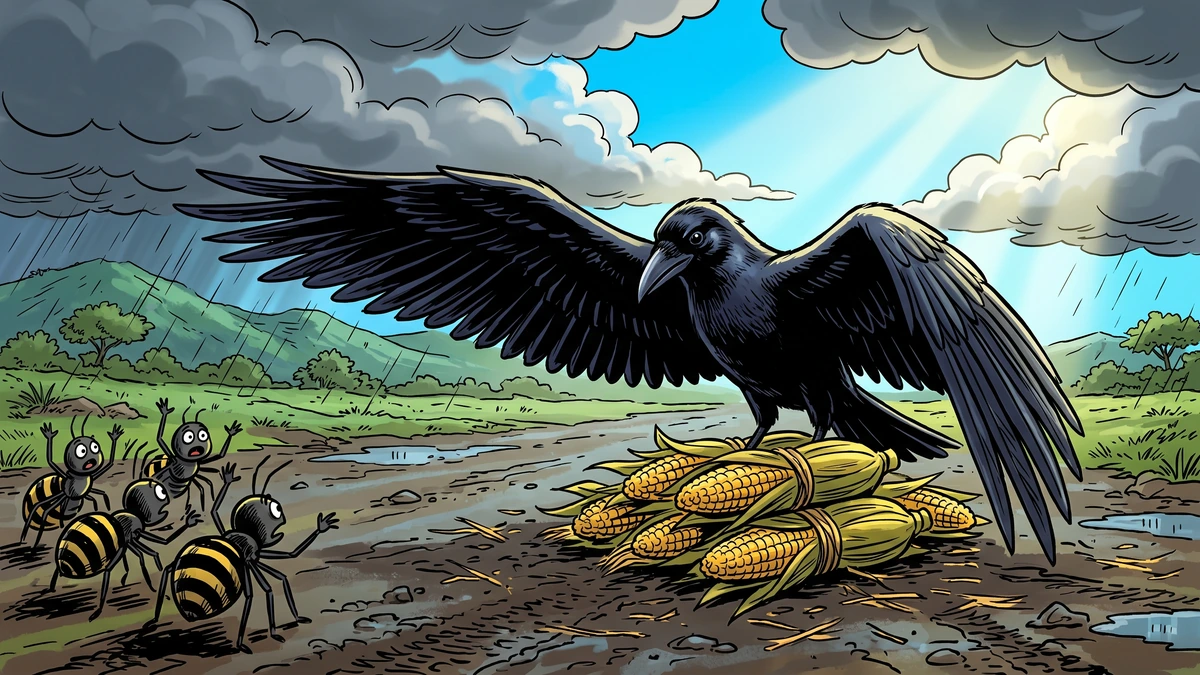
The spiders cut down every last stalk that was left, tied the corn into great bundles, and set off for the nearest market-place to sell their stolen wealth. They were about half-way there when a terrible storm came sweeping over the country. The rain and wind were so fierce that they were forced to set their burdens down by the roadside and run for shelter, leaving the heavy bundles unguarded.
When the storm had passed, the spiders returned to pick up their loads – and found a great black crow already there. Father Crow stood over the corn with his broad wings outspread, sheltering the bundles from the last of the rain. Spider went up to him and, very politely, thanked him for so kindly taking care of their property.
“Your property?” replied Father Crow. “Who ever heard of anyone leaving bundles of corn lying by the roadside? Nonsense. These loads are mine.” And with that he gathered up every bundle and carried it away, leaving Spider and all his children to trudge home sorrowful and empty-handed.
Father Crow is worth a closer look, for the storyteller chooses him with care. He is not a judge, not a king, not an avenging hero summoned to right the wrong. He is simply a passer-by – a creature of the open road and the storm sky, owing nothing to anyone. By making the instrument of justice so ordinary and so indifferent, the tale removes any sense of personal revenge. The squirrel does not get his harvest back; the story is not interested in tidy restitution. It is interested in something colder and more certain: that a dishonest claim, once loose in the world, will be claimed again by the next opportunist who happens along. Anansi’s “rule” was never really his to control. He set it walking, and it walked straight past him.
The justice of this ending is exact and beautiful. Anansi had taken the squirrel’s farm by insisting that ownership belonged to appearances – to whoever had the road – rather than to whoever had done the work. Father Crow simply applies the very same rule one step further: ownership belongs to whoever is present, to whatever the surface suggests. The corn by the roadside appears abandoned, just as the farm without a road had appeared unowned. The crow does not out-argue Anansi; he merely holds up Anansi’s own argument like a mirror. The trickster, who lived by twisting words, is undone the instant someone twists them back.
The Moral: The Deceiver’s Own Trap
“The Squirrel and the Spider” carries a moral that the Akan tradition states without flinching: thieving ways bring little profit, and the trap a cheat sets for others is the trap that finally closes on the cheat himself. Anansi’s false road led him straight to a false friend by the roadside. The clever rule he invented to rob the squirrel became the rule that robbed him. He ended exactly where he began – with nothing – except that now he had also spent his labour, lost his harvest, and exhausted his family on a long road home.
Within the wider Anansi cycle, this ending performs an important balancing act. Audiences love the spider precisely because he so often wriggles free, and a child listening to story after story might begin to believe that quick wits excuse everything. “The Squirrel and the Spider” quietly closes that loophole. It does not deny Anansi his brilliance – the false road really was a clever idea – but it draws a firm line between cleverness that builds and cleverness that merely steals. The first kind feeds a family for a season; the second kind feeds them for an afternoon and then leaves them walking home in the rain.
The Akan elders sum the matter up with a proverb still spoken in Ghana today:
“Nea ɔforo dua pa na yɛpia no.”
“It is the one who climbs a good tree who is given a helping push.”
The squirrel climbed a good tree – in the most literal sense, for the trees were his honest road, and in the deeper sense too, for he had built his fortune on real labour. Anansi climbed a rotten one: a tree of broken pots and false witness. The proverb teaches that the world, in the long reckoning, leans its shoulder behind honest effort and withholds its help from deceit. The human court failed the squirrel; but the storm, the roadside and the crow finished the judgement the court had bungled. Dishonest gain, the tale insists, is never truly held – it only passes through the cheat’s hands on its way to being lost.
Why the Tale Has Lasted
For more than a century since Barker and Sinclair printed it, and for untold generations before that around Akan fires, “The Squirrel and the Spider” has endured because it does something unusual within its own tradition. The Anansi cycle largely celebrates the trickster – it teaches the weak how wit can defend them against the powerful. But a tradition that only ever praised cleverness would risk teaching that cleverness has no limits. This tale supplies the limit. It shows the master trickster himself caught, and it does so without a single act of revenge: no one strikes Anansi, no one curses him. He is simply held to his own logic, and his own logic ruins him.
The tale also carries a quieter teaching for the young listeners it was first meant for: a warning about how easily a true thing can be made to look false, and a false thing true. The squirrel’s honest answer – “I come by the trees” – was the literal truth, and it was laughed out of court. Anansi’s scattered potsherds were a pure invention, and they carried the day. Children raised on this story learn early to ask not only “what does this look like?” but “who actually did the work?” – a habit of mind that the Akan elders prized as the beginning of fairness.
That is why the story still speaks far beyond the forests of Ghana. Every community knows the figure who builds a clever road to someone else’s field – who manufactures evidence, who argues that appearances outweigh honest work, who treats the law as a tool to be gamed rather than a truth to be served. And every community needs the deeper assurance this tale provides: that such victories are unstable, that a rule bent to rob will bend again, and that the patient, climbing, honest worker – the squirrel in his trees – is building on ground that lasts. The corn the cheat carries off so gleefully is already, though he does not yet know it, only resting by the roadside, waiting for the crow.
Frequently Asked Questions
Where does the folk tale “The Squirrel and the Spider” come from?
It is an Akan folk tale from the Gold Coast, now Ghana, in West Africa. It was printed in English in West African Folk-Tales, compiled by William H. Barker and Cecilia Sinclair and published in London by George G. Harrap & Company in 1917, where it appears as the eighth story. Before that it lived purely as oral tradition, told by village elders. The Spider in the tale is Anansi, the great trickster of Akan storytelling, and stories of this kind are called Anansesem, literally ‘spider stories’.
Why does Anansi the Spider lose in this story instead of winning?
In most Anansi tales the trickster escapes every trap through wit, which is why this story is so striking. It belongs to the worldwide ‘trickster outwitted’ pattern, catalogued by folklorists under Stith Thompson Motif-Index entry K1600, ‘Deceiver falls into his own trap’. Anansi steals the squirrel’s farm by arguing that ownership belongs to whoever has the road; Father Crow later uses that exact argument to take Anansi’s corn. The tale exists to set a limit on cleverness: it shows that a dishonest rule, once invented, will eventually rebound on its inventor.
Why does the Spider scatter broken pieces of pottery along the road?
The broken earthenware is manufactured evidence. By scattering pottery shards along the new road, Anansi makes it look as though his children had carried food and water to the farm day after day, breaking their pots through long labour. He grew no corn and tilled no soil; his entire effort went into making a lie look like the truth. The detail shows the trickster’s craft at its lowest, cleverness used not to survive but to take what another has honestly earned.
What is the moral of “The Squirrel and the Spider”?
The moral is that thieving ways bring little profit, and the trap a cheat sets for others is the trap that finally closes on the cheat himself. Dishonest gain is never truly held; it only passes through the cheat’s hands on its way to being lost. The Akan elders express the same idea with the proverb ‘Nea ɔforo dua pa na yɛpia no’, meaning ‘It is the one who climbs a good tree who is given a helping push’, a reminder that the world ultimately leans its weight behind honest effort and withholds its help from deceit.
Who is Father Crow and why does he keep the bundles of corn?
Father Crow is an ordinary passer-by, a creature of the open road, not a judge or a king summoned to right the wrong. When a storm forces the spiders to abandon their stolen corn by the roadside, the crow shelters the bundles with his outspread wings and then claims them, asking who ever heard of anyone leaving corn lying by the road. He takes them by the same logic of appearances that Anansi used against the squirrel. Because the justice comes from an indifferent stranger rather than a hero, the tale feels less like revenge and more like an inevitable natural balance.
You May Also Like
 African Folk Tales
Ages 9-12
African Folk Tales
Ages 9-12
Tit For Tat
Tit For Tat: There had been a great famine in the land for many months. Meat had become so scarce that only the rich chiefs had money enough to buy it. A
 African Folk Tales
Ages 6-8
African Folk Tales
Ages 6-8
King Chameleon And The Animals
An African folk tale about how the animals once chose a king by race — and why a clever little chameleon beat the swift hare to the stool of power.
 African Folk Tales
Ages 6-8
African Folk Tales
Ages 6-8
Thing To Do
A young person learns that the most important accomplishments are the small, caring things we do.