The Hunter And The Tortoise
The Hunter And The Tortoise: A village hunter had one day gone farther afield than usual. Coming to a part of the forest with which he was unacquainted, he was
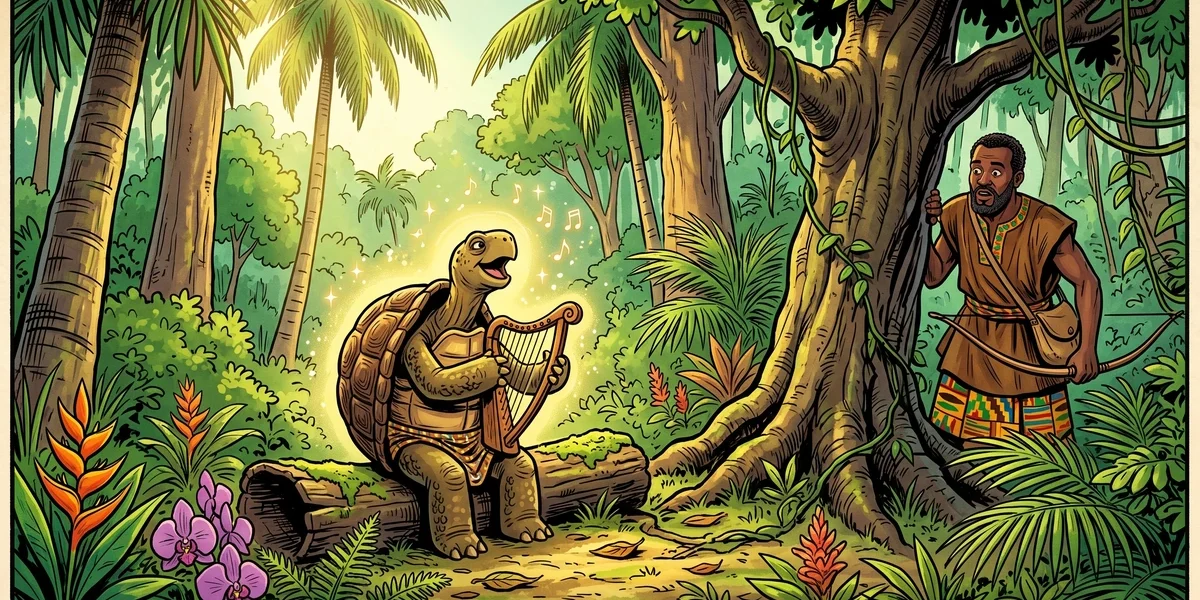
A hunter wandered farther into the forest than he had ever gone before, and there — impossibly — he heard music: a small sweet voice singing to the notes of a tiny harp. “The Hunter and the Tortoise” is a West African tale of a marvel found by accident, a promise made and broken, and a man who could not bear to keep a wonder to himself. It belongs to the Akan peoples of the Gold Coast — modern Ghana — and it ends not with a spell or a monster but with a quiet, devastating truth about why the hunter lost everything.
Where This Story Comes From
“The Hunter and the Tortoise” was collected and published in West African Folk-Tales, compiled by William H. Barker — then Vice-Principal of the Government Training College at Accra — together with Cecilia Sinclair, who also drew the volume’s illustrations. The book was issued in London by George G. Harrap & Co. in 1917, and it gathers the evening tale-telling of the Gold Coast peoples, principally the Akan.
Unlike the boisterous anansesem — the “spider stories” of the trickster Kwaku Ananse that fill much of the same collection — this is a quiet, almost solemn fable. It has no trickster and no magic beyond a single uncanny gift: a tortoise who can sing. And it is built around a refrain that the tortoise sings twice, once at the very beginning and once at the very end, framing the whole story like a proverb set to music:
“It is man who forces himself on things,
Not things which force themselves on him.”
That couplet is the key to everything that follows. The tale is a meditation on it — a story arranged, deliberately, to prove a saying true.
In the classification of folk narrative the tale draws on several old and widespread motifs. Stith Thompson’s Motif-Index of Folk-Literature records B214, the singing animal, and D1233, the magic harp or lyre; the disaster turns on C420, the taboo against uttering a secret, and on W117, boastfulness brought to ruin. The shape of the ending — a man destroyed by his own need to display a wonder — places the story among the world’s many fables of the marvel that will not perform on command, and of the teller undone less by lying than by his hunger to be believed.
A Voice in the Unknown Forest
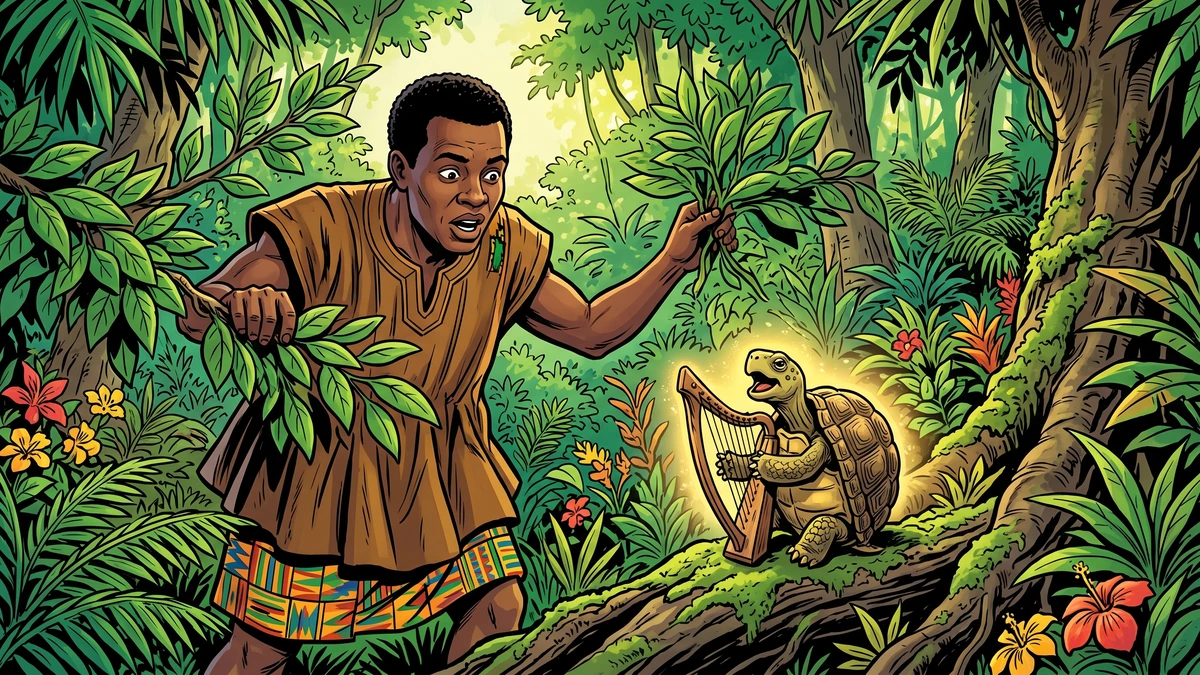
The story opens with a village hunter who, one day, had gone farther afield than usual. He came at last to a part of the forest with which he was wholly unacquainted — and there he stopped, astonished, for somewhere among the trees a voice was singing. The little song was carried on sweet music that, the tale says, entirely charmed the hunter’s heart.
When the song was finished he crept forward and peeped through the branches to see who the singer could be. What he found amazed him beyond anything in his experience: the singer was no woman and no spirit, but a tortoise, with a tiny harp slung in front of her. Never had he seen — never had anyone seen — so marvellous a thing. He had stumbled, by pure accident, into the presence of a wonder.
A Singer for the Hunter Alone
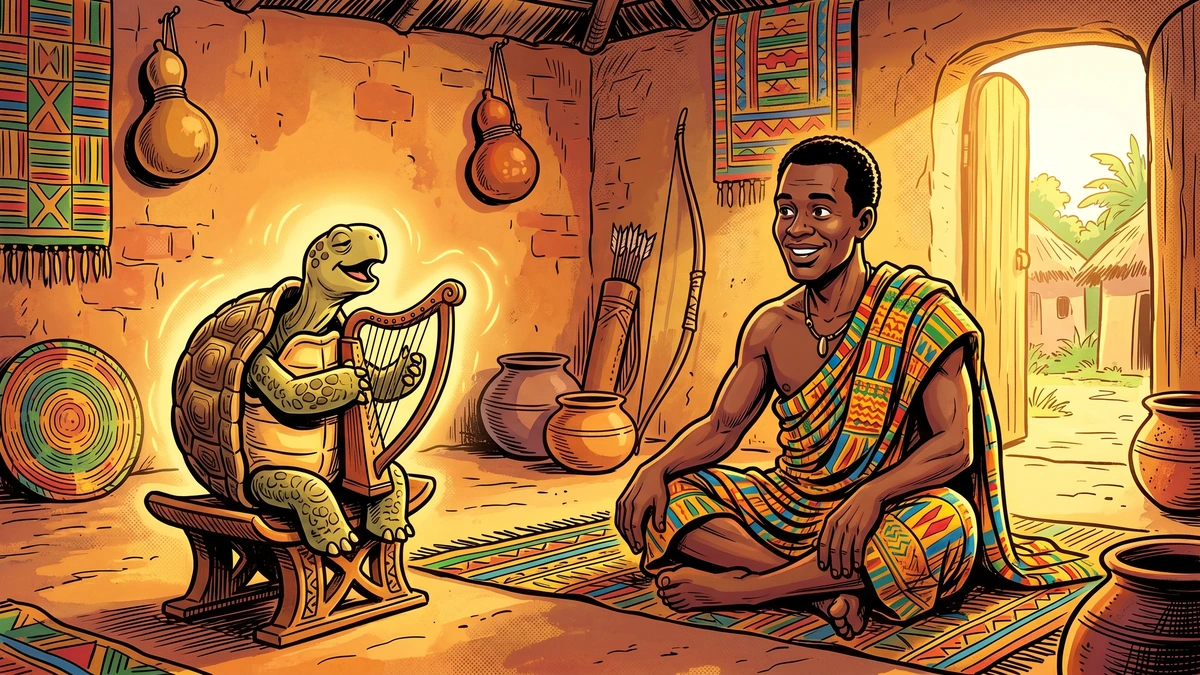
The hunter could not stay away. Time after time he returned to the same secret place in the forest, only to listen to the tortoise and her harp. At last he could not bear to leave the marvel behind him, and he begged her to let him carry her home to his hut, so that he might enjoy her music daily and in comfort.
The tortoise agreed — but on one clear condition. She would go with him, and she would sing, only on the understanding that she sang to him alone. The gift was his to enjoy, not his to exhibit. It was a small price, and at first the hunter paid it gladly. He had, in a single stroke of luck, everything the story’s refrain describes: a wonder that had come to him, not been forced from the world, and that would stay his so long as he simply let it be what it was.
The Hunger for Applause
But the hunter did not rest content for long. Sitting alone with his marvellous secret, he began to wish that he could show the singing tortoise to all the world — and he persuaded himself that by doing so he would gain great honour for himself. The wish curdled, quietly, into a decision.
He told the secret. First to one neighbour, then to another, and the tale travelled as tales do, passing from mouth to mouth and swelling as it went, until at last it reached the ears of the chief himself. What the tortoise had given on the condition of privacy, the hunter had handed away to everyone — and the moment a secret is everyone’s, it is no longer in the keeping of the man who told it.
The Boast Before the Assembly
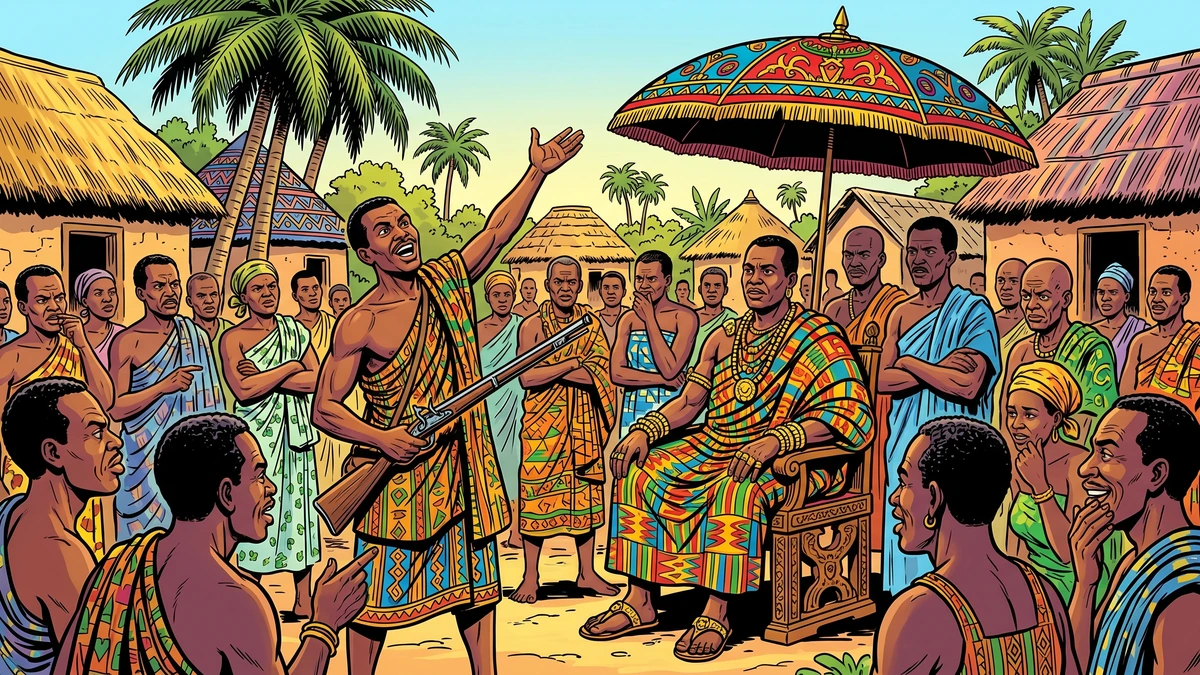
The hunter was commanded to come and tell his tale before the Assembly. He stood before the gathered people and described the tortoise who sang and played upon the harp — and the people shouted at him in scorn. They refused, flatly, to believe a word of it.
Stung by their mockery, the hunter staked everything on his claim. “If I do not speak truth,” he said, “I give you leave to kill me. To-morrow I will bring the tortoise to this place and you may all hear her. If she cannot do as I say, I am willing to die.” “Good,” the people answered, “and if the tortoise can do as you say, we give you leave to punish us in any way you choose.” The wager was sealed, and the hunter went home well pleased with the prospect — never doubting, for a moment, the gift he had so carelessly betrayed.
The Silent Tortoise
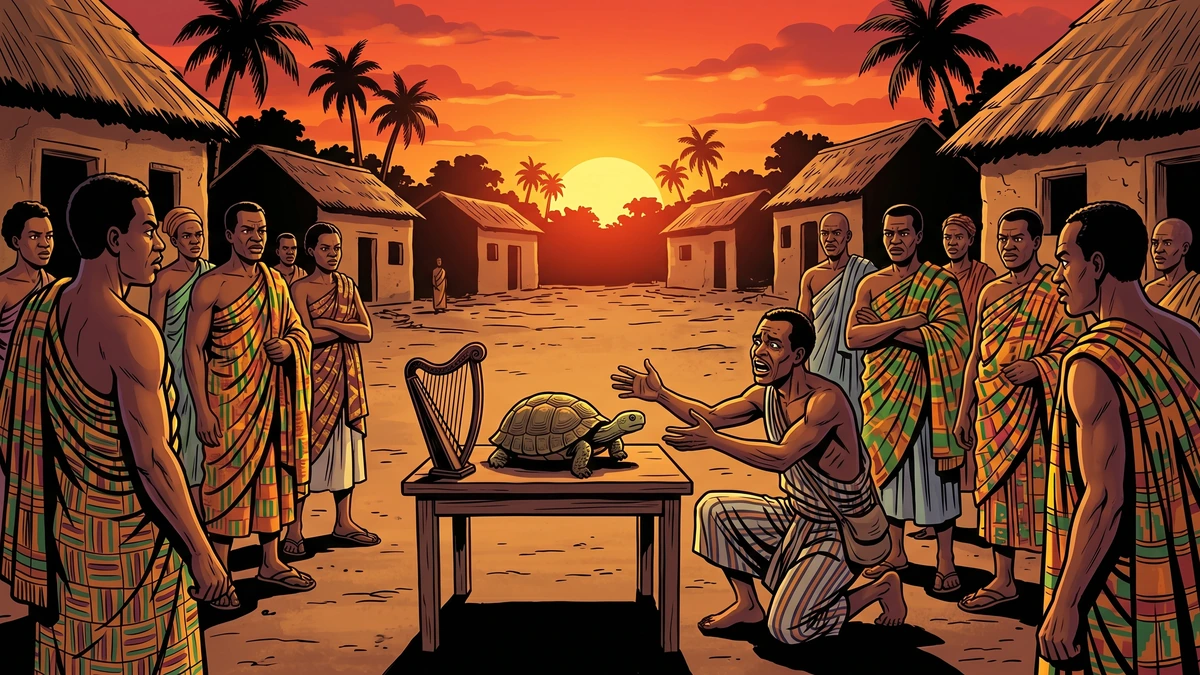
As soon as the morrow dawned, the hunter carried the tortoise and her harp down to the Assembly Place, where a table had been set ready for her. Every one of the villagers gathered round to listen. And then — nothing. No song came.
The people were patient at first, quite willing to give both tortoise and hunter their chance. Hours went by. The tortoise sat on the table and remained utterly mute. The hunter, his dismay turning to shame, tried every means in his power to coax her to sing, and every effort failed. The whispers of the crowd grew into open speech, and the open speech into scorn — scorn for the boaster and his ridiculous claims. And so the day wore down. Night came on, and brought with it the hunter’s doom: as the last ray of the setting sun faded from the sky, he was put to death for a liar.
The Tortoise’s Verdict
The instant the sentence had been carried out, the tortoise spoke. The people stared at one another in troubled wonder, and the dreadful truth settled over the Assembly Place: “Our brother spoke truth, then — and we have killed him.”
But the tortoise did not let the matter rest there, and her explanation is the heart of the tale. “He brought his punishment on himself,” she said. “I led a happy life in the forest, singing my little song. He was not content to come and listen to me. He had to tell my secret — which did not at all concern him — to all the world. Had he not tried to make a show of me, this would never have happened.” Then, in the silence she had kept all day, she sang her refrain once more: it is man who forces himself on things, not things which force themselves on him.
The Meaning of the Refrain
The tortoise’s words are not cruelty; they are a diagnosis. She names, exactly, the fault that destroyed the hunter — and it is worth seeing that the fault is not lying. The hunter never told a lie. Every word of his astonishing claim was true, and the tragedy is that he was killed for a truth. His ruin lay somewhere else entirely: in his refusal to let a good thing simply be a good thing.
The marvel had come to him freely, on its own terms, asking only privacy. That is the meaning of the refrain — that the best things in a life arrive of their own accord and stay only while they are left alone. The hunter “forced himself on” the tortoise’s gift: he was not content to receive it, he had to own it publicly, to convert a private wonder into a public reputation. And the gift, true to the refrain, would not be forced. The tortoise’s silence was not magic and not spite. It was simply the wonder withdrawing from a man who had stopped treating it as a wonder and started treating it as a possession to be shown.
The Moral of the Tale
On its plainest level the story warns against boastfulness and the hunger for applause: the hunter had happiness in his hands and traded it, knowingly, for the chance of “great honour” before the crowd. Beneath that lies a lesson about keeping a trust — the tortoise asked only that he keep her secret, and the whole catastrophe unfolds from the moment he tells “first one, then another.” And beneath that again is the sober observation that some losses cannot be undone: the people’s horrified “we have killed him” changes nothing.
“It is man who forces himself on things,
Not things which force themselves on him.”
— the tortoise’s refrain, sung at the opening and the close of the tale, in West African Folk-Tales, W. H. Barker & C. Sinclair, 1917
The Akan storyteller lets the tortoise, not a narrator, deliver the verdict — and lets her sing it rather than merely say it, so that the lesson leaves the Assembly Place as a song the listeners can carry home. Contentment, the tale insists, is itself a kind of wisdom: the hunter possessed something rare and sufficient, and lost it precisely because “sufficient” was not enough for him.
The Tortoise and the Akan World
It is no accident that the wonder at the centre of this tale is a tortoise. In the folklore of the Gold Coast the tortoise is a recurring figure of patience, age and quiet shrewdness — the slow creature that, in story after story, outlasts faster and louder rivals. The same collection that holds this tale also explains, in “How the Tortoise Got Its Shell,” why the animal carries its house upon its back. Here the tortoise is something subtler still: not a trickster and not a victim, but a kind of living proverb, an animal whose very nature — small, unhurried, content in the deep forest — embodies the wisdom the story wants to teach.
Her harp roots the tale just as firmly in Akan soil. The Akan are a people of rich musical tradition, and the stringed instrument the storyteller pictures recalls the seperewa, the Akan harp-lute once played at court and in the courtyards of the Gold Coast. To imagine a tortoise with such an instrument “slung in front of her” is to imagine the marvel in thoroughly Akan terms — a domestic, familiar music made strange and precious by the impossible creature performing it. And because the tale was itself meant to be performed aloud, the tortoise’s sung refrain would have been a real song in the storyteller’s mouth, the listening village briefly placed in the hunter’s own position: charmed, and warned.
The Tale Among Its Cousins
“The Hunter and the Tortoise” belongs to a family of stories told all over the world about a wonder that cannot survive being shown. In tale after tale a marvel — a singing bird, a magic beast, a secret gift — keeps its power only while it is kept private, and fails or vanishes the moment its keeper parades it for an audience. The shape recurs because the temptation it describes is universal: almost everyone who has ever held something rare has felt the itch to display it and to be admired for having it.
What gives the Akan version its particular sting is the courtroom ending. This is not simply a wonder that fades; it is a wonder whose silence is fatal, and fatal to a man who told nothing but the truth. The story thus folds a second, harder lesson inside the first. It warns the boaster — but it also warns the crowd, the Assembly that scorned what it had not seen and killed a man for a marvel it refused to imagine. “Our brother spoke truth, then, and we have killed him” is addressed to every listener who has ever mocked a claim simply because it was strange. Few folk tales distribute their blame so evenly, or so uncomfortably.
Why the Story Has Lasted
More than a century after Barker and Sinclair set it in print, “The Hunter and the Tortoise” still travels — read aloud in classrooms, retold in folklore anthologies, recorded and broadcast far beyond the Gold Coast forests where it was first spoken. It lasts, in part, because it is so unlike the tales around it: where the Anansi stories reward quick wit, this one quietly warns that wit and luck are worth nothing without the discipline to keep what they bring.
It lasts, too, because its ending refuses the comfort of poetic justice. The hunter is not punished for wickedness; he is punished, terribly and ironically, for a truth — and the crowd that kills him is punished with the knowledge of what it has done. That refusal to tidy the ending gives the tale the weight of something real. And it lasts because of its refrain. A story that opens and closes on the same sung couplet hands the listener a portable proverb: long after the plot is half-forgotten, the line stays — it is man who forces himself on things, not things which force themselves on him — a small, durable warning against the universal temptation to grasp, to display, and to boast.
Frequently Asked Questions
Where does “The Hunter and the Tortoise” come from?
It is a West African folk tale of the Akan peoples of the Gold Coast — modern Ghana — published in West African Folk-Tales, collected by William H. Barker and Cecilia Sinclair and issued by George G. Harrap & Co. in London in 1917. Unlike the trickster anansesem in the same collection, it is a quiet wisdom-fable.
What did the hunter discover in the forest?
Wandering into an unfamiliar part of the forest, the hunter heard singing and sweet music. Peeping through the branches, he found that the singer was a tortoise with a tiny harp slung in front of her — a wonder he had never imagined possible.
Why did the tortoise stop singing?
The tortoise had agreed to live with the hunter only on the condition that she sang to him alone. When he broke that trust by telling her secret to the whole village and the chief, she fell silent before the Assembly — the gift withdrawing from a man who had tried to make a public show of it.
Was the hunter punished for lying?
No — and that is the tale’s tragic irony. Every word the hunter said was true. He was beheaded as a liar because the tortoise chose silence. His real fault was not dishonesty but boastfulness and the betrayal of a trust that “did not at all concern” the world.
What is the moral of the story?
Keep a trust, value contentment, and resist the hunger for applause. The hunter held a rare happiness and lost it because he could not let a private wonder simply remain his. The tale’s refrain sums it up: “It is man who forces himself on things, not things which force themselves on him.”
You May Also Like
 African Folk Tales
Ages 6-8
African Folk Tales
Ages 6-8
The Lion’s Whisker
An Amhara wisdom tale from Ethiopia: a young stepmother, desperate to win her grieving stepson's love, is sent by a wise hakim to pluck a whisker from a living lion - and learns that patience, not magic, is the cure.
 African Folk Tales
Ages 6-8
African Folk Tales
Ages 6-8
How We Got The Name ‘Spider Tales’
Anansi the spider climbs to the Sky God to buy the world's stories — and almost every folk tale in Africa now wears his name.
 African Folk Tales
Ages 6-8
African Folk Tales
Ages 6-8
The Grinding-Stone That Ground Flour By Itself
A poor brother borrows a magic mill — and that is why, to this very day, the sea tastes of salt.