King Chameleon And The Animals
An African folk tale about how the animals once chose a king by race — and why a clever little chameleon beat the swift hare to the stool of power.
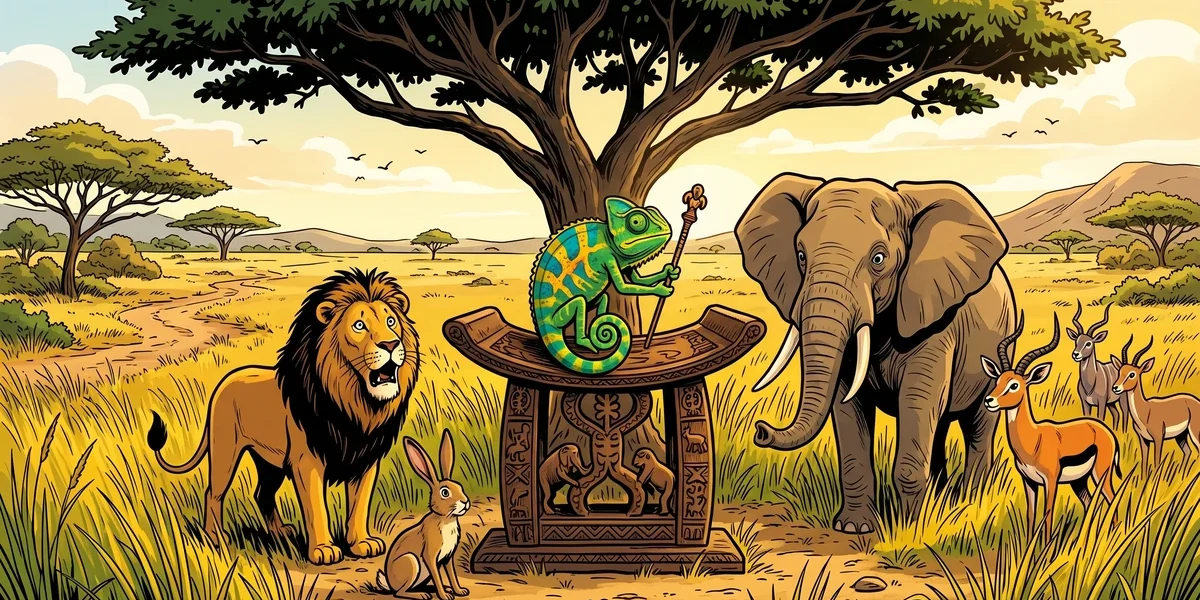
There is a tale told along the Gold Coast of West Africa — in the towns of the Akan and the Twi-speaking villages of what is now Ghana — about the strange morning the animals chose a king. It is a story about a footrace, and like every good footrace story it seems, at first, to belong to the swift. The hare runs it. The hare wins it, or very nearly. And yet when the dust on the running-ground had settled and the watching crowd pressed forward to see who sat upon the sacred stool, it was not the hare they found there. It was a small, slow, sideways-eyed creature who had never run a step: the chameleon.
The earliest published English version of this tale appears in West African Folk-Tales, collected and arranged by W. H. Barker and Cecilia Sinclair and issued by George G. Harrap & Co. of London in 1917. William Henry Barker served as an inspector of schools on the Gold Coast, and he gathered the stories from Twi- and Ewe-speaking storytellers and from the schoolchildren in his care; Cecilia Sinclair arranged them for a young readership. The collection stands beside R. S. Rattray’s later Akan-Ashanti Folk-Tales (1930) as one of the foundational printed records of southern Gold Coast oral narrative. In the Aarne–Thompson–Uther index the story belongs with the great family of contest tales gathered under ATU 1074, “Race Won by Deception,” and it turns specifically on motif K11.1, “Race won by deception: riding on the back” — the trick by which a weaker creature clings, unseen, to a swifter one and is carried to the very edge of victory. It also closes on an etiological note, motif A2433, “Animal’s characteristic haunt,” explaining why the chameleon lives alone in the high trees and calls, at night, for company that never comes.
A Kingdom With No King
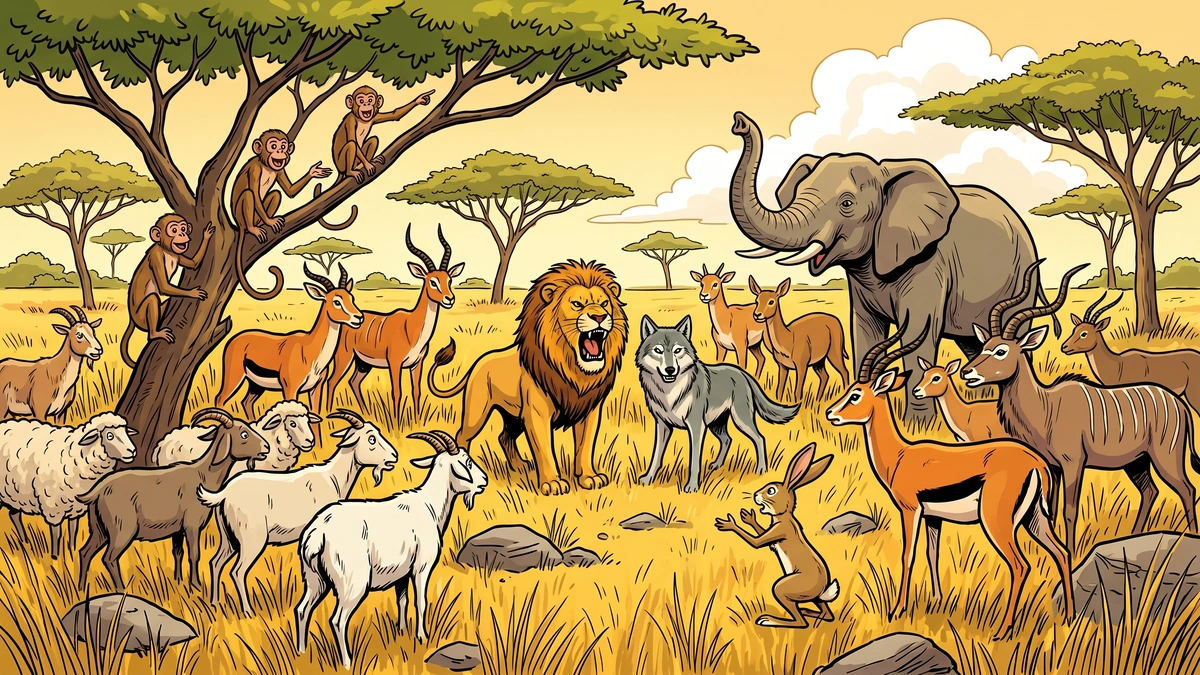
The story opens in a time before order. “In the olden days,” the tale begins, all the animals of the world lived together in friendship — but they had no one to rule over them and no one to judge between them. The storyteller is precise about what this absence costs. Without a king, the tale says, “many very wicked deeds were constantly being done, as no one needed to fear any punishment.” It is a small sentence carrying a large idea. Friendship alone, the Akan storyteller suggests, does not hold a community together; goodwill without authority leaks away into quarrels and theft and unanswered wrongs. What the animals lack is not affection. It is justice.
So they do the sensible thing: they call a meeting. The whole animal world gathers to debate “this bad state of affairs,” and they resolve to choose a king. But here the tale plants its first real difficulty — not the choosing itself, but the how of choosing. The animals quickly discover that picking a ruler by acclaim is impossible, because every candidate is somebody’s enemy.
Lion is suggested first, and Lion is the obvious choice: strong, commanding, the very picture of a monarch. But the assembly opposes him, the tale says plainly, “because he was too fierce.” A king is meant to protect the weak, not frighten them, and a lion’s strength is the strength his subjects would have most reason to dread. Wolf is named next — and here the objection is sharper still. The sheep and the goats refuse him outright, “because he was their foe. They knew they would have bad treatment if he were chosen.” The prey will not crown the predator. In two swift refusals the tale lays down a quiet constitutional principle: power, on its own, does not qualify a creature to rule. The animals are not looking for the most dangerous beast. They are looking for a king under whom the smallest goat can sleep safely.
The Race for the Sacred Stool
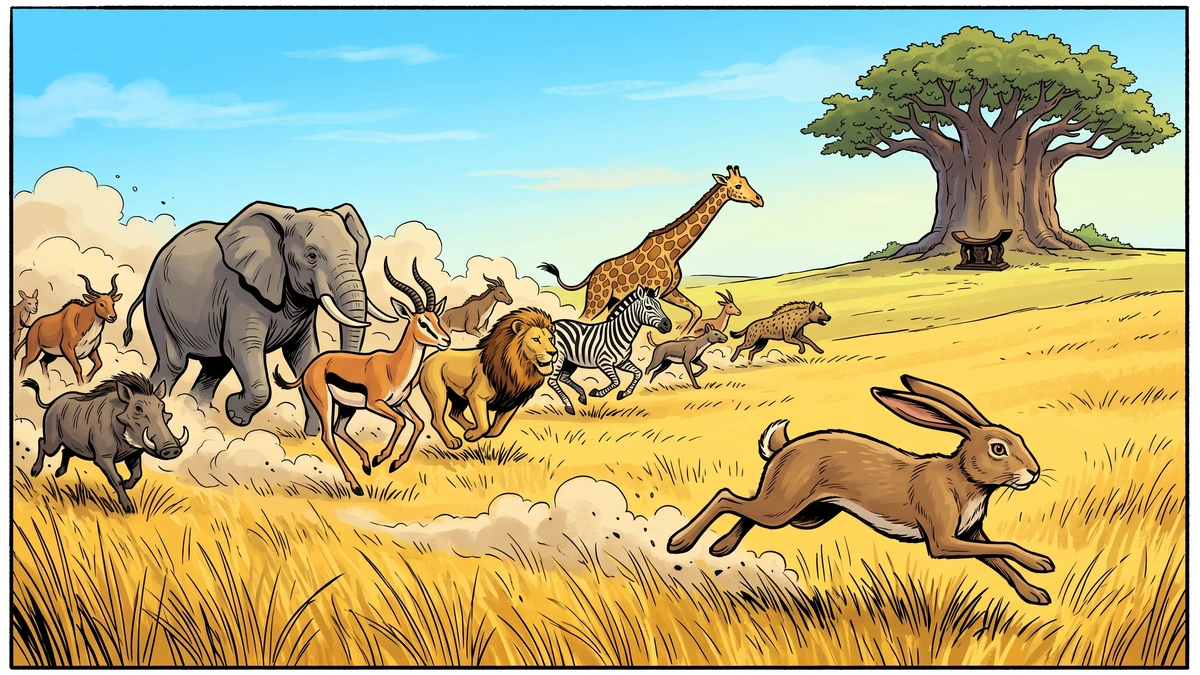
Since no candidate can win by agreement, the animals turn to a method that needs no agreement at all. They will hold a race. Two miles away, the tale tells us, stood “a great stool, placed under a very ancient tree which they believed to be the abode of some of their gods.” Whichever animal reached that stool and sat down upon it first would be king.
The choice of a stool is not incidental detail, and an Akan listener in 1917 would have caught its weight at once. Among the Akan peoples the stool is the single most sacred object of chiefship. A chief is not crowned; he is “enstooled,” and the Golden Stool of the Asante — the Sika Dwa Kofi — was believed to hold the very soul of the nation. To seat oneself upon a stool beneath a tree thought to house the gods is, in this story, to be raised to legitimate authority by something larger than the crowd’s shifting opinion. The race removes the problem of partiality. No one need vote for a friend or against a foe. The stool, and the gods above it, will decide.
And so the morning of the race arrives, and “all animals, great and small, prepared to take part in it.” The image is a fine one: the elephant and the ant on the same starting line, the swift and the slow given, for one morning, exactly equal standing. The signal is given. The animals start off. And almost at once the field stretches and thins, because one runner is simply better than all the rest. The hare — “a very fine runner,” the tale says — speedily outdistances every other creature. By the time he nears the sacred tree he is fully five hundred yards ahead of the next animal behind him. The throne, it seems, is already decided. The hare has only to cross the last stretch of ground and sit.
The Voice From the Stool
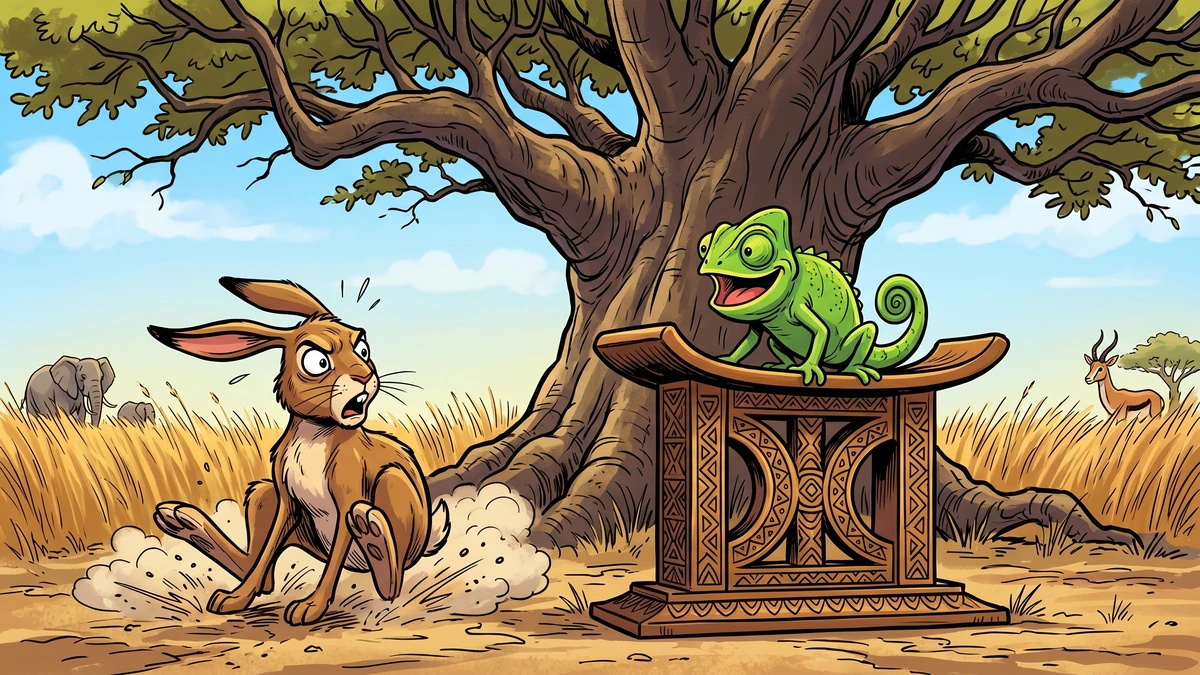
Here the tale delivers its turn, and it delivers it as a piece of pure theatre. The hare reaches the stool. He slows, triumphant, and bends to take his seat as king of all the animals — and a voice stops him. “Take care, Mr Hare, take care,” it says. “I was here first.”
The voice belongs to the chameleon, and the chameleon is sitting on the stool.
The explanation, when the storyteller gives it, is both simple and quietly brilliant. The chameleon “being able to change his colour to suit his surroundings, had seized Mr Hare’s tail just as the race began.” He had matched his colour exactly to the hare’s fur, so that no creature in all that watching crowd had noticed the small passenger clinging there. He held on — the tale stresses this — “very tightly,” through the whole two miles of the hare’s tremendous run. And at the last instant, in the very moment the hare turned to lower himself onto the stool, the chameleon “dropped off and landed on the stool.” First by a heartbeat. First by the length of a turning body. But first.
It is worth pausing on how clear-eyed this trick is. The chameleon never pretends he can run. He has measured himself honestly and found himself slow, and rather than envy the hare’s legs he studies what he himself possesses: the gift of vanishing against any background, and the patience to hold a grip without moving for the length of a race. He does not try to be the hare. He uses the hare. The story is careful, too, not to call this cheating in any tidy way — the animals had set a single rule, that the first creature to sit on the stool would be king, and by that rule, exactly, the chameleon has won. The hare is furious. He “saw how he had been tricked and was very angry,” and he might well have done the chameleon harm — but the other animals arrive before he can, and “according to the agreement they had made, they had no choice but to make Chameleon king.”
The Loneliest Throne
A lesser story would end on that flourish: the clever underdog enthroned, the proud favourite humbled, the moral neatly tied. But this Akan tale is braver than that, and its final movement is its wisest. The chameleon has the stool. He has the title. He has won precisely what was promised. And it does him no good at all.
“None of the animals were satisfied with the choice,” the tale says. They had agreed to the race; they could not deny its result; but a crown won by a trick commanded no loyalty. “As soon as the meeting was over, all scattered in every direction and left Chameleon quite alone.” There is no rebellion, no war, no dramatic overthrow. There is only a slow, total withdrawal — every subject simply walking away — and a king left sitting on a sacred stool with no one in the world to rule.
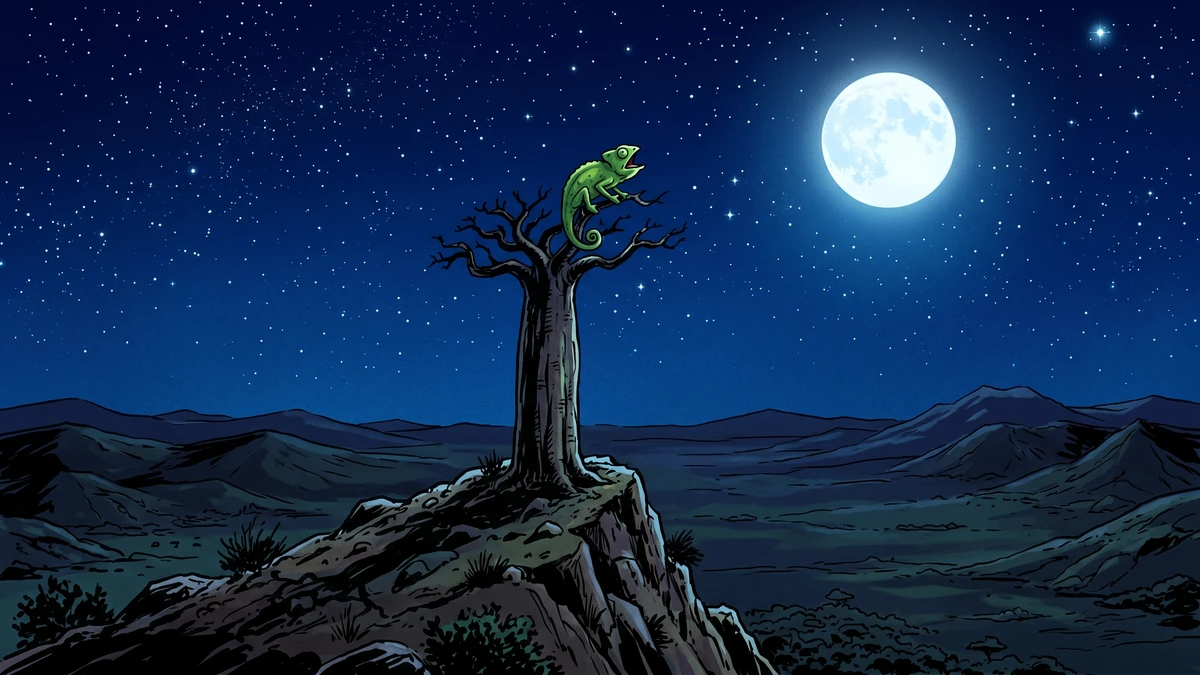
The chameleon’s response is the most human note in the whole story. He is not angry. He is ashamed. So ashamed, the tale says, that “he went and made his home at the top of a very high tree on a mountain.” And here the story shades into a pourquoi tale, an explanation of something a Gold Coast child could see and hear for themselves. “In the dead of night,” the storyteller says, “you may hear him calling his attendants to come and stay with him. But he is left quite alone.” Every solitary chameleon high in the branches, every strange small cry in the dark, became proof of the story — the eternal, unanswered roll-call of a king who has a throne and a title and not one single subject. The tale ends on a line that needs no commentary, and the storyteller gives it none: “A king without subjects is no king.”
The Chameleon, the Stool, and the Animal Kingdom
To understand why this tale chose a chameleon for its hero, it helps to know how the creature was regarded across West and Central Africa. The chameleon is one of the most widely honoured animals in the continent’s oral tradition, and not for its speed. In a great body of myth stretching from the Yoruba of Nigeria through the Akan of Ghana to many Bantu-speaking peoples of Central and Southern Africa, the chameleon is the messenger of the Creator — often the bearer of the message of eternal life, who walks so slowly that a faster, careless animal overtakes him and delivers, instead, the message of death. The chameleon, in other words, is the African storyteller’s standing emblem of the slow, the deliberate, the one who is underestimated precisely because he will not hurry. To make such a creature win a footrace is a deep and deliberate joke, and an Akan audience would have felt the rightness of it long before the trick was explained.
The tale’s framework — an assembly of animals choosing a ruler — belongs to one of the oldest patterns in world folklore, the “animal kingdom” cycle, in which beasts hold councils, argue precedence, and elect or depose kings. African versions of this pattern are rarely idle entertainment. They are a society reasoning aloud about its own institutions: how authority should be granted, what disqualifies a candidate, what a ruler owes the ruled. The rejection of the lion for fierceness and the wolf for predation is a community working out, in the safe disguise of animals, that a chief must be a guardian and not a threat. And the sacred stool at the heart of the contest roots the whole story in real Akan political life, where chiefship was — and in many communities still is — conferred by enstoolment, and where a chief who lost the confidence of his people could be “destooled,” removed from the very seat that made him. Heard against that background, the chameleon’s empty throne is not a fantasy. It is the story’s vivid picture of a ruler who has, in everything but name, already been destooled by the silent departure of his people.
The Moral of the Tale
It is tempting to read “King Chameleon and the Animals” as a simple cousin of Aesop’s “The Tortoise and the Hare” — a warning that the swift grow careless and the patient prevail. That reading is there, and it is true: the hare loses a race he had already won, undone by the one thing he never thought to do, which was to look behind him. Confidence that does not check itself is only a slower kind of carelessness.
But the Akan tale reaches past that lesson to a harder and more political one. Its real subject is the difference between winning power and holding it. The chameleon does everything correctly by the letter of the contest. He is, by the agreed rule, the rightful king. And he discovers — sitting alone on the most sacred stool his world possesses — that legitimacy on paper is worth nothing without the consent of the governed. Authority is not a seat. It is a relationship. A ruler whose people do not trust how he rose will rule no one, however unimpeachable his claim. The animals do not break the law to depose him; they simply decline to be ruled, and that quiet refusal is enough to empty a throne.
This is why the chameleon’s exile is the truest part of the story. He is not punished by the gods or driven out by force. He punishes himself, with shame, and the punishment fits exactly: a creature who took the crown alone is left to keep it alone. The Akan elders who told this tale framed leadership not as a prize to be seized but as a trust to be earned, and they kept a store of proverbs to say so. One of the best known runs:
“Tikoro nkɔ agyina.”
“One head does not go into council.” — Akan (Twi) proverb
A single head cannot hold a meeting; a single creature cannot constitute a kingdom. The chameleon climbs to the top of his lonely tree still calling, in the dark, for the council he never gathered — and the proverb explains, in five words, why no one comes.
Why This Story Has Lasted
“King Chameleon and the Animals” has survived for more than a century in print, and for far longer in the mouths of storytellers, because it works on every age of listener at once. To a small child it is a delicious surprise — the tiny clinging creature who beats the fastest runner in the world — and an explanation, as good as any, for why chameleons live high and alone and seem to call in the night. To an older listener it becomes something graver: a meditation on how communities choose their leaders, on the gap between a rightful claim and a real mandate, and on the loneliness that waits for anyone who grasps at authority without first earning trust.
It endures, too, because of its honesty. Many trickster tales let the clever winner enjoy the spoils; the audience is invited to cheer the trick and forget the cost. This Akan story refuses that easy pleasure. It lets the chameleon’s cleverness succeed completely — and then shows, without flinching, that a victory the community never accepted is no victory at all. Collected by Barker and Sinclair in 1917 from the storytellers of the Gold Coast and retold in classrooms ever since, the tale remains a quietly exact piece of teaching. Strength alone does not make a king; speed alone does not make a king; cleverness alone does not make a king. A king is made by the people who agree to be ruled — and a crown taken without them is only a high, cold branch, and a voice in the dark that nothing answers.
You May Also Like
 African Folk Tales
Ages 6-8
African Folk Tales
Ages 6-8
The Leopard And The Ram
The Leopard And The Ram: A ram once decided to make a clearing in the woods and build himself a house. A leopard who lived near also made up his mind to do the
 African Folk Tales
Ages 6-8
African Folk Tales
Ages 6-8
The Hunt Of Lion And Jackal
A Khoikhoi trickster tale from the Cape of Good Hope: the jackal cheats his hunting partner the lion out of an eland's fat with a false blood-trail, talks his way out of being caught, and escapes scot-free with his family.
 African Folk Tales
Ages 9-12
African Folk Tales
Ages 9-12
Why Spiders Are Always Found In The Corners Of Ceilings
Why Spiders Are Always Found In The Corners Of Ceilings: Egya Anansi was a very skilful farmer. He, with his wife and son, set to work one year to prepare a