The Lion’s Whisker
An Amhara wisdom tale from Ethiopia: a young stepmother, desperate to win her grieving stepson's love, is sent by a wise hakim to pluck a whisker from a living lion - and learns that patience, not magic, is the cure.

High in the mountains of Ethiopia, where the air is thin and cold and the rivers cut deep red valleys through the rock, the Amhara people have told for generations a story about a young woman, a lonely child, and a lion. It is called “The Lion’s Whisker,” and although it is short enough to be told in the time it takes a fire to burn low, it carries one of the largest ideas in all of folklore — that the fiercest heart in the world can be won, but never by force, and never quickly.
It is, on its surface, the story of a woman who needs a single whisker plucked from the muzzle of a living lion. But the whisker is never really the point, and the wise old healer who sends her after it knows that perfectly well. “The Lion’s Whisker” is a tale about patience — about the slow, humble, daily work of earning trust — and about a teacher clever enough to know that some lessons cannot be told, only lived. It is also, quietly and remarkably, a tale that takes the most maligned figure in world folklore, the stepmother, and makes her its patient, loving heroine.
Origins and Canonical Attribution
“The Lion’s Whisker” is a traditional folktale of the Amhara, the highland people of central and northern Ethiopia whose language, Amharic, is the working language of the Ethiopian state. Like nearly all Ethiopian folk literature it lived for centuries entirely in the mouths of storytellers — recited in the evening within the round thatched tukul, passed from grandmother to grandchild, shaped and re-shaped by every teller — long before any of it was written down. It belongs to the great Ethiopian tradition of the wisdom tale: a short narrative built not around magic or adventure but around a single hard-won insight into how people may live well with one another.
Origin & Canonical Attribution
Tradition: Amhara oral literature of the Ethiopian highlands — a wisdom parable, or tale of patience, from the folk repertoire of central and northern Ethiopia.
Principal printed source: Russell Davis and Brent Ashabranner, The Lion’s Whiskers: Tales of High Africa (Boston: Little, Brown and Company, 1959) — a collection of Ethiopian folktales the two authors gathered while living and teaching in Ethiopia; the title story is the Amhara tale retold here.
Later retellings: Nancy Raines Day, The Lion’s Whiskers: An Ethiopian Folktale, illustrated by Ann Grifalconi (New York: Scholastic, 1995); the tale is widely anthologised in collections of African and world folklore.
Story type: A migratory wisdom parable of the “impossible token” kind — the seeker is sent to obtain something from a dangerous animal and learns the true lesson in the getting of it. The tale is not assigned a single discrete Aarne–Thompson–Uther number; its closest and most famous cognate is the Korean “The Tiger’s Whisker,” and related forms are told across the Near East and East Asia.
Principal motifs: H1154, the task of obtaining a token from a dangerous wild animal; B771, the wild animal tamed by gentleness; J163, wisdom purchased or earned through experience; the loving stepmother — a deliberate inversion of the cruel-stepmother figure (compare motif S31).
The tale reached print, and the English-speaking world, chiefly through The Lion’s Whiskers: Tales of High Africa, published in 1959 by Russell Davis and Brent Ashabranner. The two Americans had lived and worked in Ethiopia, and they set down folktales from the many peoples of the country, giving their whole collection the name of this single Amhara story because it spoke so directly to the heart of what folktales are for. The book was later revised into a shorter edition for younger readers, and in 1995 the children’s writer Nancy Raines Day retold the title tale on its own as a picture book. Through these tellings “The Lion’s Whisker” has become one of the best-loved Ethiopian stories outside Ethiopia — yet its shape and its lesson remain exactly those of the highland original.
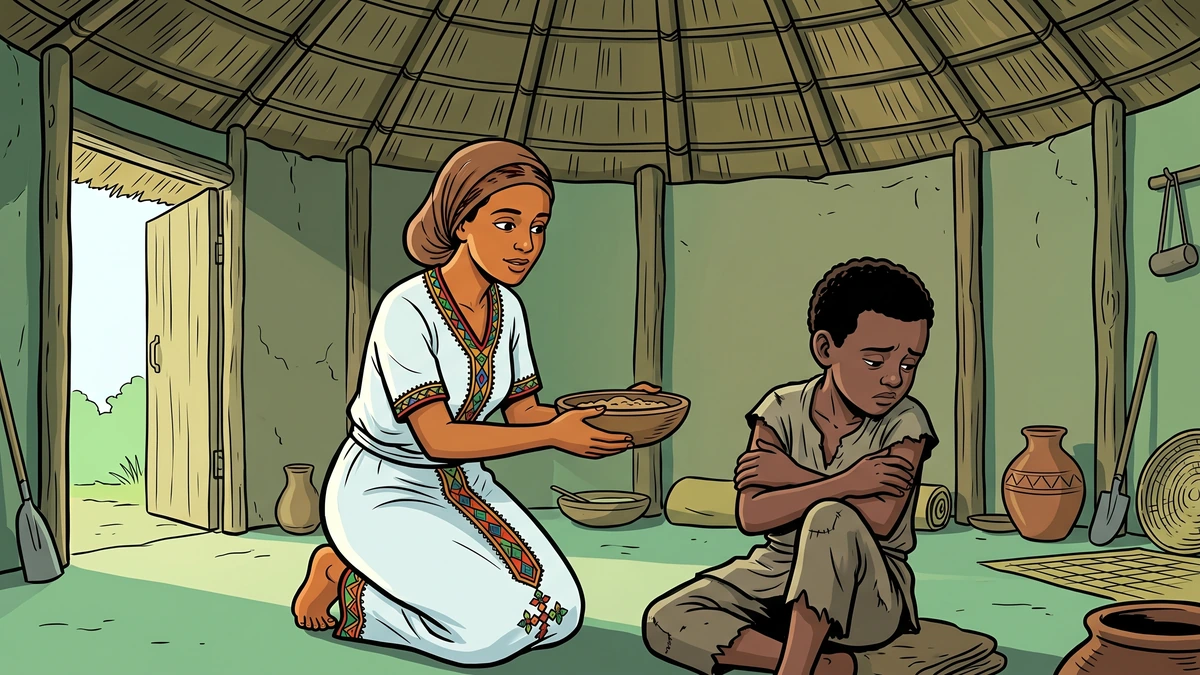
The Bride Whose Stepson Would Not Love Her
The story begins with a marriage and a sorrow. A young woman named Fanaye marries a widower of her highland village — a good man whose first wife has died, leaving him with a young son. Fanaye comes to the marriage full of hope. She is gentle by nature, and she has already decided, before she ever crosses the threshold, that she will love her husband’s boy as if he were her own, and that the three of them will make a household warm with affection.
But the child does not want her. He is still deep in grief for the mother he has lost, and the arrival of this new woman in his mother’s place feels to him like a wound rather than a comfort. When Fanaye cooks for him, he will not eat. When she speaks to him kindly, he turns his face to the wall. When she comes near, he gets up and walks away; when she calls after him, he runs. He spends his days alone on the hillside with the goats and comes home only to sleep. He does not shout at Fanaye and he does not insult her — he simply will not let her reach him, and a closed door, as Fanaye soon learns, can be harder to bear than an angry one.
Month after month she tries, and month after month she fails, and slowly the hope she carried into the marriage begins to thin into despair. She begins to believe that the boy will never love her, that she has no place in this household after all, that whatever she does is wasted. And it is out of that despair — not out of cruelty, but out of a longing to be a true mother to a child who needs one — that Fanaye makes up her mind to seek help from the one person in the district said to be wiser than anyone alive.
The Hakim and the Impossible Errand
In the highlands above the village there lived an old hakim — a healer and a wise man, the keeper of remedies and counsel for all the country around. People climbed to his dwelling with their fevers and their broken bones, and also with their griefs and their tangled troubles, for the hakim was known to have a cure, of one kind or another, for almost everything. To him, at last, Fanaye climbed.
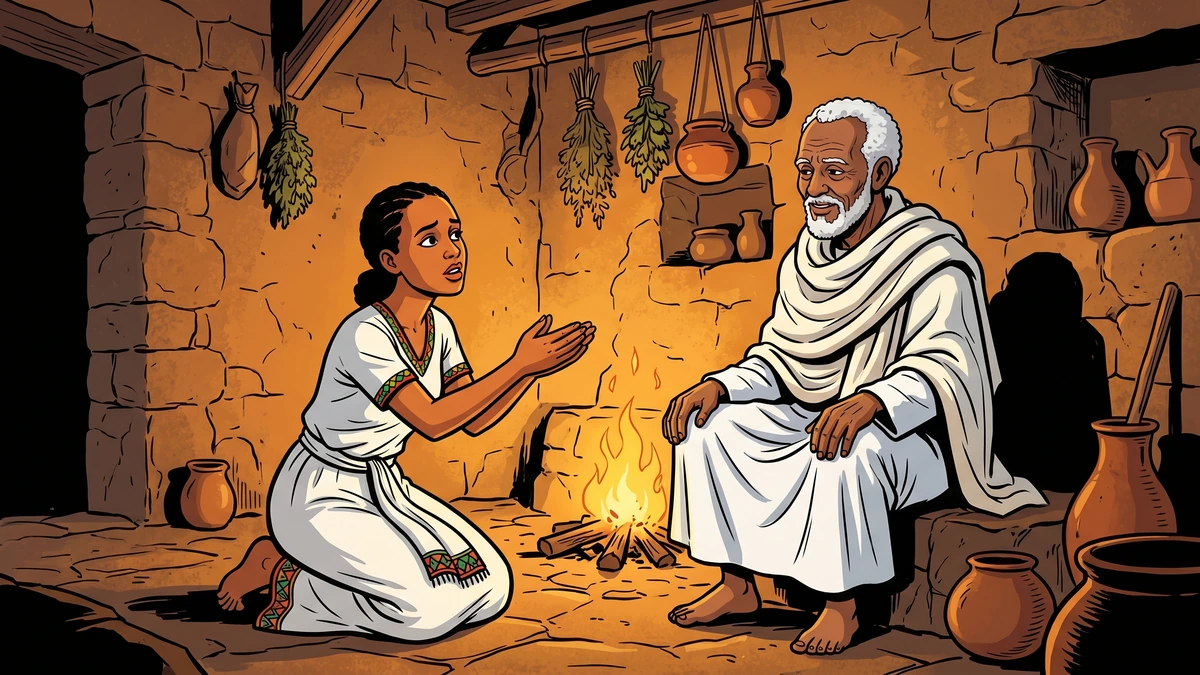
She told him everything: the marriage, the motherless boy, the food refused, the face turned to the wall, the running feet, the long slow death of her hope. And then she asked him for what she had come all that way to ask. “Make me a medicine,” she begged. “Mix me a potion that will make my husband’s son love me. I will pay whatever you ask. Only give me something that will open his heart.”
The old hakim listened to all of it without a word, and his face was kind. When Fanaye had finished he was quiet for a long moment. Then he said that yes — such a medicine could be made. But it needed one ingredient, and that ingredient he could not gather himself, for he was too old to go where it was found. “You must bring it to me with your own hands,” he told her. “Bring me a single whisker plucked from the chin of a living lion — from the great lion with the black mane that hunts alone in the lowland of black rock. Bring me that one whisker, and I will make your potion.”
Fanaye went home cold with fear. Everyone in the highlands knew that lion. It was huge, and it was fierce, and to walk into its country unarmed was thought to be simply a way of dying. To pluck a whisker from its living face was not difficult — it was impossible. And yet, as she lay awake that night, Fanaye understood that the hakim had not refused her. He had said the medicine could be made. He had named the price. The price was the whisker, and if the whisker was the price, then somehow — some way she could not yet imagine — she would have to find a way to pay it.
The Long, Slow Taming of the Lion
So Fanaye began. Early the next morning she carried a small piece of meat down out of the green highlands and into the dry lowland of black rock where the lion hunted. When she saw the lion in the distance — vast, tawny, its dark mane stirring in the heat — her courage nearly failed her. She did not go near it. She set the meat down on a flat stone as far away as she dared, and then she turned and walked home, her heart hammering. From a safe distance she watched the lion come, sniff, and eat what she had left.
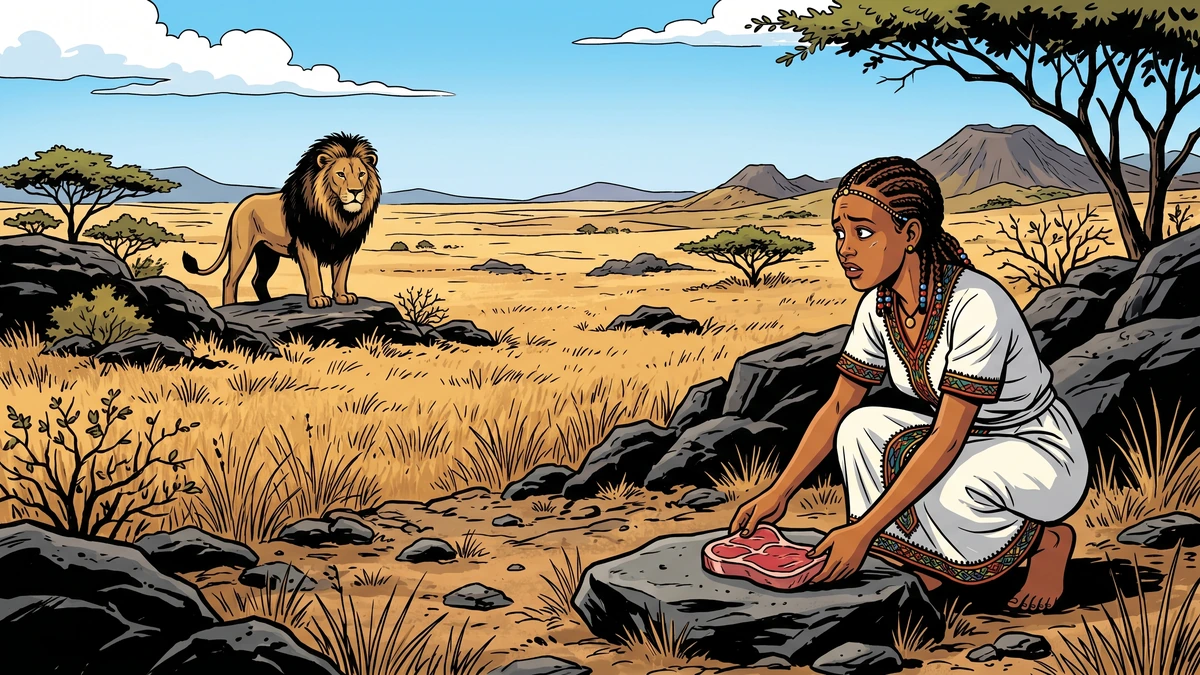
The next day she came again, and left meat again, a little nearer than before. And the day after that, a little nearer still. This was the whole of Fanaye’s plan, and it was the only plan that could ever have worked: to come every single day, to bring food every single day, and each day to close the distance between herself and the lion by no more than a hand’s breadth — so little that the lion would never be startled, never be threatened, never have cause to charge or to flee. She did not hurry. She did not force a single step. She let the lion set the pace, and the lion’s pace was slow.
Weeks passed, and then months. Day by patient day the lion grew used to the woman who brought it food and asked nothing and never came too fast. The day came when it no longer rose and moved off at her approach, but lay still and watched her. The day came when it ate while she stood near. The day came when it took the meat from her hand. And at last there came a day — many long months after the first frightened morning — when Fanaye could sit quietly beside the great lion in the lowland sun, and stroke its rough mane, and feel it lean its enormous head against her without the smallest fear on either side. The fiercest creature in the country had come to trust her, because she had given it, every day and without fail, gentleness, food, and time.
The Whisker, and the Hakim’s Lesson
And so, one warm afternoon, with the lion drowsing peacefully at her side, Fanaye reached out a steady hand, took hold of a single whisker on the lion’s chin, and with one swift gentle pull plucked it free. The lion stirred, and looked at her, and did not so much as growl. Fanaye rose, the precious whisker safe in her hand, and walked out of the lowland of black rock and up into the green highlands, and climbed the long path to the hakim’s dwelling with her heart singing. She had done the impossible thing.
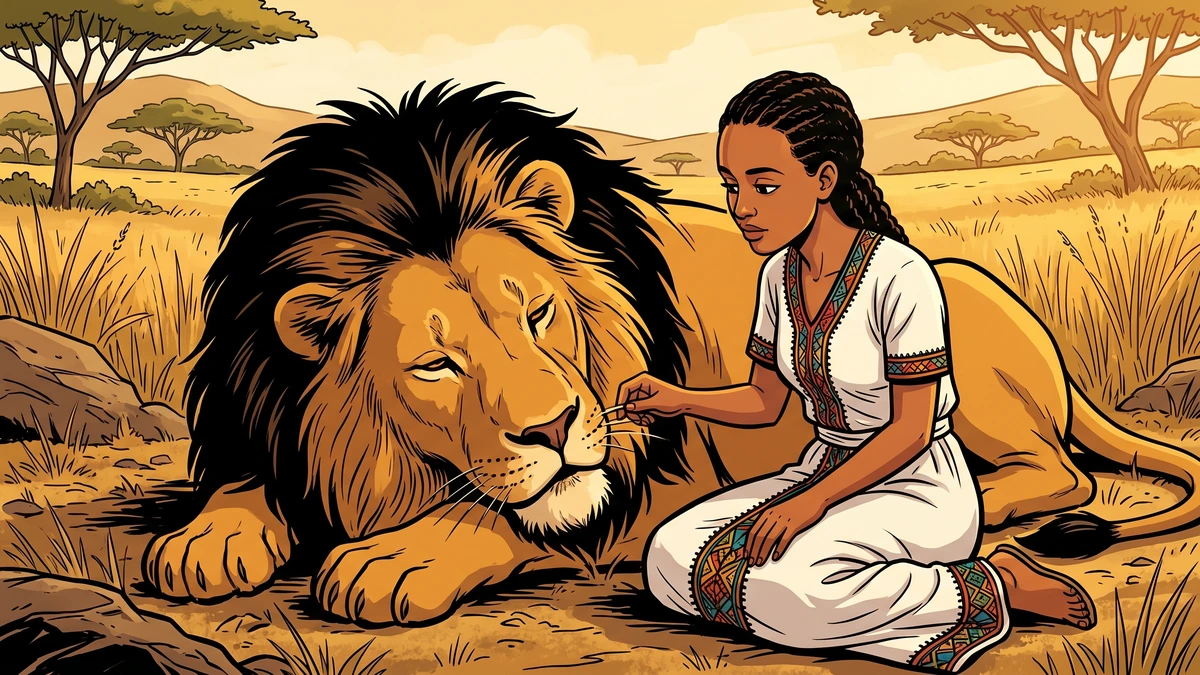
She held out the whisker to the old man. “Here it is,” she said. “A whisker from the chin of the living lion. I brought it with my own hands, exactly as you asked. Now — please — make me the medicine that will make my husband’s son love me.”
The hakim took the whisker from her and turned it in his old fingers, and looked at it for a long while. Then he leaned forward and dropped it into the fire. Fanaye cried out and started up — all those months, all that fear and patience, gone in a curl of smoke. “What have you done?” she gasped. “Why have you destroyed it?”
“Sit down, Fanaye,” the hakim said gently, “and tell me how you did it. Tell me how a woman walks up to the fiercest lion in the country and takes a whisker from its face and is not harmed.” And so Fanaye told him — the meat carried down each morning, the distance closed a hand’s breadth at a time, the months of coming and coming again, never forcing, never hurrying, until the wild thing learned that she meant it no harm and opened its heart to her.
The hakim nodded. “Then you do not need my medicine,” he said, “for you already possess it, and you have just told me its whole receipt. Was the lion not stronger than your husband’s son? Was it not fiercer, and more dangerous, and far more likely to turn on you? And yet you won it — not with a potion, and not with force, and not in a day, but with patience, and gentleness, and small kind things done faithfully, over and over, for as long as it took. A grieving child is not so different from a frightened lion. Go home, Fanaye. Go to the boy as you went to the lion. Do not rush him and do not force him. Bring him your kindness every day and ask nothing back, and close the distance between you a little at a time, and wait. His heart will open. It cannot help but open. You have already proved that you know exactly how it is done.”
And Fanaye, who had climbed the mountain expecting a bottle and a charm, went back down it carrying something far better — the knowledge of what she had been capable of all along. She went home to her husband’s son, and she began again; and this time she understood the work, and she did not lose heart, and in the slow fullness of time the motherless boy came to love her as his own.
The Moral of The Lion’s Whisker
On its surface “The Lion’s Whisker” teaches the plainest and most necessary of lessons: that trust and love cannot be seized, commanded, hurried, or bought, but can only be earned, slowly, by patient and faithful kindness. There is no potion. There was never going to be a potion. The hakim’s genius is that he understood Fanaye did not need a remedy — she needed to discover, in her own body and over many months, that she already had within her every quality the task required. So he sent her to learn it on a lion, where the lesson could not be argued with, and then he burned the whisker so that she could not mistake the token for the cure.
“ቀስ በቀስ እንቁላል በእግሩ ይሄዳል።”
— Amharic proverb: “Kes be kes, enkulal be egru yihedal” — “Slowly, slowly, the egg will walk on its own legs.”
The deeper moral lies in that famous Ethiopian saying, which the tale exists to dramatise. An egg is the most fragile and the least promising of things; the idea that it might one day stand and walk seems absurd. And yet, the proverb insists, what cannot be forced can still be reached — if you are willing to allow it the slow, patient time that growth requires. Fanaye could not make the lion love her, and she could not make the boy love her, in the way one breaks a stick or lifts a stone. But she could do something better and harder: she could keep faith, day after unremarkable day, with a process whose results she could not see and could not rush. The story honours the unglamorous virtue that holds families and friendships and whole communities together — the willingness to keep showing up with kindness, expecting nothing immediate in return, trusting that closeness grows the way an egg becomes a creature: invisibly, gradually, and only in its own good time.
Why The Lion’s Whisker Has Lasted
This small Amhara tale has travelled out of the Ethiopian highlands and into the folklore collections, classrooms and picture books of the whole world, and it is worth asking why so modest a story has reached so far. Part of the answer is the sheer perfection of its shape. The errand the hakim invents is a single, unforgettable image — a whisker from a living lion — and the moment he drops that hard-won whisker into the fire is one of the great quiet turns in folk storytelling, a teacher destroying the thing his pupil thinks she came for so that she can finally see what she truly came for. Nothing in the tale is wasted, and its ending lands like a key turning in a lock.
It has lasted, too, because of its unusual heroine. The folklore of every continent overflows with wicked stepmothers — jealous, scheming, murderous women set against the children in their care. “The Lion’s Whisker” knows that figure perfectly well and deliberately turns her inside out. Fanaye is a stepmother whose whole struggle is to love a child who will not yet let himself be loved, and the story treats her longing with complete tenderness and respect. In a world that still tells children to fear the second wife, this Ethiopian tale offers the rarer and kinder truth: that a stepmother may be the most patient and devoted parent a grieving child could be given.
Above all the story has lasted because its lesson never goes out of date and never stops being difficult. Every generation, in every land, has to learn again that the people we most want to reach — the hurt child, the wary friend, the partner who has closed a door, the colleague who does not trust us yet — cannot be reached by pushing. They can only be reached the way Fanaye reached the lion: with patience that does not flag, gentleness that asks nothing, and small faithful kindnesses repeated for as long as it takes. The hakim’s words to Fanaye are, in the end, addressed to everyone who has ever despaired of winning a heart. Go to it as you went to the lion. Do not rush it. Bring your kindness every day. And wait.
You May Also Like
 African Folk Tales
Ages 6-8
African Folk Tales
Ages 6-8
The Lioness And The Ostrich
The Lioness and the Ostrich is a Khoikhoi folk tale of southern Africa from Bleek's Reynard the Fox in South Africa (1864) and Honey's South-African Folk-Tales (1910). A lioness accepts an ostrich as her equal, then lets her cubs' flattering scorn break that bond - and dies of it.
 African Folk Tales
Ages 9-12
African Folk Tales
Ages 9-12
The Dance For Water Or Rabbit’s Triumph
A Khoikhoi trickster tale from the Cape of Good Hope: during a drought the animals dance water out of a dry riverbed, and the rabbit who scorned the work is trapped on a pitch-covered tortoise, then escapes by reverse psychology - an African root of the Tar-Baby tale.
 African Folk Tales
Ages 9-12
African Folk Tales
Ages 9-12
The Story Of Hare
The Story of Hare is a Xhosa folktale from South Africa. Five careless watchmen die guarding the animals' fat from the monstrous inkalimeva, until the clever hare alone outwits the beast by its own trick - then nearly undoes himself through greed.