The Lost Message
A southern African folk tale: the many kinds of ants fail to agree at their council, and the saving message of unity, entrusted to the slow Beetle, never arrives.
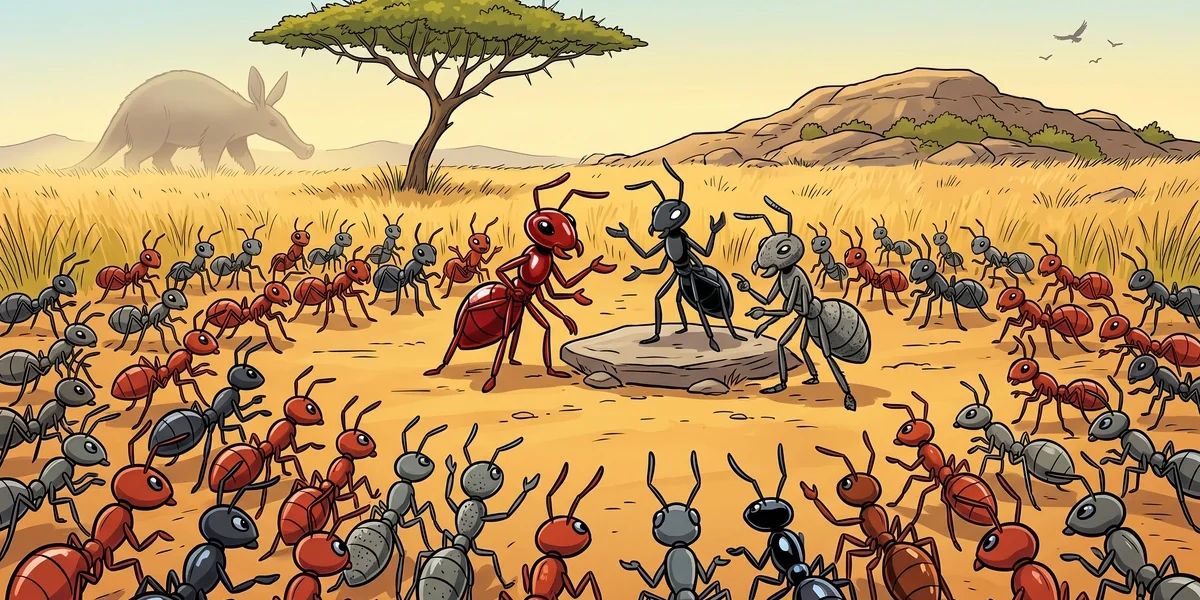
On the wide, dry veld of southern Africa, where the earth is warm underfoot and the sky hangs pale above the thorn trees, the storytellers kept a small and rueful fable about the ant. It is a tale that begins with a sensible idea — that the most threatened creatures of the grassland should meet, take counsel, and agree on a way to be safe — and ends with that idea quietly defeated, not by an enemy, but by the ants themselves. The Lost Message is a story about a council that came to nothing, a wisdom that was offered too late, and a messenger who never arrived. Beneath its gentle humour lies one of the oldest questions a community can ask: what good is the right answer if it is never delivered, and never heard?
The answer the tale gives is unsparing and a little sad. The ants are not weak; each kind of ant, the story is careful to say, works with perfect discipline within its own small nation. What the ants lack is not effort but unity — the willingness to listen across the lines that divide them. And when at last a true and saving message is sent to them, it is entrusted to the slowest of all possible couriers, and so it is, in the most literal sense, lost on the road. The ants remain to this day, the storyteller says with a shrug, “the embodiment of discord, and consequently the prey of enemies.”
Origins and Canonical Attribution
This fable belongs to the body of southern African oral narrative gathered and printed in the nineteenth and early twentieth centuries. Its best-known form appears in South-African Folk-Tales, compiled by the American physician James A. Honeÿ and published in New York in 1910. Honeÿ’s slim anthology was not the fruit of his own field collecting; it was an assembly drawn openly from the earlier and more scholarly labours of others — above all from Wilhelm Heinrich Immanuel Bleek, the German-born philologist whose Reynard the Fox in South Africa; or, Hottentot Fables and Tales (London, 1864) was the first published collection of indigenous southern African literature, and from the later Cape collectors who followed him. “The Lost Message” sits among the moral and etiological pieces of Honeÿ’s book, the tales that explain why the world’s creatures live as they do.
Origin & Canonical Attribution
Tradition: Southern African oral narrative, Cape region; an etiological animal fable of the kind told across the veld peoples of the region.
Primary printed source: James A. Honeÿ, South-African Folk-Tales (New York: Baker & Taylor, 1910), “The Lost Message.”
Antecedent collection: W. H. I. Bleek, Reynard the Fox in South Africa; or, Hottentot Fables and Tales (London: Trübner & Co., 1864), the foundational anthology of Cape oral literature on which later compilers drew.
Tale type: An etiological “why” fable; it carries no single Aarne–Thompson–Uther number, but its closing belongs to the widespread African “undelivered message” family, structurally akin to the origin-of-death message cycle (motif A1335.1, “origin of death from falsified or delayed message”).
Principal motifs: A2494, why certain animals are enemies; A2230, animal characteristics as the result of a past event; J1010, value of co-operation; the delayed or undelivered message.
The classification is worth dwelling on, because it places a modest insect fable inside a much larger pattern. Across the African continent there runs a great family of stories in which a vital message — very often the message that human beings shall not die, but live again like the changing moon — is entrusted to an animal courier who dawdles, garbles it, or is overtaken by a faster and more careless messenger. In those famous origin-of-death tales the slow courier is usually the chameleon and the swift one the lizard, and the result is that death enters the world. “The Lost Message” takes that same deep structure — a saving truth, a poor choice of messenger, a message that never lands — and turns it to a gentler, more domestic end. Here the undelivered message is not immortality but simply the secret of working together; and the courier who fails is the Beetle. The tale thus joins an etiological explanation (why ants live scattered and unprotected) to a meditation on communication itself.
The Small Folk and Their Many Enemies
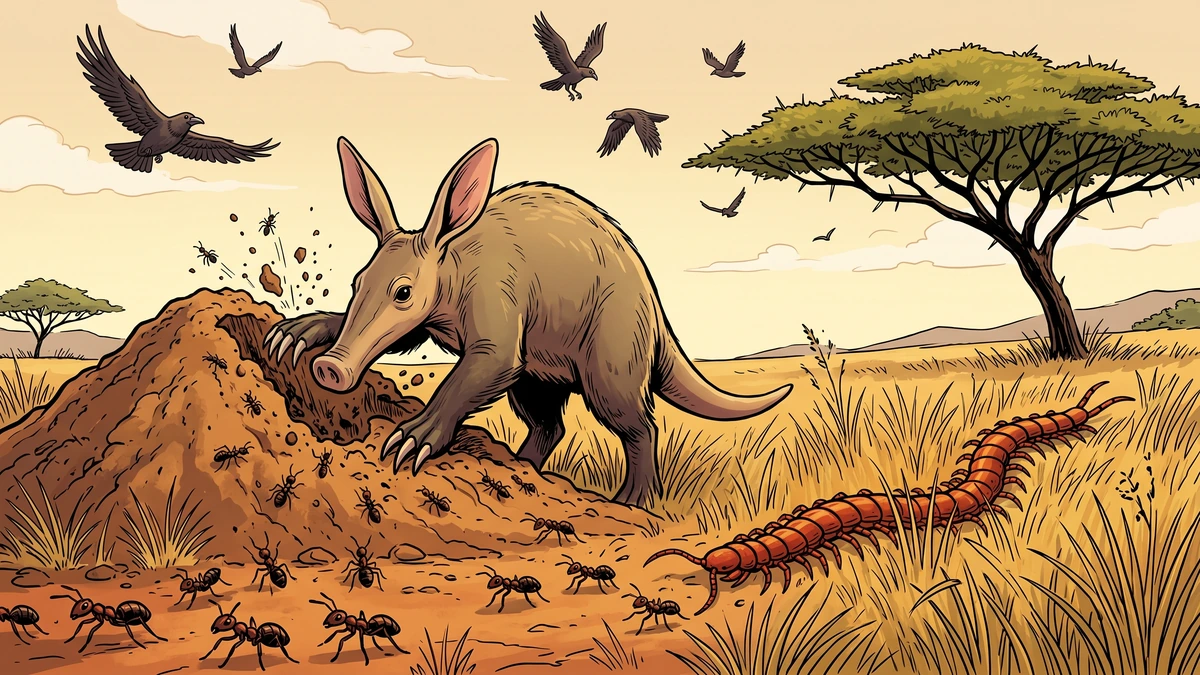
The story opens with a clear-eyed account of danger. The ant, the storyteller observes, has had from time immemorial a great many enemies, and because he is small and busy and everywhere, there have always been terrible slaughters among the ant nations. Most of the birds of the veld hunt them. The creature the tale calls Anteater — almost certainly the aardvark, that long-snouted night-walker of the southern grasslands — lives very largely upon them, levelling in a single minute the nest that has cost a colony many days of labour. And Centipede lies in wait wherever he can, taking his toll at every season and in every place.
It is against this constant pressure that a few thoughtful ants conceive a sensible plan. They will hold a council. They will gather the many kinds of ants together, talk the danger through, and see whether they cannot arrive at some shared arrangement — some agreed place or method of retreat — by which all of them might reach safety when the robber birds and the digging beasts came. It is, on the face of it, exactly the right idea. The threat is common to all the ants; the answer, surely, should be common too. The tale never mocks the plan. It mocks only what the ants make of it.
For the trouble with a council is that it requires not merely attendance but agreement, and agreement requires that each speaker be willing, for a moment, to set down his own certainty and pick up someone else’s. The ants come to the gathering. They do not come ready to listen.
A Babel of Voices
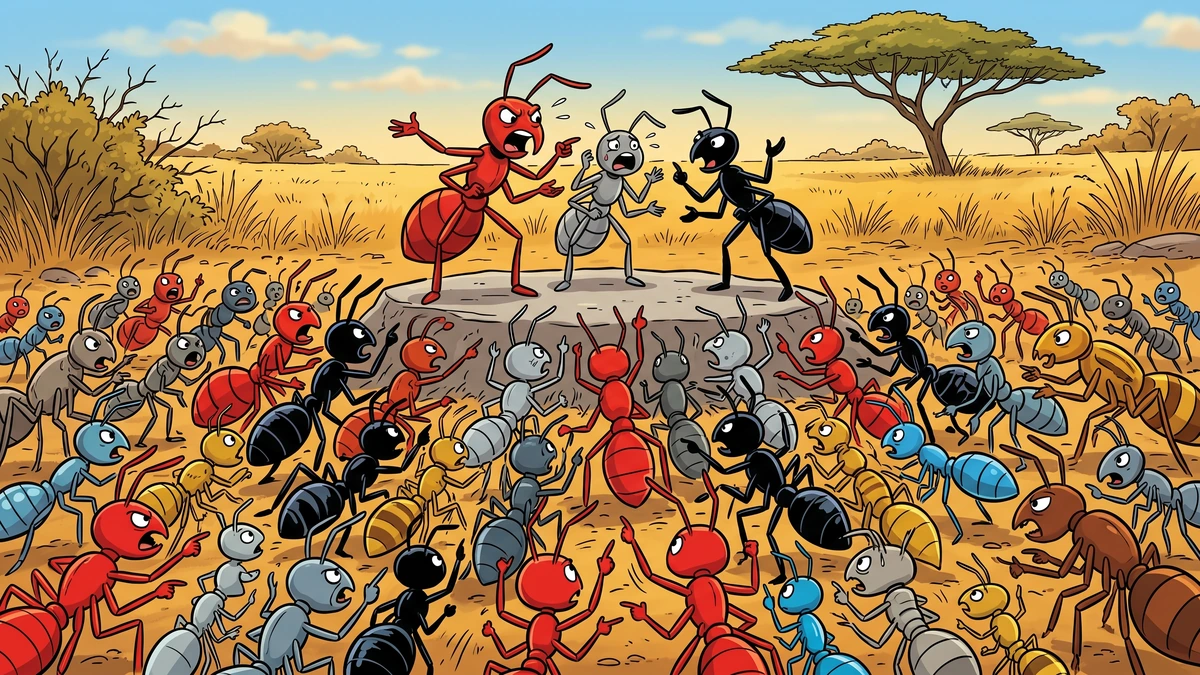
And so the council convenes, and at once the storyteller reaches for a memorable phrase: the discussion, he says, was “a true babel of diversity.” There was Red-ant and there was Rice-ant; there was Black-ant, Wagtail-ant, Gray-ant and Shining-ant, and many another kind besides, and every one of them had an opinion, and no two opinions agreed. The talk went on for a long time. It came, in the end, to nothing at all.
The plans themselves are worth setting out, because the tale lists them with care, and each is a small portrait of a way of thinking. One party wished that all the ants should go down together into a single small hole in the ground and live there, hidden. A second party wanted no hiding at all, but a great strong fortress raised upon the surface, a dwelling so well built that nothing larger than an ant could ever enter it. A third party argued for the trees — for climbing up out of the reach of Anteater altogether — forgetting, in their eagerness, that the branches were already the hunting ground of the birds. And a fourth party, boldest and most impatient of all, was inclined to grow wings and simply fly away from the whole problem.
Each of these plans contains a fragment of sense. Each also contains a fatal blindness, and the blindness is always the same: every faction has solved the danger it personally fears and ignored the dangers it does not. The tree-climbers escape the aardvark and forget the birds. The hole-dwellers escape the birds and deliver themselves to the digger. No single faction is foolish; the foolishness lies entirely in the spaces between them, in the truths each group could have learned from another if only it had been willing to hear. A council that does not listen is not a council. It is merely a number of speeches happening in the same place. And when the long babel finally exhausted itself, the ants did the most natural and the most ruinous thing: each party resolved to go away and to work in its own way, on its own responsibility, and to trouble itself no further with the rest.
Each Faction Goes Its Own Way
Here the tale performs a quiet and clever turn, and it is the heart of the whole fable. Having shown us ants who cannot agree, the storyteller now insists, with something close to admiration, on how well each separate faction worked once it was left alone. Greater unity than the unity within each ant nation, he says, could be found nowhere in the world. Every ant had its appointed task; every ant did that task regularly and faithfully; some of the groups even chose a king from among themselves and divided their labour so that everything ran as smoothly as it possibly could. The ants, in other words, were never short of discipline, never short of industry, never short of loyalty. They had every virtue a community needs — except the one that would have saved them, which was the willingness to extend all those virtues beyond the borders of their own kind.
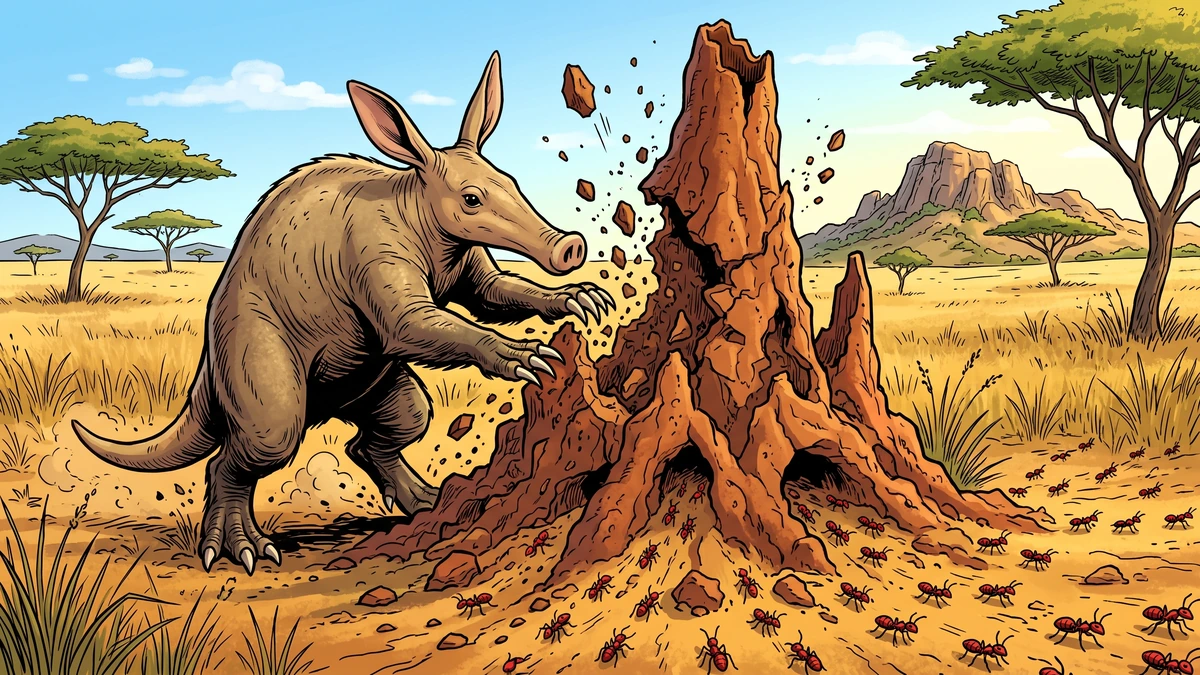
And so, faction by faction, the tale records the outcome, and the outcome is a steady, sorrowful drumbeat of defeat. The Red-ants built their strong house upon the ground and lived snugly beneath it — and Anteater levelled it to the dust in a minute, undoing many days of precious labour. The Rice-ants went down to live under the ground — and it went no better with them, for whenever they ventured out Anteater was waiting, and carried them off sack and pack. The Wagtail-ants fled up into the trees — and there, on branch after branch, sat Centipede waiting, or else the birds came and gobbled them up. The Gray-ants pinned their hopes on flight, meaning to save themselves by sheer speed of escape — and that availed them nothing either, because the Lizard and the Hunting-spider and the birds all went a great deal faster than an ant can fly.
Every plan failed, and every plan failed for the same underlying reason. Each was a partial answer to a whole problem. The danger the ants faced was many-sided — it came from below and from above, from the digger and the climber and the flyer — and only a many-sided answer, an answer pooled from every faction’s knowledge, could ever have met it. That answer existed. It was scattered in fragments around the council ground, one piece in each faction’s plan. It was never assembled, because no one would listen long enough to assemble it.
The Beetle Who Never Came
The fable could have ended there, with its etiological point made — this is why the ants live as they do, divided and unguarded. But it has one more movement, and it is the movement that gives the tale its name and its lasting sting.
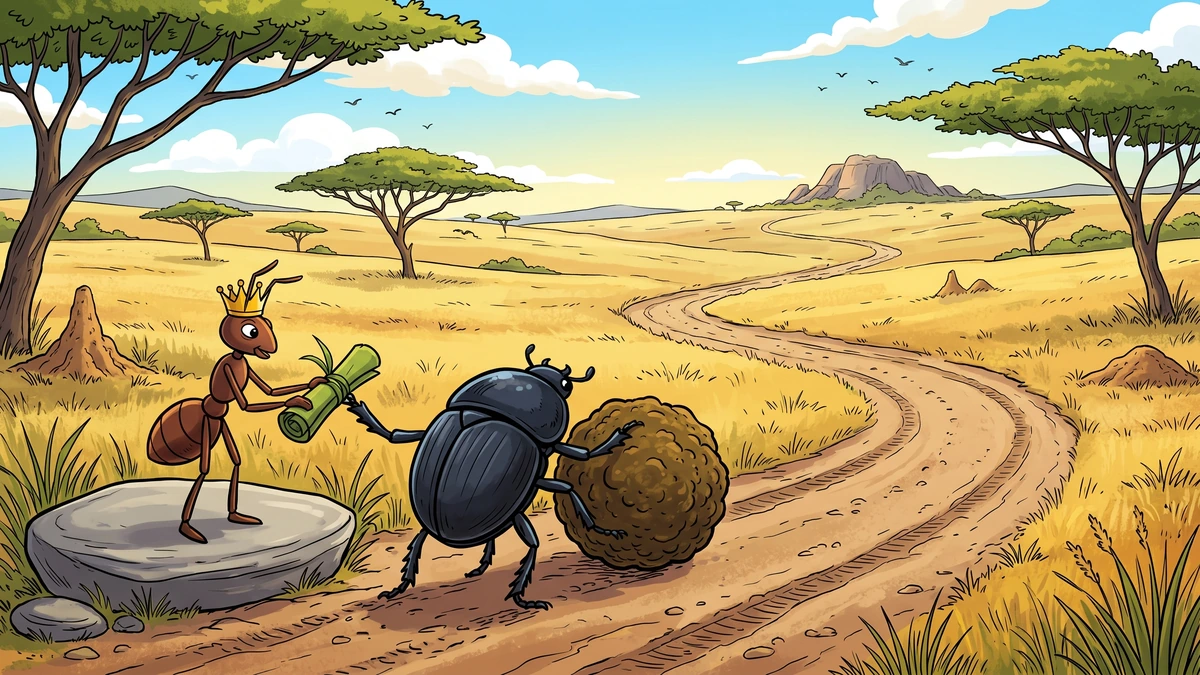
Word of the ants’ failure travels. When the Insect-king himself hears that all the kinds of ants have met and quarrelled and parted without an agreement, he is moved to help them. He does not send an army. He does not send a weapon. He sends, the storyteller says, the one thing that could truly have saved them: the secret of unity, the message of Work-together. The right answer, after everything, is dispatched. The wisdom the council failed to find for itself is placed in the hands of a courier and sent out across the veld toward the scattered ant nations.
And then comes the line that turns the whole fable on its hinge. For his messenger the Insect-king chose the Beetle — and the Beetle, the tale says, “has never yet arrived at the Ants.” The dung-beetle of the southern veld is a famously slow and roundabout traveller, forever rolling its heavy burden, forever stopping, forever taking the long way; and so the message of unity is still, in the storyteller’s patient present tense, somewhere out on the road. It has not been lost in the sense of destroyed. It has simply never been delivered. The ants are still waiting for news they do not know is coming, and so they remain to this day exactly what the failed council made them: the embodiment of discord, and the prey of every enemy that hunts the grass.
It is a remarkable ending, because it places the blame in two distinct places at once. The ants failed first — the council was their chance, and they wasted it in a babel of unyielding voices. But the rescue failed too, and it failed through a careless choice: the right message given to the wrong messenger. The tale will not let either party off. A good answer, it insists, is only half of what a community needs. The other half is the will to carry that answer faithfully, and swiftly, to the people who must hear it. Wisdom undelivered is wisdom wasted, and a truth still travelling is, for all practical purposes, a truth that never came.
The Meaning of the Tale
On its plainest level, The Lost Message is a fable about unity — about the plain, hard fact that a community divided against itself cannot be defended, however brave or industrious its separate parts may be. The ants are never short of strength. They are short only of one another. Each faction, walled inside its own certainty, holds a fragment of the answer and guards it like a private possession, and so the answer is never made whole. The storyteller’s judgement is gentle but final: it was not the aardvark or the centipede or the bird that doomed the ants. It was the council that would not become a council.
But the tale carries a second lesson folded inside the first, and it is the one the title points to. Even when unity fails, wisdom may still be sent — and wisdom, to do any good at all, must actually arrive. The Insect-king does everything right; he diagnoses the trouble and dispatches the cure. His single error is the messenger, and that single error undoes everything. The story thus becomes a fable about communication as much as about co-operation: about the teacher’s note that the child forgets to carry home, the warning that is written but never read, the good counsel offered to a friend who never passes it on. The Cape farmers who borrowed and retold the animal stories of the veld had a blunt proverb for the truth the ants never reached, and it became, in time, a motto known across the whole of southern Africa:
“Eendrag maak mag.”
— Afrikaans proverb: “Unity makes strength.”
The proverb is the message the Beetle never carried. Had it reached the council ground — had the ants been willing to hear it — the hole-dwellers and the tree-climbers and the fortress-builders and the would-be flyers might each have given up a little of their certainty, pooled what they knew, and built between them a defence that no single faction could imagine alone. They did not. The message is still on the road. And the ants, divided and busy and brave and doomed, are still waiting.
Why This Story Has Endured
Etiological fables — the “why” stories that explain how the leopard got his spots or why the ants live scattered and unguarded — are among the oldest and most durable forms of human storytelling, and The Lost Message shows exactly why they last. It answers a small, real question that a child might genuinely ask while watching ants stream across a path: why are there so many different kinds, living in so many different ways, and why does nothing seem to protect them? The story’s reply is not science but parable, and the parable carries a lesson the science never could.
It has endured, too, because its meaning has kept pace with its listeners. To the herders and farmers who first told it, the tale explained the visible disorder of the insect world and warned, in passing, against the disorder of human councils — against the village meeting that dissolves into a babel of voices and decides nothing. To later readers it became a parable of every divided community, every committee, every nation whose factions each hold a piece of the answer and will not lay the pieces side by side. And in any age its closing image speaks for itself: a message of rescue, true and sufficient and already sent, creeping so slowly toward the people who need it that it might as well never have been written at all.
That is why the story is still told to children on this site and elsewhere. It is short, it is faintly funny — the picture of the dawdling Beetle is hard to forget — and it leaves behind two thoughts worth keeping for a lifetime. The first is that a community is only as strong as its willingness to listen across its own divisions. The second is quieter and, in its way, more urgent: that having the right answer is never enough by itself, and that the kindest, wisest thing a person can do with good news is to make very sure it actually arrives.
Frequently Asked Questions
What is the moral of “The Lost Message”?
The fable teaches a double lesson. First, that a community divided against itself cannot be defended: the ants are industrious and disciplined within each kind, but because the many kinds will not listen to one another their council fails and each faction is destroyed separately. Second, that wisdom must actually be delivered to do any good. When the Insect-king finally sends the saving message of unity, he entrusts it to the slow Beetle, and so the message never arrives. The story argues that the right answer is only half of what a community needs; the other half is carrying that answer faithfully and swiftly to the people who must hear it.
Why could the ants not agree at their council?
Each kind of ant came to the council certain of its own plan and unwilling to weigh anyone else’s. One party wanted to live hidden in a single hole, another to build a strong fortress on the surface, another to climb into the trees, and another to grow wings and fly away. Every plan answered the danger that one faction personally feared while ignoring the dangers it did not, so no plan was complete. The foolishness lay not in any single faction but in the spaces between them — in the truths each group could have learned from another if it had been willing to listen.
Who is the messenger, and why is the message “lost”?
When the Insect-king hears that the ants cannot agree, he sends them the secret of unity, the message of “Work-together.” For his courier, however, he chooses the Beetle — the famously slow, roundabout dung-beetle of the veld — and the Beetle, the storyteller says, has never yet arrived at the ants. The message is not destroyed; it is simply never delivered. That is the “lost message” of the title: a true and saving wisdom still creeping along the road, while the creatures who need it wait, divided and unprotected, to this day.
Where does this folk tale come from?
It is a southern African etiological fable from the Cape region, printed in James A. Honey’s “South-African Folk-Tales” (New York, 1910). Honey’s anthology drew on the earlier work of Cape collectors, above all the philologist W. H. I. Bleek, whose “Reynard the Fox in South Africa; or, Hottentot Fables and Tales” (London, 1864) was the first published collection of indigenous southern African literature. The tale belongs to a wide African family of “undelivered message” stories, structurally related to the famous origin-of-death narratives in which a slow courier fails to bring the message of eternal life.
Who or what is the “Anteater” in the story?
The creature the tale calls Anteater is almost certainly the aardvark, a long-snouted, burrowing nocturnal mammal of the southern African grasslands. The aardvark is a formidable enemy of ants and termites: it can tear open a hard-built nest in moments and eat tens of thousands of insects in a single night. In the story it is Anteater who levels the Red-ants’ surface house and who waits at the mouth of the Rice-ants’ underground tunnels, embodying the constant, many-sided danger the ant council was meant to answer.
You May Also Like
 African Folk Tales
Ages 9-12
African Folk Tales
Ages 9-12
Why The Lizard Continually Moves His Head Up And Down
Why The Lizard Continually Moves His Head Up And Down: In a town not very far from Anansi’s home lived a great king. This king had three beautiful daughters
 African Folk Tales
Ages 6-8
African Folk Tales
Ages 6-8
Why the Sun and Moon Live in the Sky
An Efik pourquoi tale from southern Nigeria: the Sun and his wife the Moon welcome their friend the Water too well, are flooded out of the great house they built, and are driven up to live in the sky forever.
 African Folk Tales
Ages 6-8
African Folk Tales
Ages 6-8
Anansi And Nothing
Anansi And Nothing: Near Anansi’s miserable little hut there was a fine palace where lived a very rich man called Nothing. Nothing and Anansi proposed, one