Why Mosquitoes Buzz in People’s Ears
West African pourquoi chain-tale — a mosquito’s lie, a forest of fright, Mother Owl, and a guilty buzz — ages 3–5 / 6–8.
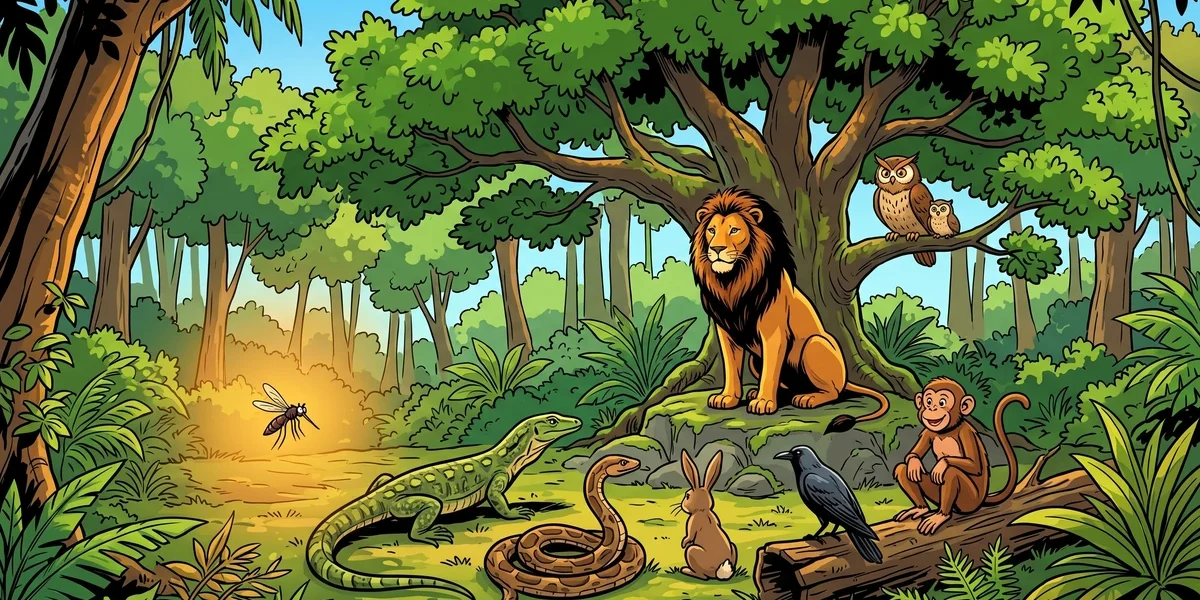
In the great forests and grasslands of West Africa, where the day belongs to the heat and the night belongs to a thousand small voices, there is a sound that no one can quite escape — the thin, whining buzz of a mosquito circling close to a sleeper’s ear. “Why Mosquitoes Buzz in People’s Ears” is the story West African storytellers tell to answer the most natural question a child can ask about that sound: not merely what it is, but why it never stops, and why it always seems to come looking for a human ear in particular.
It is a pourquoi tale — a “why” story — and one of the most perfectly built in all of African folklore. A single foolish lie, told by a creature too small to matter, sets loose a chain of fright that runs through the whole animal kingdom, climbs all the way to a death, and ends only when a council of animals sits in judgment under the eye of a king. By the time the tale closes, the listening child has learned three things at once: where a familiar sound comes from, how one careless word can topple a whole world of consequences, and what a guilty conscience sounds like when it can never be still.
Origins and Canonical Attribution
“Why Mosquitoes Buzz in People’s Ears” belongs to the deep tradition of West African etiological folklore — stories that explain the origins of natural things, the calls of animals, and the shapes of the world. Tales of exactly this kind have been told across the forest belt of West Africa, among the Igbo and Yoruba of Nigeria, the Akan of Ghana, and neighbouring peoples, for as long as anyone can trace. The Igbo of southeastern Nigeria, in particular, preserve their own old explanation for why the mosquito forever whines beside the human ear, and it is from this living current of oral tradition that the tale draws its authority.
For modern readers worldwide, the story is best known through the celebrated 1975 picture book Why Mosquitoes Buzz in People’s Ears: A West African Tale, retold by Verna Aardema and illustrated by Leo and Diane Dillon. That book won the Caldecott Medal in 1976 for its illustrations and has introduced the tale to generations of children outside Africa. It is told as a cumulative chain-tale, a form that folklorists place in the large international family of cumulative tales (Aarne–Thompson–Uther types ATU 2000–2199), in which each event is linked to the next so that the whole story can be “run backwards” to find its first cause. Its central puzzle — how a particular animal came by its cry or its habit — corresponds to Stith Thompson’s motif A2426.2, “origin of animal cries and calls,” while the closing trial scene belongs to motif B270, “animals in legal relations — the council of beasts.”
An honest word about provenance is owed to the reader. The genuine, old, and widely attested tradition is the West African pourquoi explanation for the mosquito’s buzz and its uneasy conscience. The particular sequence of frightened animals, the named characters, and the courtroom framing as they appear here form a literary retelling shaped for the page — faithful to the spirit, the structure, and the moral of the oral tale, but not a transcription of any one performance. The version below restores the tale’s African setting, gives its animals their proper forest home, and keeps the cumulative engine that makes it unforgettable.
The Mosquito’s Foolish Boast
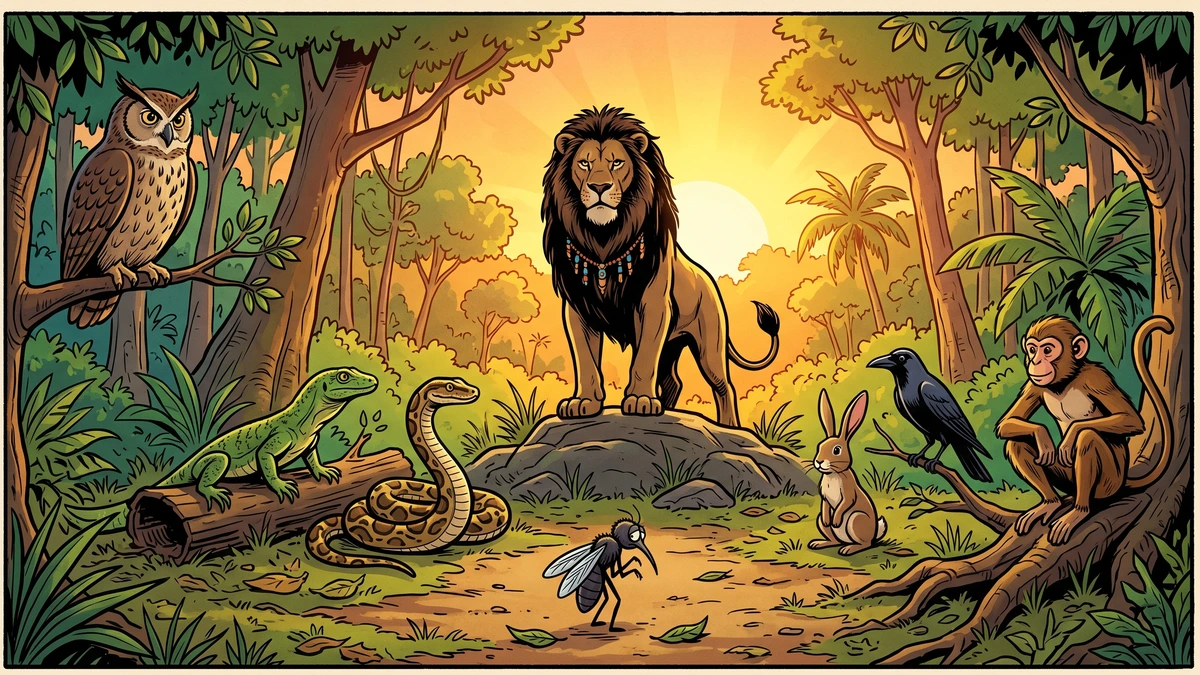
One bright morning, at the edge of the great forest, a mosquito went whining past a pool where Iguana lay drinking. The mosquito was a small creature with an enormous wish to be thought important, and he could never simply pass a neighbour by — he had to stop, and buzz, and say something that would make the larger animal pay attention to him.
“Iguana,” he hummed, hovering close, “you will never guess what I saw this morning. I saw a farmer digging yams almost as big as I am!”
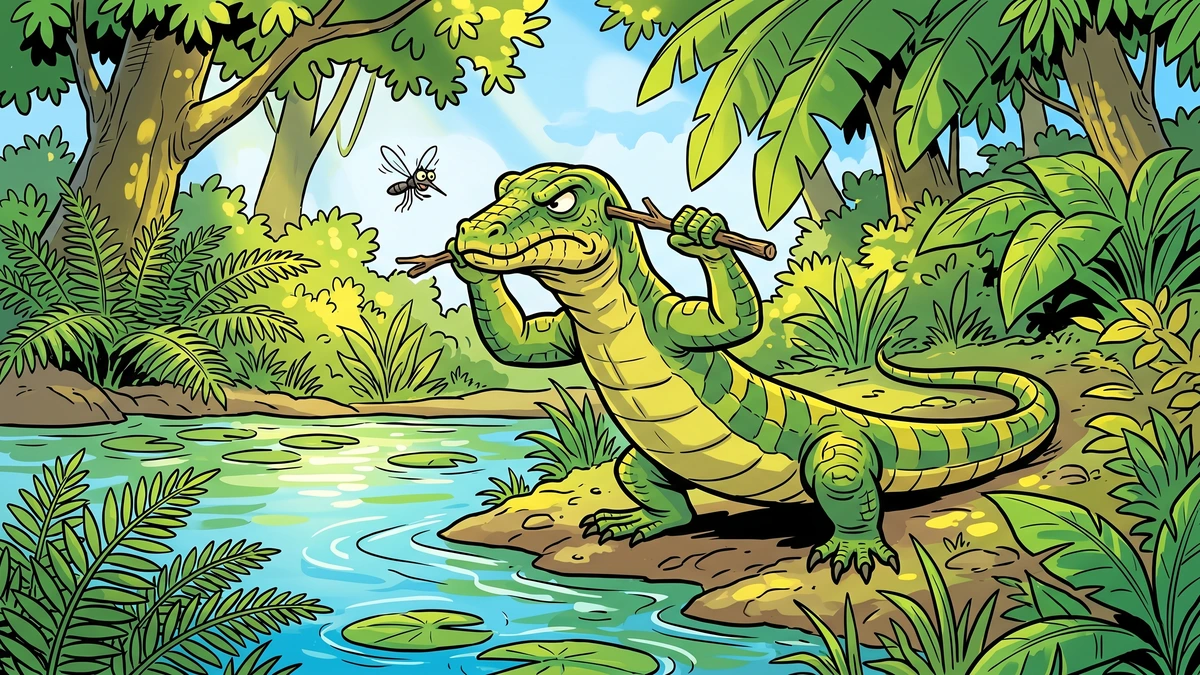
It was a silly thing to say — a yam the size of a mosquito is no yam at all — and it was, of course, not true. The mosquito only wanted to seem like a creature who had seen great things. But Iguana was in no mood for nonsense. He rolled one heavy eye at the buzzing speck and thought, “If I must listen to such foolishness so early in the day, I would rather not hear at all.” So Iguana picked up two small sticks and pushed them into his ears, and went lumbering off through the reeds, deaf to the whole world — mek, mek, mek, over the rustling stalks.
The mosquito watched him go and felt only the smallest twinge of unease. He had told an empty boast to make himself feel large, and the only result, it seemed, was that Iguana had stopped his ears. Surely no harm could come of a thing so small as that. But a lie, however tiny, is never the end of itself — it is only the beginning of everything that follows. The mosquito flew off, and the sticks stayed in Iguana’s ears, and the morning, which had begun so brightly, began very quietly to come apart.
The Chain of Fright Through the Forest
Iguana came scuttling through the tall reeds with the sticks still plugging his ears, and there, sunning himself across the path, lay Python. “Good morning, Iguana,” said Python politely. But Iguana, who could hear nothing at all, went lumbering past without so much as a nod — mek, mek, mek — staring straight ahead.
Python’s pride was stung. “Why will Iguana not speak to me?” he wondered. “He must be plotting some mischief against me!” And in his fright the great snake went sliding away to hide — straight down the first dark hole he could find, which happened to be the burrow of Rabbit.
Rabbit, crouched in her tunnel, saw a long shadow come pouring in at her door and did not stop to ask its name. She bolted out the back way and went racing across the clearing in broad daylight, which a sensible rabbit never does. Crow, perched high above, saw Rabbit running as though the sky itself were falling, and Crow did the one thing a crow knows how to do with bad news: he flew up cawing the alarm to the whole forest — kaa, kaa, kaa! — so that every creature who heard him believed some terrible danger was loose among the trees.
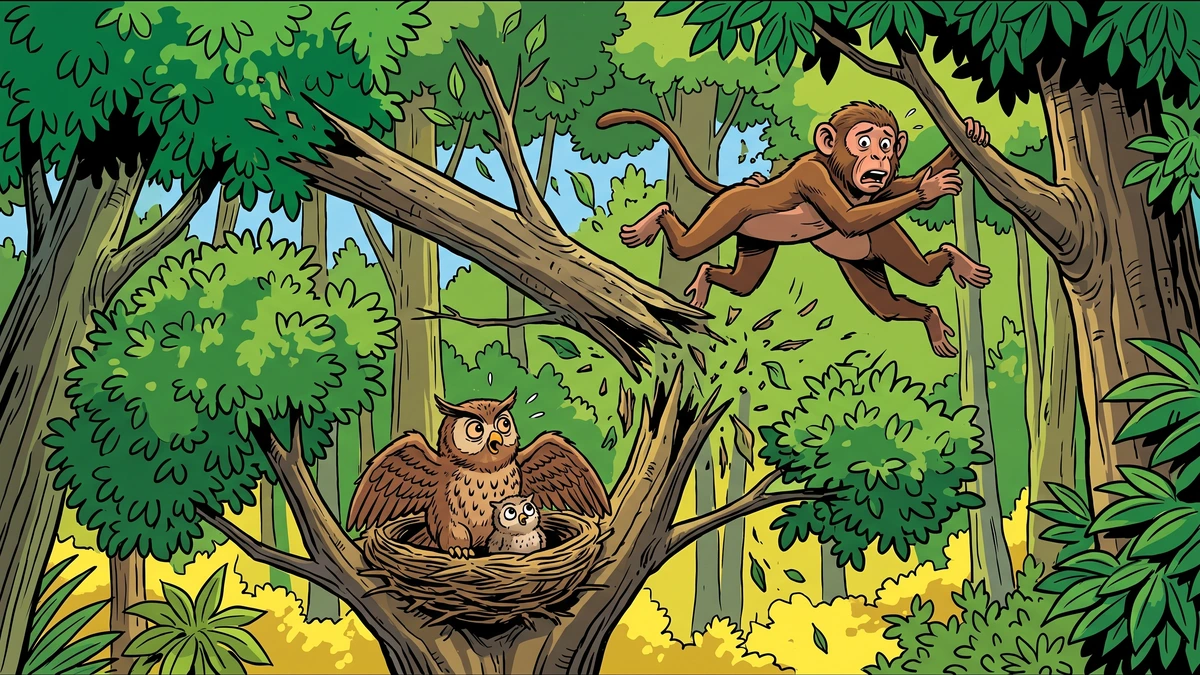
The alarm reached Monkey, and Monkey, certain now that the forest was in deadly peril, went leaping wildly from branch to branch to spread the warning further still. And here the chain of fright, which had begun with two sticks and an empty boast, arrived at last at its cruel end. As Monkey crashed from limb to limb, one rotten branch gave way beneath his weight — and it fell, heavy and sudden, straight into the nest of Mother Owl, killing one of her owlets where it slept.
The Night That Would Not End
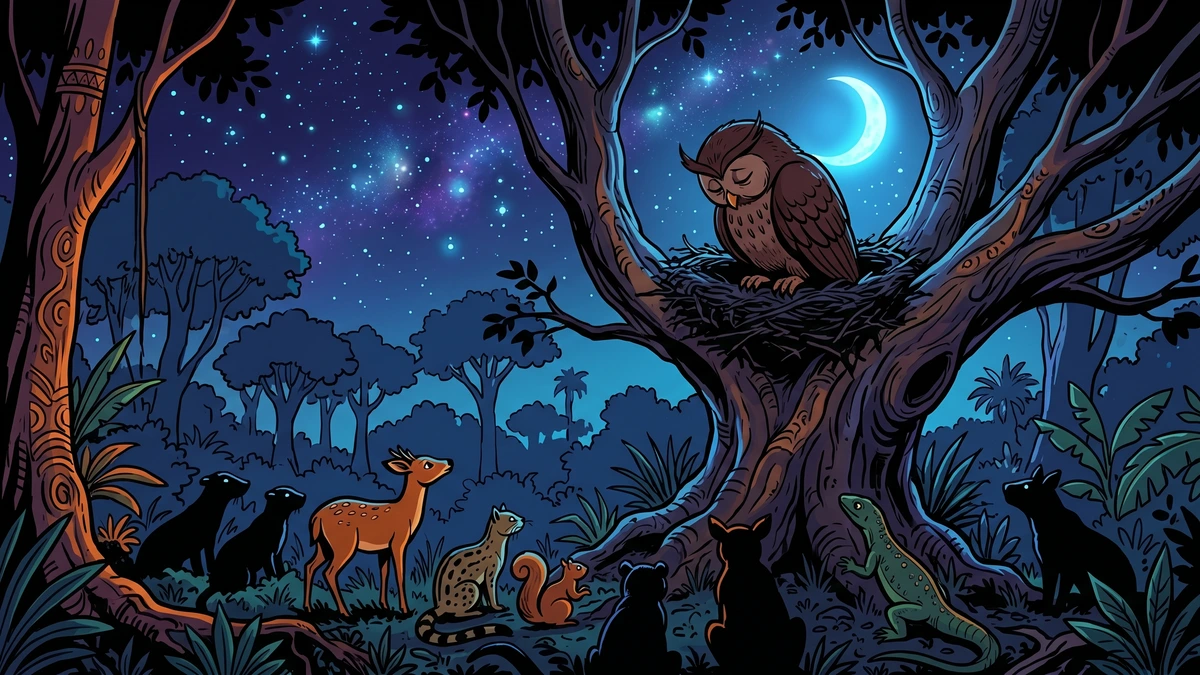
Now Mother Owl was no ordinary bird. It was her solemn task, each and every dawn, to call up the sun — to hoot the long hoot that told the night it was over and woke the morning for all the world. But when Mother Owl returned to her tree and found her owlet dead beneath the fallen branch, her grief was so deep and so heavy that she could not speak. She sat in her nest in silence, and when the hour came for her to wake the sun, she did not call.
So the sun did not rise. The night stretched on and on, hour upon dark hour, and still it did not end. The animals waited in the cold for a dawn that would not come, and fear ran through the forest a second time — not the quick fright of a fleeing rabbit now, but the slow dread of creatures who sense that something at the very root of the world has gone wrong.
At last King Lion understood that the long night could not be allowed to continue. He climbed to Mother Owl’s tree and asked her gently why she would not call the sun. “King Lion,” she answered, “Monkey killed one of my owlets. My heart is too heavy to wake the morning. Until I know how this came to pass, and who is truly to blame, I cannot hoot the sun awake.” And King Lion, hearing the justice in her sorrow, summoned every animal of the forest to a council, so that the whole tangled morning might be unwound, link by link, until its first cause stood revealed.
The Council of the Animals
Under the great council tree the animals gathered, and King Lion began to draw the chain backwards, one creature at a time. “Monkey,” he asked, “why did you kill Mother Owl’s owlet?”
“It was not my fault, King Lion,” said Monkey. “Crow was crying the alarm. I leaped through the branches to spread the warning, and a dead limb gave way beneath me.”
“Then it was Crow,” said the King — but Crow answered, “I only cawed because Rabbit was running for her life in the open daylight; I thought a great danger was loose.” And Rabbit said, “I ran because Python came pouring into my burrow, and I was afraid.” And Python said, “I hid in the burrow because Iguana would not return my greeting; I feared he was plotting against me.” And Iguana — once the sticks had been gently drawn from his ears so that he could hear the question at all — said, “I put sticks in my ears, King Lion, because the mosquito was buzzing foolish lies at me, and I could not bear to listen.”
So the long chain came to rest at its very first link, and the council saw the truth plainly: it was the mosquito, with his empty boast told only to seem important, who had set the whole disaster in motion. King Lion declared the judgment of the council — that the mosquito alone was guilty of the owlet’s death — and Mother Owl, satisfied at last that justice had been spoken, lifted her head and hooted, and the sun climbed gratefully back into the sky.
But the mosquito had been hiding nearby, and he had heard every word of the judgment passed against him. From that day to this he has carried his guilt with him wherever he goes. He no longer dares to boast. Instead he creeps close to one ear after another, buzzing the same uneasy question over and over — “Zeeeee! Is everyone still angry at me?” — and the ear, knowing well what he did, gives him the only answer a guilty creature deserves. It slaps him. And that is why, to this very day, a mosquito buzzes in people’s ears.
The Moral of the Story
The genius of “Why Mosquitoes Buzz in People’s Ears” is that it makes a moral lesson visible by laying it out as a chain. The mosquito’s lie was small — a single foolish sentence, spoken to no one important, intended to harm no one at all. Yet the tale follows that lie link by link — sticks, snake, rabbit, crow, monkey, branch — until it arrives at a death and a world plunged into endless night. A child who hears the story cannot miss the point, because the point is the structure: a careless word does not stay where it is dropped. It travels, and it grows, and it gathers weight, and you cannot call it back. West African elders have long summed up that truth in a proverb of the Hausa people:
“Ɯarya fure take, ba ta ’ya’ya.”
— Hausa proverb: “A lie bears flowers, but it never bears fruit” — falsehood may look pleasing for a moment, yet nothing good ever grows from it.
There is a second lesson folded inside the first, and it is the one the ending dramatises so memorably. The council clears every other animal — Iguana, Python, Rabbit, Crow, even Monkey — because each acted out of honest fear, not malice. Only the mosquito is found guilty, because only the mosquito set the falsehood loose to begin with. And his punishment is not a beating handed down by the King; it is something he carries inside himself. He buzzes forever because he can never be sure he has been forgiven, and a conscience that is never at peace is the truest punishment a liar can know. The tale tells a child, very gently, that the unrest a wrongdoer feels is not cruelty done to him — it is simply the shape of the wrong, still alive in him, asking to be answered.
Why This Tale Has Lasted
One reason this story has travelled so far and lasted so long is the sheer elegance of its construction. As a cumulative chain-tale it is, quite literally, a teaching machine: each link can be recited, remembered, and then traced backwards, so that the story trains a child’s memory and a child’s reasoning at the same time that it trains a child’s conscience. The council scene at the end, in which King Lion unwinds the chain question by question, is nothing less than a small lesson in how to think clearly — how to follow consequences back to causes instead of blaming whoever happens to stand closest to the harm.
It has lasted, too, because it answers a real and universal question with warmth instead of dread. Every child everywhere has been kept awake by that thin whine beside the ear. This tale takes a small nightly nuisance and turns it into a story with a culprit, a court, and a moral — so that the buzz, ever after, carries a meaning. The mosquito is not merely an insect; he is a small, anxious, guilty character, and the listening child is invited to feel a flicker of pity for him even while learning never to be like him.
Finally, the story endures because its central insight does not age. Long before anyone spoke of rumours travelling through a village or a falsehood racing across a continent in an afternoon, West African storytellers had already built the perfect picture of it: one empty boast at a forest pool, and by nightfall the sun itself will not rise. In an age when a careless word can indeed circle the world before the truth has finished dressing, the tale of the mosquito’s buzz feels less like an old explanation of an insect’s habit and more like a piece of plain, urgent wisdom — which is exactly what the grandmothers always knew it to be.
Frequently Asked Questions
Is “Why Mosquitoes Buzz in People’s Ears” a real African folk tale?
Yes. It belongs to the genuine and long-established tradition of West African pourquoi or etiological folklore — stories that explain the origins of natural things and the calls and habits of animals. Explanations for why the mosquito whines beside the human ear are told across the West African forest belt, and the Igbo people of southeastern Nigeria preserve their own old version of the idea. The tale is best known worldwide through Verna Aardema and Leo and Diane Dillon’s Caldecott Medal–winning picture book of 1975, which retells it as a cumulative chain-tale. The named characters and the exact sequence here are a literary retelling, but the underlying tradition is authentic and old.
Why does the mosquito buzz in people’s ears, according to the story?
Because of a guilty conscience. The mosquito’s foolish lie caused a chain of fright that ended in the death of Mother Owl’s owlet, and a council of animals under King Lion judged him to be the one at fault. Having heard that judgment, the mosquito can never be sure he has been forgiven. So he creeps close to one ear after another, buzzing the same anxious question — whether everyone is still angry at him — and the ear answers him with a slap. The buzz, in the logic of the tale, is the sound of a wrongdoer who cannot find peace.
What kind of folk tale is this, and how do folklorists classify it?
It is a pourquoi tale (a “why” or etiological story) told in the form of a cumulative chain-tale. Folklorists place cumulative tales, in which each event is linked to the next so the whole can be recited and traced backwards, in the international family of tale-types ATU 2000–2199. Its core puzzle — the origin of an animal’s cry or habit — matches Stith Thompson’s motif A2426.2, “origin of animal cries,” and the closing trial scene matches motif B270, the council of beasts sitting in judgment.
What is the moral of the story?
That a small lie is never as small as it looks. A single empty boast, told only so the mosquito could seem important, travels link by link through the whole forest until it causes a death and a night that will not end. The tale teaches that careless or false words cannot be called back once spoken — a truth the Hausa capture in the proverb “A lie bears flowers but never fruit.” It teaches, too, that a guilty conscience is its own lasting punishment, since the mosquito’s endless buzzing is the unrest of a wrongdoer who can never be sure he is forgiven.
How does this tale relate to other folk tales around the world?
It belongs to the worldwide family of cumulative or chain tales (ATU 2000–2199), in which events are linked one to the next — the same structure that underlies the English “The House That Jack Built” and the Russian “The Turnip.” As a pourquoi story explaining an animal’s habit, it sits beside countless African origin tales, such as those telling how the leopard got its spots or how the tortoise got its shell, and beside Rudyard Kipling’s Just So Stories. Its closing courtroom of animals, in which a king unwinds a chain of blame, echoes the long folklore tradition of the council of beasts found from Aesop to the West African trickster cycles.
Frequently Asked Questions
**Q: West African or Indian?**
**Q: Why does the mosquito buzz?**
**Q: Age?**
**Q: Picture book?**
You May Also Like
 African Folk Tales
All Ages
African Folk Tales
All Ages
Ohia And The Thieving Deer
Ohia And The Thieving Deer: There once lived upon the earth a poor man called Ohia, whose wife was named Awirehu. This unfortunate couple had suffered one
 African Folk Tales
Ages 9-12
African Folk Tales
Ages 9-12
The World’s Reward
The World's Reward is the Cape South African form of the Bremen Town Musicians: seven cast-off old animals join forces, frighten a band of robbers out of their house, and keep it for themselves.
 African Folk Tales
Ages 6-8
African Folk Tales
Ages 6-8
Anansi and the Pot of Wisdom
The Akan (Ashanti) trickster tale of how Kwaku Anansi the spider tried to hoard all the wisdom of the world in one clay pot - and how his own small son taught him the lesson that scattered wisdom across the whole earth.