Why The Moon And The Stars Receive Their Light From The Sun
Why The Moon And The Stars Receive Their Light From The Sun: Once upon a time there was great scarcity of food in the land. Father Anansi and his son, Kweku
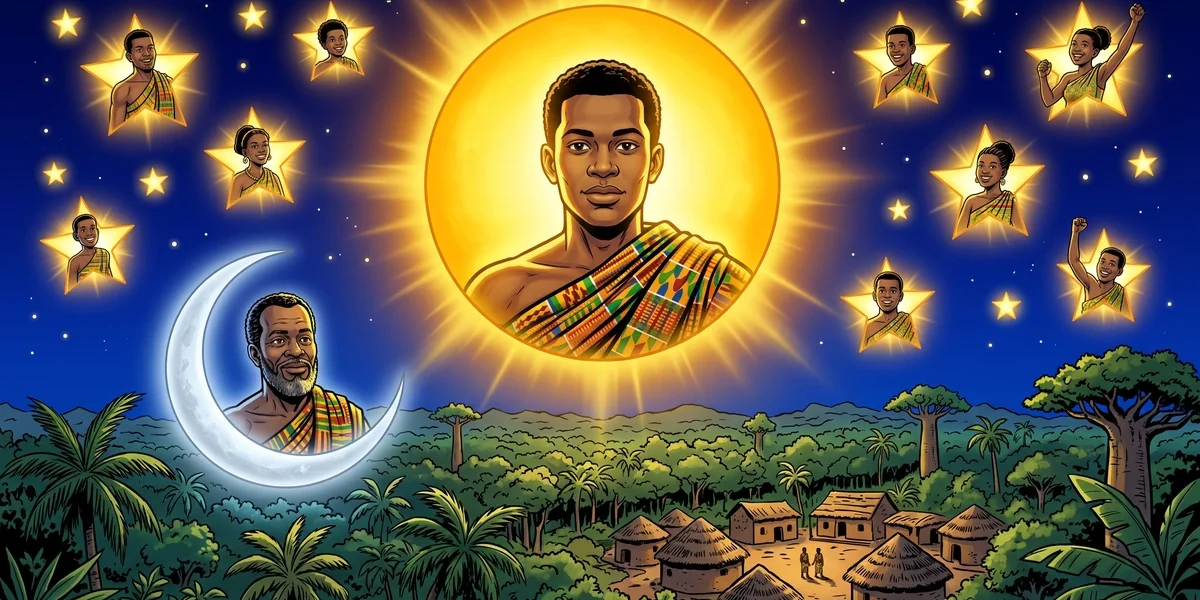
When the people of the Gold Coast looked up at the night sky, they saw a quiet hierarchy written in light. The sun ruled the day alone, fierce and undivided. The moon followed it across the heavens with a paler, gentler glow, and the stars trailed behind in their countless thousands, each one a faint spark that seemed to wait on a brighter master. To the Akan storytellers who first shaped this tale, that arrangement was no accident of astronomy. It was the settled end of an old adventure — the record of a day when a clever young man outwitted a monster, freed a houseful of captives, and was lifted into the sky to become the source of all light and heat in the world.
This is a pourquoi tale — an etiological story that explains why the natural world looks and behaves as it does — and it belongs to one of the richest storytelling traditions on the African continent: the cycle of Anansi the spider. Beneath its bright surface of dragons and rope ladders lies a steady argument about courage, cleverness, and the duty of a gifted person to use that gift for the rescue of the whole community rather than for himself alone.
A Creation Story from the Anansi Cycle of the Akan People
This story was recorded in West African Folk-Tales, compiled by William H. Barker and Cecilia Sinclair and published in London by George G. Harrap & Company in 1917. It stands at the very head of that collection — the opening tale, chosen to introduce English-speaking readers to the world of the spider stories. Barker, an educationist who worked in the Gold Coast, the territory that is now Ghana, gathered the tales with Sinclair to preserve the oral literature of the Akan peoples — principally the Ashanti (Asante) and Fanti communities — for young readers in Africa and abroad. The book remains one of the standard early printed sources for the Anansi cycle in English, and is freely available today through Project Gutenberg.
In Akan culture these stories are called Anansesem, literally “spider stories” or “words about Ananse.” The term came to mean folktales in general, so central was the spider to the whole tradition. The trickster at its centre is Kwaku Ananse, a figure who is part man, part spider, and entirely unpredictable. In this particular tale, however, the spotlight falls not on Anansi himself but on his son, Kweku Tsin, whose patient intelligence carries the story — while Anansi is left in a supporting role that the ending will gently, and pointedly, confirm.
Folklorists classify the tale by its working parts. Its spine is the great family of celestial origin myths, motif A714, “Sun and moon placed in the sky,” and motif A745, “Relation of the moon to the sun,” which accounts for why one body borrows its brightness from another. The escape itself rests on motif F51, “Sky-rope,” the ladder or cord by which mortals climb between earth and heaven, and on motif D1415.2, “Magic musical instrument compels dancing,” the enchanted fiddle that no listener can resist. The pursuit, in which the hero delays a monster by throwing down food, belongs to the widespread obstacle-flight pattern found in tale type ATU 313. The story therefore braids a creation myth, a monster-escape, and a magic-music episode into a single, swift narrative.
Famine in the Land and a Hunt in the Forest
Once, long ago, there was a great scarcity of food in the land. The rains had failed, the farms gave little, and hunger crept into every house. Among those who felt it most keenly were Father Anansi and his son, Kweku Tsin. One morning, unable to bear the empty pot any longer, the two set out together to hunt in the forest, hoping the wild places might give what the farms could not.
Fortune smiled first on the son. Before the morning was old, Kweku Tsin brought down a fine deer, a supply of meat large enough to carry the family through many lean days. He dragged it back to the resting-place where he and his father had agreed to meet, and Anansi, seeing it, was overjoyed. The carcass was too heavy to move whole, so Anansi told his son to stay and guard it while he hurried home for a large basket in which to carry the meat.
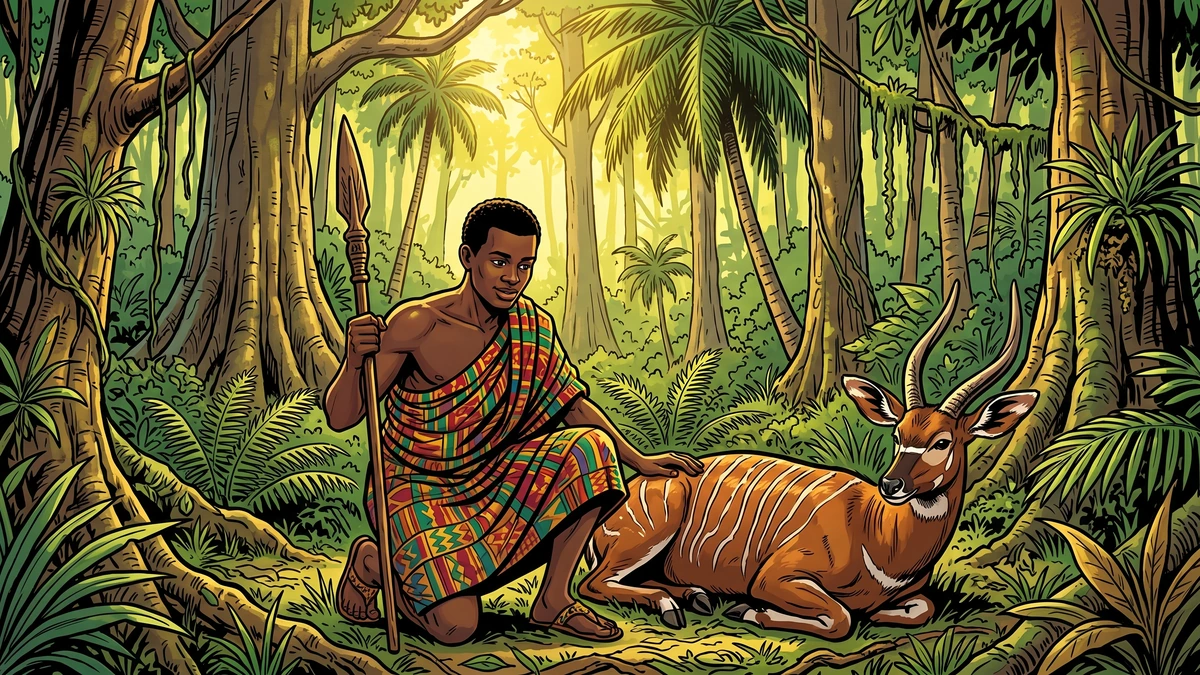
An hour passed, and then another, and Anansi did not return. Kweku Tsin grew uneasy. Fearing his father had lost the path, he cupped his hands and called loudly into the trees, “Father! Father!” To his relief a voice answered from the green distance, “Yes, my son.” He shouted again, certain it was Anansi drawing near — but the thing that stepped out of the forest was no father. It was a terrible dragon, a monster that breathed fire from its great nostrils and was dreadful in every line of its body. Kweku Tsin, with the quick instinct that would later save many lives, did not freeze and did not run blindly. He slipped at once into a cave nearby and made himself small and silent in the dark.
The Fire-Breathing Dragon and the Castle of Captives
The dragon reached the resting-place and found only the body of the deer. Cheated of the human voice it had been hunting, the monster vented its temper in blows upon the carcass and stamped away. Not long after, Father Anansi at last appeared with his basket. Kweku Tsin came out of hiding and told him everything, and Anansi — curious in the reckless way that so often undoes him — declared he should like to see this dragon for himself.
He had his wish, and more of it than he wanted. The monster, catching the scent of human flesh on the wind, came racing back and seized both father and son in its claws. It carried them to its castle, and there they discovered they were far from alone. The dragon’s halls were crowded with other captives — men and women and creatures gathered from across the country, all of them waiting in dread for the monster’s appetite to turn their way.
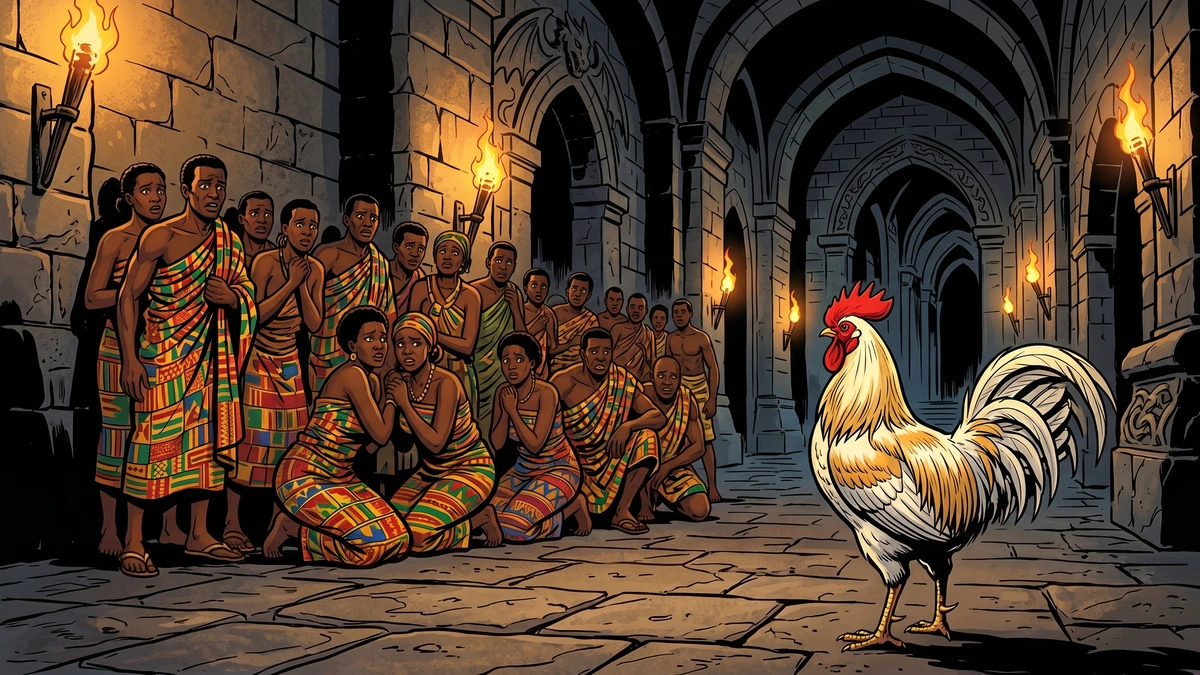
The prison had a single watchman: a fine white cock, which the dragon kept as a servant and an alarm. Whenever anything unusual stirred in the castle while its master was away, the cock would crow, and the crowing would summon the dragon home at once. With that arrangement set, and trusting his cock entirely, the dragon went off again into the forest in search of more prey. The captives were left alone — guarded only by a bird, but a bird whose single cry could undo any escape.
The Rice, the Rope Ladder, and the Sack of Bones
Kweku Tsin now did the thing that marks him out as a true hero of the Anansesem: he did not think only of his own skin. He called all his fellow-prisoners together to plan a way out for everyone. At first they despaired, and with reason. The dragon’s powers were terrifying. Its eyesight was so keen it could see a fly moving miles away, and it could cross the ground so swiftly that no runner alive could hope to outdistance it. But Kweku Tsin had been studying the prison, and a plan had quietly taken shape in his mind.
He had noticed one simple fact: the white cock would not crow so long as it had grain to peck. So Kweku Tsin opened the castle’s great store and scattered on the ground the contents of forty bags of rice. The cock fell upon the feast and pecked away in perfect, busy silence. While its alarm was thus disarmed, Kweku Tsin set the spinners among the prisoners to work, twisting fine hempen cord into a long and exceedingly strong rope ladder.
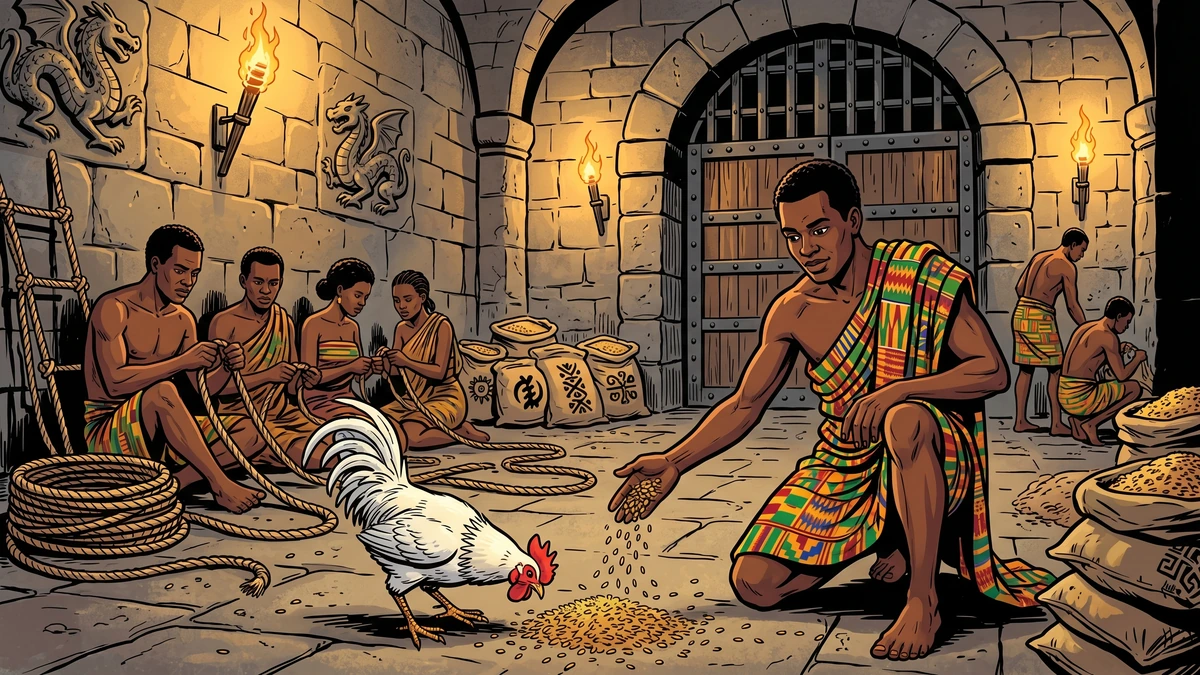
He prepared two more things with the same careful foresight. As the captives killed and ate the cattle they needed for the journey, Kweku Tsin asked them to save every bone, and he gathered all of them into a great sack. Then he took down the dragon’s own magic fiddle and set it ready at his side. He had a use in mind for the bones, and a use for the fiddle, and only when both were prepared did he judge the escape ready to begin. The lesson is quiet but firm: courage without forethought is only noise, and Kweku Tsin’s courage was armed at every point with a plan.
The Climb to Heaven and the Dragon’s Fall
When all was ready, Kweku Tsin took one end of the great ladder and flung it high into the sky. It rose, and it was caught and held fast — for the gods above had taken notice of what was happening below. One after another the dragon’s victims began to climb, mounting the swaying rope toward the heavens, while Kweku Tsin stayed at the foot of the ladder to send each of them safely up before himself.
But the dragon’s far-seeing eyes had caught the unusual stir at its castle, and the monster came tearing back. Seeing it approach, Kweku Tsin sprang onto the ladder himself, the sack of bones on his back and the fiddle under his arm, and began to climb. The dragon climbed after him. Each time the monster drew too close, Kweku Tsin flung down a bone; and the dragon, ravenous, was forced to scramble back to the ground to devour it before resuming the chase. Bone after bone bought the climbers a few more rungs of safety, until the sack was empty and every prisoner was high in the sky.
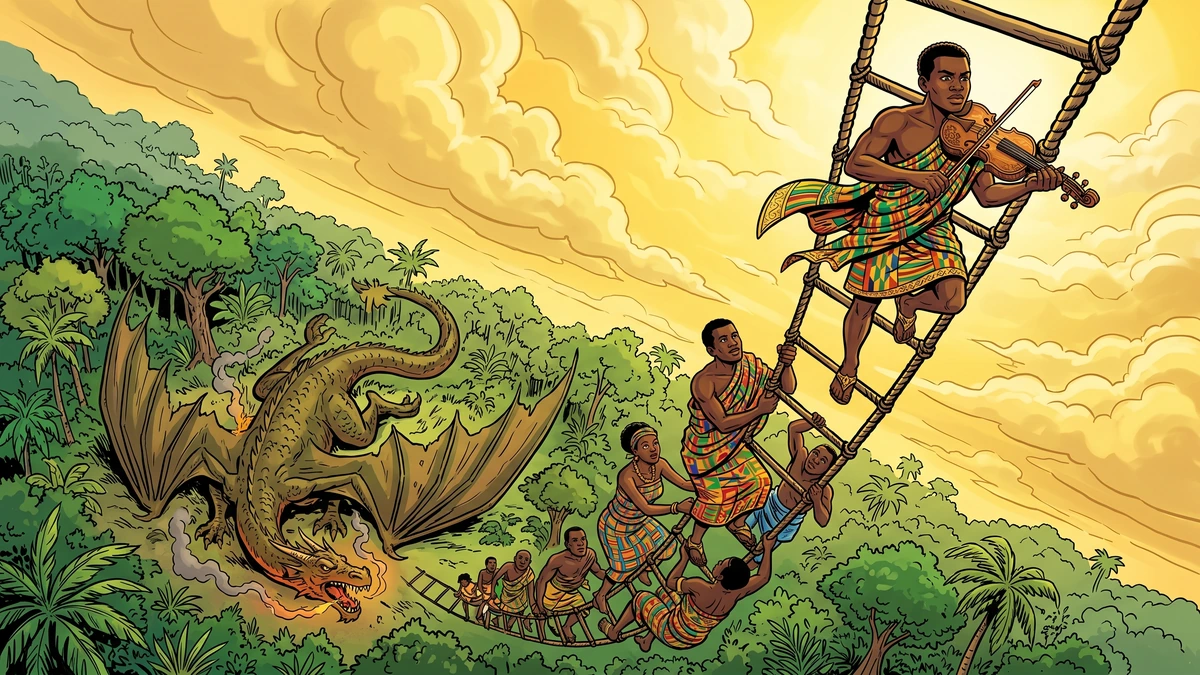
Then Kweku Tsin reached for the fiddle. Each time the dragon gained on him, the young man stopped and drew the bow across the magic strings, and the monster — unable to resist the enchanted music — was dragged back down to the earth to dance. When Kweku Tsin had almost reached the top, with the dragon nearly upon him once more, he leaned down and cut the ladder away below his own feet. The monster was dashed to the ground and destroyed, while Kweku Tsin was pulled up into safety by the waiting gods. The gods were so pleased with his wisdom and his bravery in winning freedom for all his fellow-prisoners that they made him the sun, the source of all light and heat in the world. His father Anansi they made the moon, and his friends became the stars. And from that day it has been Kweku Tsin’s privilege to give light to them all, each of them dim and powerless until his brightness reaches it.
Kweku Tsin and Anansi: Wit as the Weapon of the Weak
The Anansesem tradition is built on a single deep idea: that intelligence, not strength, is the true power in the world. The spider Anansi is small, soft, and physically helpless, yet he routinely outmanoeuvres leopards, pythons, and even the sky-god. For audiences whose own histories knew famine, hard labour, and the brute force of more powerful neighbours, the trickster offered a consoling and practical message — that the weak can prevail if they think faster than the strong.
This tale gives that idea a clear-eyed twist. The hero is not Anansi but his son. Kweku Tsin shows every virtue the spider lacks: where Anansi is curious to the point of folly — insisting on seeing the dragon and so getting himself caught — Kweku Tsin is curious to the point of mastery, studying the cock and the storehouse until the prison’s weakness lies open to him. Where Anansi’s cleverness in other stories curdles into greed, Kweku Tsin’s cleverness is spent entirely on others. He frees forty captives before he frees himself; he climbs last. The story’s final image makes the comparison unmistakable. The son becomes the sun, the origin of light; the father becomes the moon, shining only with light that is borrowed. The Akan listener, who knew Anansi’s faults by heart, would have caught the affectionate joke at once.
Reading the Sky: Pourquoi Tales and Celestial Order
Across every inhabited continent, people have told stories to explain the lights in the sky. A pourquoi tale of this kind is not a failed attempt at astronomy; it was never meant to be measured against a telescope. It is a way of stitching the human moral world into the natural one, so that an everyday sight — the moon trailing the sun, the stars waiting for night — becomes a permanent, visible reminder of a community’s values.
What this tale chooses to encode is a lesson about interdependence and right order. The astronomical fact it begins from is real and observable: moonlight and the faint shine of the planets are indeed reflected sunlight, and the night sky genuinely does depend on a single distant source. The storytellers took that quiet truth and gave it a moral shape. The sun is supreme not because it seized power but because it earned its place through wisdom and self-sacrifice. The moon and stars are not humiliated by depending on it; they are simply part of a working whole, each with its station, each lit by the same generous source. For a society that valued the chief, the elder, and the bonds of kinship, the night sky became a nightly lesson that a community thrives when each member accepts a place within a larger, ordered family.
The Moral: One Broom-Stick Breaks, the Bundle Holds
The heart of this story is not the dragon and not the climb, but the moment Kweku Tsin gathers the prisoners together and plans an escape for all of them. He could have slipped out alone; his cleverness would have served one man perfectly well. Instead he turned that cleverness into a rescue, and it is for that — for freeing his fellow-men, the tale says plainly — that the gods raised him to the sky. A gift used for the self buys a small reward; a gift used for the community buys the sun.
The Akan express this conviction in one of their most enduring proverbs, often spoken while holding up a household broom:
“Pra⁔e, woyi baako a, ⁔bu; woka b⁔ mu a, ⁔mmu.”
“A single broom-stick is easily broken; bound into a bundle, the broom cannot be broken.”
One captive, alone and afraid, could do nothing against the dragon’s eyes and speed. Forty captives, organised by a clear mind and bound to a common plan, walked out of an impossible prison and into the heavens. The white cock was silenced by shared rice; the ladder was woven by many spinners; the bones were saved by every hand at the feast. The escape was a bundle, not a stick. And the sky that resulted — sun, moon, and stars, each shining as part of one system — is the proverb made visible, hung above the world every single night.
Why This Tale Has Lasted
As the opening story of West African Folk-Tales, this tale has introduced more than a century of readers to the world of Anansi, and it has kept its place because it works on every level a story can. For the youngest listener it is pure adventure: a fire-breathing dragon, a daring climb, a magic fiddle, a monster outwitted. For the older child it is a lesson in planning — in the patient, unglamorous foresight that gathers rice and bones and rope long before the moment of danger arrives. For the adult it is a meditation on leadership and on the proper use of a gift, told with the affectionate humour the Akan always reserved for Anansi.
It has lasted, too, because it answers a question every culture asks. Children everywhere look up and want to know why the moon is dimmer than the sun, and why the stars must wait for the dark. This tale gave the Akan an answer that was also a teaching: the light you see at night is borrowed light, and there is no shame in that, for a community is exactly such an arrangement — many lesser lights, one generous source, and a wisdom that holds them all together. Carried across the Atlantic with the Anansi cycle during the era of the slave trade, the spider and his family found new homes in the Caribbean and the Americas, and the stories travelled with them. Today the tale belongs to the whole world, but it still carries, undimmed, the voice of the Gold Coast storytellers who first looked at the night sky and chose to read kindness and order there.
You May Also Like
 African Folk Tales
Ages 6-8
African Folk Tales
Ages 6-8
How Wisdom Became The Property Of The Human Race
How Wisdom Became The Property Of The Human Race. Long ago, wisdom belonged only to a few. Learn how one person changed everything by sharing knowledge.
 African Folk Tales
All Ages
African Folk Tales
All Ages
Quarcoo Bah-Boni
Quarcoo Bah-Boni: Once upon a time in a certain village lived a man and his wife who were childless. One day, however, when the husband was away hunting, the
 African Folk Tales
Ages 6-8
African Folk Tales
Ages 6-8
Anansi And Nothing
Anansi And Nothing: Near Anansi’s miserable little hut there was a fine palace where lived a very rich man called Nothing. Nothing and Anansi proposed, one