Farmer Mybrow And The Fairies
Farmer Mybrow And The Fairies — a tale of justice and vindication. Farmer Mybrow faces cruel accusations, but justice arrives through supernatural intervention.
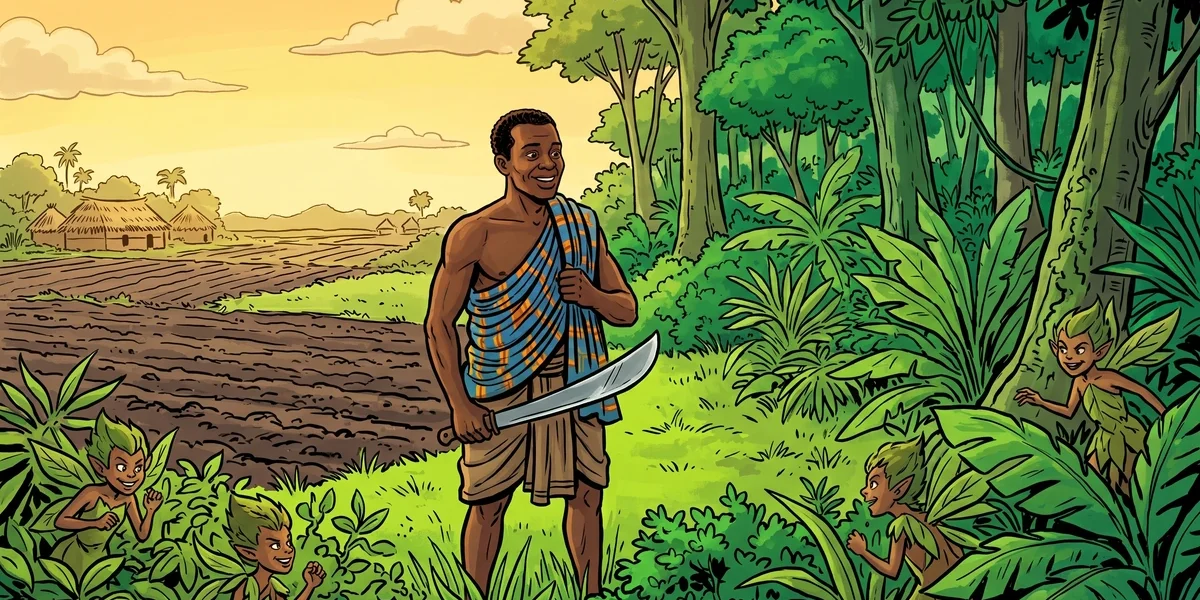
On the green margin where cultivated land surrenders to the deep Gold Coast forest, a farmer once struck his cutlass into a bush and heard the bush answer him. “Farmer Mybrow and the Fairies” is a West African cautionary tale of unseen helpers, a secret field, and a promise broken by a single careless word. It belongs to the Akan peoples of the Gold Coast — modern Ghana — and it turns on a truth every farming community understands: that abundance is fragile, and that the surest way to ruin a harvest is to gather it before its time.
Where This Story Comes From
“Farmer Mybrow and the Fairies” was collected and published in West African Folk-Tales, compiled by William H. Barker — then Vice-Principal of the Government Training College at Accra — together with Cecilia Sinclair, who also drew the book’s illustrations. The volume was issued in London by George G. Harrap & Co. in 1917. The collection draws on the oral storytelling of the Gold Coast peoples, principally the Akan, among whom evening tale-telling — the same tradition that carries the famous anansesem spider stories of Kwaku Ananse — was a settled institution of village life.
The tale’s “fairies” are a translation, made for an English-reading audience, of beings the Akan know as mmoatia: small forest spirits, often described as a hand or two high, living deep in the bush, mischievous, capricious, and famous both for granting help and for withdrawing it without warning. Barker and Sinclair’s choice of the English word “fairies” deliberately invited comparison with European fairy lore, and the resemblance is real. As later folklorists noted, the plot stands close to Celtic stories of fairy helpers whose gifts dissolve when a human breaks a condition — yet the African detail is unmistakable, for the wealth at stake is not gold but standing corn and yams, the staple crops on which a Gold Coast household lived.
In the international tale-type indices the story sits beside the ATU 503 family, “The Gifts of the Little People,” the group named for the Brothers Grimm’s Die Geschenke des kleinen Volkes (KHM 182), in which supernatural folk reward and punish according to whether a mortal keeps faith. Its driving engine is the motif of the forbidden answer — the taboo on speech (Stith Thompson motif C495, “forbidden answers”; with F340, “gifts from fairies”) — a condition the helpers attach to their generosity, and which the human, fatally, forgets.
The Field at the Forest’s Edge
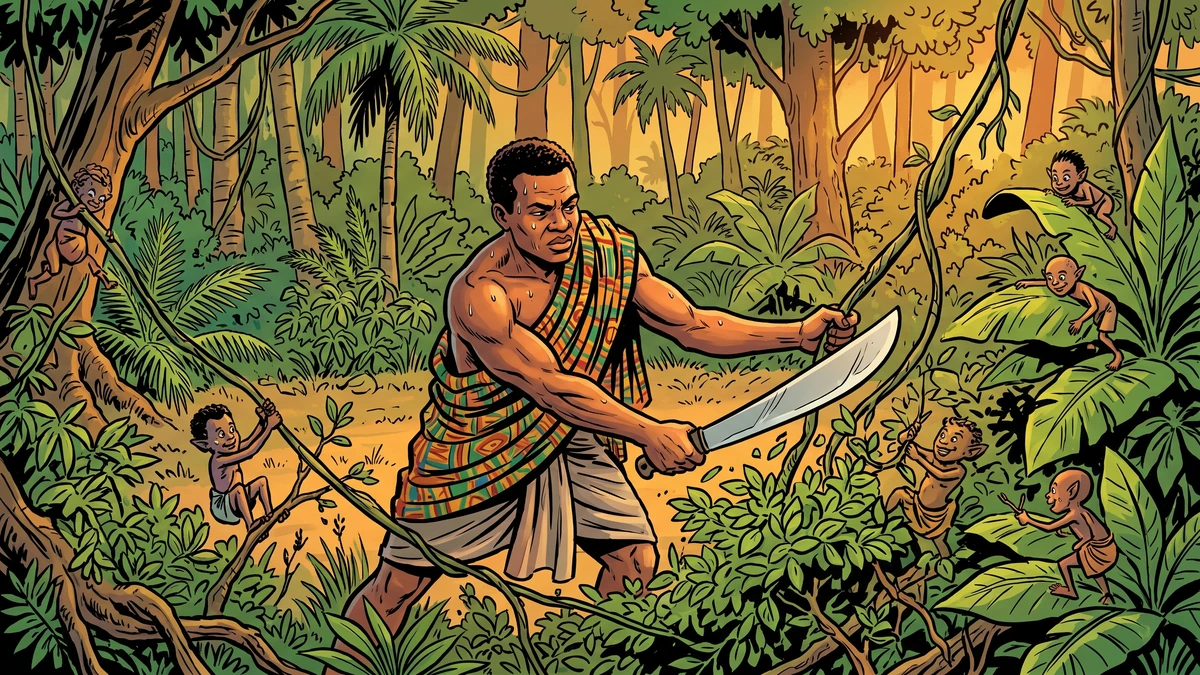
Farmer Mybrow was looking for a piece of land to clear into a field. He wished to grow corn and yams, and he found a fine spot close against a great forest — and the forest, though Mybrow did not yet know it, was the home of the fairies. He sharpened his great knife and began to cut down the bushes.
He had scarcely touched the first when a voice asked, “Who is there, cutting down the bushes?” Mybrow was too astonished to answer. The question came again, and this time he understood that one of the forest people was speaking, and he replied, “I am Mybrow, come to prepare a field.” It was his good fortune that the fairies were in great good humour that day. He heard one of them say, “Let us all help Farmer Mybrow to cut down the bushes,” and the rest agreed. To his delight the whole tract was cleared rapidly, with very little labour of his own. He walked home well pleased — and he resolved, that very evening, to keep the field a secret even from his wife.
A Harvest Raised by Unseen Hands
Early in January, when the cut bush had dried and the time had come to burn it, Mybrow set off again, carrying the means of a fire. Hoping for the fairies’ help once more, he struck a tree-trunk on purpose as he passed. At once came the question, “Who is there, striking the stumps?” — and at his answer the dried bush was burned away and the field left clear in less time than it takes to tell. The next day it was the same: he came to chop the stumps for firewood, and in a short while his faggots stood piled and the field lay bare.
So it went on through every stage. The field was divided in two, one part for maize and one for yams, and in all the work — the digging, the sowing, the planting — the fairies gave great assistance. The soil was prepared so carefully that the crops promised magnificently. Still Mybrow kept the whereabouts of the field hidden from his wife and his neighbours alike, visiting it quietly from time to time and congratulating himself on the splendid harvest to come.

The Secret a Wife Would Not Leave Alone
One day, while the maize and yams were still green and in their milky state — that is, well short of ripe — Mybrow’s wife came to him. She wished to know where his field lay, so that she might go and fetch firewood from it. At first he refused to tell her. But she was very persistent, and at last she got the answer out of him — on one strict condition. She must not answer any question that should be asked her. This she readily promised, and she set off for the field.
When she reached it she was amazed at the wealth of corn and yam before her; she had never seen such crops. The maize, still in its tender milky state, looked most tempting, and she plucked an ear. As she did so a voice asked, “Who is there, breaking the corn?”
The Word That Spoiled the Harvest
“Who dares ask me such a question?” she answered angrily — and in her anger she had entirely forgotten her husband’s command. She went on to the field of yams and pulled up one of those as well. Again the voice: “Who is there, picking the yams?” “It is I, Mybrow’s wife,” she retorted. “This is my husband’s field, and I have a right to pick.”
That was the answer the fairies had been waiting for. Out they came. “Let us all help Mybrow’s wife to pluck her corn and yams,” they said — and before the frightened woman could utter another word, they fell on the field with a will and laid the whole crop on the ground. Every ear, every yam was green and unripe; the harvest was utterly spoiled. She wept bitterly, but weeping changed nothing. She walked slowly home, and decided to say nothing at all.

The next morning the farmer set off cheerfully to see how his fine crops were coming on. His dismay can be imagined when he found the field a complete ruin — all his foresight and all the fairies’ patient labour brought to nothing through a single forgotten promise. The story ends there, without softening: no second chance, no restored field, only a man standing in a wasted harvest because a word was spoken that should have been held back.

The Mmoatia and the Logic of the Bush
To follow the tale’s reasoning, it helps to know what the Akan understood the forest spirits to be. The mmoatia were not the gentle, gauze-winged fairies of Victorian nurseries. They were the small unpredictable powers of the uncleared bush, beings who could grant a hunter game or a farmer a cleared field, but who attached conditions to everything and enforced those conditions to the letter. They are creatures of the boundary — the place where the village ends and the wild begins — and Mybrow’s field, set “close to a great forest,” is precisely such a boundary place. A farmer who works that margin works among powers not his own.
This is why the fairies’ help is never simply a gift. It is a relationship, and a relationship has terms. The voice in the bush always asks the same thing — “Who is there?” — and the help flows only after a truthful, respectful answer. Mybrow understood the etiquette and observed it each time. His wife, who never learned it, met the same question with anger and a claim of ownership: “I have a right to pick.” In the moral world of the bush, no one has a right to the help of the mmoatia; one has only their goodwill, and goodwill withdrawn is indistinguishable from ruin.
Why a Broken Promise Destroys Rather Than Delays
Modern readers sometimes expect the wife’s mistake to cost a portion of the crop, not all of it. The tale is harsher, and deliberately so. The fairies do not punish her by taking; they punish her by helping — “Let us all help Mybrow’s wife to pluck her corn and yams” — using the very same words and the very same eager labour with which they once helped her husband. The horror of the ending is that nothing changes except the timing. Help given at the right season builds a harvest; the identical help given at the wrong season annihilates it.
That is the tale’s quiet agricultural genius. Maize and yams in the “milky state” are alive and ripening; pulled green, they are simply destroyed, and no labour can put them back on the stalk. The wife’s broken promise does not slow the harvest — it converts a future of plenty into a present of waste, instantly and permanently. The story thereby teaches something a farming child needed to feel in the body: that there is a right time for the gathering of every grown thing, and that impatience is not a small fault but a total one.
The Tale Among Its Cousins
Folklorists have long noted how comfortably “Farmer Mybrow and the Fairies” sits among the fairy-helper stories of other traditions. In the Celtic world there are many tales of the “good people” who clear a field, thresh a barn, or finish a night’s spinning for a mortal — and who vanish, taking their gift with them, the moment a condition is broken or a thank-you given wrongly. The English and German tradition keeps the household brownie or the kleine Volk of Grimm’s KHM 182, whose generosity likewise turns on the manners of the people they serve. What unites this whole family of stories, scattered across continents, is a single shared intuition: that help from the unseen world is real, valuable, and conditional, and that the condition is never decorative — it is the hinge on which everything turns.
Yet the African setting reshapes the inherited pattern in instructive ways. The prize is not a heap of fairy gold that might be spent in a day, but a season’s corn and yams — wealth that must be grown, tended, and above all timed. The condition broken is not a forbidden thank-you or a forbidden glance but a forbidden answer, a speech taboo, which makes the wife’s own voice the instrument of the disaster. And the punishment is not the silent disappearance of a treasure but the loud, busy, cheerful destruction of a crop by helpers who never stop smiling. The story takes a worldwide template and grounds it firmly in the economic life of a Gold Coast farming village, where the difference between a milky ear and a ripe one was the difference between a fed household and a hungry one.
The Moral of the Tale
“Farmer Mybrow and the Fairies” carries a layered lesson. On its plainest level it is about keeping a promise: the wife agreed to a single condition, broke it within minutes, and the cost fell not on her alone but on her whole household. Beneath that lies a lesson about the careless tongue — for it was not greed that ruined Mybrow but speech, an answer flung out in anger when silence had been sworn. And beneath that again is the older wisdom that the help of unseen powers always comes bound with conditions, and the conditions are the price.
“Who is there, breaking the corn?” … “Who dares ask me such a question?” she replied angrily — quite forgetting her husband’s command.
— West African Folk-Tales, W. H. Barker & C. Sinclair, 1917
An Akan proverb sharpens the point: the insect that bites you comes from inside your own cloth — meaning that the trouble which undoes a household most often enters from within it. Mybrow guarded his secret field from neighbours and strangers, and was ruined not by any of them but by his own wife, and she not by malice but by a moment’s forgetfulness. The tale asks its listeners to govern the small things — a promise, a word, the urge to answer back — because it is precisely the small ungoverned things that bring the large ones down.
Why the Story Has Lasted
More than a century after Barker and Sinclair set it in print, “Farmer Mybrow and the Fairies” still travels — read aloud in classrooms, retold in folklore anthologies, recorded for listeners who never saw the Gold Coast. It lasts because its lesson is portable. Few of us now clear fields at the forest’s edge, but everyone makes promises, everyone is told a secret on a condition, and everyone knows the temptation to answer back when silence was the wiser course. The tale also lasts because of its restraint: it refuses the comfort of a happy ending, and that refusal gives it the weight of something true. A story that let the wife off lightly would teach nothing. By letting the green field fall and stay fallen, the tale makes its single point unforgettable — that a harvest, like a trust, is gathered only once, and only at its proper time.
Frequently Asked Questions
Where does “Farmer Mybrow and the Fairies” come from?
It is a West African folk tale of the Akan peoples of the Gold Coast (modern Ghana), published in West African Folk-Tales, collected by William H. Barker and Cecilia Sinclair and issued by George G. Harrap & Co. in London in 1917. It descends from the oral storytelling tradition of Gold Coast village life.
Who or what are the “fairies” in the story?
They are an English rendering of the mmoatia, small forest spirits of Akan belief — capricious beings of the deep bush who may help a farmer or hunter but always attach strict conditions to their aid and enforce those conditions exactly.
Why was the whole harvest ruined instead of just part of it?
Because the fairies punished the wife by helping rather than by taking. They plucked the entire crop while it was still green and milky, using the same eager labour that had once built the field. Unripe corn and yams cannot ripen once pulled, so a single broken promise turned a future of plenty into total waste.
What is the moral of the story?
Keep your promises and guard your tongue. The wife swore a single condition — to answer no question — and broke it in a moment of anger, ruining her household’s harvest. The tale also teaches that there is a right season for every harvest and that impatience can destroy what patience has grown.
What tale type does the story belong to?
It stands within the ATU 503 family, “The Gifts of the Little People,” and turns on the motif of the forbidden answer (Stith Thompson C495), in which supernatural helpers attach a speech taboo to their gift and withdraw the gift when the human breaks it. The plot resembles Celtic fairy-helper stories, while its crops and forest spirits mark it as distinctly West African.
You May Also Like
 African Folk Tales
Ages 6-8
African Folk Tales
Ages 6-8
The Judgment Of Baboon
A mouse tears the tailor's cloak, and when every creature blames the next, Baboon the judge turns the chain of excuses into a chain of punishment - a Khoikhoi tale from Namaqualand explaining why the cat hunts the mouse and the baboon walks on all fours.
 African Folk Tales
Ages 6-8
African Folk Tales
Ages 6-8
How The Tortoise Got Its Shell
How The Tortoise Got Its Shell: A few hundred years ago, the chief Mauri (God) determined to have a splendid yam festival. He therefore sent his messengers to
 African Folk Tales
Ages 6-8
African Folk Tales
Ages 6-8
Anansi The Blind Fisherman
Anansi the Blind Fisherman: A Tale of Cleverness and Justice In a village near a great river in Africa, there lived a spider named Anansi. Unlike...